
Holding one atom, counting one photon
Nobel Prize in Physics, 2012: Serge Haroche and David J. Wineland
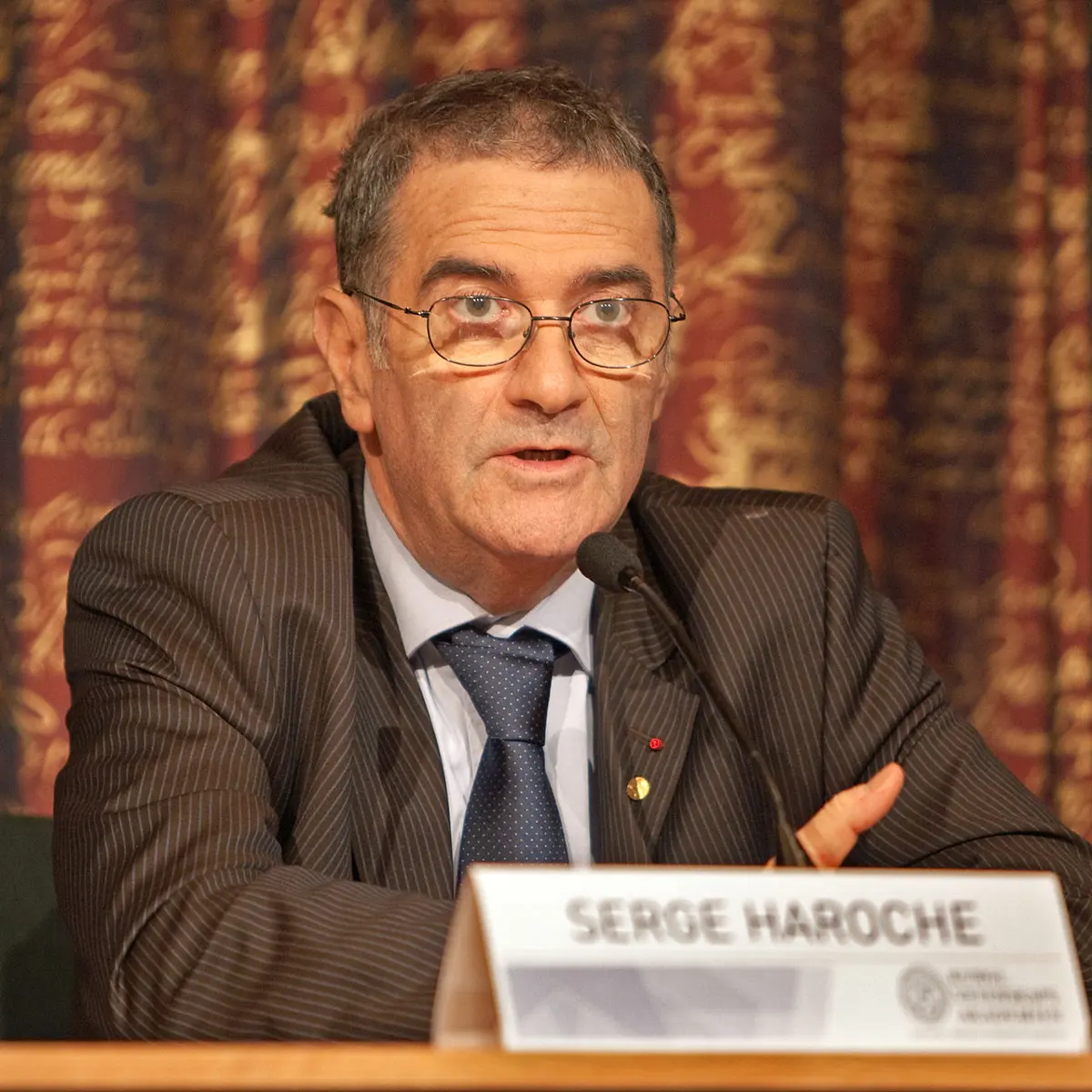
Serge Haroche
born 1944 in Morocco
He grew up in Casablanca and moved to Paris with his family at eleven, in 1956, when Morocco became independent. Apart from spells at Stanford and Yale in the United States, he has done his research in Paris.
Photo: Bengt Nyman, CC BY 2.0
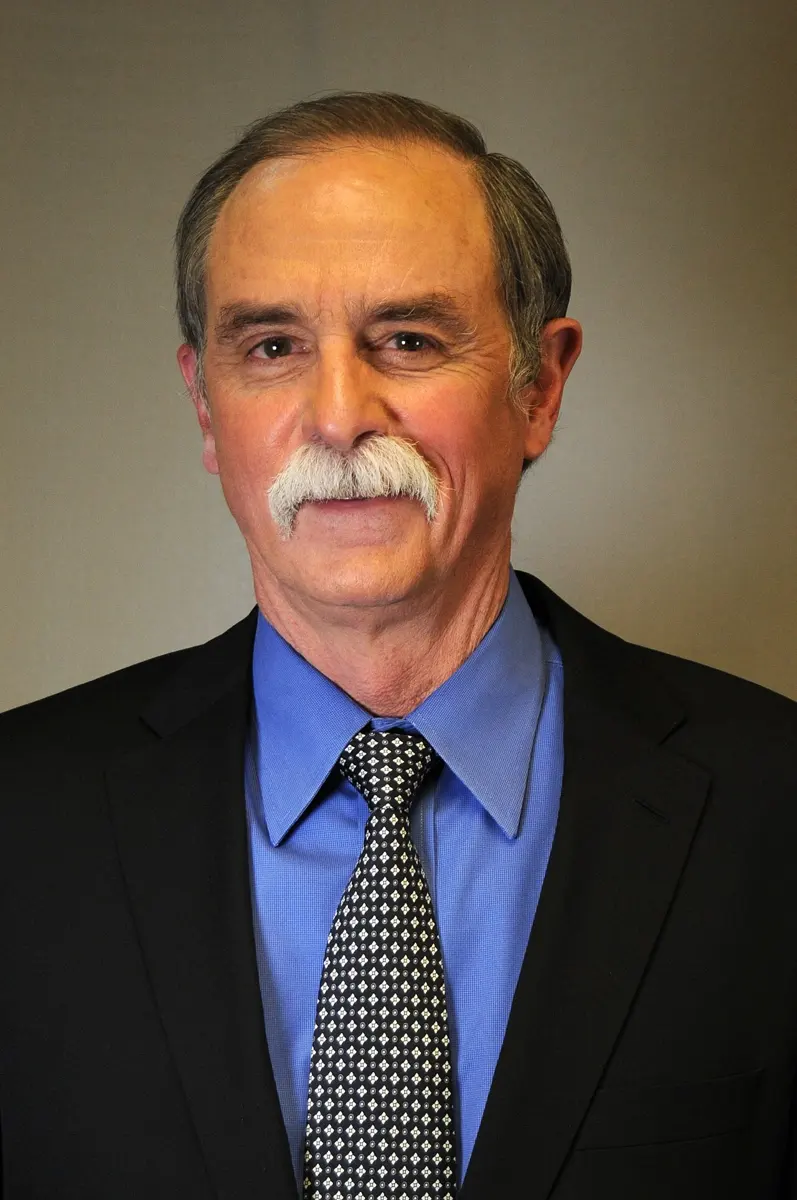
David J. Wineland
born 1944 in the United States
He grew up in California building model airplanes and fixing old cars, and took his first physics class in his last year of school.
Photo: Credit Line: Photograph by James Burrus/NIST, courtesy of AIP Emilio Segrè Visual Archives, W. F. Meggers Gallery of Nob, CC0
Switch on an LED bulb. Every second it gives out billions of billions of photons, the tiny packets that light comes in. A single grain of sand holds billions of billions of atoms. In everyday life we never meet one atom or one photon on its own. We always meet huge crowds of them.
For most of the last century, physicists thought that studying one atom or one photon, and keeping it in its strange natural state, was impossible. In 2012 the Nobel Prize in Physics went to two scientists who did it: Serge Haroche in Paris, who caught single photons in a box, and David Wineland in Boulder, Colorado, who held single atoms in a trap made of electric fields.
The problem: the quantum world hides when you look
In the 1920s physicists worked out the rules that very small things obey. These rules are called quantum physics, and they are very different from the rules of footballs and buses.
One of the strangest rules is called superposition. You know that the electrons of an atom can only have certain fixed amounts of energy, like the steps of a ladder Grade 9: Shells and their energy. Quantum physics says that an atom can be on the lower step and the upper step at the same time. It isn’t that we don’t know which step it is on. It is really on both, until something measures it. Then it is found on one step only, the lower one or the upper one, by chance.
Nothing in your life behaves like that. A cup of tea is on the table or in your hand, never both. Why? Because a big thing is touched all the time by air molecules, heat and light, and each touch is like a tiny measurement. A superposition lasts only while nothing from outside disturbs it. For a single atom in the open air, that is a tiny fraction of a second.
So the quantum world hides as soon as you look at it. The great physicist Erwin Schrödinger, one of the founders of quantum physics, wrote in 1952: “We never experiment with just one electron or atom or (small) molecule.” He thought such experiments could only ever be imagined.
Why don’t we see a cup or a football in two places at once?
Pick an answer to see why.
Why it was so hard
To study a single particle in its quantum state, you must do three things that seem to fight each other.
- Hold it without touching it. Any wall it touches is warm, and warmth means jiggling atoms that would knock it out of its state.
- Keep it still and alone. An atom at room temperature moves at hundreds of meters per second. You must slow it down and remove all the air around it.
- Look at it without destroying it. This is the hardest part. To see a photon, your eye or a camera absorbs it: the photon is gone. To see an atom, you shine light on it, and the light pushes it about.
Wineland and Haroche solved these problems in opposite ways. Wineland held atoms and used light to control and read them. Haroche held light and used atoms to control and read it.
What they did, step by step
Wineland: one atom held by electric fields
David Wineland joined the National Bureau of Standards in Boulder, Colorado (now called NIST) in 1975. His job was to make better atomic clocks, and he chose to work with ions, atoms that have lost an electron and so carry a positive charge Grade 9: Ion.
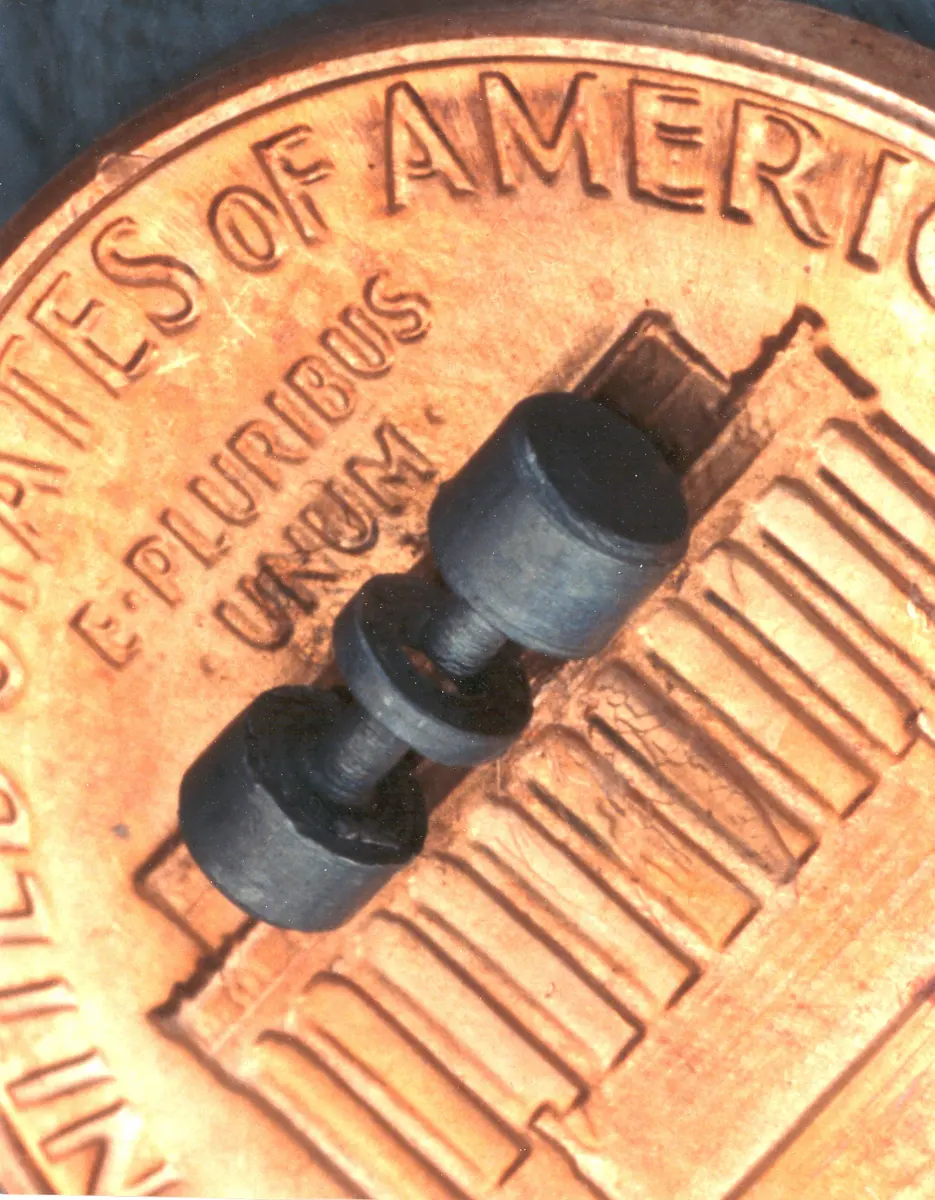
- The trap. Because an ion is charged, electric forces can hold it. In an ion trap, metal electrodes a few millimeters apart carry changing voltages that push the ion back to the middle from every side. The ion floats in a vacuum, a space with almost all the air pumped out, touching nothing. (The ion trap itself won the 1989 Nobel Prize, for Wolfgang Paul and Hans Dehmelt, in whose laboratory Wineland had worked.)
- 1975 and 1978: cooling with a laser. In 1975 Wineland and Dehmelt suggested that a laser could slow trapped ions down. In 1978 Wineland’s team did it, with magnesium ions. Each photon an ion absorbs gives it a tiny push. The laser’s color is chosen so that an ion takes in photons mostly when it is moving towards the laser, so every push slows it down. Thousands of these pushes a second bring it almost to a stop. This is laser cooling.
- 1981: one ion alone. Wineland’s team, like Peter Toschek’s group in Germany a year before, held a single ion. A trapped ion glows as it scatters the laser light, so a camera can see it as a tiny bright dot.
- 1989: the lowest step. With a cleverer kind of laser cooling, they brought an ion down to the lowest energy it can have in the trap. It still trembles a little, because quantum rules never let anything be perfectly still, but it can’t lose any more energy.
- The 1990s: superposition on demand. A laser pulse of just the right length nudges the ion halfway up to a higher energy level, leaving it on both steps at once. They could also pass that superposition from the ion’s energy into its back-and-forth motion in the trap, and back again. In 1995 they used this to carry out the first quantum logic operation, the basic step of a quantum computer, and in 1996 they made a cat state: one ion in two places at once, less than a ten-thousandth of a millimeter apart.
How do you read an ion’s state? Shine a laser that only an ion on the lower step can absorb. If it is on the lower step, it scatters millions of photons and glows; if it is on the upper step, it stays dark. One glance at the camera tells you which. Finding out does end the superposition, so they used the same trick again and again, each time with a fresh ion prepared in the same way, and counted how often it came out bright.
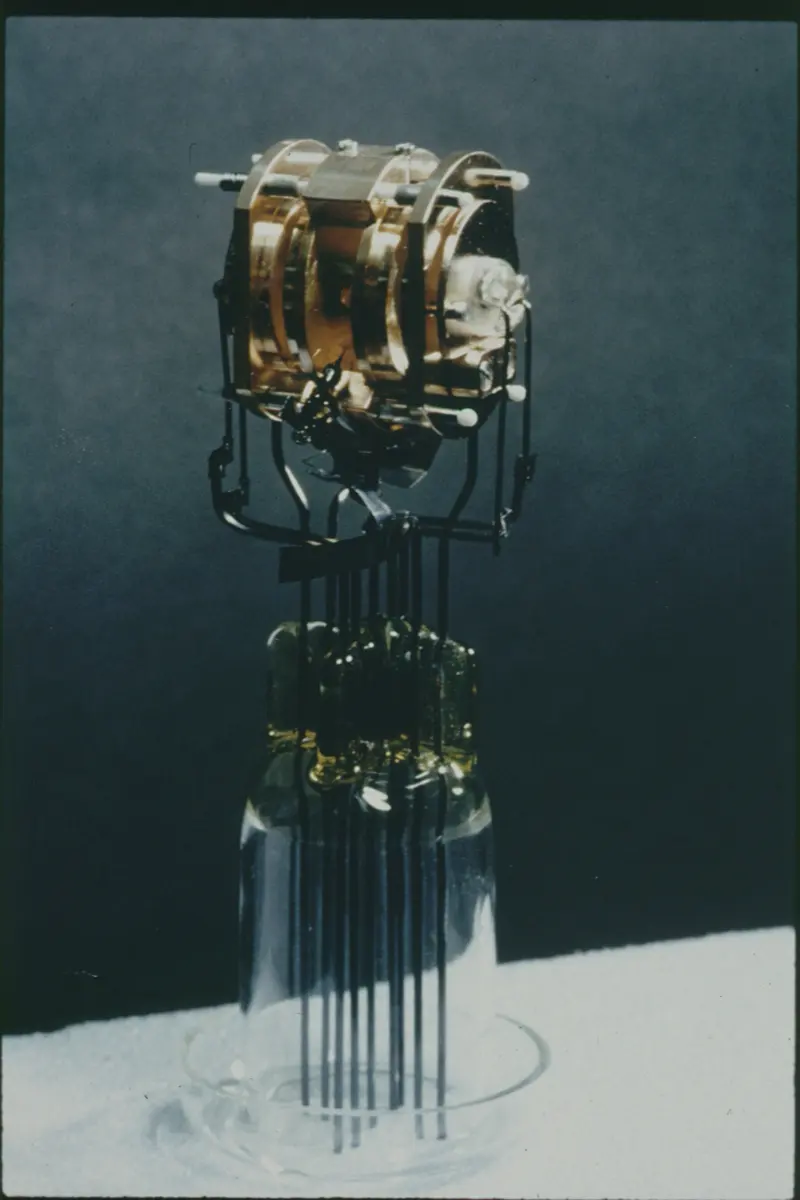
Haroche: a box that holds light
In Paris, at the École Normale Supérieure, Serge Haroche worked with Jean-Michel Raimond and Michel Brune on the opposite problem: holding photons and looking at them without destroying them.
- The box. Light normally escapes at once: it travels 300,000 km in one second. To keep a photon, they built a box of two curved mirrors, 2.7 cm apart, facing each other. The mirrors are made of niobium, a metal that becomes a superconductor when very cold, and are cooled to less than 1 °C above absolute zero, the coldest temperature possible (−273 °C). The photons are microwaves, like those in a microwave oven but far fewer Grade 9: Microwaves.
- The best mirrors in the world. By the 2000s their mirrors were so good that a photon bounced between them more than a billion times before it was lost, staying for about 0.13 seconds. In that time it travels about 40,000 km, the distance once round the Earth.
- Giant atoms as spies. To look into the box, they sent Rydberg atoms through it, one at a time. A Rydberg atom (they used rubidium) has its outer electron lifted very far from the nucleus, so the atom is about 1,000 times wider than an ordinary one. It is very sensitive to the microwaves. Each atom flew through the box at a speed they chose exactly.
- Looking without taking. The atoms were tuned so that they could not absorb the photon. But a photon in the box slightly changed the rhythm of the atom’s own quantum “clock”. Before the box, each atom was put into a superposition, which ticks like a clock hand. With no photon in the box the hand came out pointing one way; with one photon, it came out pointing the opposite way. A detector after the box read the hand. The photon was still in the box, untouched, ready to be measured again by the next atom.
- 1996: a cat made of light. Using one atom, they put the light in the box into a superposition of two different states at once, and then watched how fast that cat state faded into an ordinary one. The bigger the cat, the faster it faded: this is exactly why big things never show superposition.
- 2007: watching one photon live and die. Atom after atom, they counted the photons in the box without destroying them, as you might count marbles in a bowl. They could follow a single photon: there… still there… still there… and then, suddenly, gone, absorbed by the mirrors. Nobody had ever seen one photon like that before.
Haroche counted the photons in his box without destroying them. How?
Pick an answer to see why.
How it is used now: the most precise clocks
Every clock counts something that repeats: a pendulum’s swings, the vibrations of a quartz crystal in a watch. The best clocks of the last 60 years count the vibrations of microwaves that make cesium atoms change state. Since 1967 the second has been defined that way: 9,192,631,770 vibrations make one second.
Wineland’s team used trapped ions to build a better kind, an optical clock. It counts the vibrations of ultraviolet light that makes one aluminium ion jump between two energy levels. Light vibrates about 100,000 times faster than microwaves, so it cuts time into far finer pieces, like a ruler marked in finer and finer lines Grade 9: Importance of least count.
There was a problem: an aluminium ion is hard to cool and to read with lasers. So they trapped it together with a second ion, of magnesium or beryllium. The two ions share their back-and-forth motion in the trap. The second ion does the cooling and reads the aluminium ion’s state through that shared motion, without disturbing its tick. Wineland called this a quantum logic clock.
By 2010 these clocks were accurate to better than one part in 10¹⁷. A clock that good, started at the Big Bang about 14 billion years ago, would be off today by only about five seconds.
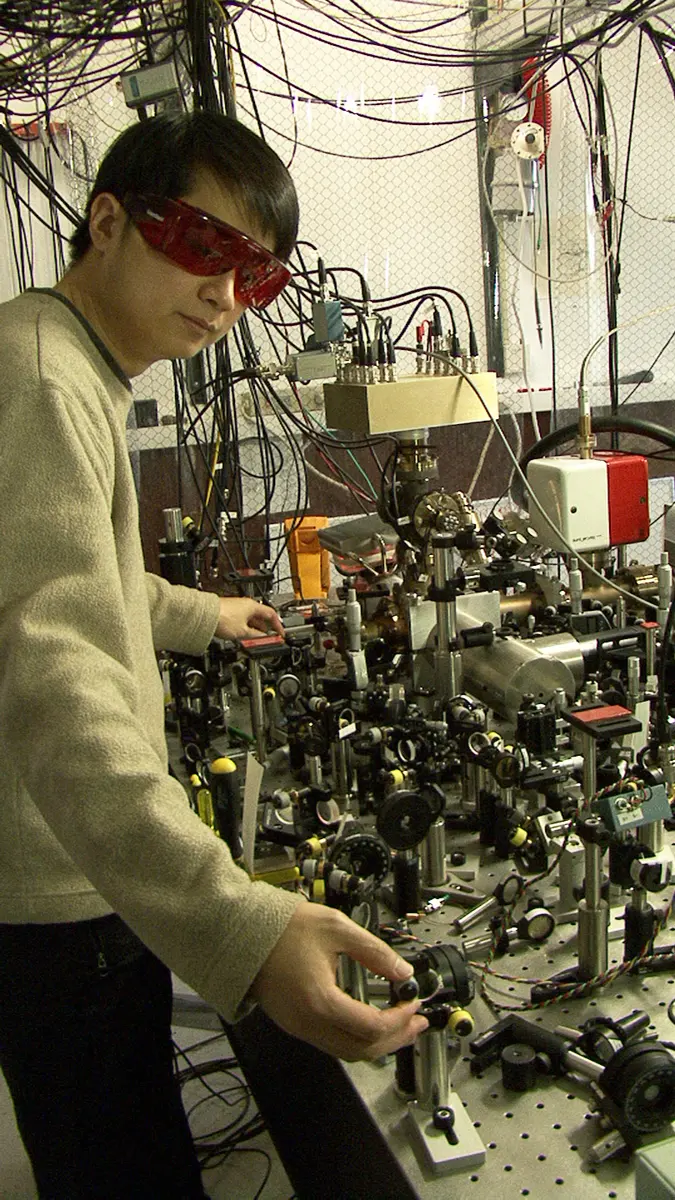
Einstein, tested on a laboratory bench
Einstein’s theory of relativity says that time runs at different speeds in different places. Clocks run slower where gravity is stronger, closer to the Earth, and slower when they move. In everyday life the difference is far too small to notice. But in 2010 Wineland’s team compared two optical clocks and found that lifting one by only about 30 cm made it run faster, by just the amount Einstein’s theory predicts.
Why does an optical clock measure time more finely than a cesium clock?
Pick an answer to see why.
In your life today
- The time on your phone. Your phone sets its clock from the network and from GPS satellites, and each GPS satellite carries atomic clocks Grade 9: Global Positioning System (GPS). Those clocks must even be corrected for relativity, because they are higher up and moving fast. Today’s GPS clocks still use microwaves, not Wineland’s light, but the clocks that check them are getting better because of his work.
- A new second. The world’s experts on measurement are preparing to define the second using optical clocks instead of cesium, perhaps around 2030.
- Mapping with clocks. Because time runs faster higher up, optical clocks can measure differences in height and in gravity. Scientists are testing them for studying the Earth, including how the ground and ice sheets rise and fall.
What came next: quantum computers
A normal computer stores information in bits, each 0 or 1. A quantum bit, or qubit, can be in a superposition of 0 and 1. Two qubits can be in a superposition of all four patterns, 00, 01, 10 and 11, and each extra qubit doubles the number. With 300 qubits there would be 2³⁰⁰ patterns at once, more than the number of atoms in the whole universe.
For some problems, such as working out how new medicines or materials behave, a quantum computer could do in hours what an ordinary computer could never finish. Wineland’s trapped ions were the first qubits to carry out a quantum logic step, in 1995. Today companies and universities are building quantum computers from trapped ions, and others from tiny superconducting circuits that work much like Haroche’s box.
The difficulty is the one both laureates fought all their lives. A qubit must be kept alone, so that nothing ends its superposition, and yet it must be controlled and read. With a few qubits that is possible; with thousands, every small disturbance adds up.
In your science books
- Grade 9: shells and their energy (the energy “steps” of an atom), ions, microwaves and the electromagnetic spectrum, least count, and GPS, which needs precise clocks.
- Going Further (Grades 9–12): Einstein’s packets of light, what a photon is, and why GPS satellites take 12 hours to go round.
Learn more
- The Nobel Prize’s own explanation: Particle control in a quantum world (nobelprize.org).
- The laureates’ Nobel lectures: Haroche and Wineland.
The official reason
The prize was given “for ground-breaking experimental methods that enable measuring and manipulation of individual quantum systems.”