
Every liter of petrol in a Kathmandu motorbike, and every cylinder of cooking gas, comes from abroad. Since 2019 diesel has also come through a pipe, 69 km long, that runs under the border from Motihari in India to Amlekhganj in Bara: South Asia’s first pipeline for oil between two countries. It is refined in India, from oil pumped out of the ground thousands of kilometers away, in places like Iraq, Saudi Arabia and Russia.
Yet Nepal is not without it entirely. At Muktinath, little blue flames of natural gas have burnt for centuries beside a spring, and a well drilled about 4 km down at Jaljale in Dailekh has found a large amount of gas. So why does the ground under some countries hold oceans of oil, and the ground under others almost none? Why is there copper in Chile, gold in the sand of the Karnali, and water a few meters under a Terai field but deep under parts of Kathmandu?
The answer, for all of them, is the same: the Earth’s past put them there. A resource is found where, long ago, the right things happened in the right order. This topic shows what those things were, so that you can explain why a resource is where it is, and why, once we use it up, it doesn’t come back.
Not spread evenly
You met Nepal’s minerals in Grade 8, and where each is found: building sand and groundwater in the Terai, iron, copper, lead and zinc in the hills, rock salt in Mustang Grade 8: Minerals in Nepal. Grade 8 told you where. This topic is about why there.
Look at the whole world and the unevenness is striking:
- About half of the world’s known oil lies under a small part of it, the Middle East (end of 2020).
- About a quarter of the world’s copper is mined in one country, Chile (in 2024).
- Some valleys sit on rock full of water; others, a few kilometers away, have almost none.
Here is a surprising fact. Almost every rock has a little copper in it, a little gold, a little iron. Ordinary rock in the Earth’s crust has, on average, about 28 grams of copper in every tonne. But no one could make a living from that: to get 1 kg of copper, you would have to dig up and crush about 36 tonnes of rock. A copper ore is rock in which something has gathered the copper together, a few hundred times richer than ordinary rock (Ores, in Grade 10).
| Metal | In ordinary rock (grams per tonne) | In a typical ore (grams per tonne) | How many times richer |
|---|---|---|---|
| aluminium | 82,000 | about 250,000 (bauxite) | about 3 |
| iron | 39,000 | about 600,000 | about 15 |
| copper | 28 | about 6,000 | about 200 |
| gold | 0.0015 | about 1.5 | about 1,000 |
So the real question is: what gathers a resource together in one place? Nature has a few ways. Heat can cook buried mud into oil. Oil, being light, can float up through rock and collect under a lid. Hot water can dissolve metals from a great volume of rock and drop them in one crack. A river can sort heavy grains from light ones. Rain can soak into gravel and stay there. Each leaves its resource only where it happened.
Ordinary rock everywhere has a little copper in it. Why, then, is copper mined in only a few places?
Pick an answer to see why.
Oil: buried, then cooked
Oil and natural gas are fossil fuels: you know from Grade 9 that they formed from living things buried millions of years ago Grade 9: Fossil fuels. But living things die everywhere. Why did only a few places get oil? Because it needs a recipe, and every step must happen.
Step 1: a lot of life, buried without air. Most oil began as plankton: tiny plants and animals, most too small to see, that float near the surface of the sea in their billions. When they die they sink. In most seas, the oxygen in the water lets bacteria and animals eat them up on the way down or on the sea floor. But in some seas the bottom water has little or no oxygen. There the remains pile up, mixed with fine mud, and are buried before they rot. The mud becomes a dark rock rich in the remains of life, the source rock, usually a black shale.
Step 2: buried deeper, and heated. As more mud settles on top over millions of years, the source rock sinks deeper. The deeper rock is, the hotter: on average about 25 °C hotter for every kilometer down. At about 60 °C the remains slowly begin to break up into oil. Between about 60 and 120 °C, over millions of years, they make oil; this range is the oil window. Hotter still, the big molecules break into small ones, and the rock gives natural gas, mostly methane. Hotter than about 200 °C, nothing more is made: the rock has been cooked dry.
Two seas have the same amount of plankton. In one, the bottom water is full of oxygen; in the other, it has almost none. Which is more likely to leave a source rock for oil, and why?
Pick an answer to see why.
Why oil collects in traps
Oil made in a source rock doesn’t stay there. The rock is squeezed by the weight above it, and oil is lighter than water. You have seen what that means: drops of oil on a bowl of soup rise and float on top. Underground, the tiny spaces in the rocks are full of water, so the oil, and the gas even more, slowly creep upwards, squeezing through any rock with spaces in it.
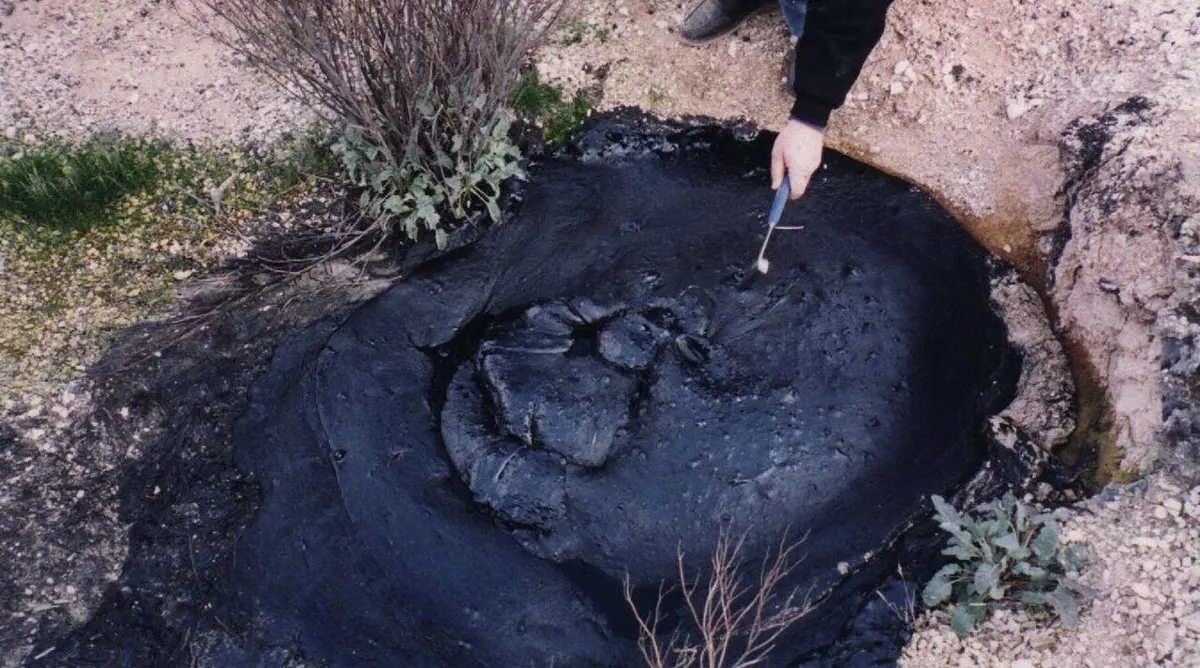
Most of it rises all the way to the surface and is lost. Over millions of years, bacteria eat it, or it dries into tar. Oil and gas are left for us only where something stopped them on the way. That needs two more things.
A reservoir rock, with spaces to hold the oil. Sandstone is made of sand grains stuck together, and between the grains there are tiny gaps, called pores. Up to a third of a sandstone can be pores. Some limestones are full of holes too. An oil field is not an underground lake: it is solid rock with oil in its pores, like water in a sponge.
A seal and a trap. Above the reservoir there must be a layer that oil can’t get through, a cap rock, such as shale (its pores are far too small) or salt. And the layers must be shaped so that the oil, rising under the lid, has nowhere to go. The commonest shape is an arch, an anticline: the layers bent upwards, like an upside-down bowl. Oil creeping up under the arch gathers at its top, as air gathers under an upturned cup held in a bucket of water. Such a place is an oil trap.
So an oil field needs five things, in the right order: a source rock, the right burial and heat, a reservoir rock, a seal, and a trap that formed before the oil came up. Miss any one and there is no oil. That is why oil is found in so few places, and why most wells drilled to look for it come up dry.
Oil formed in a source rock and rose into a sandstone, but the sandstone has no cap rock above it. What happens to the oil?
Pick an answer to see why.
Why Saudi Arabia and not Nepal?
Much of the oil of Saudi Arabia formed from plankton buried about 150 million years ago, in warm, shallow seas at the edge of an ocean called the Tethys. Above the source rocks lie thick limestones full of pores, then a thick seal of anhydrite (a mineral like gypsum), all gently bent into huge, broad arches. Since then the rocks have been left almost undisturbed. Every step of the recipe happened, on a huge scale, and nothing broke the traps afterwards.
The same ocean is in Nepal too. The black shaligram stones of the Kali Gandaki hold ammonites that lived in the Tethys at about the same time. But Nepal’s rocks have had a rougher history. As India has pushed into Asia over the last 50 million years, they have been folded, broken by great faults, stacked on top of each other and heated. A break through a cap rock lets oil escape, as it does at Muktinath, and great heat turns any oil into gas. Only a few deep wells have been drilled in Nepal. Shell’s, near Biratnagar in the late 1980s, went down 3,520 m and came up dry; the Dailekh well found gas, not oil.
Ores: where hot water ran
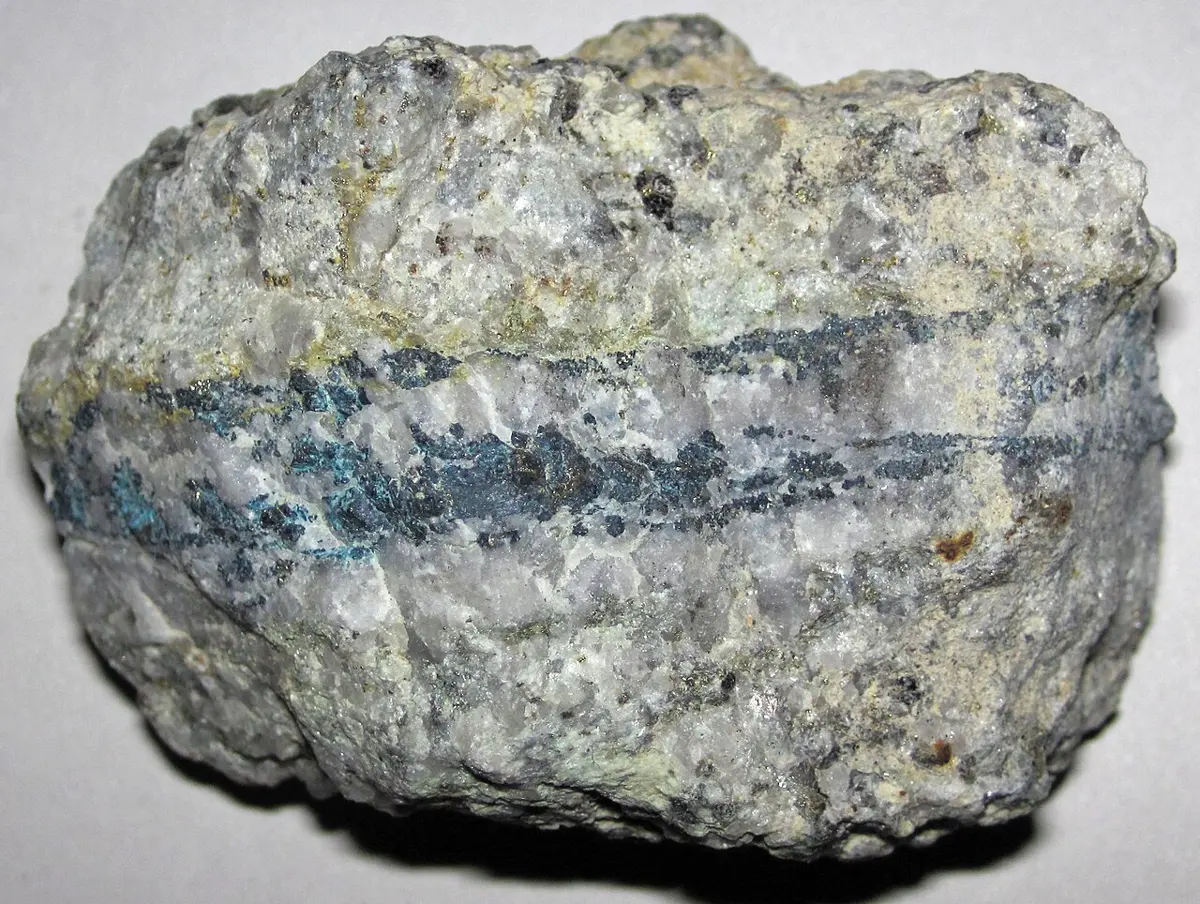
Most metal ores were made by hot water. Deep underground, near a body of molten rock (magma), water that has soaked down through cracks is heated to a few hundred degrees. Hot water under pressure can dissolve small amounts of metals out of the rock it passes through. The hot water rises, through kilometers of rock, along cracks. As it rises it cools, and the pressure drops, and it can no longer hold the metals. They come out of the water as solid minerals and line the cracks: a vein. A trickle of water carrying a few grams of metal per tonne, flowing for thousands of years, can fill a crack with ore that is hundreds of times richer than the rock it came from.
Where is there magma near the surface for long enough? Mostly where one of the great plates of the Earth’s outer shell slides down under another, as you read in Do Continents Really Move?. The sinking plate carries water down with it, and that water makes rock above it melt. The magma rises and feeds a chain of volcanoes along the edge of the continent. Under the volcanoes, magma cools slowly, and its hot water makes ore.
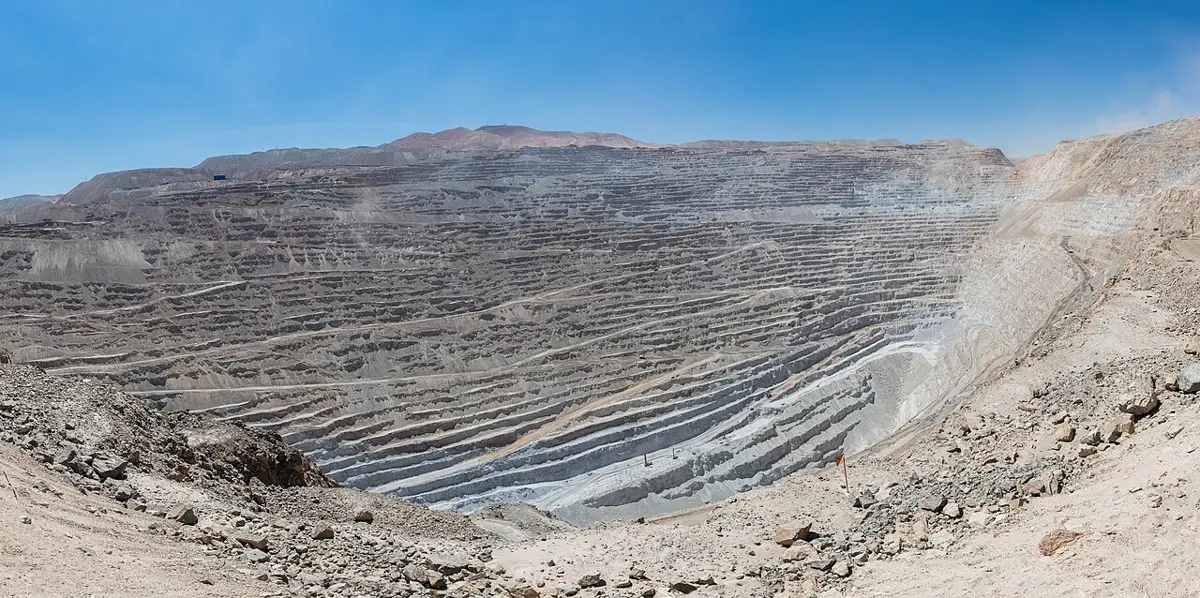
That is why the world’s biggest copper mines are in a line along the Andes mountains of Chile and Peru: under them, the floor of the Pacific Ocean (the Nazca Plate) is sinking under South America, as it has for well over a hundred million years. The ore bodies are old magma chambers whose roofs have since been worn away by rain and rivers, bringing the ore close enough to the surface to dig.
Sorted by a river
Ore in a mountain doesn’t stay there forever. Rain and frost break the rock, and rivers carry the pieces away. Most minerals break down or are ground into sand and mud. But gold doesn’t rust or dissolve in water, and it is very heavy for its size: gold’s density is 19.3 g/cm³, about seven times that of quartz sand (2.65 g/cm³).
A river carries sand while it flows fast. Where it slows, it drops what it carries, and the heaviest grains first. So gold specks wash out of the mountains and gather where the river slows: on the inside of bends, behind big boulders, in cracks in the river bed. Such a deposit of heavy grains, sorted out by water, is a placer. The gold in the sand of the Sunkoshi, the Kali Gandaki and the Rapti (Grade 8’s table), and of the Karnali, came from veins somewhere upstream, broken down and carried by the river.
Two other kinds of process make ores where the rock sits still:
- Weathering in a hot, wet climate. Rain soaking through the ground for millions of years can wash almost everything out of a rock except the things that hardly dissolve. That is how bauxite, the ore of aluminium, forms (Ores of aluminium, Grade 10): the aluminium is left behind, concentrated.
- Evaporation. Where a shallow sea or salt lake dries up, its salts are left behind in layers: rock salt, gypsum and anhydrite. Most of the world’s rock salt formed that way, and so did the anhydrite that seals Saudi Arabia’s oil.
Gold dust is found in the sand of the Karnali, but not in the sand of every river. What does that tell you?
Pick an answer to see why.
Water under your feet
When rain falls, some runs off into streams, some evaporates, and some soaks into the ground (The paths water takes, in Where Does the Rain Come From?). It doesn’t gather in underground rivers or lakes, except in caves. It fills the pores between grains of sand and gravel, and cracks in rock, just as oil fills the pores of sandstone. This water is groundwater.
Dig a hole in the ground and, at some depth, it starts to fill with water. Below that level, every pore is full of water; above it, the pores hold air and a little water. That level is the water table. A well is a hole dug or drilled below the water table.
How much water a rock or soil can hold, and how easily the water can flow through it, are two different things:
- The fraction of the volume that is pores is the rock’s porosity. Sand and gravel are about 25–40% pores. Clay can be 40–70% pores, but they are so tiny that water hardly moves through them.
- How easily water flows through is its permeability. Gravel and sand are very permeable: water flows through them, and a well in them fills quickly. Clay and shale are almost impermeable.
A layer of permeable rock or sediment full of water that a well can draw from is an aquifer. A layer of clay above it keeps it apart from the water table above, like a lid; then the water in the aquifer is under pressure, and may even rise up a well by itself.
Groundwater in Nepal
Why is there groundwater a few meters down in most of the Terai, but water is scarce in other places close by? Because of how the Terai was built. For millions of years, the rivers coming out of the Himalaya have dumped what they carry where they leave the hills and slow down: coarse boulders and gravel first, right at the foot of the Chure hills, then sand, then silt and clay farther south.
- The belt of boulders and gravel at the foot of the hills, the Bhabar, is so permeable that streams sink into it, and the water table lies deep. Villages there can be short of water although the ground below holds a great deal.
- Where the gravel meets finer sediment, water comes out in a line of springs.
- Farther south, in the Terai proper, layers of sand full of water lie between layers of clay. The water table is near the surface, and a hand pump a few meters deep gives water. A well drilled through a clay layer into the sand below sometimes overflows by itself: an artesian well, because the water has come from the higher Bhabar and is under pressure.
The Kathmandu Valley is different. Long ago it held a lake, and on its bed settled thick layers of fine black clay, the kalimati (“black soil”) that gives a part of Kathmandu its name. The clay is almost impermeable. So the deep aquifers, sand and gravel under the clay, are refilled only around the north of the valley, where sand and gravel reach the surface and rain can soak in. Everywhere else, rain on the clay can’t get down to them.
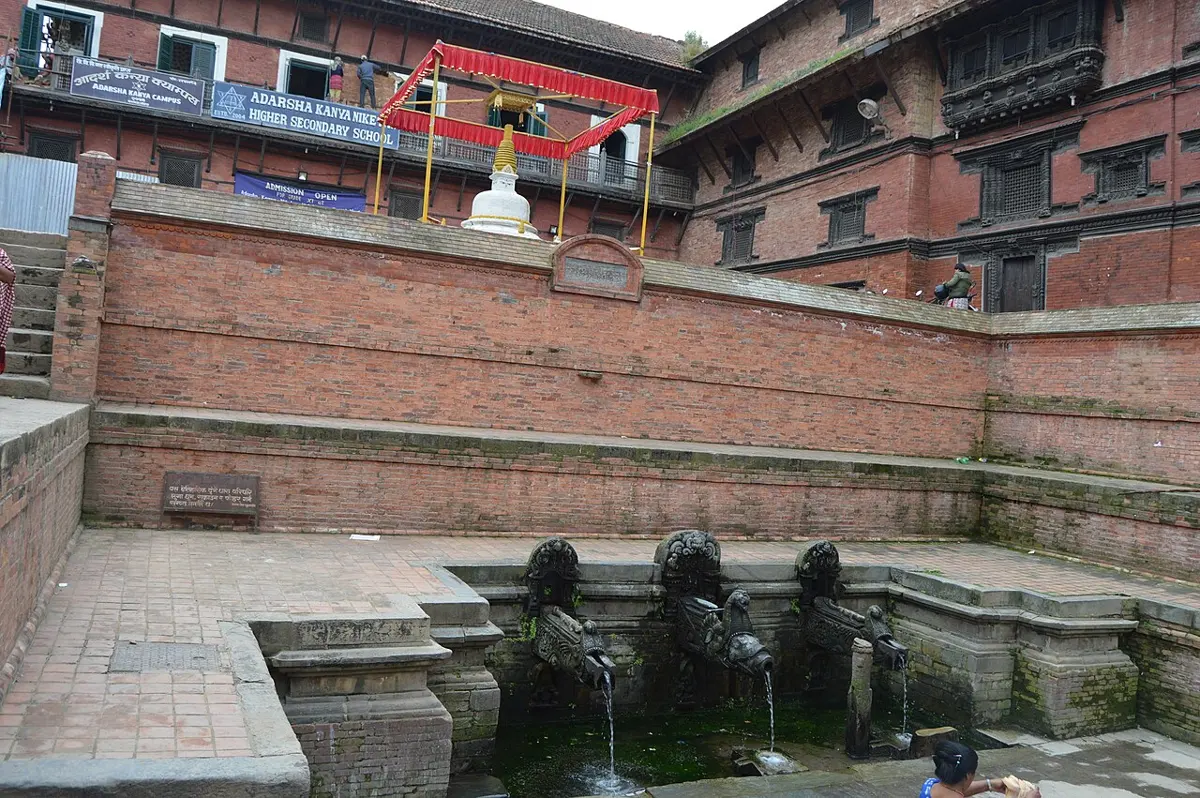
For centuries the valley’s stone spouts gave plenty of water from shallow aquifers, kept full by ponds and canals. Today hundreds of deep wells pump from the deep aquifers (more than a thousand, by one count in the late 2010s), and studies agree that the water is taken out several times faster than rain refills it, though their numbers differ. The water table has fallen, ponds have been built over, and many spouts have dried. Of 573 spouts on record in the 2019 survey, 94 were lost and fewer than half of the rest still gave water.
In the Kathmandu Valley, it rains a lot in the monsoon, yet the deep aquifers are refilled very slowly. Why?
Pick an answer to see why.
Soil: where rock breaks down or rivers drop it
Soil is a resource too: all our food grows in it. It is made from rock broken down by rain, frost, roots and living things (weathering, the first step of the rock cycle), mixed with the remains of plants. So soil, like the others, is found where the Earth’s processes made it:
- where rock has been weathering in place for a long time, on gentle land where the soil isn’t washed away;
- where rivers drop what they wear from the mountains, as on the Terai, whose deep, fine soil is the mountains’ worn-down rock, and around the rivers of the Kathmandu Valley.
On steep slopes, soil is thin, because rain and landslides carry it away almost as fast as it forms. And it forms slowly: it can take up to 1,000 years to make 1 cm of topsoil (FAO, 2015). A heavy monsoon on a bare slope can wash off in one season what took centuries to make.
Used faster than they form
You learned in Grade 7 that some resources are renewable, made again as fast as we use them (sunlight, wind, river water), and others non-renewable. Now you can see why oil, gas, coal and ores are non-renewable. Oil is still forming today, in a few seas, but it takes millions of years: the oil we pump formed over tens of millions. Ore veins took thousands of years to fill, and millions more for the rock above them to wear away. We use them up in a few decades.
Groundwater is in between. It is renewed by rain, so it is renewable if it is pumped no faster than it is refilled. Pump faster, and you are mining it like ore: the water table falls, shallow wells and springs dry up, and in a clay-filled valley the ground itself can slowly sink as the drying clay squeezes together. Some aquifers, under deserts, hold water that soaked in thousands of years ago, when the climate was wetter, and get almost no rain now. Pumped out, it won’t return for thousands of years.
So people change where resources are, too. A mined-out ore body, an emptied oil field and a dry spout all used to be resources. And new ones appear on the map when new ways of finding or getting them are invented, like the Dailekh well.
Questions
Which of these is not needed for an oil field?
Pick an answer to see why.
A well is drilled into a sandstone in an anticline. Going down, it passes through which order?
Pick an answer to see why.
Explain why oil is found under some places on the Earth and not others. Use the words source rock, reservoir rock, cap rock and trap.
Answer
Oil forms only where plankton were buried in mud without oxygen, so that their remains were preserved: a source rock. It must then be buried deep enough, for long enough, to be heated to about 60–120 °C, when the remains slowly turn into oil. The oil, lighter than water, rises through the rocks. It is kept only where it rises into a porous reservoir rock (such as sandstone) with an impermeable cap rock (such as shale or salt) above it, shaped into a trap (such as an anticline) where it can gather. In most places at least one of these is missing, so the oil was never made, or it leaked away to the surface long ago. Oil fields exist only where every step happened, in the right order.
Ordinary rock contains about 28 g of copper per tonne. A copper ore contains 0.6% copper. (i) How many grams of copper are in a tonne of the ore? (ii) How many times richer than ordinary rock is it? (iii) Describe the process that most likely concentrated it.
Answer
- i.0.6% of 1 tonne = 0.006 × 1,000,000 g = 6,000 g.
- ii.6,000 ÷ 28 = about 210 times richer.
- iii.Most copper ores were made by hot water around magma. Water soaking down near a body of magma was heated, dissolved small amounts of copper from a great volume of rock, and rose along cracks. As it rose it cooled, and the copper minerals came out of the water and filled the cracks, making veins and patches of ore. Such magma is common above places where one plate sinks under another, which is why the great copper mines of the Andes lie in a line above the sinking Pacific floor.
Gold is found in the sand at the inside of a river bend, but not in the sand on the outside of the bend. Explain why.
Answer
The water flows faster on the outside of a bend and slower on the inside. A fast river can carry heavy grains; where it slows, it drops the heaviest first. Gold is about seven times as dense as quartz sand, so it settles out where the water slows, on the inside of the bend (and in hollows behind boulders), while lighter sand is carried on. On the outside, the fast water carries everything away and wears the bank.
Two towns are 20 km apart. Town A is on a plain of thick sand and gravel; town B is on a plain of thick clay, with sand and gravel deep below the clay. It rains equally in both. Which town’s wells will refill faster when pumped? Explain using the words porosity and permeability.
Answer
Town A’s. Sand and gravel are porous and permeable: rain soaks straight down into them and refills the aquifer, and water flows easily to a well. In town B the clay is very porous too (it holds a lot of water) but almost impermeable: water hardly passes through it, so rain can’t get down to the sand and gravel below. That deep aquifer is refilled only where its sand and gravel reach the surface, perhaps far away, so pumping in town B lowers the water level much faster than rain can replace it. This is the Kathmandu Valley’s problem.
A village in the Bhabar has a stream that disappears into the ground, and the village is short of water in the dry season. 15 km to the south, people in the Terai have water a few meters down, and some wells overflow by themselves. Explain how these are connected.
Answer
The Bhabar is made of coarse boulders and gravel, which are so permeable that the stream sinks into them. The water table there is deep, so the village’s shallow wells and springs dry up in the dry season, though there is plenty of water far below. That water flows slowly south underground. Where the gravel meets finer sand and clay, it rises in springs, and farther south it fills sand layers between clay layers. Because it has come from the higher Bhabar, it is under pressure, so a well drilled through the clay into the sand can overflow: an artesian well.
The deep aquifers under Kathmandu are being pumped much faster than they are refilled. Predict three things that will happen if this goes on, and suggest two things the valley could do.
Answer
What will happen:
- The water table in the deep aquifers will keep falling, so wells must be drilled deeper and pumping costs more.
- Shallow wells and stone spouts that depend on groundwater will dry up (many already have).
- As water is drawn out of the clay and sand, the ground can slowly sink, damaging buildings and pipes.
What could be done (any two):
- Pump no more than is refilled: limit and register deep wells.
- Help rain soak into the ground: recharge pits and wells, especially in the north of the valley where the gravel reaches the surface; keep ponds and open land free of buildings.
- Bring water from outside the valley, as the Melamchi project does, so less is pumped.
- Collect rainwater from roofs, and repair leaking pipes.
Oil is called a non-renewable resource, but it is still forming today in some seas. Explain why it is still non-renewable.
Answer
Oil forms extremely slowly: the remains of plankton must be buried for millions of years and heated before they turn to oil, and then the oil must collect in a trap. The oil we pump today took tens of millions of years to form, and the world uses about 16 billion liters a day. New oil forms millions of times more slowly than we use it, so for us it is used up: it will not be replaced in any time that matters to people.
Where to go next
- Where Does Plastic Come From? What happens to oil after it comes out of the ground: how its chains are taken apart and built into plastic.
- How Does One Rock Become Another? The rock cycle: how sandstone, shale and limestone, the rocks of oil fields, are made, and the heat that drives the cycle.
- What Happens When There Are More of Us, Each Using More? More people, each using more oil, metal and water: what that does to the Earth’s resources.