
Blue LEDs: the light that was missing
Nobel Prize in Physics, 2014: Isamu Akasaki, Hiroshi Amano, and Shuji Nakamura

Isamu Akasaki
1929–2021, born in Japan
A professor who kept working on one material for twenty years after almost everyone else had dropped it.

Hiroshi Amano
born 1960 in Japan
Akasaki’s student. He was in his twenties when he grew the first really good crystal.

Shuji Nakamura
born 1954 in Japan
An engineer at a small chemical company, who built and rebuilt his own machine until it worked.
Photo: Glenn Beltz, CC BY 2.0
Look around you. The bulb in your ceiling, the screen of a phone, the torch on it, the strings of lights at Tihar: almost all of them are now LEDs. An LED gives the same light as an old bulb for about a seventh of the electricity, and it lasts for years.
But for thirty years, LEDs could not make white light at all, because nobody could make a bright blue one. In 2014 the Nobel Prize in Physics went to the three people who finally did.
The problem: light that was mostly heat
For more than a hundred years, electric light came from filament bulbs. A current flows through a very thin wire (the filament) and heats it until it glows white-hot, at between 2,500 and 3,000 °C. It works, but it is wasteful: only about 5% of the electrical energy becomes light. The other 95% becomes heat. That is why an old 60 W bulb burnt your fingers Grade 9: Heating effect of electric current. A filament also burns out, usually after about 1,000 hours.
Fluorescent tubes and CFL bulbs were better, but they contain a little mercury, a poisonous metal, and they still waste a lot of energy.
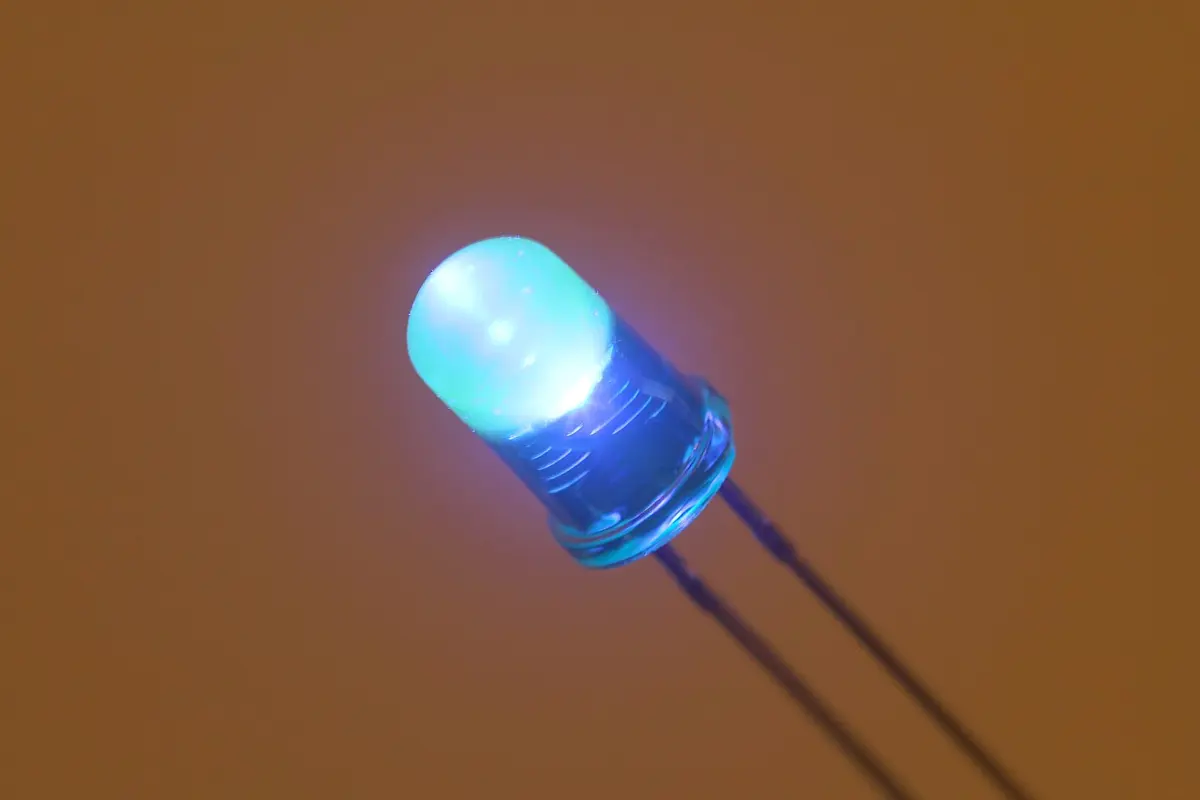
Then there was the LED, short for light-emitting diode. An LED makes light without getting hot first. By the end of the 1960s there were red LEDs and green ones: the little lights on radios, calculators and digital watches. But these could not light a room. To make white light you need red, green and blue together, and blue was missing.
Why does a filament bulb waste so much electricity?
Pick an answer to see why.
How an LED makes light
To understand why blue was so hard, first see how an LED works.
An LED is a tiny chip, about the size of a grain of sand, made of semiconductors. A semiconductor is a material that conducts electricity better than an insulator such as plastic, but much less well than a metal such as copper. Silicon, in every computer chip, is one. By adding tiny amounts of other elements, a semiconductor can be made in two kinds:
- an n-type layer has extra electrons, free to move (n for negative);
- a p-type layer has electrons missing. Each gap where an electron should be is called a hole, and it behaves like a positive charge that can move (p for positive).
An LED is a sandwich: an n-type layer and a p-type layer, with a very thin active layer between them. Connect a battery, and the electrons are pushed one way and the holes the other, so they meet in the active layer. When an electron falls into a hole, it gives up a fixed amount of energy, and that energy comes out as a tiny packet of light, a photon.
The color of the light depends on how much energy each electron gives up, and that is fixed by the material. Think of the electron jumping down a step: a small step gives red light, a bigger step gives green, and a very big step gives blue. Blue light carries more energy than red light, because its wavelength is shorter Grade 9: Electromagnetic spectrum.
So, to make a blue LED, you need a semiconductor with a very big step. In the 1970s and 80s, scientists knew of two possible ones: zinc selenide and gallium nitride (GaN, a compound of the metal gallium and nitrogen). Most of them chose zinc selenide. It looked easier.
A red LED and a blue LED are made of different materials. Why?
Pick an answer to see why.
Why blue was so hard
Gallium nitride had the right step for blue, but it had two big problems.
- Nobody could grow a good crystal of it. For an LED, the atoms must sit in a perfect, regular pattern, a crystal, built up layer by layer on a flat base. Gallium nitride’s atoms are spaced differently from those of any base material people could use, so the crystals came out full of cracks and faults. Faults waste the energy as heat instead of light.
- Nobody could make p-type gallium nitride. Without a p-type layer there are no holes, and without holes, no light. Every attempt failed.
By the 1980s most laboratories in the world had given up on gallium nitride. Big electronics companies had spent years and lots of money on blue LEDs and got nowhere.
What they did, step by step
Two teams, working separately in Japan, solved both problems in different ways.
Akasaki and Amano: a cushion, and a lucky glow
Isamu Akasaki had been working on gallium nitride since the 1970s and was sure it was the right material. At Nagoya University he worked with a young student, Hiroshi Amano. Building much of their equipment themselves, they did thousands of experiments, and most of them failed.
- 1986, the crystal. They grew their gallium nitride on sapphire (a hard, clear crystal), but first laid down a very thin layer of aluminium nitride, like a cushion between two things that don’t fit. The gallium nitride that grew on top was the best anyone had ever made.
- Late 1980s, the p-type layer. They added a little magnesium, which should have made p-type material. It didn’t, until they noticed something odd. Under the beam of a scanning electron microscope (a microscope that looks with a beam of electrons instead of light), their material glowed more and more brightly. The electron beam was turning it into p-type material.
- 1992: they showed an LED that gave out bright blue light.
Nakamura: building his own machine
Shuji Nakamura worked at Nichia, a small chemical company in Tokushima, on the island of Shikoku. He had spent about ten years making materials for red LEDs that sold poorly. In 1988 he asked the company’s founder to pay for something bolder: a blue LED, in gallium nitride. The founder agreed.
- The machine. Nakamura spent a year in the United States learning how gallium nitride crystals are grown, then came home and rebuilt the machine for growing them, changing it again and again, often every day.
- 1990, the crystal. He found his own way to grow good crystals: first a very thin layer of gallium nitride at a low temperature, then the rest on top of it at a higher temperature.
- 1992, the p-type layer, and why. Nakamura worked out what the electron beam had been doing. Hydrogen atoms left over from making the crystal were sticking to the magnesium and stopping it from working. The beam knocked the hydrogen off. Nakamura found a simpler, cheaper way: just heating the material. That could be done for a whole wafer of chips at once, in a factory.
- 1993, bright blue. Mixing a little indium into the gallium nitride (indium gallium nitride) made the light bluer and much brighter. Nichia began selling bright blue LEDs, and in 1996 the first white ones.
How white LED light is made
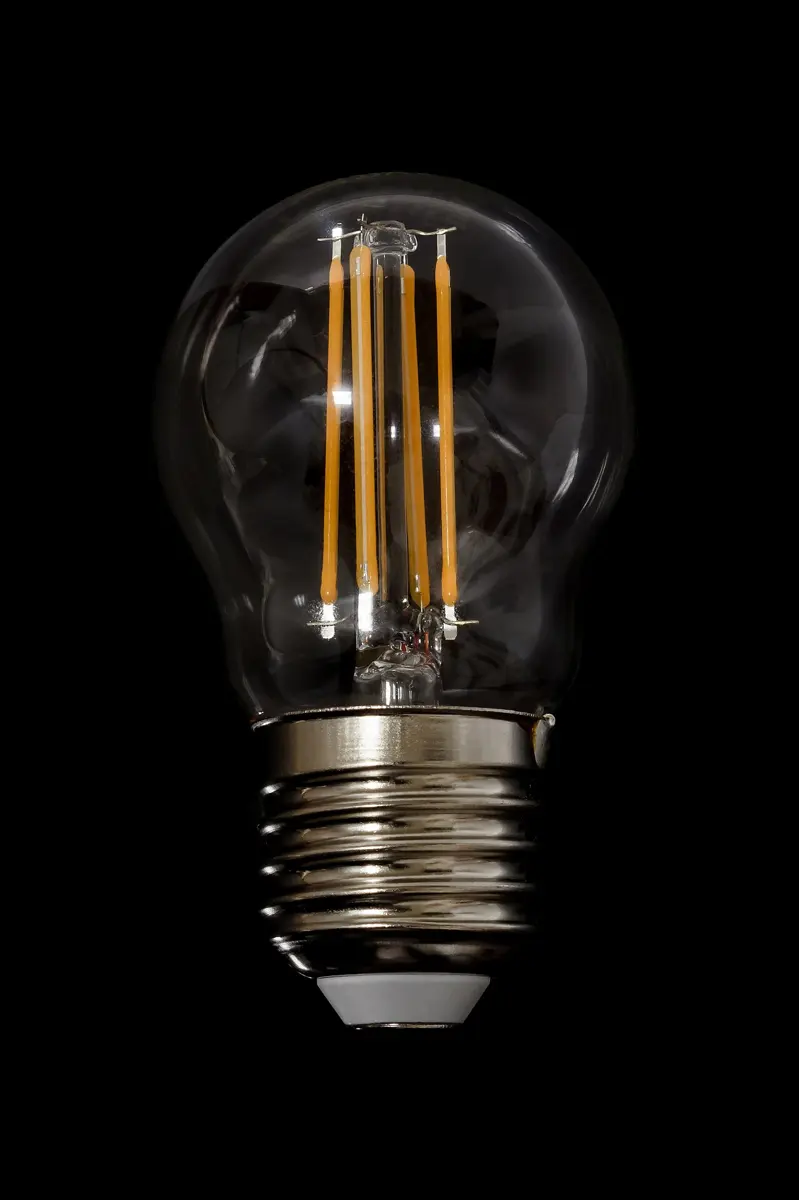
A white LED bulb doesn’t contain three colors of LEDs. It contains blue LEDs with a yellow coating called a phosphor. A phosphor is a material that soaks up light of one color and gives out light of another. Some of the blue light passes straight through; the rest is turned into yellow (and some red and green) light. The blue and the yellow together look white to your eye.
A white LED bulb is switched off. What color is the tiny LED inside it?
Pick an answer to see why.
In your life today
- Lighting. A 9 W LED bulb gives as much light as a 60 W filament bulb Grade 8: Electric bulb, and it can last tens of thousands of hours. When the prize was given, about a quarter of the world’s electricity was used for lighting, so this saves a great deal of energy.
- Screens. The screen of your phone, a laptop or a flat TV is lit from behind by white LEDs.
- Tihar lights. The strings of tiny colored lights on houses at Tihar are LEDs. They use so little power that a long string costs almost nothing to run.
- Solar lanterns. Because an LED needs so little power, a small solar panel and a battery can light a home. In 2014 more than 1.5 billion people had no mains electricity; in many places a solar LED lamp was their first electric light. In Nepal, solar lamps light homes in villages that the grid hasn’t reached and street lamps along roads Grade 9: Solar lamps and solar street lamps.
What came next
- Ultraviolet LEDs. Gallium nitride with aluminium mixed in gives ultraviolet light, which kills germs. UV LEDs are now used to make drinking water safe without chemicals.
- The “green gap”. Strangely, the best green LEDs are still much less efficient than the best blue and red ones. Nobody has yet found a material that makes green light as well. This is an open problem that engineers are working on now.
- Too much light? LEDs are so cheap to run that cities now leave more lights on, and white LEDs give out a lot of blue light, which spreads through the air and brightens the night sky. Astronomers and people who study animals that are active at night are worried about light pollution. Many towns now choose warmer, more yellow LEDs and point street lamps downward. See how many stars a dark sky really holds in our Night Sky.
In your science books
- Grade 8: the electric bulb, and why LED bulbs use less electricity.
- Grade 9: the heating effect of electric current (why filament bulbs waste energy), electric power, the electromagnetic spectrum and visible light.
- Grade 10: dispersion of light, white light as a mixture of colors.
Learn more
- The Nobel Prize’s own explanation: Blue LEDs: filling the world with new light (nobelprize.org).
- The three laureates’ Nobel lectures: Akasaki, Amano and Nakamura.
The official reason
The prize was given “for the invention of efficient blue light-emitting diodes which has enabled bright and energy-saving white light sources.”