
Neutrons: where atoms are, what they do
Nobel Prize in Physics, 1994: Bertram N. Brockhouse and Clifford G. Shull
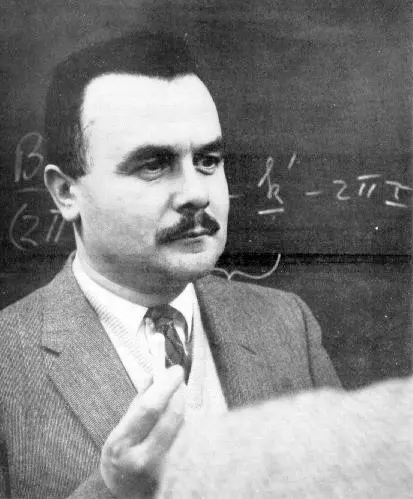
Bertram N. Brockhouse
1918–2003, born in Lethbridge, Canada
He repaired radios for a living as a young man, serviced the navy’s sonar sets in the Second World War, and only started university at 27.
Photo: Wikimedia Commons, Public domain
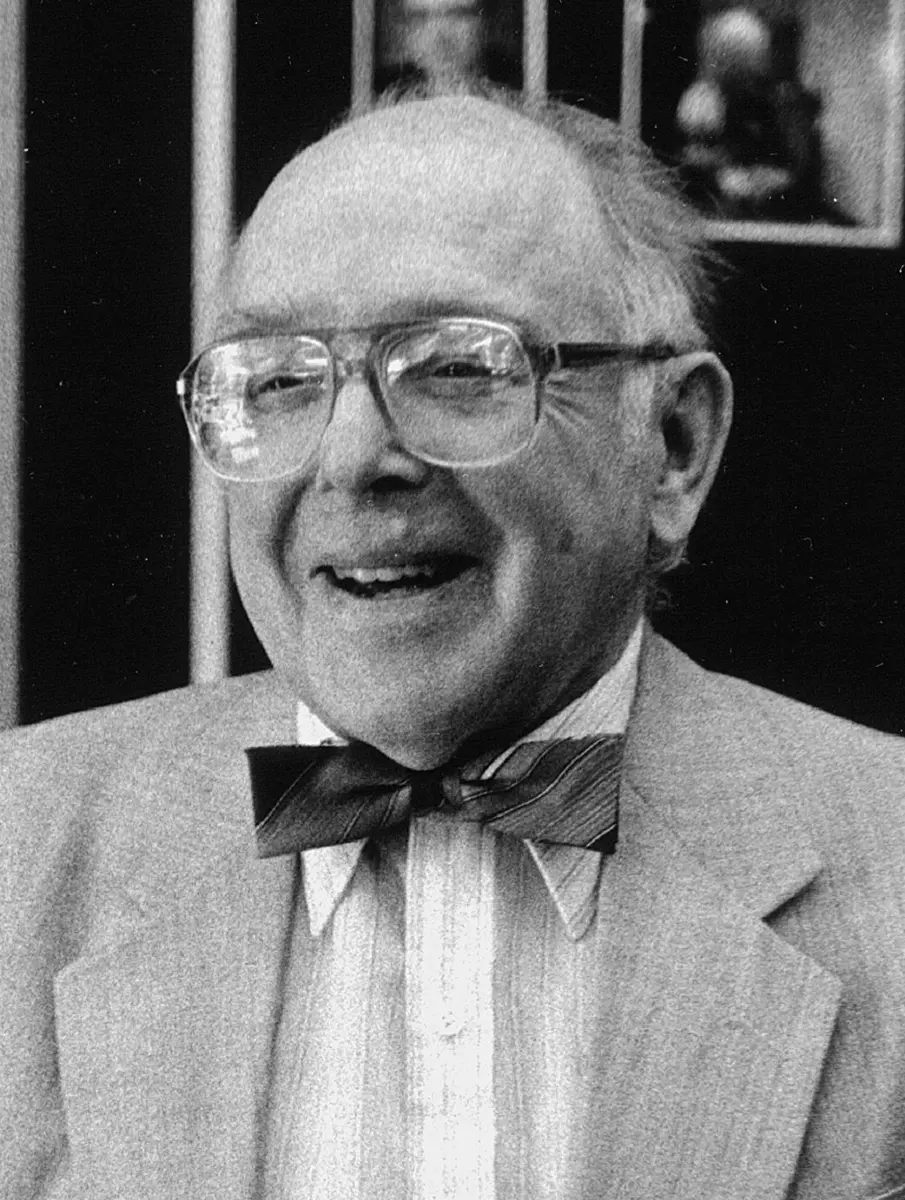
Clifford G. Shull
1915–2001, born in Pittsburgh, USA
During the war his oil company refused to let him leave to work on the atomic bomb. He won the prize at 79, nearly fifty years after his discovery.
Photo: ENERGY.GOV, Public domain
A grain of salt from your kitchen is a crystal: its atoms of sodium and chlorine sit in a perfectly regular pattern, like the bricks in a wall. Ice is a crystal too, and so is the iron in a steel bar. But atoms are far too small to see, even with the best ordinary microscope. So how do scientists know where they are? And atoms never stay still: in every solid they are always jiggling. How can anyone watch them move?
In 1994 the Nobel Prize in Physics went to two men who found ways to answer both questions with beams of neutrons. As the Nobel committee put it, Clifford Shull helped answer the question of where atoms are, and Bertram Brockhouse the question of what atoms do.
The problem: looking at something smaller than light
You see an object when light bounces off it into your eyes. But light can only show details bigger than about its own wavelength, roughly half a millionth of a meter. Atoms are a few thousand times smaller than that, so light just washes over them.
X-rays have a much shorter wavelength, about the same as the distance between atoms Grade 9: X-rays. In 1912–1913 scientists found that a crystal sends X-rays off in a pattern of sharp spots, and from the pattern William and Lawrence Bragg worked out where the atoms sit (their Nobel Prize, 1915). This is called diffraction, and it showed the structure of salt, diamond and thousands of other crystals.
But X-rays have weaknesses. They bounce off an atom’s electrons. A heavy atom with many electrons shows up strongly. Hydrogen, with only one electron, is almost invisible, though it is in water, in every living thing and in many useful materials. X-rays also can’t show which way the tiny atomic magnets inside a magnetic material point. And they show where atoms are on average, not how they move.
How neutrons can help
The neutron, found by James Chadwick in 1932, is one of the two particles in an atom’s nucleus Grade 8: The particles inside an atom. It has no electric charge, which gives it some useful habits:
- It goes deep. With no charge, it isn’t pushed about by electrons, so it can pass through centimeters of metal and look at the whole inside of a sample.
- It bounces off the nucleus, not the electrons. How strongly depends on the nucleus, not on the number of electrons, so hydrogen shows up clearly.
- It is a tiny magnet. It is pushed and pulled by the atomic magnets in a material, so it can show which way they point.
Neutrons, like all particles, also behave as waves. A neutron let out of a nuclear reactor and slowed down in it moves at about 2,200 meters per second, faster than a rifle bullet. At that speed its wavelength is about 0.18 billionths of a meter (0.18 nm): almost exactly the distance between atoms in a solid. And its energy is about the same as the energy of the atoms’ jiggling. Slow neutrons are, by luck of nature, just right for looking at both.
Why are neutrons better than X-rays for finding hydrogen atoms in a material?
Pick an answer to see why.
Why it was hard
You need a great many neutrons to do this, and before 1942 nobody had a source strong enough. The first nuclear reactors, built during the Second World War to make materials for the atomic bomb, changed that Grade 9: Nuclear fission. A reactor gives out huge numbers of neutrons. After the war, scientists were allowed to use them for peaceful research.
Even then it was slow, hard work. A neutron leaves no track: you can only count it, one at a time, when it is swallowed in a special detector. A beam picked out from a reactor is weak, so each point on a graph could take many minutes of counting, and a full measurement days. Nobody yet knew how strongly each element scatters neutrons, so every result had to be worked out from the beginning.
What they did, step by step
Shull: where the atoms are
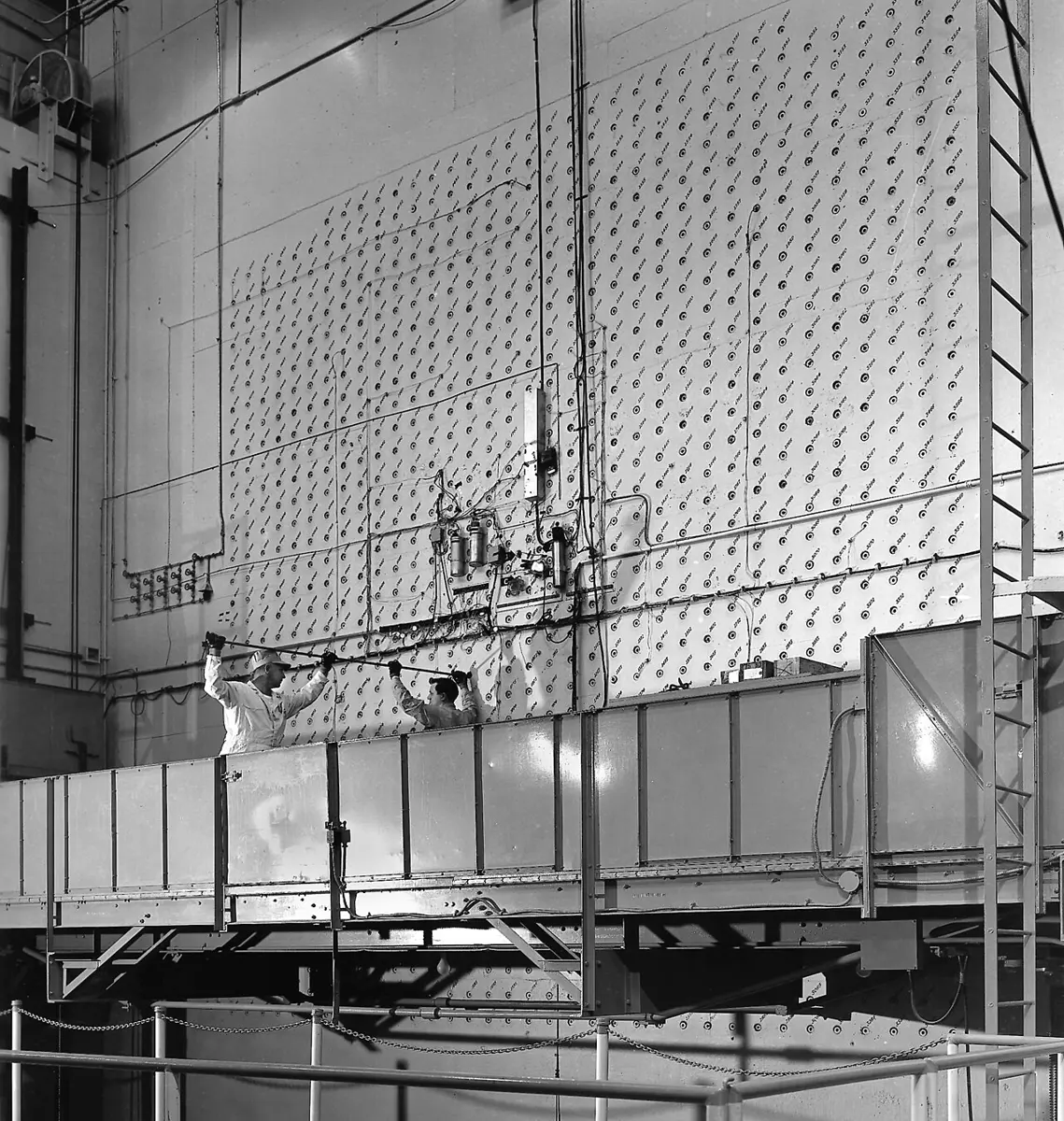
In 1946 Clifford Shull moved to Oak Ridge in Tennessee, USA, to work with Ernest Wollan, who had built a simple instrument at the face of the Graphite Reactor there. Shull had spent the war studying catalysts with X-rays, so he knew diffraction well.
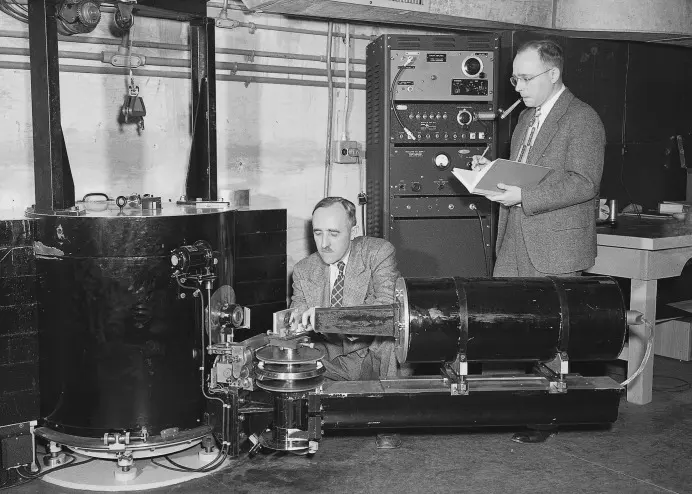
- 1946–1947: the method. They sent neutrons from the reactor onto a crystal, which reflected only neutrons of one wavelength towards the sample. A detector moved round the sample to count the neutrons scattered at each angle. They measured how strongly each element scatters, element after element, so that patterns could be read.
- 1948–1949: hydrogen found. They showed where the hydrogen atoms sit in crystals such as sodium hydride, and then in ice, something X-rays had never managed.
- 1949: hidden magnets. Shull and J. Samuel Smart looked at manganese oxide, which isn’t magnetic to an ordinary magnet. The neutrons showed why: its atoms are tiny magnets, but they point in opposite directions in alternate layers, so they cancel out. This arrangement, called antiferromagnetism, had been predicted, but this was the first time anyone saw it.
- 1955: to MIT. Shull moved to a university to teach and train students, and kept working with neutrons until he retired in 1986.
Why peaks? Each row of atoms sends back a weak wave. In most directions the waves from different rows are out of step and cancel. Only in a few directions are they all in step, so they add up into a strong beam. Those directions depend on the distance between the rows, so the angles of the peaks measure that distance, and the pattern of peaks gives the whole arrangement of atoms. The same thing happens with light on a CD: its tracks are evenly spaced, so each color comes off strongly only at its own angle, and you see a rainbow.
Manganese oxide is made of atoms that are tiny magnets, yet the material does not attract a fridge magnet. What did Shull’s neutrons show?
Pick an answer to see why.
Brockhouse: what the atoms do
The atoms in a solid are held by their bonds as if by springs. Heat makes them jiggle. But they don’t jiggle separately: a push on one passes to the next, so the jiggling travels through the solid as waves, rather like a ripple running along a row of people. Sound in a solid is such a wave Grade 8: How sound travels. The smallest packet of energy such a wave can have is called a phonon.
Bertram Brockhouse joined the Canadian laboratory at Chalk River, Ontario, in 1950, where there was a powerful reactor called NRX.
- 1951: the idea. He realized that when a slow neutron passes through a solid, it can set off a phonon and lose exactly that much energy, or pick up energy from one and leave faster. Measure the neutron’s energy before and after, and you measure the vibrations of the atoms.
- 1952–1954: a setback. An accident at the NRX reactor in November 1952 stopped the work for almost two years.
- 1955: first results. With Alec Stewart, he measured the waves of vibration in aluminium: how the energy of each wave depends on its wavelength. Nobody had ever measured this directly.
- 1956–1958: the triple-axis spectrometer. He built the instrument that is still the basis of the method today, with three turning parts (axes), and invented a better way to use it.
He used it to study vibrations in crystals, the waves of turning atomic magnets in magnetic materials, and the restless movement of atoms in liquids such as water and molten lead.
How it works now
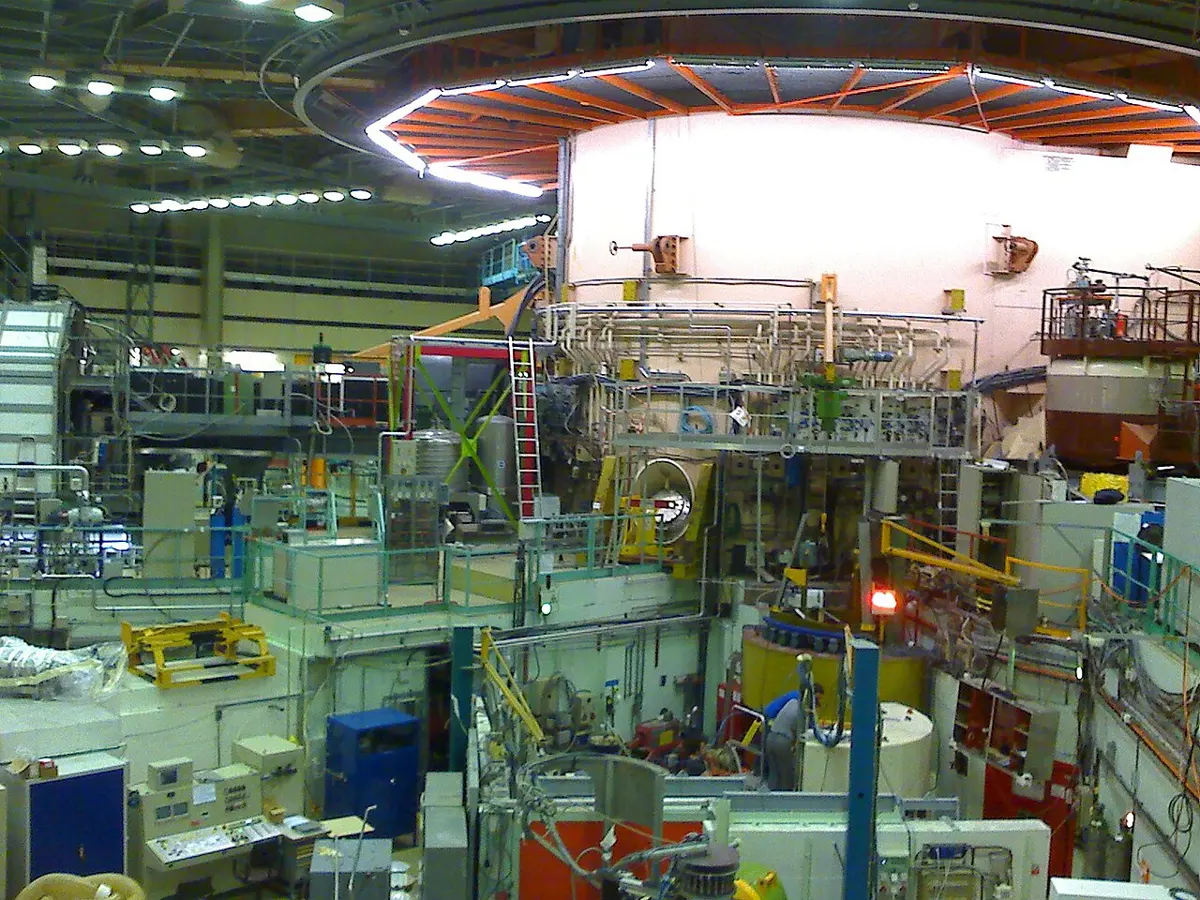
Since the 1950s, neutron scattering has grown into a large field, used by thousands of scientists. Special research reactors and spallation sources (which knock neutrons out of heavy metal with a powerful particle beam) feed neutrons to dozens of instruments each. The best known include the Institut Laue-Langevin in Grenoble, France, whose reactor has run since the early 1970s, and the Spallation Neutron Source in Oak Ridge, USA, completed in 2006. Scientists from many countries apply for time on them.
In your life today
- Batteries. Lithium is a light atom that X-rays hardly see. Neutrons can watch lithium move inside a working battery as it charges and discharges, which helps engineers design batteries that last longer (Lithium-ion batteries).
- Safe metal parts. Because neutrons go deep into metal, they can measure the hidden strains locked inside a weld, a railway line or a jet engine part, before a crack starts.
- Medicines. Many medicines work by sticking to a protein in the body, often through hydrogen atoms. Neutrons show where those hydrogen atoms are, which X-rays usually cannot.
- Magnets. The tiny magnets that store data, and the strong magnets in motors and wind turbines, are studied with neutrons, the only way to see how the atomic magnets inside them are arranged.
What came next
- Brighter sources. A new and much more powerful neutron source, the European Spallation Source, is being built and brought into use in Lund, Sweden.
- New materials. Neutrons helped show how atoms are arranged in high-temperature superconductors, materials that carry electricity with no resistance at all when cooled, and how the magnets of their atoms behave. Exactly how these materials work is still not fully understood, and neutron experiments are among the main tools for finding out.
- Living things. Because neutrons can tell ordinary hydrogen from its heavier twin, deuterium, scientists can “color” parts of a cell membrane or a protein and see them separately.
In your science books
- Grade 8: the particles inside an atom, and how sound travels.
- Grade 9: structure of an atom, nuclear fission (what happens in a reactor), and X-rays.
- Going Further: particles that never stop (Grades 6–8), and four kinds of solid (Grades 9–12).
- More Nobel Prizes: the Braggs and X-ray crystals.
Learn more
- The Nobel Prize’s own explanation: the press release, with a drawing of both methods (nobelprize.org).
- The laureates’ Nobel lectures: Brockhouse and Shull.
The official reason
The prize was given “for the development of neutron spectroscopy.”
The prize was given “for the development of the neutron diffraction technique.”