
Pick up a steel spoon that has been standing in a cup of hot tea, and it burns your fingers, though only its bottom touched the tea. Hold your hands near a fire and they warm up, though nothing touches them. Look into the same spoon and you see your face, upside down on one side and the right way up on the other. Ring a bell, and someone in the next room hears it through the wall.
Heat, light and sound are three kinds of energy you use every minute of the day. This unit shows how each one travels: how heat creeps through a spoon, rides along in moving air and water, and crosses 150 million kilometers of empty space from the Sun; how curved mirrors gather light or spread it out; and how a sound is made, how fast it goes, and why too much of it harms you.
Energy in daily life
Look at the pictures of a dam spilling water, the Sun, a solar panel, a car being filled with petrol, and glowing coal, and think about these questions.
- What types of energy do you see?
- Can one type of energy do every job?
- Where does each type of energy come from?
You read, write, play, carry loads and work in the fields. You can’t keep doing any of it for long without food. A bus doesn’t move without diesel, and a fan doesn’t turn without electricity. In each case something gives the ability to do work, and that ability is called energy.
Energy is the capacity (ability) to do work. Its SI unit is the joule (J). An older unit, still widely used for food and heat, is the calorie (cal), the unit of energy in the CGS system:
Energy comes in many forms: mechanical energy, heat energy, light energy, sound energy, magnetic energy, electrical energy, chemical energy and nuclear energy. The places we get these forms of energy from are called sources of energy.
Sources of energy are of two kinds.
- Non-renewable sources can’t be replaced quickly once they are used up: coal, petroleum products (petrol, diesel, kerosene, LPG) and nuclear fuel. Coal and oil took millions of years to form.
- Renewable sources don’t run out however much we use them, because nature keeps renewing them: solar energy, wind energy, the energy of flowing water and of the tides.
Which of these is a renewable source of energy?
Pick an answer to see why.
7.1 Heat
Look at these everyday scenes: a frying pan on a gas flame, a pot of water on a stove, hands held out to a fire, clothes drying on a line, and warm air rising over a valley in the sun. How does the heat travel in each one? Does it travel the same way every time?
Heat is a form of energy that gives us the feeling of warmth. Touch something hotter than your body, and heat flows from it into your skin, so it feels hot. Touch something colder, and heat flows from your skin into it, so it feels cold. That is why ice feels cold: it is taking heat out of your hand.
Heat always flows from a hotter body to a colder one, from a higher temperature to a lower temperature, never the other way by itself. The flow of heat energy from one object or place to another is called the transmission of heat (or heat transfer).
Heat travels in three ways, and the rest of this part is about each of them.
You hold a glass of cold water. Your hand feels cold because:
Pick an answer to see why.
7.1.1 Conduction
Activity 7.1: pins that drop one by one
The rod itself doesn’t move, and none of its particles travel from one end to the other. So how does the heat get along? A solid is made of tiny particles (molecules or atoms) held in place, each vibrating a little about its own fixed position. Heating the end of the rod makes the particles there vibrate harder. They knock into their neighbors and make them vibrate harder, those knock into the next ones, and so the extra vibration, which is heat, is passed along the rod, particle to particle, like a message passed down a line.
Conduction is the transfer of heat through a solid from particle to particle, without the particles moving from their places. It is how heat travels in solids.
Conductors and insulators
Activity 7.2: which things let heat through?
Materials that let heat pass through them easily are good conductors of heat: iron, copper, aluminium, silver, gold and other metals. Materials that hardly let heat pass through them are insulators of heat (bad or poor conductors): wood, plastic, rubber, cloth, wool, paper, porcelain and air.
Thermal conductivity
Some materials conduct heat faster than others. Thermal conductivity tells how quickly or slowly a material conducts heat. A material with a high thermal conductivity carries heat fast; one with a low thermal conductivity carries it slowly. It is a property of the material itself: it depends on what the material is made of (its molecules and how they are arranged), and a little on its temperature.
| Material | Thermal conductivity (roughly, W per meter per °C) |
|---|---|
| diamond | 2,000 |
| copper | 400 |
| aluminium | 240 |
| iron | 80 |
| stainless steel | 16 |
| glass | 1 |
| water | 0.6 |
| wood | 0.1 to 0.2 |
| wool, cotton wool | 0.04 |
| still air | 0.025 |
Most metals have a high thermal conductivity, so they heat up quickly near a flame. That is why cooking pots are made of them. Plastic, cotton, wool, rubber and air have a very low thermal conductivity, and that is useful too: warm clothes keep your body heat in.
Not every metal is equally good: copper conducts about 25 times better than stainless steel. And not every non-metal is poor: diamond conducts heat about five times better than copper, and graphite (the “lead” of a pencil) conducts heat well along its layers.
Which would you choose for the bottom of a pan that should heat food quickly and evenly?
Pick an answer to see why.
Uses of conduction in daily life
Why are cooking pots made of copper, steel, iron or aluminium, while their handles are wood or plastic? Why does a jacket keep you warm? Why is a mud house cool in summer and warm in winter? Why do birds look fat and fluffy on very cold days? All of these depend on how well things conduct heat.
- Cooking pots and kettles are made of metal, which carries heat easily from the flame to the food.
- The handle of a kettle is made of plastic, a poor conductor, so heat does not reach your hand.
- Woolen clothes and blankets keep you warm in winter. Wool is a poor conductor, and the air trapped between its fibers, and between the layers of your clothes, is an even poorer one. So your body heat escapes very slowly. Several thin layers trap more air than one thick layer.
- Teacups and coffee mugs are made of porcelain, an insulator, so the tea stays hot longer and the cup is comfortable to hold.

7.1.2 Convection
Activity 7.3: colored water on the move
Here is why the water moves. Water at the bottom of the beaker is heated by the flame. Warm water expands, so it becomes less dense (lighter for its size) than the cooler water above it. The lighter warm water rises, just as a cork rises in water, and the heavier cool water sinks to take its place at the bottom. There it is heated in turn, and rises too. The moving water carries the heat with it, and this goes on until all the water is hot.
Convection is the transfer of heat in a liquid or a gas by the actual movement of its particles (molecules) from a hotter place to a colder place. The loop of moving liquid or gas is a convection current.
Notice the difference from conduction: in conduction, the particles stay in place and pass the heat on; in convection, the particles themselves carry the heat as they move. Liquids and gases (together called fluids) can flow, so they mostly carry heat by convection. Solids can’t flow, so convection can’t happen in a solid.
Convection happens in air in just the same way. Air over a hot surface is heated, becomes less dense and rises; cooler air flows in to take its place.
Wind
During the day, the Sun heats the ground, and the ground heats the air just above it. The warm air expands, becomes lighter and rises, leaving behind air at a lower pressure. Cooler air from nearby flows in to take its place. Moving air is wind, and convection is the main cause of wind.
Sea breeze and land breeze
On a coast, the land and the sea heat up and cool down at different speeds. Water has a much higher specific heat capacity than land: it needs much more heat to warm up by each degree, and gives out much more heat as it cools by each degree. So the sea warms up slowly in the day and cools down slowly at night, while the land changes temperature quickly.
Sea breeze (by day). The Sun heats the land and the sea, but the land gets hotter faster. The air over the land is heated, expands and rises, making an area of low pressure over the land. The air over the cooler sea is denser, at a higher pressure. Air flows from high pressure to low, so cool air blows from the sea to the land. This daytime wind is the sea breeze.
Land breeze (by night). After sunset, the land cools quickly, but the sea stays warm. Now the warm air over the sea rises, making low pressure there, and cool air blows from the land to the sea. This night-time wind is the land breeze.
Natural and forced convection
There are two types of convection.
- Free or natural convection: the fluid moves by itself, only because the hotter parts are less dense and rise. The air next to a hot object is heated, becomes less dense and rises, and cooler air takes its place: a natural convection current. Water boiling in a pot goes round in this way: warm water rises from the bottom, spreads and cools at the top, and sinks again. Sea breezes, land breezes and the clouds that bring rain are all caused by natural convection.
- Forced convection: something pushes the fluid along, a fan, a pump or a blower, using outside energy such as electricity. An electric fan, a room heater with a fan, a hair dryer, an air conditioner, and a pump pushing hot water through pipes are examples. Your heart does it too: it pumps warm blood from the warm center of your body out to your hands and feet.
Convection currents and weather
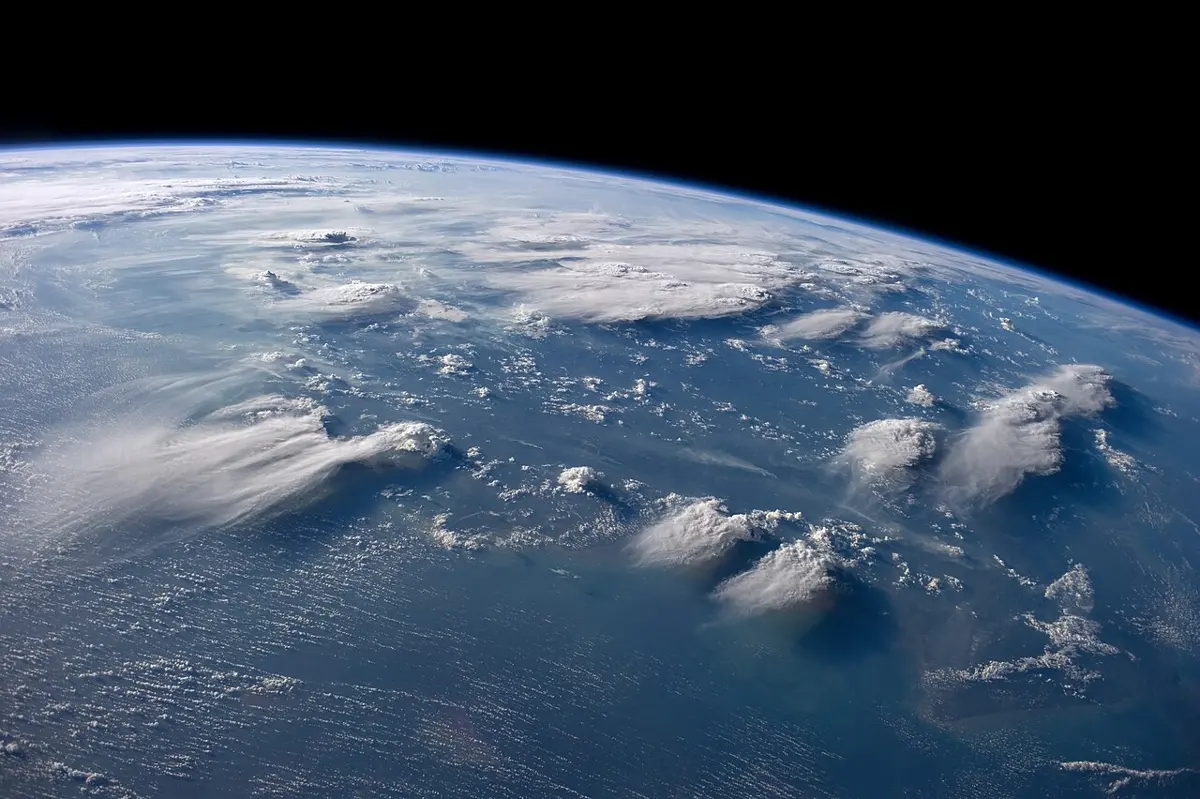
Convection helps us understand the weather and forecast it. The process starts every sunny morning. The Sun heats the ground, and the ground heats the layer of air just above it. Bare surfaces like sand, rock and roads heat up faster than water or ground covered with plants. So the air above different places is heated unevenly. The air above a hot, bare patch becomes warmer and less dense than the air around it, and starts to rise: a rising current of warm air called a thermal. (Eagles and vultures circle in thermals to climb without flapping their wings.)
As the thermal rises, it carries heat and moisture upwards. The hotter the ground, the stronger the convection, which is why it is strongest on very hot days. High up, the rising air cools. If it holds a lot of moisture, clouds form; with strong convection they grow into tall thunderclouds, with lightning, thunder and heavy rain.
Convection also carries extra heat away from the Earth’s surface up into the air. Without it, the ground would be far hotter: by some estimates around 50 to 60 °C (125 to 140 °F), instead of the Earth’s present average surface temperature of about 15 °C (59 °F).
Uses of convection in daily life
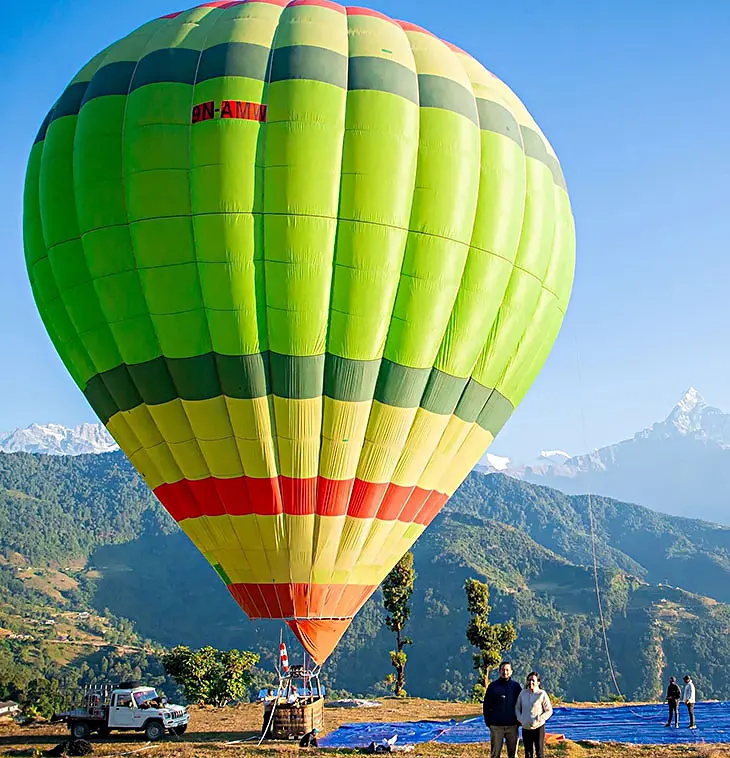
Have you seen a hot air balloon rising, or steam curling up from a cup of tea? Both are convection: the transfer of heat from a hotter place to a colder place through a liquid or a gas by the movement of its particles. When a liquid or gas is heated, its particles move faster and spread farther apart, so it becomes less dense and rises.
- Water and other liquids are heated mainly by convection when they boil in a pot.
- In warm-blooded animals (mammals and birds), blood carries heat from the warm center of the body to the skin, pumped by the heart (forced convection).
- Electric fans and air conditioners move air around a room (forced convection).
- Room heaters and the cooling part of a refrigerator work by setting up convection currents. In many fridges the freezer is at the top: the air it cools sinks through the fridge, and the warmer air rises to be cooled.
- Convection causes winds, clouds, rain, thunderstorms and lightning.
A room heater warms the whole room, though it stands in one corner. This is mainly because of:
Pick an answer to see why.
7.1.3 Radiation
Why do you feel warm when you sit in the sun, or near a heater? Between the Sun and the Earth, above our air, is almost empty space, with nothing in it to conduct heat, and no air to carry it by convection. (And convection only carries heat upwards, as warm air rises; it could never bring the Sun’s heat down to the ground.) Yet the Sun’s heat reaches us every day. It travels by a third way, which needs no material at all.
The Sun gives out heat and light, and they travel as waves. These waves don’t need any material to travel through, so they can cross empty space. The transfer of heat without any material medium is called radiation. In a vacuum (completely empty space), heat can travel only by radiation. It is also how you feel the warmth of a fire or a heater from across the room.
Which of these warms you mainly by radiation?
Pick an answer to see why.
7.1.4 Waves
Activity 7.5: ripples in a pond
The ripples are water waves. The stone disturbs the water where it falls, the water particles there move up and down, and they pull their neighbors up and down a moment later, and so on outwards. So the wave spreads from the point of disturbance to the edge of the pond, but the water itself stays where it is: each particle only moves up and down about its own place. In the same way, if you tie one end of a rope to a tree and jerk the other end up and down, a wave runs along the rope, while each bit of rope only moves up and down. A wave is produced by vibration, and it carries energy from one place to another without carrying the material along.
Mechanical and electromagnetic waves
Some waves need a material to travel through, and some don’t.
- Mechanical waves need a material medium (a solid, liquid or gas) to travel. Sound is a mechanical wave: its energy is passed on by the vibration of the particles of the medium. The material that vibrates as the wave passes is called the medium. As a mechanical wave travels, the medium takes some of its energy, so the wave grows weaker and can only travel a limited distance. Its speed is different in different media: sound travels at about 332 m/s in air (at 0 °C), 1,481 m/s in water and 5,120 m/s in iron.
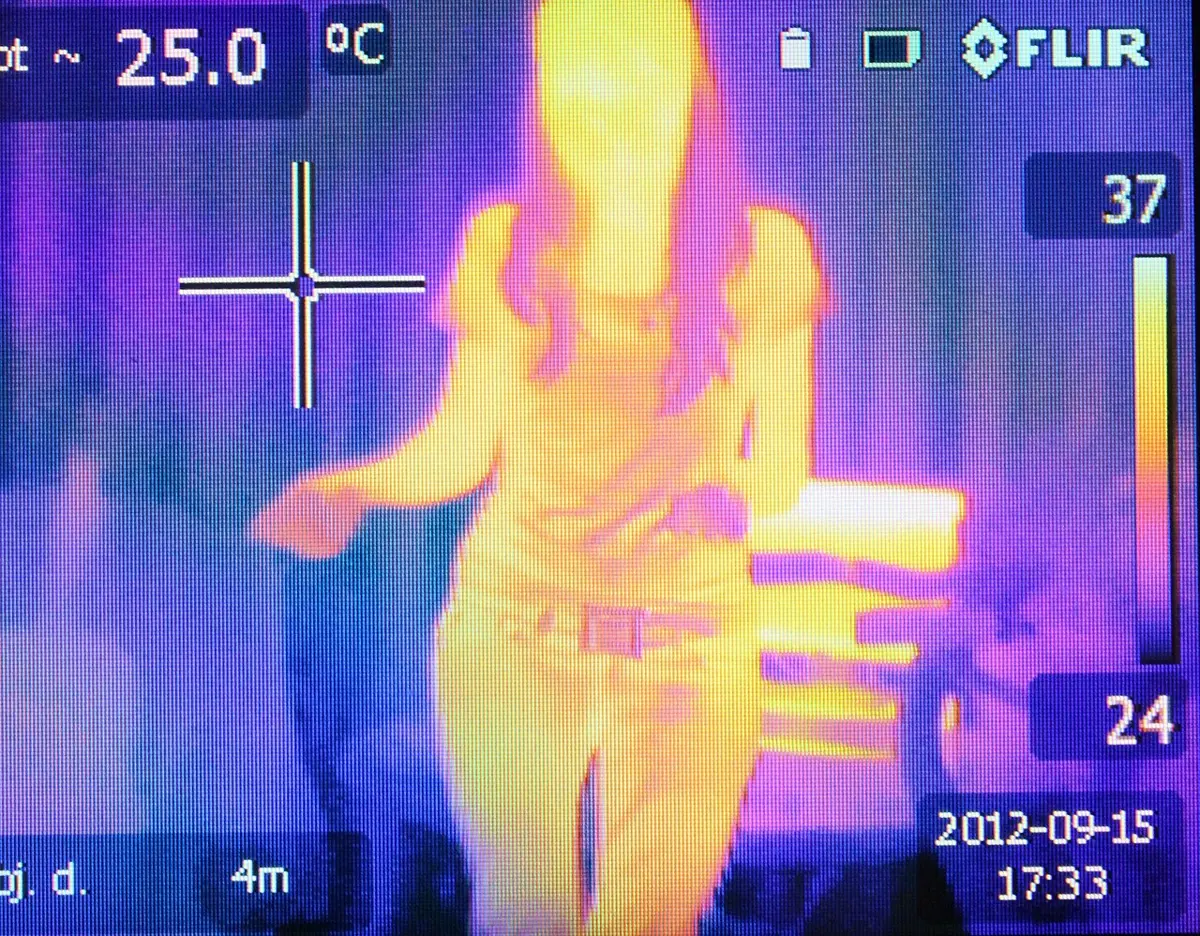
- Electromagnetic waves don’t need a medium; they can travel through a vacuum. Light, infrared (the heat rays we can’t see), radio waves, microwaves, ultraviolet rays, X-rays and gamma rays are electromagnetic waves. Crossing empty space, they don’t lose energy to any medium. All of them travel through a vacuum at the speed of light, 3 × 10⁸ m/s (300,000 km every second).
Light from the Sun takes about 8 minutes and 20 seconds to reach the Earth. When you see the Sun, you are seeing it as it was 8 minutes ago.
Radiation is the transfer of energy as electromagnetic waves, without any material medium. Heat travels by radiation mainly as infrared rays. This is called thermal radiation, and it is how the Earth gets its heat from the Sun.
Which of these is a mechanical wave?
Pick an answer to see why.
The color of an object and radiation
Activity 7.6: which box gets hottest?
Dark, dull surfaces are good absorbers of radiation: they take in most of the heat rays that fall on them. White, pale and shiny surfaces are poor absorbers: they reflect most of it. A surface that is a good absorber is also a good emitter: a hot black object gives out heat rays faster than a hot shiny one at the same temperature.
So:
- White or light-colored clothes are worn in summer and in hot places; dark clothes are better for winter and cold places.
- The inside of a solar water heater or a solar cooker box is painted black, to absorb as much of the Sun’s radiation as possible.
- Cooking pots are often black on the outside, to absorb more heat from the flame, cook faster and save fuel.
Uses of radiation in daily life
Why do a cup of tea and a plate of hot food go cold if you leave them? Anything hotter than its surroundings gives out more heat by radiation than it receives, so it cools down, until it reaches the same temperature as its surroundings: thermal equilibrium. Anything colder than its surroundings absorbs more radiation than it gives out, so it warms up. (The tea also loses heat by convection and evaporation.)
- Sitting near a fire, your body receives heat from it by radiation.
- The Sun’s radiation heats the land, the sea and the air.
- The black grid of pipes (the condenser) at the back of a refrigerator gives off the heat taken from inside the fridge into the room, partly by radiation, which is why it is painted black, and partly by convection.
- White or light-colored clothes are worn in summer because they absorb less of the Sun’s heat.
7.1.5 Thermos flask
Activity 7.7: inside a thermos
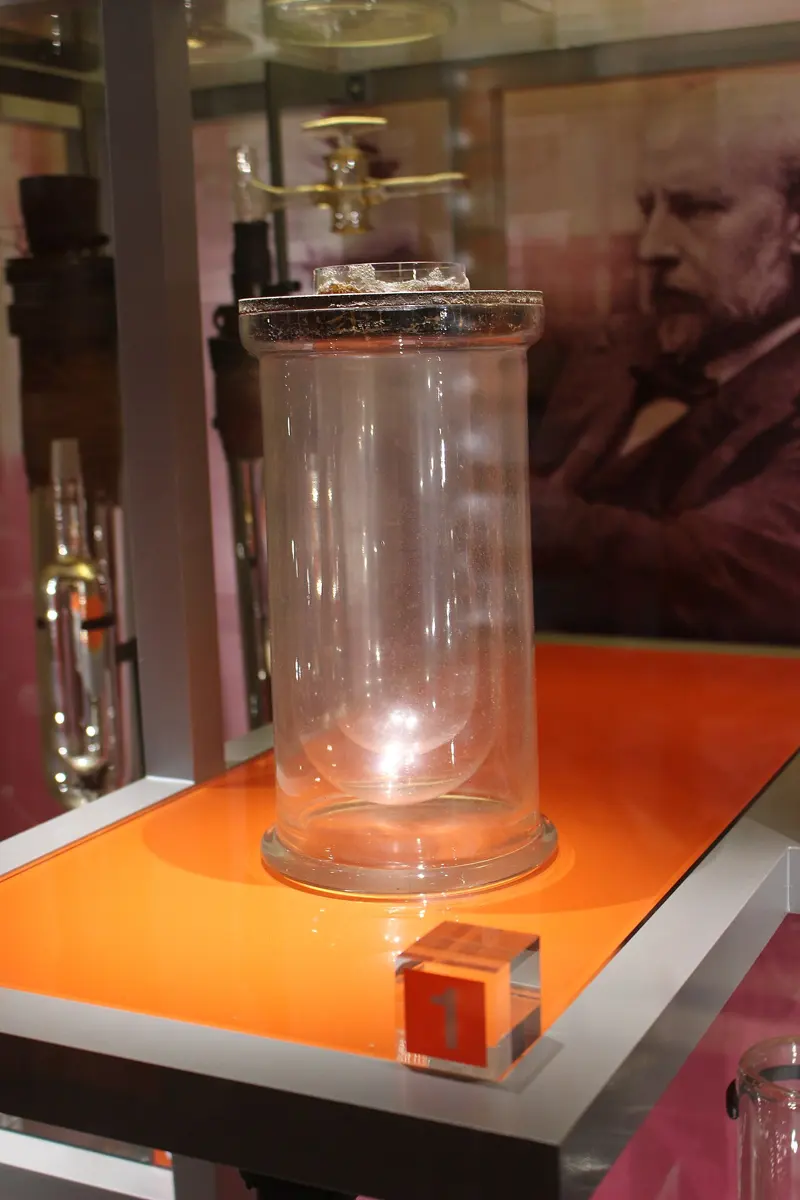
A thermos flask (vacuum flask) keeps hot drinks hot and cold drinks cold for many hours. It does this by stopping all three ways that heat can travel: conduction, convection and radiation.
| Part | What it is | How it stops heat |
|---|---|---|
| double glass walls | a glass vessel with two thin walls | glass is a poor conductor |
| vacuum | the space between the walls, with the air pumped out | with no particles in it, heat can’t cross by conduction or convection |
| silvered surfaces | the outer surface of the inner wall and the inner surface of the outer wall, shiny like a mirror | shiny surfaces are poor emitters and reflect heat rays back, so they reduce radiation |
| insulating stopper | a cork or plastic stopper in the neck | stops hot air escaping by convection, and stops evaporation |
| insulating support | cork or rubber pads holding the vessel | stop heat being conducted to the case, and protect the glass from knocks |
| outer case | metal or plastic | protects the fragile glass from damage |
So heat can neither escape from nor enter the flask easily: hot liquids stay hot, and cold liquids stay cold. (A little heat still gets out, mostly by conduction through the stopper and the glass at the neck, which is why tea in a flask is warm, not hot, by the next day.)
In a thermos, which part mainly stops heat escaping by radiation?
Pick an answer to see why.
7.1.6 Greenhouse
Have you seen a greenhouse, or the long plastic tunnels farmers build over vegetables in the hills of Nepal? Why do they build them? And what would happen to the Earth if there were no greenhouse gases in its air?
A greenhouse is a house made of glass or clear plastic on a metal or bamboo frame. It is used mainly to grow off-season vegetables and plants, like tomatoes and cucumbers in winter, or seedlings early in spring.
Sunlight is mostly short-wave radiation (visible light), and it passes easily through glass and clear plastic. Inside, it is absorbed by the soil and the plants, which warm up. Warm things give out their own radiation, but it is long-wave infrared, and glass lets very little of it through (plastic sheet lets more through than glass, but still holds some back). So heat is trapped and the greenhouse warms up. The walls and roof also stop the warm air from rising and blowing away, which matters just as much. Inside, the temperature, light and moisture are kept just right for the plants to grow. The roof of a greenhouse is sloped so that as much sunlight as possible enters through it.

The natural greenhouse effect
The Earth’s air does something similar. The Sun’s short waves pass through the air and warm the ground and the sea. The warm Earth gives out long-wave infrared rays, day and night, back towards space. Some gases in the air, the greenhouse gases, absorb much of this infrared and send part of it back down to the ground. So the Earth’s surface stays warmer than it would otherwise be, warm enough for life.
The greenhouse effect is the warming of the Earth’s surface because greenhouse gases in the air absorb the heat (long-wave radiation) given out by the Earth, instead of letting it all escape into space. It works like a blanket round the Earth, and stops the surface from freezing.
The main greenhouse gases are carbon dioxide (CO₂), water vapor, methane (CH₄), nitrous oxide (N₂O) and chlorofluorocarbons (CFCs). People add more of them to the air by burning coal, oil and gas in factories and vehicles, by cutting down forests (trees take in CO₂), and from farming and rubbish dumps (methane).
Global warming
More factories and vehicles, and fewer forests, mean more greenhouse gases in the air. These trap more heat, so the average temperature of the Earth’s surface rises. This is global warming. In 2024, the warmest year on record (as of 2026), the Earth was about 1.5 °C warmer than in the late 1800s, and the warming has already led to more floods, droughts, heatwaves and other disasters.
Activity 7.8: a model greenhouse
Effects of an increased greenhouse effect
- a.It raises the average temperature of the Earth.
- b.It changes the pattern of the water cycle: rain comes at the wrong times, with more droughts and more floods.
- c.It harms human health: more heatwaves, and diseases spreading to new places, like dengue, carried by mosquitoes, now found in the hills of Nepal.
- d.It lowers farm production and the productivity of the land.
- e.Snow and glaciers in the mountains melt, and glacial lakes fill up. If a lake’s natural dam of rock and ice breaks, it causes a glacial lake outburst flood (GLOF).
- f.Sea levels rise as glaciers melt and warm sea water expands, so low-lying land near the coasts is at risk of going under water.
- g.It reduces biodiversity: plants and animals that can’t move or adapt fast enough die out.
- h.It causes desertification: dry land becomes desert.
- i.It upsets the balance of ecosystems.
Why the greenhouse effect is needed
A natural greenhouse effect is essential. It keeps the Earth’s temperature suitable for life. Without it, the heat given out by the Earth’s surface would escape straight into space, and the Earth’s average temperature would be about −18 °C instead of about 15 °C (some books round this to −20 °C). The oceans would freeze, and life as we know it would hardly be possible.
Artificial greenhouses are useful too. In them:
- off-season vegetables can be grown, which farmers sell at a good price;
- plants that would die in the cold can be kept alive;
- plants from hot places can be grown even in very cold countries.
The trouble comes only when the greenhouse effect becomes too strong: then it has the harmful effects listed above.
7.2 Light
Look around: the Sun, a candle, a torch, a bulb, a laser pointer shining on a mirror, a girl looking into a mirror, a big round mirror at a bend in the road. Which of these give out light of their own? What is reflection? Do all objects reflect light in the same way? What kinds of mirrors can you find?
In the day, we see things around us by the light from the Sun. At night we can’t see them, until we switch on a light. Light is a form of energy that lets us see. Things that give out their own light, like the Sun, a candle flame and a glowing bulb, are luminous. We see everything else because it sends some of the light that falls on it into our eyes.
When light falls on an object, some of it is absorbed, some is reflected (sent back), and the rest may be transmitted (passed through it). The bouncing back of light after it strikes a surface is called the reflection of light.
- A smooth, flat, polished surface, like a mirror or still water, reflects light evenly in one direction, so it looks shiny, and you can see images in it. This is regular reflection.
- A rough surface, like paper, cloth or a wall, scatters the light in all directions, so it looks dull, and you see no image. This is diffuse (irregular) reflection.
You can see your face in a still lake but not in a sheet of paper, though both reflect light. Why?
Pick an answer to see why.
When you stand in front of a mirror, light from you is reflected by the mirror into your eyes, and you see your image. A mirror is a smooth, polished surface that reflects the light from an object and forms an image of it where the reflected rays meet (or seem to meet). Mirrors are of two main types: plane mirrors (flat, like the one on your wall) and spherical mirrors (curved). This part is about the two kinds of spherical mirror, concave and convex, what images they make, and the difference between real and virtual images.
7.2.1 Concave and convex mirrors
Activity 7.9: a spoon mirror
A surface that is sunk in (depressed) at the middle and raised at the edges (like the inside of a bowl) is a concave surface. A surface that is raised in the middle and curving away at the edges (like the back of a spoon) is a convex surface. So a spoon is two mirrors in one: concave in front, convex behind.
A spherical mirror is a mirror whose reflecting surface is part of a hollow sphere, a ball. There are two kinds.
Concave mirror
A concave mirror is a spherical mirror whose reflecting surface is curved inwards: the hollow side, sunk in at the middle, reflects. When rays of light parallel to the principal axis (the line through the middle of the mirror, below) fall on a concave mirror, they are reflected and meet at a point on the principal axis, called the principal focus. Because it brings rays together, a concave mirror is also called a converging mirror. When an object is very close to a concave mirror (nearer than its focus), the mirror forms an enlarged image of it, the right way up.
Convex mirror
A convex mirror is a spherical mirror whose reflecting surface bulges outwards: the middle is raised and the edges curve away. A convex mirror spreads out (diverges) the rays falling on it, so it is also called a diverging mirror. It always forms an image that is erect (the right way up) and diminished (smaller than the object). Because it shrinks big, far-away things into a small image, a convex mirror shows a much wider view than a plane mirror of the same size.
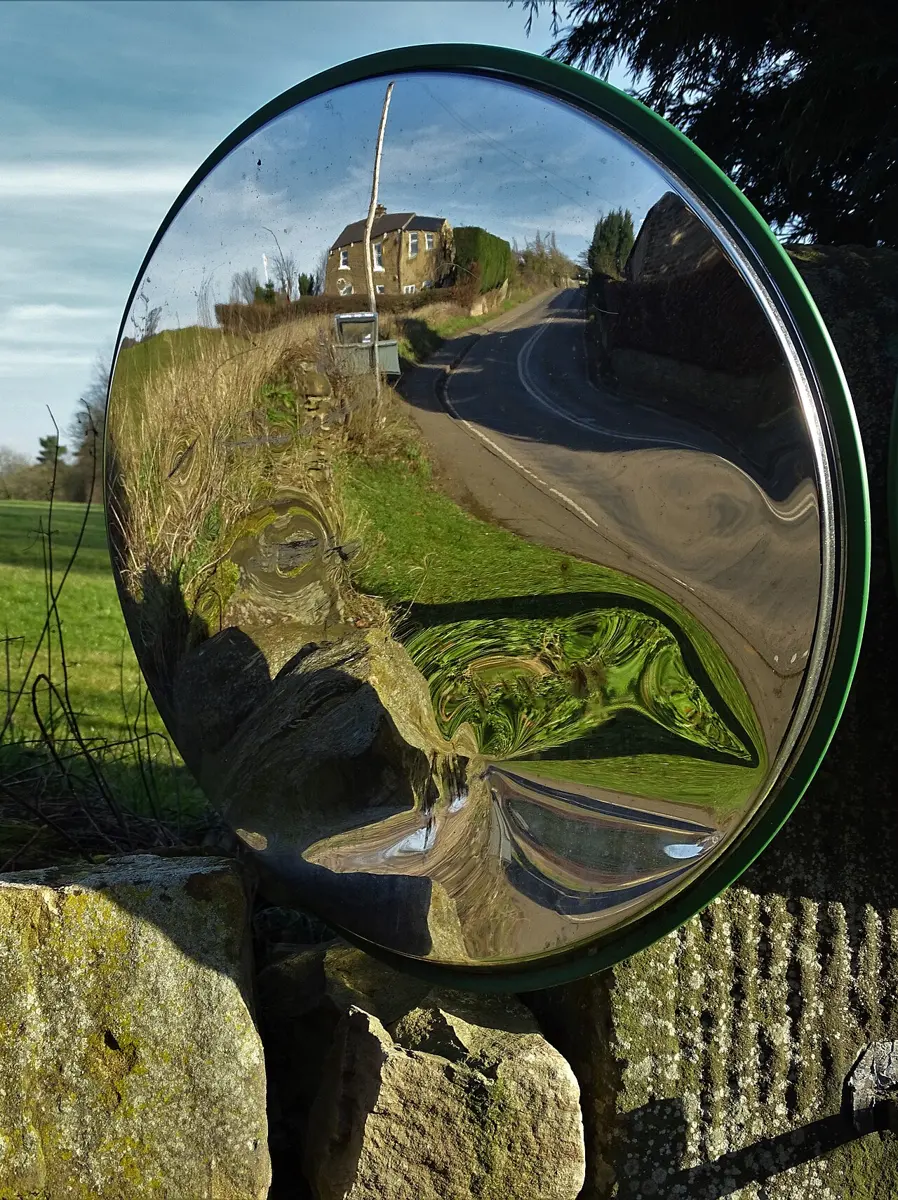
Which mirror is called a converging mirror?
Pick an answer to see why.
Spherical mirror terms
To talk about spherical mirrors, and to draw them, we need a few words. Imagine the mirror as a piece cut from a hollow glass ball, silvered on one side.
- a.Pole (P): the middle point of the reflecting surface of the mirror. All distances are measured from the pole.
- b.Center of curvature (C): the center of the hollow sphere that the mirror is a part of.
- c.Radius of curvature (R): the radius of that sphere: the distance from the center of curvature to the pole, CP.
- d.Principal axis: the imaginary straight line passing through the pole (P) and the center of curvature (C).
- e.Principal focus (F): the point on the principal axis where rays parallel to the principal axis meet after reflection from a concave mirror, or from where they seem to come after reflection from a convex mirror. The focus of a concave mirror is in front of the mirror, and the reflected rays really pass through it, so it is a real focus. The focus of a convex mirror is behind the mirror, and the rays only seem to come from it, so it is a virtual focus. The focus lies halfway between the pole and the center of curvature.
- f.Focal length (f): the distance from the pole (P) to the principal focus (F). Its SI unit is the meter (m).
Because F is halfway between P and C, the focal length is half the radius of curvature:
Rules for drawing rays
To find where a mirror forms an image, we draw a few rays from the top of the object. Three rays are easy to draw, because we know exactly where they go after reflection.
For a concave mirror:
- A ray parallel to the principal axis passes through the principal focus F after reflection.
- A ray passing through the principal focus F is reflected parallel to the principal axis.
- A ray passing through the center of curvature C hits the mirror square on, and is reflected back along the same path.
For a convex mirror:
- A ray parallel to the principal axis is reflected so that it seems to come from the focus F behind the mirror.
- A ray heading towards the focus F (behind the mirror) is reflected parallel to the principal axis.
- A ray heading towards the center of curvature C (behind the mirror) is reflected back along the same path.
Real and virtual images
Activity 7.11: catching an image on a card
An image that can be caught on a screen is a real image. It forms where the reflected rays actually meet. An image that can’t be caught on a screen is a virtual image. It forms where the reflected rays only seem to meet, when you trace them backwards behind the mirror; they never really meet there. Your image in a plane mirror is virtual: there is no light behind the mirror.
In general, a concave mirror can form a real image (except when the object is very close to it), while a plane mirror and a convex mirror always form virtual images.
| Real image | Virtual image |
|---|---|
| Formed in front of the mirror. | Formed behind the mirror. |
| Can be obtained on a screen. | Can’t be obtained on a screen. |
| Formed where the reflected rays actually meet. | Formed where the reflected rays appear to meet, behind the mirror. |
| Inverted (upside down). | Erect (the right way up). |
| Formed by a concave mirror. | Formed by plane and convex mirrors, and by a concave mirror when the object is very close. |
Which of these images could you show on a screen?
Pick an answer to see why.
Images formed by spherical mirrors
Activity 7.12: drawing a ray diagram
Images formed by a concave mirror
Where the image forms, how big it is, and whether it is real or virtual all depend on where the object is: its distance from the mirror compared with the mirror’s focal length. Here are the six positions.
- Object at infinity (very far away): the image forms at the focus F. It is real, inverted and highly diminished (a point).
- Object beyond C: the image forms between F and C. It is real, inverted and diminished.
- Object at C: the image forms at C. It is real, inverted and the same size as the object.
- Object between C and F: the image forms beyond C. It is real, inverted and magnified (bigger than the object).
- Object at F: the reflected rays are parallel, so the image forms at infinity. It is real, inverted and highly magnified.
- Object between F and P: the image forms behind the mirror. It is virtual, erect and magnified.
| Position of the object | Position of the image | Nature and size of the image |
|---|---|---|
| at infinity | at F | real, inverted, highly diminished (a point) |
| beyond C | between F and C | real, inverted, diminished |
| at C | at C | real, inverted, same size |
| between C and F | beyond C | real, inverted, magnified |
| at F | at infinity | real, inverted, highly magnified |
| between F and P | behind the mirror | virtual, erect, magnified |
Images formed by a convex mirror
Wherever an object is in front of a convex mirror, the image forms behind the mirror, and it is always virtual, erect and diminished.
- Object at infinity: a point image forms at the focus F, behind the mirror. It is virtual, erect and highly diminished.
- Object anywhere between infinity and P: the image forms behind the mirror, between P and F. It is virtual, erect and diminished. The closer the object, the bigger the image, but it is always smaller than the object.
Uses of spherical mirrors
Concave mirrors are used:
- in torches, searchlights and vehicle headlights, with the bulb at the focus, to send light out in a nearly parallel beam that reaches far;
- by doctors (ear, nose and throat doctors and dentists), to see a magnified view of the inside of the ear, nose, mouth or throat, and to shine light into it;
- as shaving and make-up mirrors, held close (within the focal length) to give an enlarged, erect image of the face;
- in reflecting telescopes, to collect the faint light of stars and planets;
- in solar cookers: as a converging mirror, it gathers the Sun’s rays to a focus where the pot sits.
Convex mirrors are used:
- as rear-view and side mirrors of vehicles, to see a wide view of the traffic behind;
- in street lamps, to spread light over a wide area;
- at blind bends on roads, and in shops and car parks, to see round corners.
7.3 Sound
You hear people talking, birds singing, temple bells, a guitar, a drum, the horn of a bus, the radio. Anything that produces sound is a source of sound. Sound is a form of energy that gives us the sensation of hearing, and it is produced when an object vibrates. The sound travels from its source through a material medium, a solid, a liquid or a gas, to our ears. Sound can’t travel through a vacuum, where there is no material at all.
Sounds are different. A guitar’s note is sharp and high; a drum’s is deep and low. Some sounds are loud, some faint. This part is about what a sound wave is, how fast it travels, the kinds of sound by frequency (infrasound, audible sound and ultrasound), how strong a sound is (its intensity), and the causes of noise pollution and how to reduce it.
Activity 7.13: feel a sound
How sound travels
When an object vibrates, it pushes the particles of air next to it back and forth. They push the next particles, and these push the next, so the vibration is passed on through the air as a sound wave, carrying energy from the source to your ear. Sound needs a material medium to travel through, so sound is a mechanical wave, and it can’t travel through a vacuum.
As a sound wave passes, each particle of the medium vibrates to and fro, along the direction the sound is traveling. A wave in which the particles of the medium vibrate along the direction in which the wave travels is called a longitudinal wave. So sound is a longitudinal wave. Where the particles are pushed close together, the air is squeezed: a compression. Where they are pulled apart, the air is stretched: a rarefaction.
Characteristics of a sound wave
A sound wave is described by four quantities: its frequency, time period, wavelength and amplitude.
Frequency
The number of complete waves (vibrations) produced in one second is called the frequency. It is written f and its SI unit is the hertz (Hz): 1 Hz is one wave per second. Bigger units are the kilohertz (1 kHz = 1,000 Hz), megahertz (1 MHz = 1,000,000 Hz) and gigahertz (1 GHz = 1,000,000,000 Hz). A high frequency sounds high-pitched (sharp, shrill); a low frequency sounds low-pitched (flat, deep).
Time period
The time taken to produce one complete wave is called the time period. It is written T and its SI unit is the second (s). If f waves are made in 1 second, then one wave takes 1/f seconds:
Wavelength
The distance a sound wave travels during one complete vibration is called its wavelength. It is also the distance between two neighboring compressions (or two neighboring rarefactions), or, on the graph, between two neighboring crests or troughs. It is written with the Greek letter λ (lambda) and its SI unit is the meter (m).
Amplitude
The largest distance the particles of the medium move from their resting (mean) position as the wave passes is called the amplitude. It is written A and its SI unit is the meter (m). A bigger amplitude means a louder sound.
The graph in Figure 7.23 shows the air pressure, not how far the particles move. The two go together: when the particles swing farther (a bigger amplitude), the air is squeezed harder in each compression, so the pressure crests are higher too. A louder sound has both a bigger particle movement and a bigger pressure swing.
A girl hums a note softly, and then the same note loudly. What changes?
Pick an answer to see why.
Speed of a sound wave
The distance traveled by sound in one second is called the speed of sound. In a given medium (at a given temperature), the speed of sound is fixed, but it is different in different media: about 332 m/s in air at 0 °C, faster in water and much faster in solids like iron.
In one time period, the wave moves forward by one wavelength. In one second there are f waves, so the wave moves forward f wavelengths:
With the wavelength in meters and the frequency in hertz (per second), the speed comes out in m/s.
The speed of sound in a medium stays the same whatever its frequency or wavelength: high notes and low notes from a band reach you at the same moment. Since f × λ always equals the same v, if the frequency goes up, the wavelength must go down, and if the frequency goes down, the wavelength goes up. (They are inversely proportional.)
Types of sound by frequency
Different sources give out sounds of different frequencies, even in the same medium. Sound waves can have frequencies from less than 1 Hz to many millions of hertz. Children’s and most women’s voices have higher frequencies than men’s, so they sound sharper. As boys grow up, their vocal cords grow longer and thicker, and the voice “breaks” and becomes deep (dhodro). A man’s speaking voice is roughly 85–180 Hz; a woman’s, roughly 165–255 Hz.
We can’t hear every frequency. A healthy human ear can hear frequencies from about 20 Hz to 20,000 Hz (20 kHz). By frequency, sounds are sorted into three types.
a. Infrasonic sound (infrasound)
Sound with a frequency below 20 Hz is infrasound (or infrasonic sound; some books call it subsonic). Humans can’t hear it, but very strong infrasound can be felt as a shaking or pressure. It is produced by earthquakes, volcanic eruptions, storms and big waves. Elephants, whales and rhinoceroses make infrasonic calls; an elephant’s low rumble can be heard by other elephants several kilometers away.
b. Audible sound
Sound with a frequency from 20 Hz to 20 kHz is audible sound: humans can hear it. Speaking, singing, tuning a guitar, and music on the radio are examples.
c. Ultrasonic sound (ultrasound)
Sound with a frequency above 20 kHz is ultrasound (ultrasonic sound). Humans can’t hear it. Bats, dolphins, rats and mice, and some insects can make and hear it; dogs can hear it too (a dog whistle is ultrasonic). Because its wavelength is very short, ultrasound can be sent out in a narrow beam and reflects even from small objects, which makes it useful for finding things and for seeing inside the body.
Uses of ultrasound
Ultrasound has frequencies above 20 kHz, and so very short wavelengths. A beam of ultrasound spreads out very little, so it can be aimed precisely, and it bounces back (echoes) from the boundaries between different materials, even small ones. That makes it useful in many ways:
- Ultrasonography (USG): an ultrasound scan, to check how a baby is growing in the mother’s womb, and to find stones, tumors and diseases in the liver, kidneys, heart and other internal organs, without cutting the body and without harmful rays.
- Treatment without cutting: focused beams of strong ultrasound can heat and destroy some tumors, and break up kidney stones, without cutting the skin, so there is no bleeding.
- Cleaning and killing bacteria: in ultrasonic cleaners, ultrasound shakes dirt and germs off medical instruments, jewelry and machine parts.
- SONAR (sound navigation and ranging): to find the depth of the sea, and to find fish shoals, wrecks and submarines. A ship sends a pulse of ultrasound down to the sea bed and times its echo. Knowing the speed of sound in sea water, it calculates the depth:
(divided by 2 because the sound goes down and back up).
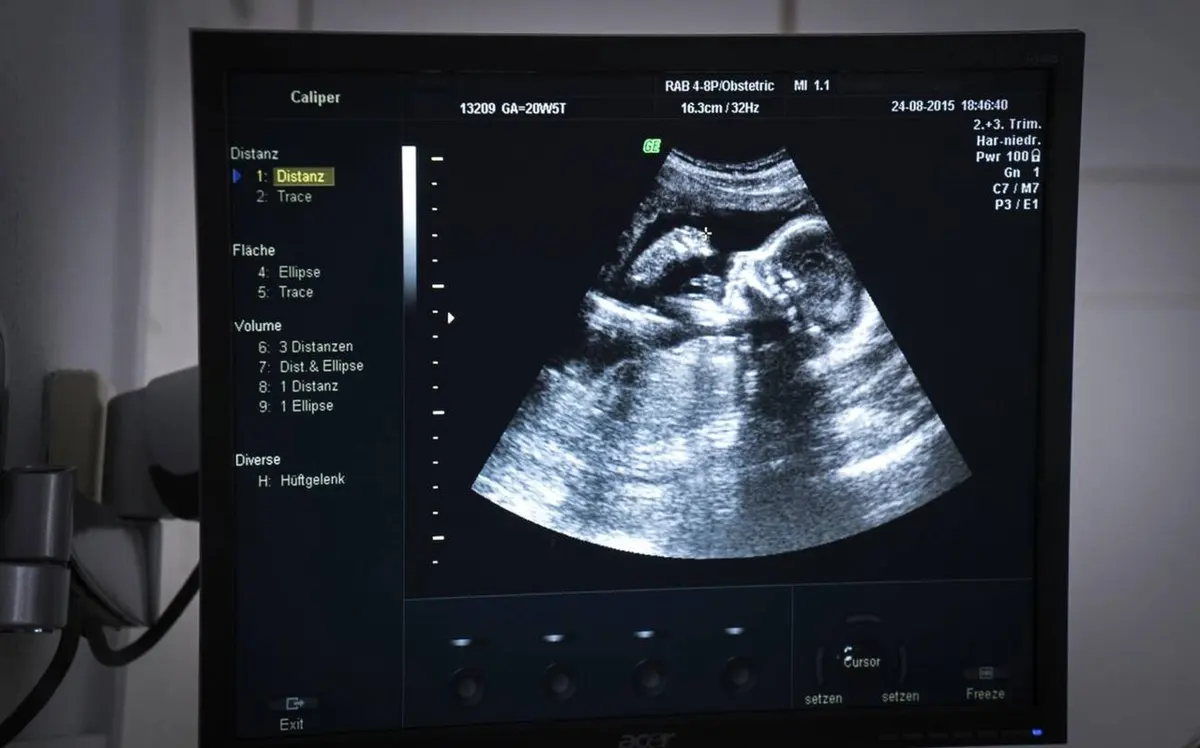
Intensity of sound
Sound waves carry energy. The amount of sound energy passing through a unit area (1 m²) every second is called the intensity of sound. A louder sound has a higher intensity.
The loudness of a sound, its sound level, is measured in decibels (dB). The faintest sound a healthy ear can hear is about 0 dB. The scale goes up in a special way: each 10 dB more means ten times the intensity, and sounds about twice as loud to us.
A person who can’t hear sounds quieter than about 45 to 60 dB has lost part of their hearing. Someone who can’t hear sounds even as loud as 80 dB is called deaf. Very intense sounds can damage hearing for ever.
| Sound | Sound level (dB, roughly) |
|---|---|
| leaves rustling, quiet breathing | 10–20 |
| a whisper | 20–30 |
| a quiet library | 30–40 |
| normal conversation | 50–60 |
| busy traffic | 70–85 |
| a printing press, factory machines | 80–90 |
| a railway station with trains | 85–110 |
| a motorbike or a bus horn close by | 100–115 |
| a loud music concert, thunder overhead | 110–120 |
| threshold of pain: sound that hurts | 120–140 |
| a jet engine close by, firecrackers next to you | 140–160 |
Measuring the intensity of sound
The intensity of sound at a point is the rate at which sound energy passes through a unit area, held square to the direction the sound is traveling. It is written I and its SI unit is the watt per square meter (W/m²):
where P is the power of the sound (the sound energy passing per second, in watts) and A is the area (in m²).
What the intensity of sound depends on
- Amplitude: the intensity is proportional to the square of the amplitude (). Double the amplitude, and the intensity becomes four times as much.
- Distance from the source: the intensity is greatest near the source and decreases as you move away. The sound spreads out over a bigger and bigger area, and as it travels through the air, some of its energy is absorbed by the air, some is reflected, and the rest goes on. So a sound grows fainter with distance.
- Density of the medium: for the same vibration, sound is more intense in a denser medium. Cold air is denser than hot air, so the same vibration gives a slightly more intense sound in cold air than in hot air.
- Area of the vibrating body: the larger the vibrating surface, the more air it pushes, and the more intense the sound: a big temple bell or a big drum is louder than a small one.
- Frequency: for the same amplitude, a higher frequency gives a higher intensity, so a sharp, shrill sound carries more energy than a deep one of the same amplitude.
Sound pollution
Sound pollution (noise pollution) is unwanted or too much sound that harms the health of people and animals and the quality of the environment. Noise is any unwanted sound that is unpleasant, too loud or disturbing. Noise in the environment causes sound pollution.
Causes of sound pollution
- Loud and unnecessary sounds in markets, crowded towns and heavy traffic, especially vehicle horns.
- Construction sites: drills, hammers, mixers and generators.
- Televisions, radios and music played very loudly, and loudspeakers at events.
- Machines running in factories and workshops.
- Crowds shouting in markets, and announcements over loudspeakers.
Effects of sound pollution
- It weakens hearing, and loud noise can burst the eardrum and cause deafness.
- It raises blood pressure, and can lead to heart disease.
- It causes headaches, stress, lack of sleep, and problems in digestion.
- It makes it hard to concentrate on reading, writing or any other work; children in noisy schools learn more slowly.
- It disturbs animals and birds, which use sound to find mates, food and each other.
Ways to reduce noise pollution
- Plant trees along roads and around factories and industrial areas: leaves and branches absorb and scatter sound.
- Fit silencers on vehicles and keep engines in good order; don’t use the horn without need.
- Play music and the television softly, and don’t disturb others while practicing an instrument or listening to music.
- Keep noisy factories away from homes, schools and hospitals, and give workers ear protection.
- Run awareness programs in the community about the harm noise does.
Exercise
7.1 Heat
1. Choose the best answer
a. What is the transfer of heat by the actual movement of molecules called?
Pick an answer to see why.
b. By which process is heat mainly transferred in liquids and gases?
Pick an answer to see why.
c. How is heat transferred through a vacuum?
Pick an answer to see why.
d. In which of these is heat transferred by radiation?
Pick an answer to see why.
e. What is the average temperature of the Earth’s surface?
Pick an answer to see why.
f. Which one of these is an example of a mechanical wave?
Pick an answer to see why.
2. Differentiate between
Conductor of heat and insulator of heat
Answer
| Conductor of heat | Insulator of heat |
|---|---|
| Lets heat pass through it easily. | Hardly lets heat pass through it. |
| Has a high thermal conductivity. | Has a low thermal conductivity. |
| Gets hot all over quickly when one part is heated. | Stays cool away from the heated part. |
| Used where heat must flow: pots, kettles, irons. | Used where heat must be stopped: handles, clothes, flasks. |
| e.g. copper, aluminium, iron | e.g. wood, plastic, wool, air |
Conduction and insulation
Answer
| Conduction | Insulation |
|---|---|
| The transfer of heat through a material, particle to particle. | Stopping or slowing the transfer of heat. |
| Happens well in good conductors, like metals. | Done with insulators, like wool, plastic, cork and air. |
| Is wanted in cooking pots and irons. | Is wanted in handles, warm clothes, thermos flasks and the walls of houses. |
| e.g. heat flowing along a metal spoon in hot tea | e.g. a woolen sweater keeping body heat in |
Mechanical waves and electromagnetic waves
Answer
| Mechanical waves | Electromagnetic waves |
|---|---|
| Need a material medium (solid, liquid or gas) to travel. | Don’t need a medium; they can travel through a vacuum. |
| Made by the vibration of particles of the medium. | Made of vibrating electric and magnetic fields. |
| Lose energy to the medium, so they travel only a limited distance. | Lose no energy in a vacuum and can travel huge distances. |
| Fairly slow: sound in air about 332 m/s. | Travel at the speed of light, 3 × 10⁸ m/s, in a vacuum. |
| e.g. sound waves, water waves | e.g. light, infrared, radio waves, X-rays |
Sea breeze and land breeze
Answer
| Sea breeze | Land breeze |
|---|---|
| Blows during the day. | Blows at night. |
| Blows from the sea to the land. | Blows from the land to the sea. |
| The land is hotter than the sea, so air rises over the land (low pressure there). | The sea is warmer than the land, so air rises over the sea (low pressure there). |
| Brings cool air to the coast. | Carries cool air out to sea. |
3. Give reasons
Mud houses are cooler in summer and warmer in winter.
Answer
Thick mud walls (and roofs) are poor conductors of heat, and they hold a lot of heat. In summer, the outside heat takes a very long time to be conducted through them, so the rooms stay cool through the hot afternoon. In winter, the warmth inside escapes through them only slowly, so the rooms stay warm.
A teacup is usually made of porcelain.
Answer
Porcelain is a poor conductor (an insulator) of heat. So the heat of the tea doesn’t reach your fingers quickly, and the cup is comfortable to hold, and the tea loses heat more slowly and stays hot longer.
We prefer light-colored clothes in summer.
Answer
Light-colored clothes reflect most of the Sun’s radiation and absorb little of it. So less heat reaches the body, and we feel cooler. Dark clothes absorb more radiation and get hot.
Ventilators are put in the upper part of a wall or above a door.
Answer
Warm, used air in a room (from our breath, bodies, stoves and lamps) is less dense, so it rises to the top of the room by convection. A ventilator high up lets this warm air out, while fresh, cooler air comes in through doors and windows lower down. This keeps a convection current of fresh air moving through the room.
Transparent plastic is used to cover the roof and walls of an artificial greenhouse.
Answer
Transparent plastic lets the Sun’s short-wave radiation (light) pass through into the greenhouse, where the soil and plants absorb it and warm up. The warm soil and plants give out long-wave radiation, which the plastic lets out only in part, and the plastic also stops the warm air from blowing away. So heat is trapped inside, and the plants get the light they need too.
4. Answer these questions
What is the transmission of heat?
Answer
The flow of heat energy from one object or place to another, always from the hotter one (higher temperature) to the colder one (lower temperature), is called the transmission of heat. It happens in three ways: conduction, convection and radiation.
What is meant by the conduction of heat?
Answer
Conduction is the transfer of heat through a solid from particle to particle, without the particles leaving their places. The heated particles vibrate harder and pass this vibration (heat) on to their neighbors. Example: the handle of a metal spoon in hot tea gets hot.
How does the wind blow? Explain.
Answer
Wind blows because of convection in the air. During the day, the Sun heats the ground unevenly, and the ground heats the air above it. Where the air is heated, it expands, becomes less dense and rises, leaving an area of low pressure. Cooler, denser air from nearby (at higher pressure) flows in to take its place. This movement of air from high pressure to low pressure is the wind. A sea breeze is an example: by day, cool air blows from the sea towards the hotter land.
What is convection? Write down its uses in daily life.
Answer
Convection is the transfer of heat in a liquid or a gas by the actual movement of its particles: the heated part becomes less dense and rises, and the cooler, denser part sinks to take its place, setting up a convection current.
Uses:
- Water and other liquids in a pot are heated by convection.
- Room heaters, fans and air conditioners warm or cool a whole room by moving air.
- In many refrigerators the freezer is at the top, so that the air it cools sinks and warmer air rises to it.
- Ventilators near the ceiling let warm, stale air out of a room.
- Hot-air balloons rise because hot air is less dense than the air around.
- In nature, convection causes winds, sea and land breezes, clouds and rain.
What is radiation? Write down its uses in daily life.
Answer
Radiation is the transfer of heat as electromagnetic waves (mainly infrared), without any material medium. It can happen even through a vacuum, at the speed of light.
Uses:
- The Earth gets heat and light from the Sun by radiation.
- We warm ourselves near a fire or heater by radiation.
- Clothes, grain and fish are dried in the sun.
- Solar water heaters and solar cookers, painted black inside, absorb the Sun’s radiation.
- The black condenser at the back of a refrigerator gives out heat partly by radiation.
- Light-colored clothes are worn in summer because they absorb less radiation.
What is an electromagnetic wave? Give any three examples.
Answer
An electromagnetic wave is a wave that does not need any material medium to travel; it can travel through a vacuum, at the speed of light (3 × 10⁸ m/s). It is made of vibrating electric and magnetic fields.
Examples (any three): light, infrared rays, radio waves, microwaves, ultraviolet rays, X-rays, gamma rays.
Draw a neat, labeled diagram of a thermos flask.
Answer
Draw a cross-section like Figure 7.10 and label: cap (cup), insulating stopper, double glass walls, vacuum, silvered surfaces, hot liquid, outer case, insulating support.
What is the greenhouse effect? Write down its uses (importance).
Answer
The greenhouse effect is the warming of the Earth’s surface because greenhouse gases in the air (carbon dioxide, water vapor, methane, nitrous oxide, CFCs) absorb the long-wave heat radiation given out by the Earth and send part of it back down, instead of letting it all escape into space.
Importance:
- It keeps the Earth’s average temperature at about 15 °C; without it, the Earth would be about −18 °C and frozen, and life would hardly be possible.
- In artificial greenhouses, farmers grow off-season vegetables and earn a good income.
- Plants that can’t survive the cold can be protected in greenhouses.
- Plants of hot places can be grown even in cold countries.
(Too strong a greenhouse effect, caused by extra greenhouse gases, leads to global warming.)
7.2 Light
1. Choose the best answer
a. Which mirror do we use to look at our faces every day?
Pick an answer to see why.
b. Which mirror can make a real image of an object?
Pick an answer to see why.
c. Which image is called a real image?
Pick an answer to see why.
d. What is a concave mirror also called?
Pick an answer to see why.
e. A ray of light passing through the center of curvature of a concave mirror:
Pick an answer to see why.
2. Differentiate between
Concave mirror and convex mirror
Answer
| Concave mirror | Convex mirror |
|---|---|
| The reflecting surface is curved inwards (hollow). | The reflecting surface bulges outwards. |
| Converges parallel rays: a converging mirror. | Diverges parallel rays: a diverging mirror. |
| Its focus is in front of the mirror and real. | Its focus is behind the mirror and virtual. |
| Forms real, inverted images, or a virtual, erect, magnified image when the object is very close. | Always forms virtual, erect, diminished images. |
| Used in torches, headlights, shaving mirrors, solar cookers. | Used as side mirrors of vehicles, at road bends, in street lamps. |
Real image and virtual image
Answer
| Real image | Virtual image |
|---|---|
| Formed where the reflected rays actually meet. | Formed where the reflected rays only appear to meet. |
| Can be obtained on a screen. | Can’t be obtained on a screen. |
| Formed in front of the mirror. | Formed behind the mirror. |
| Always inverted. | Always erect. |
| Formed by a concave mirror. | Formed by plane and convex mirrors (and a concave mirror with the object between F and P). |
3. Define these terms
Principal axis
Answer
The imaginary straight line passing through the pole (P) and the center of curvature (C) of a spherical mirror.
Focus
Answer
The principal focus (F) is the point on the principal axis where rays parallel to the principal axis meet after reflection from a concave mirror, or from which they appear to come after reflection from a convex mirror. It lies halfway between the pole and the center of curvature.
Center of curvature
Answer
The center of the hollow sphere of which the spherical mirror is a part. It is written C.
Focal length
Answer
The distance between the pole (P) and the principal focus (F) of a spherical mirror. It is written f, its SI unit is the meter, and it is half the radius of curvature ().
4. Give reasons
A concave mirror is also called a converging mirror.
Answer
When rays of light parallel to its principal axis fall on a concave mirror, they are reflected and meet (converge) at one point, the principal focus. Because it brings rays together, it is called a converging mirror.
A concave mirror is used in solar cookers.
Answer
A concave mirror is a converging mirror. The Sun’s rays arrive almost parallel, and the mirror reflects them all to one point, its focus. The heat of a large area of sunlight is gathered onto the small area of the pot placed there, so it gets hot enough to cook food.
Convex mirrors are used as side mirrors in vehicles.
Answer
A convex mirror always forms an erect and diminished image. Because the image is small, a wide field of view, a long stretch of road and many vehicles behind, fits in the small mirror, and because it is erect, the driver sees the traffic the right way up.
Convex mirrors and plane mirrors can’t produce a real image.
Answer
A real image forms only where reflected rays actually meet. A convex mirror spreads (diverges) the rays, and a plane mirror reflects them so that they keep spreading, just as they came from the object. In both, the reflected rays never meet in front of the mirror; they only appear to meet behind it, where no light goes. So both always form virtual images, which can’t be caught on a screen.
5. Answer these questions
What is meant by the reflection of light?
Answer
The bouncing back of light into the same medium after it strikes a surface is called the reflection of light. A smooth, polished surface like a mirror reflects light regularly and forms an image; a rough surface scatters it in all directions.
Which mirror is called a spherical mirror?
Answer
A mirror whose reflecting surface is a part of a hollow sphere is called a spherical mirror. There are two kinds: a concave mirror, which reflects from the inner (hollow) side, and a convex mirror, which reflects from the outer (bulging) side.
On what does the image formed by a concave mirror depend?
Answer
It depends on where the object is: the object’s distance from the mirror, compared with the mirror’s focal length (whether the object is at infinity, beyond C, at C, between C and F, at F, or between F and P). This decides where the image forms, whether it is real or virtual, erect or inverted, and how big it is compared with the object.
Which mirror is suitable for shaving and putting on make-up, and why?
Answer
A concave mirror. When the face is held close to it, nearer than its focus (between F and P), it forms a virtual, erect and magnified image, so the face looks bigger and the right way up, and small details are easy to see.
Why are convex mirrors used in street lamps?
Answer
A convex mirror is a diverging mirror. Placed behind the bulb, it spreads the light reflected from it over a wide area of the road, instead of sending it in a narrow beam.
Draw ray diagrams of the image formed by a concave mirror when the object is:
- i.beyond C
- ii.at infinity
- iii.between C and F
Answer
(i) Beyond C: the image forms between F and C; it is real, inverted and diminished.
(ii) At infinity: the parallel rays meet at F; the image is real, inverted and highly diminished (a point).
(iii) Between C and F: the image forms beyond C; it is real, inverted and magnified.
In each, draw at least two of the three rays: parallel then through F; through C and back; through F then parallel.
7.3 Sound
1. Choose the best answer
a. The number of sound waves produced in how much time is called the frequency?
Pick an answer to see why.
b. What is the range of frequency of audible sound?
Pick an answer to see why.
c. Roughly what range of sound levels can the human ear take, from the faintest sound it hears to the threshold of pain?
Pick an answer to see why.
d. What happens to the intensity of a sound when its amplitude is greater?
Pick an answer to see why.
e. A person who can’t hear sounds even as loud as how many decibels is called deaf?
Pick an answer to see why.
f. Which of these animals can produce and hear ultrasound?
Pick an answer to see why.
2. Differentiate between
Wavelength and amplitude
Answer
| Wavelength | Amplitude |
|---|---|
| The distance between two neighboring compressions (or crests) of a wave. | The greatest distance a particle moves from its resting (mean) position. |
| Measured along the direction the wave travels. | Measured along the direction the particles move. |
| Goes with the pitch: at the same speed, a shorter wavelength means a higher frequency. | Decides the loudness of the sound. |
| Written λ; unit meter (m). | Written A; unit meter (m). |
Infrasound and audible sound
Answer
| Infrasound | Audible sound |
|---|---|
| Frequency below 20 Hz. | Frequency from 20 Hz to 20 kHz. |
| Humans can’t hear it (strong infrasound can be felt). | Humans can hear it. |
| Made by earthquakes, volcanoes, elephants and whales. | Made by people talking, music, birds, vehicles. |
Infrasound and ultrasound
Answer
| Infrasound | Ultrasound |
|---|---|
| Frequency below 20 Hz. | Frequency above 20 kHz. |
| Very long wavelength. | Very short wavelength. |
| Heard by elephants and whales. | Heard by bats, dolphins and dogs. |
| Made by earthquakes and volcanoes. | Made by bats, dolphins and machines for USG and SONAR. |
| Used to detect earthquakes and distant explosions. | Used in ultrasonography, SONAR and cleaning instruments. |
3. Answer these questions
The speed of sound stays the same when its frequency or wavelength changes. Why?
Answer
The speed of sound depends only on the medium it travels through (and its temperature), not on the sound itself. In a given medium, is fixed. So if the frequency increases, the wavelength decreases in the same proportion (and the other way round), and their product, the speed, stays the same.
What is the range of frequency of sound that human beings can hear?
Answer
From about 20 Hz to 20,000 Hz (20 kHz). This is audible sound.
What is the relationship between the wavelength, frequency and speed of a sound wave?
Answer
Speed = frequency × wavelength, , where v is in m/s, f in Hz and λ in m. In one second, f waves pass, each one λ long, so the wave travels f λ meters every second.
Draw a neat diagram of a sound wave.
Answer
Draw the compressions and rarefactions of the air, and below them the wave as a graph, labeling the wavelength (between two crests, or two compressions), the amplitude, a crest and a trough, as in Figure 7.23.
What is an ultrasonic wave? Name any two animals that can produce and hear ultrasound.
Answer
A sound wave with a frequency above 20 kHz, too high for humans to hear, is an ultrasonic wave (ultrasound).
Animals: bats and dolphins (also rats and mice, and some insects).
Write down any three uses of ultrasound.
Answer
- In ultrasonography (USG), to see a baby growing in the womb and to find stones, tumors and diseases of the internal organs.
- In SONAR, to find the depth of the sea and to locate shoals of fish, wrecks and submarines.
- To clean medical instruments and jewelry and kill bacteria, and to break up kidney stones and destroy some tumors without cutting.
Why does a sound sound fainter as the listener moves away from its source?
Answer
The intensity of sound decreases with distance. As the sound travels outwards, its energy spreads over a bigger and bigger area, so less of it passes through each square meter. Also, on the way, some of the energy is absorbed by the air and some is reflected. So less sound energy reaches the ear of a listener farther away, and the sound is fainter.
Write any two effects of sound pollution and any two ways to reduce it.
Answer
Effects: (any two) it weakens hearing and can cause deafness; it raises blood pressure; it causes headaches, stress and lack of sleep; it makes it hard to concentrate.
Ways to reduce it: (any two) plant trees along roads and around factories; fit silencers on vehicles and avoid unnecessary horns; keep the volume of TVs, radios and loudspeakers low; run awareness programs.
4. Solve these numerical problems
Find the wavelength of a sound wave if the speed of sound in air is 332 m/s and its frequency is 10 Hz.
Answer
v = 332 m/s, f = 10 Hz, λ = ?
The wavelength is 33.2 m. (A 10 Hz sound is infrasound: no one can hear it.)
Find the speed of a sound wave whose wavelength is 22 m and frequency 15 Hz.
Answer
λ = 22 m, f = 15 Hz, v = ?
The speed is 330 m/s.
If the speed of sound in air is 332 m/s, find the wavelengths of the shortest and the longest sound waves that humans can hear.
Hint
Humans hear from 20 Hz to 20,000 Hz. The highest frequency has the shortest wavelength.
Answer
Shortest wavelength, from the highest frequency, 20,000 Hz:
(1.66 cm)
Longest wavelength, from the lowest frequency, 20 Hz:
So humans hear sound waves from 0.0166 m to 16.6 m long.
Sound of intensity 2 × 10⁻⁵ W/m² spreads over an area of 6 m². Find the power of the sound, and the energy it carries through that area in 1 second.
Answer
I = 2 × 10⁻⁵ W/m², A = 6 m²
From ,
Power is the energy per second, so in 1 second the sound carries 1.2 × 10⁻⁴ J of energy through the area.
Worksheet: Energy in Daily Life: heat (PDF, 4 pages)
Worksheet: Energy in Daily Life: light and sound (PDF, 4 pages)
Practice every question in the book, and keep track of the ones you miss →