
Quasicrystals: order that never repeats
Nobel Prize in Chemistry, 2011: Dan Shechtman

Dan Shechtman
born 1941 in Tel Aviv
A materials scientist from the Technion in Haifa, Israel, who trusted his own careful experiments more than the textbook.
Photo: Holger Motzkau, CC BY-SA 3.0
Think of the tiles on a floor, or the bricks of a courtyard in Bhaktapur. Square tiles fit together with no gaps. So do triangles, and so do six-sided tiles like the cells of a honeycomb. But try to cover a floor with five-sided tiles, pentagons, and you will always be left with gaps.
For more than a hundred years, scientists believed that the atoms inside every solid crystal follow the same rule as floor tiles. In 1982, Dan Shechtman saw a crystal that broke it. Almost nobody believed him. In 2011 he won the Nobel Prize in Chemistry.
The problem: what everyone knew about crystals
Salt, sugar, ice, a diamond, the copper in a wire: almost every solid is made of crystals. In a crystal the atoms are not jumbled. They sit in a regular pattern that repeats again and again in every direction, like the pattern on a sheet of wrapping paper. Cut out one small piece of the pattern, and you can build the whole crystal by copying that piece side by side, like bricks.
Because of this, crystals have symmetry. Look at a pattern of squares. Turn it by a quarter turn (90°) and it looks exactly the same as before. We say it has fourfold symmetry, because four such turns bring you back to the start. A pattern of triangles has threefold symmetry (turn by 120°), and a honeycomb has sixfold symmetry (turn by 60°).
Here is the important rule. A pattern that repeats can only have twofold, threefold, fourfold or sixfold symmetry. Fivefold symmetry is impossible, and so is sevenfold or anything higher. The pentagon floor shows why: the pieces don’t fit, and a pattern with gaps or overlaps can’t repeat.
Every crystallographer (a scientist who studies crystals) learned this rule as a student. It was in every textbook and in the International Tables for Crystallography, the great reference book that lists every kind of crystal pattern there can be.
Why can’t a floor be covered with regular pentagons?
Pick an answer to see why.
How scientists look inside a crystal
Atoms are far too small to see with an ordinary microscope. So how do scientists know their pattern?
They shine a wave through the crystal. When a wave passes through many tiny, evenly spaced gaps, it spreads out from each gap, and the spreading waves add up in some directions and cancel in others. On a screen behind, you see a pattern of bright spots. This is called diffraction, and the pattern of spots is a diffraction pattern. You can see one yourself through a piece of fine cloth (Light bends round edges).
The gaps in a crystal are the spaces between its atoms, far smaller than the gaps in cloth. Light waves are too long for them. So Shechtman used an electron microscope, which sends a beam of electrons through a very thin slice of the material. Electrons can behave as waves too, with waves short enough to be spread out by rows of atoms. The arrangement of the spots tells the scientist how the atoms are arranged.
What he did, step by step
Dan Shechtman was born in Tel Aviv in 1941. He studied engineering and materials at the Technion in Haifa, Israel, and became an expert with the electron microscope.
- 1981–1983, the visit. On leave from his university in Israel, Shechtman worked at the National Bureau of Standards near Washington, D.C., in the United States (it is now called NIST). He was studying new alloys, metals mixed together, made in an unusual way: the molten metal was cooled very fast. That should leave the atoms jumbled, with no time to form crystals.
- 8 April 1982, the ten spots. That morning he looked at a mixture of aluminium and manganese in the electron microscope. He saw rings of ten bright spots, evenly spaced. He counted them again and again. Four or six would have been normal. Ten was impossible. “There can be no such creature,” he said to himself in Hebrew, and he wrote in his notebook: 10 Fold???
- Checking for a mistake. There was one known way to fake such a pattern. Two ordinary crystals grown into each other at an angle, a twin crystal, can give strange spots. Shechtman searched for signs of twins, and found none.
- Turning the crystal. Then he tilted and turned his sample in the microscope, to see how its pattern changed. This showed that the crystal itself had fivefold symmetry, as impossible as tenfold. The atoms were arranged in an orderly way, but in a pattern that could not repeat.
Why it was so hard to be believed
Shechtman was sure of his result. Almost everyone else was sure he was wrong.
- When he showed the pattern to colleagues, many said he must be looking at twin crystals, and some laughed at him.
- The head of his laboratory gave him a textbook of crystallography and told him to read it. Shechtman knew perfectly well what it said; he trusted his experiments more.
- In the end the head of the group asked him to leave the group. Having him there had become too embarrassing.
- Back in Israel, Shechtman persuaded a colleague, Ilan Blech, to help him explain the pattern. In the summer of 1984 they sent a paper to the Journal of Applied Physics. It was rejected almost at once.
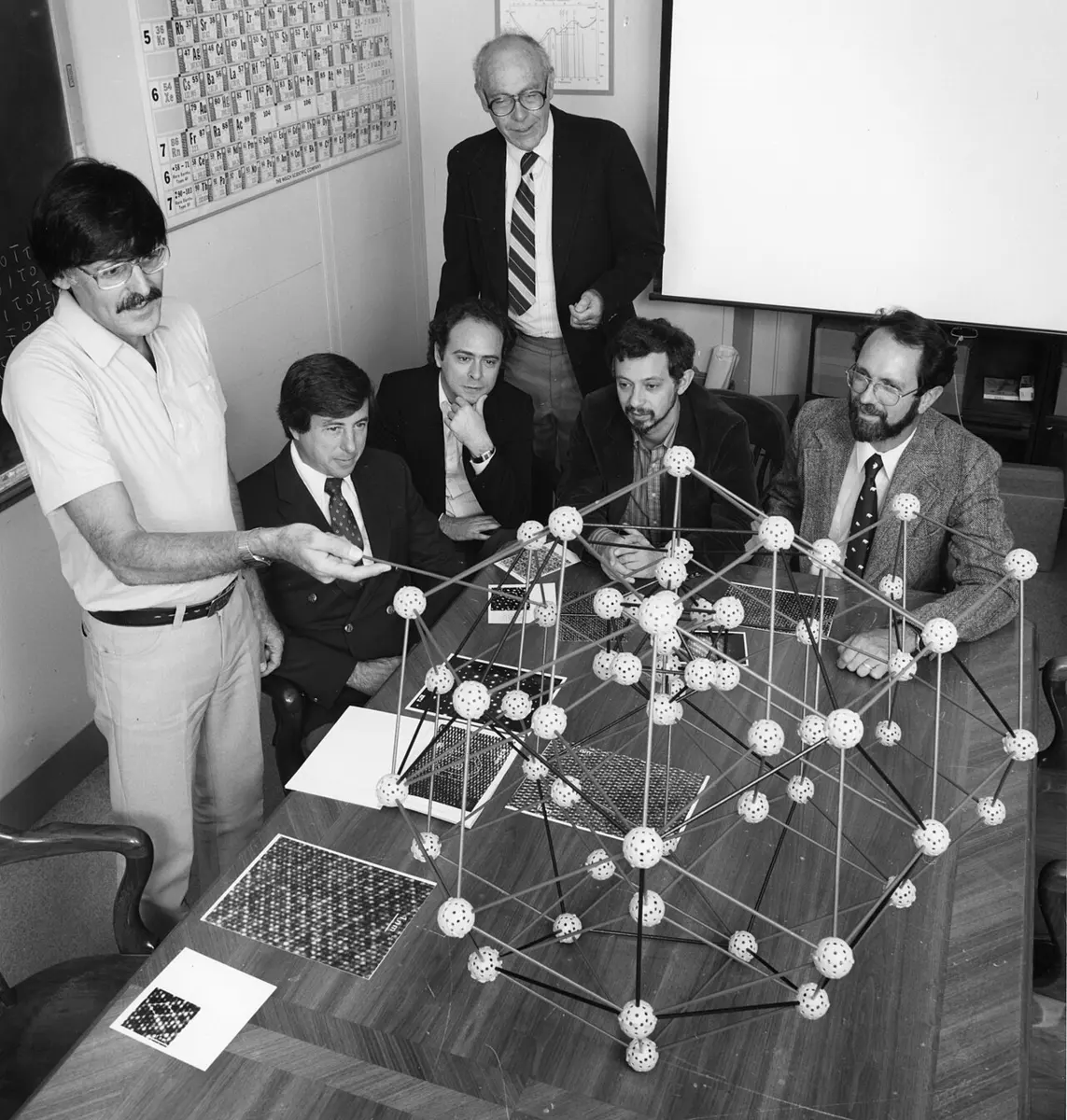
Then John Cahn, a well-known scientist at the Bureau, looked carefully at the data and asked the French crystallographer Denis Gratias to search it for mistakes. Gratias found none. In November 1984, Shechtman, Blech, Gratias and Cahn published the discovery in the journal Physical Review Letters. It went off like a bomb.
The loudest critic was the American chemist Linus Pauling, one of the most famous scientists in the world and winner of two Nobel Prizes. He argued against Shechtman until his death in 1994. Shechtman remembers him saying: “There is no such thing as quasicrystals, only quasi-scientists.”
Why did many scientists at first refuse to believe Shechtman?
Pick an answer to see why.
Then something interesting happened. Once the paper was out, crystallographers around the world went back to their drawers of old notes. Many had seen strange patterns like this before, and had thrown them away as “twin crystals”. Soon other “impossible” crystals turned up, with eightfold and twelvefold patterns too.
How a pattern can be orderly but never repeat
But what did the atoms inside actually look like? The answer came from a puzzle that mathematicians had been playing with for fun.
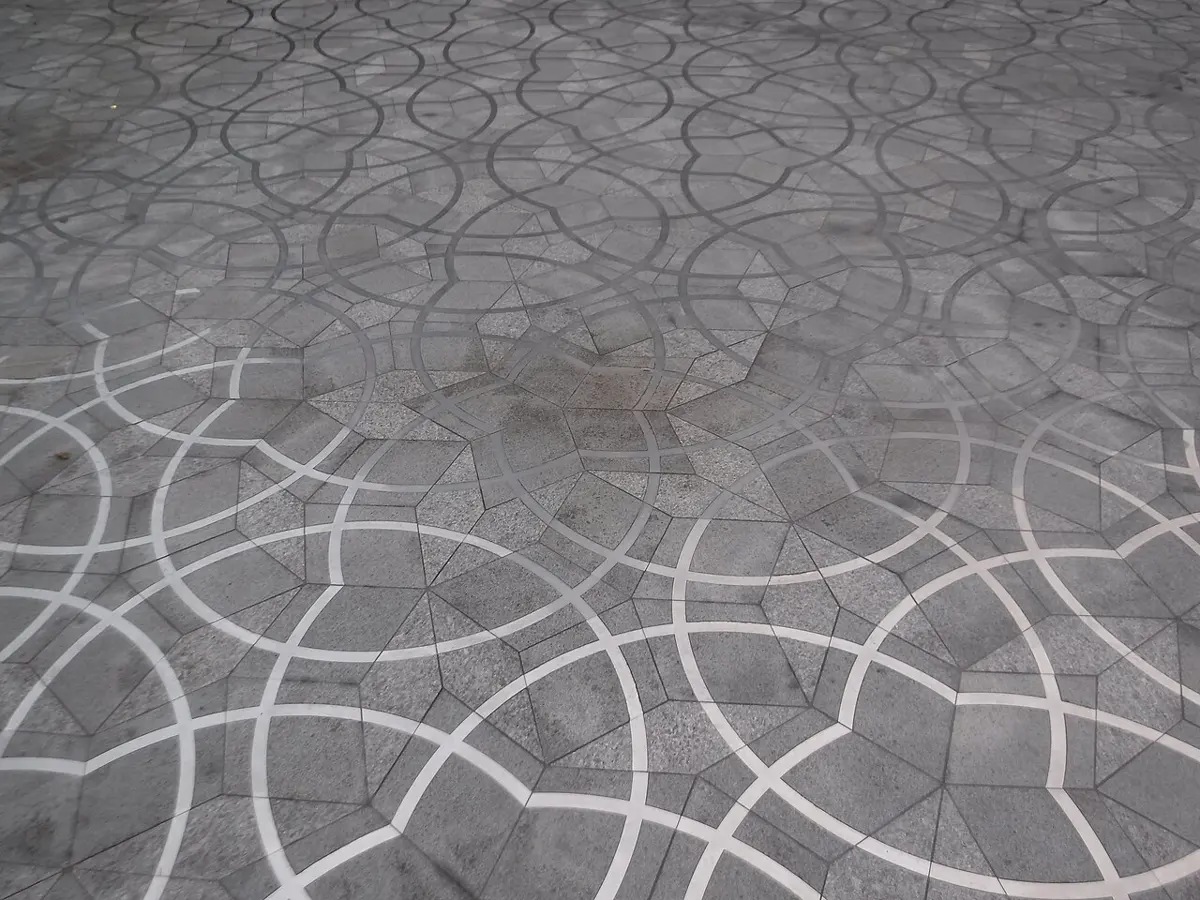
In the 1960s, mathematicians asked: can a floor be covered with a few shapes of tile so that the pattern never repeats, however far it goes? The first answer, in 1966, needed more than 20,000 different tiles. Over the years the number shrank. In the mid-1970s the British mathematician Roger Penrose found a way to do it with just two: a fat and a thin rhombus (a diamond shape with four equal sides).
A Penrose tiling is not random. It follows strict rules, and you can always work out what comes next. But you can never cut out one piece and copy it to make the rest. Orderly, but never repeating: that is a quasiperiodic pattern. (Periodic means repeating at regular steps; quasi means “almost”.)
The British crystallographer Alan Mackay had already wondered what diffraction pattern atoms placed on a Penrose tiling would give. He worked it out: ten bright spots in a ring. The American physicist Paul Steinhardt saw Shechtman’s paper before it was printed, and realized that Mackay’s imaginary pattern was real. On Christmas Eve 1984, Steinhardt and Dov Levine published the explanation, and gave the new materials their name: quasicrystals.
The golden ratio
Count the tiles in a big Penrose tiling: there are about 1.618 fat ones for every thin one. That number, called the golden ratio, turns up again and again in quasicrystals, for example in the distances between their atoms. The ancient Greek mathematicians knew it, and it appears in the regular pentagon: the long diagonal of a pentagon is 1.618 times its side.
It also hides in the Fibonacci sequence, where each number is the sum of the two before it: 1, 1, 2, 3, 5, 8, 13, 21, 34, 55, 89, 144… Divide a number by the one before it and you get closer and closer to the golden ratio.
Artists got there first
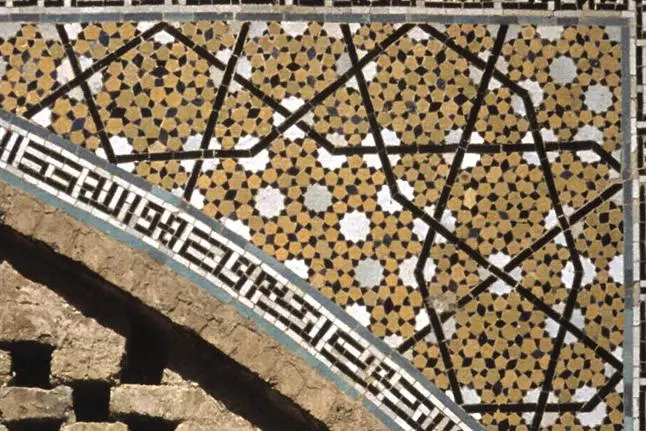
Craftsmen in the Islamic world had made patterns like this centuries earlier. With a few shapes of decorated tile called girih, they built patterns of stars and pentagons that never quite repeat. Some date from the 13th century. A doorway of the Darb-i Imam shrine in Isfahan, Iran, built in 1453, has an almost perfect quasiperiodic pattern; others decorate the Alhambra palace in Spain.
A new meaning for “crystal”
In 1992 the International Union of Crystallography changed its definition. Before, a crystal was a solid whose atoms are packed in a regularly ordered, repeating pattern. Now, a crystal is any solid that gives a diffraction pattern of sharp spots. That includes ordinary crystals, and quasicrystals too.
In your life today
- Tougher steel. A Swedish company testing new steels made one that was surprisingly strong. Inside, it had tiny hard quasicrystals held in softer steel, like armor. It is used for razor blades and for very thin needles for eye surgery.
- Coatings. Quasicrystals are hard, slippery, and bad conductors of heat and electricity. Scientists have tried them as non-stick coatings on frying pans and as heat shields in engines.
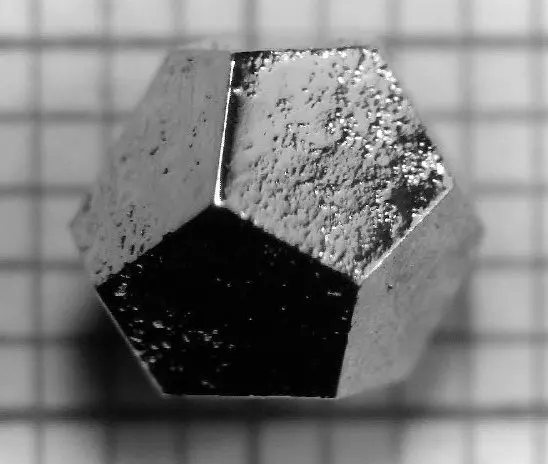
- From space. In 2009, scientists reported the first natural quasicrystal, in a rock collected near the Khatyrka River in the far east of Russia. It is a mineral of aluminium, copper and iron, named icosahedrite. Later study showed the rock came from a meteorite, a piece of an asteroid more than 4.5 billion years old.
What came next
Since 1982, hundreds of quasicrystals have been made in laboratories around the world. Some were found in places nobody looked: in the glassy rock left by the first nuclear bomb test in 1945, and in rock melted by lightning.
Scientists still argue about a deep question. In a quasicrystal, each atom must take its place in a pattern that never repeats. How do atoms, which can only feel their nearest neighbors, “know” where to go to build such a pattern over billions of atoms? Nobody is completely sure yet.
In your science books
- Grade 9: allotropes and allotropy, crystalline and non-crystalline forms of one element, and what is inside a metal.
- Grade 8: alloys and steel.
- Going Further (Grades 9–12): four kinds of solid, and light bends round edges, on diffraction.
Learn more
- The Nobel Prize’s own explanation: Crystals of golden proportions (nobelprize.org).
- Dan Shechtman’s Nobel lecture.
The official reason
The prize was given “for the discovery of quasicrystals.”