
Graphene: a sheet of carbon one atom thick
Nobel Prize in Physics, 2010: Andre Geim and Konstantin Novoselov

Andre Geim
born 1958 in Sochi, Russia
A physicist who likes to spend a little time on strange side experiments, just to see what happens. He once made a living frog float in the air.
Photo: Holger Motzkau, CC BY-SA 3.0

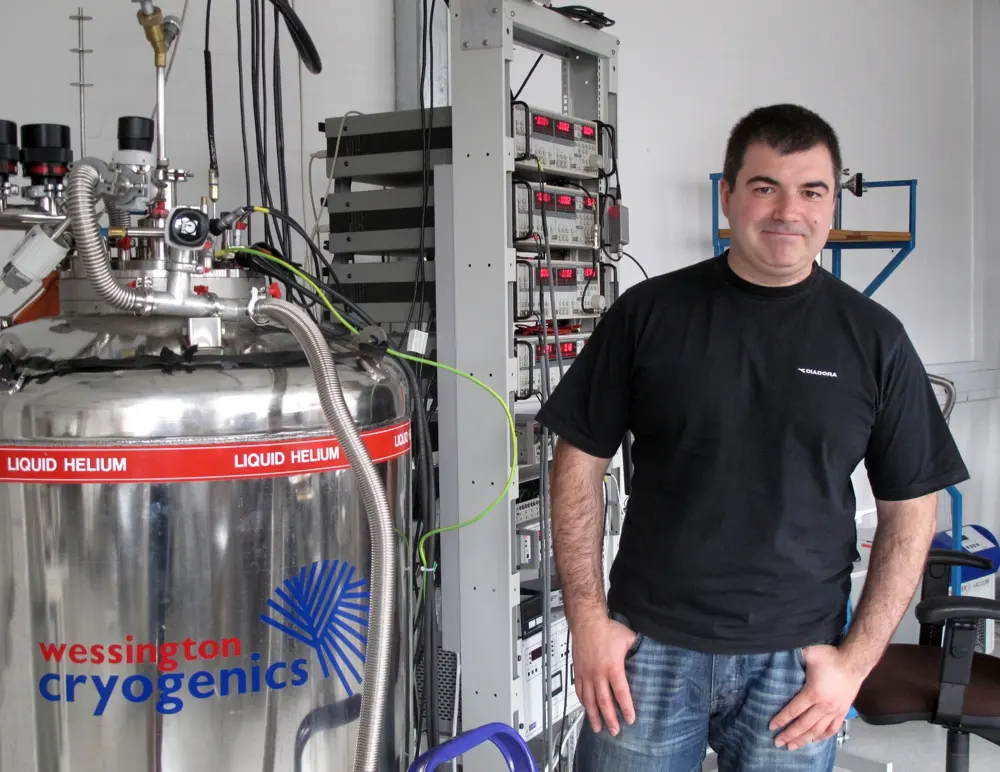
Konstantin Novoselov
born 1974 in Nizhny Tagil, Russia
Geim’s student, then his partner in the lab. At 36 he was the youngest winner of the physics prize since 1973.
Photo: Dyor, CC BY-SA 3.0
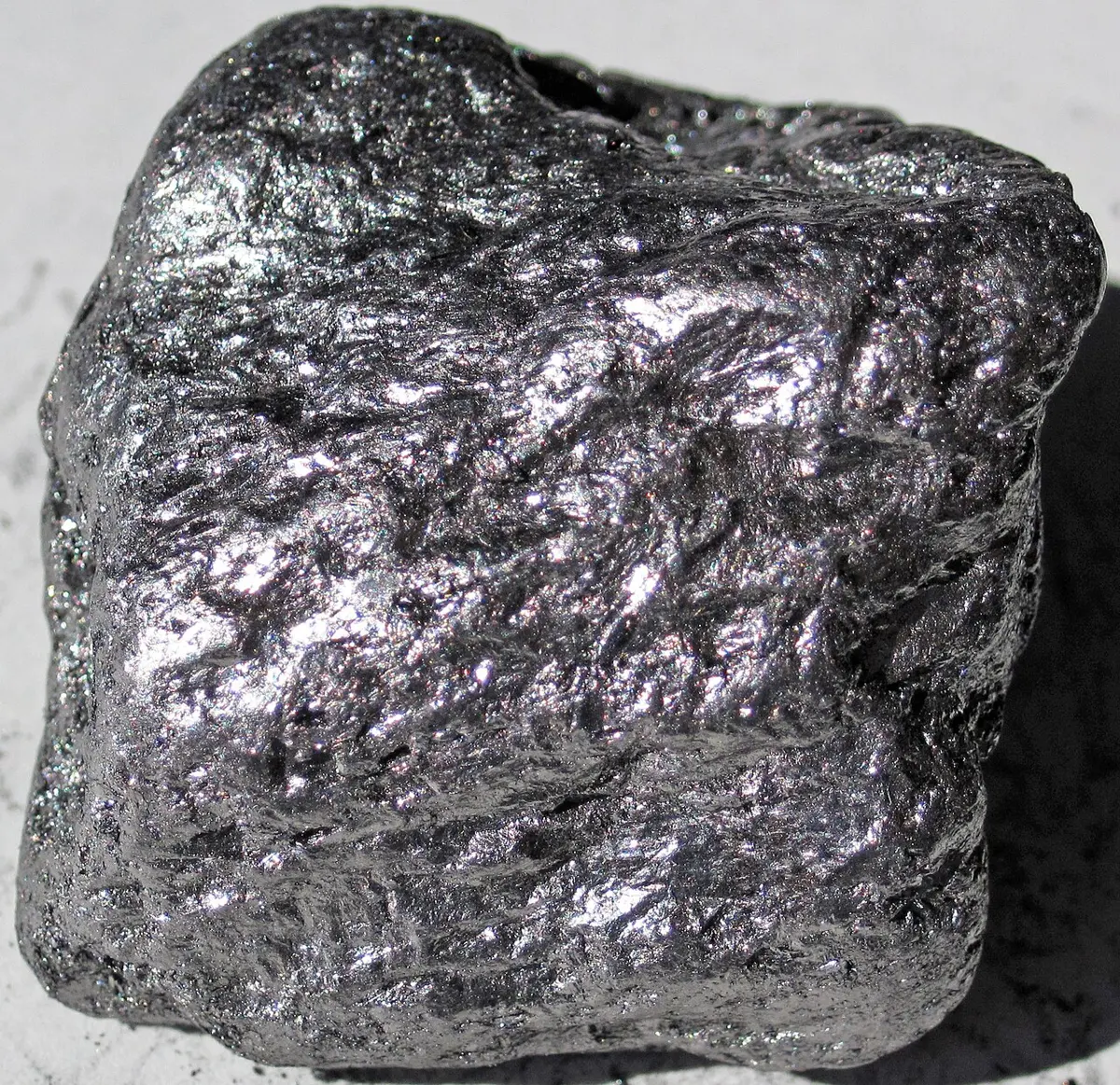
Draw a line with a pencil. The gray mark on your paper is graphite, a form of carbon. Graphite is made of flat sheets of carbon atoms piled on top of each other like the pages of a book. As the pencil rubs on the paper, sheets slide off and stay behind.
Somewhere in your pencil line there may be a sheet just one atom thick. That single sheet is called graphene. For decades, many scientists thought it could not exist on its own. In 2004, two physicists in Manchester, England, picked it out with sticky tape. In 2010 they won the Nobel Prize in Physics.
The problem: could a sheet one atom thick exist?
You know that carbon comes in different forms, called allotropes Grade 9: Diamond, graphite and fullerene. In graphite, each carbon atom is joined to three others, making flat sheets of hexagons, like chicken wire. Inside a sheet the bonds are very strong. Between the sheets the forces are weak, so the sheets slide and peel apart easily. That is why graphite is soft and slippery.
The sheets are very thin. One millimeter of graphite is a stack of about three million of them.
Scientists had studied single sheets of graphite in theory since 1947, to understand graphite itself. But most of them believed a real sheet one atom thick could never be held on its own. Something so thin, they thought, would crumple, roll up or fall to pieces at room temperature. Many had tried to make one, by putting chemicals between the sheets, by scratching graphite, or by growing thin layers on other materials. The thinnest films anyone could handle were still dozens of atoms thick.
There was a second problem. Even if someone made a single sheet, how would they find it? It is far too thin to see, and it would be lost among millions of thicker flakes.
Why does graphite peel apart into thin sheets so easily?
Pick an answer to see why.
What they did, step by step
Andre Geim was born in 1958 in Sochi, in what was then the Soviet Union, and studied physics in Moscow. In 1990 he left the Soviet Union to work in England and Denmark, and in 1994 he became a professor in Nijmegen, in the Netherlands. In 1999 a young Russian student, Konstantin Novoselov, came to Nijmegen to do his PhD with him. In 2001 Geim moved to the University of Manchester, and Novoselov followed.
Geim had a habit he called “Friday night experiments”: odd side projects, tried for a few months, outside his main research. Most failed. In Nijmegen, one of them made a living frog float inside a powerful magnet. (Water, and so a frog, is pushed away very weakly by a magnet, and a strong enough magnet can hold it up.)
The polishing machine and the bin
- Autumn 2002, a new student. Geim gave a new PhD student, Da Jiang, a side project: make graphite as thin as possible and test how it conducts electricity. He gave him a disc of graphite a few millimeters thick and told him to use a polishing machine.
- A few months later, one speck. Da showed a tiny speck of graphite. Geim measured it under a microscope: about 10 micrometers thick (a hundredth of a millimeter), still thousands of layers. Then it turned out Da had polished away the whole disc to get that one speck. “Polishing a mountain to get one grain of sand,” Geim joked.
- The sticky tape. A senior researcher working nearby, Oleg Shklyarevskii, came over with a piece of sticky tape with graphite flakes on it, fished out of the bin. Scientists who study graphite surfaces clean them by pressing on sticky tape and pulling off the top layer, then throw the tape away. Nobody had looked carefully at what was on it. Under the microscope Geim saw flakes far thinner than Da’s speck.
- Peel, and peel again. Novoselov took up the work. Pressing tape onto the flakes and peeling it off, ten or twenty times, made the flakes thinner and thinner.
- Finding them: a rainbow trick. To find the thinnest flakes, Geim brought in wafers of silicon with a thin layer of silicon dioxide on top, the material computer chips are made on. On these wafers, under an ordinary light microscope, each flake shows a color that depends on its thickness, like the rainbow colors of a film of oil on water. Even a flake one atom thick shows up as a faint shade.
The eureka moment
Within days, Novoselov was painting tiny electrical contacts onto flakes with silver paint and a toothpick. Geim later wrote that it was the highest level of experimental skill. The first rough devices showed that the flakes conduct electricity very well, and that how well they conduct could be changed by a voltage applied underneath them: the way the switches in a computer chip work. That, Geim said, was his real eureka moment.
- 2003, the hard work. For months the team made better and better devices, with the help of colleagues in Manchester and Chernogolovka, Russia. They tested more than 50 of them, and learned to recognize flakes only one atom thick.
- October 2004, the paper. The journal Nature rejected their report twice. One referee wrote that it did not show “a sufficient scientific advance”. The journal Science published it in October 2004.
The paper started a rush. Within a few years, hundreds of laboratories around the world were peeling graphite with sticky tape.
Why graphene is so special
Geim and Novoselov could only make flakes a few micrometers across, but that was enough to measure them. Graphene turned out to break records:
- The thinnest material there is: one atom thick. Yet it is so tightly woven that not even helium, the smallest gas atom, can get through it.
- The strongest material ever measured. The Nobel committee gave an example: a hammock of graphene one meter square would weigh less than a cat’s whisker, about 0.77 milligrams, yet it could hold up a 4 kg cat. It can also stretch by up to 20%.
- Almost transparent: a single sheet lets through nearly 98% of the light that falls on it.
- A very good conductor, of electricity as well as copper, and of heat better than any other known material Grade 9: Metals are good conductors.
A single sheet of graphene lets through nearly 98% of light, yet a lump of graphite is black. Why?
Pick an answer to see why.
Electrons that behave like light
The strangest thing about graphene is how its electrons move. In an ordinary wire, the electrons that carry a current keep bumping into atoms, like a ball in a pinball machine; that is where resistance comes from Grade 9: Electric resistance. In graphene, electrons can travel long distances without bumping into anything.
What is more, the electrons in graphene behave as if they had no mass at all, like particles of light. They all move at one fixed speed: about one million meters per second, three hundred times slower than light. This lets physicists test ideas from the physics of particles moving near the speed of light on a small flake in an ordinary laboratory, without a giant particle accelerator.
In your life today
Graphene is already used in small amounts, though not yet in the big ways people first dreamed of.
- Stronger, lighter materials. Mixing a little graphene into plastics, rubber or paint makes them tougher, and with about 1% graphene a plastic can even conduct electricity. Some tennis racquets, bicycle tyres and helmets contain graphene.
- Keeping phones cool. Some phones use thin graphene-based films to spread heat away from the chip.
- Touch screens and sensors. Because graphene is clear and conducts electricity, it could replace the costly material now used in touch screens. And because every atom of graphene is on its surface, a single gas molecule landing on it changes how it conducts. That makes it good for very sensitive sensors.
What came next
- A whole family. Once people knew how to make sheets one atom thick, they made them from other materials too, such as boron nitride, an insulator, and molybdenum disulfide, a semiconductor. These sheets can be stacked like bricks of Lego to make new materials that don’t exist in nature.
- The magic angle. In 2018, a team at MIT in the United States laid one sheet of graphene on another and twisted it by just 1.1°. The pair became a superconductor, carrying current with no resistance at all, at very low temperatures. Nobody had expected that from plain carbon.
- The open problem. A computer chip needs switches that turn a current fully on and fully off. Graphene conducts so well that it is very hard to switch off. Making graphene, or one of its cousins, into the chips of future computers is still an unsolved problem, and making large, perfect sheets cheaply is another.
In your science books
- Grade 9: allotropes of carbon, and diamond, graphite and fullerene, why graphite is soft and conducts electricity.
- Grade 9: metals are good conductors of electricity and electric resistance.
- Going Further (Grades 6–8): networks of atoms: diamond and sand.
- Going Further (Grades 9–12): four kinds of solid, and waves that cancel, the reason for the colors that made graphene visible.
Learn more
- The Nobel Prize’s own explanation: Graphene: the perfect atomic lattice (nobelprize.org).
- The laureates’ Nobel lectures: Geim, “Random walk to graphene”, and Novoselov.
The official reason
The prize was given “for groundbreaking experiments regarding the two-dimensional material graphene.”