
Buckyballs: carbon shaped like a football
Nobel Prize in Chemistry, 1996: Robert Curl, Harold Kroto, and Richard Smalley
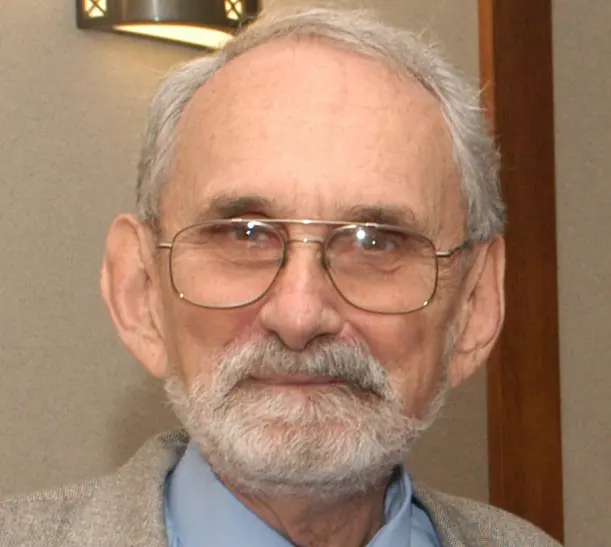
Robert Curl
1933–2022, born in the United States
A Texas chemist who loved measuring molecules with light, and who brought the other two together.
Photo: Douglas A. Lockard, CC BY-SA 3.0
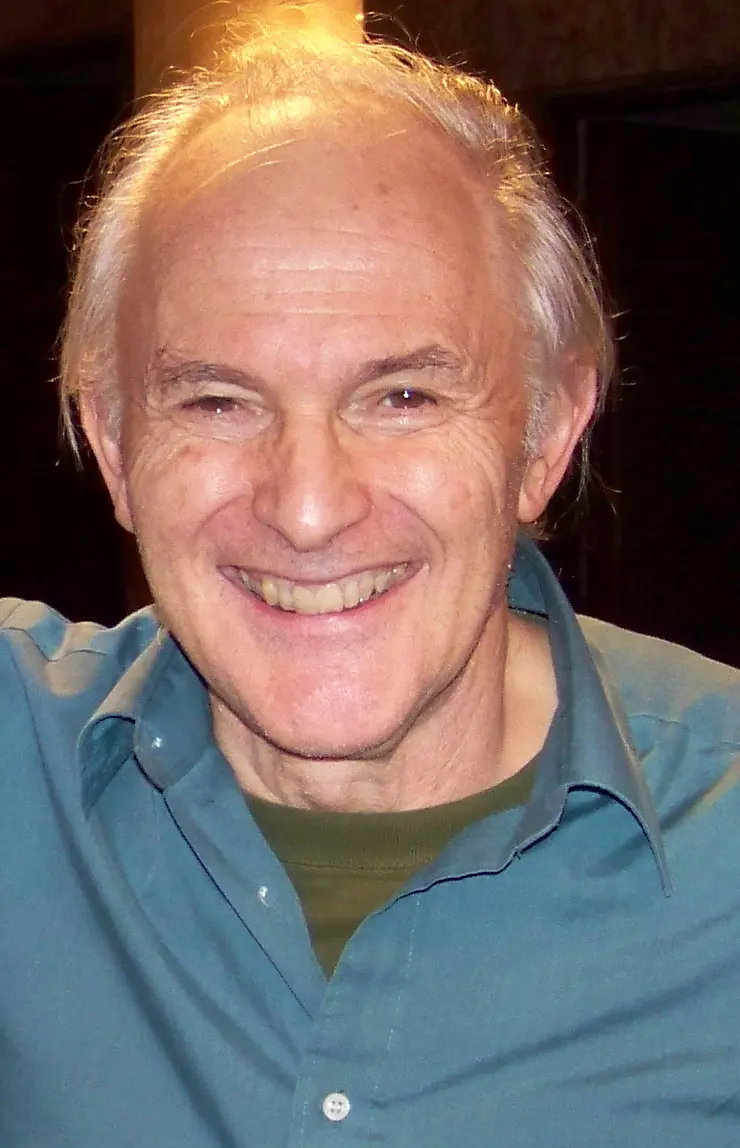
Harold Kroto
1939–2016, born in England
The son of refugees from Nazi Germany, a chemist who was also a gifted artist and designer, and who wanted to know what happens to carbon in stars.
Photo: Trevor J. Simmons, Public domain
Richard Smalley
1943–2005, born in the United States
Built the laser machine that made the discovery possible, and spent a night cutting paper to find the shape.
Look at the black soot on the bottom of a pot cooked on a wood fire, the gray “lead” of your pencil, and a diamond in a jeweler’s window. They look nothing alike, but all three are made of one element: carbon. By 1985, chemists thought they knew every way carbon atoms could join up. They were wrong.
That year, three chemists and two students found a new form of carbon: a hollow ball of exactly 60 carbon atoms, with the same pattern as the patches on a football. They named it buckminsterfullerene, and soon everyone was calling it the buckyball. In 1996 the Nobel Prize in Chemistry went to Robert Curl, Harold Kroto and Richard Smalley for finding it and the family of carbon cages it belongs to, the fullerenes.
The problem: what is carbon doing in the stars?
Harold Kroto, at the University of Sussex in England, studied molecules by the light they give out and take in. Every kind of molecule gives out radio waves of its own special wavelengths, like a fingerprint. In the 1970s, Kroto and astronomers used radio telescopes to find long chains of carbon atoms, with a nitrogen atom at one end, in the clouds of gas and dust between the stars. Some of the chains had nine carbon atoms or more.
Where did such long chains come from? Kroto had an idea. Some old stars, the red giants, are rich in carbon, and their outer layers are cooler than most stars. Perhaps the carbon chains were made there, as the hot carbon gas around the star cooled and its atoms stuck together, and then the chains drifted out into space.
To test this, he needed to make hot carbon gas in a laboratory, let it cool, and see what came out. And he knew where there was a machine that could do it.
Why it was hard
Carbon turns to gas only at about 3,600 °C, and as soon as it cools its atoms stick together into clumps of every size, all mixed up. To learn anything, you need three things at once:
- a way to make carbon hot enough, for a very short time;
- a way to let the atoms cool and join up gently, without touching the walls;
- a way to count the atoms in each clump, when the clumps are far too small to see.
What they did, step by step
The machine in Houston
At Rice University in Houston, in the United States, Richard Smalley had built exactly such a machine. He and his team used it to study clusters: tiny clumps of a few to a few hundred atoms, of metals and of the materials used in computer chips. Robert Curl, a professor down the corridor who measured molecules with light, often worked with him. Curl knew Kroto, and he put the two together.
This is how the machine works, step by step:
- A small disc of graphite (pure carbon) turns slowly inside a steel chamber.
- A powerful laser fires a flash of light at the disc, lasting only a few billionths of a second. The spot where it hits becomes many thousands of degrees hot, and a little carbon turns to gas.
- At the same moment, a puff of helium gas blows over the spot and carries the hot carbon atoms away. Helium is an inert gas: it doesn’t react with anything. Its atoms bump into the carbon atoms and cool them, and the carbon atoms join up into clusters.
- The helium and the clusters shoot out through a small hole into a vacuum. There the gas spreads out and becomes very cold, just a few degrees above the coldest possible temperature, so the clusters stop changing.
- A mass spectrometer sorts the clusters by mass. A carbon atom has a mass of 12 units, so a cluster of 60 carbon atoms has a mass of 720. The spectrometer shows how many clusters of each mass there are, as a row of peaks on a graph.
Eleven days in September 1985
Kroto arrived in Houston on 1 September 1985. With Curl, Smalley and two graduate students, James Heath and Sean O’Brien, he started making carbon clusters, day and night.
- The chains were there. The machine did make long carbon chains, as Kroto had hoped. His idea about the stars looked right.
- A strange peak. But one peak on the graph stood out: clusters of exactly 60 carbon atoms, with a smaller peak at 70. Clusters with an even number of atoms between about 40 and 80 were common, but 60 was always the tallest.
- Tuning the machine. The team found that when they let the clusters bump into the helium for longer before they escaped into the vacuum, the peak at 60 grew taller and taller, until it towered over all the others. Whatever C₆₀ was, it survived when the other clusters fell apart or kept growing. It must be unusually stable.
Why did the team think C₆₀ was special?
Pick an answer to see why.
Finding the shape: a night with paper and scissors
Why would 60 carbon atoms be so stable? In a scrap of graphite, the atoms at the edges have bonds left over with nothing to join to. Such loose ends make a cluster reactive: it grabs other atoms and changes. A stable cluster should have no edges at all. Perhaps the 60 atoms were curled round into a closed cage.
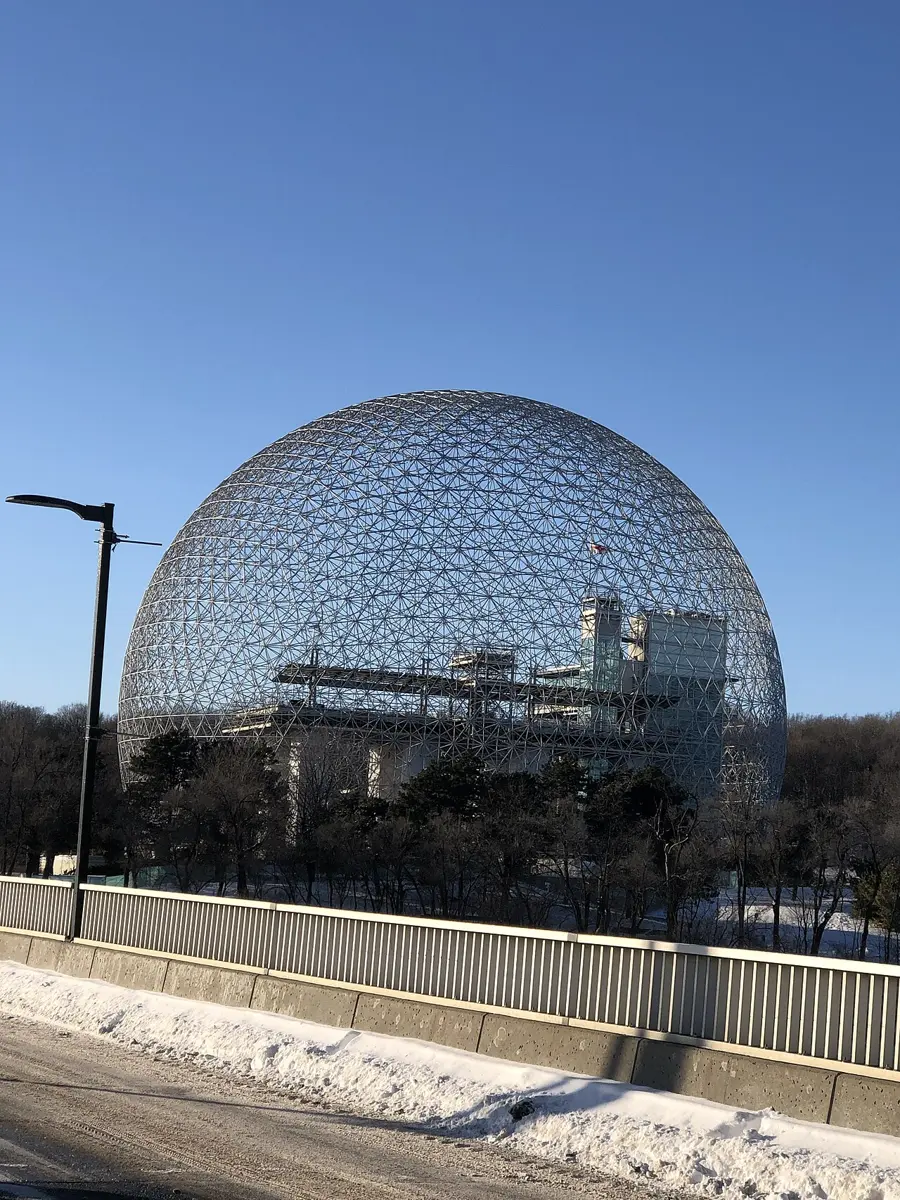
But you cannot make a ball out of hexagons alone. Graphite is flat sheets of hexagons, like chicken wire, and a sheet of hexagons stays flat. Kroto remembered the geodesic domes of the American architect Buckminster Fuller, such as the huge dome he had seen at the world’s fair in Montreal in 1967. He also remembered a cardboard dome of the stars he had made for his children, which he thought had pentagons among its hexagons.
On the night of 9 September, Smalley sat up at home with paper, scissors and sticky tape. Hexagons alone would not close. When he added pentagons, the paper began to curve, and he ended up with a ball of 12 pentagons and 20 hexagons, with exactly 60 corners. Next morning he showed it to the others. It was the pattern of a football.
Exactly who thought of what, and when, was later argued over, even among the five of them. What is certain is that by 12 September they had sent their paper, “C₆₀: Buckminsterfullerene”, to the journal Nature, which published it on 14 November 1985.
How a buckyball is built
Each carbon atom has four outer electrons it can use to make bonds Grade 9: Catenation. In diamond, each atom bonds to four neighbors. In graphite, each atom bonds to only three, in flat sheets of hexagons, and its fourth electron is free to move along the sheet Grade 9: Diamond, graphite and fullerene.
In C₆₀, too, each atom is joined to three neighbors, as in graphite. But the sheet is bent round into a ball:
- There is a carbon atom at each of the 60 corners.
- The atoms make 12 pentagons and 20 hexagons, and no two pentagons touch.
- Every atom is joined to exactly three others, and there are no edges, so there are no loose ends.
The pentagons are what bend the sheet. Put one pentagon in a sheet of hexagons and the sheet bends up into a shallow bowl. A mathematical rule found by Leonhard Euler in the 1700s says that any closed cage of pentagons and hexagons, with three edges meeting at every corner, has exactly 12 pentagons, no more and no fewer. The number of hexagons can change, which is why there are bigger cages too: C₇₀ is shaped like a rugby ball, and there are C₇₆, C₈₄ and many more. Together, they are the fullerenes.
A buckyball is tiny. It is about 0.7 nanometers across, measured from atom to atom (a nanometer is a millionth of a millimeter). The presentation speech at the prize put it this way: it is about 300 million times smaller than a football.
How many pentagons does C₆₀ have, and why must it have them?
Pick an answer to see why.
Five years of doubt, and a jar of soot
The 1985 experiment made only a tiny amount of C₆₀, mixed with other clusters, inside a machine. Nobody could hold it, look at it, or measure its shape directly. The ball was only a very good hypothesis, an explanation still to be tested Grade 9: The steps of scientific learning. Many chemists doubted it. From 1985 to 1990 the team kept testing it:
- It wouldn’t react. They added gases such as hydrogen, oxygen and ammonia to the stream of clusters. C₆₀ didn’t react with any of them, just as a ball with no loose ends shouldn’t.
- A metal atom inside. They soaked graphite in a solution of a salt of the metal lanthanum and fired the laser at it. Out came clusters of C₆₀ with one lanthanum atom, which strong laser light could not knock off. The metal atom seemed to be trapped inside the cage.
The final proof came from somewhere else. In 1990 two physicists, Wolfgang Krätschmer in Germany and Donald Huffman in the United States, made a spark jump between two graphite rods in helium gas. This made a black soot, and when they shook the soot with the liquid benzene, the C₆₀ dissolved, giving a colored solution. When the liquid dried, it left crystals of pure C₆₀. Now there were whole grams of it, and every method of finding the shape of a molecule could be used. It was a ball of 60 atoms, exactly as the team had said.
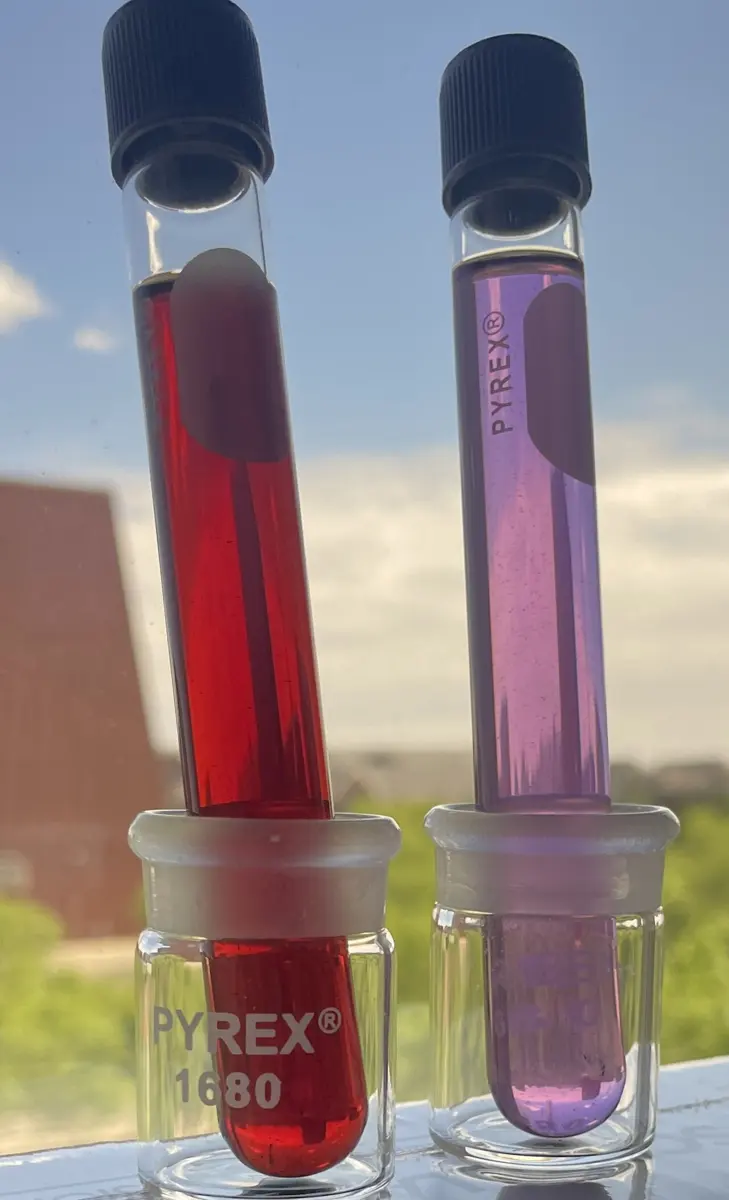
In your life today
- In a candle flame. After the discovery, chemists found that most sooty flames contain a little C₆₀. As the presentation speech said: “Think of this the next time you light a candle!” A little of it is probably in the soot on a diyo at Tihar, too.
- In space, as Kroto had guessed. In 2010, NASA’s Spitzer space telescope found the signal of C₆₀ and C₇₀ in a cloud of dust around a dying star about 6,500 light years away. Later, C₆₀ was found in the thin gas between the stars too.
- A new chemistry. The prize speech said, in 1996, that no practical use had been found yet. Since then they have been tried in plastic solar cells and in medicines, but they are still mostly used in research. The bigger change was in how chemists think: carbon could make far more shapes than anyone had imagined.
What came next
- Carbon tubes. In 1991, Sumio Iijima in Japan saw carbon nanotubes: sheets of carbon hexagons rolled into tubes only a few nanometers wide, often closed at the ends with caps like half a buckyball. For their weight, they are among the strongest materials known. Smalley spent much of the rest of his life working on them.
- The open question. Kroto’s first question was how carbon molecules form around stars and travel through space. Astronomers now know C₆₀ is out there, but how it forms in the thin, cold gas of space, and how much of the carbon between the stars is in such cages, is still not known.
In your science books
- Grade 9: allotropes and allotropy, diamond, graphite and fullerene, and catenation, carbon’s way of joining to itself.
- Grade 9: the steps of scientific learning: a hypothesis, and the tests that proved it.
- Going further: What does a molecule look like?, with diamond and graphite to turn in 3-D.
Learn more
- The prize at nobelprize.org: The Nobel Prize in Chemistry 1996, with the press release that tells the story of the eleven days and the presentation speech.
- The three Nobel lectures: Curl, Kroto and Smalley.
The official reason
The prize was given “for their discovery of fullerenes.”