
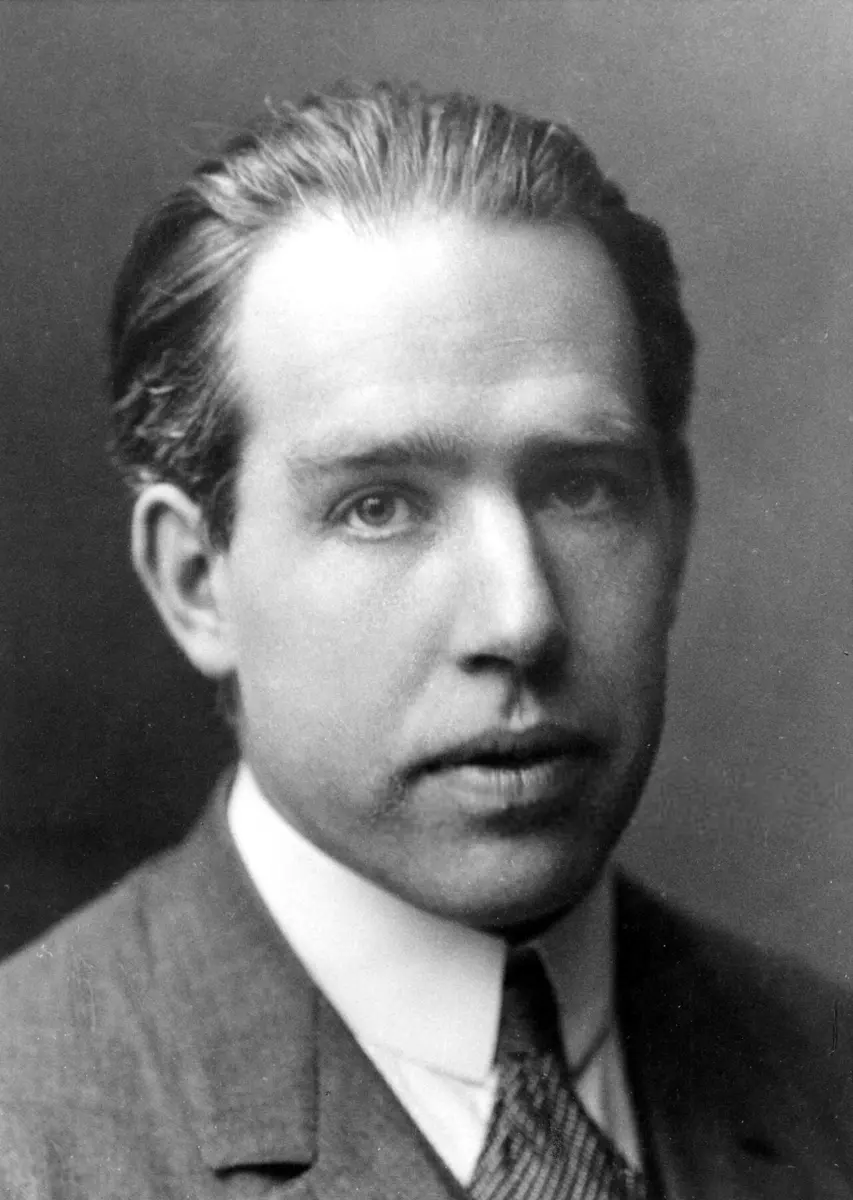
Niels Bohr
1885–1962, born in Denmark
He worked out his ideas by talking them through, slowly and carefully, with anyone who would argue with him. His institute in Copenhagen became the meeting place of the young physicists who built quantum physics.
Photo: The American Institute of Physics credits the photo [1] to AB Lagrelius & Westphal , which is the Swedish company used b, Public domain
When the dal boils over on a gas stove, the blue flame suddenly flashes bright yellow. Sprinkle a pinch of salt into a flame and you see the same yellow. At Tihar, the fireworks burst in red, green and blue. Each of these colors comes from one particular element: yellow from sodium (in salt), red from strontium, green from barium. Every element, heated, gives out its own colors of light and no others.
Why should that be? And why don’t atoms fall apart? In 1913 a young Danish physicist, Niels Bohr, answered both questions with one bold picture of the atom: electrons that may only move on certain fixed orbits. You draw his picture whenever you write the shells of an atom as 2, 8, 1. It won him the Nobel Prize in Physics in 1922.
The problem: an atom that should not exist
In 1911 Ernest Rutherford, in Manchester, found that almost all the mass of an atom is packed into a tiny, positively charged nucleus at its center. The negative electrons must be somewhere around it Grade 8: Structure of an atom. The obvious picture was a tiny solar system: electrons going round the nucleus as planets go round the Sun, held by electric attraction instead of gravity.
But the physics of the time said this atom could not last. A charge that moves in a circle gives out light (radio transmitters work this way: electrons are made to swing back and forth in the aerial). So a circling electron would keep giving out light, keep losing energy, and spiral into the nucleus, in far less than a billionth of a second. Every atom in the universe should have collapsed long ago. Plainly they hadn’t.
There was a second puzzle. If an electron spiraled in, it would give out a smooth smear of every color. But a glowing gas does nothing of the kind. Pass its light through a prism, and you see only a few sharp, bright lines of color, with darkness between them. Each element has its own set of lines, like a fingerprint. Scientists had used these fingerprints to find new elements since Kirchhoff and Bunsen in 1860, but nobody knew why the lines were where they were.
Hydrogen, the simplest atom, gives just four bright lines that we can see: red, blue-green and two violet. In 1885 Johann Balmer, a mathematics teacher at a girls’ school in Basel, Switzerland, found a simple formula that gave their wavelengths exactly, using only whole numbers. It worked perfectly. For almost thirty years, nobody could say why.
Why did Rutherford’s “solar system” atom look impossible to physicists in 1912?
Pick an answer to see why.
Why it was hard: one of two things had to go
Bohr faced a hard choice, as the Nobel committee itself said when it gave him the prize. Either Rutherford’s atom was wrong, or the great laws of electricity and light worked out by James Clerk Maxwell, which had worked perfectly everywhere else, did not hold inside an atom. Ten years earlier, every physicist would have thrown out the atom.
But by 1913 there was a crack in the old physics. In 1900 Max Planck had found that energy is given out in packets of size hf, where f is the frequency and h a tiny number now called Planck’s constant (Max Planck’s packets). In 1905 Albert Einstein had gone further: light itself comes in packets, photons. Bohr bet on Rutherford’s atom, and on Planck’s packets, and broke the old rules on purpose.
What Bohr did, step by step
Niels Bohr: three bold rules
Niels Bohr grew up in Copenhagen, the son of a professor of physiology. He and his younger brother Harald, later a famous mathematician, were also keen footballers.
- 1911, England. After his doctorate in Copenhagen, on the electrons in metals, Bohr went to Cambridge in the autumn of 1911 to work with J. J. Thomson, who had discovered the electron.
- Spring 1912, Manchester. He moved to Rutherford’s laboratory, just after Rutherford had found the nucleus, and began to think about how its electrons could be arranged. That summer he went home and married Margrethe Nørlund.
- Early 1913, Balmer’s formula. A friend in Copenhagen, Hans Hansen, who studied spectra, pointed him to Balmer’s formula for hydrogen. When Bohr looked at it, the pieces of his idea fell into place.
- July to November 1913, three papers. Bohr published his theory in three papers in the British journal Philosophical Magazine, later called “the trilogy”. At its heart were three rules.
- Rule 1: only certain orbits. An electron can move round the nucleus only on certain orbits, numbered 1, 2, 3 and so on, each with its own fixed energy. While it stays on one, it gives out no light at all, so it doesn’t spiral in. Bohr called these stationary states.
- Rule 2: light comes from jumps. An electron can jump from one orbit to another. Jumping to a lower-energy orbit, it gives out one photon, whose energy is exactly the difference between the two orbits. Jumping up, it takes in a photon of exactly that energy. By Planck’s rule, the photon’s energy decides its frequency, and so its color.
- Rule 3: which orbits. Bohr used Planck’s constant to pick out the allowed orbits. Their sizes go up as 1, 4, 9, 16… (the square of the orbit’s number, n²). The smallest, n = 1, is the hydrogen atom in its normal state, about 0.05 nm across in radius.
- The test: hydrogen’s lines. From these rules Bohr worked out every line of hydrogen. The jumps that end on orbit 2 give exactly Balmer’s four visible lines. He could even calculate the number in Balmer’s formula (now called the Rydberg constant) from the charge and mass of the electron and Planck’s constant, and his answer was within about 1% of the measured value. Jumps that end on orbit 1 give a series of ultraviolet lines, which Theodore Lyman in the United States was measuring at the same time (1906–1914); they fit too.
So each element has its own colors because each element’s atoms have their own staircase of energies. Its electrons can only drop by the particular steps of that staircase, so they can only give out photons of particular energies, that is, particular colors. Sodium’s biggest easy drop happens to give yellow light, 589 nm, which is why salt turns a flame yellow (Why each element has its own lines).
An electron in a hydrogen atom drops from orbit 3 to orbit 2, giving out red light. If it dropped from orbit 4 to orbit 2 instead, the light would be:
Pick an answer to see why.
From hydrogen to the whole periodic table
In 1916 Bohr became a professor in Copenhagen, and soon an institute was built for him there. In the early 1920s he used his ideas to work out how the electrons of heavier atoms are arranged in shells, and showed that this explains the periodic table: elements in the same group behave alike because their outer shells are alike Grade 8: Bohr and Bury’s 2n² rule.
How it works now
Bohr’s orbits were not the end of the story. In 1925–26 Werner Heisenberg, Erwin Schrödinger and others built quantum mechanics, a fuller theory of the atom. In it, an electron does not run along a thin circular track like a planet. It is spread out round the nucleus in a cloud, densest at certain distances. But Bohr’s most important ideas survived: an electron in an atom can have only certain energies, and light is given out or taken in when it jumps between them.

In your life today
- Shells in your book. Every time you write sodium as 2, 8, 1 or work out a valency, you are using Bohr’s picture Grade 9: Shells and their energy.
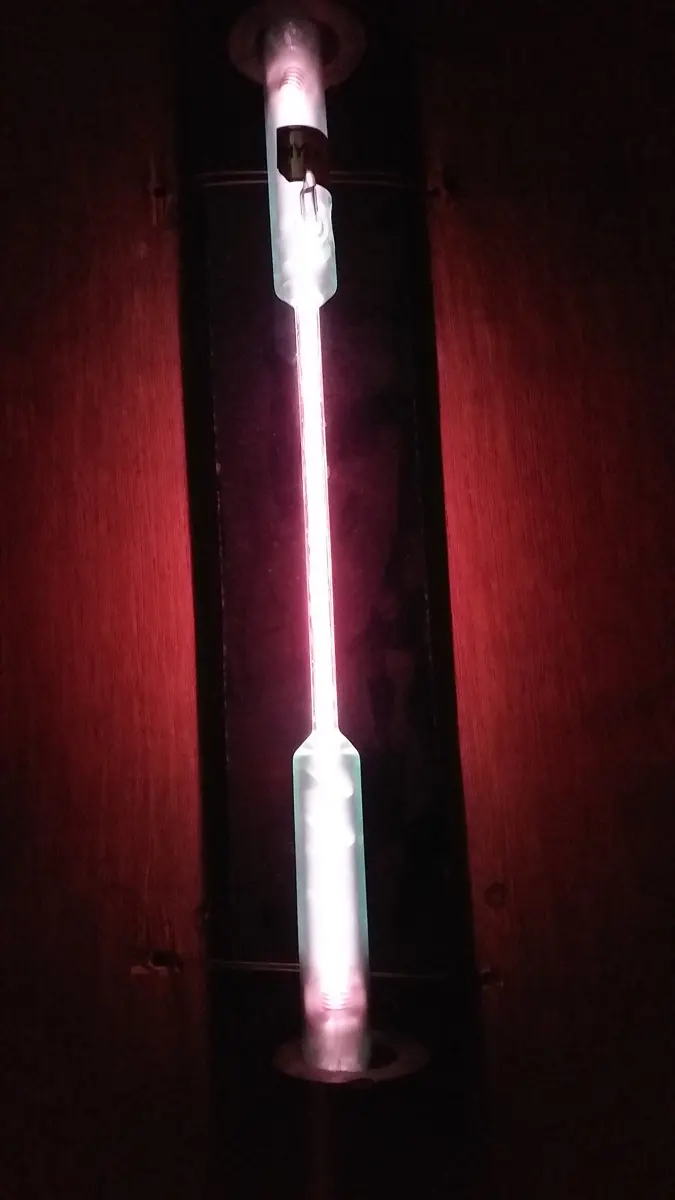
- Colored light. Old yellow street lamps were filled with sodium vapor, and glowed with sodium’s yellow line. Fluorescent tubes contain mercury vapor, whose electrons give out ultraviolet; a white coating inside the tube turns it into visible light. Neon signs glow red with neon.
- Fireworks. Each color of a firework comes from atoms of one metal, their electrons dropping between levels: strontium for red, barium for green, copper for blue, sodium for yellow.
- Reading the stars. The dark lines in the Sun’s light, at the same places as the bright lines of hydrogen, sodium and iron, tell us what the Sun and stars are made of (The barcode in sunlight).
- Lasers and LEDs. Both work by electrons dropping between energy levels and giving out photons of one color (Masers and lasers, Blue LEDs).
What came next
- The prize. Bohr’s prize was presented in Stockholm on 10 December 1922. The same day, the prize for 1921, which had been held over a year, was given to Albert Einstein.
- A center for the world. Bohr’s institute in Copenhagen, now the Niels Bohr Institute, became the place where young physicists from everywhere came to argue out quantum mechanics. One of Bohr’s sons, Aage Bohr, later led it and won the Nobel Prize in Physics himself, in 1975.
- War. When Nazi Germany occupied Denmark, Bohr, whose mother came from a Jewish family, escaped to Sweden in 1943 and went on to Britain and the United States. After the war he argued for openness between nations about atomic weapons, in an open letter to the United Nations in 1950.
- An element. Element 107 is named bohrium after him.
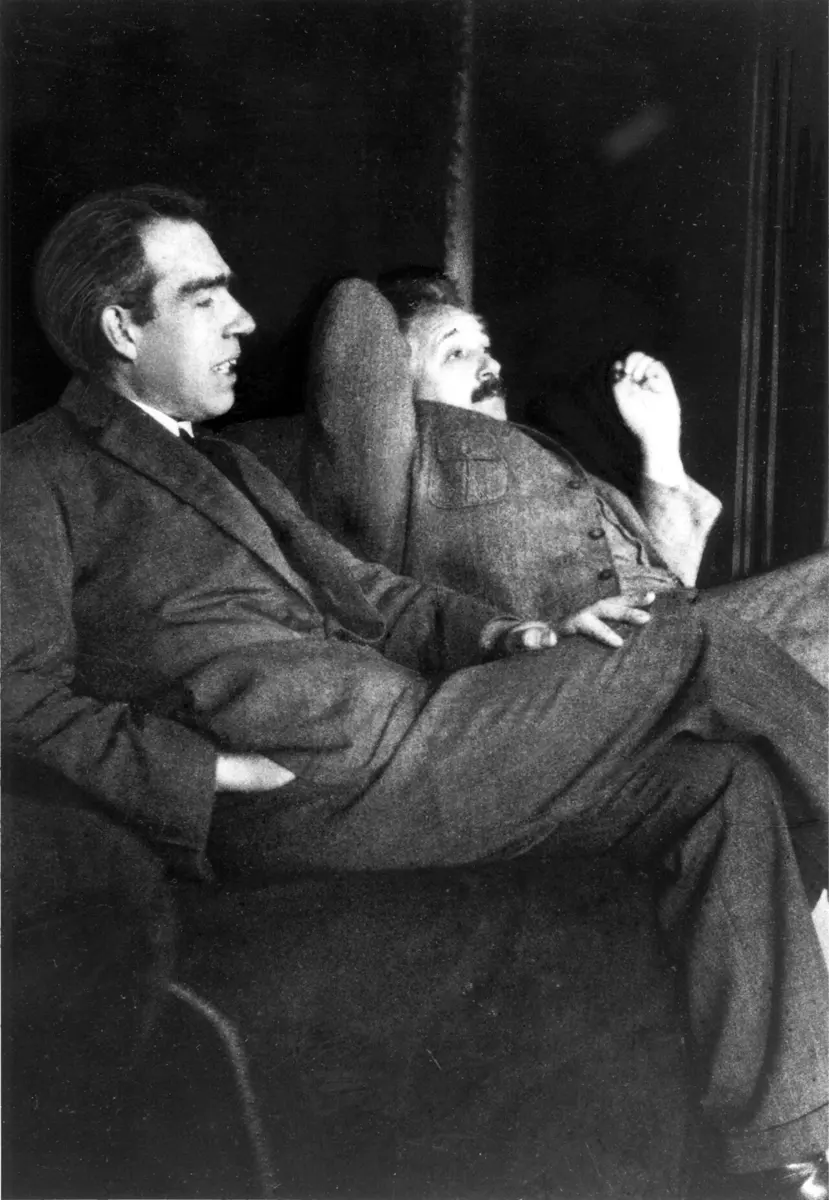
An open question: what is an electron doing between measurements? Bohr and Einstein argued about this for thirty years: Bohr said quantum physics is complete, Einstein that something must be missing. Quantum physics has passed every test since, but physicists still disagree about what it tells us is really going on inside an atom.
In your science books
- Grade 8: the structure of an atom and Bohr and Bury’s 2n² rule.
- Grade 9: shells and their energy, valence shell and valence electrons and the electromagnetic spectrum.
- Grade 10: shells, subshells and orbitals, the next step after Bohr’s shells, and dispersion of light.
- Going Further: what stars are made of, with the energy levels of hydrogen and how to read a spectrum.
Learn more
- The presentation speech, 10 December 1922, which explains the choice Bohr made between Rutherford’s atom and the old physics (nobelprize.org).
- Bohr’s Nobel lecture, The structure of the atom, 11 December 1922.
The official reason
The prize was given “for his services in the investigation of the structure of atoms and of the radiation emanating from them.”