
Quantum dots: color set by size
Nobel Prize in Chemistry, 2023: Moungi Bawendi, Louis Brus, and Aleksey Yekimov

Moungi Bawendi
born 1961 in France
He grew up in France, Tunisia and the United States, and learned how to make quantum dots as a young scientist in Brus’s own laboratory.
Photo: US Embassy Sweden, CC BY 2.0
-
Louis Brus
born 1943 in the United States
A chemist at Bell Laboratories who was trying to use sunlight to drive chemical reactions, and noticed that his tiny particles changed color as they sat on the bench.

Aleksey Yekimov
born 1945 in the Soviet Union
A physicist in Leningrad (now Saint Petersburg) who wondered why one substance could make glass of different colors.
Photo: US Embassy Sweden, CC BY 2.0
Think of tutho, the blue copper sulphate crystals used to protect crops and to color things. A big crystal is blue. Crush it into a fine powder and every grain is still blue. The color of a substance comes from what it is made of, not from its size. That is what everyone learns in chemistry, and for ordinary things it is true.
But make the grains small enough, only a few millionths of a millimeter across, and something strange happens: the same substance can glow red, yellow, green or blue, depending only on how big the grains are. These tiny crystals are called quantum dots. In 2023 the Nobel Prize in Chemistry went to Aleksey Yekimov, Louis Brus and Moungi Bawendi, who discovered them and learned how to make them well.
The problem: color is fixed by what a thing is made of
An element’s properties depend on its electrons: how many it has, and how they are arranged in shells Grade 9: Structure of an atom. The electrons also decide a substance’s color. An electron can only have certain amounts of energy, like standing on the steps of a staircase. When it jumps up a step, it soaks up light; when it drops down, it can give light out. The size of the step sets the color (Why each element has its own lines). That is why each substance has its own color.
In 1937 a physicist, Herbert Fröhlich, predicted that this rule would break for very small particles. Electrons behave partly like waves, and in a tiny particle there is no room for them to spread out. Squeezed in, they would have different energy steps, and so the substance would have different properties.
How small is “very small”? About a nanometer, a millionth of a millimeter. A human hair is tens of thousands of nanometers thick. A quantum dot is a crystal just a few nanometers across, made of a few thousand atoms. A quantum dot is to a football what a football is to the whole Earth.
In the 1970s, scientists managed to show such size effects in extremely thin layers of material. But it needed huge machines, an almost perfect vacuum and temperatures close to absolute zero. Nobody expected it to be useful.
How size can change color
Here is the idea, in a picture you already know. Pluck a guitar or sitar string. Now press the string with a finger, so that a shorter length vibrates. The note goes higher. A shorter string can only hold shorter waves, and shorter waves vibrate faster Grade 8: Frequency.
An electron in a tiny crystal is a bit like that string. The smaller the crystal, the shorter the waves that fit, and the bigger the energy step for the electron. A bigger step means light with more energy: bluer light Grade 9: Electromagnetic spectrum.
- A larger quantum dot has a smaller step, and glows red.
- A smaller quantum dot of the same substance has a bigger step, and glows green or blue.
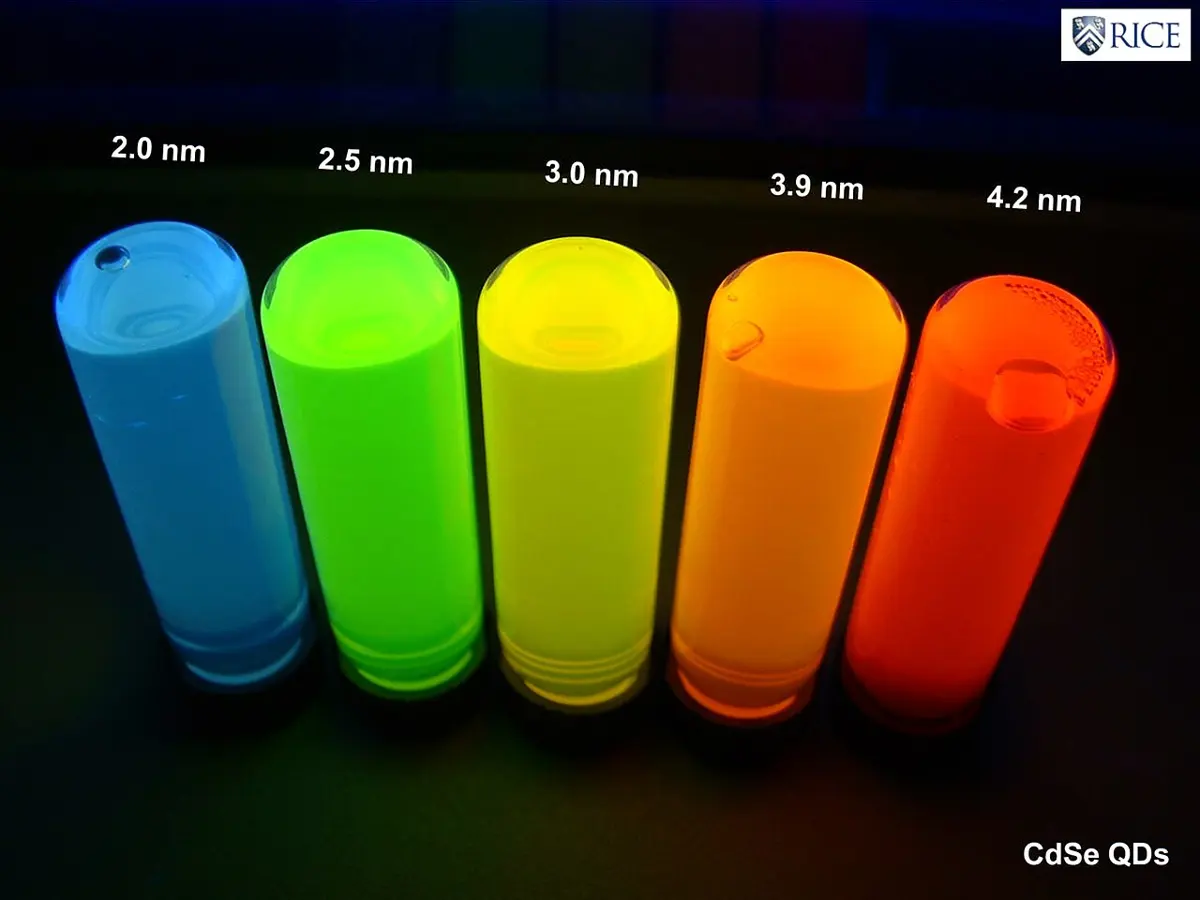
A quantum dot can soak up light of any color with more energy than its step: blue, violet or ultraviolet. It then gives out light of its own color. So one ultraviolet lamp can make dots of many sizes glow in many colors at once.
Two quantum dots are made of the same substance. One glows red and the other glows blue. Which dot is smaller?
Pick an answer to see why.
Why it was hard
To see these effects you need crystals only a few nanometers across. And to use them, you need billions of crystals that are:
- all the same size, or the colors mix into a muddy blur;
- perfect inside, because a missing atom or a crack can trap the electron and waste its energy as heat instead of light;
- easy to make, in an ordinary laboratory, not in a giant vacuum machine.
What they did, step by step
Yekimov: colors in glass (1980–1981)
For thousands of years, glassmakers have colored glass by adding small amounts of substances such as silver, gold or cadmium. By the twentieth century they knew something odd: the same substance could make glass of different colors, depending on how hot the molten glass was made and how it was cooled. Later it was found that the colors came from tiny particles that grew inside the glass.
Aleksey Yekimov, a young physicist at the Vavilov State Optical Institute in Leningrad, in the Soviet Union, found this puzzling. If you paint a picture with a red paint, it stays the same red.
- Making the glass. He made glass containing a little copper chloride, and heated it to between 500 and 700 °C, for anything from one hour to 96 hours.
- Measuring the crystals. Shining X-rays through the cooled glass showed that tiny crystals of copper chloride had grown inside it. The hotter and longer the heating, the bigger they grew: from about 2 nanometers up to about 30 nanometers.
- Measuring the color. The biggest crystals soaked up light just as ordinary copper chloride does. But the smaller the crystals, the bluer the light they soaked up.
- 1981. Yekimov realized he was seeing the size effect that quantum physics predicted. He published his discovery in a Soviet scientific journal. These were the first quantum dots made on purpose.
Brus: dots in a liquid (1983)
At that time, Europe was split by the Iron Curtain, the border between the Soviet Union and its allies and the countries of the West. Scientific journals in Russian were hard to get hold of in the West, so Louis Brus, working at Bell Laboratories in the United States, knew nothing of Yekimov’s work.
- Tiny particles for sunlight. Brus wanted to use sunlight to drive chemical reactions. He used particles of cadmium sulphide, which soak up light, floating in a liquid. He made them very small, because small particles have a much larger surface for reactions to happen on.
- A strange change. He noticed that the particles’ color changed after they had been left on the laboratory bench for a while. Could they be growing?
- The test. He made fresh particles about 4.5 nanometers across and compared them with older ones about 12.5 nanometers across. The larger ones soaked up light just as ordinary cadmium sulphide does. The smaller ones soaked up bluer light.
- 1983. Brus published this: the first quantum dots floating freely in a liquid. Then he tried other substances, and found the same rule every time: the smaller the dots, the bluer.
Yekimov in the Soviet Union and Brus in the United States both found quantum dots, but neither knew of the other’s work. Why?
Pick an answer to see why.
Bawendi: perfect dots, every time (1993)
Brus’s dots were exciting, but they were of mixed sizes and full of faults. Moungi Bawendi joined Brus’s laboratory in 1988 as a young scientist, and worked on making better ones. When he moved to the Massachusetts Institute of Technology (MIT), he kept at it.
- A very hot liquid. In 1993 his team took a carefully chosen liquid and heated it to about 300 °C.
- All at once. They injected the chemicals that form the crystals quickly, all in one go, and just enough of them to make the liquid exactly full (saturated). Billions of tiny crystal “seeds” formed at the same moment.
- Growing together. Then, by carefully changing the temperature, they let all the seeds grow together, so they stayed the same size as each other. The longer they grew, the bigger they became, and the redder their color. The liquid also coated each crystal and gave it a smooth surface.
The dots were almost perfect, and the method was simple enough for any chemistry laboratory to copy. Within a few years, chemists all over the world were making quantum dots.
How quantum dots make TV colors
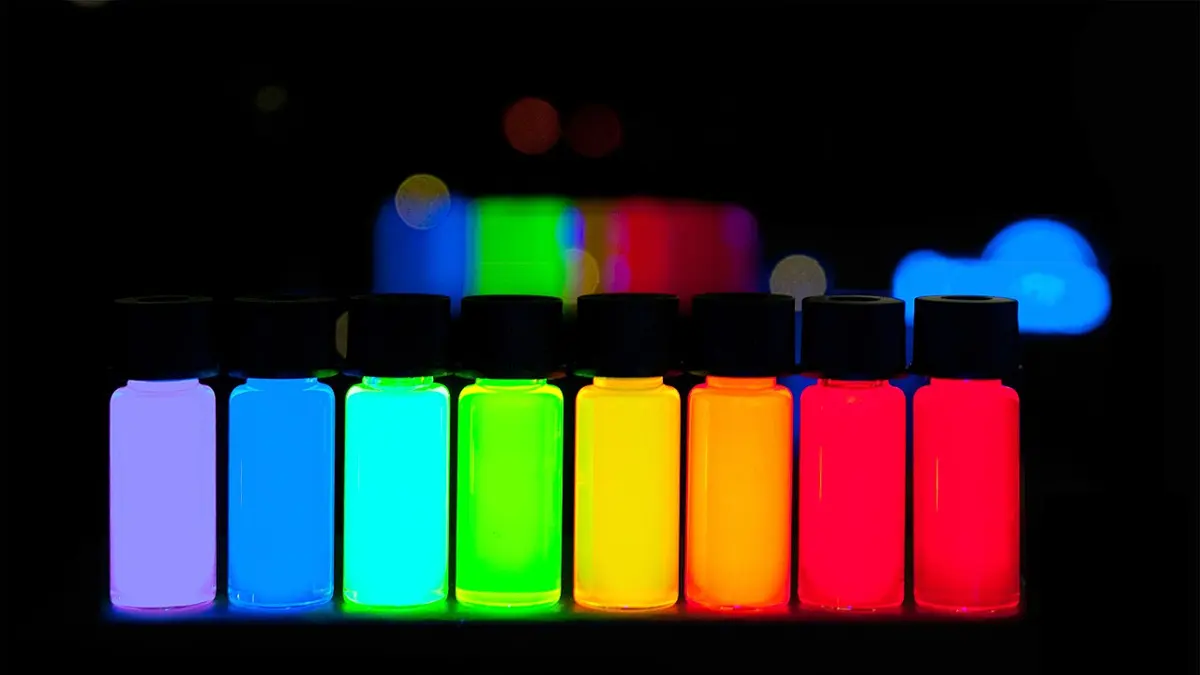
The most common use of quantum dots today is in screens. A QLED television or computer screen (the Q is for quantum dot) is lit from behind by blue LEDs, the ones that won the Nobel Prize in Physics in 2014. In front of them is a thin sheet containing two sizes of quantum dots:
- larger dots that soak up some of the blue light and give out pure red light;
- smaller dots that turn some of the blue into pure green light.
The rest of the blue goes straight through. Red, green and blue are the three colors from which a screen mixes every other color. Because each size of dot gives out a very pure color, the screen’s colors are bright and rich.
In your life today
- Screens. Many televisions and computer screens sold today, in Nepal too, use quantum dots for their colors.
- Lights. Some LED lamps use quantum dots to change the cold, bluish light of the LEDs into a warmer color, or into light more like daylight.
- Medicine and biology. Biologists attach quantum dots to molecules that stick to particular cells, so that those cells light up under a microscope. Doctors are testing whether glowing quantum dots can help surgeons see exactly where a tumor ends, so they can remove all of it.
- A warning. Many quantum dots contain cadmium, a poisonous metal. Many screen makers now use dots made of other substances, such as indium phosphide, that contain no cadmium.
What came next
Thirty years after Bawendi’s method, researchers are working on quantum dots for:
- solar cells that are thinner and cheaper, and can be printed like ink;
- tiny sensors that change color when they meet a particular chemical;
- flexible electronics that bend, and perhaps secret, unbreakable messages sent with single particles of light.
The committee described it as if the periodic table gained a third direction. Before, a chemist choosing a material could pick only its elements. Now, at the nanometer scale, size is a choice too. An open question is how far that can go: can we make materials whose every property, not just color, is set by the size and shape of their crystals?
In your science books
- Grade 8: frequency of a sound wave, and why a shorter string gives a higher note.
- Grade 9: the structure of an atom, the electromagnetic spectrum and visible light.
- Grade 10: the modern periodic table and dispersion of light, white light as a mixture of colors.
- Going further: why each element has its own lines of color.
Learn more
- The Nobel Prize’s own explanation: They added color to nanotechnology (nobelprize.org).
- The laureates’ Nobel lectures: Bawendi, Brus and Yekimov.
The official reason
The prize was given “for the discovery and synthesis of quantum dots.”