
A third of an electron’s charge
Nobel Prize in Physics, 1998: Robert B. Laughlin, Horst L. Störmer, and Daniel C. Tsui
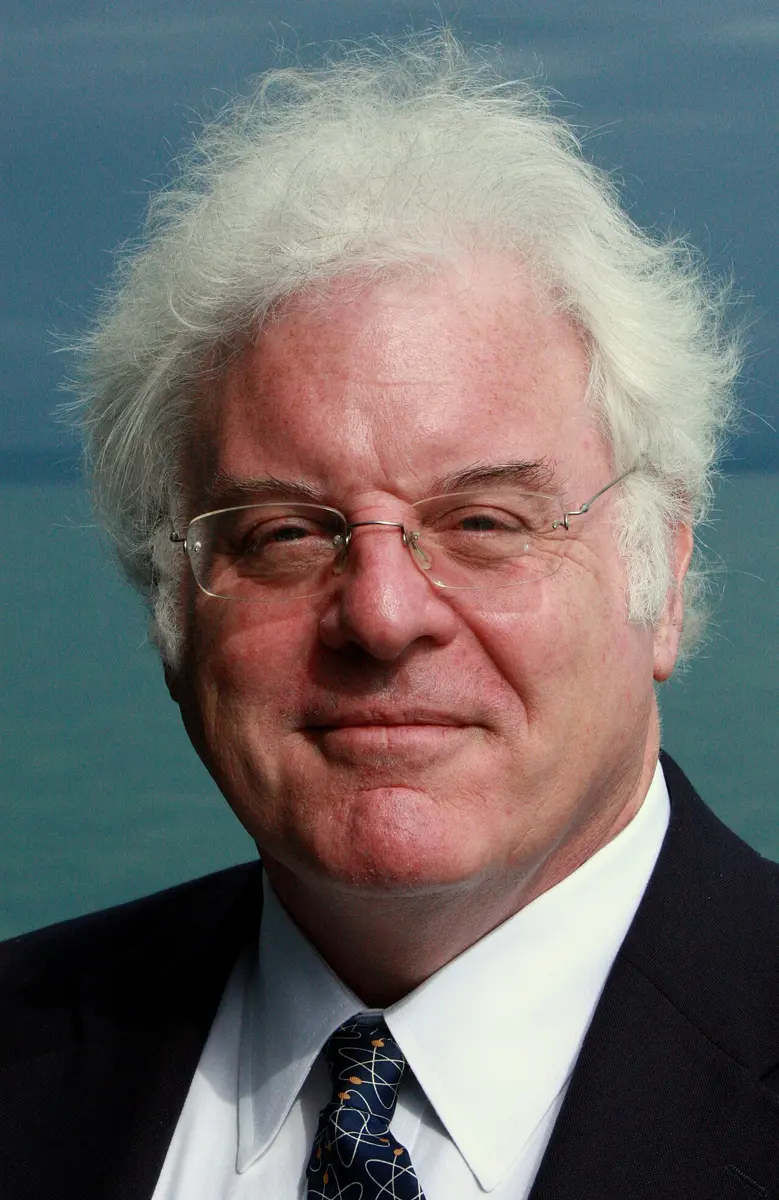
Robert B. Laughlin
born 1950 in the USA
The theorist. During the Vietnam War he was drafted into the US army, which sent him to Germany. Years later he explained the discovery in four pages.
Photo: Markus Pössel, CC BY-SA 3.0
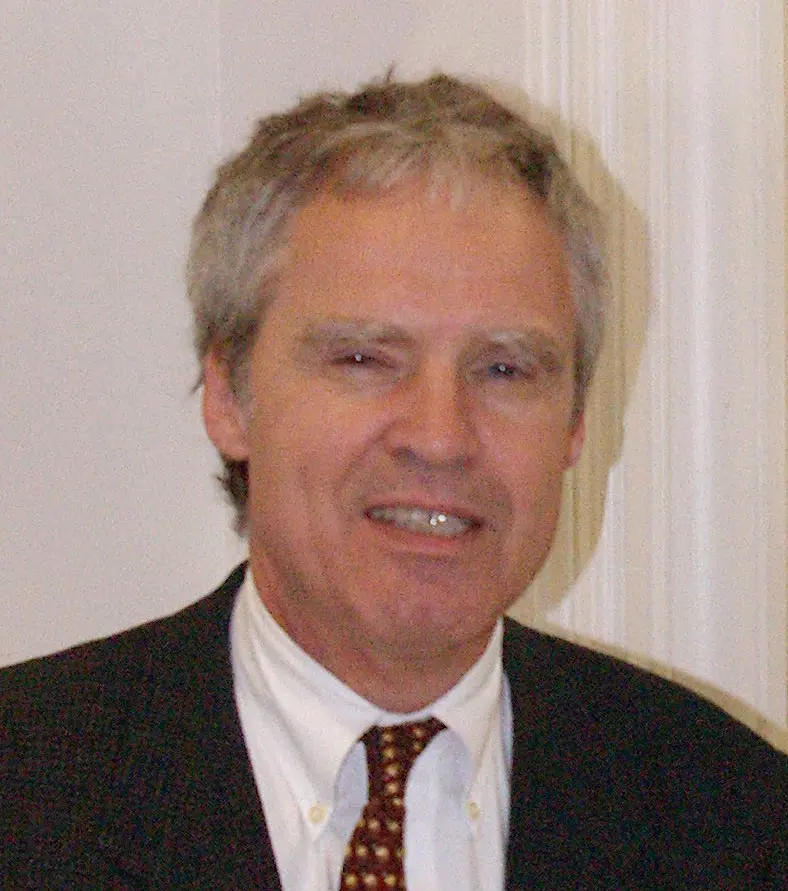
Horst L. Störmer
born 1949 in Germany
As a boy he built a rocket that exploded in his hand and took off half his right thumb. He first studied architecture, then switched to physics.
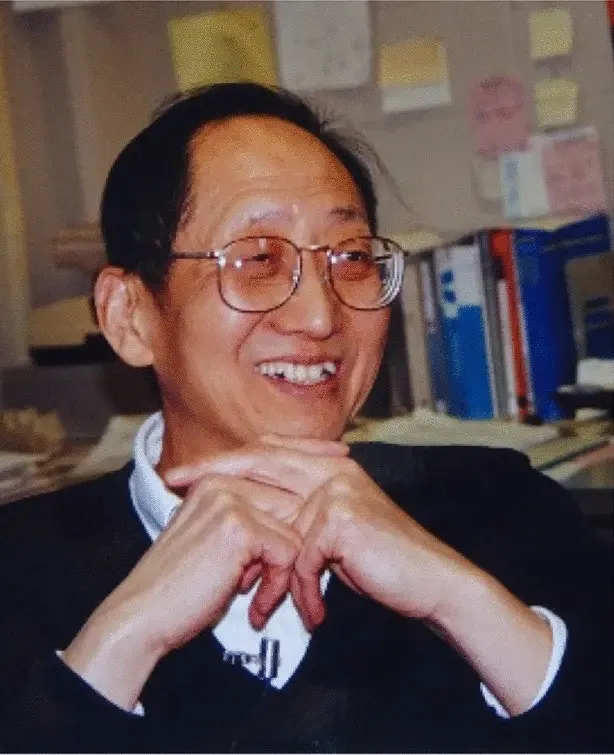
Daniel C. Tsui
born 1939 in China
He grew up in a village in Henan, where his parents could not read or write. In 1951, when he was about twelve, they sent him away to school in Hong Kong, so that he could have the education they never had.
Photo: Istvan Hargittai, CC BY 4.0
You have learned that electric charge comes in tiny, fixed packets. One electron carries a charge of 1.6 × 10⁻¹⁹ coulomb, and every charge in a battery, a wire or a lightning flash is a whole number of these packets Grade 9: The units of charge and current. Nobody has ever caught a free piece of an electron.
So in 1981, when two physicists in the USA measured something that seemed to say “a third of an electron’s charge”, it looked impossible. In 1998 the Nobel Prize in Physics went to them, Daniel Tsui and Horst Störmer, and to Robert Laughlin, who explained what they had seen. The electrons had not been split. They had learned to dance together.
The Hall effect: a magnet pushes current sideways
In 1879 Edwin Hall, a student at Johns Hopkins University in the USA, did a simple experiment. He passed a current along a thin strip of gold leaf and held a strong magnet so that its field went straight through the strip.
You know from the motor effect that a magnetic field pushes on a wire carrying a current Grade 10: Motor effect. The push is really on the moving charges inside the wire. In Hall’s strip, the electrons could not leave the metal, so the push moved them sideways, towards one edge. Negative charge piled up on one edge, and the other edge was left short of electrons. That made a small voltage across the strip, from one edge to the other. It is called the Hall voltage.
Hall found that his voltage grew in a straight line with the strength of the magnet. Divide the Hall voltage by the current and you get a number in ohms, called the Hall resistance Grade 9: Ohm’s law. It tells physicists how many free electrons a material has, and today it is used in millions of small Hall sensors: in cars, in bicycle speedometers, and in many phones, to sense a magnet or the Earth’s magnetic field.
In a Hall experiment, why does a voltage appear across the strip, from edge to edge?
Pick an answer to see why.
Electrons in flatland
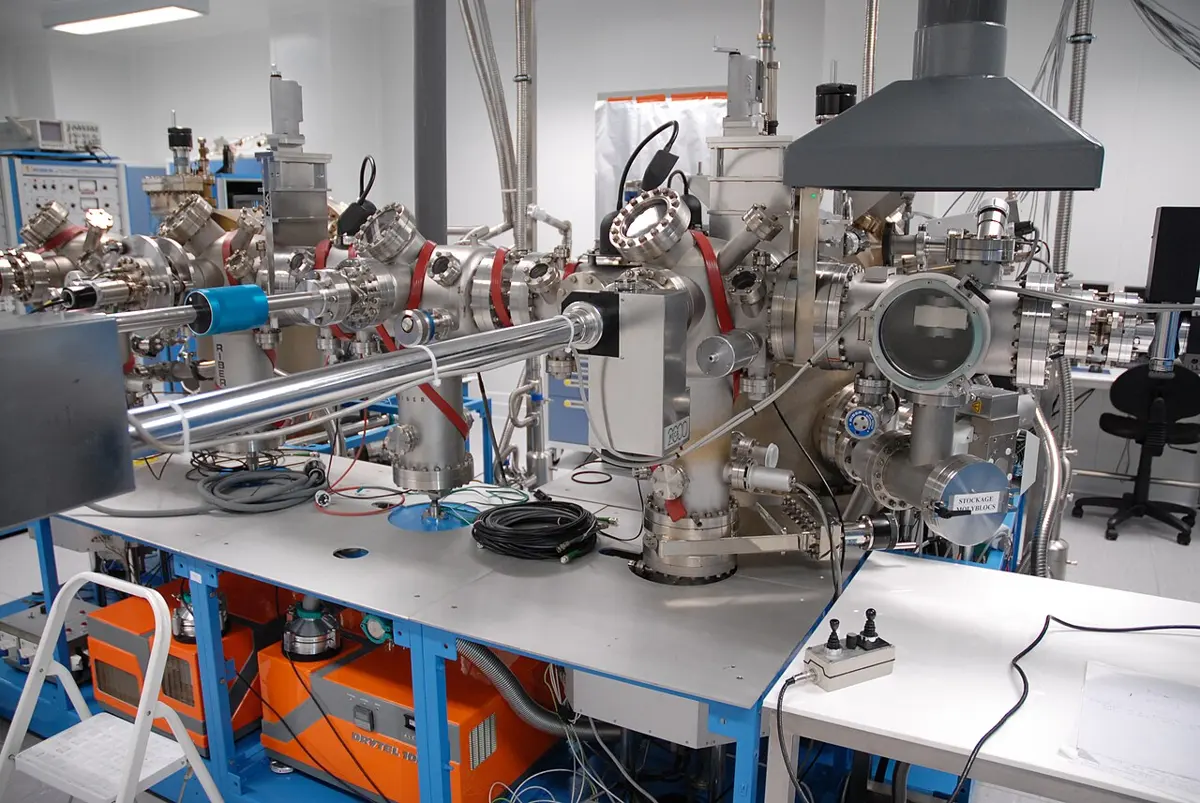
A hundred years later, physicists made a new kind of strip. Instead of gold leaf, they used two crystals, gallium arsenide and aluminium gallium arsenide, grown on top of each other one layer of atoms at a time, in a machine called a molecular beam epitaxy machine. Where the two crystals meet, electrons get trapped in a layer only a few atoms thick. They can move freely along the layer, forwards, backwards and sideways, but not up or down. They live in two dimensions, like drawings on a sheet of paper.
In 1977–78, Horst Störmer, newly arrived at Bell Labs, a famous research laboratory in New Jersey, had a clever idea for such layers, worked out with Ray Dingle. Electrons are set free by adding a few atoms of another element, but those atoms get in the electrons’ way. Störmer’s idea was to put these atoms in the neighboring layer, a little way off. The electrons jump across into the clean layer and leave their atoms behind. Arthur Gossard and Willy Wiegmann, also at Bell Labs, learned to grow the crystals this way. Today such electrons can travel about a fifth of a millimeter, past about a million atoms, without bumping into anything.
Steps instead of a line
In 1980, the German physicist Klaus von Klitzing measured the Hall effect in such a flat layer of electrons, at a few degrees above absolute zero and in a very strong magnetic field. He did not get Hall’s straight line. He got steps: the Hall resistance stayed flat while the field grew, then jumped up to the next step.
The steps were very exact. On every sample, made by anyone, the highest step was 25,813 ohms, a number set only by the electron’s charge and a constant of nature, and the lower steps were exactly a half, a third, a quarter of it. This is the quantum Hall effect, and it won von Klitzing the Nobel Prize in 1985. It could be explained by thinking of each electron on its own: in a strong field, electrons can only have certain energies, and each step was where a whole number of these energy “floors” were full.
The puzzle: past the last step
The highest step comes when all the electrons are crowded onto the lowest floor. Make the field stronger still, and that floor has room for more electrons than there are. Nobody expected any more steps there. Some theorists thought that at even stronger fields the electrons might freeze into a regular pattern, an electron crystal. That is what Tsui and Störmer went looking for.
What they did, step by step
Tsui and Störmer: a step three times too high (1981–82)
Daniel Tsui had worked at Bell Labs since 1968 and was an expert on flat layers of electrons. Horst Störmer had joined in 1977. Together they often took samples to a magnet laboratory at MIT, near Boston, which had some of the strongest magnets in the world.
- The sample. Gossard and Wiegmann made them a new, very clean layer, with fewer electrons than ever before. The piece they took was about 6 mm long and 1.5 mm wide, with gold wires attached.
- October 1981, the measurement. They cooled it to about 1.5 degrees above absolute zero (about −271.6 °C) and put it in a magnet that reached about 15 teslas, hundreds of thousands of times stronger than the Earth’s magnetic field. The Hall resistance passed the last step, as expected, and went on rising along a line.
- The surprise. At about 15 teslas, a new step began to appear, and the ordinary resistance along the strip dropped. There should have been nothing there.
- “Quarks!” Tsui measured the distance on the paper chart with two fingers and found that the new step was three times higher than the highest step allowed. He joked “quarks!”: quarks, the particles inside protons and neutrons, are the only known particles whose charges come in thirds of an electron’s. In the explanation of the steps, a step three times higher meant that the current was being carried by something with one third of an electron’s charge.
- 1982. Tsui, Störmer and Gossard published the result. They did not know what it meant. Soon they and others found more steps, at other fractions such as 2/3, 2/5 and 3/7. The discovery is called the fractional quantum Hall effect.
Laughlin: the electrons’ dance (1983)
Robert Laughlin was a young theorist. He had just been told there was no permanent job for him at Bell Labs, and had moved to the Lawrence Livermore laboratory in California. When he received Tsui and Störmer’s paper, he later wrote, he looked at the graph for about ten seconds and was sure: the electrons must be acting together, and something in them must carry a third of the charge. The hard part was to show how.
- Electrons avoid each other. All electrons are negative, so they push each other away. In the flat layer, in a very strong field and at very low temperature, this push becomes more important than anything else.
- A quantum fluid. Laughlin found a way to describe how perhaps 100 billion electrons move all at once. They form a new kind of liquid, in which every electron keeps out of every other’s way in a perfectly coordinated pattern, like dancers in a huge crowd who never bump. It is a quantum fluid, related to superconductors, which carry current with no resistance.
- Whirls. In this fluid the magnetic field acts as if it is made of tiny whirls, and at the 1/3 step there are exactly three whirls for every electron. Each electron keeps its three whirls around it, and that keeps the dancers apart.
- Thirds. Now push in one extra whirl. It takes a share of the room that would belong to a third of an electron, so the electrons move a little apart, and a small patch of the fluid is left short of exactly one third of an electron’s charge. This disturbance moves through the fluid like a particle. It is called a quasiparticle (“almost a particle”).
His paper explained the 1/3 step exactly, in four pages, and led to explanations of the other fractions.
What carries a charge of one third of an electron’s in the fractional quantum Hall effect?
Pick an answer to see why.
1997: hearing the thirds
Laughlin’s fractions explained the steps, but could the thirds be seen directly? In 1997 two teams, one at the Weizmann Institute in Israel and one near Paris, measured the tiny, crackling ups and downs of a current through such a fluid. A current carried by charges that come in lumps is never perfectly smooth, like the patter of hail on a roof. The size of the patter showed that each lump carried a third of an electron’s charge. The Nobel committee compared it to hearing a hailstorm and telling from the sound that the hailstones are a third of their usual size.
In your life today
- Phones and dishes. The transistors made from these flat layers of electrons amplify weak radio signals: in mobile phones and their towers, and in the dish antennas that pick up satellite TV on rooftops all over Nepal Grade 10: Information and communication technology.
- The ohm itself. Von Klitzing’s steps are so exact that the world’s standard laboratories use them to define the ohm, the unit of resistance. Since 2019 the international units have been based on fixed values of the electron’s charge and of a constant of nature, so a quantum Hall step gives an exact resistance anywhere in the world.
- Hall sensors. The plain Hall effect, Edwin Hall’s, is in sensors that count wheel turns in a car’s brakes and help a phone’s compass.
What came next
- More fractions. Many dozens of fractions have since been found. In 1989 Jainendra Jain, a physicist born in India, found a simpler way to see many of them, as electrons each carrying whirls along with them, called composite fermions.
- New materials. The effect has since been seen in graphene, a sheet of carbon one atom thick (the 2010 prize).
- A new kind of computer? When two quasiparticles swap places, they behave like neither electrons nor any ordinary particle; they are called anyons, and in 2020 two experiments showed this directly for the 1/3 kind. One step, at 5/2, may hold anyons of a stranger kind, which “remember” how they have been moved around each other. Physicists hope such particles could make the building blocks of a quantum computer that errors cannot easily upset. Whether the 5/2 kind can be used for computing is an open question that labs around the world are working on now.
Why do physicists study these effects at only a degree or two above absolute zero?
Pick an answer to see why.
In your science books
- Grade 9: charge and current, the unit of charge, Ohm’s law and resistance; the structure of an atom.
- Grade 10: the magnetic effect of a current and the motor effect, the push that causes the Hall effect.
- Going further: how magnets push without touching.
Learn more
- The Nobel Prize’s press release for 1998, with its graph of the steps.
- The Nobel lectures: Störmer (with the original chart paper from October 1981), Tsui and Laughlin.
The official reason
The prize was given “for their discovery of a new form of quantum fluid with fractionally charged excitations.”