
The germ behind stomach ulcers
Nobel Prize in Physiology or Medicine, 2005: J. Robin Warren and Barry J. Marshall

J. Robin Warren
1937–2024, born in Adelaide, Australia
A pathologist: a doctor who studies tissue under the microscope. He saw the bacteria first, and kept saying they mattered when almost nobody believed him.

Barry J. Marshall
born 1951 in Kalgoorlie, Australia
A young doctor in training when he joined Warren. To prove their idea, he drank a broth full of the bacteria.
Photo: Binarysequence, CC BY-SA 4.0
In Nepal, when people have a burning pain in the stomach, they often say they have “gastric”. Many blame it on too much chilli, too much tea, an empty stomach, or worry. For most of the 20th century, doctors around the world thought much the same: stomach ulcers came from stress, spicy food and too much acid.
Two doctors in Perth, Australia, showed that this was mostly wrong. Most ulcers are caused by an infection: a small spiral bacterium that lives in the stomach. An ulcer that once troubled a person for life can now be cured with a week or two of medicines. In 2005 Robin Warren and Barry Marshall won the Nobel Prize in Physiology or Medicine for this discovery.
The problem: ulcers that kept coming back
What an ulcer is
Your stomach makes hydrochloric acid, strong enough to dissolve metals like zinc Grade 8: Acids. The acid kills most germs in your food and helps enzymes break down proteins (Taking food apart). The stomach does not digest itself because its inner wall is covered by a thick layer of mucus, a slimy coat that keeps the acid away from the cells.
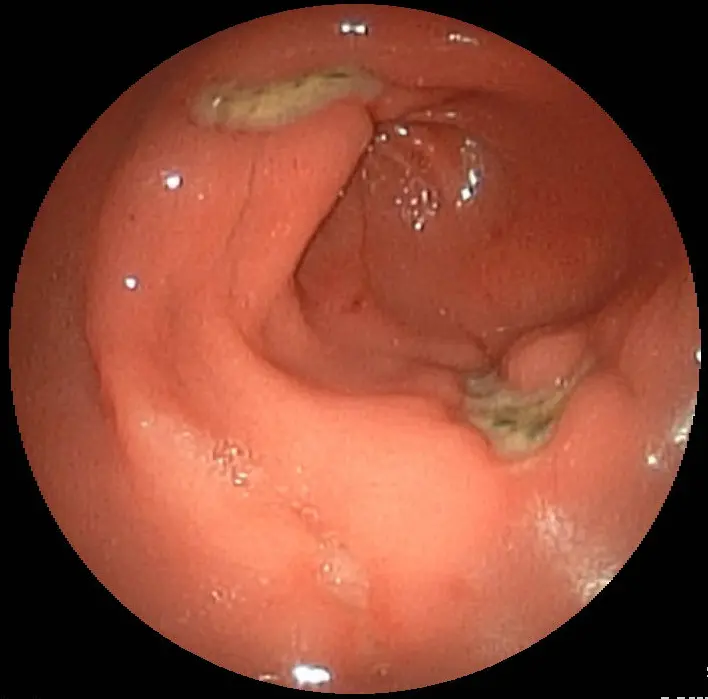
Sometimes the wall gets inflamed: red, swollen and sore. This is gastritis. If the damage goes deeper, an open sore forms, like a mouth ulcer but in the stomach. This is a peptic ulcer. Most form not in the stomach itself but just after it, in the first part of the small intestine, the duodenum.
Ulcers are painful. They can bleed, and they can even make a hole right through the wall, which can kill. They are one of the most common diseases in the world.
“No acid, no ulcer”
Doctors believed ulcers came from too much acid, caused by stress and the wrong food. So they treated the acid. Patients were told to rest, eat bland food and drink milk. From the late 1970s, new medicines that cut the stomach’s acid healed ulcers well. But when patients stopped taking them, the ulcers usually came back. Many people took the tablets for years. Others had part of the stomach removed by surgery.
And there was one thing every doctor knew: no bacteria could live in the stomach. The acid was far too strong.
Why did doctors believe that no bacteria could live in the stomach?
Pick an answer to see why.
What they did, step by step
Warren: bacteria where there should be none (1979–1981)
Robin Warren was a pathologist at Royal Perth Hospital. Every day he looked at thin slices of tissue, taken from patients, under the microscope.
- June 1979. Looking at a small piece of a patient’s stomach wall (a biopsy), Warren saw a thin blue line on its surface. His colleagues could not see anything there, so he used a silver stain, which makes bacteria show up dark. The line was made of huge numbers of small curved and spiral bacteria, lying close against the stomach’s cells.
- A pattern. He began finding the same bacteria in many more biopsies: in about half of the patients. And he noticed something important. Wherever the bacteria were, the stomach wall underneath was inflamed. Where there were no bacteria, the wall was usually healthy.
- Nobody listened. Warren told his colleagues that the bacteria might be causing the gastritis. Most of them did not believe him. Other people had reported spiral bacteria in the stomach before, as far back as the 1800s, but everyone had decided they were just germs swallowed with food, or a mistake.
Marshall: growing the bacteria (1981–1983)
In 1981 Barry Marshall, a young doctor in training, needed a research project. He was sent to Warren, who handed him a list of patients with the bacteria. Marshall became fascinated.
- A study of 100 patients. Together they planned a study: Marshall took biopsies from 100 patients during endoscopy, an examination in which a thin flexible tube with a camera is passed down the throat into the stomach. Warren looked for the bacteria.
- Growing them failed. To study a germ properly, you need to culture it: grow it on a plate of nutrient jelly in a warm cupboard (an incubator). Marshall’s plates showed nothing, again and again, for months.
- Easter 1982, a lucky accident. A biopsy from patient number 37 was put on plates on the Thursday before Easter. The laboratory was very busy that weekend, and nobody looked at the plates until Tuesday: five days later. Tiny see-through colonies had grown. Marshall then learned that the laboratory had been treating his samples like throat swabs and throwing them away after two days. His bacteria simply grow slowly.
- The results. The bacteria were found in almost all patients with gastritis, with a duodenal ulcer, or with a stomach ulcer. Warren and Marshall wrote about them in the medical journal The Lancet in 1983 and 1984. In 1989 the bacterium got its present name: Helicobacter pylori (“helico” for its spiral shape, “pylori” for the lower part of the stomach where it lives).
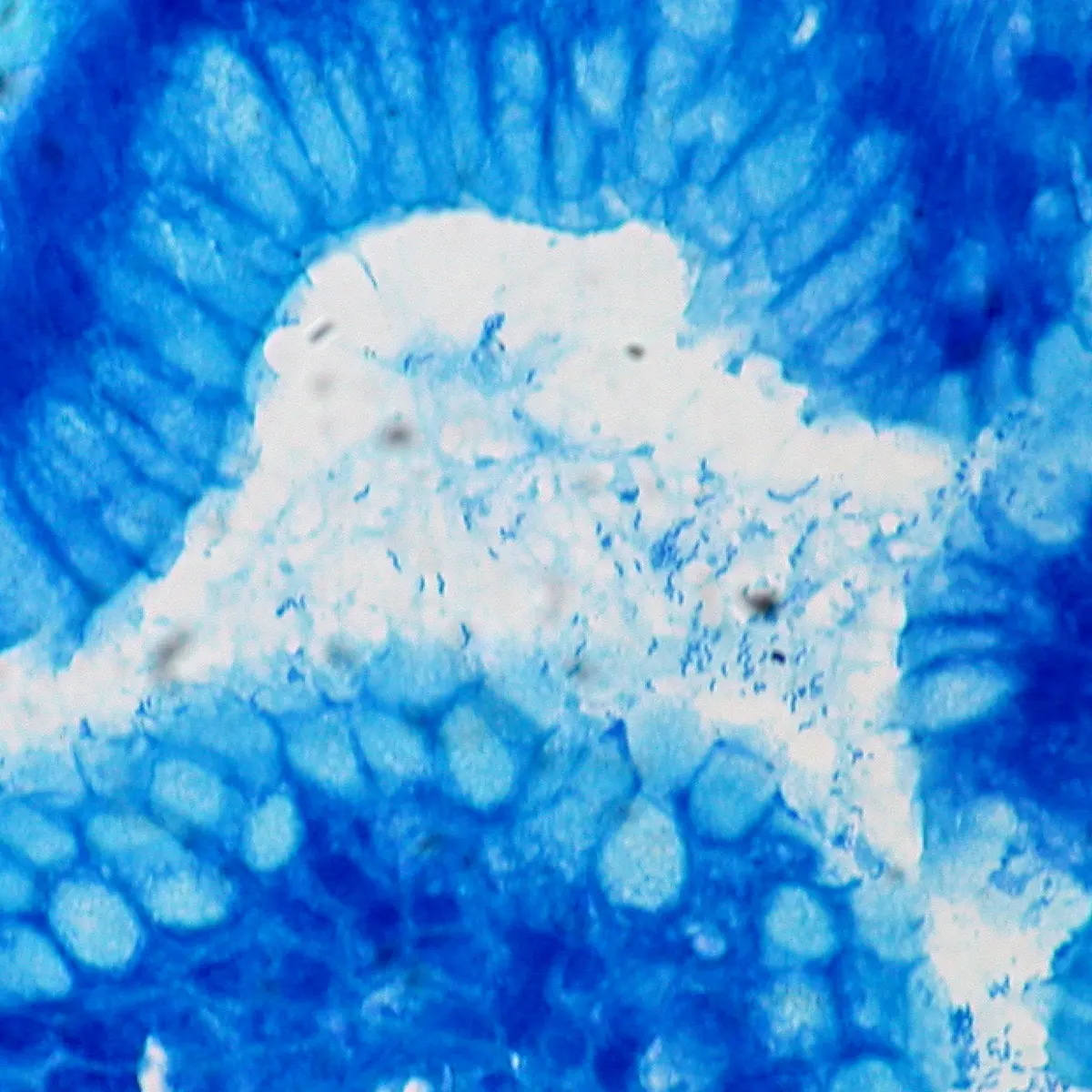
Many doctors still did not believe it. Finding bacteria in sick stomachs did not prove that the bacteria made them sick. Perhaps the bacteria simply liked to live in stomachs that were already damaged.
The test on himself (1984)
More than a hundred years ago, the German doctor Robert Koch set out rules for proving that a germ causes a disease (see Koch and tuberculosis). The hardest one: the germ, grown on its own, must cause the same disease when given to a healthy animal. Marshall tried to infect piglets, but it did not work. H. pylori lives only in humans.
So Marshall decided to test it on himself.
- The start. First he had an endoscopy to show that his own stomach was healthy, with no bacteria.
- The drink. In 1984 a colleague scraped the bacteria from a culture plate into a small amount of broth. Marshall drank it in one gulp. He did not tell his wife until that evening.
- Getting sick. For a few days he felt fine. Then, from about the fifth day, he woke up feeling sick and vomited each morning. He felt tired and his breath smelled bad. His wife noticed.
- The proof. About ten days after the drink, a second endoscopy showed that his stomach was inflamed, and the biopsy was full of spiral bacteria. The germ, grown on its own, had caused gastritis in a healthy person.
- The end. Two weeks after the drink, the bacteria had gone, and Marshall then took an antibiotic too.
The cure
The last part of the proof was to remove the germ and see whether the ulcer stayed away. Marshall, Warren and other doctors gave ulcer patients antibiotics along with ulcer medicine. When the bacteria were wiped out, the ulcers healed and, in most patients, did not come back. When the bacteria remained, the ulcers usually returned. By the mid-1990s doctors around the world were treating ulcers with antibiotics.
Which result best showed that H. pylori causes ulcers?
Pick an answer to see why.
How H. pylori lives in the stomach
H. pylori is a small spiral bacterium, a few thousandths of a millimeter long, with several whip-like tails called flagella. It has two tricks for living where the acid is.
- It hides. It uses its spiral shape and its flagella to corkscrew through the thick mucus to the thin layer right against the stomach wall. There the mucus is almost neutral, not acidic.
- It makes its own shield. It makes large amounts of an enzyme called urease, which splits urea (a waste substance found in body fluids) into ammonia and carbon dioxide. Ammonia is a base, so it neutralizes the acid around the bacterium Grade 8: Acids react with bases.
The body fights back. White blood cells gather in the wall, and the wall becomes inflamed. But the body usually cannot get rid of the bacteria, so the inflammation goes on for years. In some people the infection also makes the stomach produce more acid, and this acid damages the duodenum, where most ulcers form.
About half of all people in the world carry H. pylori. It is usually caught in early childhood, often from a family member, and it stays for life unless treated. It is more common where homes are crowded and clean water is scarce. Most people who carry it never feel ill. About 10–15% of them get an ulcer at some time in their lives.
In your life today
- Ulcers can be cured. Today a patient with an ulcer and H. pylori takes an acid-reducing medicine and two antibiotics together, usually for one to two weeks. Most are cured for good. Two antibiotics are used because the bacterium is less likely to survive both (Why two drugs at once).
- A test you breathe into. One test for H. pylori uses its urease. The patient swallows a drink of urea made with a special kind of carbon. If the bacteria are there, they split it, and the special carbon comes out in the breath as carbon dioxide.
- Not every ulcer is caused by a germ. The other common cause is painkillers such as aspirin and ibuprofen, taken often or for a long time. Spicy food and stress do not cause ulcers, though they can make a sore stomach feel worse. And not every “gastric” pain is an ulcer: a doctor can find out.
- Stomach cancer. A long infection with H. pylori is also the main cause of stomach cancer, which was the fifth most common cancer in the world in 2022. Treating the infection lowers the risk.
What came next
- Antibiotics stop working. H. pylori is becoming resistant to the antibiotics used against it, especially one called clarithromycin. In 2017 the World Health Organization listed resistant H. pylori among the germs for which new medicines are most needed. Doctors now test which antibiotics will work before treating, where they can (What an antibiotic does).
- Germs behind other diseases. If a common disease like ulcers could be caused by a germ, could others be too? The discovery started a search for germs behind other long-lasting illnesses, and helped show how long infections can lead to cancer.
- An open question: friend or enemy? H. pylori has lived in human stomachs for at least tens of thousands of years, and traveled with people as they spread around the world. Most people who carry it stay healthy. Some studies suggest that, in childhood, it might even protect against some illnesses, such as asthma. Should everyone who carries it be treated, or only people who are ill? Scientists still disagree, and there is still no vaccine.
In your science books
- Grade 8: acids and acids and bases neutralizing each other.
- Grade 9: kingdom Monera (bacteria), chemical reactions in daily life (how an antacid works) and the steps of scientific learning.
- Going Further: What happens to the dal bhat you eat? and Why do antibiotics stop working?
- More Nobel Prizes: Robert Koch and tuberculosis and penicillin, the first antibiotic.
Learn more
- The Nobel Prize’s announcement: Press release: the 2005 Nobel Prize in Physiology or Medicine (nobelprize.org).
- The two laureates’ Nobel lectures, with their own stories: Warren and Marshall.
The official reason
The prize was given “for their discovery of the bacterium Helicobacter pylori and its role in gastritis and peptic ulcer disease.”