
Bouncing X-rays and trails of cloud
Nobel Prize in Physics, 1927: Arthur H. Compton and C. T. R. Wilson
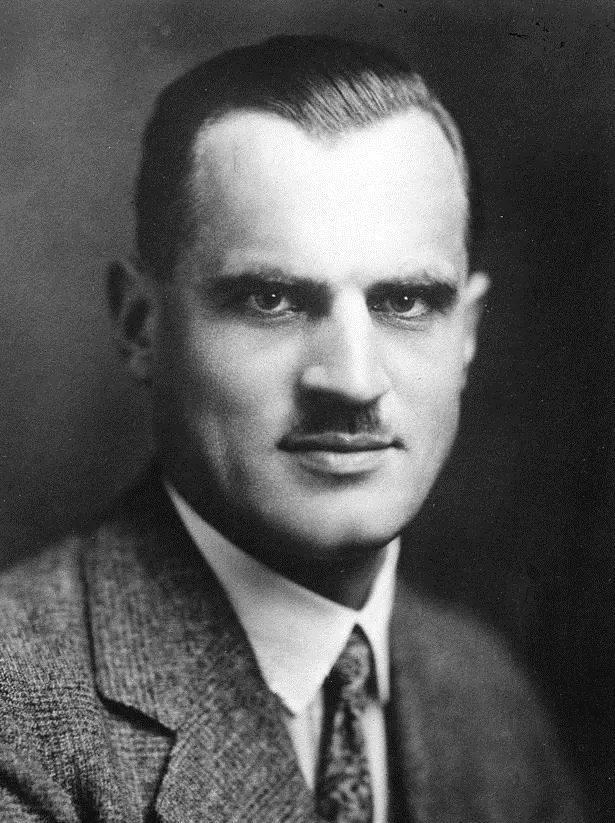
Arthur H. Compton
1892–1962, born in the United States
A careful measurer of X-rays who believed his numbers even when they disagreed with the whole of physics.
Photo: Unknown (Mondadori Publishers), Public domain
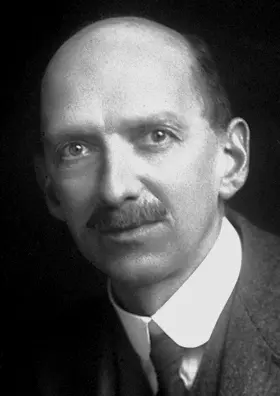
C. T. R. Wilson
1869–1959, born in Scotland
A farmer’s son who fell in love with clouds on a mountain top and spent years making them in glass jars.
Photo: The American Institute of Physics credits the photo [1] to AB Lagrelius & Westphal , which is the Swedish company used b, Public domain
Play a game of carrom. Flick the striker at a coin and watch: the coin shoots off one way, and the striker goes off another way, slower than before. It gave some of its energy to the coin.
In 1922 an American physicist, Arthur Compton, found that X-rays do exactly this when they hit electrons. An X-ray that bounces off an electron comes away with less energy, and the electron flies off. It proved that light, which everyone knew was a wave, also comes in particles. A year later a Scottish physicist, C. T. R. Wilson, photographed those flying electrons, using a machine he had invented that turns the invisible paths of tiny particles into thin trails of cloud. The two men shared the Nobel Prize in Physics in 1927.
The problem: is light a wave or a stream of particles?
For a hundred years, experiments had shown that light is a wave. Light spreads round corners and makes patterns of bright and dark stripes, just as water waves do (waves that cancel). Radio waves, light and X-rays are all the same kind of wave, electromagnetic waves, differing only in their wavelength, the distance from one crest to the next. X-rays have a very short wavelength, about ten thousand times shorter than visible light Grade 9: the electromagnetic spectrum.
But in 1905 Albert Einstein suggested that light also comes in tiny packets of energy, later called photons. His idea explained how light knocks electrons out of metal (the photoelectric effect; read our page on Einstein’s prize). Yet most physicists did not believe that photons were real. Light a stream of particles? It seemed to throw away a century of careful experiments.
There was a puzzle with X-rays, too. When X-rays pass through a material, some of them are knocked sideways, or scattered. The wave picture said the scattered X-rays must have exactly the same wavelength as the X-rays that went in. A wave makes the electrons in the material shake back and forth, and a shaking electron gives out a wave of the same wavelength, as a swing pushed in time keeps the same rhythm. But in earlier experiments, the scattered X-rays seemed slightly “softer” (less able to pass through metal) than the X-rays that went in. Nobody knew why.
According to the wave picture of light, what should happen to the wavelength of X-rays scattered by a block of carbon?
Pick an answer to see why.
What Compton did, step by step
- 1918, a careful start. At first Compton studied how X-rays are scattered by different materials, trying to explain the “softer” rays with the wave picture. None of his explanations worked well.
- 1922, the measurement. At Washington University in St. Louis, he sent X-rays of one single wavelength (from a molybdenum target, about 0.071 nanometers) onto a block of graphite, which is carbon. He caught the X-rays scattered off to the side and measured their wavelengths very exactly with a crystal spectrometer, which spreads X-rays out by wavelength as a prism spreads light.
- What he found. The scattered X-rays had two wavelengths. One was the same as before. The other was longer, by about 0.0024 nanometers for X-rays scattered at a right angle (90°). The further back the X-rays bounced, the longer the wavelength became. And the change was the same whatever material did the scattering.
- The explanation, published in May 1923. Compton stopped thinking of X-rays as waves and treated them as particles, photons, each one bouncing off a single electron.
The carrom explanation
A moving carrom striker carries energy, and it also carries a push in its direction of travel called momentum: the harder it is to stop, the more momentum it has. (In everyday things, momentum is mass × velocity.) When the striker hits a coin, both are shared out: the coin gets some energy and some push, and the striker keeps the rest, so it moves off more slowly and in a new direction (Newton’s third law: the push on the coin comes with an equal push back on the striker).
Compton said a photon does the same. Each X-ray photon carries a fixed amount of energy, and it also carries momentum, even though light has no mass. When a photon hits a free electron, the electron is knocked away, the recoil electron, and takes some of the photon’s energy. The photon bounces off with less energy. And for light, less energy means a longer wavelength: red light has less energy per photon than blue light, and blue less than X-rays.
Using only two rules that every collision obeys, that energy and momentum are never lost, only shared, Compton worked out exactly how much longer the wavelength should be at each angle. His formula matched his measurements. The change in wavelength is now called the Compton effect. Peter Debye, a Dutch physicist working in Zurich, found the same explanation independently at about the same time.
The second, unchanged wavelength comes from X-rays that hit electrons held tightly inside carbon atoms: the photon has to move the whole atom, which is thousands of times heavier, so it loses almost nothing, like a striker bouncing off the edge of the board.
Why do the bounced X-rays have a longer wavelength?
Pick an answer to see why.
What Wilson did, step by step
Charles Thomson Rees Wilson, known as C. T. R., grew up on a farm near Edinburgh. He studied to be a doctor before he turned to physics at Cambridge.
- 1894, a mountain top. In late summer 1894 he spent a few weeks at the weather observatory on the summit of Ben Nevis, the highest mountain in Britain. When the Sun shone on the mist below, he saw his shadow surrounded by rings of color, a glory, and colored rings around the Sun, called coronas. He decided to make clouds in the laboratory to study them.
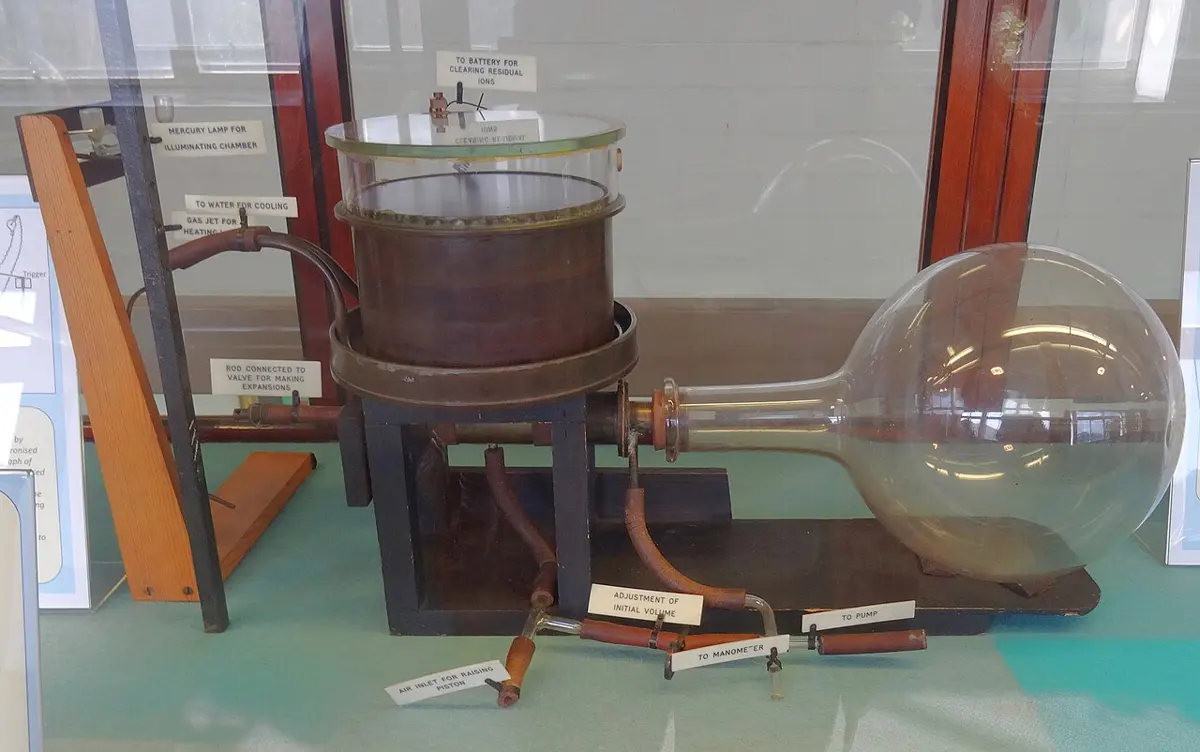
- 1895, clouds in a jar. At the Cavendish Laboratory in Cambridge he built a glass vessel of moist air that he could expand suddenly, with a piston. Air that expands suddenly cools down, and cool air can hold less water vapor, so the extra vapor turns into droplets: a little cloud. In ordinary air the droplets form on specks of dust. Wilson cleaned out all the dust and found that, if he expanded the air enough, a few drops still formed every time. Something invisible in the air was giving them a place to grow.
- 1896, the clue: ions. When he shone the newly discovered X-rays into the jar, the few drops became a thick shower. X-rays were known to turn some air molecules into ions, by knocking electrons off them. So the droplets were growing on ions: an electric charge pulls water molecules in and helps a drop to start.
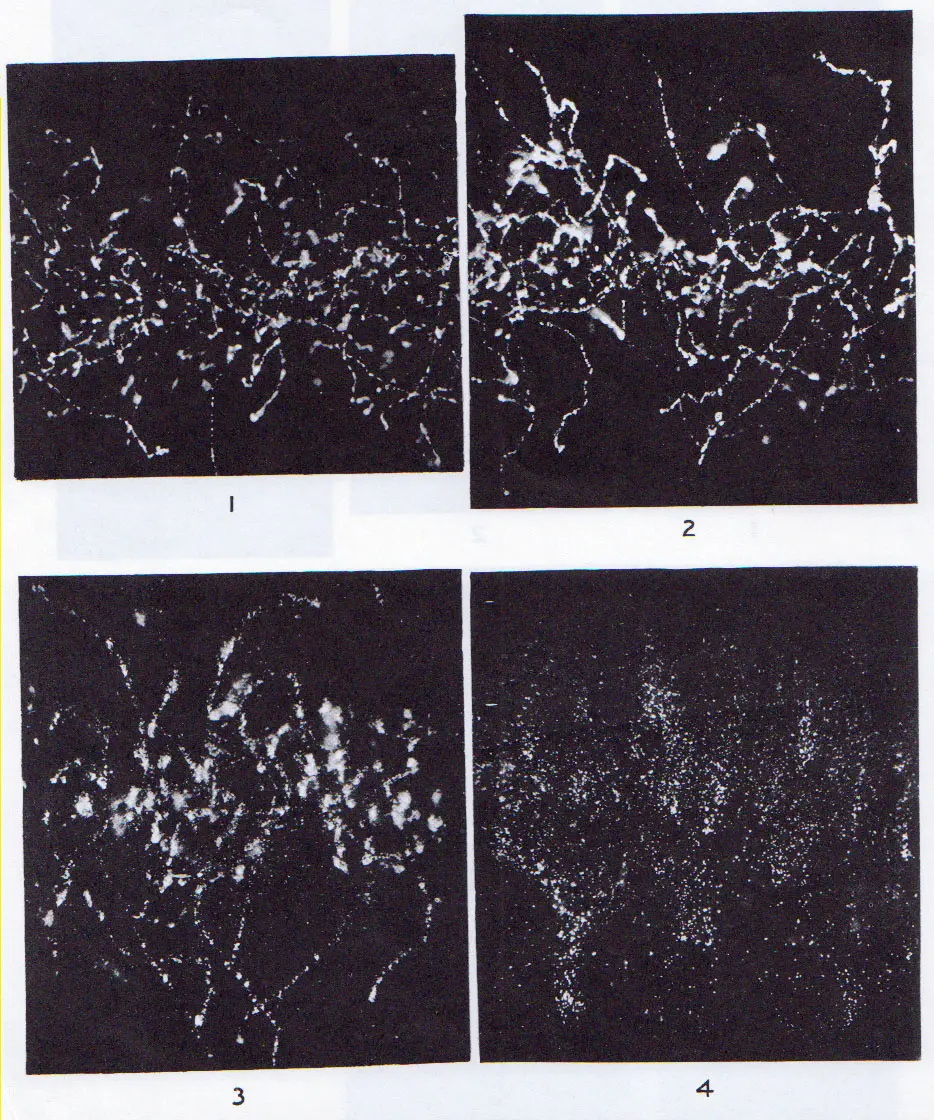
- 1911, the first tracks. A fast charged particle from a radioactive material, such as an alpha particle, leaves a trail of ions behind it as it rips electrons off the air molecules in its way. Wilson realized that if he expanded the air just after a particle passed, droplets would form along its whole path. In 1911 he became the first person to see and photograph the tracks of single alpha particles and electrons. He called the electron tracks “little wisps and threads of clouds”.
- 1923, the perfect chamber. After years of improvements, Wilson’s chamber could photograph the tracks of electrons set free by X-rays, with three pendulums timing the expansion, the X-rays and the flash of light to a small fraction of a second.

This is just how a real cloud forms in the sky, where rising air cools and its water vapor condenses on dust and salt (how a cloud is made). Wilson’s trick was to remove the dust, so that only the ions left by a particle could start the drops. The result is like the white trail an airplane leaves high in the sky: you can’t see the plane, but you can see where it went.
Two halves that fit together
Compton’s theory made a prediction no one had checked: every bounced photon must come with a recoil electron, flying off at a certain angle with a certain energy. Such electrons had never been seen.
Within months of Compton’s paper, in 1923, Wilson found them in his cloud chamber photographs: short electron tracks starting in the X-ray beam, just as Compton had predicted. Walther Bothe in Germany found them independently the same year. In 1925 Compton himself, with Alfred Simon, used a cloud chamber to show that the recoil electron and the bounced photon leave at the angles the collision rules predict, one pair at a time. Bothe and Hans Geiger showed that the photon and the electron come out at the same instant. Photons were real.
When the prizes were presented, the Swedish Academy called the discovery of the recoil electrons “a triumph for both parties”. It also said that, from then on, no theory of the atom could be accepted unless it explained the Compton effect.
How did Wilson’s cloud chamber help to prove Compton right?
Pick an answer to see why.
In your life today
- Hospital X-rays. When X-rays pass through your body, many of them are bounced by electrons in the Compton effect. These scattered X-rays fog the picture slightly, and they are one reason the radiographer stands behind a screen while taking your X-ray Grade 9: X-rays.
- Cancer treatment. The high-energy X-rays used in radiotherapy pass most of their energy to the body mainly through the Compton effect: photons knock out electrons, and the fast electrons damage the cancer cells. Nepal’s cancer hospitals treat patients this way, and the doses are planned with Compton’s rules.
- Security scanners. Some airport and border scanners send X-rays at a bag or a truck and catch the X-rays that bounce back by the Compton effect. They show light materials, such as plastics and food, that ordinary X-ray pictures miss.
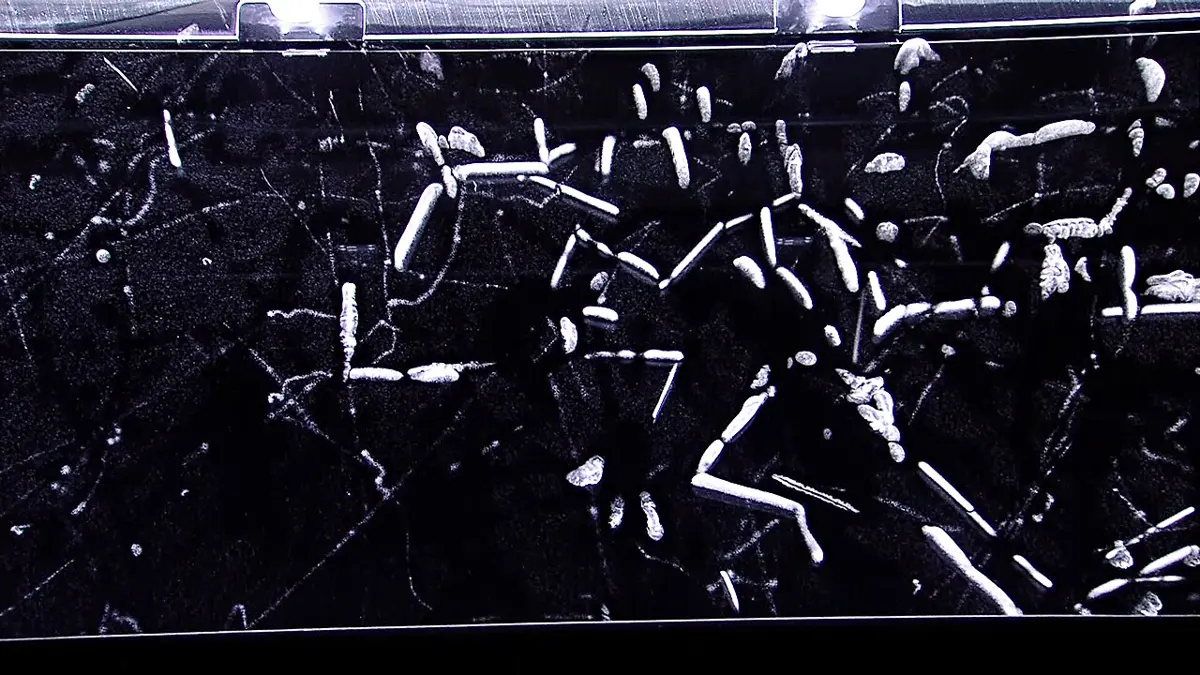
- Particle detectors. Wilson’s chamber was the first of many machines that make particles’ paths visible. Today’s detectors, at laboratories such as CERN, track particles electronically, but the idea is his: a charged particle leaves a trail of ions, and we catch the trail. Many science museums show a cloud chamber where you can watch tracks from the natural radiation all around us appear and fade.
What came next
- New particles. Cloud chambers became the most important tool of particle physics for thirty years. In 1932, in a cloud chamber photograph, Carl Anderson found the positron, the first particle of antimatter (Nobel Prize 1936), and Patrick Blackett used them to watch a gamma ray turn into an electron and a positron (Nobel Prize 1948).
- Wave and particle at once. Compton’s result left physics with a puzzle: light is clearly a wave and clearly a particle. Within a few years the new quantum mechanics showed how both can be true, and that electrons, too, behave like waves (wave or particle?).
- The bomb. During the Second World War Compton led part of the American project that built the atomic bomb, including the reactors that made the plutonium for the bomb dropped on Nagasaki in 1945.
- Lightning and gamma rays. Wilson spent much of his life studying the electricity of thunderclouds. In 1925 he suggested that the strong electric fields inside them could speed electrons up so much that they would give out X-rays and gamma rays. In 1994 a NASA satellite named after Arthur Compton, the Compton Gamma Ray Observatory, detected short flashes of gamma rays coming from thunderstorms. Wilson had been right. But exactly how a flash of lightning gets started inside a cloud is still not fully understood.
In your science books
- Grade 9: the electromagnetic spectrum and X-rays; Newton’s third law; ions; radioactive emissions, the alpha and beta particles whose tracks Wilson photographed.
- Going further: Einstein’s packets of light and wave or particle?; alpha decay, with a cloud chamber photograph; how a cloud is made.
Learn more
- The Swedish Academy’s presentation speech (nobelprize.org).
- The Nobel lectures: Compton’s X-rays as a branch of optics and Wilson’s On the cloud method of making visible ions and the tracks of ionizing particles.
The official reason
The prize was given “for his discovery of the effect named after him.”
The prize was given “for his method of making the paths of electrically charged particles visible by condensation of vapour.”