
Radioactivity: rays from inside the atom
Nobel Prize in Physics, 1903: Henri Becquerel, Pierre Curie, and Marie Curie
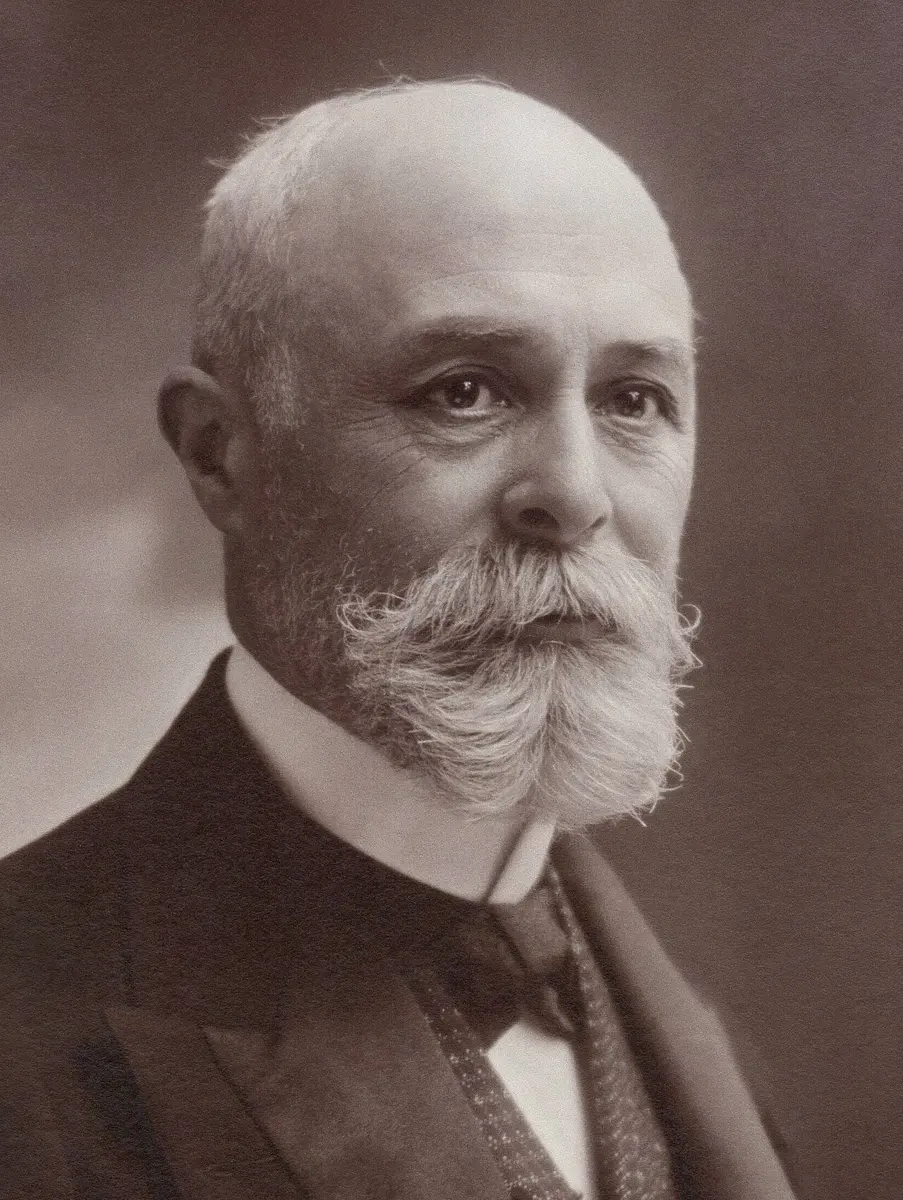
Henri Becquerel
1852–1908, born in France
The third scientist in a row in his family. He studied glowing minerals, as his father had, and found something much stranger.
Photo: Paul Nadar / Adam Cuerden, Public domain
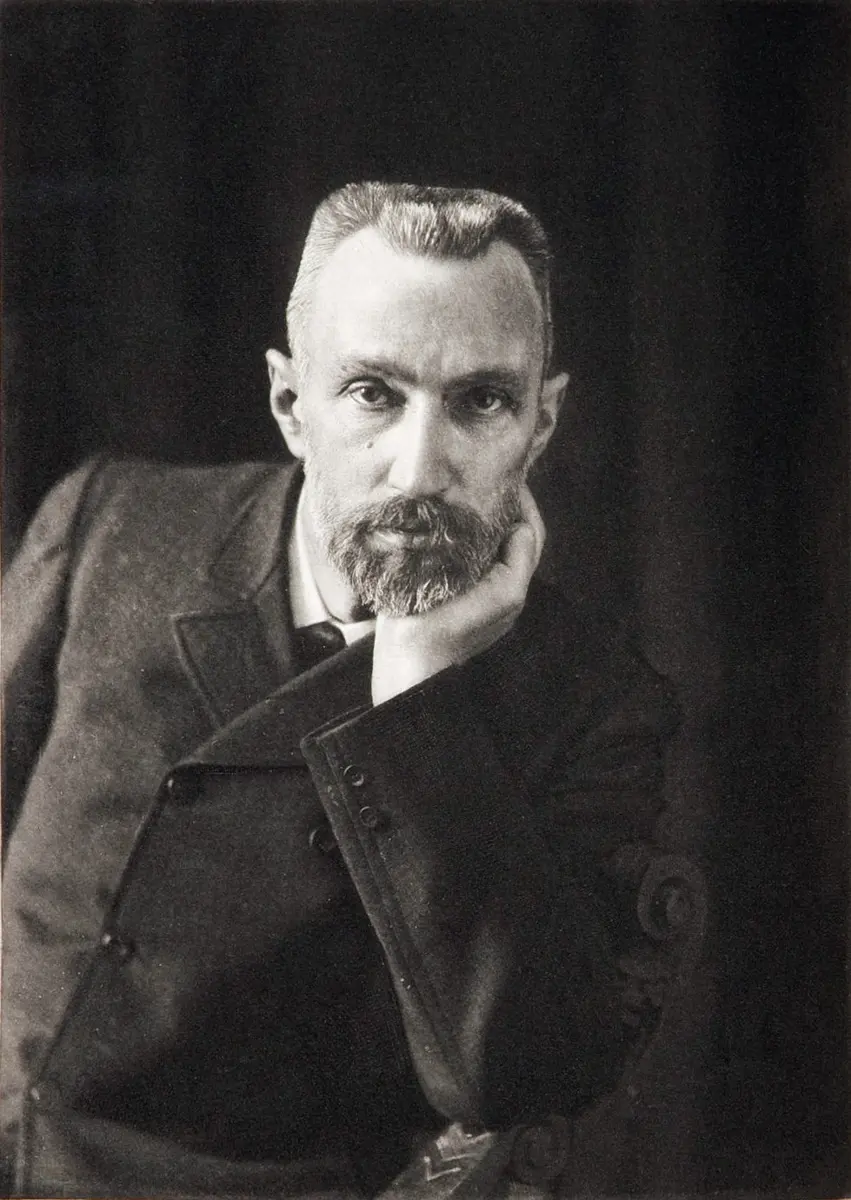
Pierre Curie
1859–1906, born in France
A quiet physicist, expert on crystals and magnets, who dropped his own research to work with his wife on hers.
Photo: Dujardin, Public domain
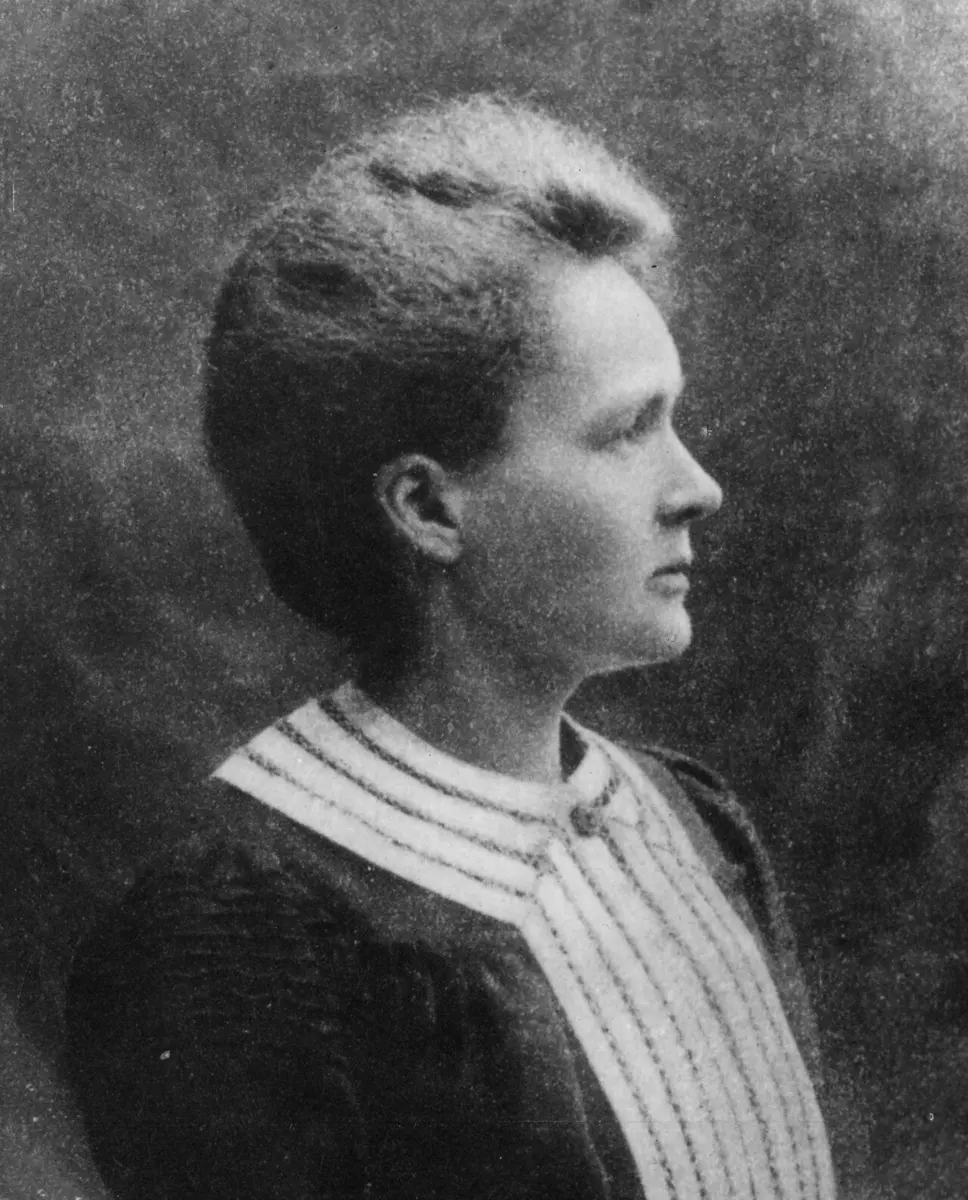
Marie Curie
1867–1934, born in Poland
Came to Paris to study with almost no money, became the first woman to win a Nobel Prize, and later won a second.
Photo: Nobel foundation, Public domain
Hospitals treat cancer with rays that come out of atoms, and rocks millions of years old are dated by them. All of this goes back to a photographic plate left in a drawer in Paris in 1896.
In 1903 the Nobel Prize in Physics was shared by Henri Becquerel, who found that uranium gives off rays all by itself, and Pierre Curie and Marie Curie, who studied those rays, gave them their name, radioactivity, and found two new elements that give off far more of them.
The problem: what are atoms like?
In 1895 almost every scientist believed that atoms were the smallest pieces of matter, and that they never changed. An atom of iron was always iron. Nobody could imagine an atom giving out energy from inside itself.
Then, in December 1895, Wilhelm Röntgen in Germany announced a new kind of ray, the X-ray, which passed through paper, wood and flesh, and blackened photographic plates (X-rays). X-rays came from a glass tube where they made the glass glow. Scientists all over the world began to wonder: do other glowing things give off X-rays too?
Some words you will need
- A photographic plate is a sheet of glass coated with chemicals that darken where light (or X-rays) falls on them. After the plate is developed in a dark room, the darkened places show up as a picture. Wrap it in thick black paper and ordinary light can’t reach it.
- Some substances glow in the dark for a while after sunlight has fallen on them, like the hands of some old watches. This is called phosphorescence. Salts of uranium, a heavy metal, do it.
- An electroscope or electrometer is an instrument that measures electric charge and very small currents.
What they did, step by step
Becquerel and the cloudy days (1896)
Becquerel’s father had studied glowing substances, and Becquerel had a supply of uranium salts from him. His idea was simple: perhaps sunlight makes uranium salts glow, and the glowing salts give off X-rays.
- The test (February 1896). He wrapped a photographic plate in thick black paper, laid crystals of a uranium salt on top, and put them in the sunshine. Sunlight couldn’t reach the plate, but X-rays could pass through the paper. When he developed the plate, it showed dark shapes of the crystals. It seemed his idea was right.
- The cloudy days (26–27 February). He set up the experiment again, this time with a thin copper cross under one group of crystals. But Paris was cloudy, with only dull daylight and a little sun, so he put the wrapped plates and the uranium salts away together in a dark drawer.
- The surprise (1 March 1896). He developed the plates anyway, expecting to see only faint shapes. Instead they were strong, and even the copper cross showed.
- In the dark. He tried again with the salts and plates kept in complete darkness the whole time, and the plates still darkened. The uranium was sending out rays all by itself, with no sunlight at all.
- More tests. Becquerel found that every uranium compound did it, whether it glowed or not, and pure uranium metal most of all. The rays came from the uranium itself. They went on and on, month after month, never getting weaker, from no source of energy anyone could find.
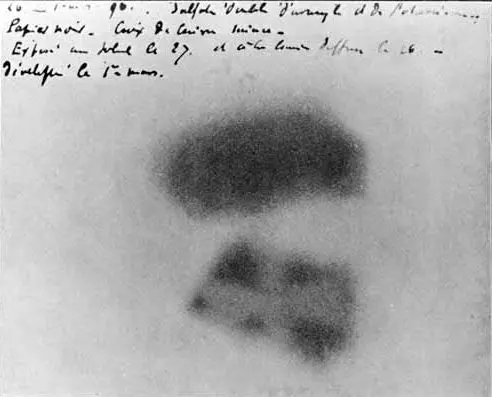
Why did the plates left in the drawer surprise Becquerel?
Pick an answer to see why.
Marie Curie: measuring the rays (1897–1898)
Maria Skłodowska was born in Warsaw, in Poland, in 1867. Women couldn’t study at a university there, and her family had little money. In 1891 she went to Paris, studied physics and mathematics at the Sorbonne, and in 1895 married Pierre Curie, a physicist.
For her doctorate, Marie chose to study Becquerel’s rays. Few people were working on them: X-rays seemed far more exciting.
- A way to measure them. Becquerel’s rays make air conduct electricity. Marie put each substance as a powder on a metal plate, below a second plate, and measured the tiny current that flowed across the air between them. To measure such small currents she used an instrument that Pierre and his brother Jacques had invented years before. Now she could put a number on the rays, not just look at a darkened plate.
- Uranium, and thorium (1898). She tested every element and mineral she could get. Of the elements, only two gave off rays: uranium and thorium. (A German scientist, Gerhard Schmidt, found thorium’s rays at about the same time.) The strength of the rays depended only on how much uranium or thorium there was, not on what it was joined to. So the rays came from inside the atoms. Marie named the effect radioactivity.
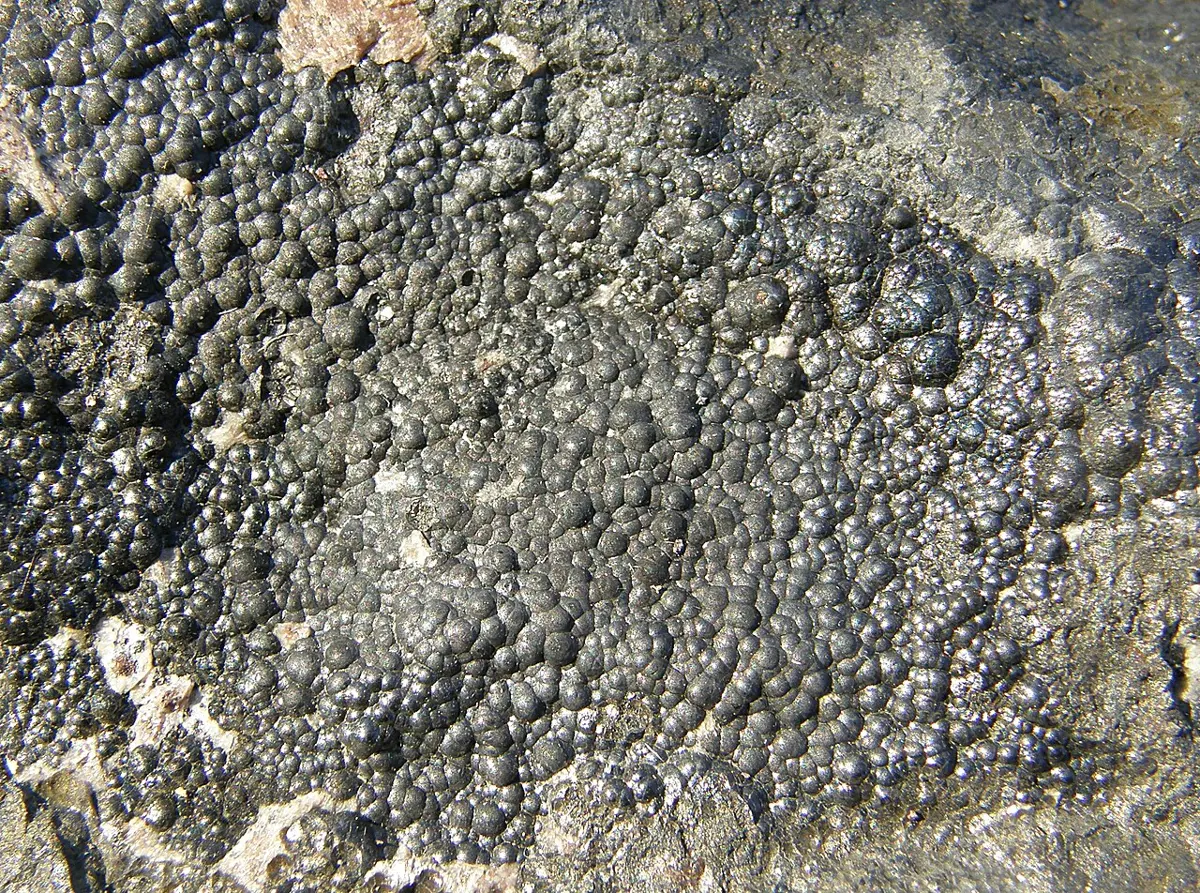
- A clue in pitchblende. Some minerals were more radioactive than the uranium in them could explain. Pitchblende, a black, heavy ore of uranium, gave off more rays than pure uranium. Marie guessed that pitchblende held a new element, in tiny amounts, far more radioactive than uranium.
Two new elements from tonnes of ore (1898–1902)
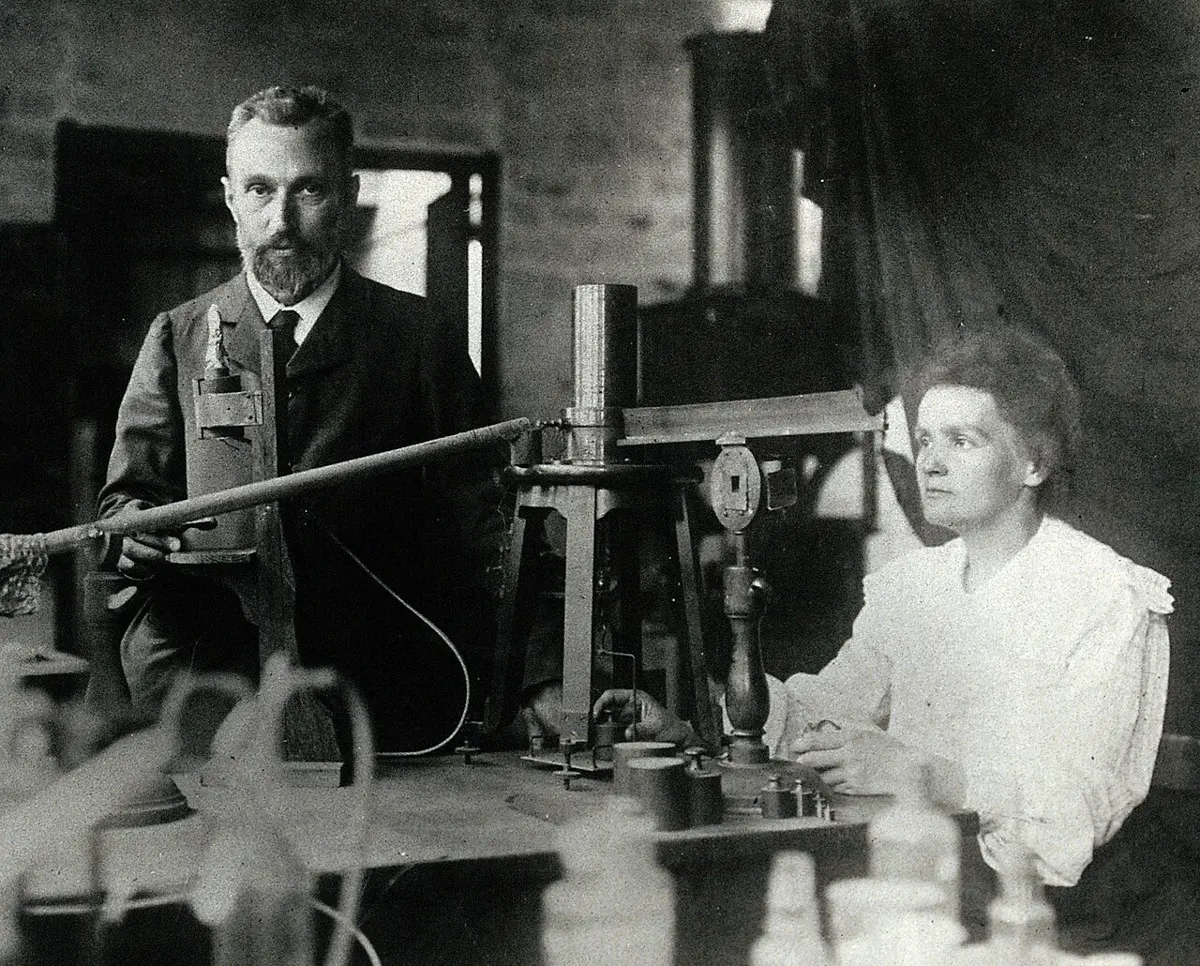
Pierre found her results so exciting that he stopped his own research and joined her.
- Following the rays. They dissolved pitchblende and split it, step by step, into its different chemicals, the way you might sort a heap of mixed seeds. After each step they measured which part was more radioactive, and kept it.
- Polonium (July 1898). One part behaved like the metal bismuth, but was hundreds of times more radioactive than uranium. It was a new element. Marie named it polonium, after Poland, which then didn’t exist as a country: it was divided between Russia, Germany and Austria.
- Radium (December 1898). Another part, with the chemist Gustave Bémont, was more radioactive still. They named it radium, from the Latin for “ray”.
- Proving it. Chemists wanted to see and weigh the new elements. But radium is extremely rare: there was far less than a gram in a tonne of ore. The Curies got tonnes of waste left over from a uranium mine in Bohemia (now in the Czech Republic). In a leaky old shed with a glass roof, Marie stirred boiling pots of ore with an iron rod nearly as big as herself, year after year. In 1902 she had about one-tenth of a gram of pure radium chloride, enough to measure the weight of radium’s atoms.
The prize (1903)
When the Nobel Prize was first proposed in 1903, the nomination named only Becquerel and Pierre Curie. A Swedish mathematician on the committee, Gösta Mittag-Leffler, warned Pierre, and Pierre wrote that if anyone was to be honored for the work on radioactivity, Marie must be too. The prize was shared: half to Becquerel, half to Pierre and Marie together. Marie Curie was the first woman to win a Nobel Prize.
How it works: atoms that break up
The Curies didn’t know where the energy came from. The answer came over the next few years, from Ernest Rutherford and others.
An atom has a tiny nucleus in the middle, made of protons and neutrons Grade 9: Structure of an atom. In most atoms the nucleus is stable and never changes. But in some heavy atoms, such as uranium and radium, the nucleus is unstable: sooner or later it breaks up, and shoots out a particle or a ray. That is radioactivity Grade 9: Radioactive elements and radioactive emission.
There are three main kinds of rays, named after the first three letters of the Greek alphabet:
- Alpha (α): two protons and two neutrons stuck together (a helium nucleus). Stopped by a sheet of paper.
- Beta (β): a fast electron, made in the nucleus. Stopped by a few millimeters of aluminium.
- Gamma (γ): a ray of very high energy, like a strong X-ray. Only thick lead or concrete stops most of it.
When a nucleus gives out an alpha or beta particle, it becomes a different element. Radium turns into radon, which turns into other elements, and in the end into lead. So atoms are not unchangeable after all.
Each radioactive element breaks up at its own steady rate, which nothing (heat, cold, pressure or chemistry) can change. Half of any amount of radium breaks up in about 1,600 years; half of the commonest kind of uranium, in about 4,500 million years. That is why uranium’s rays seemed never to weaken, and why rocks can be dated by them (A clock inside the atom).
A radioactive atom gives out an alpha particle. What happens to it?
Pick an answer to see why.
Rays that can harm
The rays from radioactive elements knock electrons off atoms and molecules in their path, just as they did to the air in the Curies’ apparatus. Inside the body this damages cells and their DNA. Large doses cause burns and sickness; smaller ones, over years, can cause cancer.
At first nobody knew this. In 1901 Becquerel carried a little tube of radium in his waistcoat pocket for some hours, and a few days later found a burn on his skin beneath it. Pierre Curie burnt his own arm on purpose with radium, to study the wound. Such burns led to the first use of radium against cancer, and to the rules for handling radioactive materials safely, from behind shields, with the warning sign ☢.
In your life today
- Treating cancer. Gamma rays and X-rays, aimed carefully at a tumor, kill the cancer cells. This is radiotherapy, and Nepal’s cancer hospitals, such as the B. P. Koirala Memorial Cancer Hospital in Bharatpur, use it every day. Radioactive substances given in tiny amounts also help doctors see how organs such as the thyroid are working.
- Smoke detectors. Many smoke detectors hold a speck of radioactive americium, whose alpha particles make the air between two plates conduct, just as in the Curies’ apparatus. Smoke gets in the way, the current drops, and the alarm sounds.
- Dating the past. Radioactive elements break up at a steady rate, so they work like clocks. Radioactive carbon dates wood and bones up to about 50,000 years old; uranium dates rocks billions of years old.
- Electricity. In nuclear power stations, the energy of breaking uranium nuclei boils water to drive generators Grade 9: Atomic energy.
- Their names. The unit of radioactivity is the becquerel (one atom breaking up each second), an older unit is the curie, and element 96 is curium.
What came next
- Inside the atom. Using alpha particles from radioactive substances as tiny bullets, Ernest Rutherford found in 1911 that every atom has a nucleus. Radioactivity became the key to the structure of the atom.
- Making radioactivity. In 1934 the Curies’ daughter Irène and her husband Frédéric Joliot made radioactive atoms that don’t occur in nature. They won the Nobel Prize in Chemistry in 1935, the Curie family’s third.
- Splitting the atom. In 1938 scientists found that uranium nuclei can split in two, releasing enormous energy.
- The open question. Some nuclear waste stays dangerously radioactive for many thousands of years. Where to keep it safe for that long is still not fully solved.
In your science books
- Grade 8: the atom and its particles.
- Grade 9: structure of an atom, nuclear stability, radioactive elements and radioactive emission, atomic energy, and X-rays.
- Going further: What happens inside a nucleus when it decays? and How old is the Earth?
Learn more
- The prize at nobelprize.org: The Nobel Prize in Physics 1903, with the presentation speech.
- The Nobel lectures of Henri Becquerel and Pierre Curie, and Marie Curie’s biography.
The official reason
The prize was given “in recognition of the extraordinary services he has rendered by his discovery of spontaneous radioactivity.”
The prize was given “in recognition of the extraordinary services they have rendered by their joint researches on the radiation phenomena discovered by Professor Henri Becquerel.”