
Think of the dal bhat you ate yesterday. A heap of rice, a bowl of dal, some tarkari and a spoon of ghee. Where is it now?
Some of it is already gone: it left your body, and not only by the way you are thinking of. Some of it kept you warm last night and moved your legs this morning. And a little of it is now you: part of the muscle in your arm, the hair on your head, the new bone that is making you taller this year. The rice became you. How?
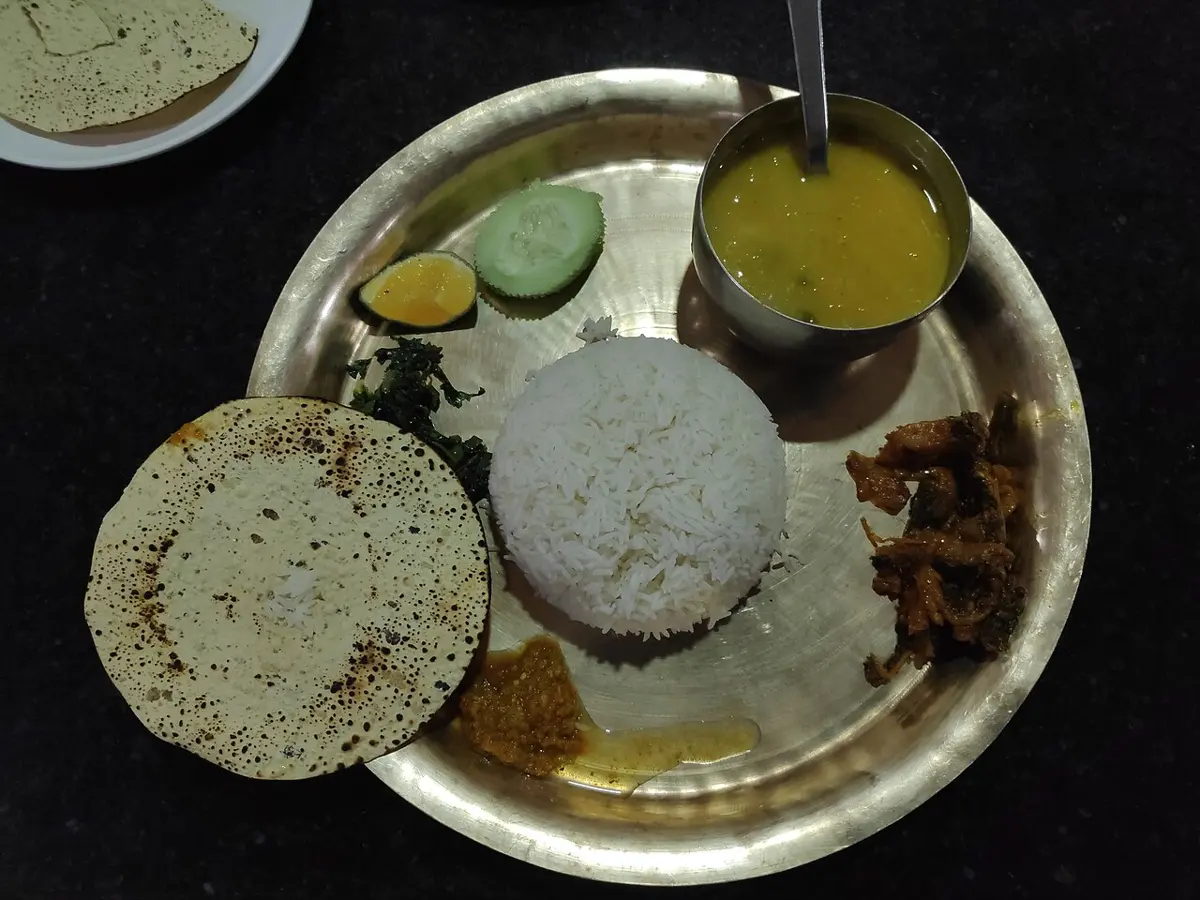
You can’t see the answer by looking at your plate, because it happens to things far too small to see: molecules. In this topic you will follow the molecules in a meal through your body. You will find that your body does two things with them, again and again: it takes them apart, and it puts the pieces together in new ways. Some new molecules become part of you. Others are broken down to give you energy.
Food is made of big molecules
In What Does a Molecule Look Like? you saw that a molecule is a group of atoms held together. Water has 3 atoms. The molecules in food are much bigger: many of them are long chains, built from small units joined end to end, like the beads on a mala.
- Starch, in rice, wheat, maize and potatoes, is a chain of glucose units. Glucose is a sugar. One starch molecule can have thousands of glucose units, some chains with branches.
- Protein, in dal, eggs, milk, meat and soybeans, is a chain of units called amino acids. There are 20 kinds of amino acid, and a protein usually has hundreds of them, in a special order, folded up into a shape.
- Fat, in ghee, oil and nuts, is made of a small molecule called glycerol with three long fatty acids joined to it.
- Fiber, in saag, fruit, the husk of grains and the skins of beans, is the part of plant food your body can’t digest. Much of it is cellulose: a chain of glucose too, like starch, but its glucose units are joined by a different kind of link.
A big molecule like starch can’t pass through the wall of your gut, and your cells can’t use it as it is. So the first job is to take the chains apart into their units. Taking food apart into small molecules that can pass into the blood is called digestion.
Rice and the cotton of your shirt are both made of chains of glucose. You can digest rice but not cotton. Why?
Pick an answer to see why.
Taking food apart
You learned in Grade 6 the parts of the digestive system: the mouth, the food pipe, the stomach, the small and large intestines, and the glands that help. In Grade 8 you saw how muscle in the walls of the gut squeezes food along, and how glands make juices with enzymes in them Grade 8: Cell, tissue and organ. Here is what those enzymes do to the molecules.
An enzyme is a protein that makes one particular chemical reaction happen fast. Each digestive enzyme cuts one kind of link. It holds a chain, and a water molecule joins in at the link, splitting it. One link cut uses up one molecule of water. Then the enzyme lets go, unchanged, and cuts the next link, over and over again.
Different enzymes work in different parts of the gut:
| Where | What happens |
|---|---|
| mouth | Teeth grind food into small lumps. Saliva wets it, and its enzyme, amylase, starts cutting starch into shorter chains. |
| stomach | The stomach churns the food with acid and the enzyme pepsin, which starts cutting proteins into shorter pieces. The acid also kills most germs in food. |
| small intestine | Juice from the pancreas has enzymes for starch, protein and fat. Bile from the liver breaks fat into tiny droplets, as soap does to grease Grade 10: Soap, so the fat enzymes can reach it. Enzymes on the gut wall finish cutting starch and protein. At the end there are single glucose units, single amino acids, and fatty acids and glycerol. |
| large intestine | Only fiber and what can’t be digested arrive here. Bacteria living in it feed on some of the fiber, and the wall takes back water. What is left leaves as feces. |
In the activity above, why do you need cup A, with no saliva in it?
Pick an answer to see why.
From the gut into the blood
Once a meal has been cut into small molecules, they have to get out of the gut and into the blood. This happens in the small intestine, through its wall. Taking digested food through the gut wall into the blood is called absorption.
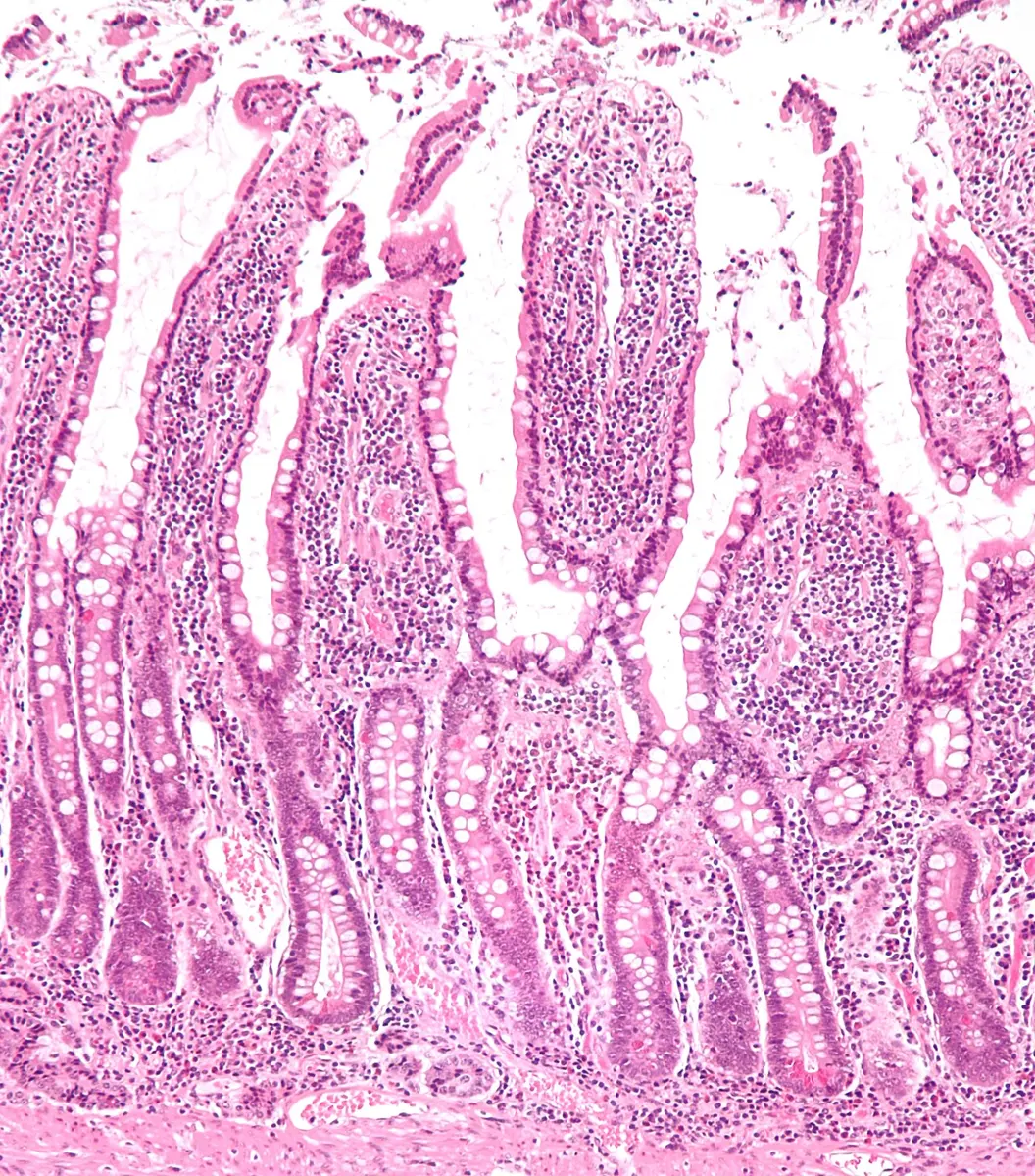
The wall of the small intestine isn’t smooth. Its inside is covered in millions of tiny finger-like bumps called villi (one is a villus), each about half a millimeter to a millimeter tall. Each villus has tiny blood vessels inside it, very close to the surface. The small molecules pass through the thin wall of the villus into the blood. (Most of the fat’s pieces go first into tiny vessels of another liquid, the lymph, which later empties into the blood.) The big molecules can’t pass, which is why they must be digested first.
From the small intestine, the blood carries the glucose, amino acids and other small molecules round the whole body, to every cell, as you will learn in Grade 10 Grade 10: Blood circulation in the human body. A meal takes about 6 to 8 hours to pass through the stomach and small intestine, and then spends a day or two more in the large intestine.
Why does the small intestine need such a large inside surface?
Pick an answer to see why.
Building you
The blood brings small molecules to every cell. Now comes the surprising part: the cell joins them back together, into new big molecules, but not the same ones you ate. It builds the molecules it needs.
Take protein. The protein in dal is a dal plant’s protein, made for a seed. Your body can’t use it as it is. But once it is cut into amino acids, your cells can join those same amino acids in a new order, to make your own proteins: the proteins in your muscles, your skin, your hair and your nails, and enzymes like amylase. The ribosomes in your cells do the joining, following instructions from the cell’s DNA Grade 8: Ribosomes. It is like taking apart a toy house made of plastic bricks and using the same bricks to build a bus.
The same happens to the other pieces:
- Glucose units are joined into glycogen, a branched chain like starch, stored in your liver and muscles to use between meals.
- Fatty acids and glycerol are joined back into fat, stored under your skin and around your organs.
- Spare glucose can even be rearranged into fat. The atoms of the glucose are taken apart and put together into fatty acids, a different kind of molecule. It is one way a person who eats much more rice and sweets than they burn puts on fat.
Making new big molecules from the small ones is how you grow, and how you repair yourself: replacing worn skin, healing a cut, mending a muscle after hard work. Even a grown-up who stops growing keeps replacing molecules and cells every day, so everyone needs food to build with.
After a meal of dal bhat, a few of the amino acids in your blood came from the dal. Which of these can they become?
Pick an answer to see why.
Burning food for energy
Most of the food you eat is not built into you. It is used for energy: to keep your heart beating and your brain thinking, to move, to keep you warm at about 37 °C, and to run the building work itself (joining molecules takes energy too).
You learned in Grade 7 and Grade 8 where this energy comes from: in the mitochondria of each cell, glucose reacts with oxygen and gives carbon dioxide and water, and energy is released Grade 8: Mitochondria. This is respiration, and it happens in every living cell, all the time.
Now look at it as a chemist would. The glucose and oxygen molecules are taken apart into their atoms, and the atoms are put back together in a new way, as carbon dioxide and water. No atom is lost and none is made. But in the new arrangement, the atoms hold on to each other more tightly than before. In Can You Make a Hand Warmer? you saw that pulling atoms apart takes in energy, and joining them gives it out. Here, joining up gives out more than pulling apart took in, and that extra is the energy you get. Respiration is an exothermic change, like burning Grade 9: Exothermic reaction.
Burning slowly
If you dry rice and set fire to it, it burns: it reacts with oxygen, gives carbon dioxide and water, and gives out all its energy at once, as heat and light. In your cells the overall change is the same, and so is the total energy, but it happens in many small steps, each helped by its own enzyme. So the energy comes out a little at a time, and much of it is caught and stored in small molecules called ATP, which carry it to wherever in the cell it is needed. The rest comes out as heat, which keeps you warm.
How much energy is in food?
Food packets in Nepal list the energy in a food in kilojoules (kJ), often with kilocalories (kcal, or Calories) beside them; 1 kcal is about 4.2 kJ.
After respiration, where are the carbon atoms that were in the glucose?
Pick an answer to see why.
Build or burn?
Now you can put the whole story together, in one model.
In every step, the molecules are taken apart and their pieces put together in new ways. Nothing is made from nothing, and nothing disappears: the atoms in your dal bhat end up either in you, or back in the air, the water and the soil.
So how much of the food you eat becomes you? You can work it out.
Plants do it too
A plant does the same two things with its food, but it makes the food itself. In Why Do Two Plants From the Same Field Grow So Differently? you saw that a green plant joins carbon dioxide and water into sugar by photosynthesis, using the energy of sunlight. Then, like you:
- it builds the sugar into new molecules: cellulose for the walls of new cells, starch to store, and, with nitrogen from the soil, proteins;
- it burns some of the sugar in respiration, in its own mitochondria, day and night, to get energy to live and grow.
The starch in a grain of rice was stored by the rice plant for its baby plant, the seed’s embryo. When a seed sprouts, its own enzymes cut that starch into glucose, which the seedling uses for energy and to build its first root and shoot. When you eat rice, you take that store for yourself. And because the plant made its sugar with the energy of sunlight, the energy you get from your dal bhat came, in the end, from the Sun Grade 9: The Sun: the ultimate source of energy.
A sprouting gram seed, kept in the dark, gets lighter (when dried and weighed) every day for the first few days. Why?
Pick an answer to see why.
Questions
Which of these is not a job of digestion?
Pick an answer to see why.
Your friend weighs herself before bed and again when she wakes up, without eating, drinking or going to the toilet. She is a few hundred grams lighter in the morning. Where did most of the mass go?
Pick an answer to see why.
Explain why starch must be digested before your body can use it, but glucose needs no digestion.
Answer
A starch molecule is a long chain of thousands of glucose units. It is far too big to pass through the wall of the small intestine into the blood, or to enter cells. Enzymes (amylase from saliva and the pancreas, then enzymes on the gut wall) cut the links until only single glucose units are left. Glucose is already one small unit, so it can pass through the wall of the small intestine into the blood straight away.
Draw a model, with labeled boxes and arrows, that shows what happens to the protein in a bowl of dal, from your mouth to a muscle cell in your leg. Show where the molecules are taken apart and where they are put together.
Answer
A good model has these steps, with arrows between them:
- Dal protein (a long chain of amino acids) in the mouth: chewed into small lumps, but not changed.
- Stomach: acid and pepsin cut the chains into shorter pieces. Taken apart.
- Small intestine: enzymes from the pancreas and gut wall cut the pieces into single amino acids. Taken apart.
- Villi: the amino acids pass through the gut wall into the blood.
- Blood: carries them to the leg.
- Muscle cell: ribosomes join the amino acids in a new order into muscle protein. Put together. (Spare amino acids are broken down for energy instead.)
The key idea the model must show: the same amino acids are first separated, then joined in a new order, so the dal’s protein becomes a different protein, yours.
Saliva was mixed with starchy water and kept at 37 °C. Every two minutes, a drop was tested with iodine solution. Here are the results (made up, but like real ones):
| Time (minutes) | 0 | 2 | 4 | 6 | 8 | 10 |
|---|---|---|---|---|---|---|
| Color with iodine | blue-black | blue-black | dark purple | reddish-brown | brown | brown |
- a.What does the color change show?
- b.After about how many minutes was there no starch left?
- c.Predict what would happen if the saliva had first been boiled, and explain why.
Answer
- a.Iodine is blue-black with starch and brown without it. The color slowly changing from blue-black to brown shows the starch was being broken down by the amylase in the saliva, into shorter pieces and sugars that iodine doesn’t color blue.
- b.After about 8 minutes: from then on the color is the brown of the iodine itself.
- c.The color would stay blue-black. Amylase is an enzyme, and enzymes are proteins; boiling changes the shape of a protein, so the enzyme can no longer cut the links in starch.
A student says: “When we respire, glucose is turned into energy, so the glucose is gone.” Use the idea of atoms to explain what is wrong, and say where the energy really comes from.
Answer
The glucose molecule is gone, but its atoms are not. Respiration takes the glucose and oxygen molecules apart and puts their atoms together again as carbon dioxide and water: 6 carbon, 12 hydrogen and 18 oxygen atoms before, and the same after. So no matter has been turned into energy. The energy comes from the change in how the atoms are held together: in carbon dioxide and water they hold on more tightly than in glucose and oxygen, so joining up gives out more energy than pulling apart took in. The difference is released, some caught in ATP and some as heat.
A cooked egg has a mass of 50 g and gives about 300 kJ. A cup of black tea with three spoons of sugar gives about 200 kJ. Which helps a growing child more to build muscle, and which only to get energy? Explain using what the foods are made of.
Answer
The egg. An egg is rich in protein (about 6 g in a 50 g egg), which is digested into amino acids that the child’s cells can join into muscle protein. It also gives energy. The sweet tea gives only sugar, which is digested into glucose and a sugar like it (fructose). These can be burned for energy or stored as glycogen or fat, but they have no nitrogen, so it can’t be built into protein. So both give energy, but only the egg gives the building blocks for muscle.
Explain why you breathe faster when you run, using the words respiration, oxygen, carbon dioxide and energy.
Answer
Running muscles need much more energy. They get it by respiration: glucose (and fat) reacts with oxygen in their mitochondria, releasing energy and making carbon dioxide and water. Faster respiration needs more oxygen to be brought in, and makes more carbon dioxide that must be got rid of. So you breathe faster and more deeply, taking more oxygen into the blood in your lungs and breathing out the extra carbon dioxide (and your heart beats faster to carry them).
Where to go next
- How Does a Touch Reach Your Brain? How your senses send messages along nerves to your brain, on the energy your cells get from food.
- Why Are There So Few Tigers? Follow energy and matter beyond one body: from plants to deer to tigers, and back to the soil and air.
- Why Do Two Plants From the Same Field Grow So Differently? Read it here: how genes and surroundings decide how much a plant or animal grows.
- Going further still: How Does Food Become Energy, and Become You? in Going Further 9–12: where the energy in food really comes from, how ATP catches it, and how sugar and nitrogen from the soil become your muscles, fat and DNA.