
Broken symmetry: why matter won
Nobel Prize in Physics, 2008: Yoichiro Nambu, Makoto Kobayashi, and Toshihide Maskawa
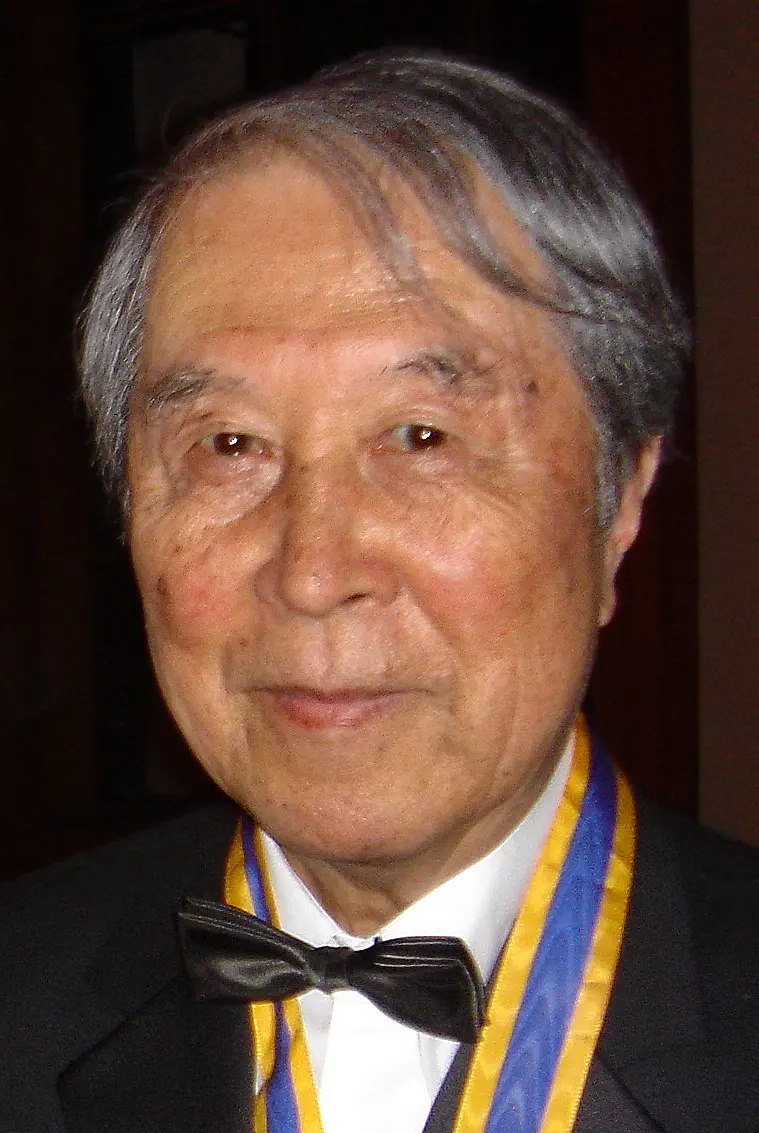
Yoichiro Nambu
1921–2015, born in Japan
A quiet theorist in Chicago, so far ahead of everyone that, as one colleague put it, people did not understand him because he saw so far.
Photo: Betsy Devine, CC BY-SA 3.0
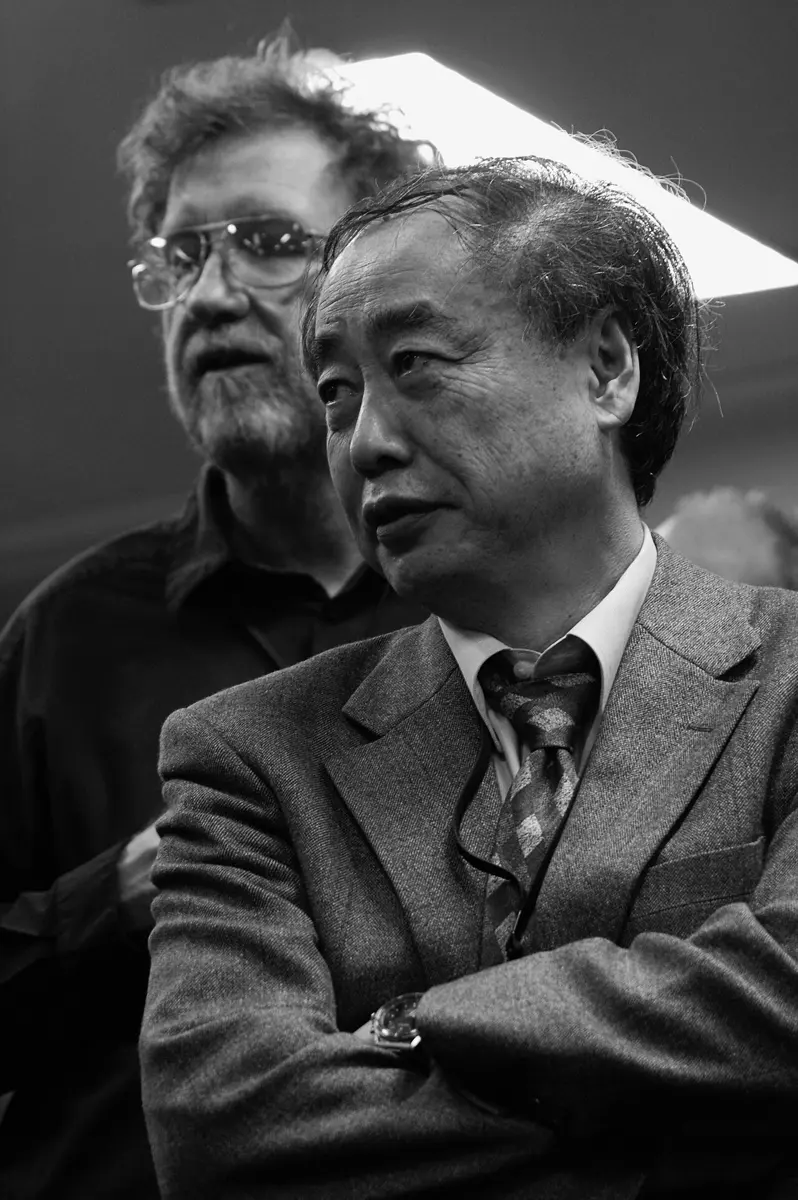
Makoto Kobayashi
born 1944 in Japan
He lost his father at the age of two and grew up in a house that had been bombed in the war. He later helped lead the Japanese laboratory whose experiment proved his idea right.
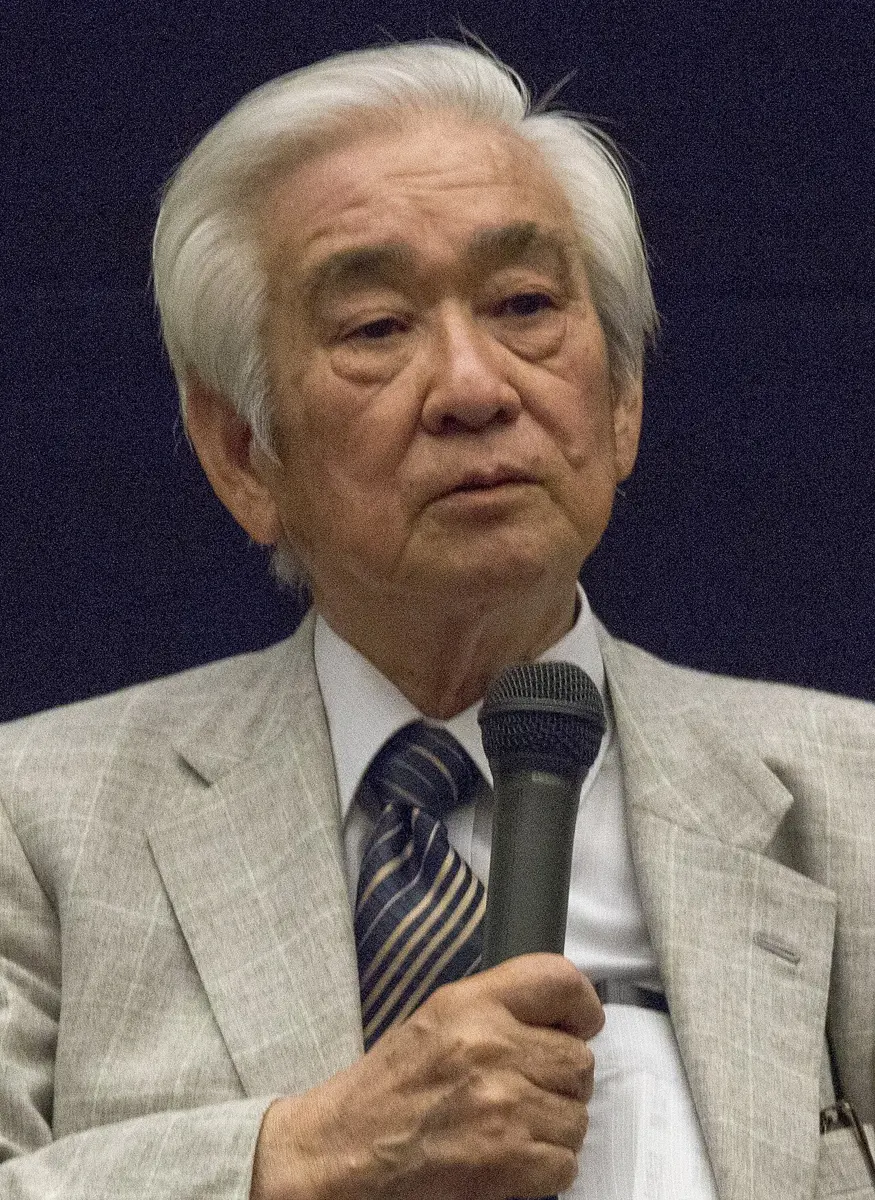
Toshihide Maskawa
1940–2021, born in Japan
The son of a sugar seller, he bought his books with money from selling old sugar sacks. He is thought never to have left Japan until he flew to Stockholm for the prize.
Fold a sheet of paper, put a blob of ink in the fold and press. When you open it, the two halves match exactly. The picture is symmetric. A butterfly’s wings, the letter A and a full moon are symmetric too. Your face is nearly symmetric, but not quite.
Physicists love symmetry. The laws of nature seem to be built on it. But the world we live in is full of things that are not perfectly even, and the biggest of all is this: the universe is made of matter, and almost none of the antimatter that should have been made with it. If the laws were perfectly fair, there would be no stars, no planets and no people. The 2008 Nobel Prize in Physics went to three Japanese-born physicists who showed how symmetries can be hidden and broken: Yoichiro Nambu, Makoto Kobayashi and Toshihide Maskawa.
The problem: laws that were too fair
What symmetry means
Something has a symmetry when you can change it in some way and it still looks the same. Hold the letter A up to a mirror and it looks the same: it has mirror symmetry. The letter Z does not. But turn a Z upside down and it still looks like a Z, while an A does not.
For the laws of physics, a symmetry means that a change makes no difference to how things happen. Physicists tested three such changes for the tiny particles inside atoms:
- Mirror symmetry. Anything that happens should also be able to happen exactly as its mirror image. Left and right should be equal.
- Charge symmetry. Every particle has an antiparticle: the same mass, but the opposite charge. The electron’s antiparticle is the positron, which has a positive charge Grade 9: Positrons in the Sun. Swapping every particle for its antiparticle should change nothing. Things made of antiparticles are called antimatter.
- Time symmetry. A film of particles colliding, played backwards, should show something that could also happen.
These symmetries are not just pretty. Each one is tied to a rule that is never broken: for example, energy is never lost or gained in a collision because the laws are the same today as tomorrow.
The matter puzzle
When a particle meets its antiparticle, both vanish. All their mass turns into energy, as light, by Einstein’s (Mass into energy). Hospitals use this every day: in a PET scan, positrons from a medicine meet electrons in the body and vanish into pairs of gamma rays, which the scanner detects.
In the heat just after the Big Bang, about 14 billion years ago Grade 10: The Big Bang theory, energy turned into particles and antiparticles in equal numbers. If the laws were perfectly fair, every particle would later have met its antiparticle, and the universe would hold nothing but light. Yet here we are. Somehow a tiny extra amount of matter survived.
Why would a universe with perfectly equal amounts of matter and antimatter end up with no stars or planets?
Pick an answer to see why.
Cracks in the mirror
For a long time, physicists were sure the three symmetries always held. Then, one by one, they cracked.
- 1956–57, mirror symmetry. Two Chinese-American physicists, Tsung-Dao Lee and Chen Ning Yang, pointed out that nobody had tested mirror symmetry in the weak force, the force behind some kinds of radioactive decay (Beta decay). Within months, Chien-Shiung Wu and her team tested it with radioactive cobalt-60. The electrons it gave out preferred one direction to the other. The mirror image of the experiment would not happen the same way.
- The rescue. Physicists hoped that a double change would still work: take the mirror image and swap every particle for its antiparticle. Called CP symmetry (C for charge, P for “parity”, the physicists’ word for mirror symmetry), it would mean that an antimatter world, seen in a mirror, behaves exactly like ours.
- 1964, CP breaks too. James Cronin and Val Fitch studied a short-lived particle called the kaon. About two in every thousand of one kind of kaon broke up in a way that CP symmetry did not allow. The difference between matter and antimatter was tiny, but it was real.
Why was this a problem? The best theory of particles at the time had no place for it. Its rules were too fair. Something had to be added to explain the break, without spoiling everything the theory already got right.
What they did, step by step
The prize had two halves, for two different ideas about symmetry: Nambu’s, about symmetries that are hidden, and Kobayashi and Maskawa’s, about one that is truly broken.
Nambu: a symmetry can hide
Yoichiro Nambu grew up in Fukui, Japan. After the Second World War he worked in Tokyo, then moved to the United States in 1952, and in 1954 to the University of Chicago, where he stayed.
- Late 1950s, an idea from metals. Nambu was studying superconductivity: some metals, when cooled to very low temperatures, suddenly let a current flow with no resistance at all. A new theory had just explained it. Nambu noticed that a superconductor’s laws are symmetric, but the state it settles into is not. The symmetry is still in the laws, only hidden in the result.
- 1960, into particle physics. He showed that the same thing can happen with the laws for the smallest particles. He called it spontaneous symmetry breaking: “spontaneous” because nothing from outside breaks it; the system breaks it itself, by settling down.
- 1961, mass from the break. With Giovanni Jona-Lasinio, he used the idea to explain where much of the mass of protons and neutrons comes from.
The Nobel committee used a pencil to explain it. Stand a pencil on its sharp point. All directions around it are exactly the same: it is perfectly symmetric. But it cannot stay that way. It falls, and once it has fallen, it points in one direction. The law that made it fall, gravity, did not prefer any direction. The pencil’s final state does.
The lowest, most settled state of anything is its ground state: for the pencil, lying flat. For the whole of space, the most settled state is called the vacuum. Nambu’s idea was that even the vacuum can be like the fallen pencil: it can settle into a state that is less symmetric than the laws. Then the laws can be beautifully symmetric, and the world we measure still lopsided.
A pencil balanced on its point falls to the east. Which statement is right?
Pick an answer to see why.
This turned out to be one of the most useful ideas in physics. A proton is made of three quarks. Add up the masses those quarks would have on their own, and you get only about one-hundredth of the proton’s mass. Most of the rest comes from the energy of the strong force holding them together, and Nambu’s hidden symmetry is part of the explanation. His idea also led directly to the Higgs field, which gives the electron and the quarks their own masses (the Higgs field, 2013).
Kobayashi and Maskawa: a third family
Makoto Kobayashi and Toshihide Maskawa both studied at Nagoya University, in the group of the physicist Shoichi Sakata. In 1972 both were young researchers at Kyoto University.
In 1972 physicists knew of only three kinds of quark: up, down and strange. Others had suggested a fourth, charm, but nobody had found it. In the theory, the weak force can make a quark switch into another kind, and the chances of each switch are written in a small table of numbers.
- May 1972, four quarks. Kobayashi and Maskawa set out to see whether the theory, with four quarks, could allow the CP break that Cronin and Fitch had seen. They proved that it could not. With four quarks, all the numbers in the table could be made plain and “fair”, and matter and antimatter would always behave the same.
- The bold step: six quarks. Then they looked at a bigger table, for six quarks in three families. A table of that size holds one extra number that cannot be made “fair”, a kind of twist. That twist makes a quark switch very slightly more often than its antiquark does. CP is broken, by just the kind of small amount seen in the kaons.
- August 1972, the paper. By the end of August they had written it up. It was published in a Japanese journal, in English, in February 1973, and hardly anyone noticed it for three years.
This was daring. Three quarks were known. They said nature needed six, and gave no particle to look for that anyone had seen.
The missing quarks turned up, one after another:
- 1974: charm, found at once at two laboratories in the United States.
- 1977: bottom, the first quark of the third family, at Fermilab near Chicago.
- 1995: top, also at Fermilab, after an 18-year search. It is the heaviest known particle, almost as heavy as an atom of gold. (The first signs were reported in 1994, which is the year the Nobel committee gives.)
How it was proved
Kobayashi and Maskawa’s twist also made a sharp prediction. In heavier particles called B mesons, which contain a bottom quark and are about ten times heavier than kaons, the difference between matter and antimatter should be much bigger. But the right kind of decay is rare, so millions of B mesons would be needed.
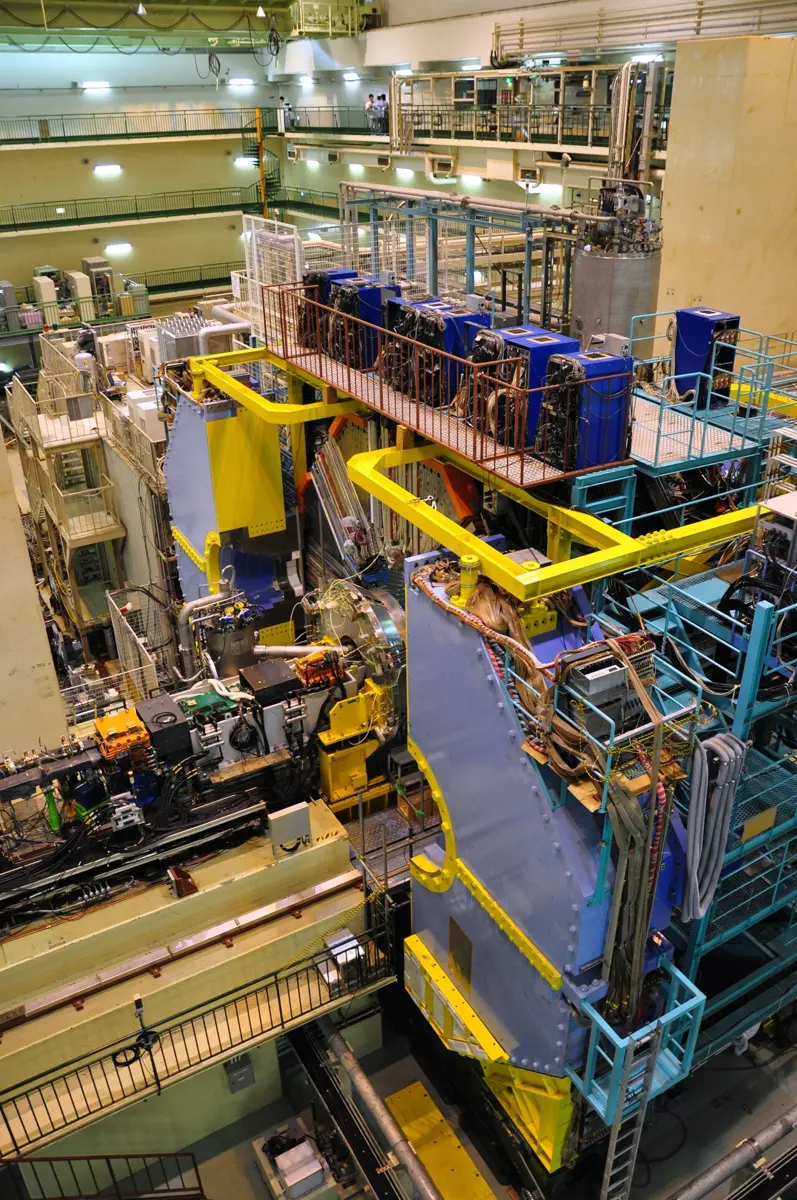
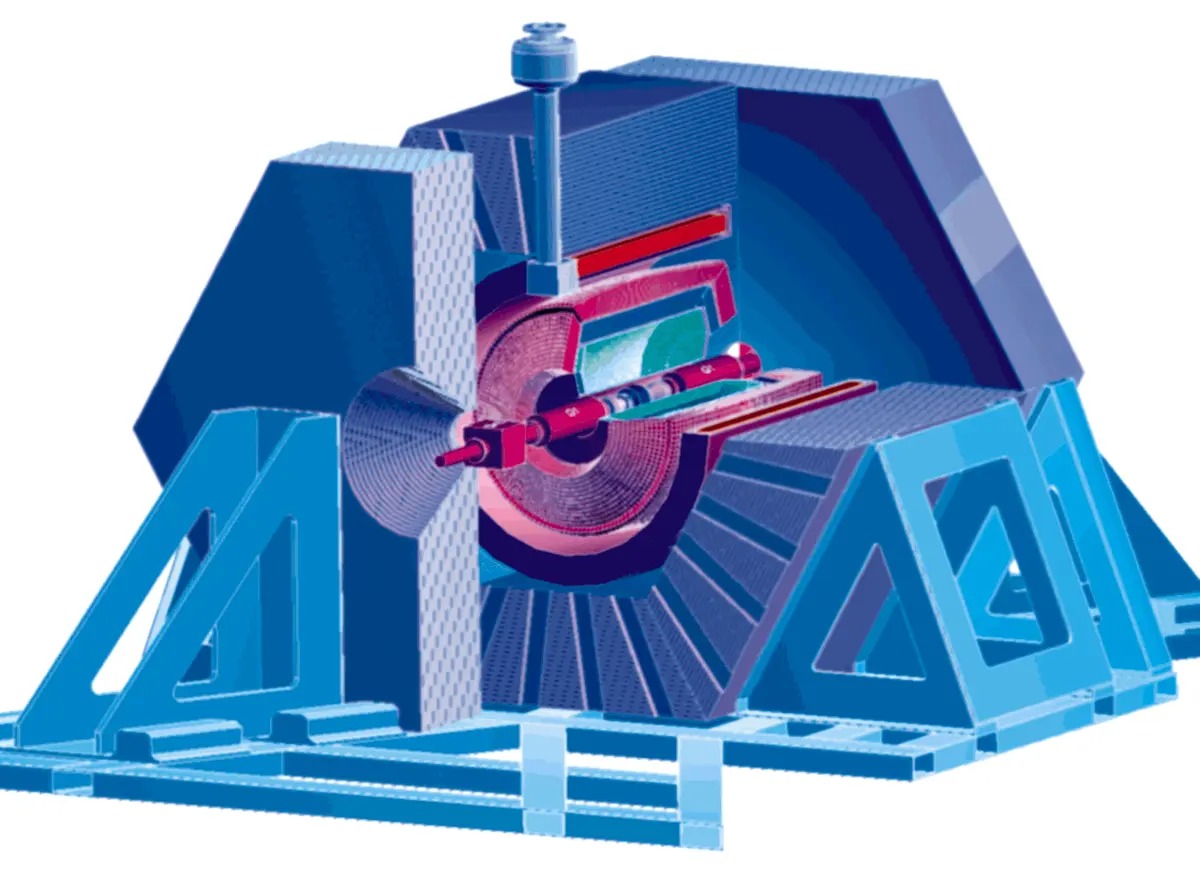
Two huge machines, called B factories, were built to make them:
- BaBar, at the Stanford Linear Accelerator Center (SLAC) in California;
- Belle, at KEK in Tsukuba, Japan, where Kobayashi himself had led the physics division that planned it.
Each smashed electrons into positrons, made more than a million B mesons a day, and watched how they and their antiparticles broke up. In 2001 both experiments, working separately, reported the same answer: B mesons and anti-B mesons do break up differently, by just the amount the theory said. The prediction was almost 30 years old.
What did the B factories show in 2001?
Pick an answer to see why.
In your life today
This is a prize for understanding, not for a machine you can buy. But it touches you in three ways.
- You exist. Every atom in your body is made of matter that survived the meeting with antimatter after the Big Bang (Where did the atoms in your body come from?).
- Your mass. Almost all of your weight is the mass of protons and neutrons, and most of that comes from the energy inside them, not from the quarks themselves, as Nambu’s idea helped to explain.
- Antimatter in hospitals. Antimatter is not only science fiction. PET scans, used to find cancers, use positrons every day.
What came next
- 2012, the Higgs particle. Nambu’s hidden symmetry is the heart of the Higgs field. Its particle was found at CERN in 2012, and Englert and Higgs won the prize the next year (the Higgs field).
- Still not enough. Here is the open question. The twist found by Kobayashi and Maskawa is real, but it is far too small to explain why so much matter survived the Big Bang. Something else must break the symmetry between matter and antimatter more strongly. Experiments such as Belle II in Japan, which began in 2018, and LHCb at CERN are hunting for it in particles with bottom quarks. Others are testing whether neutrinos, ghostly particles that pass through the whole Earth, behave differently from their antineutrinos.
- Do protons last for ever? A Russian physicist, Andrei Sakharov, showed in 1967 that a world of matter needs, among other things, laws that treat matter and antimatter differently. Some of the ideas that would explain it also say that protons should very slowly decay. Experiments have watched huge tanks of water for years and never seen one do it: protons last at least about 10³³ years, far longer than the age of the universe.
In your science books
- Grade 8: the structure of an atom: protons, neutrons and electrons, which are built from the first family of particles.
- Grade 9: the structure of an atom, radioactive emission, and positrons in the nuclear reaction in the Sun.
- Grade 10: the Big Bang theory.
- Going Further (Grades 9–12): beta decay, the weak force at work, and mass into energy.
Learn more
- The Nobel Prize’s own explanation: Unraveling the hidden symmetries of nature (nobelprize.org).
- The Nobel lectures: Nambu’s (read by Giovanni Jona-Lasinio), Kobayashi’s and Maskawa’s.
The official reason
The prize was given “for the discovery of the mechanism of spontaneous broken symmetry in subatomic physics.”
The prize was given “for the discovery of the origin of the broken symmetry which predicts the existence of at least three families of quarks in nature.”