
Catching the neutrino, finding the tau
Nobel Prize in Physics, 1995: Martin Perl and Frederick Reines
-
Martin Perl
1927–2014, born in New York, USA
He trained as a chemical engineer and made television picture tubes until a teacher told him: “Martin, what you are interested in is called physics.” He started physics at 23.
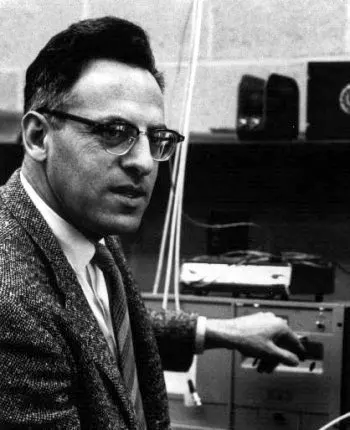
Frederick Reines
1918–1998, born in Paterson, New Jersey, USA
He sang solos in Handel’s *Messiah* and thought for a while of singing for a living. The prize came nearly forty years after his discovery; his partner Clyde Cowan had died in 1974.
Photo: Wikimedia Commons, Public domain
Hold up your thumb. Every second, about sixty-five billion tiny particles from the Sun pass through your thumbnail. They pass through the rest of you too, and through the whole Earth, day and night: at night they come up through the ground beneath your feet. You never feel a thing, and almost none of them ever hits anything. They are neutrinos, and for twenty-five years after they were imagined, nobody could prove they were real.
In 1995 the Nobel Prize in Physics went to two Americans for two discoveries about the same family of particles. Frederick Reines caught the neutrino for the first time. Martin Perl found the tau, a heavy cousin of the electron that nobody had expected.
The problem: energy that went missing
You know the law of conservation of energy: energy can change from one form to another, but it is never made or destroyed Grade 9: Principle of conservation of energy. It is one of the most trusted laws in all of science.
In the 1920s, it seemed to break. Some radioactive nuclei give out an electron, a process called beta decay Grade 9: Radioactive elements. Inside the nucleus, a neutron turns into a proton, and an electron shoots out. Every nucleus of one kind starts with the same energy and ends with the same energy, so every electron should fly out with the same energy. It doesn’t. Measured carefully, some electrons came out fast and some slow, with every speed in between. Some energy was simply vanishing.
A few famous physicists were ready to give up the law. In December 1930 the Austrian physicist Wolfgang Pauli suggested what he called a “desperate remedy”. Perhaps a second particle leaves the nucleus with the electron: a tiny one with no electric charge, which hardly touches anything, so no instrument notices it. It carries off the missing energy. The two particles share the energy in a different way each time, which is why the electron’s speed varies.
The Italian physicist Enrico Fermi named it the neutrino, Italian for “little neutral one”, and built a theory of beta decay around it. The theory worked beautifully. But Pauli was worried. “I have done a frightful thing,” he said: he had proposed a particle that could never be found.
Why did Pauli suggest that an unseen particle leaves the nucleus in beta decay?
Pick an answer to see why.
Why it was so hard
A neutrino has no charge, so it isn’t pushed or pulled by electricity or magnetism. It doesn’t take part in the strong force that holds a nucleus together. It feels only the weak force, which acts over a distance much smaller than a nucleus. So a neutrino can fly straight through matter as if it were empty space.
How empty? In 1934 the physicists Hans Bethe and Rudolf Peierls worked out that to have a good chance of stopping a neutrino from a radioactive source, you would need a wall of solid matter several light years thick. Light takes four years to reach us from the nearest star. They concluded that the neutrino would probably never be seen.
There was only one way round it: if you can’t make the wall thicker, send in more neutrinos. A huge number of neutrinos, and a big detector watched for a long time, might just catch a few.
What they did, step by step
Reines and Cowan: catching the ghost
Frederick Reines worked at Los Alamos in the USA, where the first atomic bombs were made. In 1951 he asked for time to think about what to do next, and decided to catch the neutrino. He teamed up with a colleague, Clyde Cowan.
- 1951: a bomb as the source. A nuclear explosion gives out an enormous burst of neutrinos. Their first plan was to hang a detector in a deep, airless pit near a bomb test and let it fall at the moment of the explosion, so that it would drop freely, away from the shock wave, while it counted. The Los Alamos director approved it.
- The better idea. Then they found a way to recognize a neutrino’s hit among all the other signals, so clearly that they could use a steady nuclear reactor instead of a bomb. A reactor splits uranium nuclei, and the pieces give out huge numbers of neutrinos (strictly, antineutrinos: neutrinos’ “mirror” partners, which behave in the same way).
- 1953: Hanford. They took a 300-liter tank of liquid at a reactor at Hanford, in the north-west USA. They called it Project Poltergeist, after the ghosts in stories that make noises but are never seen. They saw hints of a signal, but too much noise from cosmic rays, particles from space that rain down on the Earth all the time.
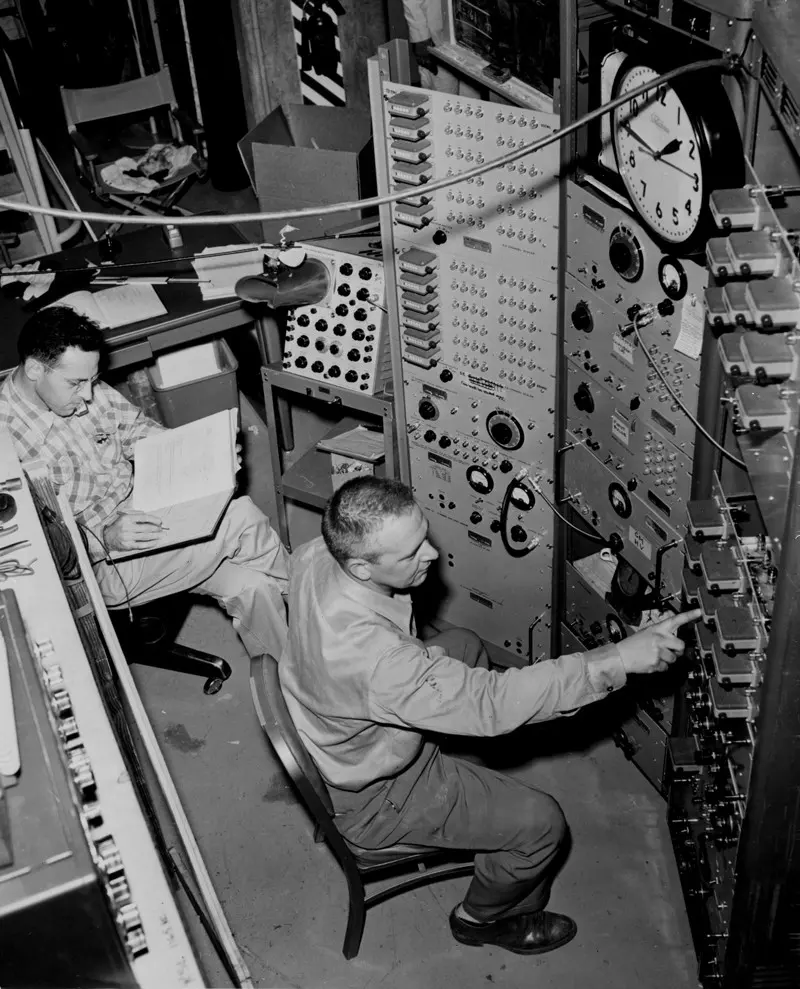
- 1955–1956: Savannah River. They built a better detector and set it up at a powerful new reactor at Savannah River, in South Carolina, 11 meters from the reactor’s core and 12 meters underground, so that the earth and concrete above kept most cosmic rays out.
Their trick was to look for two flashes, one just after the other. When an antineutrino hits a proton (the nucleus of a hydrogen atom in water), it turns it into a neutron and a positron. A positron is the electron’s antiparticle: the same mass, but a positive charge. When it meets an ordinary electron, both are destroyed, and their energy comes out as two gamma rays flying apart in opposite directions. That makes the first flash. The neutron wanders through the water for a few millionths of a second, until a nucleus of cadmium, dissolved in the water, swallows it and gives out more gamma rays: the second flash.
Many things can make one flash. Almost nothing else makes this pair, in this order, this far apart. Even so, with about ten million million (10¹³) antineutrinos passing through every square centimeter of the detector every second, they caught only about three an hour.
They checked everything. With the reactor switched off, the signal dropped. Without the cadmium, the pairs of flashes disappeared. With half the water replaced by heavy water, which has fewer ordinary protons to hit, the count fell by about half, as it should. In June 1956 they sent a telegram to Pauli: “We are happy to inform you that we have definitely detected neutrinos.” Pauli read it out at a meeting at CERN, in Switzerland. His reply, “Everything comes to him who knows how to wait”, never reached them; they saw it thirty years later.
Why did Reines and Cowan look for two flashes, one after the other, instead of just one?
Pick an answer to see why.
Perl: a cousin nobody ordered
By the 1960s physicists knew two particles like the electron. There was the electron itself, found in 1897. And there was the muon, found in cosmic rays in 1936: exactly like an electron, but about 207 times as heavy, and it breaks up in about two millionths of a second. Nobody knew why it existed. The physicist I. I. Rabi famously asked, “Who ordered that?” The electron, the muon and the neutrinos are called leptons, from a Greek word for “light” (meaning not heavy).
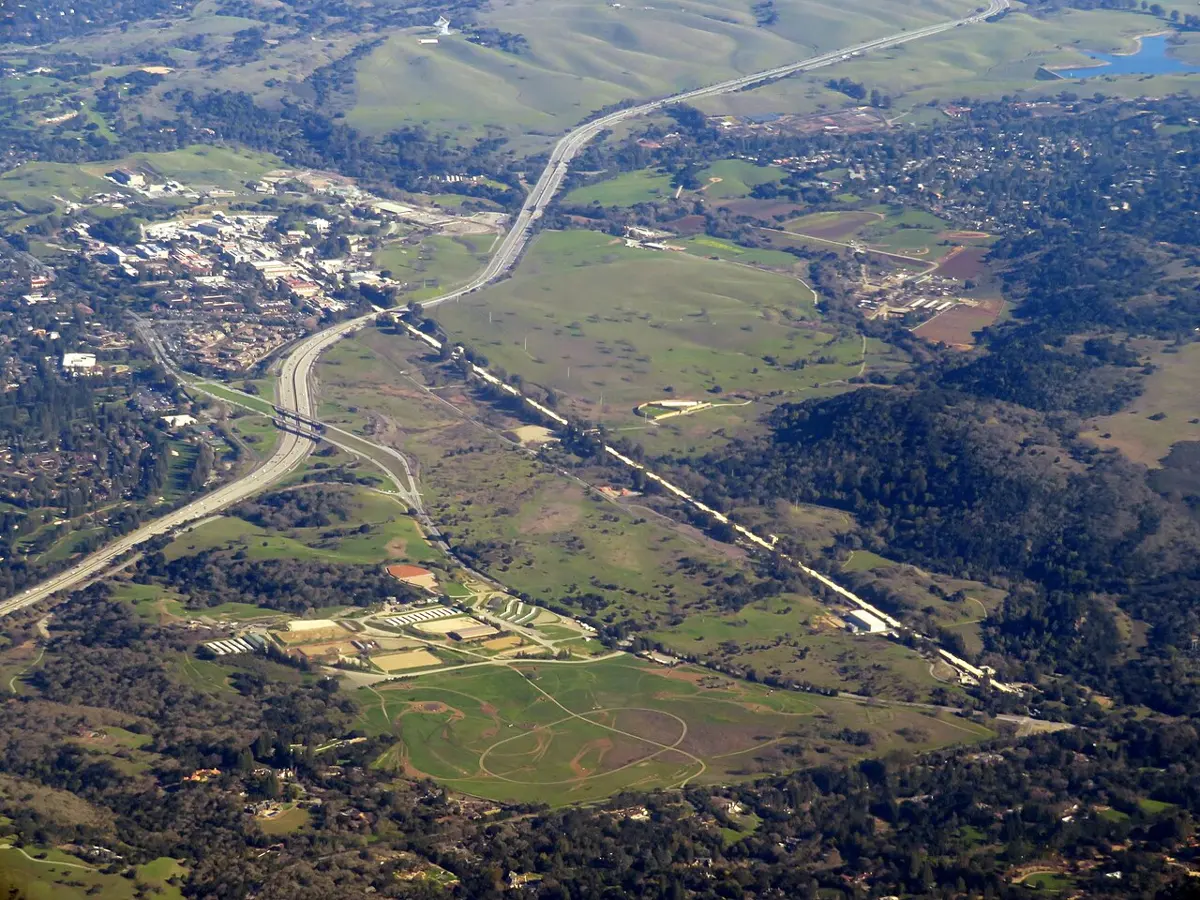
Martin Perl, at the Stanford Linear Accelerator Center (SLAC) in California, wondered whether there might be a third, even heavier lepton. Most physicists thought it unlikely, and no theory asked for one.
- 1973: a new machine. SLAC finished a collider called SPEAR, which sends electrons one way round a ring and positrons the other way, and smashes them together head on. When an electron meets a positron, both vanish and their energy can turn into a pair of new particles, if there is enough energy to make their mass.
- 1974–1975: strange events. Perl’s team looked for something odd: collisions that left behind exactly one electron and one muon, going off in different directions, and nothing else. No ordinary particle could explain such events. Yet they found them: 24 in their best set of data by mid-1975, and more as the machine ran at higher energies.
- Energy was missing. When they added up the energy of the electron and the muon, a lot was gone. At least two unseen particles must have carried it away. Neutrinos.
- 1975: “something new”. They published their results in December 1975. They suggested that each collision had made a pair of new, heavy particles, which broke up at once. They called the new particle U, for “unknown”, and later the tau (τ), the first letter of the Greek word for “third”: the third charged lepton.
In Perl’s strange events, the electron and the muon together had much less energy than the collision gave. What did this tell him?
Pick an answer to see why.
For the next two or three years many physicists doubted it. In 1977 and 1978 other experiments, including one in Hamburg, Germany, found the same kind of events, and the tau was accepted. It weighs about 3,500 times as much as an electron, nearly twice as much as a proton, and yet it behaves exactly like an electron in every other way.
How it fits together now
The tau turned out to be the first member of a whole new family of particles. Physicists now know that all ordinary matter is built from just two kinds of tiny particles: quarks, which make up protons and neutrons, and leptons. They come in three families, each with two quarks and two leptons:
| Family 1: everyday matter | Family 2 | Family 3 | |
|---|---|---|---|
| Quarks | up, down | charm, strange | top, bottom |
| Charged lepton | electron (found 1897) | muon (1936), 207 × electron | tau (1975), about 3,500 × electron |
| Neutrino | electron neutrino (caught 1956) | muon neutrino (1962) | tau neutrino (2000) |
Family 1 is all you need to build the world: up and down quarks make protons and neutrons, and with electrons they make every atom in your body Grade 8: The particles inside an atom. Families 2 and 3 are heavier copies. They are made in high-energy collisions and in cosmic rays, and they quickly break up into family 1. The tau’s two quarks were found in 1977 (bottom) and 1995 (top), so the third family was complete only in the year of this prize.
Why are there three families, and not one, or four? Nobody knows. It is one of the big open questions in physics.
In your life today
- Neutrinos from the Sun. The Sun shines by joining hydrogen nuclei into helium Grade 9: Nuclear reaction in the Sun, and every time, the weak force turns protons into neutrons and sends out neutrinos. They leave the Sun at once and reach us in about eight minutes. Detecting them proved how the Sun shines (the Nobel Prize of 2002).
- Antimatter in hospitals. Reines and Cowan’s first flash, a positron meeting an electron and giving two gamma rays going in opposite directions, is exactly what a PET scanner detects. A patient is given a little sugar carrying a substance that gives out positrons. Rings of detectors catch the pairs of gamma rays and show where in the body the sugar is used fastest, which can reveal a cancer.
- Cosmic rays. Muons from cosmic rays pass through your body all the time, roughly one through every square centimeter each minute. They are a reminder that the second family is not just a laboratory curiosity.
What came next
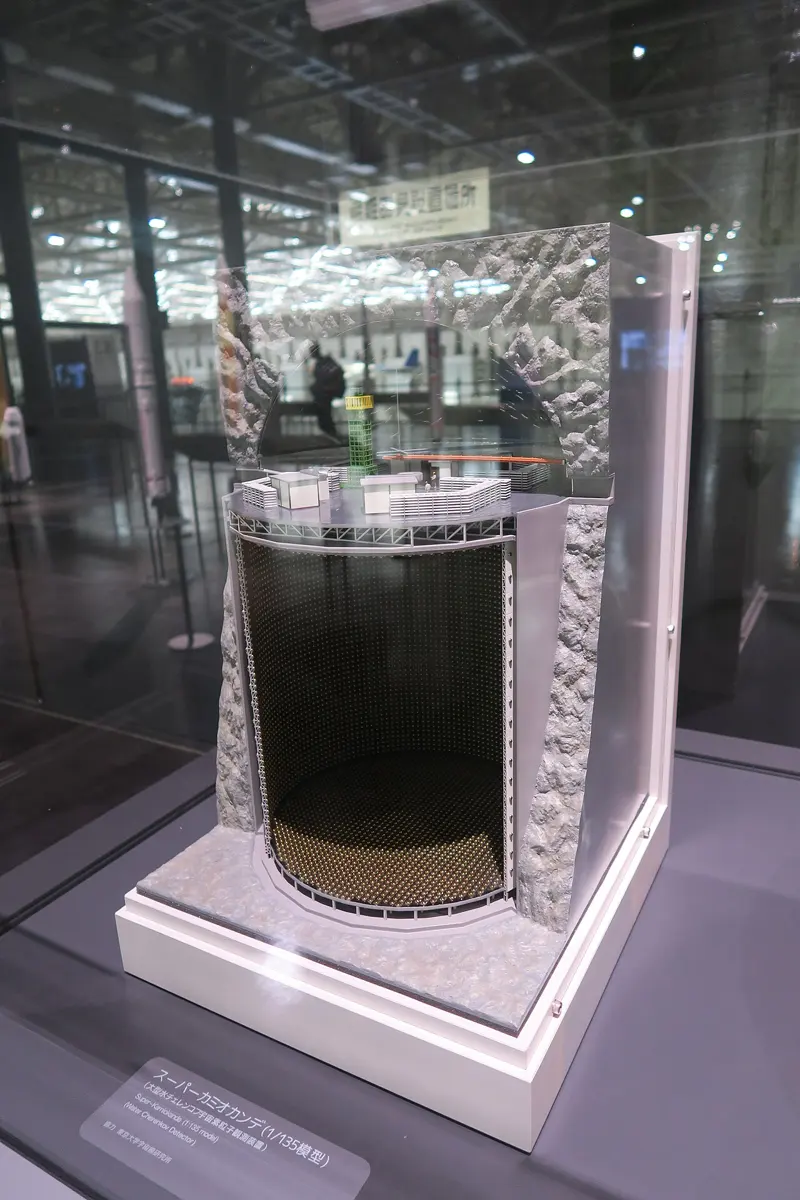
- Bigger and bigger detectors. Reines and Cowan used a few hundred liters of water. Today’s detectors use thousands of tonnes. Japan’s Super-Kamiokande, deep under a mountain, holds 50,000 tonnes of very pure water watched by about 11,000 light detectors. Antarctica’s IceCube uses a cubic kilometer of ice.
- Neutrinos from an exploding star. In February 1987, a star exploded in a small galaxy next to ours. For a few seconds, detectors in Japan, the USA and Russia (Reines’s team ran the American one) caught about two dozen neutrinos from it, before anyone had seen the explosion with a telescope.
- Neutrinos have mass. For decades physicists thought neutrinos weighed nothing at all. In 1998 Super-Kamiokande showed that neutrinos change from one kind to another as they travel, which is only possible if they have a little mass (the Nobel Prize of 2015). How much mass is still not known exactly. It is less than a millionth of an electron’s.
The universe is made almost entirely of matter, with hardly any antimatter left. Many physicists suspect that neutrinos may help explain why. Whether a neutrino is, in some way, its own antiparticle is one of the questions experiments are trying to answer today.
In your science books
- Grade 8: the particles inside an atom, and the electron.
- Grade 9: conservation of energy, radioactive elements and their rays, nuclear fission (what happens in a reactor), and the nuclear reaction in the Sun.
- Going Further (Grades 9–12): beta decay and what always stays the same when a nucleus decays.
- More Nobel Prizes: catching neutrinos from the Sun and a supernova and neutrinos that change their kind.
Learn more
- The Nobel Prize’s own explanation: the press release (nobelprize.org).
- The laureates’ Nobel lectures: Perl, on the tau and Reines, “The Neutrino: From Poltergeist to Particle”.
The official reason
The prize was given “for the discovery of the tau lepton.”
The prize was given “for the detection of the neutrino.”