
Attosecond flashes: a camera for electrons
Nobel Prize in Physics, 2023: Pierre Agostini, Ferenc Krausz, and Anne L’Huillier
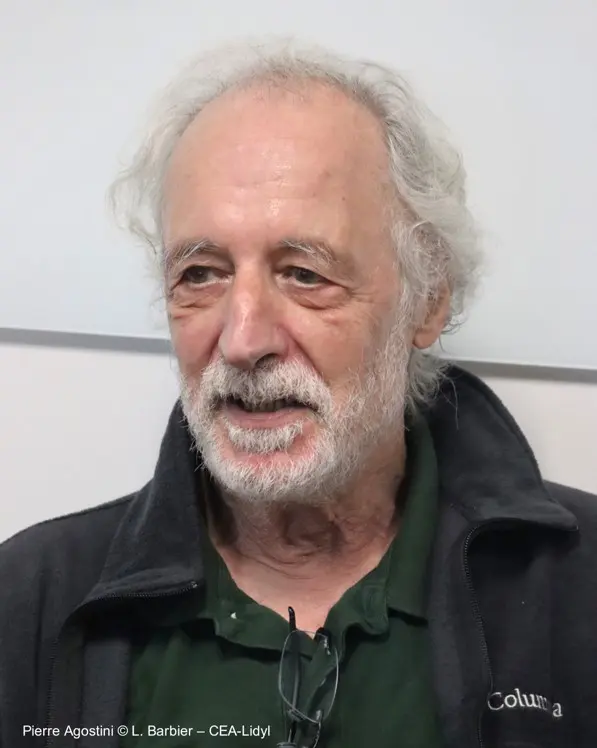
Pierre Agostini
born 1941 in Tunisia
A French physicist who spent most of his career at a research center near Paris and later moved to Ohio State University in the United States.
Photo: L. Barbier, CEA-LIDYL, CC BY 4.0
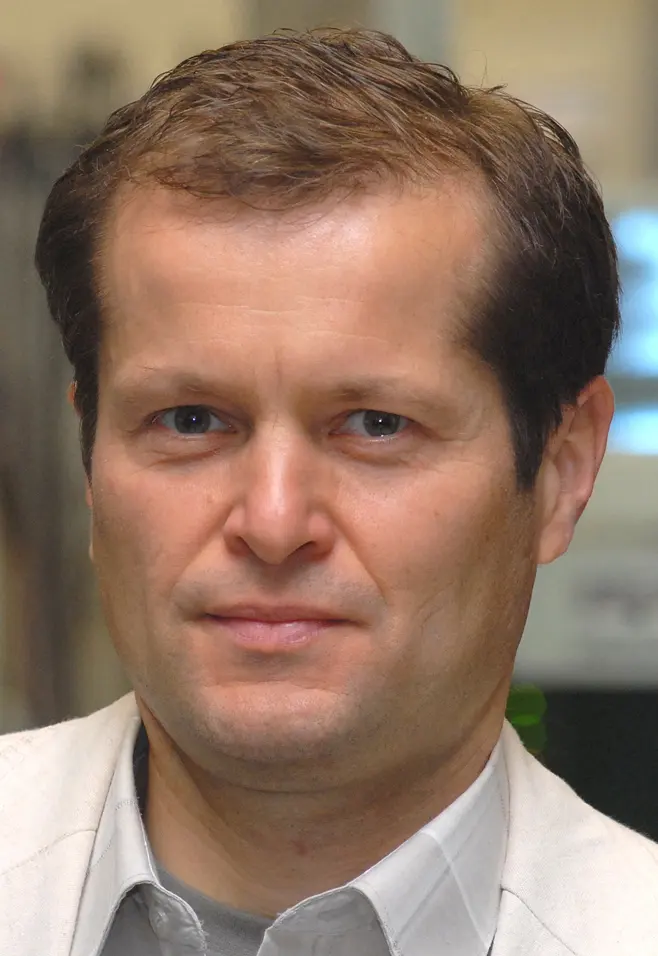
Ferenc Krausz
born 1962 in Hungary
He grew up in a small town in Hungary, did his best-known work in Vienna, and now leads an institute in Germany.
Photo: Thorsten Naeser, CC BY 2.0

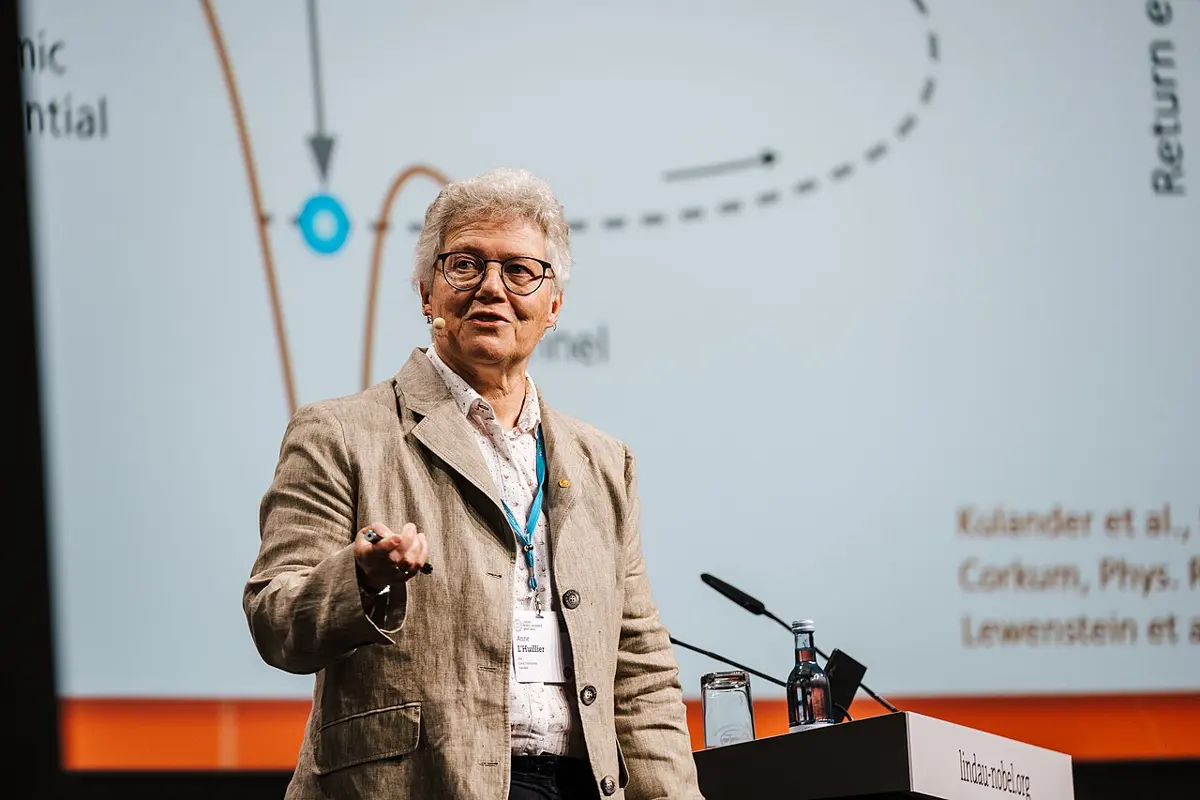
Anne L’Huillier
born 1958 in France
A professor in Sweden who first saw the strange glow that made it all possible. She was only the fifth woman ever to win the physics prize.
Photo: Bengt Oberger, CC BY-SA 3.0
Listen to a honey bee. Its buzz comes from its wings, which beat more than 200 times every second. Your eyes can’t follow them: all you see is a blur. To see a wing clearly, a camera must take its picture in much less time than one wingbeat.
Now imagine trying to photograph something more than ten thousand billion times quicker than a wingbeat: an electron moving inside an atom. In 2023 the Nobel Prize in Physics went to three scientists who made flashes of light short enough to do it. Each flash lasts only a few hundred attoseconds.
The problem: everything fast looks blurred
When you take a photo of a moving bus, a fast-moving thing comes out smeared. The camera’s shutter stays open for a short time, and while it is open the bus moves. To freeze the bus, the shutter must open and close in less time than the bus takes to move a noticeable distance.
The same rule holds for any measurement: it must be quicker than the thing you are watching. Otherwise you only see an average, a blur.

Inside atoms and molecules, things happen very fast indeed:
- Atoms in a molecule move, twist and break apart in about a femtosecond or more. Scientists learned to film this with very short flashes of laser light in the 1980s and 1990s.
- Electrons are much lighter than atoms, and much quicker. They move and jump in attoseconds, a thousand times shorter. A femtosecond flash is far too slow for them: it blurs everything an electron does.
So, for decades, nobody could watch an electron move. Scientists could only work out where electrons were on average.
How short is an attosecond?
A millisecond is a thousandth of a second. A microsecond is a thousandth of that, then come the nanosecond, the picosecond and the femtosecond, each a thousand times shorter again. An attosecond is a thousandth of a femtosecond: 10⁻¹⁸ of a second.
One second holds a billion billion attoseconds (10¹⁸). The universe is about 13.8 billion years old, which is about half a billion billion seconds. So there are roughly as many attoseconds in one second as there have been seconds since the universe began (in fact about twice as many).
Here is another way to picture it. Light is the fastest thing there is: it could go round the Earth more than seven times in one second. In one attosecond, light travels about 0.3 nanometers, roughly the width of one atom.
Why can’t a flash lasting one femtosecond show an electron moving?
Pick an answer to see why.
Why it was hard: light can’t be shorter than its own wave
Light is a wave of electric and magnetic fields Grade 9: Electromagnetic waves. Each color has its own wavelength and frequency Grade 9: Words used for waves. Red light has a wavelength of about 700 nanometers and swings up and down about 430 million million times a second.
A flash of light can’t be shorter than one swing of its wave, one full cycle. For red light, one cycle takes about 2 femtoseconds. That is why, in the 1980s, a few femtoseconds was thought to be a wall nobody could pass. To make a flash a thousand times shorter, you need light whose waves are much shorter: ultraviolet light and beyond Grade 9: Ultraviolet rays.
There is a second part to the trick. A very short flash is made by adding together many waves of different frequencies. Where all their peaks line up, they add into one tall, sharp spike. A little to either side, peaks meet troughs and the waves cancel each other out (Waves that cancel). The more frequencies you add, the narrower the spike.
These extra waves are called overtones. You know them from music. Pluck a sitar or guitar string and it doesn’t vibrate at only one frequency. It also vibrates two, three, four or more times as fast, all at once. The overtones are why a sitar and a flute playing the same note sound different Grade 8: Frequency.
So the question was: how do you make light with many overtones, all lined up?
What they did, step by step
L’Huillier: a glow of overtones (1987)
Anne L’Huillier worked at a research center at Saclay, near Paris.
- 1987, the experiment. Her team shone a very powerful infrared laser (wavelength 1,064 nanometers, invisible to the eye) through a little argon, a noble gas. Out of the gas came not only infrared light but overtones: light with 3, 5, 7, 9 … times the laser’s frequency, far into the ultraviolet. The results were published in 1988.
- The surprise. Overtones were known before, but they were expected to get weaker and weaker, the higher they went. Instead, after the first few, a long run of them came out about equally bright, up to roughly the 33rd overtone. A long, even run of overtones is exactly what is needed to build short flashes.
- The 1990s, the explanation. Through the 1990s, now at Lund University in Sweden, L’Huillier kept studying this glow. With others, she worked out where it comes from.
Here is what happens inside each argon atom, in three steps:
- The laser’s electric field is so strong that it tugs an electron right out of the atom.
- The field swings back the other way, half a wave later, and the free electron is pulled back towards the atom, gaining speed and energy on the way.
- The electron crashes back into its atom and gives up its extra energy as one tiny burst of high-energy, ultraviolet light.
This happens again and again, twice in every swing of the laser, in millions of atoms at once. Together, these bursts are the overtones.
Agostini: a train of flashes (2001)
The theory said that the overtones should add up into a train of very short flashes, one after another, like the carriages of a train. But nobody had seen them, and measuring anything that short was a problem in itself: no clock is fast enough.
Pierre Agostini and his team, also at Saclay, found a clever way. They sent the flashes into a gas together with a weak part of the original laser light, and changed the tiny delay between the two. How the electrons knocked out of the gas changed with the delay showed how the overtones were lined up. In 2001 they could say how long each flash lasted: 250 attoseconds.
Krausz: one single flash (2001)
A train of flashes is useful, but for many experiments you want just one. In Vienna, Ferenc Krausz and his team used extremely short laser pulses, only a few femtoseconds long, so that the strongest part of the laser lasted only about one swing. Then they picked out only the highest overtones with a special mirror. What was left was a single flash of 650 attoseconds.
They also used it at once. They knocked electrons out of krypton atoms with the flash, and watched how the laser’s field then pushed those electrons, attosecond by attosecond.
L’Huillier’s experiment gave out light at many overtones of the laser. Why was a long run of equally bright overtones so important?
Pick an answer to see why.
How attosecond science works now
Attosecond experiments usually work like this:
- A first flash, the “pump”, starts something: for example, it knocks an electron out of an atom.
- A second flash, the “probe”, arrives a tiny moment later and records what the electron is doing.
- The delay is changed, a few attoseconds at a time, and the experiment is repeated. Putting the results in order gives a film of the electron.
Today’s laboratories can make single flashes only a few dozen attoseconds long.
In your life today
Attosecond flashes are not yet in your home or your phone. They are a new tool for scientists, like the first microscopes were, and their uses are only beginning. But the questions they answer are about things you use every day:
- Electronics. Every switch in your phone’s chip works by moving electrons. Attosecond flashes show how fast electrons can be moved around in a material, and so how fast future switches might work.
- Solar panels and batteries. Both depend on how quickly electrons move from one place to another in a material. Watching it can help scientists design better ones Grade 9: Solar electricity.
- Chemistry. Every chemical reaction begins with electrons moving between atoms. Attosecond flashes let chemists watch the very first instant of a reaction.
- Medicine. Krausz’s team is testing whether very short pulses of light shone through a drop of blood can pick out the “fingerprint” of molecules, to spot diseases early.
What came next
- Even shorter flashes. Since 2001 the record has fallen from hundreds of attoseconds to a few dozen. Large X-ray lasers, a kilometer or more long, now also make attosecond flashes of X-rays.
- Watching chemistry. Scientists have begun to watch electrons move along a molecule in the first moments after it is hit by light, before its atoms have had time to move.
- An open question. Can we go further than watching, and steer electrons with light: break exactly the chemical bond we choose, or switch electronics a million billion times a second? Nobody knows yet how far this can go.
In your science books
- Grade 8: frequency and wavelength of a sound wave.
- Grade 9: electromagnetic waves, words used for waves, the electromagnetic spectrum, ultraviolet rays and the structure of an atom.
- Going further: waves that cancel and the photoelectric effect.
Learn more
- The Nobel Prize’s own explanation: Electrons in pulses of light (nobelprize.org).
- The laureates’ Nobel lectures: Agostini, Krausz and L’Huillier.
The official reason
The prize was given “for experimental methods that generate attosecond pulses of light for the study of electron dynamics in matter.”