
Counting holes: the shapes hidden in matter
Nobel Prize in Physics, 2016: David J. Thouless, F. Duncan M. Haldane, and J. Michael Kosterlitz
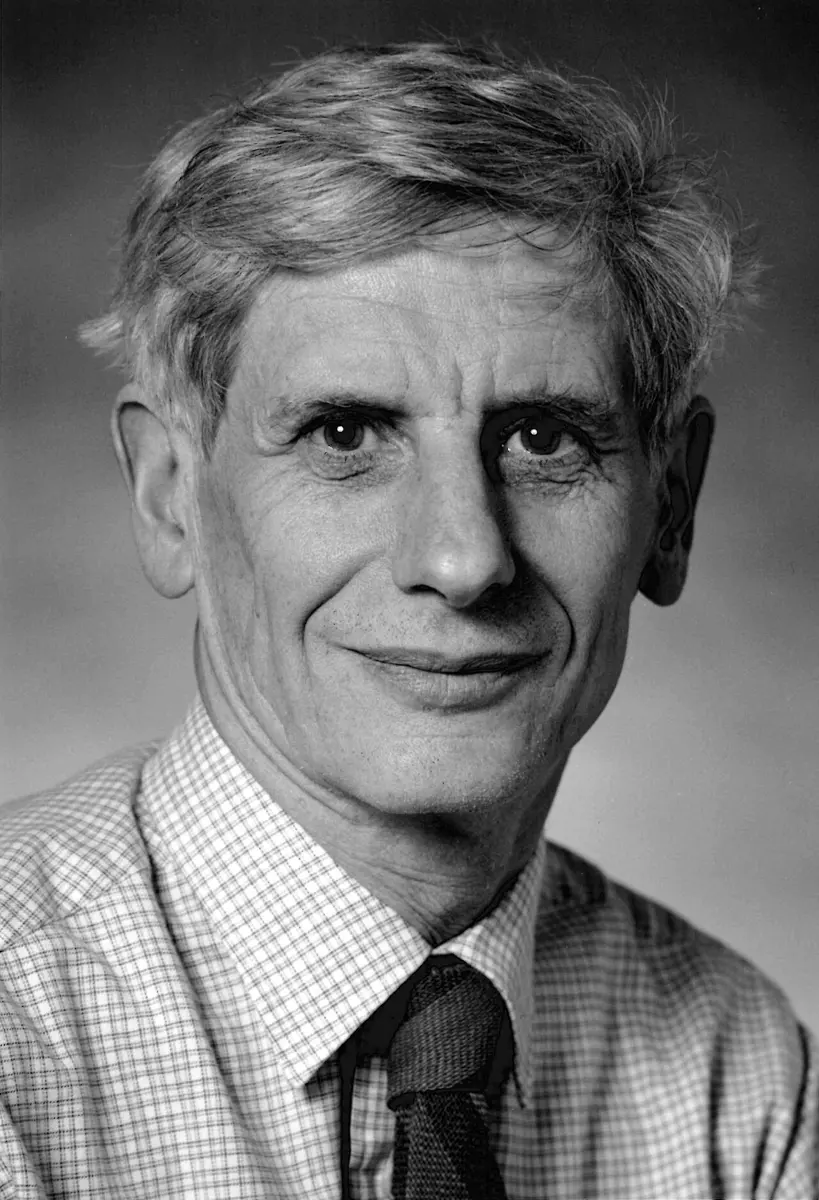
David J. Thouless
1934–2019, born in Scotland, United Kingdom
A quiet theorist who explained, twice, why something in nature comes out as an exact whole number.
Photo: Mary Levin, CC BY-SA 4.0
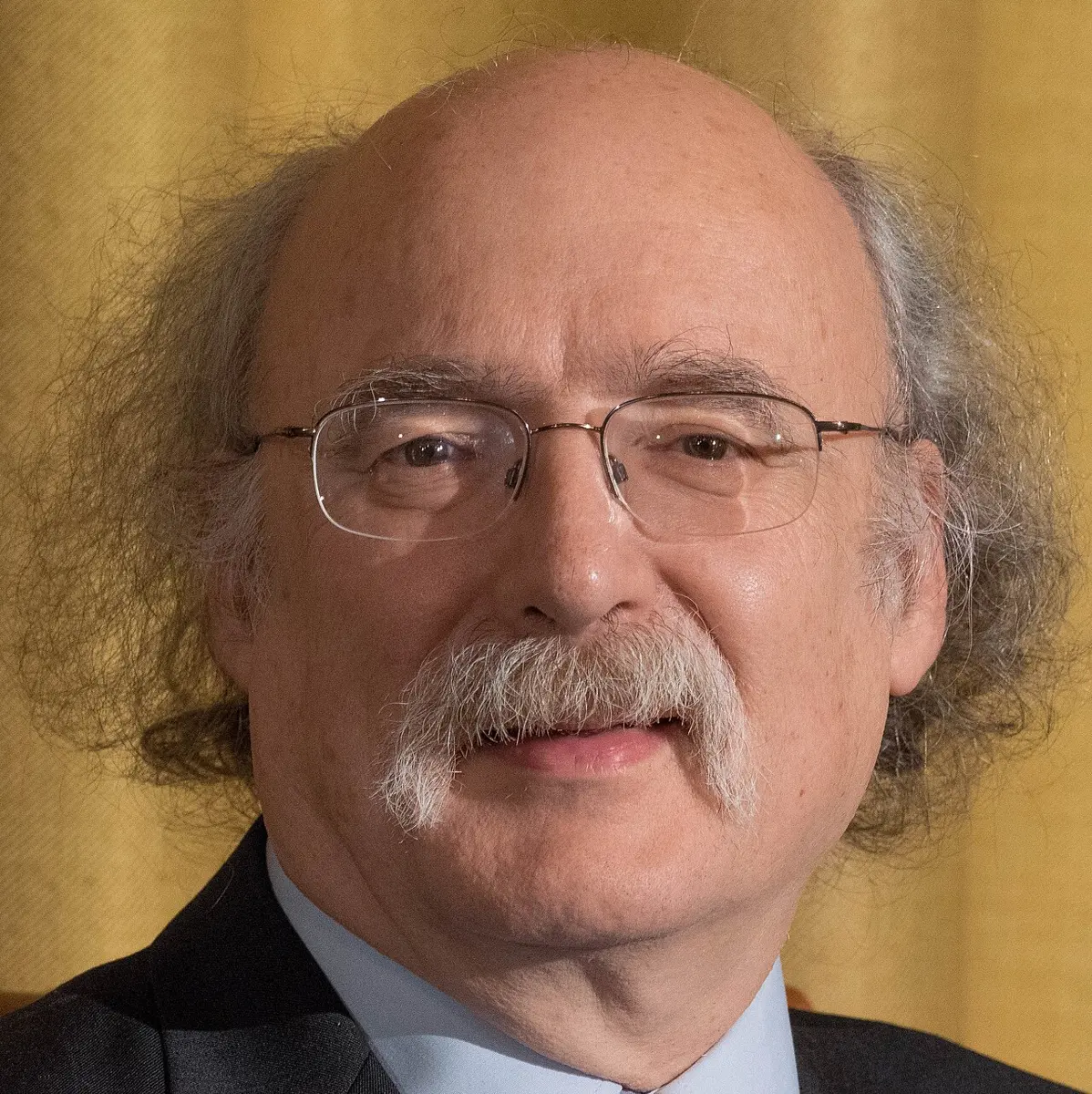
F. Duncan M. Haldane
born 1951 in London, United Kingdom
Made a prediction about chains of magnetic atoms that the experts at first refused to believe.
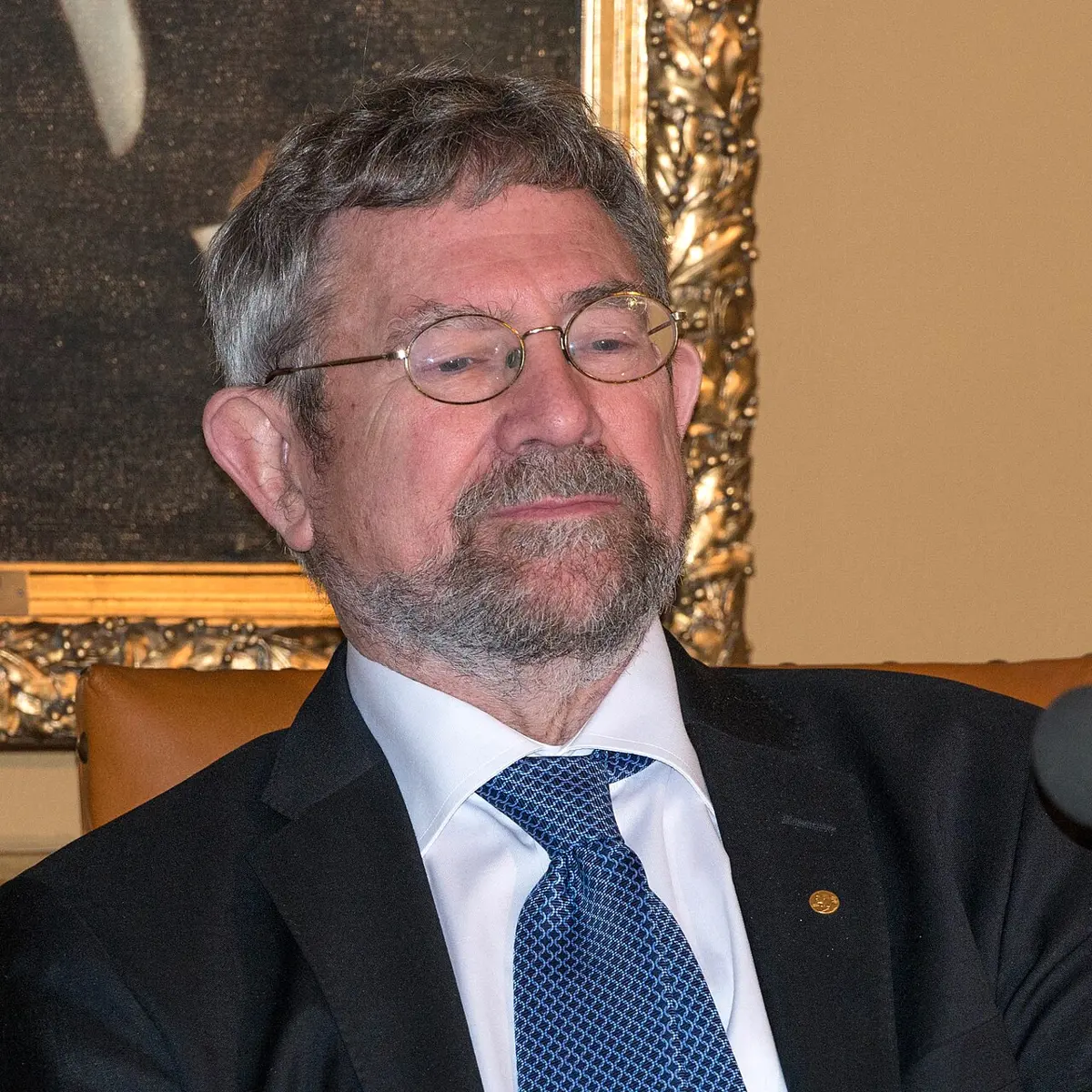
J. Michael Kosterlitz
born 1943 in Scotland, United Kingdom
A young researcher who, by his own account, took on the problem “out of ignorance”. Also a pioneering rock climber.
On 4 October 2016, a member of the Nobel committee stood in front of the world’s reporters holding a cinnamon bun, a bagel and a pretzel. He was not hungry. He was explaining that year’s Physics prize. The bun has no hole, the bagel has one, the pretzel two. You can’t have half a hole.
That simple idea, counting holes, turned out to explain some of the strangest things matter does. The prize went to three theorists who saw it: David Thouless, Michael Kosterlitz and Duncan Haldane.
The problem: matter that broke the rules
You already know the usual states of matter: solid, liquid and gas. When you heat ice, it melts at 0 °C and becomes water. In the ice the water molecules sit in a regular, ordered pattern; in the liquid they tumble about. A sudden change like this, from one state to another, is called a phase transition (What melting and boiling really do). Heating a magnet until it stops being a magnet is another one Grade 8: Demagnetization by heating.
Very close to absolute zero (−273 °C), stranger states appear. In a superconductor, electric current flows with no resistance at all. In a superfluid, a liquid flows with no friction: superfluid helium, cooled to about −271 °C, even creeps up the walls of its cup and over the top.
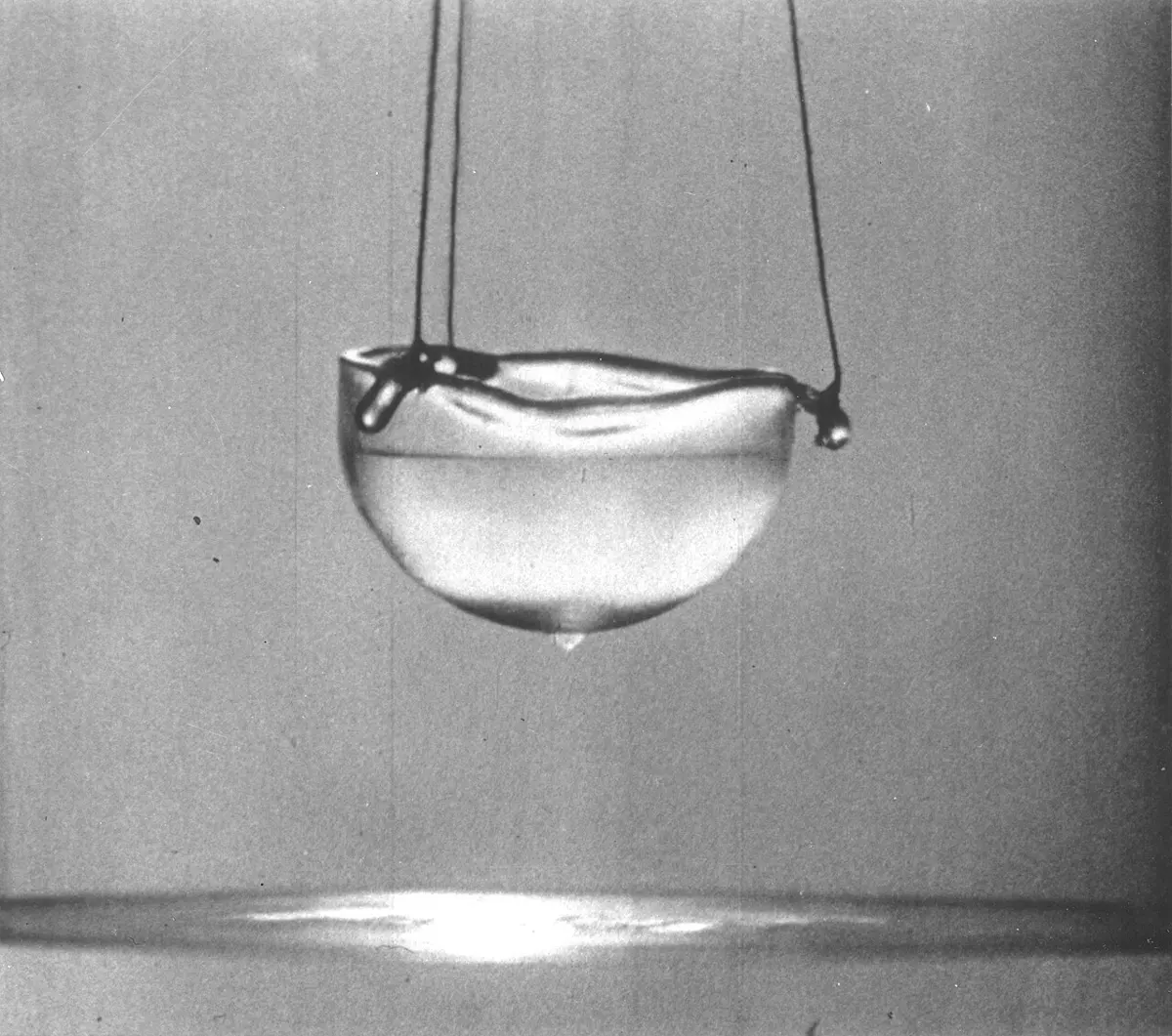
By the 1970s, physicists also had a firm belief about flat materials: a layer so thin, a few atoms thick, that it is almost two-dimensional. They believed that in such a flat world, the jiggling of heat always destroys order. With no order there can be nothing to melt, so there could be no phase transition. But experiments on very thin films of helium seemed to show superfluid films all the same.
Then, in 1980, came a second puzzle, about electricity in thin layers, which you will meet below. Both puzzles had the same answer, and it came from mathematics.
Which of these is a phase transition?
Pick an answer to see why.
Topology: what doesn’t change when you squash
Topology is the branch of mathematics that studies what stays the same when you stretch, twist or squash a shape, as long as you don’t tear it or glue it. A ball of clay can be pressed into a bowl, so to a topologist a ball and a bowl are the same. But you can’t make a bagel from a ball without poking a hole through it.
A teacup and a bagel, on the other hand, are the same: each has exactly one hole (the cup’s is in its handle). Squash the cup slowly and it can become a bagel.
The important thing about the number of holes is that it is a whole number. It can be 0, 1, 2, 3 … but never 1.5. And it can’t change a little bit at a time. You can bend a bagel as much as you like and it still has one hole; to change the number, you must tear it. A number like this, which stays fixed while everything else changes, is called a topological invariant.
The three laureates saw that some properties of matter behave like this. They come in whole numbers, and they change only in jumps.
You stretch a rubber ring into a long thin loop, then twist it into a figure 8 without cutting it. How many holes does it have, to a topologist?
Pick an answer to see why.
What they did, step by step
Kosterlitz and Thouless: whirlpools in a flat world
In the early 1970s Michael Kosterlitz, a young researcher, came to the University of Birmingham in England to work with David Thouless. They decided to attack the problem of flat layers: Thouless, they said later, out of curiosity, and Kosterlitz out of ignorance, not knowing that it was supposed to be impossible.
To picture what they did, imagine a flat sheet covered in tiny compass needles, each free to point any way in the sheet. When it is cold, neighboring needles like to point the same way.
- The whirlpool. Sometimes the needles form a vortex (a whirlpool), turning round a center point. Walk once round the center and the needles turn exactly once. Not 0.9 times, not 1.1: once. That count is a whole number, like the holes in a bagel, so a vortex can’t just fade away. It is held in place by topology.
- Pairs, in the cold. There are also antivortices, which turn the other way. Kosterlitz and Thouless showed that at low temperatures, vortices and antivortices sit together in tight pairs. Seen from far away, a pair hardly disturbs the needles around it, so the sheet stays mostly in order.
- The jump, when warm. As the temperature rises, the pairs come loose. At one exact temperature they suddenly break apart, and the free vortices wander off through the sheet, scrambling the order. That sudden change is a phase transition after all, a completely new kind: a topological phase transition.
They published it in 1972 and 1973. A physicist in Moscow, Vadim Berezinskii, had had similar ideas a year earlier, so it is now called the BKT transition. In 1978 experimenters in the United States measured a thin film of superfluid helium and found exactly the jump the theory had predicted. The same idea has since explained thin magnetic films, thin superconductors and clouds of very cold atoms.
Thouless: steps that are too exact
The second puzzle came from an experiment. When a current flows through a material inside a magnetic field, the field pushes the moving electrons sideways, the same push that turns an electric motor Grade 10: Motor effect. The electrons pile up on one side, and a small voltage appears across the material. This is the Hall effect. Dividing that voltage by the current gives a resistance, the Hall resistance.
In 1980 Klaus von Klitzing, a German physicist, measured this in an extremely thin layer of electrons, cooled to a few degrees above absolute zero, in a very strong magnetic field. As he changed the field, the Hall resistance did not change smoothly. It went in steps, flat between them. The steps were at about 25,813 ohms (the unit of resistance, Electric resistance), then exactly half of that, then a third, a quarter, and so on.
This was astonishing. Real samples are never perfect: they have impurities, the temperature drifts, the field is not exact. Yet the steps came out the same in every sample, to better than one part in a billion. Von Klitzing won the 1985 Nobel Prize for discovering this quantum Hall effect, but why it was so exact was a mystery.
- 1982, the answer. David Thouless, by then at the University of Washington in Seattle, and three colleagues (Mahito Kohmoto, Peter Nightingale and Marcel den Nijs) showed that the number of each step is a topological invariant of the electrons in the layer. It counts something like holes. Like the hole in a bagel, it can’t be changed by small things, such as a few impurities or a slightly different field. It can only jump from one whole number to the next.
- The edges. The theory also said the current runs along the edges of the layer, and later experiments found it there.
Haldane: magnetic chains, and a field that isn’t there
Duncan Haldane studied matter even thinner than a layer: chains of magnetic atoms, one atom wide, found inside some crystals.
- 1982–83, two kinds of chain. Each atom is a tiny magnet. Quantum physics says these tiny magnets come in two kinds, which physicists label with whole-number or half-number spin. Everyone believed chains of both kinds behaved in much the same way. Haldane showed they don’t: a chain of whole-number magnets is topological, with odd “half” magnets appearing at its two ends. Experts at first refused to believe him. In 1986 experiments on a crystal of cesium nickel chloride found what he had predicted.
- 1988, no magnet needed. Haldane then showed, on paper, that a thin layer could give exact quantum Hall steps without any magnetic field. He wrote that his model was unlikely ever to be made. In 2013 a team in China saw the effect in a thin magnetic film, and in 2014 a team in Switzerland built his exact model with very cold atoms held by laser light.
How it works now: topological materials
The laureates’ work started a whole new family of materials, the topological materials. The most famous are topological insulators. Inside, such a material is an insulator, like glass or plastic: current can’t flow through it. But its surface conducts electricity, and this conducting skin is protected by topology. Scratch the surface, add impurities, and it still conducts, the way a bagel still has its hole however you bend it.
The first was found in 2007, in a thin layer of mercury telluride; since then many more have been made, in thin layers and in ordinary chunks of crystal.
In your life today
- The ohm itself. Because the quantum Hall steps are the same everywhere, measuring laboratories use them to check what one ohm is. Since 2019 the step value, 25,812.807… ohms, is exact by definition. Careful measurements of resistance all over the world are traced back to it Grade 9: The ohm in fundamental units.
- Not yet in your pocket. Topological materials are mostly still in laboratories. Engineers hope that because their edges and surfaces carry current without being upset by small faults, they could make electronics that waste less energy as heat.
The surface of a topological insulator keeps conducting even when it is scratched. Why?
Pick an answer to see why.
What came next
- Quantum computers. A quantum computer’s memory is easily upset by the slightest disturbance. Some scientists hope to store it in topological states, which small disturbances can’t change. Several companies are trying; as of 2026 it is still argued whether anyone has yet made one work.
- More shapes in matter. Researchers have since found topological metals and topological superconductors, and are now sorting all the possible states of matter by their topology. This is one of the busiest fields in physics.
- An open question: which of these strange materials can be made cheaply enough, and working at ordinary temperatures, to be useful outside a laboratory?
In your science books
- Grade 8: the molecular theory of magnetism (a magnet as many tiny magnets lined up), and why heating destroys a magnet.
- Grade 9: electric resistance, the ohm in fundamental units and Ohm’s law.
- Grade 10: the motor effect, the sideways push behind the Hall effect.
- Going Further: where the heat goes when ice melts and what melting and boiling really do.
Learn more
- The Nobel Prize’s own explanation: Strange phenomena in matter’s flatlands (nobelprize.org).
- The Nobel lectures of Haldane and Kosterlitz.
The official reason
The prize was given “for theoretical discoveries of topological phase transitions and topological phases of matter.”