
A beam of neutrinos, and a second kind
Nobel Prize in Physics, 1988: Leon M. Lederman, Melvin Schwartz, and Jack Steinberger
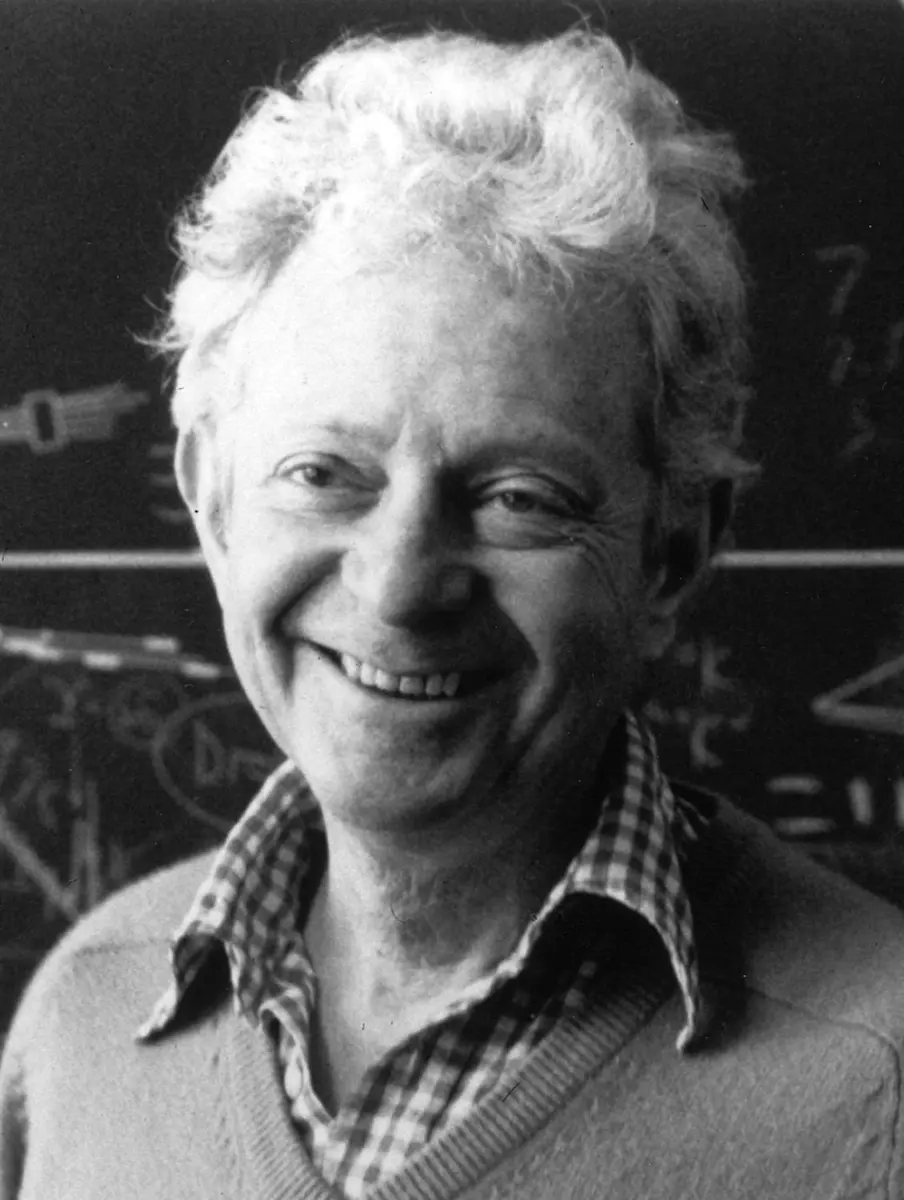
Leon M. Lederman
1922–2018, born in New York, USA
The son of a laundryman, he later ran Fermilab, the biggest physics laboratory in the USA, and worked for decades to improve how science is taught in schools.
Photo: US Department of Energy, Public domain
-
Melvin Schwartz
1932–2006, born in New York, USA
The youngest of the three. He fell in love with physics at 12, at the Bronx High School of Science, and had the idea for the experiment one evening after a coffee-time discussion.
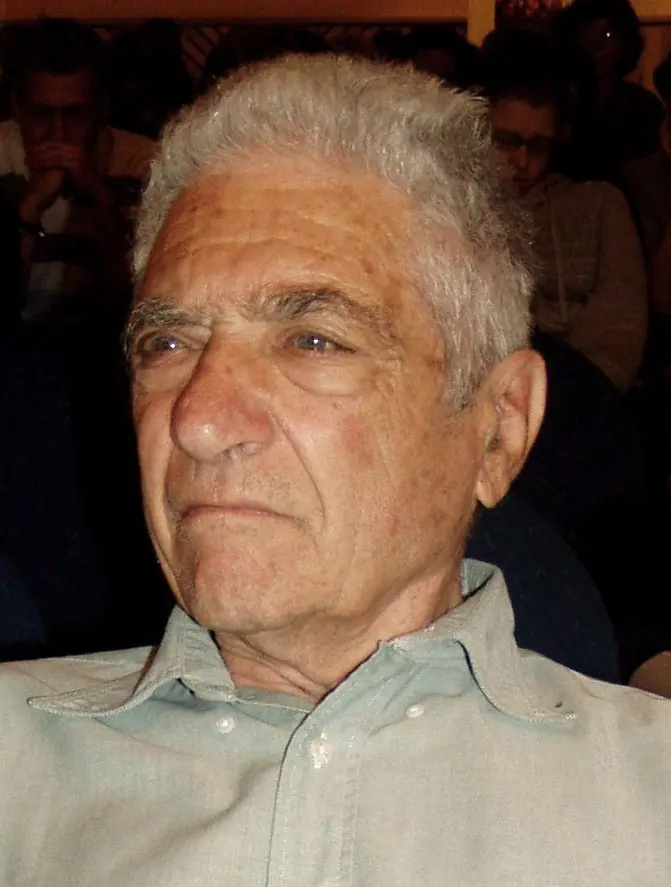
Jack Steinberger
1921–2020, born in Bad Kissingen, Germany
At 13 he was sent alone to the USA as a refugee from the Nazis. He started as a chemist, became Schwartz’s teacher, and later led experiments at CERN in Geneva for decades.
Photo: Sigismund von Dobschütz, CC BY-SA 3.0
Every second, tens of billions of neutrinos from the Sun pass through your thumbnail, and through the whole Earth, without hitting anything. They have no electric charge and almost no mass, and they hardly ever touch other matter. Catching even one is a triumph (Physics 1995).
So imagine trying to make a beam of them, aim it at a target, and do experiments with it. In the early 1960s, three physicists from Columbia University in New York did exactly that. With the first neutrino beam they found that there is not just one kind of neutrino but at least two. Leon Lederman, Melvin Schwartz and Jack Steinberger shared the 1988 Nobel Prize in Physics for it.
The problem: a force too weak to study
Physicists know four basic forces in nature: gravity, the electric and magnetic force, the strong force that holds the nucleus of an atom together, and the weak force. The weak force is the one that lets a neutron inside a nucleus turn into a proton, throwing out an electron and a neutrino. This is beta decay, one kind of radioactivity (Beta decay).
In 1960, the only way to study the weak force was to watch radioactive atoms decay by themselves, at low energies. Physicists wanted to know how the weak force behaves at high energies, but every beam they had, of protons, electrons or neutrons, also felt the strong or electric force. Those forces are so much stronger that they swamp the weak one.
There was also a puzzle about the muon. A muon is a particle exactly like an electron except that it is about 207 times heavier. It lives for only about two millionths of a second and then breaks up into an electron and two neutrinos. Physicists expected it, now and then, to break up a different way: into an electron and a flash of light (a gamma ray). No law they knew forbade it. A general rule of physics says that anything not forbidden will happen, sometimes. But in millions of muons, it was never seen. Something unknown was forbidding it.
Why couldn’t physicists study the weak force with a beam of protons?
Pick an answer to see why.
How you make a beam of neutrinos
You cannot just switch on a neutrino beam. It is made in steps, using a particle accelerator, a machine that pushes charged particles, such as protons, to enormous speeds with electric and magnetic fields.
- Fast protons. The team used the Alternating Gradient Synchrotron at the Brookhaven National Laboratory on Long Island, near New York. In 1960 it was the most powerful accelerator in the world. It whirled protons round a ring of magnets until they had about 15 billion electronvolts of energy each (a unit of energy for tiny particles), moving at almost the speed of light.
- A target. The protons smashed into a piece of the metal beryllium. The collisions sprayed out new particles, mostly pions: short-lived particles that hold nuclei together.
- Room to decay. The pions flew forward, about 21 meters through open space. A pion lives only about a forty-millionth of a second, but because it moves so fast, many get this far. On the way many broke up, each into a muon and a neutrino, both still flying forward.
- A wall. Then came a wall of steel 13.5 meters thick. It stopped every pion and every muon. Only the neutrinos went straight through, as if it were not there.
- The detector. Behind the wall waited a detector to catch the very few neutrinos that would hit something.
The faster the neutrinos, the more likely each one is to hit something. That is why the beam method was so powerful: neutrinos from an accelerator carry far more energy than those from radioactive atoms, and the higher the accelerator’s energy, the more useful the beam.
Why it was hard
- Neutrinos almost never hit. A neutrino from radioactive atoms would, on average, go through a light-year of lead without hitting anything. Even fast ones mostly pass straight through any detector.
- So you need enormous numbers. According to the Nobel presentation speech, about 10¹⁴ neutrinos, a hundred million million, passed through the detector during the experiment. Only a few dozen of them hit anything.
- False signals everywhere. Muons from cosmic rays rain down from the sky all the time. Neutrons could leak under or over the wall. Each of these could look like a neutrino’s hit.
- A brand-new detector. The detector they chose, the spark chamber, had only just been invented, and no one had built a big one.
What they did, step by step
The Columbia team
- Late 1959, a coffee break. The physics department at Columbia had a daily coffee hour where teachers and students argued about physics. One day the theorist T. D. Lee led a discussion of how anyone could study the weak force at high energies. Every idea seemed hopeless. That evening Melvin Schwartz had the key thought: make a beam of the neutrinos that pions give out. A quick calculation on paper said it might just work. He telephoned Lee at home, and the next day planning began. (The Soviet physicist Bruno Pontecorvo had similar ideas at about the same time.)
- 1960, the question. Lee and his colleague C. N. Yang argued that the missing muon decay made sense only if there were two kinds of neutrino: one that goes with the electron and one that goes with the muon. The beam could test this.
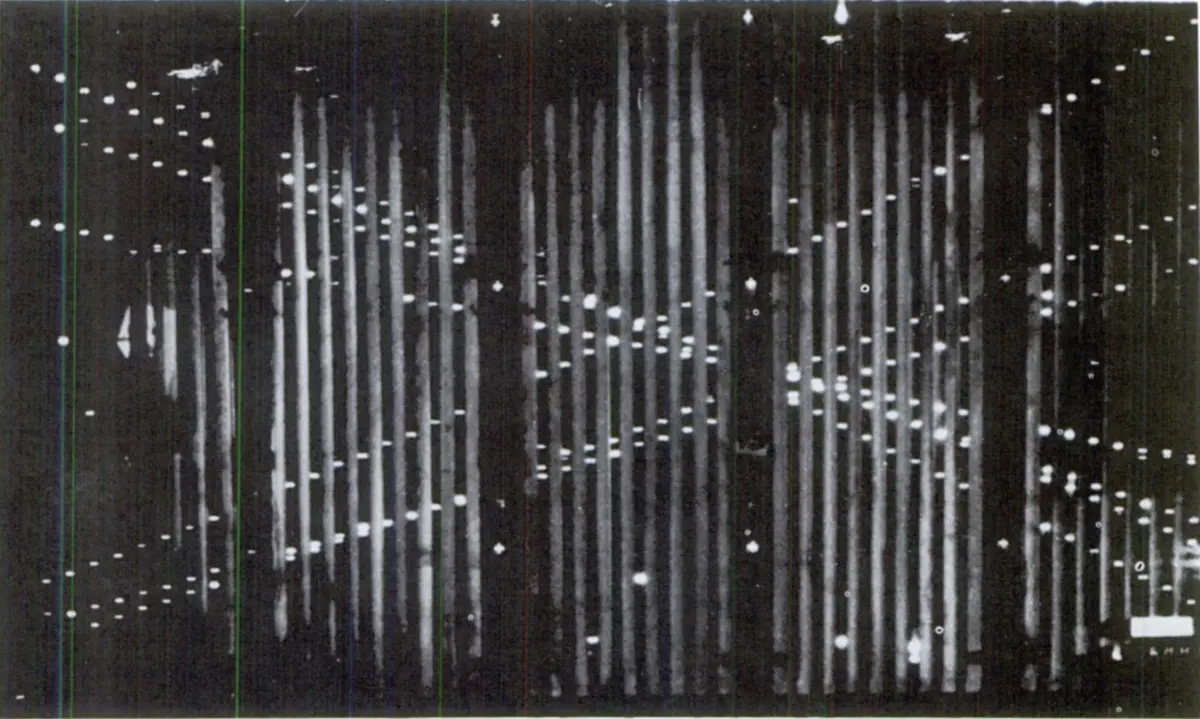
- 1960–61, the detector. Schwartz, Lederman, Steinberger and their colleagues built a spark chamber weighing 10 tonnes: 90 aluminium plates, each about 1.1 meters square and 2.5 cm thick, with narrow gaps of gas between them. When a charged particle crosses the gaps, high voltage makes a spark along its path, and cameras photograph the line of sparks. A neutrino itself leaves no trail, but if it hits a nucleus in a plate, the charged particle it makes does.
- The wall. The 13.5-meter wall was built from steel plates taken from a scrapped warship, which saved time and money.
- Fighting false signals. The accelerator hit the target in short bursts, adding up to only about two millionths of a second in every second. The detector was switched on only during those bursts, so most cosmic rays, arriving at other times, were simply never recorded. Counters around the chamber rejected particles coming in from outside.
- 1961–62, the result. Over several months the team found 29 clean tracks of single muons made by neutrinos, and more events where a muon came out with other particles. If there were only one kind of neutrino, the beam should have made electrons about as often as muons, and the cameras should have shown about as many electron tracks. They found only 6 events that might have been electrons, and those did not look like them. The neutrinos from pions made muons, and not electrons. They were a second kind of neutrino: the muon neutrino. The team published the result in 1962.
Why did finding muons but almost no electrons prove there were two kinds of neutrino?
Pick an answer to see why.
How it fits together now: families of particles
The discovery showed that the particles called leptons come in pairs. Each charged lepton has its own neutrino, and they belong together:
| Family | Charged lepton | Its neutrino |
|---|---|---|
| First | electron (found 1897) | electron neutrino (caught 1956) |
| Second | muon (found 1936) | muon neutrino (found 1962, this prize) |
| Third | tau (found 1975) | tau neutrino (found 2000) |
When a neutrino hits something and turns into a charged lepton, it always becomes the one of its own family: an electron neutrino makes an electron, a muon neutrino makes a muon. That is why a muon cannot simply break up into an electron and a gamma ray: the muon’s family has to be carried off by a muon neutrino. This pairing, which the Nobel committee called the “doublet structure of the leptons”, is now part of the Standard Model, physicists’ best description of all the particles that make up matter. The quarks inside protons and neutrons come in pairs too Grade 8: the particles inside an atom.
How many families are there? In 1989, a year after this prize, experiments at CERN, Steinberger among the leaders of one of them, measured that there are exactly three families with a light neutrino.
In your life today
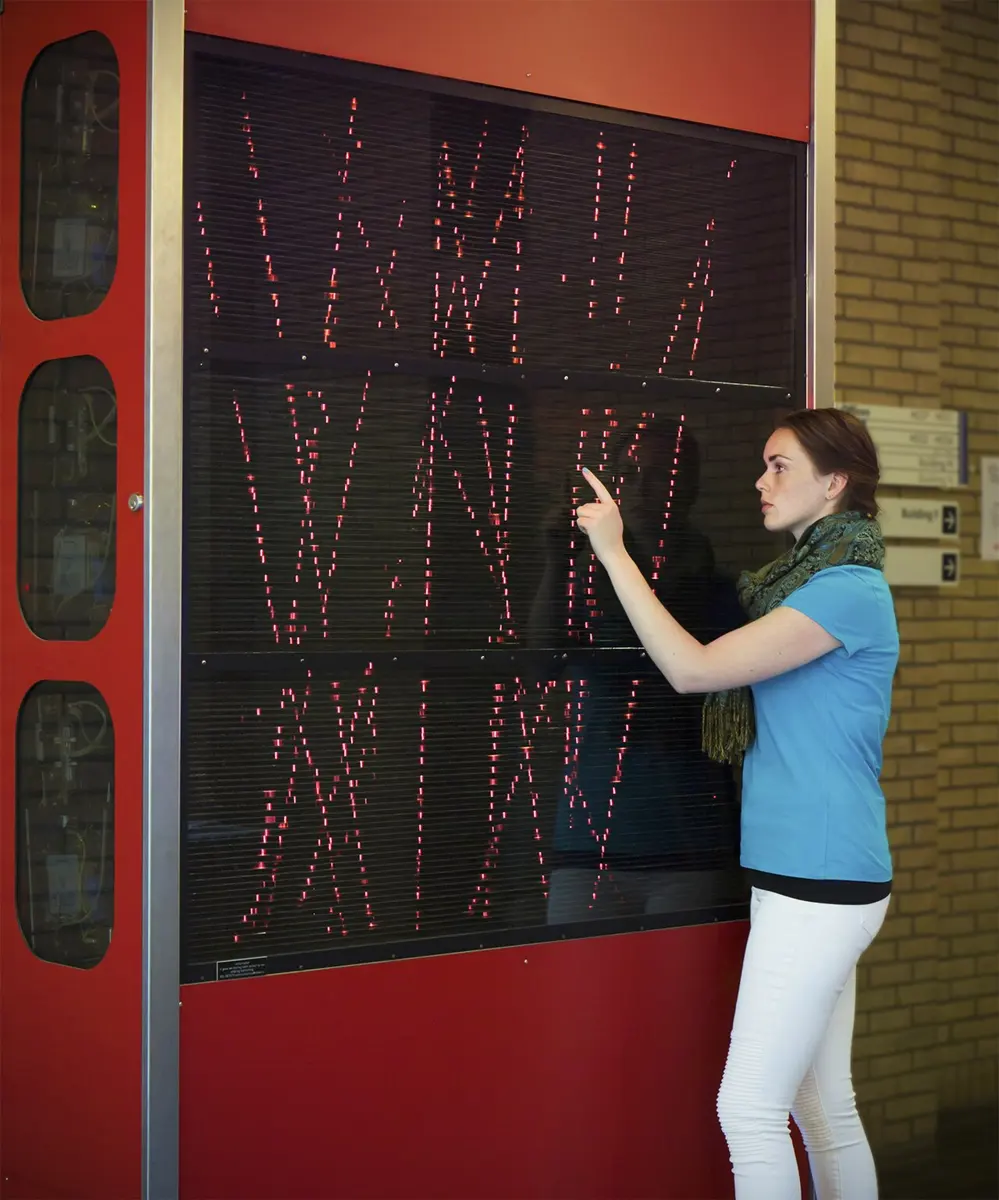
- Muons through your head. Cosmic rays hitting the top of the atmosphere make muons, which rain down to the ground. About one passes through every square centimeter of the Earth’s surface each minute, including the top of your head, whether you are in Bhaktapur or on a Himalayan peak. Spark chambers built for science museums show them as flashes of sparks.
- Seeing inside protons. Neutrino beams were later aimed at matter to look inside protons and neutrons. They helped show that these are made of smaller particles, quarks.
- Neutrinos sent through the Earth. Today accelerators fire neutrino beams hundreds of kilometers through solid rock to distant detectors, such as 295 km across Japan. A new one in the USA will send neutrinos 1,300 km underground from Fermilab, near Chicago, to South Dakota. No tunnel is needed: the neutrinos simply pass through the Earth.
What came next
- A new kind of hit. In 1973, a neutrino beam at CERN showed that a neutrino can also bounce off matter without changing into a charged lepton. This proved part of the theory joining the weak and electromagnetic forces, which won the Nobel Prize in 1979 (Physics 1979).
- More discoveries for the team. In 1977 Lederman’s group at Fermilab found the bottom quark, one member of the quarks’ third family.
- Neutrinos that change kind. In 1988 the Nobel committee asked whether the families were perfectly strict. The answer turned out to be no: in 1998 and 2001, experiments showed that neutrinos slowly change from one kind to another as they travel (Physics 2015). That can happen only if neutrinos have a little mass.
- An open question. Do neutrinos and their antiparticles change kind in exactly the same way? If not, it could help explain why the universe is made of matter, with almost no antimatter left. The long-distance neutrino beams are being built to find out.
In your science books
- Grade 8: the particles that make up an atom.
- Grade 9: the structure of an atom and the nuclear reactions in the Sun, which send out neutrinos.
- Going further: beta decay, where the neutrino was first needed, and the Sun’s neutrinos as a message from its core.
- More Nobel Prizes: catching the neutrino and finding the tau, and neutrinos that change their kind.
Learn more
- The Swedish Academy’s press release and the presentation speech (nobelprize.org).
- The Nobel lectures: Schwartz, who tells the story of the coffee hour and the experiment, Lederman and Steinberger.
The official reason
The prize was given “for the neutrino beam method and the demonstration of the doublet structure of the leptons through the discovery of the muon neutrino.”