
Find two strong magnets: the small shiny discs from a toy, or the heavy rings from the back of an old loudspeaker. Hold one still, and bring the other slowly towards it, north pole facing south. Nothing touches, yet you feel a pull long before they meet. It grows stronger and stronger, until the magnet jumps out of your fingers and the two meet with a sharp click. Now turn one round, north facing north, and push them together. An invisible cushion pushes back, and the moment you let go, the magnet jumps away.
A jumping magnet has kinetic energy, and the click is sound. Energy is never made from nothing, so where did it come from? Nothing was wound up, nothing was burnt, and nothing touched. Or was something wound up after all? This topic shows that the push and pull between magnets, and between electric charges, is carried by a field in the space between them, and that the energy of the jump was stored in that field. You put it there yourself, when you pulled the magnets apart.
Two magnets, one field
You met magnets in Grade 8: every magnet has a north and a south pole, unlike poles attract and like poles repel, and the region round a magnet where its pull can be felt is its magnetic field Grade 8: Magnet. In Grade 10 you found that an electric current makes a magnetic field too, that a coil carrying a current behaves like a bar magnet, and that a field can be drawn as field lines, crowded together where it is strong (The magnetic field around a solenoid, Magnetic flux). And in Why Is Gravity So Weak? you met electric fields: a field says, for every point at once, what force something would feel if it were put there.
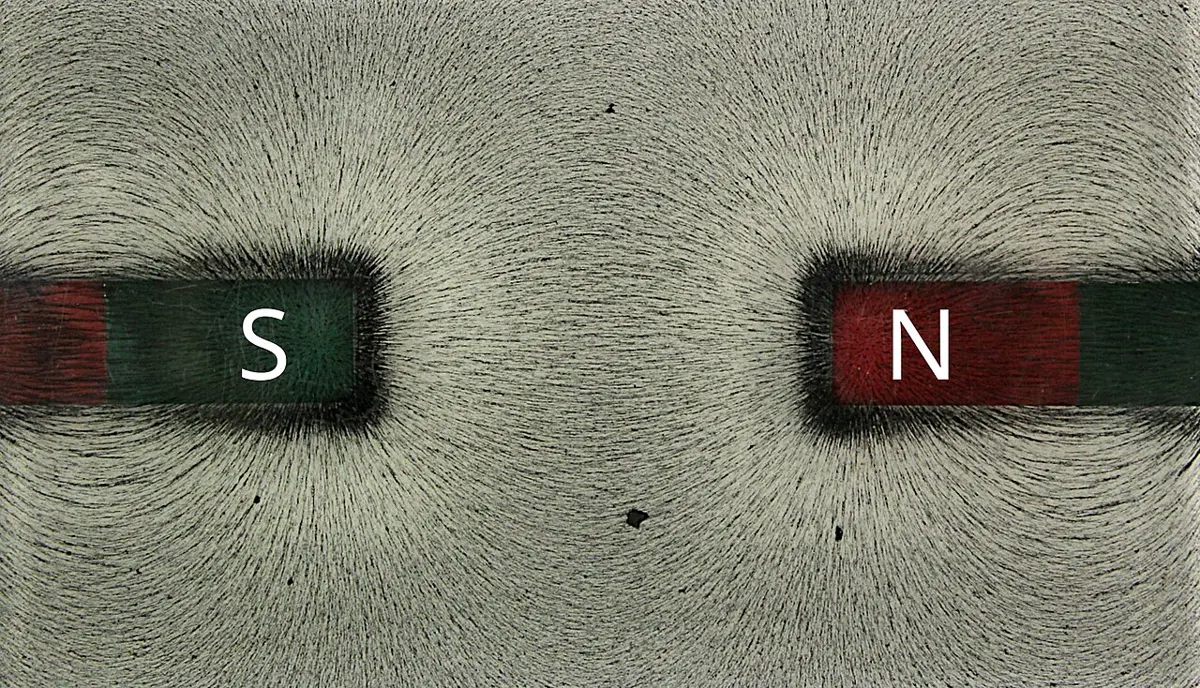
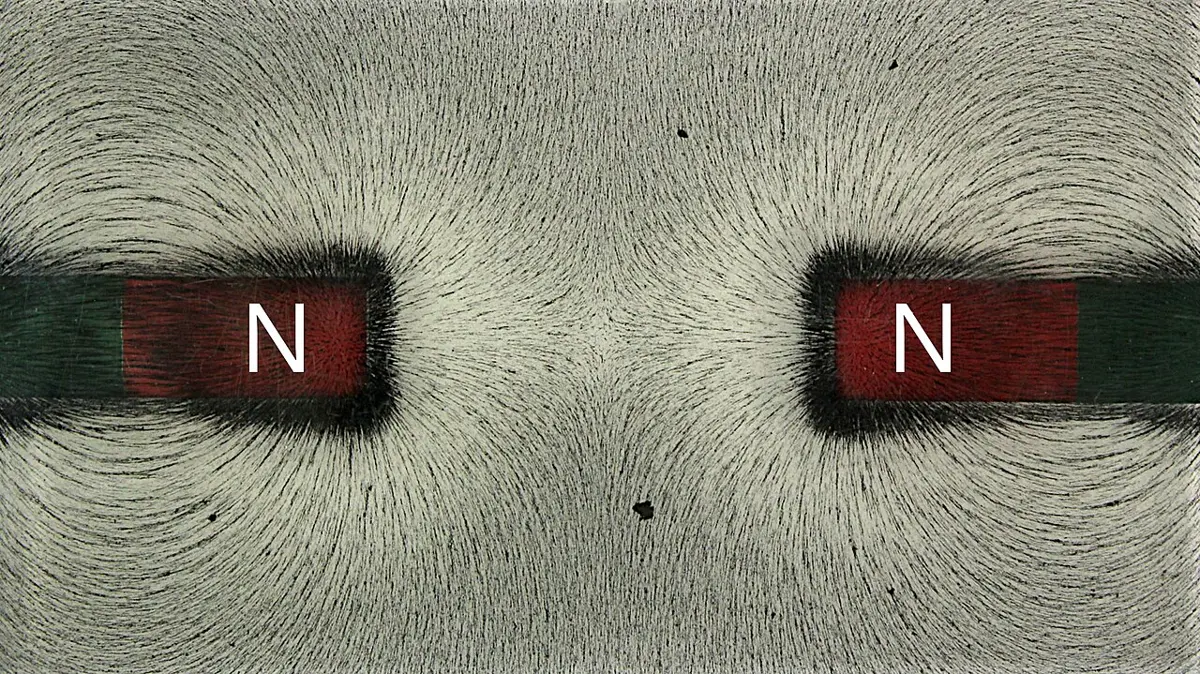
So far you have drawn the field of one magnet. But a pull needs two things. Put a second magnet near the first, and each one sits in the other’s field. The field you would map with a compass is now the two fields added together, point by point, and its shape is quite different from either magnet’s field alone.
The English scientist Michael Faraday found a way to read the force straight from a picture like this. Imagine that every field line is a stretched rubber band: it always tries to get shorter, and it pushes sideways on the lines beside it, so lines squashed together try to spread out.
- Unlike poles facing. Lines leave the N pole and run straight across the gap into the S pole. Like stretched bands, they try to shorten, and they pull the magnets together. The closer the magnets, the more lines crowd into the gap, and the stronger the pull.
- Like poles facing. No line crosses the gap. Lines from both N poles crowd into the space between them, press sideways against each other, and turn away. Their sideways push pushes the magnets apart. Halfway between two equal magnets, the two fields are equal and opposite and cancel: a point with no field at all.
This picture isn’t just a memory aid. Physicists later showed that the forces worked out this way, from the tension along the lines and their sideways pressure, are exactly the forces the magnets really feel.
Magnetic field lines never end
There is one big difference between magnetic and electric field lines. Electric field lines start on positive charges and end on negative ones (Field lines). Magnetic field lines have no start or end. A line leaves the N pole, curves round outside, enters the S pole, and carries on through the inside of the magnet back to the N pole: every magnetic field line is a closed loop.
That is why you can never cut a magnet into a north half and a south half. Every piece has both poles Grade 8: Molecular theory of magnetism. A lone north pole, a magnetic monopole, would be a place where field lines start, like a positive charge. The physicist Paul Dirac showed in 1931 that the laws of physics allow one, and physicists have searched for them ever since, in rocks, in cosmic rays and at particle colliders. None has been found (as of 2026).
Two bar magnets lie end to end with a gap between them. In the gap, the field lines bend away to the sides and none crosses from one magnet to the other. What can you say?
Pick an answer to see why.
Why can’t you cut a bar magnet to get a piece with only a north pole?
Pick an answer to see why.
Pulling apart stores energy
To pull the magnets apart, you must keep pulling against their attraction while they move. In Where Does the Energy Go When a Ball Bounces? you met work: when a force moves something, work = force × distance, and work is energy passed from one thing to another. So pulling magnets apart takes energy out of your muscles.
That energy isn’t lost. Let go, and the magnets’ pull speeds the magnet up: it gains kinetic energy. Then they hit, and the kinetic energy becomes sound and heat. While you held them apart, the energy was stored, like the energy of a ball held up high. The ball’s energy belongs to the ball and the Earth together, stored in the gravitational field between them (Gravitational potential energy). In the same way, the magnets’ energy belongs to the pair, and it is stored in the magnetic field between them. A single magnet alone on a table has no energy of this kind to give.
Like poles work the other way round. Pushing them together takes work, like squashing a spring, and letting go gives it back as the magnet flies off. Either way, the rule is the same: when two objects that push or pull each other through a field are moved against the force, energy is stored in the field; when they move the way the force pushes them, the field gives energy back.
When the force changes as you pull
Lifting a ball is easy to count, because its weight is the same all the way up: work = mg × h. A magnet’s pull is not like that. It is enormous when the magnets touch, and falls away to almost nothing a few centimeters apart.
The table gives the force between two neodymium disc magnets, 10 mm across and 5 mm thick, a common size (worked out from the strength of their material, not measured):
| Gap between the magnets (mm) | 0 | 1 | 2 | 3 | 4 | 6 | 8 | 10 |
|---|---|---|---|---|---|---|---|---|
| Force (N) | 28.3 | 16.2 | 10.9 | 7.75 | 5.65 | 3.17 | 1.89 | 1.18 |
Pulling them apart by a millimeter near contact takes far more work than a millimeter farther out. To add it up, split the pull into small steps. Over each step the force hardly changes, so the work is about (the average force) × (the step), the area of a thin strip under the force–distance graph. Add up the strips, and you have the whole area. The work done is the area under the force–distance graph: for a constant force, the area is just a rectangle, force × distance.
You push two magnets together, north pole to north pole, hold them 2 mm apart, and let go. What happens to the energy?
Pick an answer to see why.
The energy of two charges
Charges do exactly what magnets do. Two unlike charges pull each other; pull them apart, and you store energy in the electric field between them. Two like charges push; push them together, and you store energy. Because Coulomb’s law gives the force exactly (Coulomb’s law), the stored energy can be worked out exactly too.
The force between two small charges is . Add up the strips under this curve from a distance r all the way out to “far apart”, and mathematics gives a simple answer. The electric potential energy of two charges a distance r apart is
counting zero when they are far apart. U is in joules, q₁ and q₂ in coulombs, r in meters, and k = 8.99 × 10⁹ N m²/C² as before. Notice that it is r, not r²: double the distance and the stored energy halves, while the force falls to a quarter.
- Like charges: q₁q₂ is positive, so U is positive. It is the energy the pair will give out if they are let go and fly apart.
- Unlike charges: q₁q₂ is negative, so U is negative. Negative only means less than when far apart: coming together from far away, they have already given out that much energy, and you must put it back to pull them apart again.
Two like charges are 10 cm apart. They are moved to 20 cm apart. What happens to the electric potential energy?
Pick an answer to see why.
Energy between charged plates
Take two flat metal plates, face to face a little way apart, and join them to a battery. Electrons flow off one plate and onto the other, until one plate is positive, the other negative, and the potential difference between them is the battery’s voltage. Two charged plates like this make a capacitor, a store for electric energy that is in almost every electronic circuit.
Between the plates, the field lines run straight across from the + plate to the − plate, parallel and evenly spaced (except near the edges): the field is uniform, the same strength and direction everywhere between the plates, like the field inside a solenoid. So a charge q between the plates feels the same force F = qE wherever it is (Electric field strength), just as a ball near the ground feels the same weight mg at any height.
So carrying a positive charge across the gap d, from the − plate to the + plate, against the field, is like lifting a ball: the force is constant, and the work is force × distance.
You learned in Grade 9 that the potential difference between two points is the energy per coulomb, V = W/Q, so moving a charge q across a potential difference V takes energy qV Grade 9: Potential difference. Both describe the same trip, so qEd = qV, and
The field between the plates is the voltage divided by the gap. This gives a second unit for field strength, the volt per meter (V/m), the same as the newton per coulomb: 1 V/m = 1 J/(C m) = 1 N/C.
| A ball near the ground | A charge between plates | |
|---|---|---|
| the field | g, about 9.8 N/kg, uniform | E = V/d, uniform |
| the force | mg | qE |
| energy stored, moved against the field | mgh | qEd = qV |
| let go | it falls, and gains kinetic energy | it is pushed back across, and gains kinetic energy |
How much energy is stored in a capacitor?
Charging the plates means carrying charge from one plate to the other (the battery does the carrying). The first bit of charge crosses when the plates are still uncharged, with no voltage between them, so it takes almost no work. But each bit carried across makes the voltage a little higher: the voltage rises in step with the charge. The last bit is carried across the full voltage V. On average, each coulomb is carried across half the final voltage, so a capacitor holding charge Q at voltage V stores
On a graph of voltage against charge, it is the area of a triangle.
Where the energy is: in the field
The capacitor shows it most clearly: energy is stored in the space where the field is, and the stronger the field, the more energy each cubic meter holds. (The energy in each cubic meter goes as the field strength squared: double the field, four times the energy.) The same is true of magnetic fields. When two magnets snap together, the strong field that filled the gap between them vanishes, and its energy appears as the magnet’s motion. And light, which is a traveling ripple in electric and magnetic fields, carries energy across space from the Sun with no matter at all to carry it.
Motion or position, at every scale
In Every kind of energy is motion or position you saw that every kind of energy is energy of motion (kinetic) or energy of position (potential). Now you can say where the energy of position is: in a field, between things that push or pull each other.
| Example | Energy of motion | Energy of position: in which field? |
|---|---|---|
| a ball held up, then falling | the falling ball | gravitational field of the ball and the Earth |
| two magnets snapping together | the moving magnet | magnetic field between the magnets |
| a charged camera-flash capacitor | none, until it flashes | electric field between the plates |
| a hydrogen atom | the electron going round | electric field of the proton and the electron |
| a cup of hot tea | the jiggling molecules | electric fields between neighboring molecules |
| a stopped magnet, just after the click | faster jiggling of the molecules in the magnets and the air (sound, then heat) | the stretched and squeezed bonds between those molecules |
At every scale, from an atom to a planet, energy is accounted for in just these two ways. When it seems to disappear, as after the click, it has gone into the motion and positions of molecules, too small and too many to see.
A student says: “Magnets are a free source of energy. They snap together again and again, and never run down.” What is wrong with this?
Pick an answer to see why.
A charged capacitor is disconnected and left on a table. Where is its stored energy?
Pick an answer to see why.
Questions
Two unlike charges are let go from rest and move towards each other. Which describes the energy of the pair?
Pick an answer to see why.
The voltage between two parallel plates is doubled, and the gap between them is also doubled. The field between them
Pick an answer to see why.
A ring magnet floats above another ring magnet on a pencil, like poles facing, with a gap of 8 mm. You press the top magnet down until the gap is 4 mm, and let go. It shoots up, rises above 8 mm, falls back, and bobs up and down a few times before it settles at 8 mm again.
- i.Why does the top magnet float at 8 mm?
- ii.Draw an energy model: three bar charts showing the gravitational, magnetic and kinetic energy of the system, and the thermal energy, when you hold the magnet at 4 mm, when it passes 8 mm on the way up, and at the top of its first bounce.
- iii.Why does it stop bobbing?
Answer
- i.At 8 mm, the magnetic push up on the top magnet is exactly equal to its weight. Closer, the push is stronger than the weight; farther, it is weaker. So 8 mm is where the forces balance.
- ii.Holding at 4 mm: a lot of magnetic energy (you pushed like poles closer, against the push), the least gravitational energy (the magnet is at its lowest), no kinetic energy, no extra thermal energy. Passing 8 mm going up: magnetic energy much smaller (the poles are farther apart), gravitational energy a little bigger (it is higher), kinetic energy large (it is moving fastest near here, where the forces balance), a little thermal energy (friction on the pencil, air). Top of the first bounce: magnetic energy smallest, gravitational energy largest, kinetic energy zero (it stops for an instant), a little more thermal energy. The total of all the bars is the same each time, and more than when the magnet floated at rest by exactly the work you did pressing it down.
- iii.Each bob, friction against the pencil and the air turns some of the energy into thermal energy (molecular motion) and sound. When all of the extra energy you put in has gone that way, the magnet is left at rest where the forces balance.
Two small spheres, each with a charge of +30 nC, are held 5.0 cm apart. One is fixed; the other has a mass of 0.50 g and is free to move without friction.
- i.Calculate the force between them, and the electric potential energy.
- ii.The free sphere is let go. How fast is it moving when the spheres are 15 cm apart?
- iii.Explain why it speeds up quickly at first and then more and more slowly.
Answer
- i., a push. .
- ii.At 15 cm: U = 8.09 × 10⁻⁶ ÷ 0.15 = 0.54 × 10⁻⁴ J. Energy given out = 1.62 × 10⁻⁴ − 0.54 × 10⁻⁴ = 1.08 × 10⁻⁴ J = ½mv², so .
- iii.The push is : strong when the spheres are close, and falling to a ninth by the time they are three times as far apart. So the acceleration is large at first and gets smaller and smaller. The sphere never stops speeding up, but it gains less and less, heading for a top speed set by all of the starting energy, 0.80 m/s.
In a hospital X-ray tube, electrons are sped up from rest across 100,000 V, then hit a block of tungsten.
- i.How much kinetic energy does each electron have when it reaches the tungsten?
- ii.About 1 % of that energy comes out as X-rays. What happens to the rest, in terms of the motion of particles? Why must the tungsten block be cooled?
Answer
- i.Energy = qV = 1.60 × 10⁻¹⁹ C × 100,000 V = 1.6 × 10⁻¹⁴ J: the electric field in the tube has given each electron that much kinetic energy.
- ii.The other 99 % becomes thermal energy: each electron’s orderly motion is shared out among the atoms of the tungsten, which jiggle faster (and the jiggling is the electric fields between neighboring atoms being stretched and squeezed, back and forth). With many electrons a second, that heats the block strongly, so it must be cooled, often by spinning it so the beam keeps hitting a new spot, and with oil round the tube.
A student measures the force needed to hold two magnets apart at different gaps, using a kitchen scale. (These results are made up for this question, but they are like real ones.)
| Gap (mm) | 5 | 10 | 15 | 20 | 30 |
|---|---|---|---|---|---|
| Force (N) | 4.0 | 2.0 | 1.1 | 0.6 | 0.2 |
- i.Plot a graph of force against gap. Is the force inversely proportional to the gap? Explain.
- ii.Estimate the energy stored in the field when the magnets are pulled from 5 mm to 30 mm apart.
- iii.Is your estimate too big or too small? Why?
Hint
For (i), test whether force × gap is the same each time. For (ii), use strips with straight tops, and remember 1 N × 1 mm = 1 mJ.
Answer
- i.Force × gap: 20, 20, 16.5, 12, 6 (N mm). It isn’t constant, so the force is not inversely proportional to the gap: it falls off faster. (For magnets far apart compared with their size, the force falls as about 1/(distance)⁴.)
- ii.Strips: 5 to 10: (4.0 + 2.0) ÷ 2 × 5 = 15; 10 to 15: (2.0 + 1.1) ÷ 2 × 5 = 7.75; 15 to 20: (1.1 + 0.6) ÷ 2 × 5 = 4.25; 20 to 30: (0.6 + 0.2) ÷ 2 × 10 = 4.0. Total about 31 mJ (0.031 J).
- iii.Slightly too big. The curve sags below the straight line joining each pair of points, so each straight-topped strip includes a little extra area. (Measuring at more gaps would make the strips thinner and the estimate better.)
Compare the two systems: a ball and the Earth; a positive charge between two charged plates.
- i.For each, say what the field is, what force acts, and what happens to the energy when the object moves with the force and against it.
- ii.In what way are they alike, and in what ways different?
Answer
- i.Ball and Earth: a uniform gravitational field g near the ground; the force is the weight mg, down. Lifted (against the force), it gains gravitational potential energy mgh; falling (with the force), it loses that and gains kinetic energy. Charge between plates: a uniform electric field E = V/d, from + to −; the force is qE, towards the − plate. Carried towards the + plate (against the force), it gains electric potential energy qEd = qV; moving towards the − plate (with the force), it loses that and gains kinetic energy.
- ii.Alike: a uniform field, a constant force, energy stored = force × distance moved against it, stored in the field, and given back as kinetic energy. Different: gravity only ever pulls, so every mass is pulled the same way, while a negative charge between the plates is pushed the opposite way to a positive one; the electric field can be switched off or reversed with the battery; and the electric force on a small charged object can be far bigger than its weight.
Where to go next
- Where does the energy go when a ball bounces? Counting energy in joules: kinetic, gravitational and thermal, and following every joule of a bouncing ball.
- Why does heat never flow from cold to hot? Why the energy of the click spreads out into heat and never gathers itself back to push the magnets apart.
- How much electricity can a small stream make? Stored energy at work: a stream’s drop, a turbine, and a generator turning motion into electricity.