
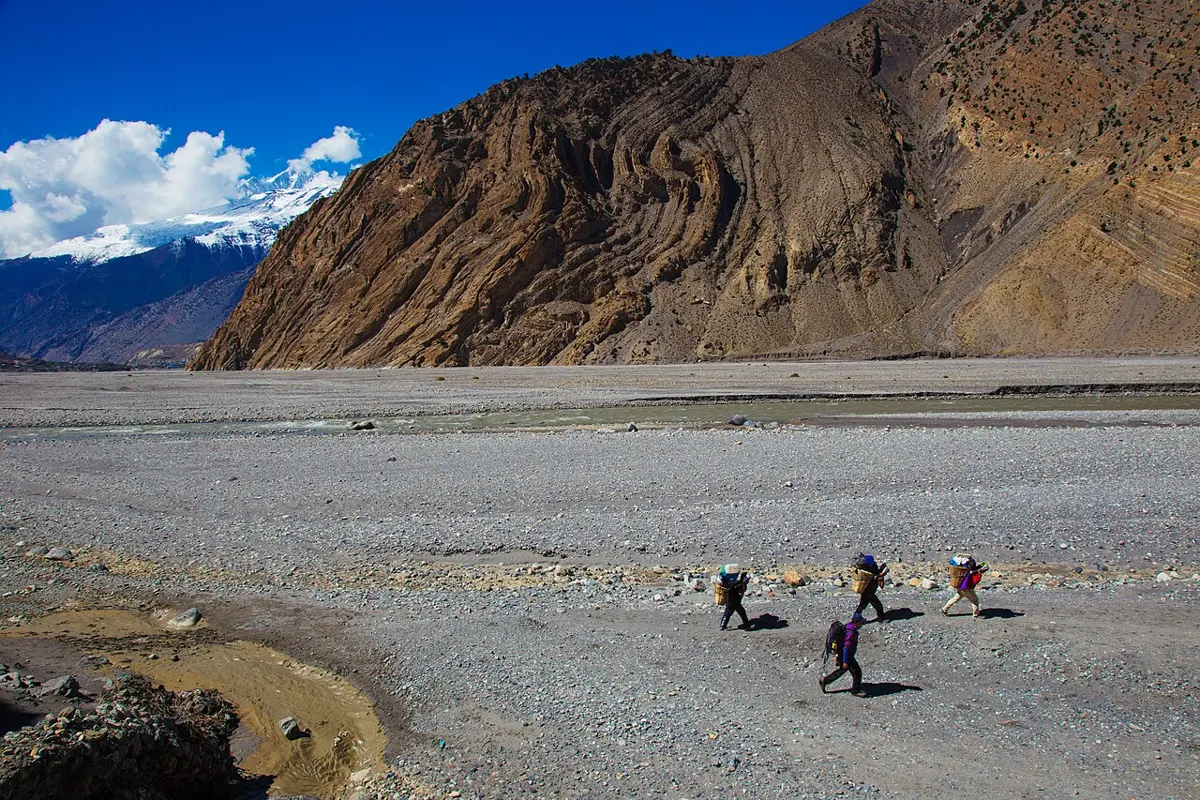
Walk up the Kali Gandaki from Jomsom towards Kagbeni and look at the valley walls. The rock is striped: bands of gray, brown and buff, some lying flat, some bent into great curves. Pilgrims pick up black stones called shaligrams in the riverbed and crack them open to find coiled ammonite shells inside. Every stripe on those walls was once loose mud or sand on the floor of a sea.
In Grade 8 you learned the Earth’s history as a calendar: eons and eras, with dates, and what lived in each Grade 8: The geological time scale. But how did anyone work out that calendar? Here is the surprising part. Geologists had put almost all of it in order by the 1840s, more than sixty years before anyone could measure the age of a single rock in years. They did it by reading layers of rock the way you would read the pages of a book. This topic shows how, so that you can do it too.
Layers in a pile
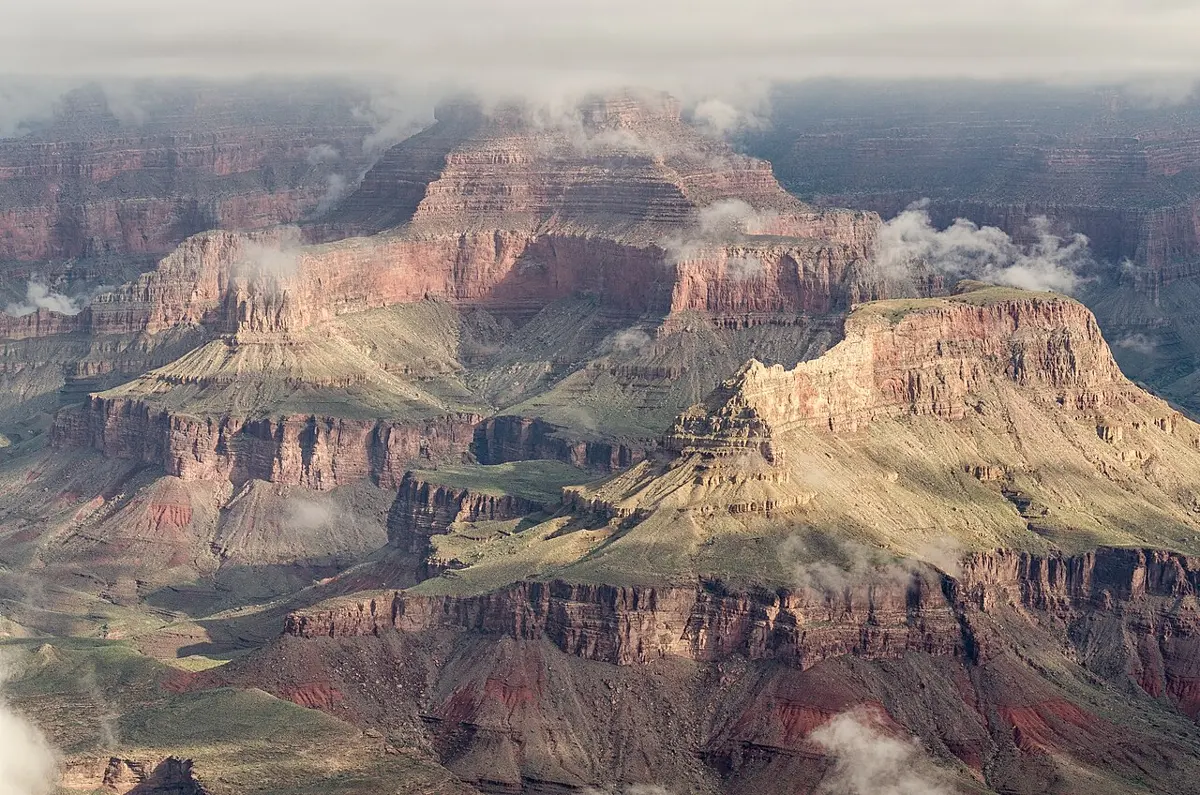
Think of a pile of old newspapers in the corner of a room. Each day’s paper goes on top. Without reading a single date, you know that the paper at the bottom is the oldest and the one on top is the newest. Unless someone has shuffled the pile, the order of the papers is the order of the days.
Rock layers form in the same way. You learned in Grade 7 that sedimentary rock is made from bits of sand, mud and shells (sediment) that settle in layers, usually under water, and are slowly pressed and cemented into rock. And in Grade 9 you will read that fossils are found in these rocks Grade 9: Evidence from fossils. A river carries mud into a lake or the sea; the mud settles on the bottom; next year more settles on top of it. Each layer of rock is called a stratum; two or more are strata.
From this, two rules follow.
- a.Superposition: in layers that have not been turned over, each layer is younger than the one below it and older than the one above. Lower is older.
- b.Original horizontality: sediment settles in flat, level layers, because gravity spreads it out. So if you see layers that are tilted or bent, they were moved after they were made.
These rules give a relative age: whether one rock is older or younger than another. They don’t give an absolute age, a number of years. Your pile of newspapers tells you that the bottom one is older than the top one, but not by itself whether that bottom paper is from last week or from 1990. Strata are the same: on their own, they tell the order of events, not their dates.
A cliff shows four flat layers: limestone at the bottom, then shale, then sandstone, then a thin layer of ash on top. Which layer is the oldest?
Pick an answer to see why.
Clues that cut across
Lower is older is only the first rule. Rocks hold other clues to the order of events.
Think of a wall. If a crack runs through the bricks, the crack must have come after the wall was built: you can’t crack a wall that isn’t there yet. And if a poster is pasted across the crack, unbroken, the poster came after the crack. Rocks work the same way.
- Cross-cutting: anything that cuts across a layer is younger than that layer. That includes a crack filled with once-molten rock (a dyke), a break along which the rock has slipped (a fault), and a valley cut by a river.
- Pieces inside: if a rock holds broken pieces of another rock, those pieces are older than the rock around them. They had to exist before they could be broken off and buried.
- Gaps: sometimes layers were lifted up, worn away by rain and rivers, then sunk again and buried under new layers. The worn surface between them is an unconformity, a gap in the record. The time when rock was being worn away, instead of laid down, left no layers at all.
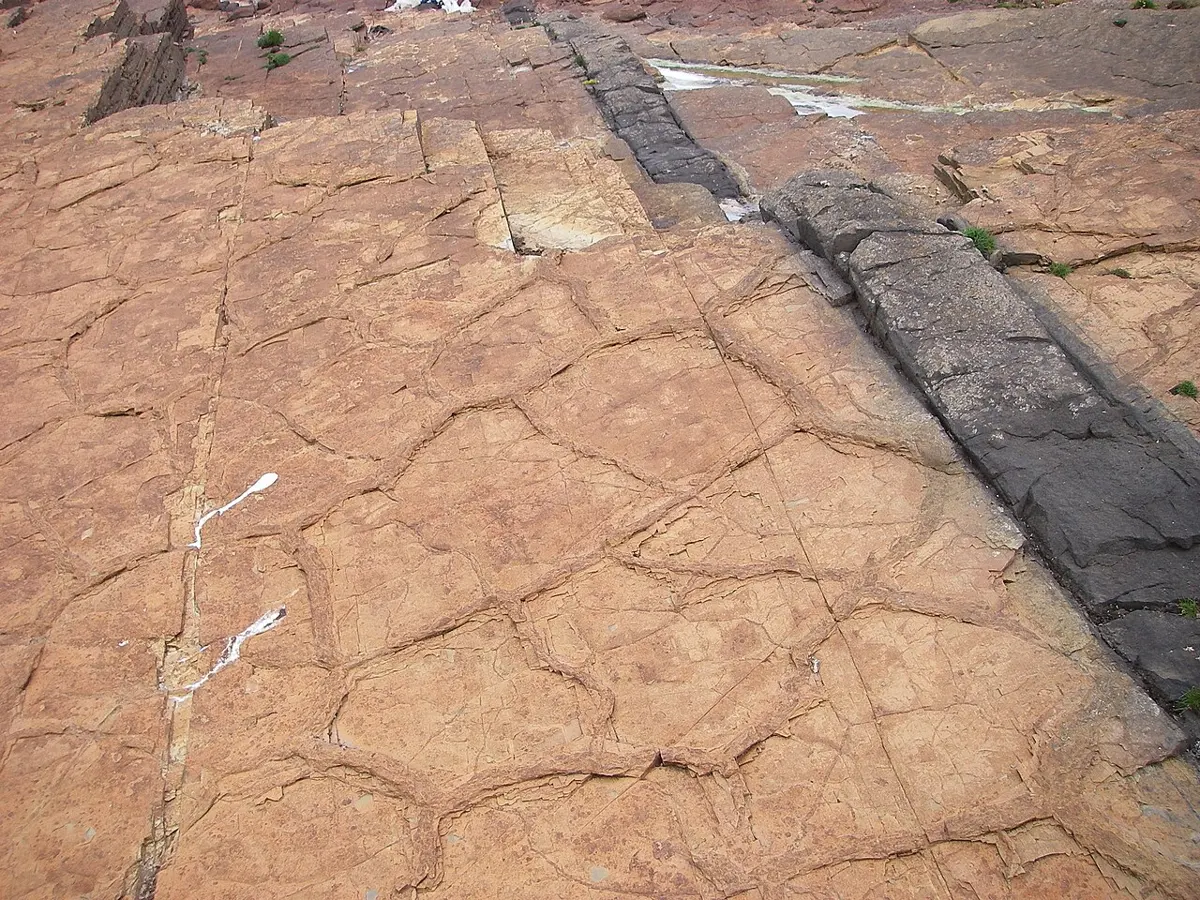
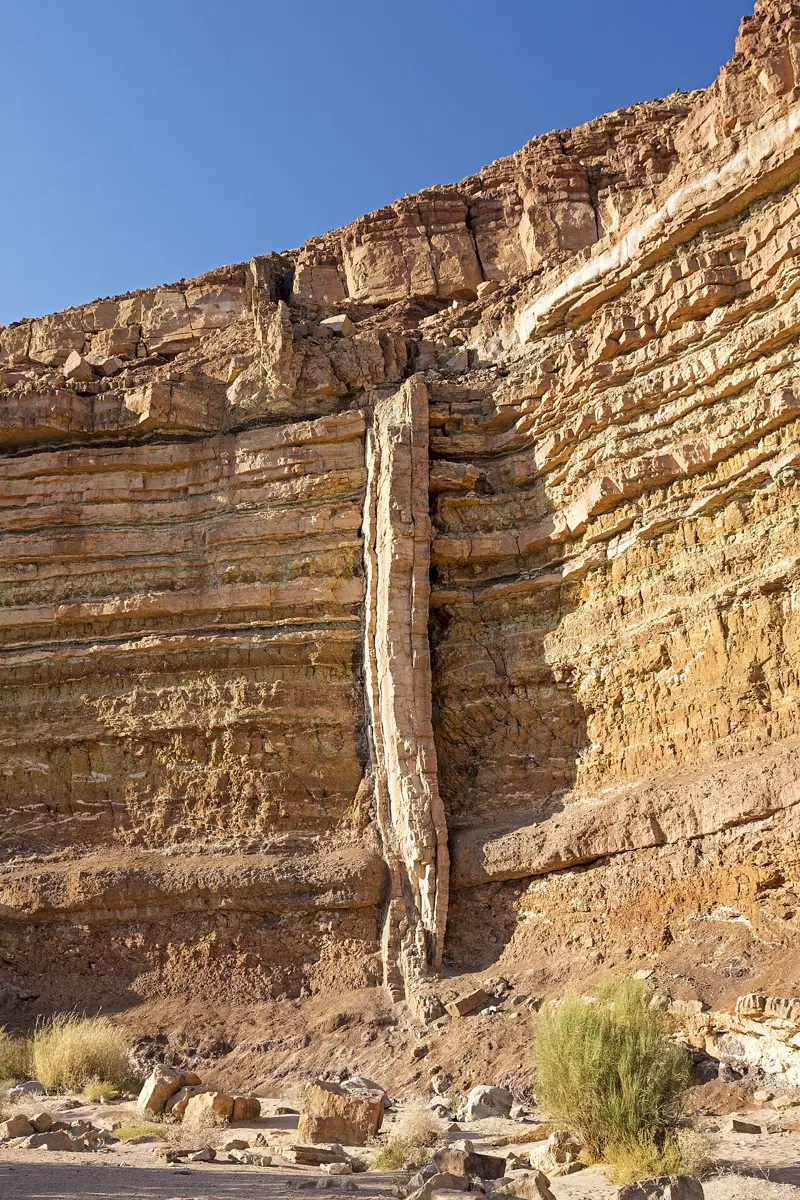
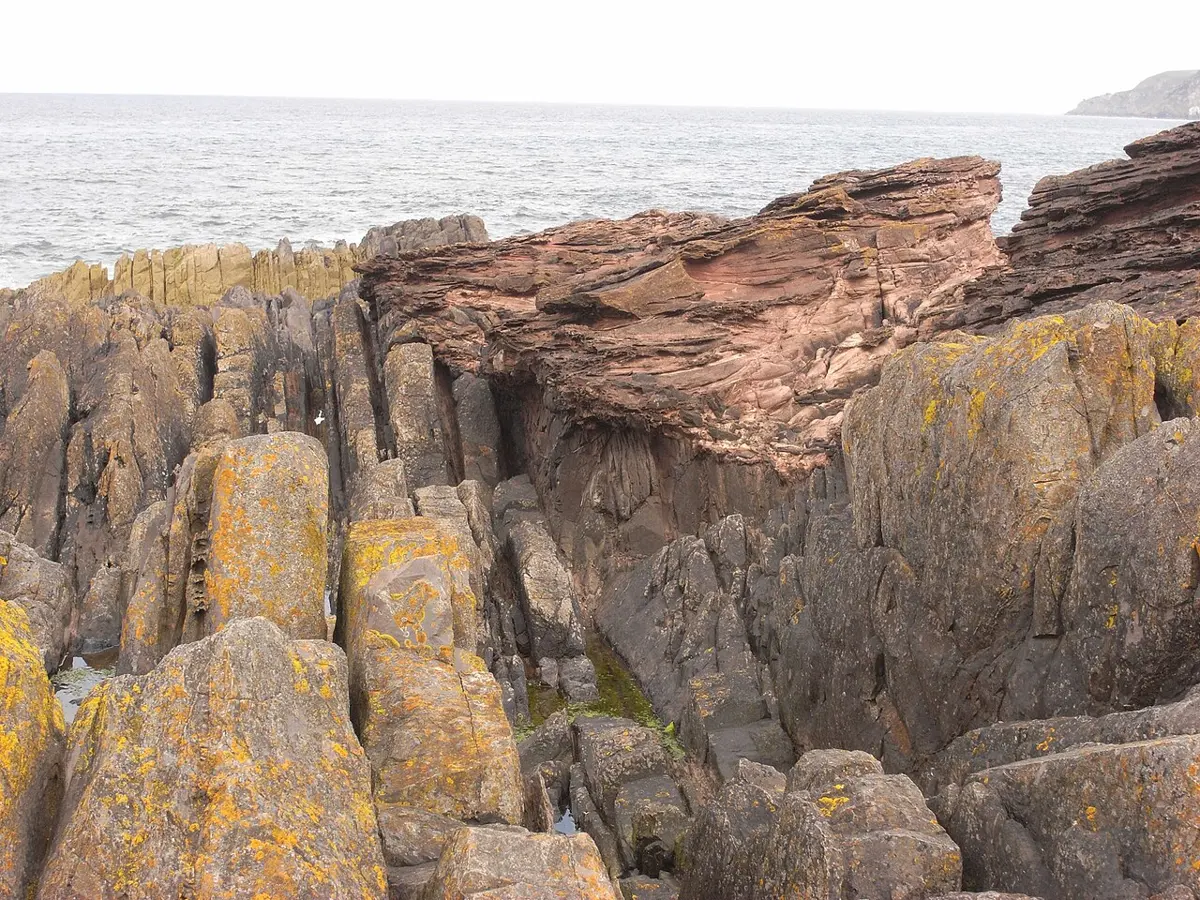
A dark dyke cuts up through layers 1, 2 and 3 of a cliff, but layer 4, on top, lies across it unbroken. What can you say about the dyke?
Pick an answer to see why.
Now you know enough to read a cliff. Geologists don’t just state the order: for each step they give the evidence, the clue in the rock that shows it.
Matching layers far apart
One cliff tells only part of the story. Its layers start at some time and stop at another, with gaps where rock was worn away. To read the Earth’s whole history, geologists need to fit together the pages from many places. Matching layers from one place to another is called correlation.
Sometimes you can simply follow a layer along a valley wall. But layers in two mountains, a hundred kilometers apart, can’t be followed: valleys, rivers and plains lie between. How do you know which layer here matches which layer there?
Not by the kind of rock. Sandstone forms whenever sand settles, and that has happened at countless times in the Earth’s history. Two sandstones can be hundreds of millions of years apart. And at one moment, the same sea can lay down sand near the shore and lime mud farther out, so one time can be two different rocks.
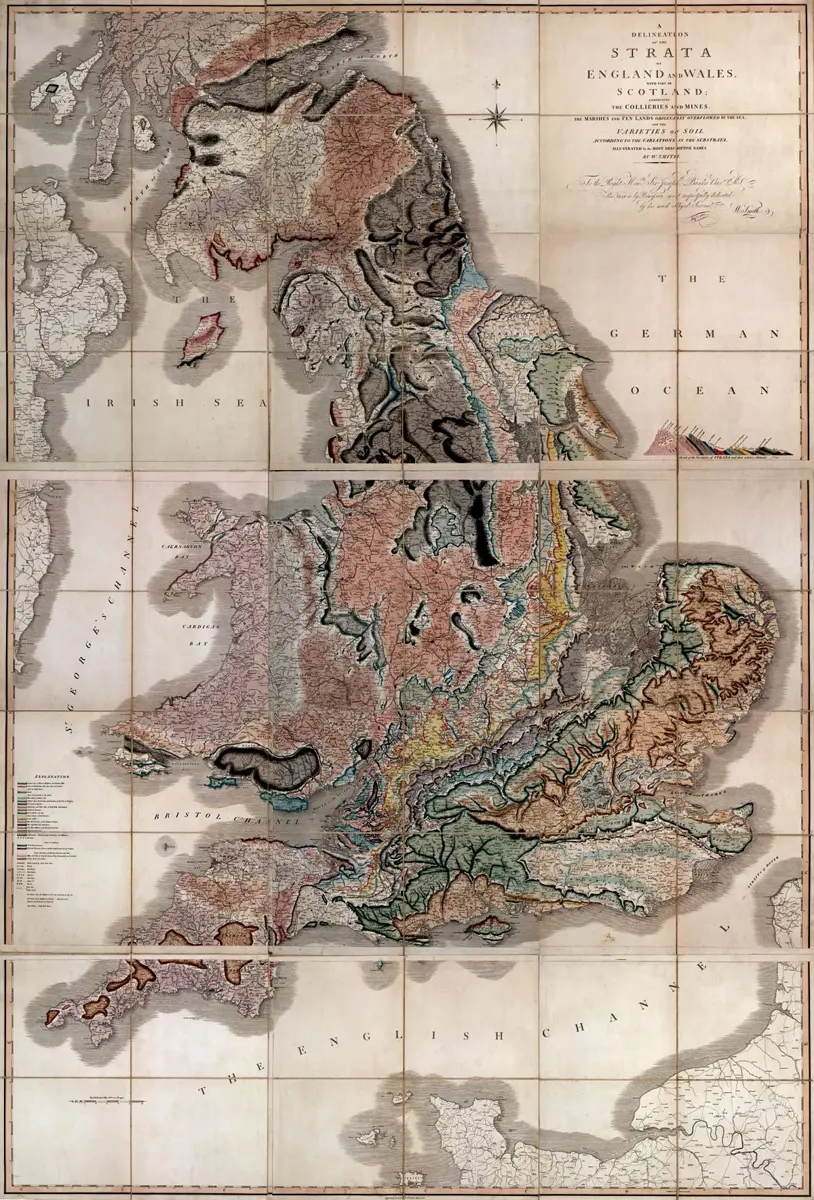
By fossils. In the 1790s the English surveyor William Smith, laying out a canal for coal barges, noticed that each layer held its own particular fossils, and that the fossils always came in the same order, from the bottom up, wherever he went. This is the principle of faunal succession: fossils follow one another in the same order everywhere. Each kind of living thing appears, lives for a while, and dies out. Once a species has died out it never comes back, so its fossils mark one stretch of time and no other.
The best fossils for matching layers, called index fossils, come from living things that:
- lived for only a short time, before changing into something different or dying out, so they pin down a short stretch of time;
- were widespread, often floating or swimming in the seas, so they are found in many places;
- were common and had hard parts, so they are easy to find;
- are easy to recognize.
Ammonoids and graptolites (tiny floating animals that lived in colonies) are among the best. Some ammonoid species lasted less than a million years, so they can match layers to within that time. Some key layers work too: when a volcano erupts, its ash falls over a huge area within days, so a layer of ash marks the same moment everywhere it falls.
Fossils can do more than match layers. Since we know when each kind of living thing was around, a rock that holds two kinds must have formed when both were alive: where their time ranges overlap.
Two cliffs 200 km apart each have a layer of red sandstone. What is the best evidence that they formed at the same time?
Pick an answer to see why.
How long did a layer take?
Strata give the order of events. Can they give the time as well? People tried, by asking how fast sediment piles up.
In some lakes fed by melting glaciers, each year leaves a pair of bands: a pale, coarse band of silt from the summer melt, and a thin, dark band of fine clay that settles slowly under the winter ice. One pair of bands, one year, is a varve. Count the varves, as you would count the rings of a tree, and you count the years.
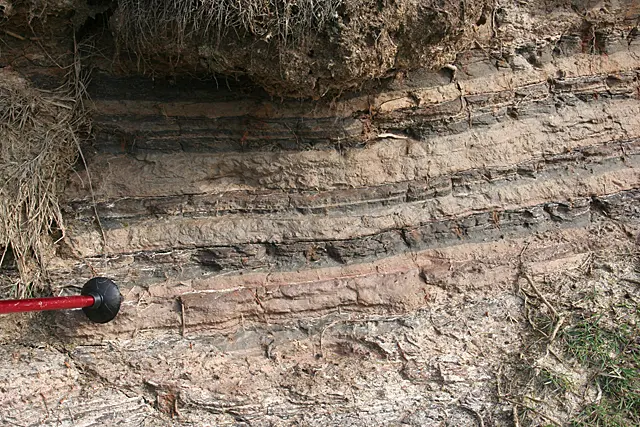
Most layers are not varves. For them, geologists can only estimate how fast the sediment built up, from what is building up today in similar places.
The dates came later. From 1907, scientists learned to read the clocks inside radioactive atoms (How Old Is the Earth? in Going Further 9–12 explains them). Volcanic ash and lava contain crystals that can be dated this way, but sandstone and limestone usually can’t. So geologists date the ash beds and lava flows above and below the fossil layers: a layer lying between ash dated at 70 million years and ash dated at 68 million years formed between those two dates. The order came from the strata; the numbers were pinned onto it.
Putting the Earth’s history in order
Now you can see how the geological time scale you met in Grade 8 was built. It isn’t a list someone made up; it is a summary of the evidence in the rocks.
- Geologists in many countries worked out the order of the layers in their own region, by superposition and cross-cutting.
- They matched the layers between regions by their fossils, and so built one long column, the order of all the strata known, far longer than any one cliff.
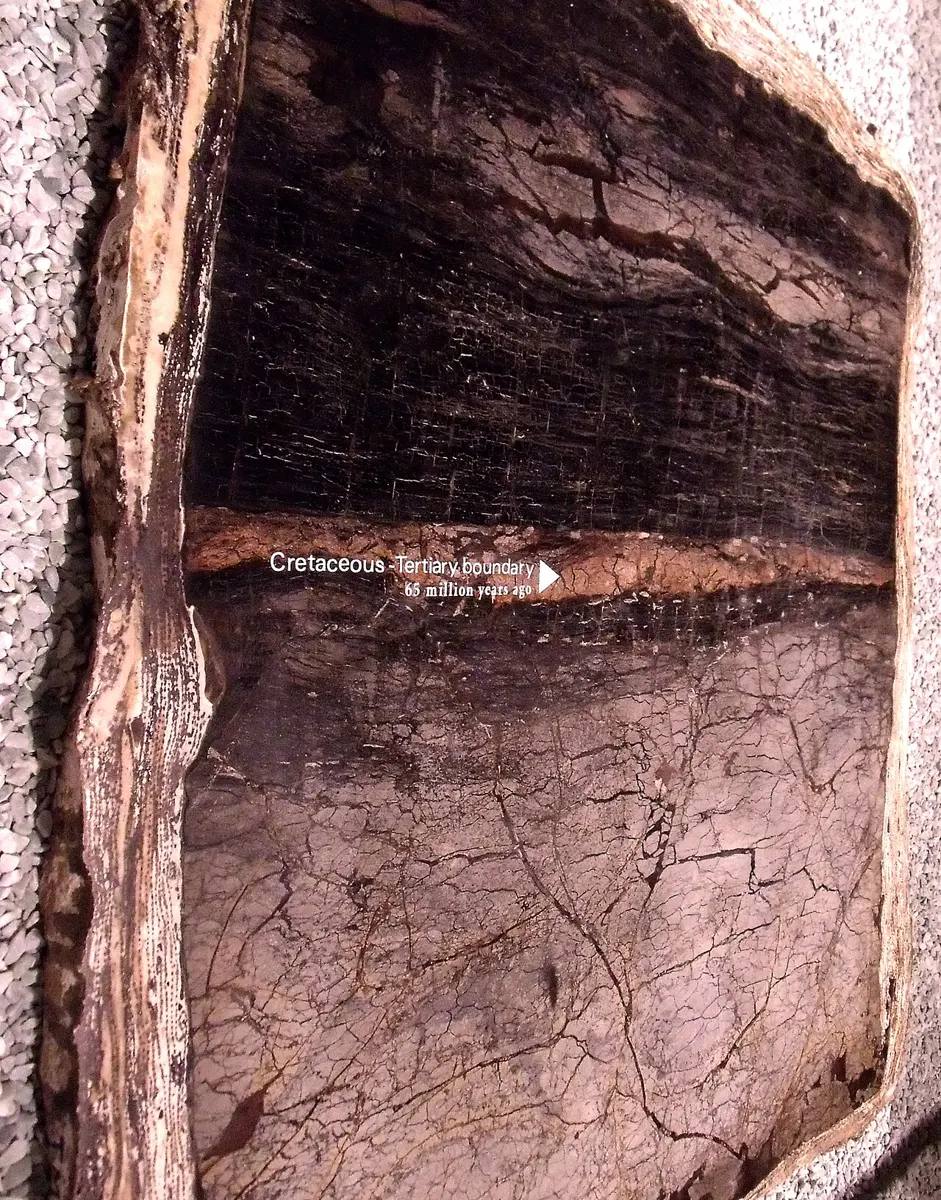
- They divided that column where the fossils change most sharply. Many of these breaks are mass extinctions, when many kinds of living things vanish from the rocks at once and new kinds appear above. That is why the eras are named by their life: Paleozoic (“old life”), Mesozoic (“middle life”) and Cenozoic (“new life”). The smaller divisions were often named after the place where their rocks were first studied: the Cambrian after Cambria, an old name for Wales; the Jurassic after the Jura mountains of France and Switzerland; the Permian after Perm in Russia.
- Last, radioactive dating of ash and lava put years on the boundaries. The first time scale with numbers was published by the English geologist Arthur Holmes in 1913, and the dates are still being refined.
So the time scale is a way to organize the Earth’s history using the evidence of the rocks. Take any big event: geologists can say what came before it and after it, and, with the dates, when.
Questions
Which of these could a geologist not learn from the strata of one cliff alone?
Pick an answer to see why.
Which would make the best index fossil?
Pick an answer to see why.
Explain the difference between a relative age and an absolute age. Give one example of each for a rock.
Answer
A relative age says whether a rock or event is older or younger than another, without a number of years: “the sandstone is older than the dyke that cuts it”. An absolute age is an age in years: “the ash bed formed 72 million years ago”, measured by radioactive dating. Strata and fossils give relative ages; radioactive clocks give absolute ages.
A cliff shows, from the bottom: a limestone (1), a shale (2), and a sandstone (3). A river valley is cut down into layers 3 and 2, and on the valley floor lies a layer of river gravel (4). A dyke cuts through layers 1, 2 and 3, but the valley has cut away its top. Put all the events in order, oldest first, giving the evidence for each step.
Answer
- Limestone, shale, sandstone (1, 2, 3): each lies on the one before (superposition).
- The dyke: it cuts layers 1–3, so it is younger than them (cross-cutting).
- The valley: it cuts into layers 3 and 2 and has cut away the top of the dyke, so it is younger than the dyke.
- The gravel (4): it lies on the valley floor, so it was laid down after the valley was cut. It is lower than layer 3, yet it is the youngest rock in the cliff: superposition compares layers lying on top of one another, not things side by side.
Why are fossils better than the kind of rock for matching layers in two places far apart?
Answer
The same kind of rock, such as sandstone, forms whenever the same conditions occur, and that happens at many different times, so two sandstones can be hundreds of millions of years apart. And at a single time, different places get different rocks (sand near the shore, lime mud farther out). But every species lives for only one stretch of time and, once extinct, never returns. So fossils follow each other in the same order everywhere (faunal succession), and layers holding the same short-lived species must have formed at the same time, whatever the rock.
A geologist finds, in one layer, fossils of ammonoids and of flowering plants (washed into the sea from the land). Use Figure 21.9 to say when the layer formed. Could the layer hold trilobites as well? Why?
Answer
Ammonoids lived from about 409 to 66 million years ago; flowering plants from about 130 million years ago until today. Both existed from 130 to 66 million years ago, so the layer formed then. It can’t hold trilobites: they died out about 252 million years ago, long before the first flowering plants.
A lake bed has a core 1.5 m long, made of varves 2.5 mm thick on average. How many years does the core cover? Why can a geologist be much more confident of this answer than of an age worked out from the thickness of a limestone?
Answer
1.5 m = 1500 mm. Years = 1500 mm ÷ 2.5 mm = 600 years.
Each varve is one year’s summer and winter bands, so counting them counts years directly, like tree rings. For a limestone, there are no yearly layers: the age depends on an estimated rate of build-up, which can change greatly, and on how much the layer has been squeezed; and gaps (unconformities) may hide time that left no rock.
The geological time scale divides the Earth’s history into eras such as the Paleozoic, Mesozoic and Cenozoic. Explain how geologists worked out the order of these eras, and where to put the boundaries between them, long before anyone could date a rock in years.
Answer
- In each region they found the order of the strata by superposition (lower layers are older) and cross-cutting (whatever cuts a layer is younger).
- They matched strata between regions by their fossils, because each species appears in the same place in the order everywhere (faunal succession). This joined the pieces from many places into one long column, the order of all the strata.
- They divided the column where the fossils change most sharply, often at mass extinctions, when many kinds of living things disappear from the rocks at once. The eras are named by their life: “old life”, “middle life”, “new life”.
John Phillips published such a time scale in 1841, with no dates at all. Numbers in years were added only after 1907, from radioactive dating of ash and lava layers above and below the boundaries.
Where to go next
- How Old Is the Earth? In Going Further 9–12: how the clocks inside radioactive atoms put years on the order the strata give, and date the Earth at 4.6 billion years.
- How Does One Rock Become Another? Sandstone and limestone are only one kind of rock. The rock cycle, and the heat and sunlight that drive it.
- Do Continents Really Move? The same fossils in rocks in India, Africa and Antarctica, matched as you matched the cliffs here, show that the continents were once joined.