
Go out on a clear, moonless night in a village far from city lights, and look up. Thousands of stars, and across the sky a faint glowing band: the Milky Way, our own galaxy, seen from inside. Every one of those stars is a sun, many far bigger and brighter than ours. Each one was born, is living, and will one day die, some quietly, some in explosions that outshine a whole galaxy.
The universe is all of space, and everything in it: all matter, all energy, and time itself. Telescopes show us stars exploding, stars circling around invisible objects whose gravity is enormous, and galaxies rushing away from one another. From such observations, scientists have worked out how stars live and die, how old the universe is, and how far away things are. This unit is about all of that, and about the people and organizations, in Nepal and around the world, who study the sky.
Life cycle of stars
Activity 12.1: the Sun and two other stars
The Sun is the star of our Solar System. Stars are huge balls of hot gas that make their own light and heat. There are more stars in the universe than grains of sand on all the Earth’s beaches. A star shines because, in its core, hydrogen nuclei fuse into helium, releasing energy Grade 9: Unit 9. Fusion goes on all through a star’s life, from its birth to its death.
Like living things, stars are born, live and die, and the material of dead stars goes into making new ones. This is the life cycle of a star. Stars differ in size, color and temperature because they differ in mass, and because they are at different stages of their lives.
Birth of a star
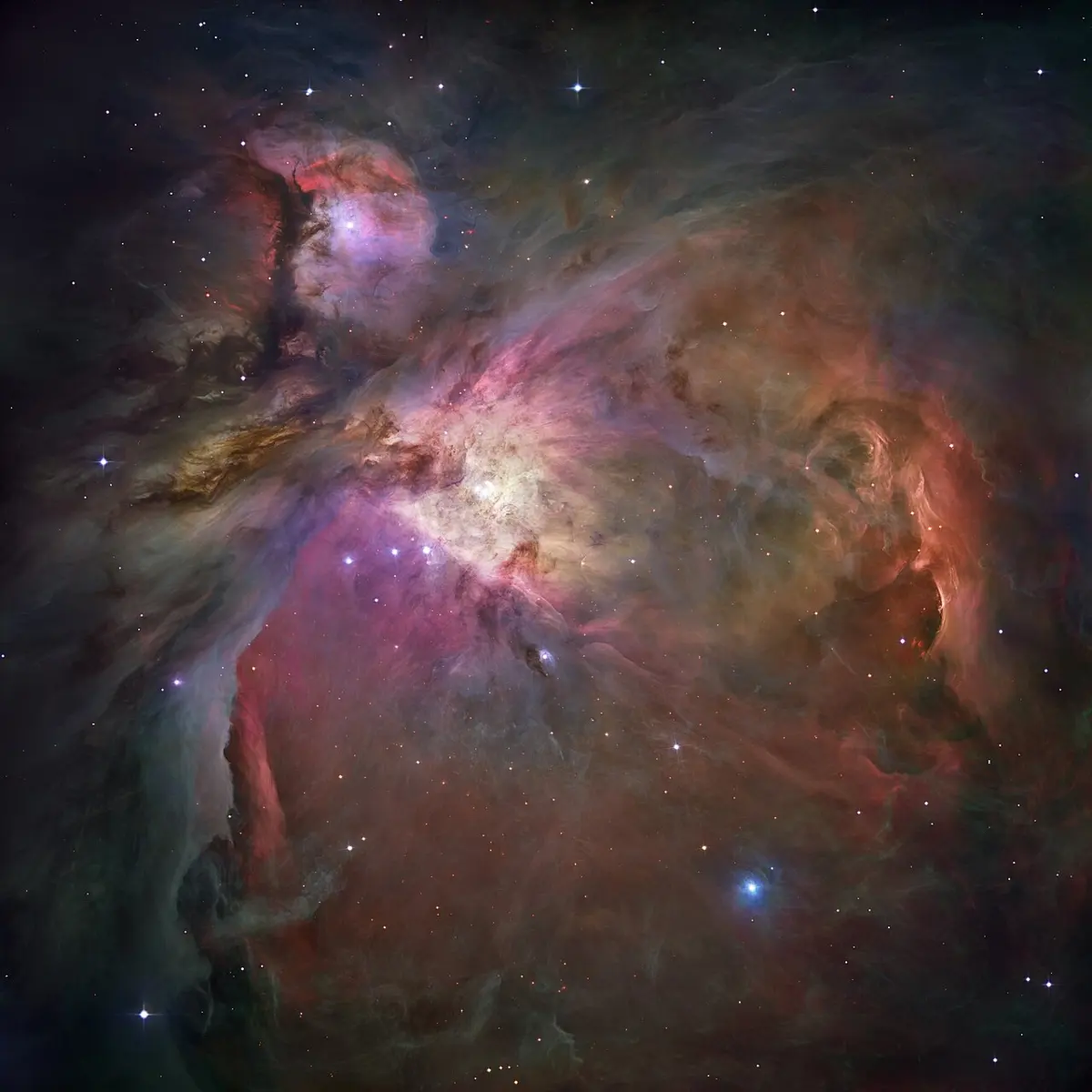
Stars are born in a nebula (plural: nebulae), a giant cloud of gas and dust in space, mostly hydrogen and helium. Some of the gas and dust in a nebula came from earlier stars that exploded. Some nebulae can be seen through telescopes, and one with the naked eye: the Orion Nebula, the fuzzy “star” in the middle of the sword hanging below Orion’s belt, 1,300 light-years away.
- In part of a nebula, gravity pulls gas and dust together into a ball.
- The ball pulls in more gas and dust from around it, and grows.
- As its mass grows, the pressure at its center rises, and squeezing the gas makes it hotter.
- This hot, growing ball of gas is a protostar (“first star”). It glows from the heat of squeezing, but it doesn’t yet fuse hydrogen. Forming one takes millions of years.
- When the core is hot enough (about 10 million K, 10⁷ K) and squeezed enough, nuclear fusion of hydrogen begins. A star is born. It will shine by fusion for millions or billions of years.
Many balls of hydrogen and helium never become stars: they don’t have enough mass to make their cores hot enough and squeezed enough for fusion to start.
Death of a star
A newly born star has plenty of hydrogen in its core, enough for fusion to go on for a very long time. But all the while, hydrogen is turning into helium. In the end, the core runs out of hydrogen. Then:
- The core, no longer held up by the heat of fusion, shrinks and heats up even more, until helium nuclei fuse into carbon (and in big stars, then into heavier elements: oxygen, silicon, up to iron). Heavier and heavier atoms are made in the core.
- The extra heat makes the star’s outer layers swell up enormously, and as they spread out they cool, so the surface glows red. Old stars like this, red and very large, are called red giants. A red giant from a very massive star is a red supergiant. Small stars may never become red giants.
The color of a star
A star’s color tells its surface temperature, just as a heated iron rod glows first red, then yellow, then white as it gets hotter.
| Color of the star | Surface temperature |
|---|---|
| blue | 11,000 °C to 25,000 °C (some even hotter) |
| yellow | 5,000 °C to 6,000 °C |
| orange | 3,500 °C to 5,000 °C |
| red | 3,000 °C to 3,500 °C |
Rigel, in Orion, is bluish white. Betelgeuse, also in Orion, is reddish. Which is hotter at its surface?
Pick an answer to see why.
Nova, supernova, and what is left
In a very old star, the swollen outer layers are held only weakly by the gravity of the core, and the star throws them off into space.
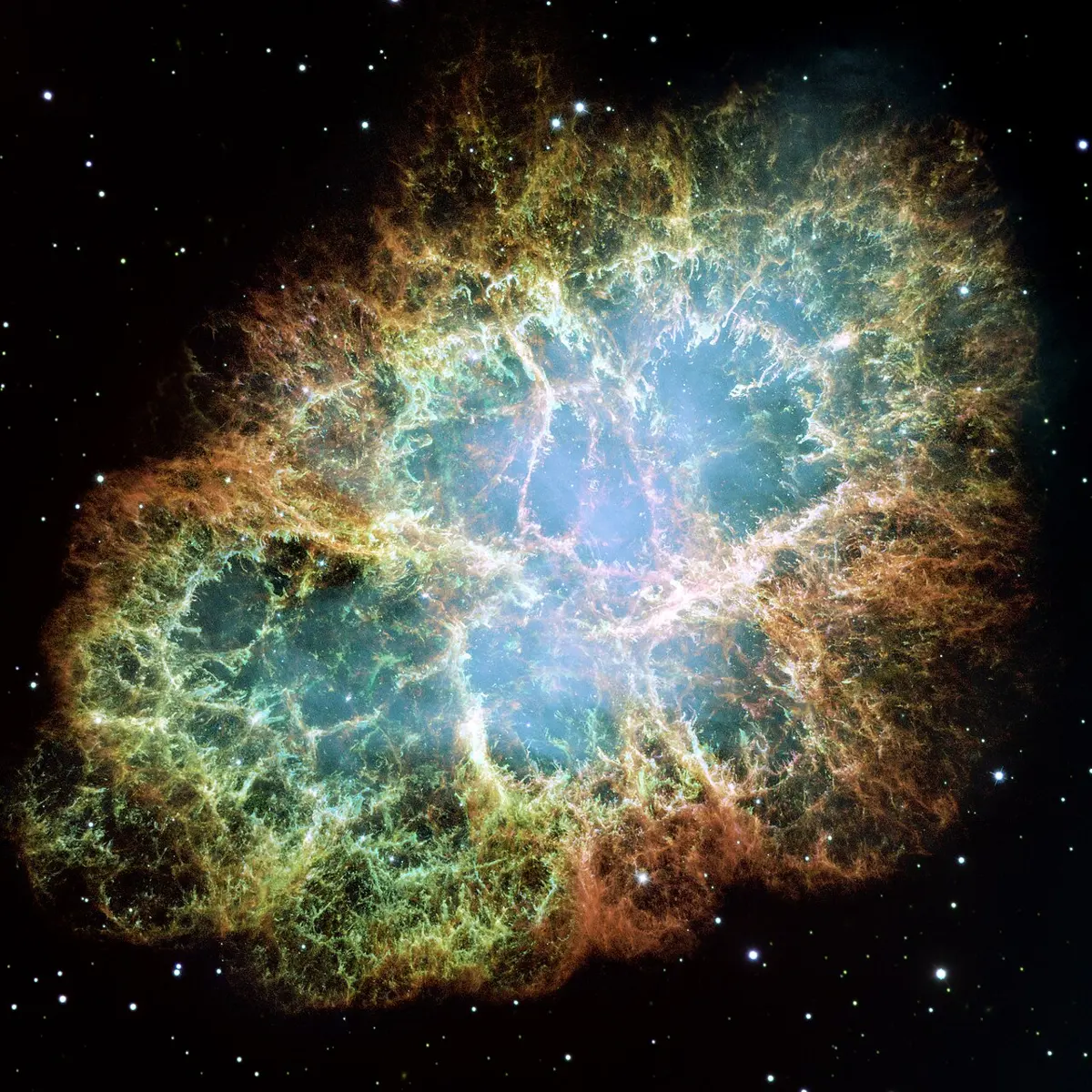
- For a star like the Sun, this happens gently: the outer layers drift away as a glowing shell of gas called a planetary nebula (nothing to do with planets: through old telescopes it looked round like a planet).
- For a star much more massive than the Sun (more than about 8 times), the core collapses in a fraction of a second, and the star blows itself apart in a tremendous explosion called a supernova. For a few weeks, one supernova can outshine all the hundreds of billions of stars of its galaxy put together.
Either way, the gas and dust of the outer layers are scattered into space, where they will mix into new nebulae and form new stars. Only the core is left. What it becomes depends on how much mass the star had:
- a.A star with about the Sun’s mass, or less: its core becomes a white dwarf: a small, very hot, dim star, about the size of the Earth but with about half the mass of the Sun. No fusion happens in it; it simply shines with its leftover heat. Over an extremely long time it will cool and fade into a cold, dark black dwarf.
- b.A star of up to about 8 times the Sun’s mass: it, too, ends as a white dwarf.
- c.A more massive star, whose core left after the supernova is about 1.4 to 3 times the Sun’s mass: gravity crushes the core so hard that its protons and electrons combine into neutrons. It becomes a neutron star: a ball of neutrons only about 20 km across, spinning very fast. A neutron star that sends out beams of radiation as it spins, like a lighthouse, is seen as a pulsar.
- d.The most massive stars, whose cores are more than about 3 times the Sun’s mass: nothing can stop the collapse. The core shrinks to almost no size with all its huge mass, and its gravity becomes so strong that not even light can escape. It is a black hole, invisible. We find black holes by their effect on things around them: stars orbiting them, and gas falling into them, which gets so hot that it gives out X-rays.
What will be left of the Sun when it dies?
Pick an answer to see why.
Why can’t we see a black hole directly?
Pick an answer to see why.
Scientific facts about the universe
How the universe began
No one was there to watch the universe begin. But we can see that the universe is expanding: the galaxies are moving away from one another. Run time backwards, and everything was once packed together, extremely hot and dense. The universe began with the sudden expansion of that hot, dense state, called the Big Bang.
In 1927, the Belgian scientist Georges Lemaître worked out that the universe could be expanding, and in 1929 the American astronomer Edwin Hubble showed that distant galaxies are indeed moving away from us and from one another, the farther ones faster. According to the Big Bang theory, the universe began about 13.8 billion years ago.
What the universe is made of
The universe is made of matter and energy. The stars, planets, gas and dust that we can see make up only a small part of it: about 5 %. About 27 % is dark matter, which we can’t see but which pulls on galaxies with its gravity, and about 68 % is dark energy, which is making the expansion of the universe speed up. What these two are, nobody knows yet: one of the biggest open questions in science.
Everything is moving
Nothing in the universe is at rest. Everything moves around something else:
- the Moon revolves around the Earth;
- the Earth revolves around the Sun, at about 30 km/s;
- the Sun, carrying the whole Solar System, moves around the center of the Milky Way at about 230 km/s, taking about 230 million years for one trip;
- and the galaxies move too.
Galaxies
There are hundreds of billions of galaxies in the universe. The Andromeda Galaxy is the nearest large galaxy to the Milky Way, about 2.5 million light-years from the Earth. On a dark autumn night it can just be seen with the naked eye, as a faint smudge: the light entering your eye set off long before our own species, Homo sapiens, existed.
The stars in a galaxy are of different ages. Our Solar System lies in one of the spiral arms of the Milky Way, about 26,000 light-years from the center, roughly halfway out. It formed about 4.6 billion years ago. The oldest pieces of the Earth itself ever found are tiny crystals of zircon from Western Australia, about 4.4 billion years old.
Planets around other stars
Planets going round other stars are called exoplanets. More than 6,000 have been found (as of 2025), and some are similar to the Earth in size and lie in their star’s habitable zone: the distance at which water could be liquid on the surface. One is TOI 700 d, an Earth-sized planet going round the small star TOI 700, in the constellation Dorado, about 101 light-years away. Its discovery by NASA’s TESS satellite was announced in January 2020. Research like this keeps adding new knowledge about the universe.
Do scientific theories change with time?
Cosmology is the branch of science that studies the origin and evolution of the universe. As the technology for studying the universe improves, new facts are discovered, and some of them replace old ideas. Science changes as it learns. For example:
- The ancient geocentric theory (the Earth at the center, with the Sun and planets going round it) was replaced by the heliocentric theory (the Sun at the center) of modern science.
- Until 2006, Pluto was counted as the ninth planet. In 2006, astronomers agreed for the first time on what a planet is, and Pluto, which shares its orbit with many other icy bodies, no longer fitted; it became a dwarf planet.
Scientists have also proposed different ideas (hypotheses) about the future of the universe. In one, the expansion slows down, stops at some point, and the universe starts to shrink; all the matter falls together into a point in a Big Crunch, after which another Big Bang might begin. Measurements since 1998 show the expansion is actually speeding up, so today most astronomers expect the universe to go on expanding for ever, growing colder and darker. But this, too, could change with new discoveries.
Which statement about science is true?
Pick an answer to see why.
Units to measure distance between celestial bodies
Can the distance from the Earth to the Moon, or to the Sun, be written in meters or kilometers, like the distance from Bhaktapur to Kathmandu? It can, but the numbers get absurd: the Sun is 150,000,000,000 m away, and the nearest star 40,000,000,000,000,000 m. So astronomers use much bigger units:
| Unit | Definition | Symbol | Value in meters |
|---|---|---|---|
| astronomical unit | the average distance between the Earth and the Sun | AU | 1 AU = 1.5 × 10¹¹ m |
| light-year | the distance light travels in one year | ly | 1 ly = 9.46 × 10¹⁵ m |
- Astronomical units are used for distances within the Solar System: between the Sun and the planets. Mars is about 1.5 AU from the Sun; Neptune about 30 AU.
- Light-years are used for the much bigger distances between stars and galaxies. Proxima Centauri, the nearest star after the Sun, is about 4.246 light-years away.
Calculating the meters in one light-year
Light travels at 3 × 10⁸ m/s, so in one second it goes 3 × 10⁸ m (one light-second). A year has 365 days, each of 24 hours of 60 minutes of 60 seconds. So in one year, light travels
Organizations working in astronomy
Nepal Academy of Science and Technology (NAST)
NAST is an independent (autonomous) national organization set up in 2039 BS (1982) to promote science and technology in Nepal and to carry out research. Its four main aims are:
- to advance science and technology for the all-round development of the nation;
- to preserve and modernize Nepal’s indigenous (traditional) technologies;
- to promote research in science and technology;
- to identify suitable technologies and help bring them to Nepal.
NAST supports research in many fields. In astronomy and space, it is working to set up a National Space Research Centre, and it led Nepal’s first satellite project.
International Astronomical Union (IAU)
The IAU is an international organization of professional astronomers, not run by any government, founded in 1919 in Brussels (its office is in Paris). Its aim is to promote astronomy, its research, teaching and public outreach, through worldwide cooperation. More than 12,000 professional astronomers from all over the world are members. Its main role is holding scientific meetings: the General Assembly, held every three years (in 2024 in Cape Town, South Africa), and many smaller ones.
- The IAU is the official body that names celestial bodies and defines them.
- It was the IAU that, with its new definition of a planet, made Pluto a dwarf planet on 24 August 2006. At the same time, Ceres, until then the largest asteroid, also became a dwarf planet.
- The International School for Young Astronomers (ISYA), started in 1967, is one of its projects: it brings young astronomers together in a different country for a few weeks to learn and share experience.
- It works to spark interest in science and mathematics in schools and to encourage research at the bachelor’s level.
National Aeronautics and Space Administration (NASA)
NASA is the space agency of the United States, set up in 1958. In those years the United States and the Soviet Union were racing each other in space: the Soviet Union had launched the first satellite (Sputnik, 1957) and would send the first person into space (Yuri Gagarin, 1961). NASA started many programs of space research.
- The first people on the Moon: on 20 July 1969, NASA’s Apollo 11 landed Neil Armstrong and Buzz Aldrin on the Moon.
- Satellites and spacecraft for study and research. With the space agencies of Russia, Europe, Japan and Canada, NASA built the International Space Station (ISS), a laboratory that circles the Earth about 400 km up, once every 90 minutes, with people living on board since 2000. (Where is the space station now?)
- Space probes to study planets, moons, dwarf planets, asteroids, comets and the Sun. The Parker Solar Probe, launched in 2018, became the first spacecraft to fly through the Sun’s outer atmosphere, the corona, in April 2021, studying the Sun’s particles and magnetic field. In December 2024 it passed just 6.1 million km from the Sun’s surface, faster than any object people have ever made.
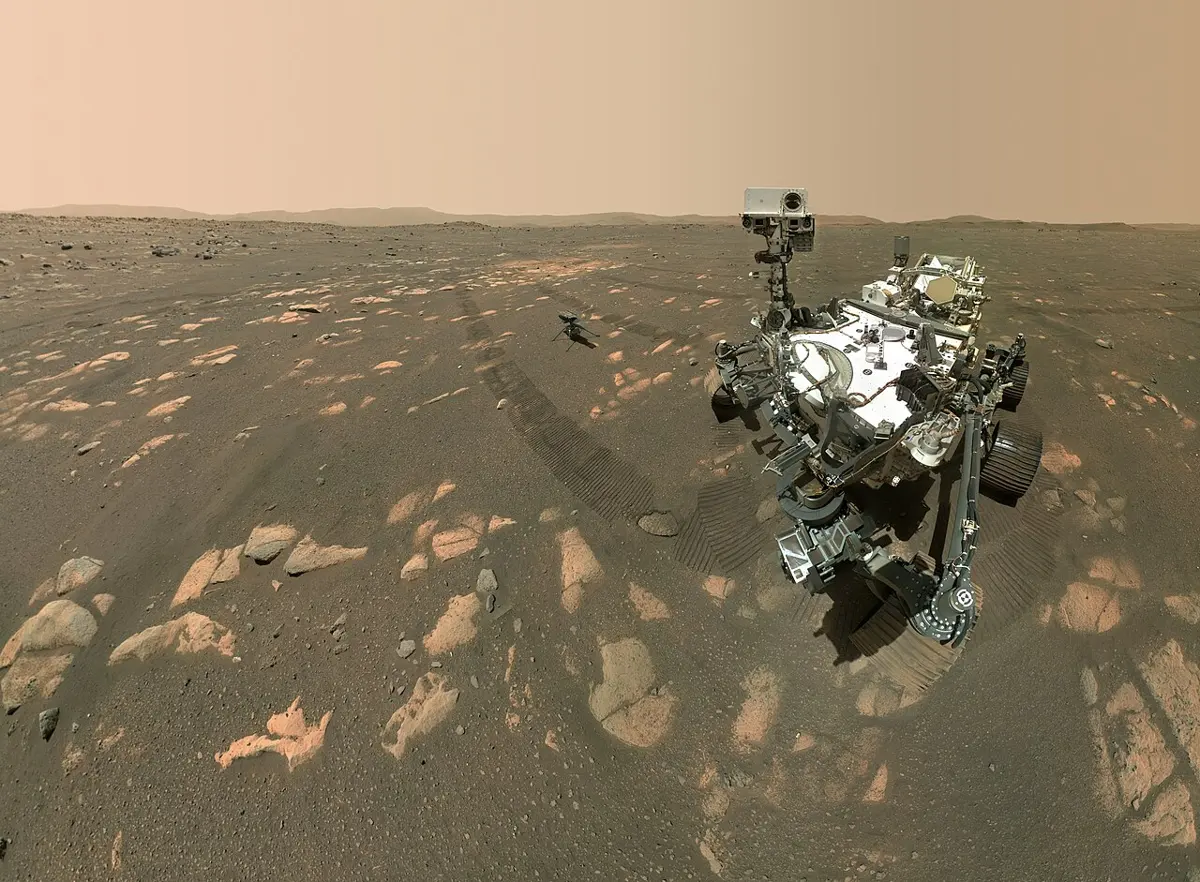
- Looking for life beyond the Earth: NASA has landed robot rovers on Mars. The Perseverance rover landed on 18 February 2021 and is collecting samples of Martian rock, sealed in tubes, which NASA hopes to bring back to the Earth one day for study. It carried a small helicopter, Ingenuity, the first powered aircraft ever to fly on another planet.
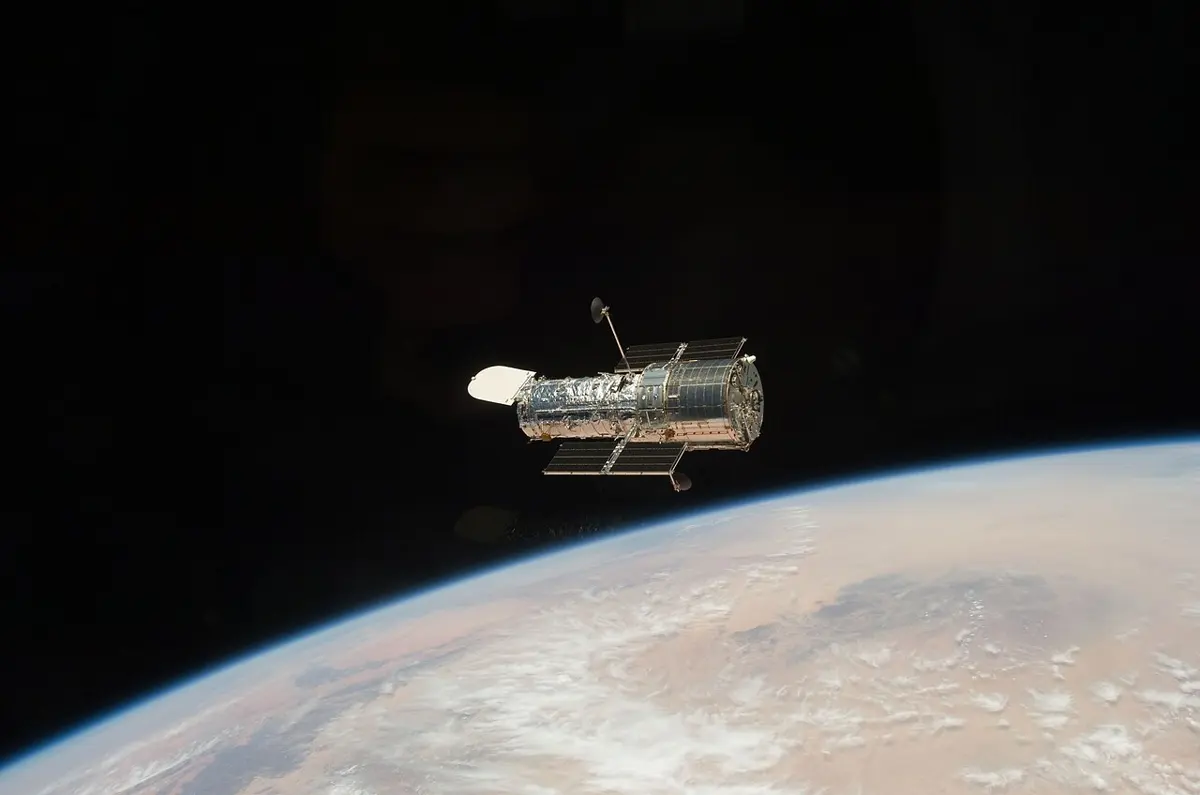
- Space telescopes: the Hubble Space Telescope, launched in 1990, has solved many mysteries of the universe. With the European and Canadian space agencies, NASA built the James Webb Space Telescope, which sees infrared light and was launched on 25 December 2021. It is showing us the first galaxies to form after the Big Bang.
Principle of conservation of energy
Activity 12.2: what happens after a lifespan?
The elements in the Earth, and in you, are the same matter that was scattered after the universe began and was later cooked in stars. All the matter and energy in the universe have been there since its beginning. Energy can neither be created nor destroyed; it can only be changed from one form to another. This is the principle of conservation of energy.
From the life cycles of living things, the water cycle, the cycles of elements like carbon on the Earth, and the life cycles of stars, we can conclude that everything in the universe has a lifespan. When it ends, its matter and energy are not lost: they go back into the universe in other forms, and become part of something new.
Exercise
1. Select the best answer
a. Which is the main element found in a nebula?
Pick an answer to see why.
b. What is the huge explosion at the death of a massive star called?
Pick an answer to see why.
c. Which is the correct order in the life cycle of a star?
Pick an answer to see why.
d. Which of these is a scientific fact about the universe?
Pick an answer to see why.
2. Differentiate between
Protostar and star
Answer
| Protostar | Star |
|---|---|
| A growing ball of gas and dust, pulled together by gravity from a nebula. | A ball of gas in which nuclear fusion is going on. |
| No fusion of hydrogen yet. | Fuses hydrogen into helium in its core. |
| Glows only from the heat of being squeezed. | Shines by the energy of fusion. |
| An early, short stage (millions of years). | Lasts for millions to billions of years. |
Red giant and red supergiant
Answer
| Red giant | Red supergiant |
|---|---|
| Formed from a star of about the Sun’s mass (up to about 8 times). | Formed from a star much more massive (more than about 8 times the Sun’s mass). |
| Very large (tens to hundreds of times the Sun’s size). | Even larger (hundreds to over a thousand times the Sun’s size). |
| Ends gently, leaving a white dwarf. | Ends in a supernova, leaving a neutron star or black hole. |
| e.g. Aldebaran; the Sun in 5 billion years | e.g. Betelgeuse, Antares |
Nova and supernova
Answer
| Nova | Supernova |
|---|---|
| A smaller outburst that throws off only the outer layers of gas. | A tremendous explosion that blows a massive star apart. |
| The star survives (as a white dwarf). | The star is destroyed; a neutron star or black hole is left. |
| Brightens a star thousands to a million times. | Can outshine a whole galaxy for weeks. |
| Can repeat. | Happens only once. |
3. Give reasons
A nebula is also called a stellar nursery.
Answer
Stars are born in nebulae. Within a nebula, gravity pulls gas and dust together into protostars, which become stars when fusion begins. So, like a nursery where babies are cared for, a nebula is where new stars form; the Orion Nebula has thousands of young stars being born in it.
Not all stars are the same color.
Answer
A star’s color depends on its surface temperature: the hottest stars glow blue, then white, yellow and orange, and the coolest red. Stars have different temperatures because they have different masses (massive stars are hotter) and are at different stages of their life (an old star that swells into a red giant cools at the surface and turns red).
A black hole is invisible.
Answer
A black hole has so much mass squeezed into so small a space that its gravity is strong enough to stop even light from escaping. We see things only by the light that comes from them, so a black hole gives out no light and can’t be seen. It is found only by its effects on stars and gas near it.
Jupiter, the giant gas planet of the Solar System, is also called a failed star.
Answer
Like a star, Jupiter is made mainly of hydrogen and helium, the same as the Sun. But it doesn’t have enough mass (it would need about 80 times as much) for its core to get hot enough and squeezed enough for hydrogen fusion to start. So it never became a star. (Strictly, it is a true planet, formed in a different way from a star, but its make-up is why people call it a failed star.)
4. Answer the following questions
What is a nebula?
Answer
A nebula is a giant cloud of gas and dust in space, made mostly of hydrogen and helium, in which stars are born. Some of its material came from earlier stars that exploded. Example: the Orion Nebula.
What is a black hole?
Answer
A black hole is what is left when the core of a very massive star collapses after a supernova: a huge mass squeezed into almost no volume, whose gravity is so strong that nothing, not even light, can escape from it. It is invisible, and is found by the stars moving around it and the X-rays given out by hot gas falling into it.
Explain the life cycle of a star, with a figure.
Answer
(Draw the flowchart in Figure 12.3.)
- Nebula: a cloud of hydrogen, helium and dust.
- Protostar: gravity pulls part of the nebula into a ball, which heats up as it shrinks.
- Star: at about 10⁷ K, hydrogen fusion starts; the star shines steadily for millions to billions of years.
- When the core’s hydrogen runs out, helium fuses into carbon, and the star swells into a red giant (or a red supergiant if it is very massive).
- A star like the Sun throws off its outer layers (as a planetary nebula, called a nova in some books) and its core becomes a white dwarf, which slowly cools into a black dwarf.
- A massive star explodes as a supernova. Its core becomes a neutron star (seen as a pulsar) or, if heavy enough, a black hole.
- The gas and dust thrown out form new nebulae, from which new stars are born.
Explain how the Sun will die after its fuel runs out.
Answer
In about 5 billion years, the hydrogen in the Sun’s core will run out. The core will shrink and heat up until helium fuses into carbon. The extra heat will make the Sun’s outer layers swell to perhaps 200 times their present size: the Sun will become a red giant, swallowing Mercury and Venus and possibly the Earth. Its outer layers, weakly held, will then drift off into space as a glowing shell of gas. The core left behind will be a white dwarf, about the size of the Earth, hot but dim, with no fusion. Over an extremely long time it will cool and fade into a cold, dark black dwarf. The Sun is not massive enough to explode as a supernova or become a black hole.
Mention some scientific facts about the universe.
Answer
- The universe began with the Big Bang about 13.8 billion years ago, and it is still expanding.
- It is made of matter and energy; the matter we can see is only about 5 % of it (the rest is dark matter and dark energy).
- Nothing in it is at rest: the Moon goes round the Earth, the Earth round the Sun, the Sun round the center of the Milky Way.
- There are hundreds of billions of galaxies; the nearest large one, Andromeda, is 2.5 million light-years away.
- The Solar System formed about 4.6 billion years ago, in a spiral arm of the Milky Way; the oldest pieces of the Earth, zircon crystals, are about 4.4 billion years old.
- Planets similar to the Earth have been found around other stars, such as TOI 700 d.
- Stars are born, live and die, and their matter is reused to make new stars and planets.
Why are units of distance such as the light-year and the astronomical unit used in astronomy?
Answer
The distances between celestial bodies are enormous. In meters or kilometers they become huge numbers that are hard to write, read and compare (the nearest star is about 40,000,000,000,000 km away). Bigger units make them simple: the Sun is 1 AU away, Mars 1.5 AU; Proxima Centauri is 4.2 light-years away. The AU (1.5 × 10¹¹ m) suits distances within the Solar System, and the light-year (9.46 × 10¹⁵ m) the distances between stars and galaxies.
Describe the state of cosmological studies in Nepal.
Answer
Cosmology and astronomy are still young sciences in Nepal, but growing:
- NAST (Nepal Academy of Science and Technology) promotes research in science and technology, is working to set up a National Space Research Centre, and led Nepal’s first satellite, NepaliSat-1 (2019).
- Universities such as Tribhuvan University teach astronomy and astrophysics within physics, and some students go on to research abroad.
- Amateur astronomy groups hold star-gazing events and public talks, and Nepal’s dark skies in the mountains are excellent for observing.
- Nepal named a star (Sagarmatha) and its planet (Laligurans) in the IAU’s 2019 naming project.
- Much remains to be done: Nepal has no large research telescope yet, and more funding, equipment and trained people are needed.
Describe the role of NASA in astronomy.
Answer
NASA, the space agency of the United States, set up in 1958, has been a leader in space exploration:
- it landed the first people on the Moon (Apollo 11, 20 July 1969);
- with other countries’ agencies, it built and runs the International Space Station, a laboratory in orbit;
- its space probes have visited every planet, studied moons, asteroids and comets, and the Parker Solar Probe has flown through the Sun’s corona;
- its rovers explore Mars for signs of past life (Perseverance, 2021);
- its space telescopes, Hubble (1990) and James Webb (2021), have shown us distant galaxies, the birth of stars and planets around other stars;
- it shares its pictures and data freely with scientists and the public all over the world.
Practice every question in the book, and keep track of the ones you miss →