
The copper in a Patan statue, the iron of a karahi and the aluminium of a pressure cooker were all once rock. Nobody digs up a pressure cooker: the metal in the ground is locked up with oxygen, sulphur or carbon, mixed with sand and clay, and getting it out pure has taken humans seven thousand years of fire, chemistry and, since 1807, electricity.
This unit follows a metal from the mine to the shop: how an ore is chosen, cleaned, roasted, reduced and refined, and why gold, iron and sodium each need a different route. Then it looks closely at the two most reactive families of metals, the alkali metals of Group 1 and the alkaline earth metals of Group 2: why sodium is kept under kerosene, why a flame turns crimson, golden or green, and why limestone needs a kiln at 900 °C to become the lime in cement.
10.1 Metals and metallurgical processes
10.1.1 Metallurgy and its types
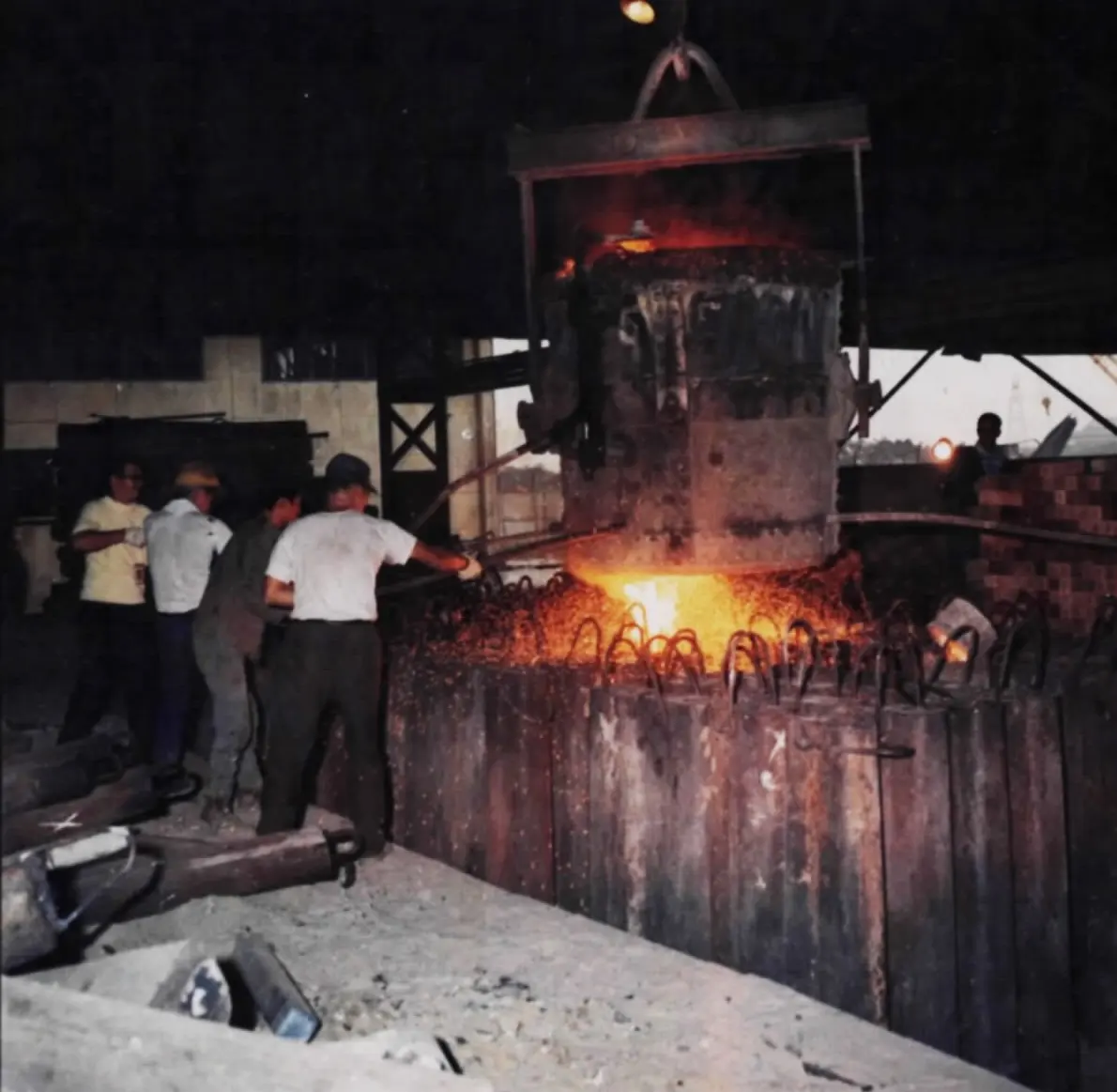
Metallurgy is the science and technology of getting metals out of their ores, purifying them and making them useful. Getting a metal out of its ore takes several physical and chemical steps, but the key one is always a reduction: the metal in the ore is in a positive oxidation state (Fe³⁺ in Fe₂O₃, Cu⁺ in Cu₂S, Na⁺ in NaCl), and it must gain electrons to become the free metal. How the reduction is done divides metallurgy into three kinds.
1. Pyrometallurgy (pyro, fire) is metallurgy at high temperature: the cleaned ore is heated strongly, usually with a reducing agent such as coke, until the metal forms, often molten. It is used for metals of middling reactivity, whose oxides carbon or another reducing agent can strip of oxygen in a furnace: iron, copper, zinc, tin, lead, mercury, chromium and manganese. Its steps are calcination, roasting, smelting and refining, all met below.
2. Hydrometallurgy (hydro, water) works in water solutions. The ore is dissolved in a suitable solution, such as dilute sodium or potassium cyanide, which takes the metal into solution as a soluble complex and leaves the rock behind; the metal is then recovered from the solution, for example by adding zinc, which displaces it. It suits metals that are easy to displace from solution, above all silver and gold, and also copper from low-grade ores. It has three stages: leaching (dissolving the metal out), concentrating and purifying the solution, and recovering the metal.
For silver, the ore silver glance, Ag₂S, is stirred with a dilute (about 0.3%) solution of sodium cyanide in air, which takes the silver into solution as a complex ion:
Zinc dust then displaces the silver, because zinc is the more reactive metal:
3. Electrometallurgy gets a metal by electrolysis: a current is passed through a molten compound (or a solution) of the metal, and the metal ions gain electrons at the cathode. It is the only practical way to get the most reactive metals, the alkali and alkaline earth metals and aluminium, because no ordinary reducing agent holds oxygen or chlorine more strongly than they do. It is usually the last step, after the ore has been purified by other means; an ore that won’t conduct is first turned into a compound that can be melted and electrolyzed (bauxite into pure alumina, rock salt into pure sodium chloride). The metal always comes out at the cathode.
Gold is usually extracted from crushed rock by dissolving it in a dilute cyanide solution and then adding zinc. This is
Pick an answer to see why.
10.1.2 Minerals and ores
Most elements, about four in five, are metals: the alkali and alkaline earth metals, the transition metals, the lanthanides and the actinides. As Grade 9 showed, metals are typically hard, malleable (they hammer into sheets) and ductile (they draw into wires), sonorous (they ring when struck), good conductors of heat and electricity, and shiny (metallic luster). Mercury is the only metal that is liquid at room temperature. Chemically, metals tend to lose their valence electrons and form positive ions, so they are good reducing agents and form basic oxides.
Between the metals and the non-metals is a small group of metalloids: boron, silicon, germanium, arsenic, antimony and tellurium. They look rather like metals (silicon is shiny gray) but are brittle, conduct electricity only moderately (they are semiconductors, conducting better when warm, which is why silicon is the stuff of computer chips), and form oxides that are acidic or amphoteric (react with both acids and bases). Their properties lie between those of metals and non-metals.
A few unreactive metals are found in nature as the metal itself, uncombined: these are native metals, above all gold, silver, platinum and some copper. Every other metal is found combined, as an oxide, sulphide, carbonate, sulphate, silicate, halide, phosphate or nitrate.
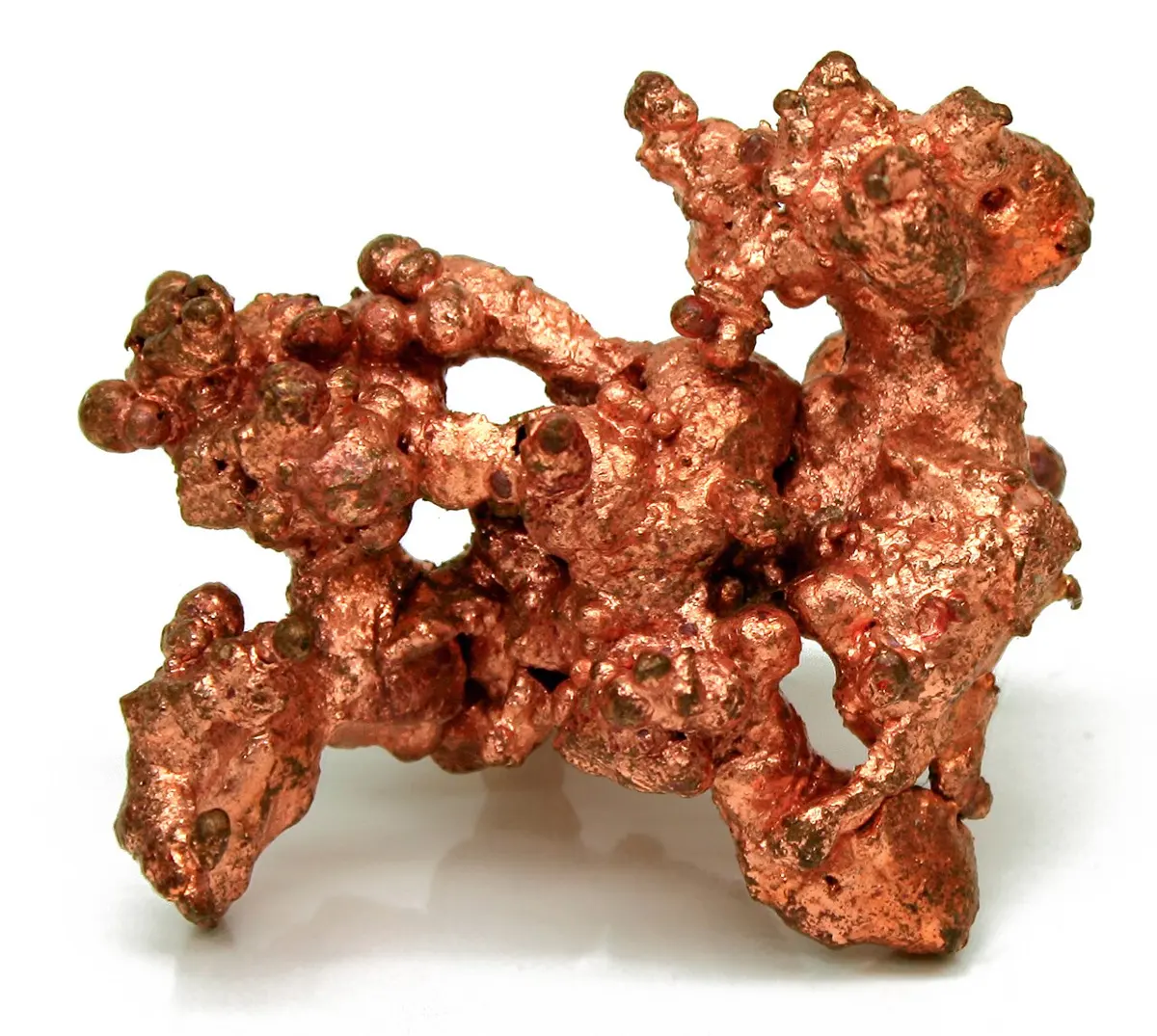
Copper shows the difference between a mineral and an ore. It turns up in the Earth’s crust as native copper and in at least seven common compounds: cuprite (Cu₂O, 89% copper by mass), chalcocite (Cu₂S, 80%), covellite (CuS, 66%), malachite (CuCO₃·Cu(OH)₂, 57%), azurite (2CuCO₃·Cu(OH)₂, 55%), chrysocolla (a hydrated copper silicate, about 34–38%) and chalcopyrite (CuFeS₂, 35%). All of these are minerals: naturally occurring substances, each with a definite composition, found in the Earth’s crust. But a mineral is worth mining only where there is a lot of it, rich enough and close together, and where the metal can be got out of it cheaply. A mineral from which a metal can be extracted conveniently and profitably is an ore of that metal. So all ores are minerals, but not all minerals are ores.
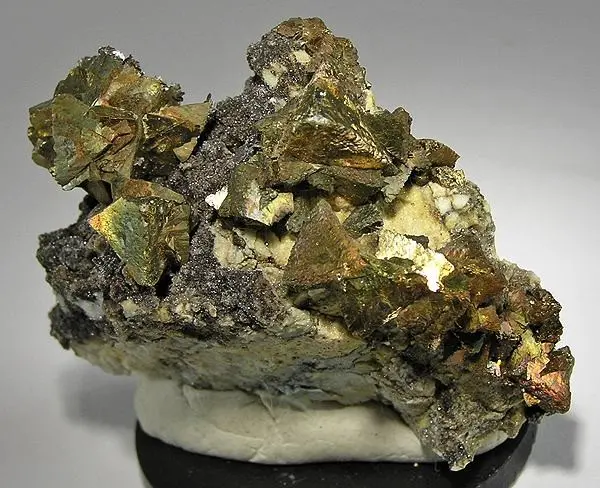
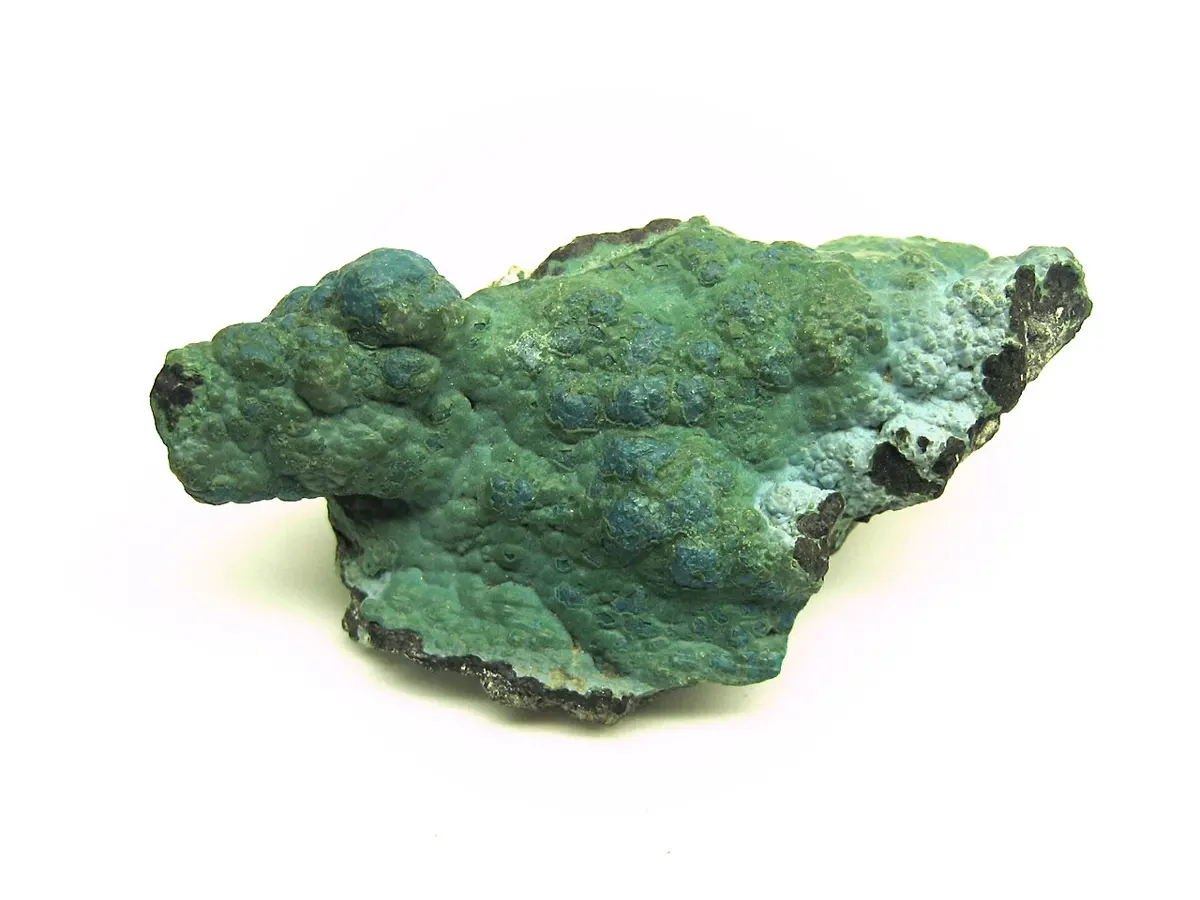
The common minerals, by the kind of compound:
A. Oxide minerals (Al, Cr, Fe, Mn, Sn, Ti, U, Zn…)
| Mineral | Formula |
|---|---|
| Corundum (alumina) | Al₂O₃ |
| Bauxite | Al₂O₃·2H₂O (Al₂O₃·xH₂O) |
| Diaspore | Al₂O₃·H₂O |
| Chrome ochre | Cr₂O₃ |
| Chromite | FeO·Cr₂O₃ |
| Franklinite | ZnO·Fe₂O₃ |
| Hematite | Fe₂O₃ |
| Ilmenite | FeO·TiO₂ |
| Limonite | Fe₂O₃·3H₂O |
| Magnetite | Fe₃O₄ |
| Pitchblende | U₃O₈ |
| Pyrolusite | MnO₂ |
| Rutile | TiO₂ |
| Cassiterite (tinstone) | SnO₂ |
| Zincite (red zinc ore) | ZnO |
B. Carbonate minerals (Mg, Ca, Fe, Cu, Zn, Pb…)
| Mineral | Formula |
|---|---|
| Azurite | 2CuCO₃·Cu(OH)₂ |
| Calamine | ZnCO₃ |
| Cerussite | PbCO₃ |
| Dolomite | MgCO₃·CaCO₃ |
| Limestone (calcite) | CaCO₃ |
| Magnesite | MgCO₃ |
| Malachite | CuCO₃·Cu(OH)₂ |
| Siderite | FeCO₃ |
C. Sulphate minerals (Na, K, Mg, Ca, Ba…)
| Mineral | Formula |
|---|---|
| Barytes | BaSO₄ |
| Epsom salt | MgSO₄·7H₂O |
| Gypsum | CaSO₄·2H₂O |
| Glauber’s salt | Na₂SO₄·10H₂O |
| Kainite | KCl·MgSO₄·3H₂O |
| Kieserite | MgSO₄·H₂O |
| Schönite | K₂SO₄·MgSO₄·6H₂O |
D. Halide minerals (the alkali metals, Mg, Ca, Ag…)
| Mineral | Formula |
|---|---|
| Rock salt (common salt) | NaCl |
| Carnallite | KCl·MgCl₂·6H₂O |
| Cryolite | Na₃AlF₆ |
| Fluorspar | CaF₂ |
| Horn silver | AgCl |
| Sylvine (sylvite) | KCl |
E. Silicate minerals (Li, K, Mg, Ca, Al…)
| Mineral | Formula |
|---|---|
| Asbestos | CaMg₃(SiO₃)₄ (a simplified formula) |
| China clay (kaolin) | Al₂O₃·2SiO₂·2H₂O |
| Feldspar | KAlSi₃O₈ |
| Mica (muscovite) | K₂O·3Al₂O₃·6SiO₂·2H₂O |
| Petalite | LiAlSi₄O₁₀ |
| Talc | 3MgO·4SiO₂·H₂O, that is Mg₃Si₄O₁₀(OH)₂ |
F. Sulphide minerals (Fe, Ni, Cu, Zn, Ag, Hg, Pb…)
| Mineral | Formula |
|---|---|
| Cinnabar | HgS |
| Copper pyrites (chalcopyrite) | CuFeS₂ |
| Copper glance (chalcocite) | Cu₂S |
| Iron pyrites | FeS₂ |
| Galena | PbS |
| Ruby silver | 3Ag₂S·Sb₂S₃ |
| Silver glance (argentite) | Ag₂S |
| Zinc blende | ZnS |
Why is chalcopyrite, CuFeS₂, the chief ore of copper, though cuprite, Cu₂O, has more copper in it?
Pick an answer to see why.
10.1.3 Gangue, flux and slag; alloys and amalgams
Gangue (or matrix) is the unwanted rock that comes up with an ore: sand, clay, limestone, silicates and aluminates. Much of it is refractory: it doesn’t melt or evaporate even at furnace temperatures, so it can’t simply be poured off.
A flux is a substance added during extraction to remove the gangue: it reacts with the infusible gangue to form a fusible (easily melted) substance, the slag. Gangue and flux are oxides of opposite kinds, so they combine as an acid and a base do.
i. An acidic flux removes a basic gangue (metal oxides such as FeO, CaO, MgO). Silica, SiO₂, is the usual one; P₂O₅ and borax, Na₂B₄O₇·10H₂O, are others. In the extraction of copper, the iron oxide left from chalcopyrite is removed by silica:
ii. A basic flux removes an acidic gangue (silica, P₂O₅). Lime (CaO), limestone (CaCO₃), magnesia (MgO), magnesite (MgCO₃) and hematite (Fe₂O₃) are basic fluxes. In the blast furnace, limestone removes the sand in iron ore:
Slag is the fusible substance formed when the flux reacts with the gangue:
Molten slag is far less dense than molten metal (about 2.5–3 g/cm³ against iron’s 7), so it floats on top and can be run off separately. Slag is not waste: blast-furnace slag is ground into cement, and used under roads.
An ore of copper has silica as its gangue. Which flux should be added?
Pick an answer to see why.
Alloys
An alloy is a mixture, usually homogeneous, of a metal with other metals or with a non-metal, made by melting them together. Alloys are made because they can have properties that none of their elements has on its own: pure iron is soft and rusts; a little carbon makes it hard steel, and chromium and nickel make it stainless. Pure gold is too soft for jewelry; alloyed with copper and silver it wears well.
A. Ferrous alloys contain iron as the main metal.
| Alloy | Composition (by mass) | Used for |
|---|---|---|
| Steel (ordinary, carbon steel) | Fe about 98–99.8%, C 0.1–2% | rods, girders, tools |
| Stainless steel | Fe about 70–74%, Cr 18%, Ni 8%, C under 0.1% | utensils, sinks, surgical tools |
| Tungsten steel | Fe 80–85%, W 14–20%, C under 1% | high-speed cutting tools |
| Nickel steel | Fe about 95%, Ni 3.5–5%, C about 0.2% | gears, cables |
| Invar | Fe 64%, Ni 36% | clock pendulums, measuring tapes (it hardly expands) |
| Nichrome 60 | Ni about 60%, Fe 25%, Cr 15% | heating elements |
B. Non-ferrous alloys contain no iron.
| Alloy | Composition (by mass) | Used for |
|---|---|---|
| Brass (pittal) | Cu 60–80%, Zn 20–40% | taps, utensils, statues |
| Bronze | Cu 75–90%, Sn 10–25% | statues, medals, bearings |
| German silver | Cu 60%, Zn 20%, Ni 20% | cheap “silver” cutlery |
| Bell metal (kansa) | Cu about 80%, Sn 20% | bells, plates and bowls |
| Gun metal | Cu 88%, Sn 10%, Zn 2% | gears, valves |
| Soft solder | Sn 50%, Pb 50% | joining wires and pipes |
| Nichrome 80 | Ni 80%, Cr 20% | heater and toaster coils |
| Pewter | Sn 80%, Pb 20% (modern pewter: Sn with a little Cu and Sb, no lead) | plates, mugs |
Amalgams
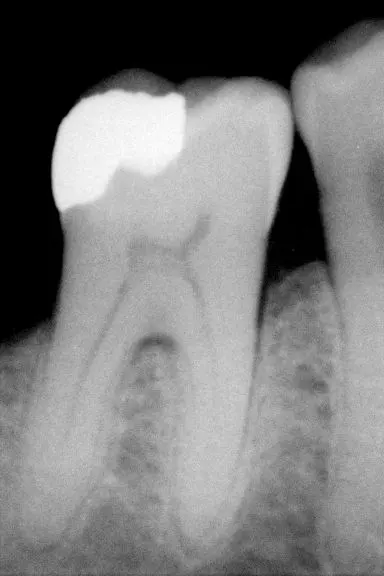
An amalgam is an alloy in which one of the metals is mercury. Mercury dissolves many metals: sodium amalgam (Na + Hg), gold amalgam, silver amalgam, zinc amalgam. Dental amalgam, used for filling teeth, is about half mercury, the rest mostly silver, tin and copper with a little zinc: it is soft when mixed, fills the hole and sets hard. Mercury forms no amalgam with iron, platinum or tungsten, which is why mercury is stored and shipped in iron flasks. Amalgams are now used less, because mercury is poisonous: the Minamata Convention (2013) is phasing out its uses.
10.1.4 General principles of extraction
Iron rods in houses and bridges come from hematite, Fe₂O₃; but the steps a metal goes through depend on the metal. For most metals the general steps are:
- crushing and pulverization
- concentration (dressing) of the ore
- conversion of the ore into an oxide (calcination or roasting)
- reduction to the metal
- refining (purification) of the metal
The route depends above all on how reactive the metal is (Figure 10.6).
1. Crushing and pulverization
The ore comes out of the mine in big lumps. These are broken into smaller pieces in a jaw crusher, two heavy steel plates, one fixed and one swinging, that squeeze the rock between them (crushing). The pieces are then ground to a fine powder in a ball mill, a slowly turning steel drum half full of steel balls that tumble onto the ore, or a stamp mill, whose heavy rods drop on it (pulverization). Powder is needed because the next steps act on the surface of the grains, and each grain should be either mostly ore or mostly rock.
2. Concentration (dressing) of the ore
The powdered ore still carries much gangue: earth, sand, limestone, rock. Removing it is called concentration or dressing of the ore. Which method is used depends on how the ore and its gangue differ: in density, in how water wets them, in magnetism, or in chemistry.
i. Hand picking. Where lumps of ore and rock look clearly different and are large enough, they can be picked apart by hand. It is slow and tedious, and used only as a first step.
ii. Gravity separation (hydraulic washing, levigation). This uses the difference in density between the ore and the gangue. Ores of heavy metals, especially oxides like cassiterite (SnO₂, density 7) and hematite (Fe₂O₃, about 5), are much denser than the sand and clay of the gangue (about 2.6). The powdered ore is washed down a sloping, shaking table with ridges (riffles) across it, the Wilfley table, by a stream of water (Figure 10.7). The light gangue is carried over the riffles and away by the water; the heavy ore grains settle in the riffles’ lee and are shaken along them to the far side.
iii. Froth flotation. This is how sulphide ores (ZnS, CuFeS₂, PbS) are concentrated, and it works on a difference in wettability: whether water or oil sticks to a grain’s surface. The powdered ore is mixed with water in a big tank, with a little pine oil or eucalyptus oil and a collector such as potassium ethyl xanthate. The collector clings to the sulphide grains and makes their surface water-repelling (hydrophobic); the rock grains stay wetted by water (hydrophilic). Air is blown in and the mixture stirred hard (Figure 10.8). The air bubbles stick to the water-repelling sulphide grains and carry them up into a froth, which the oil (the frother) keeps stable; the froth overflows and is collected. The rock, wetted by water, sinks to the bottom.
Three kinds of chemicals make flotation work:
- a frother (pine oil, eucalyptus oil) makes a stable froth;
- a collector (potassium or sodium ethyl xanthate) makes the ore grains water-repelling, so that they stick to bubbles;
- an activator or a depressant steers which mineral floats: with copper sulphate as activator, zinc blende floats; with sodium cyanide as depressant, it stays down while galena floats. So two sulphides in one ore can be floated off one after the other.
iv. Magnetic separation. Where either the ore or the gangue is magnetic, a magnet separates them. The powdered ore is carried on a conveyor belt over a magnetic roller (Figure 10.10). Non-magnetic grains fly off the end of the belt as it turns round the roller; magnetic grains are held to the belt until it leaves the roller, and fall nearer, into a separate heap. Tinstone (cassiterite, SnO₂, non-magnetic) is freed in this way from its magnetic impurity wolframite (FeWO₄); magnetite, Fe₃O₄, is itself concentrated by magnets.
v. Leaching is a chemical method: the ore is treated with a solution (an acid, an alkali, or a cyanide) in which the metal’s compound dissolves and the gangue doesn’t. It is the first step of hydrometallurgy, used for gold and silver (with cyanide) and for aluminium.
In the metallurgy of aluminium, bauxite is leached with a hot, concentrated solution of sodium hydroxide (the Bayer process). The alumina dissolves as sodium aluminate, and the iron oxide and other impurities, which don’t, are filtered off as a red mud:
The solution is cooled, diluted and seeded with a few crystals of aluminium hydroxide, which then crystallizes out:
The aluminium hydroxide is filtered, washed and heated strongly (ignited, at about 1100 °C), which gives pure alumina, ready for electrolysis:
Which method concentrates an ore by the difference in how water wets its grains?
Pick an answer to see why.
3. Conversion of the ore into an oxide: calcination and roasting
Oxides are the easiest compounds to reduce (with carbon, carbon monoxide or aluminium). So in pyrometallurgy a concentrated ore that isn’t an oxide is first turned into one, by calcination or by roasting. Both are usually done in a reverberatory furnace (Figure 10.11), where the fuel burns in a separate firebox and the flame and hot gases sweep over the ore, heating it from above by the heat reflected off the curved roof (reverberate, to throw back).
Calcination is heating a concentrated ore strongly, below its melting point, in the absence or a limited supply of air, to turn it into the metal oxide. It is used for carbonate and hydrated (or hydroxide) ores, which give up carbon dioxide or water on heating and need no oxygen to become oxides:
Calcination
- a.turns the ore into its oxide;
- b.drives off water of crystallization and moisture;
- c.burns off organic matter;
- d.leaves the ore porous, so that it reacts more easily in the next step.
Roasting is heating a concentrated ore strongly, below its melting point, in an excess of air, so that it reacts with oxygen. It is used for sulphide ores, which must lose their sulphur as sulphur dioxide:
Roasting
- a.turns the sulphide into its oxide;
- b.removes impurities of sulphur, arsenic and antimony as their volatile oxides (SO₂, As₂O₃, Sb₂O₃);
- c.burns off organic matter and drives off moisture;
- d.leaves the ore porous.
The sulphur dioxide is not let into the air any more: it is a poisonous gas that causes acid rain, so smelters turn it into sulphuric acid, a valuable by-product.
Which ore would be roasted rather than calcined?
Pick an answer to see why.
4. Reduction
The oxide is now reduced to the metal with a reducing agent: coke (C), carbon monoxide, hydrogen, or a more reactive metal such as aluminium, magnesium, sodium or zinc. Which one depends on how firmly the metal holds its oxygen. The furnace charge still carries some gangue, which is removed by adding a flux, as slag.
A. Chemical reduction
i. Carbon reduction (smelting). Heating an oxide strongly with coke, so that carbon and carbon monoxide take its oxygen and the molten metal and slag form, is smelting. The fluxes are added with the charge, so the gangue leaves as slag at the same time. Iron, zinc, tin and lead are smelted; iron in a blast furnace (Figure 10.12). Coke burns at the bottom in the hot air blast to carbon monoxide, which rises and reduces the ore:
The molten metal sinks to the bottom of the furnace and is run off through the tap hole; the slag floats on it and runs out of its own hole above.
ii. Aluminothermic reduction (the thermite or Goldschmidt process). Some oxides, such as Cr₂O₃, Mn₃O₄ and the oxides of tungsten and titanium, hold their oxygen too firmly to be reduced by carbon at an ordinary furnace temperature, and at the higher temperatures needed the metal takes up carbon and forms a hard, brittle carbide. Aluminium holds oxygen even more firmly, so it reduces them. The oxide is mixed with aluminium powder (and a flux) in a fireclay crucible lined with magnesia; a little barium peroxide with magnesium powder is put on top as the ignition mixture, and a burning magnesium ribbon is pushed into it (Figure 10.13). Barium peroxide is an oxidizing agent: it gives the magnesium the oxygen it burns in, and the heat sets off the main reaction, which is so exothermic (reaching above 2000 °C) that the metal formed is molten:
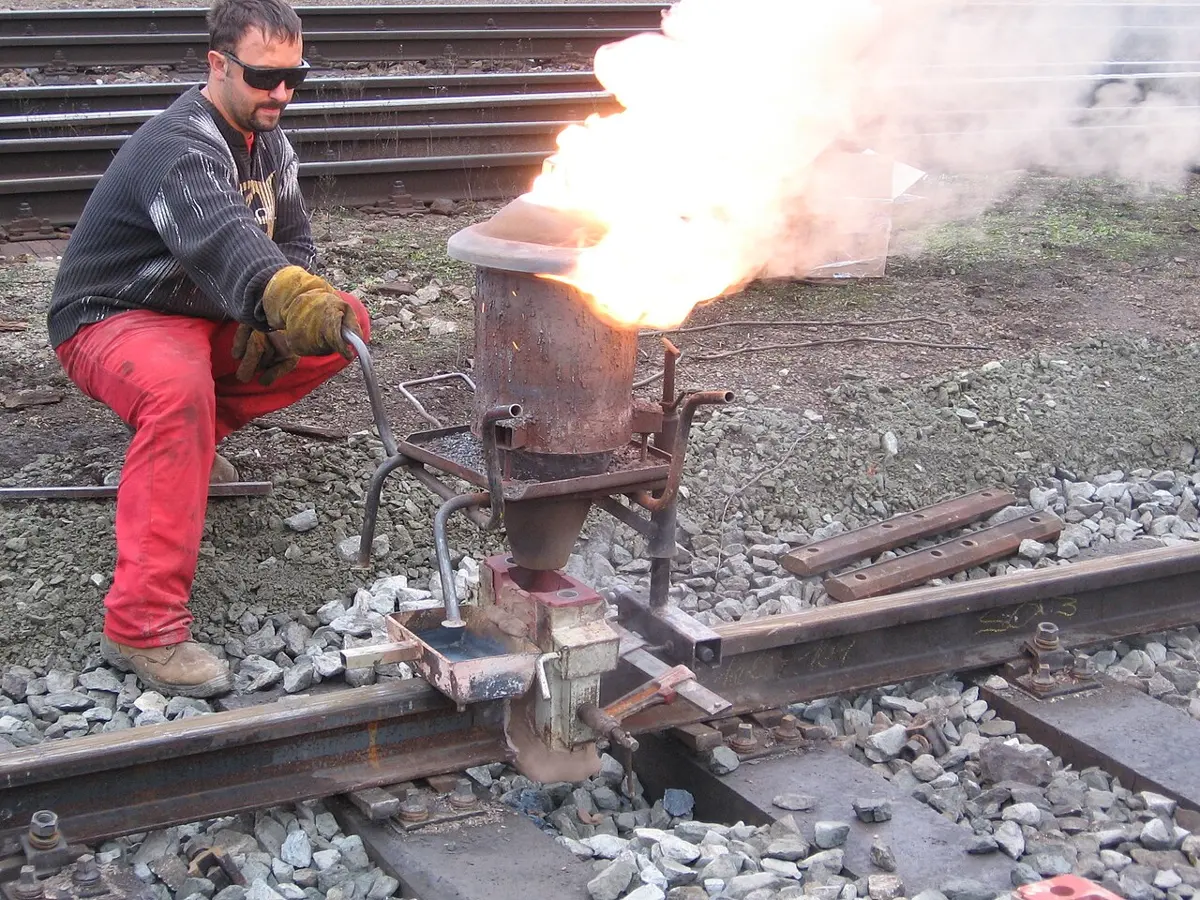
The same reaction with iron oxide, , is the thermite used to weld railway lines: the molten iron runs into a mold round the joint and welds the two rails into one.
iii. Self-reduction (auto-reduction). The sulphide ores of some unreactive metals (copper, mercury, lead) need no separate reducing agent. Part of the sulphide is roasted to the oxide, and then the oxide and the sulphide that is left react together: the sulphide’s sulphur reduces the metal and leaves as SO₂. For copper glance and cinnabar:
B. Electrochemical (electrolytic) reduction
The most reactive metals, the alkali and alkaline earth metals and aluminium, can’t be reduced chemically in a practical way. They hold oxygen and chlorine more firmly than carbon does; at the high temperatures that would be needed they form carbides with carbon, and their vapors are extremely reactive; and they are themselves among the strongest reducing agents, so nothing cheaper can reduce them. Instead their molten compounds are electrolyzed, and the metal forms at the cathode. A second salt is often added to lower the melting point.
Sodium is got by electrolyzing molten sodium chloride with calcium chloride added (Section 10.2.2):
At the cathode (reduction):
At the anode (oxidation):
Chromium is extracted from Cr₂O₃ by heating it with
Pick an answer to see why.
10.1.5 Refining (purification)
The metal got by reduction is still impure: some ore is left unreduced, and the metal picks up other metals, carbon, sulphur or silicon from the ore and the furnace. Purifying it is refining. The method depends on the metal and its impurities.
i. Poling. Used when the metal contains its own oxide as impurity: copper (with Cu₂O), lead (PbO) and tin (SnO₂). The molten impure metal is stirred with poles of green wood (Figure 10.15). The hot wood gives off hydrocarbon gases (methane and others), which reduce the oxide back to the metal, and the stirring brings the impurities to the surface as a scum, which is skimmed off:
ii. Electrolytic refining. The most important method, used for copper, silver, gold, zinc, nickel, lead and others. The impure metal is made the anode, a thin sheet of pure metal the cathode, and both dip into a solution of a salt of the metal (Figure 10.16). When the current flows, the impure anode dissolves and pure metal is deposited on the cathode: the anode gets thinner, the cathode thicker.
For copper, the electrolyte is copper sulphate solution acidified with sulphuric acid:
At the anode (oxidation):
At the cathode (reduction):
Every copper ion that leaves the anode is matched by one deposited on the cathode, so the solution stays the same. What happens to the impurities depends on their reactivity. Less reactive metals (silver, gold, platinum) don’t dissolve at all: they drop from the anode as anode mud (anode sludge), which is collected, and its silver and gold often pay for the whole refinery. More reactive metals (iron, zinc, nickel) dissolve, but stay in solution as ions, since copper ions are reduced more easily than theirs. The copper on the cathode is about 99.99% pure.
iii. Other refining methods. Where they suit a metal:
- Liquation: a metal that melts at a much lower temperature than its impurities (tin, lead, bismuth) is heated on a sloping hearth just above its melting point: the pure metal melts and runs down, leaving the solid impurities behind.
- Distillation: a metal with a low boiling point (zinc, 907 °C; mercury, 357 °C; cadmium) is boiled off and condensed, leaving the less volatile impurities behind.
- Oxidation: impurities that oxidize more easily than the metal are burnt out by blowing air through the molten metal: carbon, silicon and phosphorus are removed from pig iron in this way to make steel, and lead is removed from silver as its oxide (cupellation).
10.2 Alkali metals
The elements of Group 1 below hydrogen, lithium (Li), sodium (Na), potassium (K), rubidium (Rb), cesium (Cs) and francium (Fr), are the alkali metals. Each has one valence electron, in an s orbital: their valence-shell configuration is ns¹, so they are s-block elements. With the same outer arrangement, they behave alike. Hydrogen, 1s¹, is put at the top of Group 1 because of its configuration, but it is not an alkali metal: it is a non-metal gas made of H₂ molecules, it doesn’t easily lose its electron (its ionization energy, 1312 kJ/mol, is two and a half times lithium’s), and it often shares or gains one instead.
| Atomic number | Element | Symbol | Electron configuration |
|---|---|---|---|
| 3 | Lithium | Li | [He] 2s¹ |
| 11 | Sodium | Na | [Ne] 3s¹ |
| 19 | Potassium | K | [Ar] 4s¹ |
| 37 | Rubidium | Rb | [Kr] 5s¹ |
| 55 | Cesium | Cs | [Xe] 6s¹ |
| 87 | Francium | Fr | [Rn] 7s¹ |
They are called alkali metals because they react with water to give strong alkalis and hydrogen:
Rubidium and cesium react the same way, explosively.
10.2.1 General characteristics of the alkali metals
A. Physical properties
Every trend below comes from one fact: going down the group, each element adds a whole new shell of electrons, so the single outer electron sits farther from the nucleus, behind more inner shells, and is held more weakly. The numbers, from the CRC Handbook:
| Property | Li | Na | K | Rb | Cs |
|---|---|---|---|---|---|
| Metallic radius (pm) | 152 | 186 | 227 | 248 | 265 |
| Ionic radius of M⁺ (pm) | 76 | 102 | 138 | 152 | 167 |
| Density (g/cm³) | 0.53 | 0.97 | 0.89 | 1.53 | 1.93 |
| Melting point (°C) | 181 | 98 | 63 | 39 | 28 |
| Boiling point (°C) | 1342 | 883 | 759 | 688 | 671 |
| First ionization energy (kJ/mol) | 520 | 496 | 419 | 403 | 376 |
| Second ionization energy (kJ/mol) | 7298 | 4562 | 3052 | 2633 | 2234 |
| Electronegativity (Pauling) | 0.98 | 0.93 | 0.82 | 0.82 | 0.79 |
| Standard electrode potential, E° (V) | −3.04 | −2.71 | −2.93 | −2.98 | −3.03 |
| Flame color | crimson red | golden yellow | lilac (pale violet) | red-violet | blue-violet |
Appearance. All are silvery-white metals with a bright luster when freshly cut, which dulls within seconds in air as a layer of oxide and hydroxide forms. (Cesium is pale gold.)
Softness. They are so soft that they can be cut with a knife, and they are malleable and ductile. Each atom gives only one electron to the “sea” of electrons that holds the metal together, and the atoms are large, so the metallic bond is weak; it gets weaker down the group as the atoms grow.
Atomic and ionic size. The alkali metals have the largest atoms of their periods (leaving out the noble gases). Both atomic and ionic radii increase down the group, Li < Na < K < Rb < Cs and Li⁺ < Na⁺ < K⁺ < Rb⁺ < Cs⁺, because a new shell is added at each step. An ion is much smaller than its atom: it has lost its whole outer shell.
Density. They are light metals: lithium, at 0.53 g/cm³, is the lightest of all metals, and Li, Na and K float on water. Their large atoms, held by weak bonds, are not closely packed. Density generally increases down the group, because the mass of the atom grows faster than its volume; potassium is the exception, lighter than sodium: Li < K < Na < Rb < Cs.
Conductivity. All are good conductors of heat and electricity, because their loosely held valence electrons move freely through the metal. Sodium conducts best of them (about a third as well as copper); conductivity doesn’t follow a simple order down the group.
Melting and boiling points. Very low for metals, and falling down the group, because the metallic bond weakens as the atoms grow: cesium melts at 28 °C, in a warm hand. Li > Na > K > Rb > Cs.
Ionization energy. The alkali metals have the lowest first ionization energies in their periods, because their single outer electron is far from the nucleus and well shielded by the inner shells. It falls down the group (Li 520, Na 496, K 419, Rb 403, Cs 376 kJ/mol), as the atom grows. The second ionization energy is enormous (six to fourteen times the first), because the second electron must come from the full inner shell, which has the noble-gas arrangement ns² np⁶ and is much nearer the nucleus.
Electropositive (metallic) character. They are the most electropositive elements: they lose their electron most readily, because their ionization energy is so low. Metallic character increases down the group: Li < Na < K < Rb < Cs.
Oxidation state. Always +1: losing one electron gives the M⁺ ion with a noble gas configuration, and the next electron is far too hard to remove.
Reducing nature. They are strong reducing agents, because they give up their electron so readily. In water, the reducing power increases from sodium to cesium, but lithium is the strongest reducing agent of all, with the most negative electrode potential (−3.04 V), though its ionization energy is the highest. The tiny Li⁺ ion attracts water molecules so strongly (its hydration energy, about −519 kJ/mol, is far larger than Na⁺’s −406 or Cs⁺’s −276) that the energy released makes up for the harder ionization: in water, the whole change is the most favorable.
Electronegativity. Very low, and decreasing down the group (Li > Na > K ≥ Rb > Cs), because the atoms are large and their nuclei, behind many shells, attract a bonding pair weakly.
Flame color. The alkali metals and their salts color a flame: lithium crimson red, sodium golden yellow, potassium lilac (pale violet), rubidium red-violet and cesium blue-violet. This is the flame test, used in qualitative analysis to identify the metal in a salt. The flame’s heat excites the outer electron to a higher energy level; when it falls back to a lower level, it gives out the energy difference as light of particular wavelengths, which for these metals fall in the visible range. Each element has its own set of energy levels, so its own colors (Unit 3).
B. Chemical properties
Alkali metals have large atoms and very low first ionization energies, so they readily lose their valence electron to form M⁺ ions with a noble gas configuration. That makes them highly reactive, and their compounds ionic. Reactivity increases down the group, as the ionization energy falls.
1. With air. A freshly cut surface tarnishes within seconds, as the metal reacts with oxygen and moisture in the air. Heated in air, they burn, giving different oxides:
Lithium gives mainly the oxide (monoxide), with a little peroxide:
Sodium gives mainly the peroxide, with a little oxide:
Potassium, rubidium and cesium give superoxides:
Why the difference? The oxide ion O²⁻ is small, the peroxide ion O₂²⁻ larger, the superoxide ion O₂⁻ larger still, and a crystal is most stable when its ions are well matched in size: the small Li⁺ holds the small O²⁻ best, the large K⁺, Rb⁺ and Cs⁺ the large O₂⁻.
Because they react with air and water so readily, alkali metals are stored under kerosene or paraffin oil, which keeps both out. (Lithium, the least dense, floats even on oil; it is kept in sealed tins or under petroleum jelly.)
2. With water. They react with water to give the hydroxide and hydrogen, giving out heat:
Lithium reacts steadily, sodium vigorously, and potassium so violently that the hydrogen catches fire (with a lilac flame from the potassium); rubidium and cesium explode.
3. With hydrogen. Heated in hydrogen, they form ionic hydrides, white salts containing the hydride ion, H⁻:
4. With non-metals. They combine directly with the halogens, sulphur and phosphorus, giving halides, sulphides and phosphides:
5. With liquid ammonia. Alkali metals dissolve in liquid ammonia (at −33 °C or below) to give a deep blue solution that conducts electricity well, is paramagnetic and is a strong reducing agent. Each atom gives up its electron, and both the metal ion and the electron are surrounded by ammonia molecules: ammoniated metal ions and ammoniated (solvated) electrons.
The blue color comes from the ammoniated electrons, which absorb red and orange light (the deep red end of the visible spectrum and the near infrared) and let the blue through; the free electrons also make it conduct and make it paramagnetic. A much more concentrated solution looks like bronze metal. Left standing (faster with a catalyst), the blue solution slowly fades, giving the metal amide and hydrogen:
Which alkali metal burns in air to form mainly a superoxide?
Pick an answer to see why.
10.2.2 Sodium: extraction, properties and uses
Alkali metals are too reactive to be found free: they occur only combined. Sodium is the most abundant of them, the sixth commonest element in the Earth’s crust (about 2.3%), and the sea holds about 30 g of its chloride in every liter. Its main minerals:
| Mineral | Formula |
|---|---|
| Rock salt (common salt) | NaCl |
| Chile saltpeter (caliche) | NaNO₃ |
| Glauber’s salt | Na₂SO₄·10H₂O |
| Borax | Na₂B₄O₇·10H₂O |
| Soda feldspar (albite) | NaAlSi₃O₈ |
Extraction of sodium: the Downs process
Sodium cannot be made by reducing its compounds with carbon. Sodium holds oxygen and chlorine more firmly than carbon does, so coke won’t reduce them; and at the very high temperatures that would be needed, sodium would react with carbon to form sodium carbide (Na₂C₂). Nor can it be made by electrolyzing a solution of salt: in water, hydrogen is set free at the cathode instead, and any sodium formed would react with the water at once. So sodium is got by electrolyzing molten sodium chloride, in the Downs cell (often written Down’s cell).
Molten salt alone is hard to electrolyze, for four reasons:
- a.sodium chloride melts at 801 °C, a high temperature to reach and keep up;
- b.sodium boils at 883 °C, not far above, so at that temperature much of the sodium formed would boil away;
- c.molten sodium dissolves in molten sodium chloride, forming a metallic “fog” that is hard to separate and can short-circuit the cell;
- d.at that temperature, sodium and chlorine both attack the materials of the cell.
In 1924 James Cloyd Downs, in the USA, solved all four by mixing the salt with calcium chloride (about 40% NaCl to 60% CaCl₂; often barium chloride is added too), which brings the melting point down to about 600 °C. The mixture is electrolyzed at about 600 °C, between a graphite anode and a steel (iron) cathode.
How it works. A large graphite anode stands in the middle of a steel tank lined with fire-brick, and a ring-shaped steel cathode surrounds it (Figure 10.19). Between them hangs a cylinder of steel gauze, which lets the ions through but keeps the products apart. The anode is covered by a dome-shaped hood with an outlet at the top for the chlorine. The molten sodium, less dense than the molten salt, rises round the cathode into a ring-shaped collecting hood and flows up a pipe into a receiver, away from the air. The heat of the current keeps the salt molten, and fresh salt is added as electrolysis goes on.
At the anode (oxidation of chloride ions):
At the cathode (reduction of sodium ions):
Overall: , that is
Why isn’t calcium deposited, though Ca²⁺ ions are in the melt too? Sodium ions are more easily reduced: sodium’s standard electrode potential (−2.71 V) is less negative than calcium’s (−2.87 V), and in the hot melt the same order holds. Only a little calcium is deposited with the sodium; it crystallizes out as the sodium cools in the pipe and falls back into the cell.
Advantages of the Downs process:
- a.the sodium is very pure (over 99.5%, once the calcium is removed);
- b.its raw material, sodium chloride, is cheap and plentiful;
- c.the cell runs continuously, for a long time;
- d.chlorine, a valuable chemical, is a by-product.
Properties of sodium
1. With air. In dry air, sodium forms sodium oxide, with a little yellowish peroxide, and loses its shine:
The oxide takes up moisture to form a film of sodium hydroxide, which then absorbs carbon dioxide from the air to give sodium carbonate:
This is why sodium is stored under kerosene.
2. With water. Sodium reacts vigorously with water, giving sodium hydroxide, a strong base, and hydrogen; the heat can set the hydrogen alight, and a large piece can explode:
3. With acids. Sodium reacts with dilute hydrochloric and sulphuric acids, and with phosphoric acid, giving the sodium salt and hydrogen. The reaction is violent and can explode, so it is never done in a school laboratory:
4. With non-metals. Sodium combines directly with the halogens, sulphur and phosphorus:
5. With ammonia. In liquid ammonia, sodium dissolves to a deep blue solution of ammoniated sodium ions and ammoniated electrons, which conducts, is paramagnetic and is a strong reducing agent; concentrated, it looks bronze:
Heated in ammonia gas, sodium gives sodamide (sodium amide) and hydrogen:
Uses of sodium
- a.in sodium vapor lamps, the yellow street lights;
- b.to make the sodium extract (Lassaigne’s test) that detects nitrogen, sulphur and the halogens in organic compounds;
- c.in organic reactions such as the Wurtz and Fittig reactions and the Birch reduction;
- d.as a catalyst in making some synthetic rubbers;
- e.as sodium amalgam, a gentle reducing agent in organic chemistry;
- f.to extract other metals, such as titanium and zirconium, from their chlorides;
- g.as a strong reducing agent;
- h.in its compounds, above all sodium chloride, a nutrient every animal needs;
- i.formerly, to make tetraethyl lead (TEL), the anti-knock additive in petrol, now banned almost everywhere because lead is poisonous;
- j.liquid sodium, which carries heat well and stays liquid over a wide range, as the coolant in some nuclear reactors (fast breeder reactors).
Sodium is extracted by
Pick an answer to see why.
10.2.3 Sodium hydroxide
Sodium hydroxide, NaOH, is one of the most useful compounds of sodium, made in millions of tonnes a year. It is called caustic soda (caustic: it burns skin) or lye, and it is the alkali in soap-making and in many drain and oven cleaners.
Properties of sodium hydroxide
1. Precipitating metal hydroxides.
Most metal hydroxides are insoluble in water, so a solution of a metal salt gives a precipitate of the hydroxide with dilute sodium hydroxide. Their colors identify the metals in qualitative analysis:
Some hydroxides, those of the amphoteric metals zinc and aluminium, dissolve again in excess sodium hydroxide, giving a soluble salt:
So a white precipitate that dissolves in excess NaOH points to zinc or aluminium; one that stays (magnesium, calcium) doesn’t.
2. With carbon monoxide. Sodium hydroxide doesn’t react with carbon monoxide under ordinary conditions; but heated to about 210 °C under pressure (5–10 atm), it absorbs it, giving sodium formate, which with acid gives formic acid:
Uses of sodium hydroxide
- a.as a common laboratory reagent;
- b.to make soap, detergents, rayon (artificial silk), paper and pulp;
- c.to make other sodium compounds;
- d.to make soda lime (NaOH with CaO);
- e.to purify bauxite into alumina (the Bayer process);
- f.as a reagent in many inorganic and organic reactions;
- g.to clean machinery, and to clear drains and waste pipes;
- h.in refining petroleum (removing acidic impurities).
A white precipitate forms when NaOH solution is added to a salt solution, and it dissolves in excess NaOH. The metal could be
Pick an answer to see why.
10.2.4 Sodium carbonate
Sodium carbonate, Na₂CO₃, is the sodium salt of carbonic acid, with an alkaline (basic) solution. It is a white crystalline solid that exists anhydrous (Na₂CO₃, called soda ash) and as hydrates: the monohydrate (Na₂CO₃·H₂O), the heptahydrate (Na₂CO₃·7H₂O) and the decahydrate (Na₂CO₃·10H₂O), which is washing soda. Left in air, washing-soda crystals lose most of their water and crumble to a white powder of the monohydrate (efflorescence); heated above 100 °C, it loses the rest:
It is an ionic compound of two sodium ions and a carbonate ion, a flat triangle of three oxygens round a carbon, with the 2− charge shared over the three oxygens (Unit 5):
Properties of sodium carbonate
1. With carbon dioxide. Carbon dioxide passed into a solution of sodium carbonate gives sodium hydrogen carbonate, which is much less soluble and crystallizes out:
2. With sulphur dioxide. Sulphur dioxide passed into the solution gives sodium sulphite, and with more SO₂, sodium hydrogen sulphite (bisulphite):
This reaction is used to remove sulphur dioxide from the waste gases of power stations and smelters.
3. With water (hydrolysis). Sodium carbonate dissolves readily in water, giving out heat, and its solution is alkaline. The sodium ions do nothing; it is the carbonate ion, the ion of a weak acid, that reacts with water and makes hydroxide ions:
4. Precipitation. With solutions of many metal salts, sodium carbonate gives a precipitate of the insoluble carbonate:
Uses of sodium carbonate
- a.to make glass, caustic soda, soap, detergents, borax, paper and pulp;
- b.to soften hard water;
- c.in laundry work, as washing soda;
- d.as a laboratory reagent;
- e.in the textile industry and in refining petroleum;
- f.to raise the pH (alkalinity) of swimming pools;
- g.as soda ash, to remove sulphur dioxide from waste gases.
A solution of sodium carbonate in water is
Pick an answer to see why.
10.3 Alkaline earth metals
The elements of Group 2, beryllium (Be), magnesium (Mg), calcium (Ca), strontium (Sr), barium (Ba) and radium (Ra), are the alkaline earth metals. Each has two valence electrons, in an s orbital: their valence-shell configuration is ns², so they too are s-block elements, and they behave alike.
| Atomic number | Element | Symbol | Electron configuration |
|---|---|---|---|
| 4 | Beryllium | Be | [He] 2s² |
| 12 | Magnesium | Mg | [Ne] 3s² |
| 20 | Calcium | Ca | [Ar] 4s² |
| 38 | Strontium | Sr | [Kr] 5s² |
| 56 | Barium | Ba | [Xe] 6s² |
| 88 | Radium | Ra | [Rn] 7s² |
They are called alkaline earth metals because their oxides were once called “earths” (substances found in the Earth’s crust that fire can’t change, like lime and magnesia), and these earths dissolve in water to give alkaline solutions:
The metals themselves (except beryllium) react with water to give the same hydroxides and hydrogen:
10.3.1 General characteristics of the alkaline earth metals
A. Physical properties
The data (CRC Handbook):
| Property | Be | Mg | Ca | Sr | Ba |
|---|---|---|---|---|---|
| Metallic radius (pm) | 112 | 160 | 197 | 215 | 222 |
| Ionic radius of M²⁺ (pm) | 45 | 72 | 100 | 118 | 135 |
| Density (g/cm³) | 1.85 | 1.74 | 1.55 | 2.64 | 3.62 |
| Melting point (°C) | 1287 | 650 | 842 | 777 | 727 |
| First ionization energy (kJ/mol) | 899 | 738 | 590 | 549 | 503 |
| Second ionization energy (kJ/mol) | 1757 | 1451 | 1145 | 1064 | 965 |
| Electronegativity (Pauling) | 1.57 | 1.31 | 1.00 | 0.95 | 0.89 |
| Standard electrode potential, E° (V) | −1.85 | −2.37 | −2.87 | −2.89 | −2.91 |
| Flame color | none | none (dazzling white when burning) | brick red | crimson | apple green |
Appearance. Silvery-white (or grayish) metals with a metallic luster, which they lose in air as an oxide layer forms.
Hardness. They are malleable and ductile, but harder than the alkali metals. Each atom gives two electrons to the sea of electrons and the atoms are smaller, so the metallic bond is stronger.
Atomic and ionic size. Large atoms, but smaller than the alkali metal of the same period: with one more proton in the nucleus pulling on the same shells, the electrons are drawn in closer. Size increases down the group, Be < Mg < Ca < Sr < Ba < Ra, as a new shell is added at each step.
Density. Low, but higher than the alkali metals’, since their atoms are smaller and more closely packed. Down the group, density first falls a little (Be > Mg > Ca) and then rises (Ca < Sr < Ba).
Conductivity. Good conductors of heat and electricity: the two valence electrons per atom move freely. (Calcium conducts about four-fifths as well as aluminium, magnesium about three-fifths; gram for gram, both beat aluminium.)
Melting and boiling points. Much higher than the alkali metals’, because the metallic bond is stronger. They generally fall down the group, with magnesium an exception, the lowest of them: the way the atoms pack in the crystal also matters.
Ionization energy. Low, but higher than the alkali metals’: the atoms are smaller and the nucleus pulls harder on the outer electrons. They have two low ionization energies; the third is enormous, from a full inner shell. Losing both outer electrons gives the M²⁺ ion with a noble gas configuration. Both values fall down the group, as the atoms grow.
Oxidation state. Always +2:
Reducing nature. Strong reducing agents, though weaker than the alkali metals; the reducing power increases from beryllium to barium, as the electrode potentials grow more negative (Be −1.85 V to Ba −2.91 V) and the ionization energies fall.
Flame color. Calcium gives a brick-red flame, strontium crimson, barium apple green and radium carmine red. Beryllium and magnesium give no color: their electrons are held so tightly that the flame can’t excite them enough, and the light they would give out is in the ultraviolet. (Burning magnesium’s dazzling white light is a different thing: it is the glow of white-hot magnesium oxide.) Strontium’s red and barium’s green are the reds and greens of fireworks.
B. Chemical properties
The alkaline earth metals lose their two valence electrons to form M²⁺ ions with a noble gas configuration. So they are reactive, though less so than the alkali metals, and their compounds are mostly ionic. (Beryllium, whose small Be²⁺ ion would pull hard on any neighbor’s electrons, forms mostly covalent compounds.) Reactivity increases down the group.
1. With air. In air they become dull, as a layer of oxide forms on the surface:
Heated, magnesium burns with a dazzling white flame, giving white magnesium oxide (and a little magnesium nitride with the nitrogen of the air). Beryllium is hardly affected by air: its thin oxide film protects it.
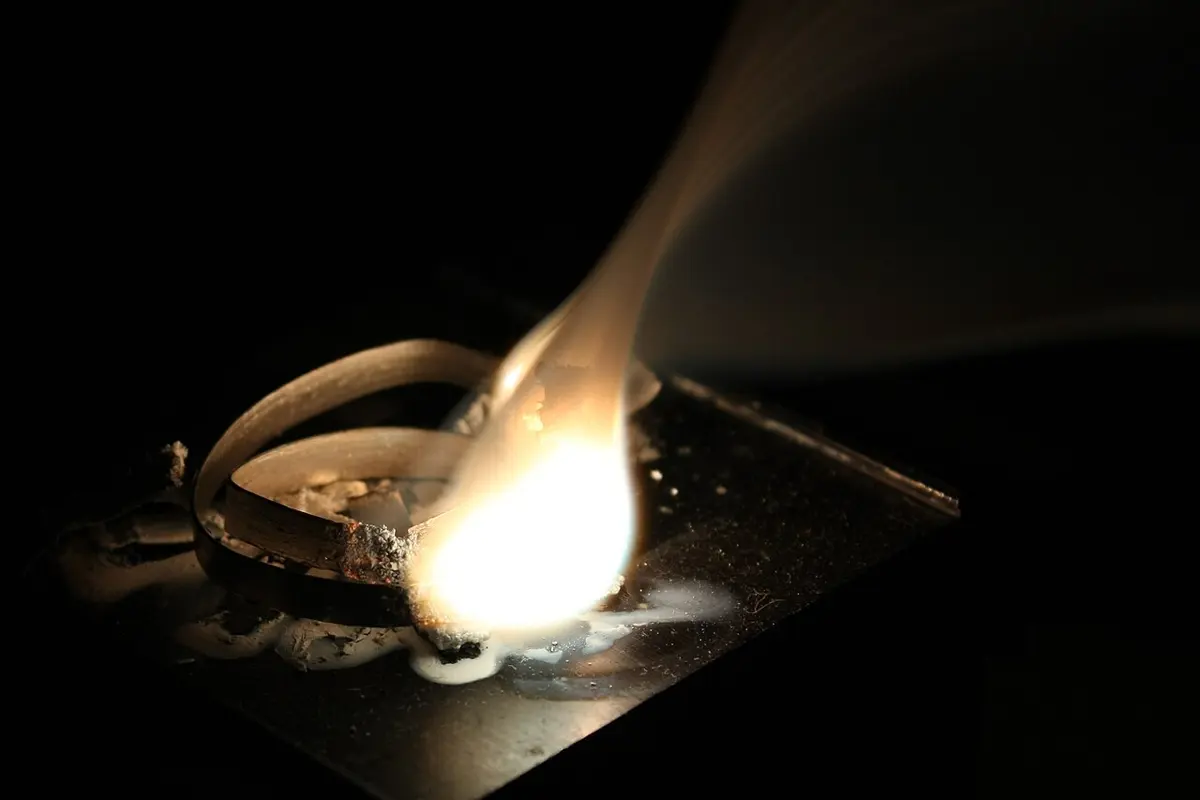
2. With water. Except beryllium, they react with water to give the hydroxide and hydrogen. Calcium, strontium and barium react with cold water, steadily rather than violently:
Magnesium reacts only very slowly with cold water, quicker with hot or boiling water, and burns in steam giving the oxide:
3. With hydrogen. Except beryllium, they combine with hydrogen when heated, forming hydrides:
4. With nitrogen. Heated in nitrogen, they form nitrides:
5. With acids.
They react with dilute acids, giving the salt and hydrogen:
(Calcium’s reaction with sulphuric acid soon slows, as insoluble calcium sulphate coats the metal.) Beryllium dissolves in dilute hydrochloric and sulphuric acids, but cold nitric acid makes it passive: a tough oxide film forms and stops the reaction.
6. With non-metals. They combine with the halogens, sulphur, phosphorus and carbon when heated:
Which alkaline earth metal gives no color in a flame test?
Pick an answer to see why.
10.3.2 Some compounds of the alkaline earth metals
1. Quicklime, CaO. Calcium oxide is called quicklime or burnt lime; in Nepal, chuna, the word used for lime generally (the whitewash on walls and the lime in a paan are slaked lime, Ca(OH)₂, made by adding water to quicklime). It is made by heating limestone in a kiln:
Uses of quicklime:
- a.to make calcium carbide (CaC₂) and bleaching powder;
- b.as a raw material for cement;
- c.to make soda lime (NaOH + CaO);
- d.to make glass;
- e.as a basic flux in metallurgy;
- f.to dry gases and alcohol (it absorbs water);
- g.to reduce the acidity of soils, as agricultural lime.
2. Bleaching powder, CaOCl₂. Commonly called bleaching powder, chloride of lime or chlorinated lime, and chemically calcium chlorohypochlorite, Ca(OCl)Cl, usually written CaOCl₂. It is made by passing chlorine over slaked lime. In moist air or water it releases chlorine (and hypochlorous acid), which kills germs and bleaches.
Uses of bleaching powder:
- a.to make chloroform;
- b.to bleach paper, pulp, cotton and linen;
- c.as a disinfectant, for toilets, drains and floors;
- d.to sterilize drinking water, in tanks and in floods;
- e.as an oxidizing agent in the laboratory;
- f.to whiten clothes and remove stains.
3. Magnesia, MgO. Magnesium oxide is called magnesia. It melts at about 2850 °C.
Uses of magnesia:
- a.as a refractory material, lining furnaces and making fire-bricks, because of its very high melting point;
- b.in some cements (magnesia cement);
- c.to make crucibles;
- d.in medicine: stirred into water it becomes magnesium hydroxide, Mg(OH)₂, and a suspension of that is milk of magnesia, a laxative for constipation;
- e.as an antacid, to relieve acidity in the stomach;
- f.as a basic flux in metallurgy.
4. Plaster of Paris, CaSO₄·½H₂O. Calcium sulphate hemihydrate (one molecule of water for every two of CaSO₄, (CaSO₄)₂·H₂O). It is made by heating gypsum, CaSO₄·2H₂O, gently, to about 120 °C. Mixed with water, it takes the water back and sets hard into gypsum within minutes, swelling slightly, so it fills a mold exactly:
Uses of plaster of Paris:
- a.to set fractured bones in a plaster cast;
- b.for statues, models and decorations;
- c.in fireproofing materials, and for blackboard chalk;
- d.for artificial marble and false ceilings;
- e.to fill cracks and gaps in walls and roofs.
5. Epsom salt, MgSO₄·7H₂O. Magnesium sulphate heptahydrate is called Epsom salt, after a spring at Epsom in England whose bitter water held it.
Uses of Epsom salt:
- a.as a laxative (purgative) in medicine;
- b.in making paints, soaps and fireproof materials;
- c.as a mordant in dyeing, and in tanning leather;
- d.as a laboratory reagent;
- e.in cosmetic lotions and bath salts;
- f.as a fertilizer where soil is short of magnesium.
Which compound sets hard when mixed with water, and is used for setting broken bones?
Pick an answer to see why.
10.3.3 Solubility of the hydroxides, carbonates and sulphates
Two energies decide whether an ionic compound dissolves in water.
Lattice energy is the energy released when the gaseous ions come together to form one mole of the crystal; it is the same energy that must be supplied to pull the crystal apart again into separate ions. The greater the lattice energy, the more firmly the ions hold each other, and the less soluble the compound. It is larger for smaller ions and higher charges.
Hydration energy (hydration enthalpy) is the energy released when one mole of gaseous ions is surrounded by water molecules (Figure 10.23): the δ− oxygen ends of water turn to a cation, the δ+ hydrogen ends to an anion. The greater the hydration energy, the more soluble the compound. It is larger for smaller ions and higher charges, which draw the water molecules closer: Mg²⁺ releases about 1921 kJ/mol, Ba²⁺ only about 1305 kJ/mol.
A compound dissolves well when the hydration energy is greater than, or close to, the lattice energy. Going down Group 2, the cation grows, and both energies get smaller: which wins depends on the anion.
Solubility of the hydroxides
The hydroxide ion is small, so the lattice energy of the hydroxides depends strongly on the size of the cation: going down the group, the cation grows and the lattice energy falls a lot. The hydration energy falls too, but less. So the lattice energy falls faster, and the solubility of the hydroxides increases down the group:
Magnesium hydroxide is almost insoluble (milk of magnesia is a suspension of it); calcium hydroxide dissolves a little (its solution is limewater); barium hydroxide dissolves well and gives a strongly alkaline solution.
Solubility of the carbonates and sulphates
The carbonate and sulphate ions are large, much larger than the cations. So when the cation grows from Be²⁺ to Ba²⁺, the distance between the ions’ centers hardly changes, and the lattice energy stays nearly the same. But the hydration energy, which depends on the cation alone, falls steadily as the cation grows. So the solubility of the carbonates and sulphates decreases down the group:
In short: a larger cation has a lower charge density, attracts the polar water molecules less, and so is less soluble with these large anions.
| MgSO₄ | CaSO₄ | SrSO₄ | BaSO₄ | |
|---|---|---|---|---|
| Solubility (g in 100 g of water, about 20 °C) | about 35 | 0.21 | 0.013 | 0.00024 |
10.3.4 Thermal stability of the carbonates and nitrates
The carbonates and nitrates of the alkaline earth metals all decompose on heating, to the metal oxide. Carbonates give carbon dioxide:
Nitrates give nitrogen dioxide (a brown gas) and oxygen:
Going down the group, the compounds become harder to decompose: a higher temperature is needed. Why?
The answer is the polarizing power of the cation (Figure 10.26). A small cation with a 2+ charge has a high charge density: it pulls the electron cloud of the large, soft carbonate ion towards itself. The electrons drawn towards the cation are taken from the C–O bonds on that side, which are weakened; it then takes less heat to break the carbonate ion into an oxide ion (which stays with the metal) and a CO₂ molecule (which leaves). The more the carbonate ion is distorted (polarized), the less heat is needed. The small Be²⁺ and Mg²⁺ polarize it strongly; the large Sr²⁺ and Ba²⁺ hardly at all. And the small cations also hold the small oxide ion that is formed especially strongly, which helps the change. So the thermal stability increases down the group:
The nitrates follow the same order, for the same reason:
Exercise
Metals and metallurgy (10.1)
A. Multiple choice questions
- What are the impurities associated with an ore called?
Pick an answer to see why.
- For which metal is the aluminothermic process used?
Pick an answer to see why.
- Which pair of metals makes brass?
Pick an answer to see why.
- Which of these is an acidic flux?
Pick an answer to see why.
- What is the formula of hematite?
Pick an answer to see why.
- By which kind of metallurgy are silver and gold extracted?
Pick an answer to see why.
- Which of these metals is best suited to extraction by pyrometallurgy?
Pick an answer to see why.
- Which of these is not a method of dressing (concentrating) an ore?
Pick an answer to see why.
- In which concentration process are collectors and activators used?
Pick an answer to see why.
- Which of these ores is roasted?
Pick an answer to see why.
- For which of these ores is calcination used?
Pick an answer to see why.
- In electrolytic refining, at which electrode is the pure metal collected?
Pick an answer to see why.
- Which of these is used to refine metals?
Pick an answer to see why.
B. Short answer questions
- a.Define minerals and ores, with examples.
- b.What are alloys? Why are they made?
- c.Explain the terms flux and matrix.
- d.What are metalloids? Give some examples.
Answer
What is metallurgy? Briefly explain pyrometallurgy and electrometallurgy.
Answer
What types of metals are extracted by hydrometallurgy?
Answer
Give reasons:
- a.All ores are minerals, but all minerals are not ores.
- b.Alkali metals are not extracted by carbon reduction.
- c.Sulphide ores are roasted rather than calcined.
Answer
Differentiate between:
- a.calcination and roasting
- b.electrometallurgy and hydrometallurgy
- c.pyrometallurgy and hydrometallurgy
- d.gangue and flux
- e.poling and liquation
- f.metalloids and amalgams
- g.self-reduction and electrochemical reduction
- h.the carbon reduction process and the aluminothermic process
Answer
Write a note on gangue, flux and slag.
Answer
Describe the steps involved in metallurgy.
Answer
Draw a flow sheet showing the steps in the extraction of a metal from its ore.
Answer
What are metalloids? Give some examples, and write their general characteristics.
Answer
What do you mean by alloys? Why are they prepared? Give some examples.
Answer
What is an amalgam? Write its importance.
Answer
Write a brief note on:
- a.pyrometallurgy
- b.crushing and pulverization
- c.gravity separation
- d.froth flotation
Answer
Explain:
- a.distillation
- b.poling
- c.electrolytic refining
- d.self-reduction
- e.the thermite process
Answer
What are refractory materials? Give some examples. How are they removed during the extraction of a metal?
Answer
What is smelting? Write its significance in metallurgy.
Answer
Give the formulas of two ores on which each of these operations is carried out:
- a.leaching
- b.smelting
- c.froth flotation
- d.poling
- e.self-reduction
- f.liquation
- g.roasting
Answer
Which types of ores or metals are treated by these operations?
- a.gravity separation
- b.calcination
- c.froth flotation
- d.electrochemical reduction
Answer
What principles are used in gravity separation and in magnetic separation?
Answer
How are metals generally extracted and purified from sulphide ores?
Answer
Alkali and alkaline earth metals (10.2–10.3)
A. Multiple choice questions
- What is the valence-shell configuration of the alkali metals?
Pick an answer to see why.
- Which statement about the alkali metals is false?
Pick an answer to see why.
- Which property do the alkali metals show?
Pick an answer to see why.
- What color does cesium give to a flame?
Pick an answer to see why.
- Alkali metals dissolve in liquid ammonia to give a blue solution. The blue color is due to ammoniated
Pick an answer to see why.
- Which alkali metal does not form a superoxide?
Pick an answer to see why.
- Which pair of atomic numbers are both s-block elements?
Pick an answer to see why.
- Which of these has the lowest melting point?
Pick an answer to see why.
- By which principle is sodium extracted from halide ores like NaCl?
Pick an answer to see why.
- Which process is used to make sodium commercially by electrolysis of fused NaCl?
Pick an answer to see why.
- What happens at the anode during the electrolysis of fused NaCl?
Pick an answer to see why.
- How is sodium metal extracted?
Pick an answer to see why.
- Which is the most abundant alkali metal in nature?
Pick an answer to see why.
- Which metal is in the mineral Chile saltpeter?
Pick an answer to see why.
- What is the formula of borax?
Pick an answer to see why.
- Why is CaCl₂ added in the Downs process?
Pick an answer to see why.
- In the electrolysis of concentrated aqueous NaCl (brine), what forms at the cathode?
Pick an answer to see why.
- Which of these is an alkaline earth metal?
Pick an answer to see why.
- Which statement about the alkaline earth metals is false?
Pick an answer to see why.
- Which of these gives an apple-green color to a Bunsen flame?
Pick an answer to see why.
- What is the formula of bleaching powder?
Pick an answer to see why.
- Which oxidation state do the alkaline earth metals show?
Pick an answer to see why.
- Which compound forms when calcium is exposed to air?
Pick an answer to see why.
- What is the formula of quicklime?
Pick an answer to see why.
- Which is the least soluble in water?
Pick an answer to see why.
- Which is the most soluble sulphate?
Pick an answer to see why.
- What is the trend in the thermal stability of the Group 2 nitrates?
Pick an answer to see why.
- Which of these has the highest thermal stability?
Pick an answer to see why.
B. Short answer questions
- a.What are alkali metals? List them. Why are they called so?
- b.How does sodium react with ammonia?
Answer
Give reasons:
- a.Alkali metals become dull when exposed to the atmosphere.
- b.Alkali metals are good reducing agents.
- c.Potassium is more reactive than sodium.
- d.Sodium metal is stored in paraffin oil.
- e.Sodium cannot be extracted by pyrometallurgy.
Answer
Define the terms a. soda ash b. caustic soda, and write their formulas.
Answer
Differentiate between:
- a.sodium and potassium
- b.baking soda and washing soda
- c.caustic soda and soda ash
- d.Mg and Ba
- e.alkali metals and alkaline earth metals
Answer
An element X has the valence-shell configuration 3s¹.
- a.Identify X.
- b.How does X react with sulphur?
- c.Why is X stored in kerosene?
- d.What happens when a piece of X is added to water?
Answer
Sodium, the most abundant alkali metal in the Earth’s crust, is extracted by electrolysis of a mixture of molten NaCl and CaCl₂, in the ratio of about 2 : 3, in the Downs process.
- a.Write two advantages of adding CaCl₂.
- b.What would happen if NaCl alone were electrolyzed?
- c.Write the electrode reactions in the Downs cell.
- d.Give three uses of sodium.
Answer
The figure shows a Downs cell, used to extract sodium.
- a.Write the importance of the Downs cell.
- b.What is the purpose of mixing CaCl₂ with NaCl?
- c.Identify A and B, with the electrode reactions.
Answer
What happens when
- a.a pellet of sodium hydroxide is added to copper sulphate solution?
- b.sodium carbonate is added to a solution of MgCl₂?
- c.caustic soda is heated with CO under high pressure?
Answer
List the uses of a. caustic soda b. sodium carbonate c. sodium metal.
Answer
What are alkaline earth metals? Why are they called so? List their general characteristics.
Answer
Give reasons:
- a.Magnesium becomes dull when exposed to the atmosphere.
- b.Alkaline earth metals show a +2 oxidation state.
- c.Alkaline earth metals don’t occur in the native state.
Answer
- a.How does magnesium react with boiling water?
- b.What is the use of quicklime in metallurgy?
- c.Write the formulas of magnesia and Epsom salt.
Answer
An element Y has the valence-shell configuration 3s².
- a.Identify Y.
- b.How does Y react with sulphur?
- c.What happens when a piece of Y is put in boiling water?
Answer
C. Long answer questions
Calcination is one of the processes that turn an ore into its oxide. It is usually done in the furnace shown.
- a.Name the furnace.
- b.Define calcination, and give two examples of ores that are calcined.
- c.Write two reactions that take place in it.
- d.Name two waste gases given off.
Answer
Describe the trend in the solubility of the alkaline earth metal hydroxides.
Answer
Describe the trend in the solubility of the alkaline earth metal carbonates.
Answer
Describe the trend in the solubility of the alkaline earth metal sulphates.
Answer
Describe the trend in the thermal stability of the alkaline earth metal sulphates.
Answer
Describe the trend in the thermal stability of the alkaline earth metal nitrates.
Answer
List the uses of a. quicklime b. plaster of Paris c. Epsom salt d. bleaching powder.
Answer
The trends in the solubility of the Group 2 sulphates and hydroxides are given: MgSO₄ (most soluble) → CaSO₄ → SrSO₄ → BaSO₄ (least soluble); Mg(OH)₂ → Ca(OH)₂ → Sr(OH)₂ → Ba(OH)₂, solubility and alkalinity increasing.
- a.What causes these trends?
- b.Which sulphate is precipitated most easily, and why?
- c.Which hydroxide solution has the highest pH, and why?
Answer
Use the flow sheet to answer the questions.
- a.Identify X and Y.
- b.Write balanced equations for the change of Ca to Y, and of CaO to CaCl₂.
- c.Write balanced equations for the action of heat and of HCl on X.
- d.What are the common names of X, Y and CaO?
Answer
A blast furnace for smelting an ore is shown in Figure 10.12.
- a.Define smelting.
- b.Write the chemical reactions that take place in the furnace.
- c.What is the job of the flux?
- d.What is the impact of this process on the environment?
- e.In which part of the furnace is slag formed, and why there?
Answer
Printable PDFs
- Study notes 3 pages
- Worksheet 5 pages Answer key
Quiz yourself: Materials and Chemicals We Use, Grades 5–12 →
Practice every question in the book, and keep track of the ones you miss →
A companion to your textbook, not a replacement for it: study from the book your school uses, and where the two differ, follow your teacher. Found a mistake? Please tell us.