
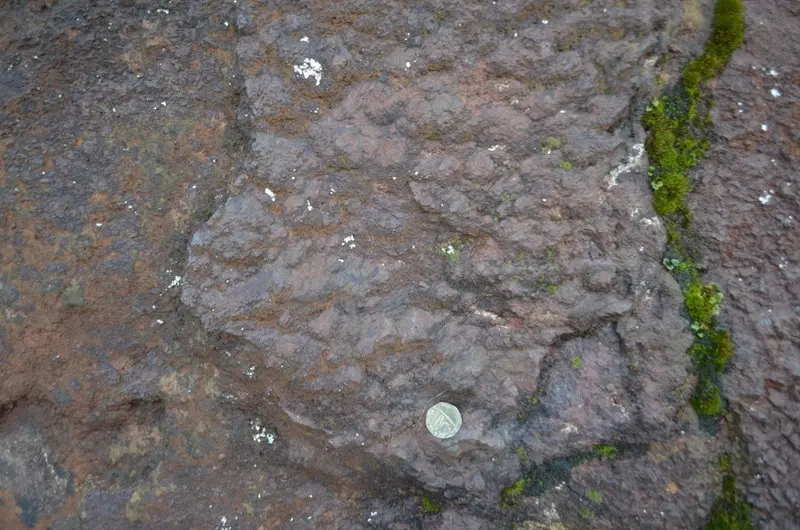
Pick up a lump of hematite, the commonest ore of iron, and it looks like nothing much: a heavy, rust-red rock that leaves a red streak on paper. Yet seven tenths of its mass is iron. Every steel rod in the pillars of a new house, every nail, every karahi started as rock like this, and the iron was got out of it in a tower as tall as a ten-storey building, burning day and night for years without being let go cold.
Gold is the opposite. It is found as gold, shining in river sand, and it stays shining for thousands of years. No single acid in the laboratory can dissolve it. But mix two acids, each of which leaves it alone, and the gold disappears. This unit is about how metals are got out of their ores, how iron is made in a blast furnace, and how five metals we use every day, iron, copper, aluminium, silver and gold, behave and react.
10.1 Metallurgy
Introduction
A few unreactive metals, such as gold, platinum and sometimes silver and copper, are found in the ground as the metal itself: they are found native (in the free state). Most metals are too reactive for that. Over millions of years they have joined with oxygen, sulphur, carbon dioxide or water, and are found as compounds in rocks: they are found in the combined state.
A few words you will need, all from Grade 10 Science:
- A mineral is a substance found naturally in the Earth’s crust, with a definite composition. Hematite (Fe₂O₃), bauxite (Al₂O₃·2H₂O) and copper pyrites (CuFeS₂) are minerals.
- An ore is a mineral from which a metal can be extracted easily and profitably. Every ore is a mineral, but not every mineral is an ore: clay contains aluminium, but getting aluminium out of clay costs far too much, so clay is not an ore of aluminium; bauxite is.
- Gangue is the unwanted rock, sand and earth mixed with the ore as it comes out of the mine.
- A flux is a substance added to the furnace to join with the gangue and make a liquid that is easy to remove. Limestone is the flux in a blast furnace.
- Slag is that liquid waste: the flux joined with the gangue. It floats on the molten metal and is run off.
Metallurgy is the process of extracting a metal from its ore and purifying it for use. More widely, it is the whole science and technology of metals: getting them out of their ores, purifying them, and making them into useful alloys.
The steps of metallurgy
No two metals are extracted in exactly the same way, and not every metal needs every step (gold, found native, needs no roasting or reduction), but the main steps are these (Grade 10 Science draws them as a flowchart):
- Crushing and grinding (pulverization). Big lumps of ore are broken in crushers and ground to a powder in ball mills. A powder has a huge surface, so every later step goes faster.
- Concentration (ore dressing). The gangue is removed, so that more of what is left is ore. It is done by gravity separation (washing away the lighter gangue with water, for heavy ores like hematite), magnetic separation (for magnetic ores like magnetite), or froth flotation (for sulphide ores like copper pyrites, which stick to oily bubbles while the sand sinks).
- Roasting or calcination. The concentrated ore is changed into the metal’s oxide, which is the easiest form to reduce. Roasting heats it strongly in plenty of air, for sulphide ores: 2ZnS + 3O₂ → 2ZnO + 2SO₂. Calcination heats it strongly with little or no air, for carbonate and hydrated ores: ZnCO₃ → ZnO + CO₂. Both also drive off water and burn off impurities such as sulphur and arsenic as gases.
- Reduction. Oxygen is taken away from the oxide to leave the metal. Metals in the middle of the reactivity series (zinc, iron, lead, copper) are reduced by heating with carbon or carbon monoxide; done hot enough to melt the metal, this is called smelting. Very reactive metals (sodium, magnesium, aluminium) hold oxygen too tightly for carbon, and are got by electrolysis of their molten compounds.
- Refining. The impure metal is purified, for example by distillation (zinc, mercury) or by electro-refining (copper).
Why is clay not called an ore of aluminium, even though it contains aluminium?
Pick an answer to see why.
10.2 Extraction of iron
The ores of iron
| Ore | Chemical name | Formula | Iron by mass |
|---|---|---|---|
| Hematite | iron(III) oxide (ferric oxide) | Fe₂O₃ | 70% |
| Magnetite | iron(II,III) oxide (ferrosoferric oxide) | Fe₃O₄ | 72% |
| Limonite | hydrated iron(III) oxide | 2Fe₂O₃·3H₂O | 60% |
| Siderite | iron(II) carbonate | FeCO₃ | 48% |
| Iron pyrites | iron disulphide | FeS₂ | 47% |
Iron is extracted mainly from hematite, and also from magnetite. Iron pyrites, the shiny “fool’s gold”, is not used: getting rid of its sulphur costs too much, and the sulphur dioxide pollutes the air. It is used to make sulphuric acid instead.
Steps of extraction of iron
Iron is extracted from hematite in four steps.
1. Crushing and pulverization
The big lumps of hematite are broken into small pieces in jaw crushers and then ground into a powder in ball mills.
2. Concentration
The powdered ore is washed in a stream of water. Hematite is heavy (about 5 g/cm³), so it settles, while the lighter sand and clay are carried away: gravity separation. If the ore is magnetite, it is separated with a magnet instead: magnetic separation.
3. Calcination
The concentrated ore is heated strongly in a furnace with only a little air. This:
- drives off water: 2Fe₂O₃·3H₂O → 2Fe₂O₃ + 3H₂O
- decomposes any carbonate: FeCO₃ → FeO + CO₂
- turns iron(II) oxide into iron(III) oxide, so that it doesn’t join the sand to make slag and waste iron: 4FeO + O₂ → 2Fe₂O₃
- burns off impurities as gases: S + O₂ → SO₂, 4As + 3O₂ → 2As₂O₃, and phosphorus as its oxide.
The ore also becomes porous, so the gases in the blast furnace get into it more easily.
4. Smelting (reduction) in the blast furnace
The calcined ore is reduced to iron in a blast furnace: a tall steel tower, 30 meters or more high, lined inside with fire bricks to stand the heat. It is narrow at the top, widens downward, and narrows again near the bottom, ending in the hearth, where the molten iron collects.
The charge. A mixture of calcined ore, coke (nearly pure carbon, made by heating coal without air) and limestone (CaCO₃) goes in at the top, in a ratio of about 8 : 4 : 1 by mass. Coke is the fuel, and it makes the reducing agent; limestone is the flux.
The hot blast. Air preheated to about 1,000 °C (in tall stoves called Cowper stoves, heated by burning the furnace’s own waste gas) is blown in through pipes called tuyeres (say “tweer”) at the top of the hearth.
As the charge sinks slowly down the furnace and the hot gases rise up through it, the reactions take place in four zones, from the bottom up:
i. Zone of combustion (1,300–1,500 °C), at the bottom, near the tuyeres. The coke burns in the hot air and gives out a great deal of heat:
Right in front of the tuyeres the gas is hotter still, near 2,000 °C. This zone heats the whole furnace.
ii. Zone of fusion (1,200–1,300 °C), just above it. The carbon dioxide rising from below meets more hot coke and is reduced to carbon monoxide. This reaction takes in heat, so the temperature falls a little:
Here the spongy iron coming down from above melts (“fusion” means melting), and so does the slag. Molten iron dissolves some carbon (partly as iron carbide, 3Fe + C → Fe₃C), and silicon, phosphorus and sulphur from the impurities. Any iron oxide that reaches this far is reduced by the coke itself:
iii. Zone of slag formation (700–1,000 °C), in the middle. The limestone breaks down into lime (calcium oxide) and carbon dioxide:
The lime, a basic oxide, joins with the sand of the gangue, an acidic oxide, to make slag, calcium silicate:
iv. Zone of reduction (400–700 °C), near the top. The rising carbon monoxide reduces the iron oxide to iron:
It is too cool here for iron to melt, so the iron formed is a solid full of holes, spongy iron, which sinks into the hotter zones and melts. (The reduction really happens in steps, Fe₂O₃ → Fe₃O₄ → FeO → Fe, from the top of the furnace down into the zone of slag formation; the overall equation is the one above.)
What comes out. At the bottom, the molten iron collects in the hearth, with the lighter molten slag floating on it, which also keeps the iron from being oxidized again by the blast. The slag is run off through the slag hole, higher up, and the iron through the tap hole at the bottom, every few hours. The waste gases (nitrogen, carbon dioxide and some carbon monoxide) leave at the top and are burnt to heat the Cowper stoves. The iron from the blast furnace, about 93–95% iron with 3.5–4.5% carbon and some silicon, manganese, phosphorus and sulphur, is called pig iron.
In which zone of the blast furnace does limestone react with sand?
Pick an answer to see why.
Molten slag is useful inside the blast furnace because it:
Pick an answer to see why.
Forms of iron
Pig iron is hard but brittle: a bar of it breaks rather than bends when hammered. How useful iron is depends almost entirely on how much carbon it contains.
| Cast iron | Steel | Wrought iron | |
|---|---|---|---|
| Carbon | 2–4.5% | about 0.1–1.5% (up to 2%) | less than 0.1% |
| How it is made | pig iron melted again, with scrap, and poured into molds | most carbon burnt out of pig iron with oxygen, then the right amount kept or added | almost all carbon removed (by heating it in a furnace lined with iron oxide) |
| Properties | hard, brittle; can’t be hammered into shape and is hard to weld; melts at a lower temperature, so it is easy to cast | hard and strong yet tough; can be rolled, hammered and welded; its hardness can be set by its carbon and by heat treatment | the purest (about 99.5% iron), soft, tough, easily hammered and welded; rusts less |
| Uses | manhole covers, pipes, stoves, engine blocks, karahis | rods for buildings, bridges, vehicles, tools, utensils (stainless steel), blades | chains, ornamental gates and railings (rarely made today; mild steel has replaced it) |
Flow sheet of the extraction of iron
All the steps can be shown in one chart, called a flow sheet, with what goes in and what comes out at each step.
10.3 Physical properties and uses of iron, copper, aluminium, silver and gold
All five are typical metals: they are shiny (have luster), conduct heat and electricity, are malleable (can be beaten into sheets) and ductile (can be drawn into wires), and are solids at room temperature. But they differ a great deal, and each is used for what it does best.
| Property | Iron (Fe) | Copper (Cu) | Aluminium (Al) | Silver (Ag) | Gold (Au) |
|---|---|---|---|---|---|
| Color | silvery gray | reddish brown | silvery white | shiny white | yellow |
| Density (g/cm³) | 7.87 | 8.93 | 2.70 | 10.5 | 19.3 |
| Melting point (°C) | 1,538 | 1,085 | 660 | 962 | 1,064 |
| Boiling point (°C) | 2,861 | 2,562 | 2,519 | 2,162 | 2,856 |
| Electrical conductivity (best is 1st) | 5th | 2nd | 4th | 1st | 3rd |
| Malleability and ductility | malleable and ductile, less than copper | very malleable and ductile | very malleable and ductile | very malleable and ductile | the most malleable and ductile of all metals |
| Magnetic? | yes (ferromagnetic, up to 770 °C) | no | no (weakly paramagnetic) | no | no |
Iron
Pure iron is a silvery gray, fairly soft metal, attracted strongly by a magnet. It is the cheapest of all metals and, as steel, the most used: far more steel is made each year than all other metals together.
Uses: as steel, for the rods and frames of buildings and bridges, railway lines, vehicles, ships, machines, tools, pipes and wire; as stainless steel, for kitchen utensils, sinks and surgical instruments; as cast iron, for stoves, manhole covers and heavy pans; in electromagnets and the cores of transformers and motors (soft iron); and the iron in our blood’s hemoglobin carries oxygen, so iron tablets are given for anemia.
Copper
Copper and gold are the only common metals with a color of their own; all the others are silvery or gray. It conducts electricity better than any metal except silver, and costs far less, and it is very ductile.
Uses: electric wires and cables, the coils of motors, fans and transformers; water pipes and the bottoms of cooking pots (it carries heat well and doesn’t react with water); copper water vessels (the gagri and karuwa); alloys such as brass (copper and zinc) and bronze (copper and tin), used for statues, bells, utensils and coins.
Aluminium
Aluminium is light, only a third as dense as iron or copper, and it doesn’t rust: a thin, tough layer of aluminium oxide forms on it at once in air and protects the metal underneath. It conducts heat and electricity well, and is very malleable.
Uses: cooking pots, pressure cookers and kitchen foil; window frames and doors; the frames and bodies of aircraft, buses and bicycles (as light alloys such as duralumin); overhead power lines (light, and good conductors, with a steel core for strength); drink cans and food packaging; and paint for metal roofs and tanks.
Silver
Silver is a shining white metal, the best conductor of heat and electricity of all metals, and the best reflector of light. It is soft, so for jewelry and coins it is hardened with a little copper. In air with traces of hydrogen sulphide it tarnishes black (silver sulphide).
Uses: jewelry, ornaments and utensils for worship; coins and medals; mirrors (a thin silver coat behind glass); electrical contacts and the conducting lines printed on solar panels; in medicine and water filters (silver kills germs); and silver bromide was the light-sensitive part of photographic film.
Gold
Gold is a soft, heavy, yellow metal that never tarnishes. It is the most malleable and ductile of all metals: it can be beaten into gold leaf so thin, about a ten-thousandth of a millimeter, that light shows green through it.
Uses: jewelry and ornaments; held by banks and governments as wealth (gold reserves); electrical contacts in phones and computers (it never corrodes); in dentistry; and as gold leaf on temples and statues. Pure gold is too soft for jewelry, so it is mixed with copper or silver. Its purity is given in carats: pure gold is 24 carat, and 22-carat gold is 22 parts gold in 24.
Overhead power lines are made of aluminium, with a steel core, rather than copper because aluminium:
Pick an answer to see why.
10.4 Chemical properties with dilute acids, and gold with aqua regia
How a metal reacts with acids depends on where it is in the reactivity series:
K, Na, Ca, Mg, Al, Zn, Fe, Pb, (H), Cu, Hg, Ag, Pt, Au
Metals above hydrogen can push hydrogen out of an acid: they give their electrons to the acid’s hydrogen ions, which become hydrogen gas. Metals below hydrogen can’t.
With dilute hydrochloric acid and dilute sulphuric acid
Iron reacts readily. Bubbles of hydrogen rise, and the solution turns pale green with iron(II) ions:
(The iron goes only to Fe²⁺: hydrogen ions are not strong enough to take its third electron.)
Aluminium is high in the reactivity series, yet at first nothing seems to happen: its thin coat of oxide keeps the acid off. Once the acid has eaten through the coat, the reaction is fast, and the solution stays colorless:
Copper and silver are below hydrogen, so they don’t react with dilute hydrochloric acid or dilute sulphuric acid:
(Copper does dissolve very slowly in these acids if air is bubbled through for a long time, because oxygen takes its electrons: 2Cu + 4HCl + O₂ → 2CuCl₂ + 2H₂O. This is why sour pickles should not be kept in copper pots.)
The gas is tested by bringing a burning splinter to the mouth of the tube: hydrogen burns with a squeaky pop.
With dilute nitric acid
Nitric acid is different. Besides being an acid, it is a strong oxidizing agent: its nitrate part (nitrogen in the +5 state) takes electrons from a metal more strongly than its hydrogen ions do. So when a metal reacts with nitric acid, the hydrogen ions don’t become hydrogen gas; instead the nitrogen is reduced to a lower state, giving one of the oxides of nitrogen (or, with very dilute acid, ammonium nitrate). In general, nitric acid gives no hydrogen with metals. (Only magnesium and manganese give some hydrogen, with very dilute, cold nitric acid.) And because its nitrate takes electrons so strongly, nitric acid dissolves copper and silver, which are below hydrogen.
Which product forms depends on how dilute the acid is: the more dilute, the further the nitrogen is reduced.
| Nitrogen’s product | Its oxidation state | Formed with |
|---|---|---|
| nitrogen dioxide, NO₂ (brown) | +4 | concentrated acid |
| nitric oxide (nitrogen monoxide), NO (colorless) | +2 | dilute acid (about 1 : 1 with water) |
| nitrous oxide, N₂O | +1 | more dilute acid, with reactive metals |
| ammonium ion, NH₄⁺ (stays in the solution as NH₄NO₃) | −3 | very dilute, cold acid, with reactive metals like iron and zinc |
Nitric oxide is colorless, but the moment it reaches the air at the mouth of the tube, it joins with oxygen to make brown nitrogen dioxide:
So brown fumes over the tube tell you nitric oxide is being made.
Copper dissolves in dilute nitric acid, the solution turns blue with copper(II) nitrate, and nitric oxide comes off:
Silver dissolves in dilute nitric acid as silver nitrate, a colorless solution:
Iron with cold, dilute nitric acid gives iron(II) nitrate and ammonium nitrate, both of which stay dissolved:
With slightly stronger (still dilute) acid, iron gives nitric oxide and is oxidized all the way to iron(III):
(Concentrated nitric acid doesn’t dissolve iron at all: it forms a thin film of oxide on the iron’s surface that stops the reaction. The iron is then said to be passive.)
Aluminium reacts only slowly with dilute nitric acid, because of its oxide coat, giving aluminium nitrate and nitric oxide:
Concentrated nitric acid makes aluminium passive, like iron, which is why concentrated nitric acid can be carried in aluminium tanks.
Gold and aqua regia
Gold doesn’t react with dilute or concentrated hydrochloric acid, sulphuric acid, or even nitric acid. But a mixture of 3 parts concentrated hydrochloric acid and 1 part concentrated nitric acid dissolves it. Alchemists called the mixture aqua regia, “royal water”, because it dissolves gold, the king of metals.
The two acids react together, giving nitrosyl chloride and chlorine (shown in many books as “nascent chlorine”, written [Cl]):
The chlorine attacks the gold, making gold(III) chloride, which dissolves in the extra hydrochloric acid as chloroauric acid, a yellow solution:
Overall, with nitric oxide coming off:
What is really happening: nitric acid on its own can take a few electrons from gold, but the gold ions it makes take them straight back, so almost nothing dissolves. In aqua regia, every gold ion that forms is grabbed at once by four chloride ions, as the very stable ion AuCl₄⁻. The gold ions are locked away, so more gold keeps dissolving. Nitric acid does the oxidizing; hydrochloric acid’s chloride holds on to the gold.
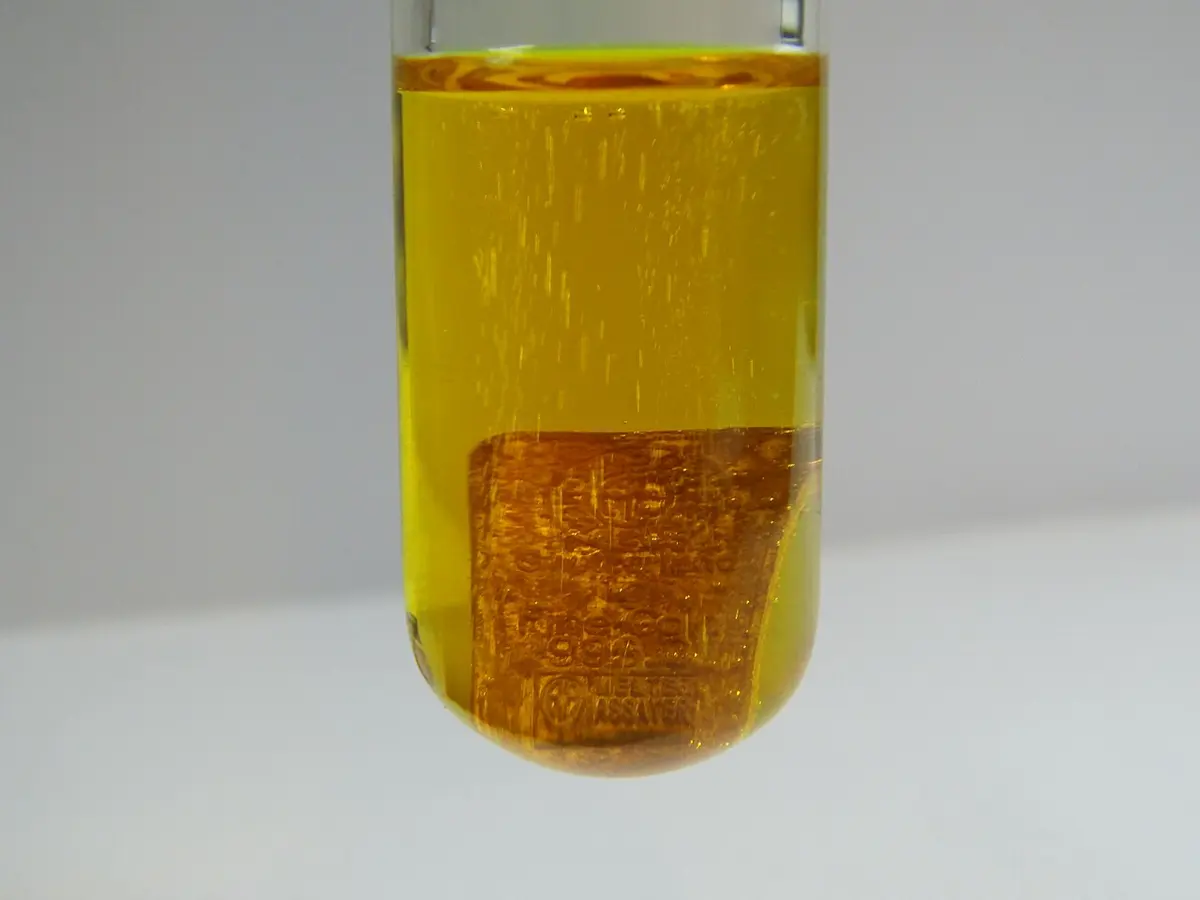
Silver doesn’t dissolve in aqua regia, although it dissolves in nitric acid alone: the silver chloride it forms is insoluble, and coats the silver with a white skin that stops the reaction.
Which of these metals gives no hydrogen with dilute sulphuric acid, but dissolves in dilute nitric acid?
Pick an answer to see why.
Aqua regia is a mixture of:
Pick an answer to see why.
Exercise
1. Choose the correct option
a. The main ore from which iron is extracted is:
Pick an answer to see why.
b. The flux used in the extraction of iron is:
Pick an answer to see why.
c. The hottest part of the blast furnace is the:
Pick an answer to see why.
d. Which form of iron has the least carbon?
Pick an answer to see why.
e. Which metal reacts with dilute hydrochloric acid to give hydrogen?
Pick an answer to see why.
f. When copper reacts with dilute nitric acid, the gas given off is:
Pick an answer to see why.
g. Which metal does not dissolve in aqua regia?
Pick an answer to see why.
2. Give reasons
All ores are minerals, but all minerals are not ores.
Hint
Answer
The ore of iron is calcined before it is put in the blast furnace.
Hint
Answer
Limestone is added to the charge of a blast furnace.
Hint
Answer
Coke is used in the blast furnace.
Hint
Answer
Aluminium seems not to react with dilute hydrochloric acid at first, though it is above hydrogen in the reactivity series.
Hint
Answer
Nitric acid does not give hydrogen with most metals.
Hint
Answer
Gold dissolves in aqua regia but not in nitric acid alone.
Hint
Answer
3. Differentiate between
Roasting and calcination
Hint
Answer
Cast iron and steel
Hint
Answer
Action of dilute sulphuric acid and dilute nitric acid on copper
Hint
Answer
4. Answer the following questions
What is metallurgy? Describe its main steps briefly.
Hint
Answer
Draw a labeled diagram of a blast furnace showing its zones.
Hint
Answer
Describe the reactions that take place in the different zones of a blast furnace, with equations.
Hint
Answer
Write the physical properties and two uses each of iron, copper, aluminium, silver and gold.
Hint
Answer
How do copper, silver and iron react with dilute nitric acid? Write the equations. Why are brown fumes seen at the mouth of the test tube?
Hint
Answer
What is aqua regia? How does it react with gold?
Hint
Answer
5. Numerical problems
5.6 g of iron filings are added to excess dilute hydrochloric acid. (i) What mass of hydrogen is given off? (ii) What volume does it occupy at STP? (Fe = 56, H = 1)
Hint
Answer
Which gives more hydrogen at STP with excess dilute sulphuric acid: 2.7 g of aluminium or 5.6 g of iron? Show your working. (Al = 27, Fe = 56)
Hint
Answer
19.05 g of copper dissolves completely in dilute nitric acid. What volume of nitric oxide is formed at STP? (Cu = 63.5)
Hint
Answer
A gold bangle has a mass of 23.3 g and a volume of 1.30 cm³. Is it pure gold? (density of pure gold 19.3 g/cm³)
Hint
Answer
Printable PDFs
- The unit as a book (A5) 22 pages Answers as an A4 booklet, 6 sheets
- Study notes 2 pages
- Worksheet 5 pages Answer key
- Harder practice questions 3 pages Answer key
Practice every question in the book, and keep track of the ones you miss →
Found a mistake? Please tell us.