
Sit at a dal bhat lunch and count the non-metals on your plate. The water in the dal is hydrogen and oxygen. The rice is carbon, hydrogen and oxygen; the dal’s protein adds nitrogen and a little sulphur; the salt is half chlorine; the bones of the chicken (and your own) are full of phosphorus. Every breath you take is four-fifths nitrogen and one-fifth oxygen. The metals get the attention, gold and iron and copper, but you are made almost entirely of the handful of elements at the top right of the periodic table, plus hydrogen.
This unit takes those non-metals one at a time. Hydrogen comes first: its odd atomic and “newborn” forms, its three isotopes, heavy water, and why it might fuel the buses of the future. Then oxygen and the oxides it makes with almost every element, hydrogen peroxide, and ozone, the thin shield that a few refrigerator gases nearly destroyed. Nitrogen follows: why the gas is so lazy, and its two hard-working compounds, ammonia and nitric acid. Then the halogens, the fiercest non-metals of all, and their acids; carbon in its many forms, from diamond to the soot on a lamp; phosphorus and the fishy-smelling gas phosphine; and last sulphur, with hydrogen sulphide, sulphur dioxide and sulphuric acid, the “king of chemicals”. Each element ends with its own exercise.
9.1 Hydrogen
Hydrogen is the first element of the periodic table, atomic number 1: one proton and one electron, the simplest atom there is. Its configuration, 1s¹, is like the alkali metals’ ns¹, so it is placed at the top of group 1.
Hydrogen gas is made of diatomic molecules, H₂ (dihydrogen). It is colorless, odorless and tasteless, the lightest of all gases, barely soluble in water, and it burns in air with a pale blue, almost invisible flame.
The position of hydrogen
Where does hydrogen belong? It has some properties of the alkali metals (group 1) and some of the halogens (group 17), and some of its own:
| Like the alkali metals | Like the halogens |
|---|---|
| one electron in its outer shell, ns¹ | one electron short of a noble gas’s configuration (He), like ns²np⁵ |
| loses it to form a positive ion, H⁺ (in acids, as H₃O⁺) | gains one to form a negative ion, H⁻ (hydride, in NaH, CaH₂) |
| a +1 oxidation state, in HCl, H₂O | diatomic molecules, H₂ like Cl₂, and a gas |
| a reducing agent, like Na | forms covalent compounds with non-metals (CH₄ like CCl₄) |
But hydrogen is not a metal, its ionization energy (1312 kJ/mol) is far higher than sodium’s (496 kJ/mol), its H⁺ ion is a bare proton that never exists alone in solution, and its electron affinity is far lower than a halogen’s. So it fits neither group well, and its position is still argued over. Most tables put it at the top of group 1 because of its electronic configuration; some put it in both places, or float it above the table on its own.
9.1.1 Chemistry of atomic and nascent hydrogen
Atomic (active) hydrogen
The bond in H₂ is strong: 436 kJ is needed to split one mole of it into atoms. That is why hydrogen gas is not very reactive at room temperature. Supply that energy, though, and the molecules fall apart.
When hydrogen gas at low pressure is passed through an electric arc struck between two tungsten electrodes, the arc’s heat (several thousand degrees) splits the molecules into free atoms:
This is atomic hydrogen: free hydrogen atoms, each with one unpaired electron. It can be made in a gas stream and studied, but it lasts only a moment (its half-life in the arc’s gas is about a third of a second), because the atoms quickly pair up again. As they do, all the energy that split them comes back as heat:
If the stream of atoms is blown onto a metal surface, the atoms recombine on the metal and the surface gets fiercely hot, around 4000 °C, hotter than an oxy-acetylene flame. That is the atomic hydrogen torch, invented by the American chemist Irving Langmuir in the 1920s for welding and cutting metals. The hydrogen around the weld also keeps oxygen away, so the hot metal doesn’t oxidize.
Free atoms don’t have to break a bond before they react, so atomic hydrogen is very reactive, far more than H₂, and a strong reducing agent: it reduces many metal oxides, chlorides and sulphides to the metal even at room temperature, for example those of iron, copper, silver and mercury.
Uses of atomic hydrogen: as a strong reducing agent; and for welding metals, in the atomic hydrogen torch.
Nascent hydrogen
Nascent means “newly born”. Nascent hydrogen is hydrogen that reacts at the moment it is produced, in the same mixture, at ordinary temperature: zinc and dilute acid, for example, in the presence of the substance to be reduced. It is written [H]. It can’t be isolated or stored: if nothing is there to react with it, it simply escapes as ordinary H₂.
Chemists say such a reactive species is made in situ (Latin for “in its place”): made right where it is needed, in the reaction mixture, because it is too unstable to be made first and added later.
So nascent hydrogen is a much more powerful reducing agent than molecular hydrogen. It reduces acidified potassium permanganate, acidified potassium dichromate and ferric chloride, none of which H₂ gas will touch at room temperature:
(In each, the [H] comes from zinc and dilute sulphuric acid in the same solution.)
Why should hydrogen be stronger “newborn”? The old explanation was that it is released as free atoms. A better one is that it isn’t really free hydrogen at all: the reaction is an electron transfer on the zinc’s surface, , and the electrons go straight to whatever can take them, with no strong H–H bond to break. The label [H] is a useful bookkeeping device for balancing such equations, and that is how it is used here.
Uses of nascent hydrogen: as a reducing agent, in the laboratory and in industry; to reduce substances that ordinary hydrogen can’t, such as nitrobenzene to aniline (Grade 12).
Why does acidified KMnO₄ lose its color with zinc in it, but not when hydrogen gas is bubbled through?
Pick an answer to see why.
9.1.2 Isotopes of hydrogen
Atoms of the same element (same atomic number) with different mass numbers are called isotopes. The difference in mass number comes from a different number of neutrons in the nucleus. Hydrogen has three isotopes found in nature, the only element whose isotopes have names of their own:
| Name of the isotope | Protium | Deuterium | Tritium |
|---|---|---|---|
| Symbol | ¹₁H or H | ²₁H or D | ³₁H or T |
| Common name | ordinary hydrogen | heavy hydrogen | radioactive hydrogen |
| Atomic number (protons, electrons) | 1 | 1 | 1 |
| Neutrons | 0 | 1 | 2 |
| Mass number | 1 | 2 | 3 |
| Atomic mass (amu) | 1.008 | 2.014 | 3.016 |
| Electronic configuration | 1s¹ | 1s¹ | 1s¹ |
| Molecular formula | H₂ | D₂ | T₂ |
| Stability | stable | stable | radioactive (half-life 12.3 years) |
Since their electronic configurations are the same, the three isotopes have the same chemical properties: D₂ burns to D₂O just as H₂ burns to H₂O. But their masses differ more than any other element’s isotopes (deuterium is twice as heavy as protium), so their physical properties differ noticeably: densities, boiling points, and the rates of their reactions. Bonds to deuterium break more slowly than bonds to protium, because the heavier atom vibrates more slowly. These differences caused by the difference in mass are called the isotope effect.
Tritium is radioactive because a nucleus of one proton and two neutrons has too many neutrons to be stable. One of its neutrons turns into a proton, giving out an electron (a β particle), and the tritium becomes helium-3:
Uses of protium (ordinary hydrogen): filling balloons for weather and toys (though helium, which doesn’t burn, is safer); hydrogenation of vegetable oils to make vanaspati ghee; making ammonia by Haber’s process; and as a rocket fuel, burned with liquid oxygen.
Uses of deuterium: as a tracer for studying how reactions happen (a D atom can be followed through a reaction because it is heavier); to make heavy water, D₂O, used as a moderator in some nuclear reactors; deuterated solvents such as CDCl₃ in proton NMR spectroscopy, because deuterium doesn’t show up in a proton spectrum; and as a fuel in nuclear fusion, in hydrogen bombs and in experimental fusion reactors.
Uses of tritium: as fuel, with deuterium, in nuclear fusion research and in thermonuclear weapons; as a radioactive tracer in chemistry, medicine and biology; and as the energy source of self-luminous lights in watch dials, exit signs and gun sights, where its weak β particles make a phosphor glow for years without a battery.

9.1.3 Application of hydrogen as a fuel
Hydrogen releases more energy for its mass than any other fuel: burning 1 g of hydrogen gives about 143 kJ, against about 50 kJ for 1 g of petrol or LPG, and its only product is water:
It can be burned in an engine, but it is used far better in a fuel cell, which turns the energy of this reaction directly into electricity, without burning. In a hydrogen–oxygen fuel cell, hydrogen gas is fed to one electrode and oxygen (or air) to the other, with a thin electrolyte between them.
At the anode (−), hydrogen loses electrons:
The protons cross the membrane, while the electrons flow through the outside wire, which is the current. At the cathode (+), oxygen takes them back:
Adding them gives the overall reaction, the same as burning: . A fuel cell turns about 40–60% of the reaction’s energy into electricity, against about 25–30% for a petrol engine. The first hydrogen fuel cell bus was shown by the Canadian company Ballard Power Systems in 1993; today fuel cell cars, buses, trucks, forklifts and trains run in Japan, Korea, Europe, China and the USA, and fuel cells have powered spacecraft since the 1960s (the Apollo astronauts drank the water theirs made). Many countries hope to move from a fossil fuel economy to a hydrogen economy.
Advantages of hydrogen as a fuel
- It gives the most energy for its mass of any fuel, and fuel cells use it efficiently.
- Its only product is water: no carbon dioxide (a greenhouse gas), no carbon monoxide, no smoke.
- Water, the raw material, is everywhere, and hydrogen made from it with renewable electricity (Nepal’s hydropower, for example) is a renewable, almost pollution-free fuel, often called green hydrogen.
- It can store surplus electricity: split water when power is cheap, use the hydrogen later.
Disadvantages of hydrogen as a fuel
- It is hard to produce cheaply: splitting water takes a lot of electricity, and most hydrogen made today comes from natural gas, which gives out CO₂.
- It is hard to store and transport: a very light gas, it must be compressed to about 700 atm or liquefied at −253 °C, and it leaks through tiny gaps and makes some metals brittle.
- It is very flammable and forms explosive mixtures with air over a wide range (4% to 75%), so it needs careful handling.
- Fuel cells are expensive, because they need catalysts such as platinum.
9.1.4 Heavy water and its applications
Heavy water, D₂O (deuterium oxide), is water whose hydrogen is deuterium. Its molecular mass is 20 against 18 for ordinary water, which is why it is called heavy water. It looks, smells and tastes like ordinary water (it isn’t radioactive), and its chemical reactions are the same, but slower, because of the isotope effect. Its physical properties differ:
| Property | H₂O | D₂O |
|---|---|---|
| Molecular mass | 18 | 20 |
| Density at 25 °C | 0.997 g/mL | 1.104 g/mL |
| Melting point | 0 °C | 3.8 °C |
| Boiling point | 100 °C | 101.4 °C |
| Temperature of maximum density | 4 °C | 11.2 °C |
Preparation. Heavy water is made by the prolonged electrolysis of water (with a little alkali to make it conduct). Ordinary hydrogen is released at the cathode a few times faster than deuterium, so as the water is split away, the water left behind grows richer and richer in D₂O. The process is slow: roughly 30,000 liters of water must be electrolyzed to get one liter of 99% D₂O. Today most heavy water is made more cheaply, by exchanging deuterium between water and hydrogen sulphide gas, then finishing by electrolysis or distillation.
Applications of heavy water
- As a moderator in nuclear reactors (such as Canada’s and India’s CANDU-type reactors): it slows down the fast neutrons released in fission so that they can split more uranium-235 nuclei, keeping the chain reaction going in a controlled way, while absorbing very few neutrons itself, so the reactor can run on natural uranium.
- As a coolant in the same reactors, carrying away the heat of fission.
- As a tracer compound, to study the mechanism of reactions and how water moves in living things.
- To make deuterium gas (D₂) and deuterium compounds: by electrolysis, or .
Project work
Exercise (9.1 Hydrogen)
A. Multiple choice questions
- Which of the following is a radioactive form of hydrogen?
Pick an answer to see why.
- Which of the following particles is emitted by tritium?
Pick an answer to see why.
- How many neutrons are there in protium?
Pick an answer to see why.
- Which one is the molecular formula of heavy water?
Pick an answer to see why.
- Which of the following is a use of heavy water?
Pick an answer to see why.
- Which of the following is true for hydrogen fuel?
Pick an answer to see why.
- When nascent hydrogen comes in contact with acidified KMnO₄ solution, which property does KMnO₄ show?
Pick an answer to see why.
- An atom X contains one proton and three neutrons. What is its electronic configuration?
Pick an answer to see why.
- Which of the following is true for nascent hydrogen?
Pick an answer to see why.
- Which of the following statements is true for isotopes?
Pick an answer to see why.
B. Short answer questions
Hydrogen exists in three isotopic forms.
- a.Define isotope.
- b.What are the isotopes of hydrogen?
- c.List one use of each isotope of hydrogen.
- d.Which isotope of hydrogen is radioactive?
Answer
Differentiate between:
- a.deuterium and tritium
- b.nascent hydrogen and atomic hydrogen
- c.ordinary water and heavy water
Answer
“Hydrogen fuel can serve as an alternative to petroleum.” Justify the statement.
Answer
What is heavy water? Write any four applications of heavy water.
Answer
What is nascent hydrogen? Give any three chemical reactions to show that nascent hydrogen is a more powerful reducing agent than molecular hydrogen.
Answer
Mention an important use of each of the following:
a. atomic hydrogen b. heavy hydrogen c. nascent hydrogen d. heavy water e. tritium
Answer
What do you mean by isotopes? Give the main characteristics of isotopes.
Answer
C. Long answer questions
H₂, H and [H] are three different forms of hydrogen. Discuss their properties under these headings:
a. production b. reactivity c. stability d. reducing power
Answer
Some cars use hydrogen–oxygen fuel cells as an alternative source of energy.
- a.Discuss the major advantages of this fuel cell over other cells.
- b.What are the limitations of this fuel?
Answer
Complete the information about the isotopes of hydrogen in the table.
| Isotope of hydrogen | Number of neutrons | Atomic mass | Uses |
|---|---|---|---|
| Protium | |||
| 2 | |||
| 2 |
Answer
Match the items in column I with the relevant items in column II.
| Column I | Column II |
|---|---|
| a.Heavy water is used in | i.dihydrogen |
| b.Atomic hydrogen | ii.acidified KMnO₄ |
| c.Electrolysis of water produces | iii.nuclear reactors |
| d.Nascent hydrogen reduces | iv.recombines on a metal surface to produce a high temperature |
| e.Zn and dilute H₂SO₄ react to produce | v.hydrogen and oxygen |
Answer
Atomic hydrogen combines with almost all elements, but molecular hydrogen does not. Explain.
Answer
How do normal water and heavy water differ? Write their applications.
Answer
9.2 Oxygen
9.2.1 Allotropes of oxygen
Diamond and graphite are both pure carbon: they burn to the same carbon dioxide, so they are chemically the same element, yet diamond is the hardest natural substance and graphite is soft enough to write with. Such forms are called allotropes. The word allotropy comes from the Greek allos, “other”, and tropos, “way” or “form”.
Allotropy is the existence of an element in two or more forms that differ in their physical properties but have the same chemical properties, because they are made of the same atoms arranged differently.
Oxygen shows allotropy too:
| Element | Allotropes |
|---|---|
| Oxygen | dioxygen (O₂), ozone or trioxygen (O₃), tetraoxygen (O₄), octaoxygen (O₈, “red oxygen”, made under huge pressure) |
The two familiar ones are dioxygen, O₂, called simply oxygen, and trioxygen, O₃, called ozone. Their properties compare like this:
| Oxygen (O₂) | Ozone (O₃) |
|---|---|
| colorless, odorless gas | pale blue gas with a sharp, pungent smell |
| chemically less reactive | chemically far more reactive |
| a weaker oxidizing agent | a strong oxidizing agent |
| does not absorb the Sun’s UV-B and UV-C between 200 and 320 nm (it absorbs only below about 240 nm) | absorbs ultraviolet rays strongly |
| a more stable molecule | a less stable molecule (it slowly turns back into O₂) |
| liquefies at −183 °C | liquefies at −112 °C |
9.2.2 Oxygen
| Element | Oxygen |
|---|---|
| Symbol | O |
| Atomic number | 8 |
| Atomic mass | 16 amu |
| Molecular formula | O₂ |
| Electronic configuration | 1s² 2s² 2p⁴ |
| Group | 16 |
| Period | 2nd |
| Block | p-block |
| Isotopes | ¹⁶₈O (99.76%), ¹⁷₈O (0.04%), ¹⁸₈O (0.20%) |
Oxygen is the most abundant element in the Earth’s crust, about 46.5% of it by mass, almost all combined in silicates, oxides and carbonates. It makes up about 21% of the atmosphere by volume and 88.8% of water by mass. In the universe as a whole it is the third most abundant element, after hydrogen and helium. Read more on its own page: oxygen.
Oxides
When carbon burns in air, carbon dioxide forms; potassium, sodium, phosphorus, zinc and almost every other element also combine with oxygen. Oxides are binary compounds of oxygen with another element. Na₂O, K₂O, SO₂, P₂O₅, ZnO, SiO₂, Al₂O₃, H₂O₂ and Cl₂O₇ are all oxides. (Compounds of oxygen with fluorine, such as OF₂, are not oxides but fluorides, because fluorine is more electronegative than oxygen; in OF₂, oxygen has the oxidation state +2.)
Types of oxides
1. Classification of oxides by their chemical behavior
By how they behave towards acids and bases, oxides are of four types.
i. Acidic oxides form acids when they dissolve in water, and react with bases to give a salt and water. They are mostly oxides of non-metals, and also of metals in high oxidation states (CrO₃, Mn₂O₇, V₂O₅). An acidic oxide is called the anhydride (“without water”) of its acid. Examples: CO₂, SO₂, SO₃, NO₂, N₂O₃, N₂O₅, P₂O₅, SiO₂, ClO₂, Cl₂O₇, CrO₃, V₂O₅.
| With water: an acid | With a base: a salt and water |
|---|---|
| (carbonic acid) | |
| (sulphurous acid) | |
| (phosphoric acid) | |
| (nitric acid) | |
| (chromic acid) |
(Silica, SiO₂, doesn’t dissolve in water, but it is still acidic: it reacts with hot concentrated alkalis and fused sodium carbonate, giving silicates.)
ii. Basic oxides form alkalis (soluble bases) when they dissolve in water, and react with acids to give a salt and water. They are oxides of metals:
- the oxides of group 1 (the alkali metals) and of group 2 except beryllium: Li₂O, Na₂O, K₂O, MgO, CaO, BaO. They dissolve in water (MgO only slightly);
- the oxides of d-block metals in their lower oxidation states, such as FeO, MnO, CuO and Ag₂O. These hardly dissolve in water, but still react with acids.
| With water | With an acid: a salt and water |
|---|---|
| (sodium hydroxide) | |
| (calcium hydroxide) | |
| (barium hydroxide) | |
| FeO: insoluble | |
| CuO: insoluble |
iii. Neutral oxides are neither acidic nor basic: they react with neither acids nor bases. Examples: N₂O, NO, CO, and water, H₂O. (Water is a special case: it is the neutral liquid in which the others show their acid or base nature, and on its own it can act as a very weak acid or base.)
iv. Amphoteric oxides
Amphoteric oxides (from the Greek amphoteros, “both”) show the properties of both acids and bases: they react with acids and with bases, giving a salt and water each time. Examples: ZnO, PbO, SnO, Al₂O₃, Ga₂O₃, Cr₂O₃, BeO. They are oxides of the metals near the metalloid line.
Across period 3, the oxides go Na₂O, MgO, Al₂O₃, SiO₂, P₄O₁₀, SO₃, Cl₂O₇. How does their character change?
Pick an answer to see why.
2. Classification of oxides by their oxygen content
i. Peroxides contain the peroxide ion, O₂²⁻ (an –O–O– unit), in which oxygen has the oxidation state −1. Examples: Na₂O₂, Li₂O₂, BaO₂, and H₂O₂ itself. Peroxides react with dilute acids to give hydrogen peroxide:
Alkali metals form peroxides of the type M₂O₂ (Na₂O₂) and alkaline earth metals of the type MO₂ (BaO₂, SrO₂), M being the metal.
ii. Superoxides contain the superoxide ion, O₂⁻, in which each oxygen has the oxidation state −½. The larger alkali metals form them when they burn in air: (potassium superoxide; rubidium and cesium do the same).
iii. Mixed oxides (compound oxides) behave as a combination of two simpler oxides of the same element in different oxidation states. Examples: Fe₃O₄, Mn₃O₄, Pb₃O₄. Fe₃O₄ (magnetite) behaves as FeO·Fe₂O₃: with dilute hydrochloric acid it gives both iron(II) chloride and iron(III) chloride.
In the same way Pb₃O₄ behaves as 2PbO·PbO₂: with dilute nitric acid the PbO part dissolves as lead nitrate and the PbO₂ part is left as a brown solid.
(N₂O₄ is sometimes listed here too, since it gives two acids, but it is a single molecule, O₂N–NO₂, with both nitrogens at +4, not two oxides combined: it is a mixed anhydride, not a mixed oxide.)
9.2.3 Hydrogen peroxide
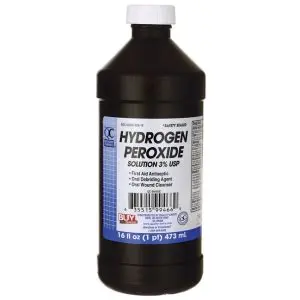
Hydrogen peroxide, H₂O₂, is the commonest peroxide. Pure H₂O₂ is a pale blue liquid, a little more viscous than water (and denser, 1.45 g/mL). It is sold as a solution in water. Its strength is often given as a “volume”: “20 volume” H₂O₂ is a solution of which 1 mL gives 20 mL of oxygen gas at STP when it decomposes, which is about 6%.
It decomposes slowly into water and oxygen, faster in light, when warmed, or with a catalyst such as manganese dioxide or the enzyme catalase in blood:
That is the fizz you see when it is poured on a cut: catalase in the blood splits it, and the oxygen froths up.
Handling hydrogen peroxide. Hydrogen peroxide is a strong oxidizing and bleaching agent, and concentrated solutions are dangerous. So:
- concentrate or distill it only below its boiling point, under reduced pressure;
- store it in a dark (opaque) bottle in a cool place, away from flammable substances: light and heat speed up its decomposition, and the oxygen it releases can feed a fire;
- in the laboratory, work with it in a chemical fume hood wherever possible;
- avoid contact with the body: it is corrosive to the skin and eyes, and its mist irritates the lungs.
Applications of hydrogen peroxide
- as a bleaching agent, for delicate materials such as silk, wool, hair, ivory and paper pulp, which chlorine would damage;
- as a mild antiseptic, for cleaning wounds;
- as an oxidizing agent in many reactions;
- in wastewater treatment, to remove organic impurities;
- to sterilize surgical instruments and medical equipment;
- to soften and clean earwax;
- as a rocket propellant (concentrated, 85–98%);
- in tooth-whitening gels and mouthwashes;
- to make organic peroxides, used to start polymerization in plastics making;
- to treat acne (in creams, often as benzoyl peroxide).
9.2.4 Medical and industrial applications of oxygen
When a person’s lungs can’t take in enough oxygen on their own, they need oxygen therapy, which helps every organ and tissue keep working and helps the body recover. The highly pure oxygen used in hospitals, about 99% (or at least 93% from the oxygen plants and concentrators many hospitals now run), checked for impurities, is medical oxygen. Oxygen used for burning fuels and making gases in industry need not be so pure, and isn’t tested in the same way: that is industrial oxygen. Industrial cylinders shouldn’t be used for patients.
Medical applications of oxygen
- life support for patients on artificial ventilators;
- treating respiratory distress syndrome (RDS) in newborn babies;
- an antidote for carbon monoxide poisoning: breathing pure oxygen pushes CO off the blood’s hemoglobin about five times faster than air does;
- treating diseases such as chronic obstructive pulmonary disease (COPD), pulmonary embolism, heart attack and pneumonia;
- for climbers and for altitude sickness, and in pressure chambers for divers;
- (in every one of us) aerobic respiration by the cells, which oxidize the food we eat to release energy.
Industrial applications of oxygen
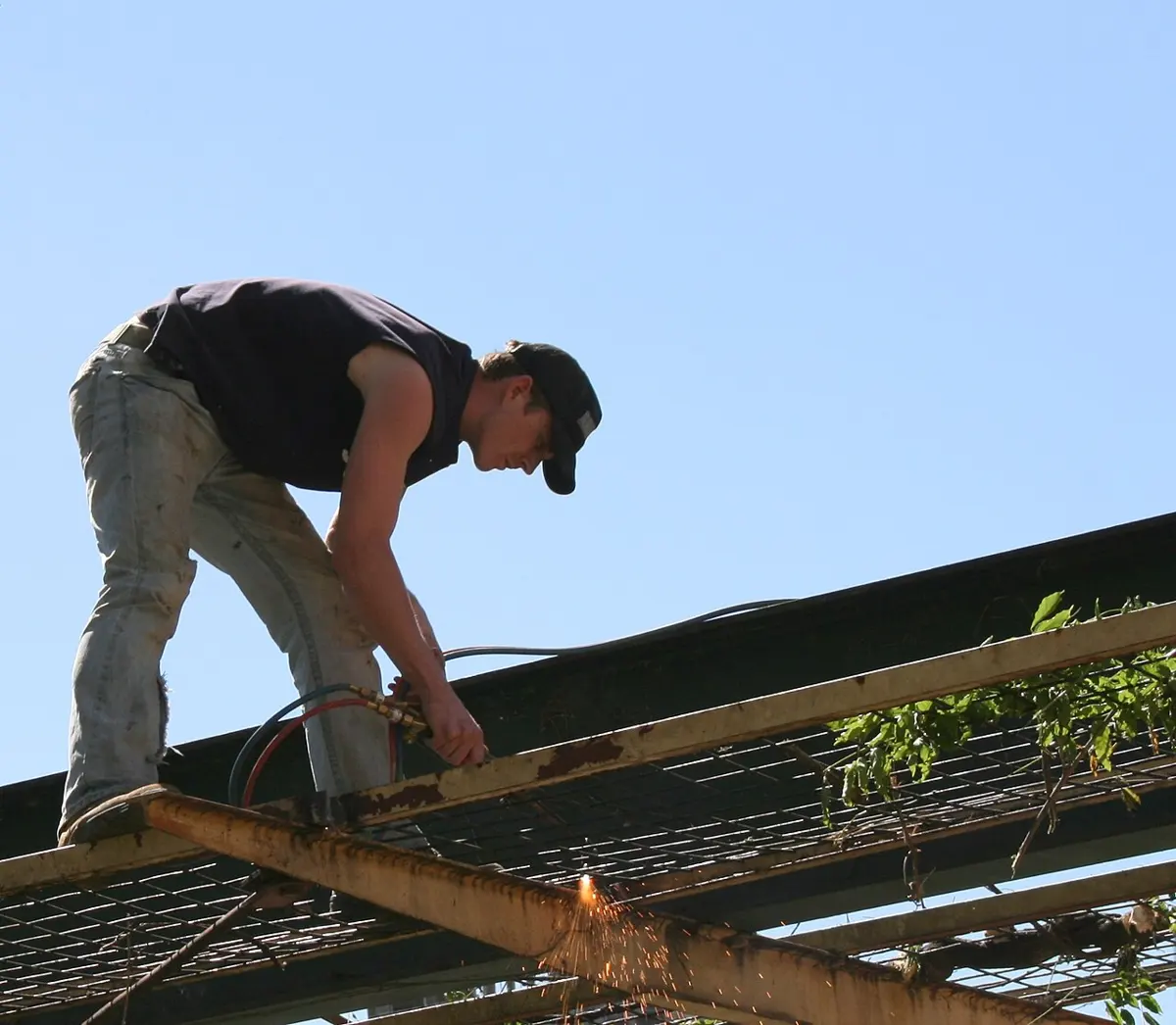
- with fuel gases (acetylene) in gas welding and cutting, and in flame cleaning, hardening and straightening of metals;
- in steelmaking, blown through molten iron to burn off carbon;
- in sewage treatment and water purification, to help bacteria break down waste;
- to bleach wood pulp for high-quality paper;
- as liquid oxygen, the oxidizer that burns the fuel of rockets and missiles;
- in hydrogen fuel cells, to produce electricity.
Project work
Exercise (9.2 Oxygen)
A. Multiple choice questions
- What is the correct electronic configuration of an element in group 16 and the 2nd period?
Pick an answer to see why.
- Which block of the periodic table does oxygen belong to?
Pick an answer to see why.
- Which of the following is not an oxide?
Pick an answer to see why.
- Pick out the amphoteric oxide.
Pick an answer to see why.
- Which of the following is an acidic oxide?
Pick an answer to see why.
- How much oxygen is present in the atmosphere, by volume?
Pick an answer to see why.
- What forms when alkaline earth metals react with oxygen?
Pick an answer to see why.
- In a peroxide the oxidation state of oxygen is −1. Which of the following is a peroxide?
Pick an answer to see why.
- Choose the mixed oxide.
Pick an answer to see why.
- Which two forms of oxygen are found in the atmosphere?
Pick an answer to see why.
- Which of the following is a neutral oxide?
Pick an answer to see why.
- Which of the following group 2 elements does not form a basic oxide?
Pick an answer to see why.
- Pick out the most strongly acidic oxide.
Pick an answer to see why.
- Which of the following is true about hydrogen peroxide?
Pick an answer to see why.
- Which of the following acts as an antidote for carbon monoxide poisoning?
Pick an answer to see why.
B. Short answer questions
Define the terms:
a. allotropy b. superoxide c. mixed oxide d. basic oxide e. neutral oxide
Answer
Give reasons:
- a.N₂O₅ is an acidic oxide whereas NO is neutral.
- b.OCl₂ is an oxide whereas OF₂ is not.
- c.100% oxygen is harmful to breathe.
- d.H₂O is a neutral oxide whereas H₂O₂ is a peroxide.
- e.CO₂ is an acidic oxide whereas Na₂O is a basic oxide.
Answer
List some medical and industrial applications of oxygen.
Answer
What are oxides? Classify the following oxides into acidic, basic, neutral (and amphoteric), giving reasons: ZnO, Fe₃O₄, Al₂O₃, CuO, NO, CaO.
Answer
Write a note on:
- a.oxides and their types
- b.hydrogen peroxide and its applications
Answer
Differentiate between:
- a.a peroxide and a superoxide
- b.an acidic oxide and a basic oxide
Answer
C. Long answer questions
Oxygen is the third most abundant element in the universe, and it readily forms oxides with other elements. Some are: SO₃, ZnO, CO, K₂O.
- a.Identify the acidic, basic, amphoteric and neutral oxides, with justification.
- b.Give two examples of peroxides.
Answer
Two allotropes of the same element are shown in Figure 9.8 and Figure 9.9.
- a.Why are they called allotropes?
- b.Write any two differences in their physical properties.
- c.Name the shape of the O₃ molecule.
Answer
The table shows the highest oxides of the elements of groups 1 to 17.
| 1 | 2 | 13 | 14 | 15 | 16 | 17 | |
|---|---|---|---|---|---|---|---|
| Period 2 | Li₂O | BeO | B₂O₃ | CO₂ | N₂O₅ | ||
| Period 3 | Na₂O | MgO | Al₂O₃ | SiO₂ | P₄O₁₀ | SO₃ | Cl₂O₇ |
| Period 4 | K₂O | CaO | Ga₂O₃ | GeO₂ | As₂O₅ | SeO₃ | Br₂O₅ |
| Period 5 | Rb₂O | SrO | In₂O₃ | SnO₂ | Sb₂O₅ | TeO₃ | I₂O₅ |
| Period 6 | Cs₂O | BaO | Tl₂O₃ | PbO₂ | Bi₂O₅ | PoO₃ |
The acidic character increases from left to right across a period, and the basic character increases down a group.
- a.Identify any two acidic, two basic and two amphoteric oxides from the table.
- b.Write chemical reactions to prove that ZnO is amphoteric.
- c.Give a reason why Na₂O is called a basic oxide.
- d.Name the most basic and the most acidic oxide in the table.
Answer
Write all the possible oxides of the following elements and classify them with reasons: a. N b. H c. C d. K e. Ba f. B
Answer
X and Y are two series of oxides:
X: SO₃, SiO₂, Cl₂O₇, P₂O₅
Y: Al₂O₃, CuO, Na₂O, MgO
- a.Which series is acidic and which is basic?
- b.Arrange the oxides of each series in order of increasing acidic or basic strength, with reasons.
Answer
9.3 Ozone
After dioxygen, the next most common allotrope of oxygen is ozone, O₃, also called trioxygen: a pale blue gas with a sharp smell (its name is from the Greek ozein, “to smell”). You can smell it near a photocopier, or in the air after a lightning storm.
9.3.1 Occurrence of ozone
Ozone occurs naturally in the stratosphere, mostly between about 15 and 35 km up, where it shields the Earth from the Sun’s harmful ultraviolet rays. It is formed there by the Sun’s own ultraviolet light: UV of wavelength below 240 nm splits oxygen molecules into atoms, and each atom joins another O₂ molecule.
Ozone is also split by ultraviolet light, , and that is how it shields us: each time an ozone molecule absorbs a UV photon, that photon’s energy is turned into heat in the stratosphere instead of reaching the ground. Made and unmade like this over and over, the ozone stays at a steady level, and the stratosphere is warm (it is why the temperature rises with height there).
9.3.2 Preparation of ozone from oxygen
In the laboratory, ozone is made by passing a silent electric discharge (a high-voltage discharge without sparks) through pure, dry oxygen in an apparatus called Siemens’ ozonizer. It has two coaxial glass tubes, the inner one coated with tin foil on its inside and the outer one coated on its outside; the two foils are joined to the terminals of an induction coil. Dry oxygen flows slowly through the narrow space between the tubes, and the discharge turns about 5–10% of it into ozone. The gas that comes out is ozonized oxygen.
The reaction is endothermic and reversible: ozone has more energy than the oxygen it is made from, and sparks or heat would decompose it again. That is why the discharge must be silent, the apparatus is kept cool, and the oxygen must be dry (moisture would carry the discharge as sparks).
Why does Siemens’ ozonizer use a silent discharge and not sparks?
Pick an answer to see why.
9.3.3 Structure of ozone
Electron diffraction and microwave spectroscopy show that ozone is indeed bent (V-shaped), with a bond angle of 116.8°. Both its O–O bonds are the same length, 127.8 pm (1.278 Å), between the length of an O–O single bond (148 pm, in H₂O₂) and an O=O double bond (121 pm, in O₂). No single Lewis structure shows this: ozone is a resonance hybrid of two structures, each with the double bond on a different side. The real molecule is neither: each bond is “one and a half” bonds, and each end oxygen carries half a negative charge.
9.3.4 Tests for ozone
a. The starch-iodide test. Ozone liberates iodine from potassium iodide solution, and the iodine turns starch blue-black:
So a filter paper soaked in starch and potassium iodide turns blue-black in ozone. (Chlorine and other oxidizing gases do the same, so this test shows an oxidizing gas; the next one is more particular to ozone.)
b. The tailing of mercury. Pure mercury in a glass vessel rolls about in bright beads with a curved surface (meniscus). When ozone is passed over it, the mercury loses its meniscus and sticks to the glass, leaving a smear or tail as it moves. This is because a thin film of mercurous oxide forms on it:
Shaking it with water removes the oxide and the mercury rolls again.
9.3.5 Ozone layer depletion
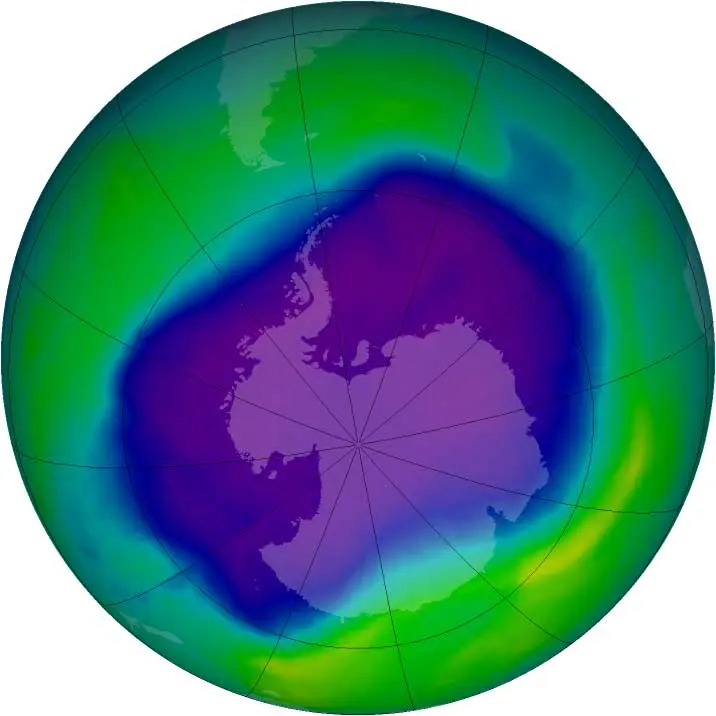
The thinning of the ozone layer was discovered in 1985 by Joe Farman, Brian Gardiner and Jonathan Shanklin of the British Antarctic Survey, from measurements made at Halley station in Antarctica, and confirmed by NASA’s satellite data, which showed the hole covering the whole continent. It returns every spring over Antarctica, and a smaller thinning happens over the Arctic.
The ozone layer is the region of the stratosphere, about 15–35 km above the Earth’s surface, with the highest concentration of ozone. It covers the whole planet and protects life by absorbing most of the Sun’s harmful ultraviolet rays. Its gradual thinning, caused by chlorine- and bromine-containing compounds released by people, is called ozone layer depletion. The compounds that destroy ozone are called ozone-depleting substances (ODS); they come from industry and from everyday products.
The main ODS are the chlorofluorocarbons, CFCs: methane and ethane with all their hydrogen atoms replaced by chlorine and fluorine, sold under the trade name Freons. Examples:
| Freon | Formula | Name |
|---|---|---|
| Freon-11 | CCl₃F | trichlorofluoromethane |
| Freon-12 | CCl₂F₂ | dichlorodifluoromethane |
| Freon-13 | CClF₃ | chlorotrifluoromethane |
| Freon-112 | C₂Cl₄F₂ | 1,1,2,2-tetrachloro-1,2-difluoroethane |
Freons are extremely stable: unreactive, non-flammable and non-toxic, and they are easily liquefied by pressure at room temperature. These properties made them ideal refrigerants in refrigerators and air conditioners, propellants in spray cans, and blowing agents for plastic foams (Freon-11). But their stability is also what makes them dangerous: nothing in the lower air breaks them down, so over years they drift up into the stratosphere.
Mechanism of ozone layer depletion. In the stratosphere the CFCs meet strong ultraviolet light, which breaks a C–Cl bond and sets free a chlorine atom (a free radical, Cl•):
The chlorine atom takes an oxygen atom from an ozone molecule, and the chlorine monoxide formed gives it to a free oxygen atom, setting the chlorine free again:
Steps (ii) and (iii) repeat over and over, and their sum is : ozone is destroyed and the chlorine is not used up. It is a catalyst. One chlorine atom can destroy about 100,000 ozone molecules before it is finally locked away, for example as HCl.
Why over Antarctica? In the dark polar winter the stratosphere there gets cold enough (below about −78 °C) for thin polar stratospheric clouds of ice crystals to form. On their surfaces, chlorine locked up in harmless compounds (HCl, ClONO₂) is turned into Cl₂. When the Sun returns in spring, its light splits the Cl₂ into atoms, and the ozone goes very fast. (Most of the Antarctic loss actually runs through a second cycle in which two ClO join as Cl₂O₂ and are split by sunlight; the result is the same.)
Effects of ozone layer depletion. With less ozone, more UV-B reaches the ground:
- in people and animals: more sunburn, skin cancer (including the deadly melanoma), cataracts (clouding of the eye’s lens), faster aging of the skin, and a weaker immune system;
- in plants: slower growth, less flowering and photosynthesis, and lower crop yields;
- in water: damage to plankton, fish larvae and the rest of the pond and ocean ecosystems that depend on them;
- overall, a disturbance of ecological balance, and faster breakdown of plastics and paints outdoors.
Nepal is especially exposed: UV rises by roughly 10% for every 1,000 m of height, so in the hills and mountains, and on snow, which reflects most of it back, sunburn and snow blindness come quickly.
Control measures for ozone layer depletion
- stop or reduce the use of ozone-depleting substances, replacing CFCs in refrigerators and air conditioners with substitutes that contain no chlorine (HFCs, and now hydrocarbons and ammonia);
- dispose of old refrigerators and air conditioners properly, so their gas is collected, not released;
- avoid cleaning products and solvents that contain chlorine or bromine compounds, and use eco-friendly ones;
- governments should make and enforce rules against ODS, as the Montreal Protocol requires (Nepal bans the import of CFCs);
- raise public awareness of the chemicals that harm the ozone layer.
(Cutting vehicle emissions helps the climate and city air, but car exhaust isn’t a major cause of ozone depletion. And though both are sometimes lumped together, the ozone hole and global warming are different problems: CFCs, though, are also strong greenhouse gases, so the Montreal Protocol has helped the climate too.)
9.3.6 Uses of ozone
- to sterilize surgical instruments and medical equipment;
- to purify water (in place of chlorine) and air in crowded closed places such as cinema halls, tunnels and shopping malls (in carefully controlled amounts, since ozone itself harms the lungs);
- as a bleaching agent, for oils, ivory, flour, starch and textiles;
- in preserving food and raw materials, by killing bacteria and molds in cold stores;
- as an oxidizing agent and catalyst in industrial processes;
- in preparing organic compounds such as aldehydes and ketones, by ozonolysis of alkenes (Grade 12).
Project work
Exercise (9.3 Ozone)
A. Multiple choice questions
- In which layer of the atmosphere is ozone mostly found?
Pick an answer to see why.
- Which gas is detected by the starch-iodide test?
Pick an answer to see why.
- What happens when ozone-depleting substances are released into the atmosphere?
Pick an answer to see why.
- Ozone depletion causes which of these diseases?
Pick an answer to see why.
- Which of the following synthetic chemicals is responsible for ozone layer depletion?
Pick an answer to see why.
- Ozone is a triatomic form of oxygen. Which relationship do O₂ and O₃ show?
Pick an answer to see why.
- Which of the following is used in the artificial preparation of ozone?
Pick an answer to see why.
- Which of the following statements about ozone is true?
Pick an answer to see why.
- Between what heights is the ozone layer most concentrated?
Pick an answer to see why.
- In which region are ozone holes mainly found?
Pick an answer to see why.
- When was the ozone hole first discovered?
Pick an answer to see why.
- Which of the following is a Freon?
Pick an answer to see why.
- Where was the ozone hole first discovered?
Pick an answer to see why.
- What is the formula of Freon-11?
Pick an answer to see why.
- Which of the following elements is not found in a CFC molecule?
Pick an answer to see why.
- What type of chemical substances are regulated by the Montreal Protocol?
Pick an answer to see why.
B. Short answer questions
Define the terms:
a. Freons b. allotropy c. ozone layer d. ODS
Answer
What is ozone? Write its importance. How would you prepare ozone artificially?
Answer
Differentiate between:
- a.Freon-12 and Freon-21
- b.dioxygen and trioxygen
Answer
Write any four ozone-depleting substances (ODS).
Answer
What is the main risk from the extra UV rays that reach the ground because of ozone layer depletion?
Answer
How does ozone block the UV rays coming from the Sun?
Answer
“Is ozone a greenhouse gas?” Give your opinion.
Answer
Write a note on:
- a.the mechanism of ozone layer depletion
- b.preventive measures of ozone layer depletion
Answer
Write the effects and control measures of ozone layer depletion.
Answer
C. Long answer questions
Oxygen is the third most abundant element in the universe. Its allotropes are O₂ and O₃.
- a.Draw the resonance structures of the ozone molecule.
- b.Why are both O–O bond lengths in ozone equal?
- c.Write any two chemicals responsible for destroying the ozone layer.
- d.What happens when ozone gas is passed through a starch-iodide solution?
Answer
Study Figure 9.14 and answer:
- a.What does the picture show?
- b.Write the structure of ozone.
- c.In which layer of the atmosphere is the ozone layer?
- d.What happens when UV rays are not blocked by the ozone layer?
- e.Is ozone a greenhouse gas?
Answer
9.4 Nitrogen
| Element | Nitrogen |
|---|---|
| Symbol | N |
| Atomic number | 7 |
| Atomic mass | 14.007 amu |
| Molecular formula | N₂ |
| Electronic configuration | 1s² 2s² 2p³ |
| Group | 15 |
| Period | 2nd |
| Block | p-block |
| Valency | 3 |
Nitrogen is a non-metal: a colorless, odorless, tasteless gas. The Earth’s atmosphere is 78% nitrogen by volume and about 75.5% by mass. It is in every protein and every strand of DNA, yet most living things can’t use the gas directly: it must first be “fixed” into ammonia or nitrates, by bacteria in the roots of beans and lentils, by lightning, or in fertilizer factories. Read more on its own page: nitrogen.
9.4.1 Reason for the inertness of nitrogen
An electric bulb with a tungsten filament would burn out at once in air, because the white-hot tungsten combines with oxygen. So old filament bulbs were filled with an unreactive gas, argon with some nitrogen. Nitrogen isn’t a noble gas, so why is it used?
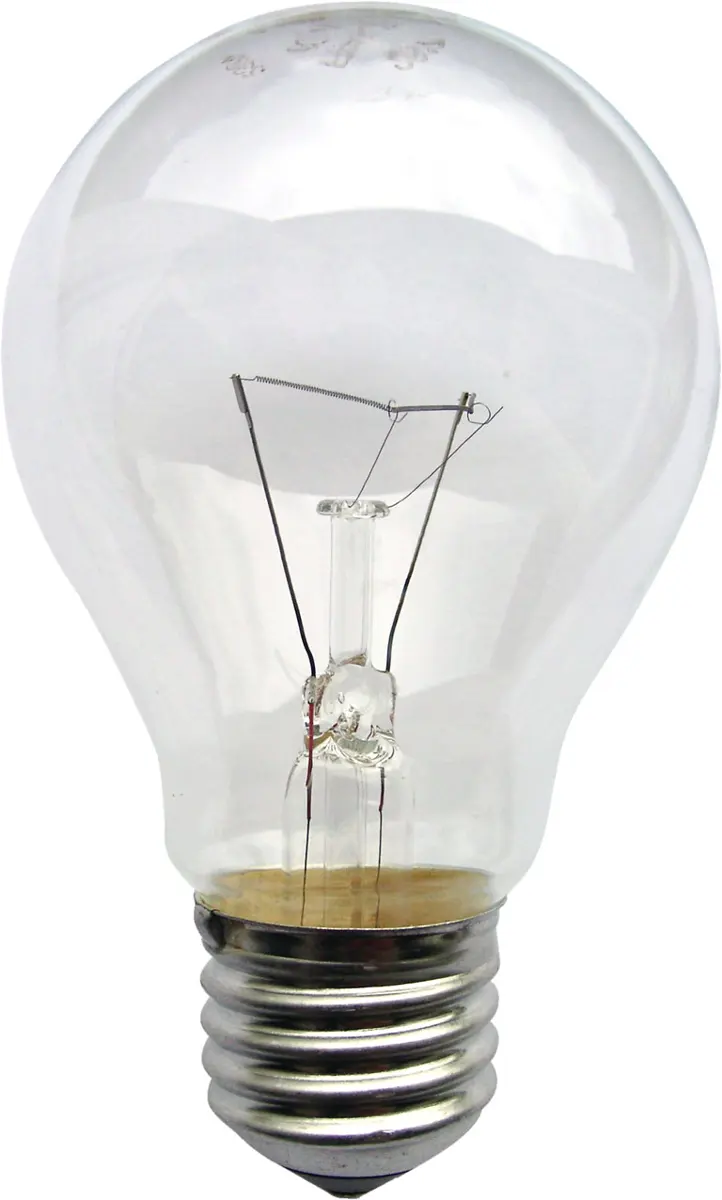
Because N₂ is inert (unreactive) at ordinary temperatures. Its two atoms are held by a triple bond, N≡N, with a bond energy of 946 kJ/mol, far stronger than most bonds. Before nitrogen can react, this bond must be broken, and that needs a lot of energy. The small size of the nitrogen atoms makes the bond short and strong, and the molecule has no polarity and no easy point of attack. So N₂ reacts only at high temperatures, with a catalyst, or with very reactive substances: with magnesium and lithium (giving nitrides, ), with hydrogen in the Haber process, and with oxygen in lightning or a car engine ().
Its inertness is also what makes it useful: nitrogen fills packets of crisps and chips (so they don’t go stale and aren’t crushed), blankets reactive chemicals in factories, and as a liquid at −196 °C keeps blood, sperm and cells frozen for years.
Active nitrogen
Late in the nineteenth century chemists noticed, and in 1911 the English physicist Robert Strutt (later the fourth Lord Rayleigh) studied fully, a strange form of nitrogen. When an electric discharge is passed through nitrogen at very low pressure, the gas glows a brilliant golden yellow, and the glow lasts for several seconds after the discharge is switched off. The nitrogen coming out is far more reactive than ordinary nitrogen: it combines at room temperature with metals such as mercury and zinc, with phosphorus and sulphur, and with nitric oxide. This form is called active nitrogen.
It is a mixture of free nitrogen atoms, made when the discharge splits N₂, with excited nitrogen molecules. The golden glow is light given out as the atoms join again into excited N₂ molecules, which then drop to their normal state. Active nitrogen is to N₂ what atomic hydrogen is to H₂. Today chemists also use other “sources of active nitrogen” for making nitrogen compounds: excited molecules, nitrous oxide, and solids such as graphitic carbon nitride (g-C₃N₄).
9.4.2 Ammonia
Ammonia, NH₃, is a colorless gas with a sharp, pungent smell. It occurs naturally, from rotting plant and animal matter and in animal urine (the sharp smell of a cowshed), and is also made on a vast scale, about 180 million tonnes a year, by the Haber process (; see Unit 8, Haber’s process, and its full plant in Unit 17). It exists in all three states: gas, NH₃(g); liquid, NH₃(l), below −33 °C; and solid, NH₃(s), below −78 °C.
Chemical properties of ammonia
1. Action with copper sulphate solution: forming a complex. When ammonia is passed into blue copper sulphate solution, a pale blue precipitate of copper(II) hydroxide forms first. With more ammonia it dissolves again, giving a deep blue solution of tetraamminecopper(II) sulphate:
The deep blue copper–ammonia solution (made from copper hydroxide and ammonia) is called Schweizer’s reagent. It dissolves cellulose, and was once used to make artificial silk (cuprammonium rayon) from cotton and wood pulp. Here ammonia is a complexing agent: its lone pair bonds to the Cu²⁺ ion (a coordinate bond, Unit 5).
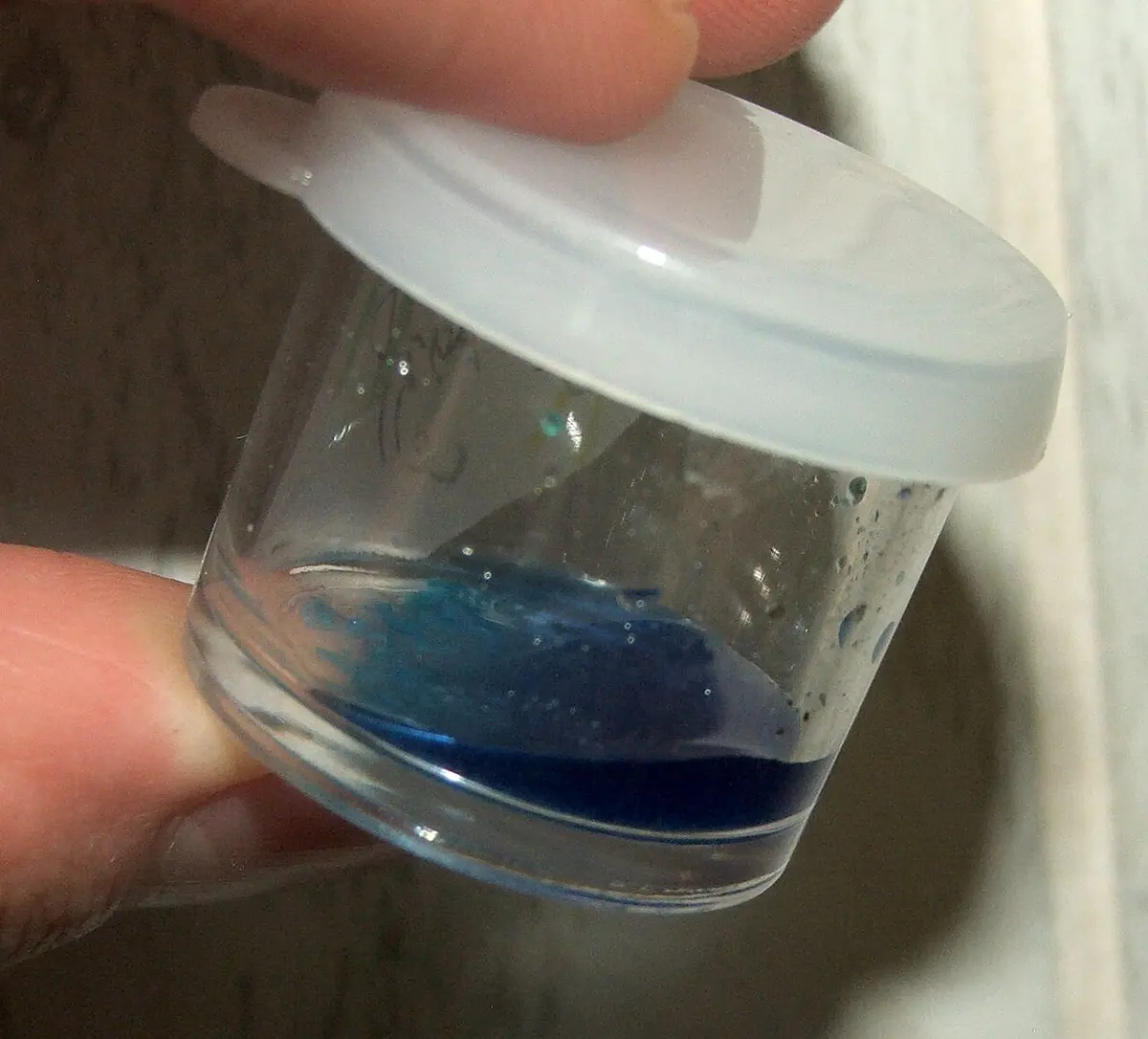
2. Action with water: a weak base. Ammonia dissolves in water to give aqueous ammonia, also called ammonium hydroxide or liquor ammonia. A small fraction of it takes a proton from water, giving hydroxide ions, so the solution is a weak base: it turns red litmus blue and phenolphthalein pink.
(There is no real molecule NH₄OH: the solution is NH₃ molecules surrounded by water, with about 1 in 250 of them turned into NH₄⁺ and OH⁻ at 0.1 M. “NH₄OH” is still a handy way to write it in equations.)
3. Action with ferric chloride: a precipitating agent. Aqueous ammonia precipitates many metal ions as their insoluble hydroxides, such as Fe³⁺, Al³⁺ and Cr³⁺ (used in group III of salt analysis). With ferric chloride solution, it gives a reddish brown precipitate of ferric hydroxide:
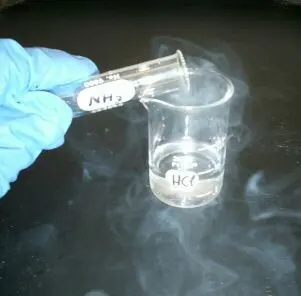
4. Action with concentrated hydrochloric acid. Hold a glass rod dipped in concentrated hydrochloric acid near the mouth of a jar of ammonia: dense white fumes of ammonium chloride form, tiny crystals of the salt in the air. This is the standard test for ammonia (or for HCl).
5. Action with mercurous nitrate paper. A filter paper soaked in mercurous nitrate solution turns black in ammonia. The black is a mixture of finely divided mercury (black) and white mercury(II) amidonitrate (“basic mercuric amido nitrate”):
This is another test for ammonia: no other common gas turns mercurous nitrate paper black.
6. Action with oxygen: ammonia as a reducing agent. Ammonia doesn’t burn in air, but in pure oxygen it burns with a pale yellowish-green flame, giving nitrogen and water vapor:
Here oxygen is reduced (0 → −2, to water) and ammonia is oxidized (its nitrogen −3 → 0, to N₂): ammonia acts as a reducing agent. It also reduces hot copper oxide to copper, .
With a hot platinum catalyst at about 850 °C, ammonia and oxygen give nitric oxide instead:
This catalytic oxidation of ammonia is the first step of Ostwald’s process for making nitric acid on a large scale: the nitric oxide is then oxidized to NO₂ (), and the NO₂ absorbed in water with more air (). The plant itself is in Unit 17.
In , what happens to ammonia?
Pick an answer to see why.
9.4.3 Applications of ammonia
Ammonia is a building block for many products used every day:
- to make urea, the commonest fertilizer, (Figure 9.25), and other nitrogen fertilizers such as ammonium sulphate, ammonium nitrate and diammonium phosphate (DAP); about 70% of all ammonia goes into fertilizers;
- to make nitric acid (Ostwald’s process), and from it explosives, nylon and other fibers, plastics and dyes;
- as a laboratory reagent;
- in making washing soda, Na₂CO₃, by the Solvay process;
- in household cleaners (dilute ammonia solution), to remove oil and grease from glass and kitchens;
- as a reagent in the qualitative analysis of salts;
- as a refrigerant, in ice plants and large cold stores.
9.4.4 Harmful effects of ammonia
Ammonia is one of the most widely produced chemicals in the world. It is also made in our own bodies (the liver turns it into urea) and forms wherever plants, animals and their wastes rot. It is irritating, pungent, corrosive and toxic. Its harmful effects:
- exposure causes coughing, nausea, dizziness and skin irritation;
- its corrosive vapor causes immediate burning of the eyes, nose, throat and lungs; strong exposure can blind, and can cause pneumonia-like swelling of the lungs and ulcers of the airways;
- too much ammonia in the blood (as in liver or kidney failure) damages the brain;
- exposure of pregnant women to high levels may harm the unborn child;
- even small amounts in water (about 1 mg/L) kill fish and other aquatic life, so leaks from fertilizer plants, farms and sewage are dangerous to rivers;
- in the air, ammonia from fertilizer and livestock combines with other pollutants to form tiny particles of ammonium salts (PM2.5), a large part of the winter haze over the Indo-Gangetic plain and Nepal’s Terai.
Safe handling: work with ammonia in a well-ventilated room or fume cupboard, wear goggles and gloves, never mix ammonia cleaners with bleach (they form toxic chloramine gases), and wash any splash at once with plenty of water.
9.4.5 Oxyacids of nitrogen
An oxyacid (oxoacid, or ternary acid) is an acid that contains oxygen, with at least one hydrogen bonded to an oxygen atom, and at least one other element, usually a non-metal such as S, N or P (H–O–X). Its acidic hydrogen is the one on oxygen: it leaves as H⁺. How strong the acid is depends on the electronegativity and the oxidation state of the central atom. Nitrogen forms several oxyacids:
| S. N. | Oxyacid of nitrogen | Molecular formula | Oxidation state of N | Nature |
|---|---|---|---|---|
| 1. | Hyponitrous acid | H₂N₂O₂ | +1 | white solid, unstable, explosive when dry; a weak acid |
| 2. | Nitrous acid | HNO₂ | +3 | known only in cold, dilute solution; unstable; a weak acid; both an oxidizing and a reducing agent |
| 3. | Nitric acid | HNO₃ | +5 | colorless fuming liquid; stable; a strong acid and a strong oxidizing agent |
| 4. | Pernitric acid (peroxynitric acid) | HNO₄ | +5 | unstable, explosive; contains an –O–O– link; an oxidizing agent |
(In pernitric acid, HO–O–NO₂, the extra oxygen is a peroxide oxygen, so nitrogen stays at +5, not +7.)
Nitric acid
The most commonly used oxyacid of nitrogen is nitric acid, HNO₃, a highly corrosive mineral acid, with nitrogen at +5. The alchemists called it aqua fortis, “strong water”, because it dissolves silver and copper, though not gold.
9.4.6 Chemical properties of nitric acid
1. Nitric acid as an acid. Nitric acid is a strong acid: in water it ionizes completely, giving hydrogen ions.
Its acidic nature can be shown in these ways:
a. It turns blue litmus red, the yellow of methyl orange to red, and pink phenolphthalein (in an alkali) colorless.
b. It reacts with bases, basic oxides and carbonates to form nitrates:
c. Unlike other acids, nitric acid generally does not give hydrogen with metals: the nitrate ion is a stronger oxidizing agent than H⁺, so any hydrogen formed is oxidized at once to water, and the acid itself is reduced. The exceptions are magnesium and manganese, which give hydrogen with very dilute (about 1–2%) nitric acid in the cold:
2. Nitric acid as an oxidizing agent. In HNO₃ nitrogen is at +5, its highest oxidation state. It can only be lowered, so nitric acid is a strong oxidizing agent: it oxidizes most metals, many non-metals and many compounds. As it does, it is itself reduced, to one of several products:
| Product | NO₂ | NO | N₂O | N₂ | NH₄⁺ (as NH₄NO₃) |
|---|---|---|---|---|---|
| Oxidation state of N | +4 | +2 | +1 | 0 | −3 |
| Usually from | concentrated acid | moderately concentrated acid | dilute acid | dilute acid (some metals) | very dilute acid, with active metals |
The more concentrated the acid, the smaller the change in nitrogen’s oxidation state; the more dilute the acid and the more reactive the metal, the further the nitrogen is reduced.
A. Oxidation of metals
Most metals, except the noble metals platinum, gold, iridium and rhodium, react with nitric acid to give the metal nitrate, water and an oxide of nitrogen (or ammonium nitrate). Which product forms depends on three things:
- the nature of the metal (how electropositive it is);
- the concentration of the nitric acid;
- the temperature.
To balance these equations, it helps to split each into two steps. There are two ways to do it, which give the same final equations; both are used here, as in most Nepali books.
Metals more electropositive than hydrogen (Mg, Mn, Zn, Fe and so on) are explained by the nascent hydrogen theory: the metal displaces hydrogen from the acid, and the nascent hydrogen at once reduces more acid.
a. Zinc
With hot, concentrated HNO₃, zinc gives nitrogen dioxide (N: +5 → +4):
With moderately concentrated HNO₃ (about 50%), it gives nitric oxide (+5 → +2):
With cold, dilute HNO₃ (about 20%), it gives nitrous oxide (+5 → +1):
With very dilute HNO₃ (about 5%), it gives ammonium nitrate (+5 → −3), and no gas at all:
b. Magnesium reacts with concentrated and moderately concentrated nitric acid just as zinc does:
But with very dilute nitric acid, magnesium gives hydrogen: it reacts so fast that some hydrogen escapes before the nitrate can oxidize it.
(These equations can also be balanced by the nascent oxygen method below; the final equations are the same.)
c. Iron
With concentrated nitric acid, iron becomes passive: a very thin, tight layer of oxide (written Fe₃O₄) forms on its surface and stops the reaction. This is called passivity, and such iron is passive iron: it no longer dissolves even in dilute acid, and no longer displaces copper from copper sulphate, until the layer is scratched off.
So, after the first instant: Fe + HNO₃ (concentrated) → no further reaction.
With moderately concentrated, hot HNO₃, iron gives ferric nitrate and nitrogen dioxide:
With cold, dilute HNO₃, it gives ferric nitrate and nitrous oxide:
With cold, very dilute HNO₃, it gives ferrous nitrate and ammonium nitrate:
Metals less electropositive than hydrogen (Cu, Bi, Hg, Ag) can’t displace hydrogen from acids at all. Their reactions are explained by the nascent oxygen theory: the acid decomposes to give nascent oxygen, which oxidizes the metal to its oxide, and the oxide then dissolves in more acid as a nitrate.
Copper
With concentrated HNO₃, copper gives cupric nitrate and brown nitrogen dioxide:
With cold, dilute (moderately concentrated, about 1 : 1) HNO₃, it gives nitric oxide, which turns brown at the mouth of the tube as it meets the air ():
Mercury and silver react with nitric acid in the same way:
Which metal gives hydrogen gas with very dilute nitric acid?
Pick an answer to see why.
B. Oxidation of non-metals
Solid non-metals such as carbon, sulphur, phosphorus and iodine are oxidized by hot, concentrated nitric acid to their highest oxyacids or oxides, with nitrogen dioxide and water.
i. Sulphur is oxidized to sulphuric acid:
ii. Carbon is oxidized to carbon dioxide (some of which dissolves in the water, as carbonic acid, ):
iii. Phosphorus is oxidized to phosphoric acid, and iodine to iodic acid:
C. Oxidation of reducing agents
Compounds that are reducing agents, such as hydrogen sulphide, sulphur dioxide, iodides and ferrous salts, are oxidized by nitric acid.
i. Sulphur dioxide is oxidized to sulphuric acid:
ii. Hydrogen sulphide is oxidized to yellow sulphur:
(With dilute nitric acid it gives NO instead: .)
iii. Potassium iodide gives violet iodine:
9.4.7 Ring test for the nitrate ion
The ring test (brown ring test) detects nitrate ions by the brown ring that forms between two layers of liquid. It works because nitrate (with acid) is an oxidizing agent. The sulphuric acid turns the nitrate into nitric acid at the junction; ferrous ions (Fe²⁺) reduce it to nitric oxide, NO, and are themselves oxidized to Fe³⁺. The nitric oxide then combines with more ferrous sulphate, giving the brown nitroso ferrous sulphate, FeSO₄·NO (the brown ion [Fe(H₂O)₅(NO)]²⁺).
Or, in ions: then
The ferrous sulphate must be freshly prepared: in air, Fe²⁺ is slowly oxidized to Fe³⁺, which can’t reduce the nitrate. (Nitrites give the brown color even with dilute acid, so they must be removed first if both may be present.)
Project work
Exercise (9.4 Nitrogen)
A. Multiple choice questions
- Why is N₂ relatively unreactive?
Pick an answer to see why.
- Which of the following is used as a refrigerant?
Pick an answer to see why.
- Why does ammonia have a higher melting and boiling point than the other hydrides of its group?
Pick an answer to see why.
- Which of the following combines with the Fe²⁺ ion to form a brown complex?
Pick an answer to see why.
- Pick out the metal that liberates hydrogen from very dilute HNO₃.
Pick an answer to see why.
- What product is expected when Zn is treated with very dilute nitric acid?
Pick an answer to see why.
- The passivity of iron is due to a thin surface layer of which substance?
Pick an answer to see why.
- What is the major product when P₄ reacts with concentrated HNO₃?
Pick an answer to see why.
- Which of the following describes ammonia?
Pick an answer to see why.
- What is the molecular formula of hyponitrous acid?
Pick an answer to see why.
- What is the role of ammonia in this reaction?
Pick an answer to see why.
- Which of the following chemicals is used in the brown ring test?
Pick an answer to see why.
- Identify X:
Pick an answer to see why.
- What is the reduction product of nitric acid when KI is treated with concentrated HNO₃?
Pick an answer to see why.
- Which of the following mixtures is aqua regia?
Pick an answer to see why.
- Pick out the formula of the brown ring that confirms the nitrate ion.
Pick an answer to see why.
- Which of these is the weakest base?
Pick an answer to see why.
B. Short answer questions
Give reasons:
- a.Ammonia turns moist red litmus paper blue.
- b.Concentrated nitric acid turns yellow-brown on long standing.
- c.Old electric bulbs were filled with nitrogen.
- d.Ammonia is highly soluble in water.
- e.Ammonia is a complexing agent.
Answer
Differentiate between:
- a.active nitrogen and molecular nitrogen
- b.ammonia and nitric acid
Answer
Give a few large-scale applications of ammonia.
Answer
Write your observation when ammonia gas is passed through or over:
- a.moist red litmus paper
- b.aqueous copper sulphate solution
- c.aqueous ferric chloride solution
- d.concentrated hydrochloric acid
- e.mercurous nitrate paper
Answer
Write a note on:
- a.the harmful effects of ammonia
- b.the ring test
- c.the oxidizing nature of nitric acid
- d.the basic nature of ammonia
Answer
What happens when:
- a.mercurous nitrate paper comes in contact with ammonia?
- b.very dilute nitric acid is poured on magnesium?
- c.hot, concentrated nitric acid comes in contact with copper?
- d.sulphur dioxide is treated with concentrated nitric acid?
- e.concentrated hydrochloric acid is brought near ammonia?
Answer
How does copper react with nitric acid under different conditions?
Answer
Give a reaction to show the acidic nature of nitric acid. How would you test for nitric acid in the laboratory? Give a balanced chemical equation.
Answer
In what way does dilute nitric acid differ from other acids when it reacts with metals?
Answer
Show your acquaintance with:
a. aqua fortis b. aqua regia
Answer
C. Long answer questions
Four test tubes (I–IV) each contain zinc and nitric acid under different conditions. Write the balanced equations when:
- a.I contains very hot, concentrated HNO₃;
- b.II contains moderately concentrated HNO₃;
- c.III contains cold, dilute HNO₃;
- d.IV contains cold, very dilute HNO₃.
Answer
Mention any three important uses of nitric acid, and the property of nitric acid involved in each.
Answer
- a.Dilute nitric acid is generally a typical acid, except in its reactions with metals. How does it differ from other mineral acids like H₂SO₄ and HCl when it reacts with metals?
- b.Write equations for the reactions of dilute and concentrated nitric acid with zinc.
Answer
- a.Explain the brown ring test for the nitrate ion, with balanced equations.
- b.Why is freshly prepared ferrous sulphate solution used in the test?
Answer
You are given an unknown acid. How would you show that it is nitric acid? Write the balanced equations. Draw the Lewis structure of nitric acid and write one use.
Answer
Complete the table.
| Species | HNO₃ | Gas produced | Reaction involved |
|---|---|---|---|
| Mg | very dilute | ||
| Zn | concentrated | ||
| Cu | concentrated | ||
| H₂S | dilute | ||
| C | hot, concentrated |
Answer
Study the flow chart and write balanced equations for the reactions X, Y and Z.
Mg₃N₂ ←(Z)– NH₃ –(X)→ NH₄Cl, and NH₄Cl –(Y)→ NH₃
Answer
Write the balanced equation for each of the following:
- a.adding ammonia solution to ferric chloride;
- b.adding excess ammonia to copper sulphate solution;
- c.adding ammonia to mercurous nitrate;
- d.adding phosphorus to hot, concentrated nitric acid;
- e.adding concentrated sulphuric acid and freshly prepared ferrous sulphate to nitric acid.
Answer
Complete the table.
| Metal / non-metal | Concentration and temperature of HNO₃ | Products |
|---|---|---|
| Zn | Zn(NO₃)₂ + NH₄NO₃ + H₂O | |
| moderately concentrated | Zn(NO₃)₂ + NO + H₂O | |
| Fe | very dilute | |
| Cu(NO₃)₂ + NO₂ + H₂O | ||
| Mg | very dilute | |
| Zn(NO₃)₂ + N₂O + H₂O | ||
| C | concentrated |
Answer
9.5 Halogens
Group 17 (VIIA) of the periodic table holds fluorine, chlorine, bromine, iodine and astatine. They react readily with metals to form a wide range of salts, such as calcium fluoride (CaF₂), sodium chloride (NaCl), potassium iodide (KI) and silver bromide (AgBr), which is why they are called halogens. Each element has its own page: fluorine, chlorine, bromine, iodine, astatine.
| Element | Symbol | Atomic number | Atomic mass (amu) | Electronic configuration |
|---|---|---|---|---|
| Fluorine | F | 9 | 19.0 | [He] 2s² 2p⁵ |
| Chlorine | Cl | 17 | 35.5 | [Ne] 3s² 3p⁵ |
| Bromine | Br | 35 | 79.9 | [Ar] 3d¹⁰ 4s² 4p⁵ |
| Iodine | I | 53 | 126.9 | [Kr] 4d¹⁰ 5s² 5p⁵ |
| Astatine | At | 85 | (210) | [Xe] 4f¹⁴ 5d¹⁰ 6s² 6p⁵ |
(Astatine has no stable isotope; 210 is the mass number of its longest-lived one, with a half-life of 8.1 hours. There is probably less than 30 g of astatine in the whole Earth’s crust at any time.)
Halogens are very reactive non-metals, because of their high electronegativity and electron affinity. So they are never found free in nature, only combined:
| Halogen | Sources |
|---|---|
| Fluorine | fluorspar or fluorite (CaF₂), cryolite (Na₃AlF₆), fluorapatite (3Ca₃(PO₄)₂·CaF₂) |
| Chlorine | sea water and rock salt (NaCl), sylvine (KCl), carnallite (KCl·MgCl₂·6H₂O), horn silver (AgCl) |
| Bromine | sea water and salt lakes (the Dead Sea), as NaBr, KBr, MgBr₂, CaBr₂ |
| Iodine | seaweeds such as kelp; Chile saltpeter, which contains sodium iodate (NaIO₃); brines from oil and gas wells |
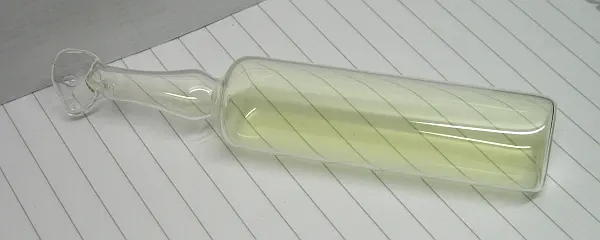
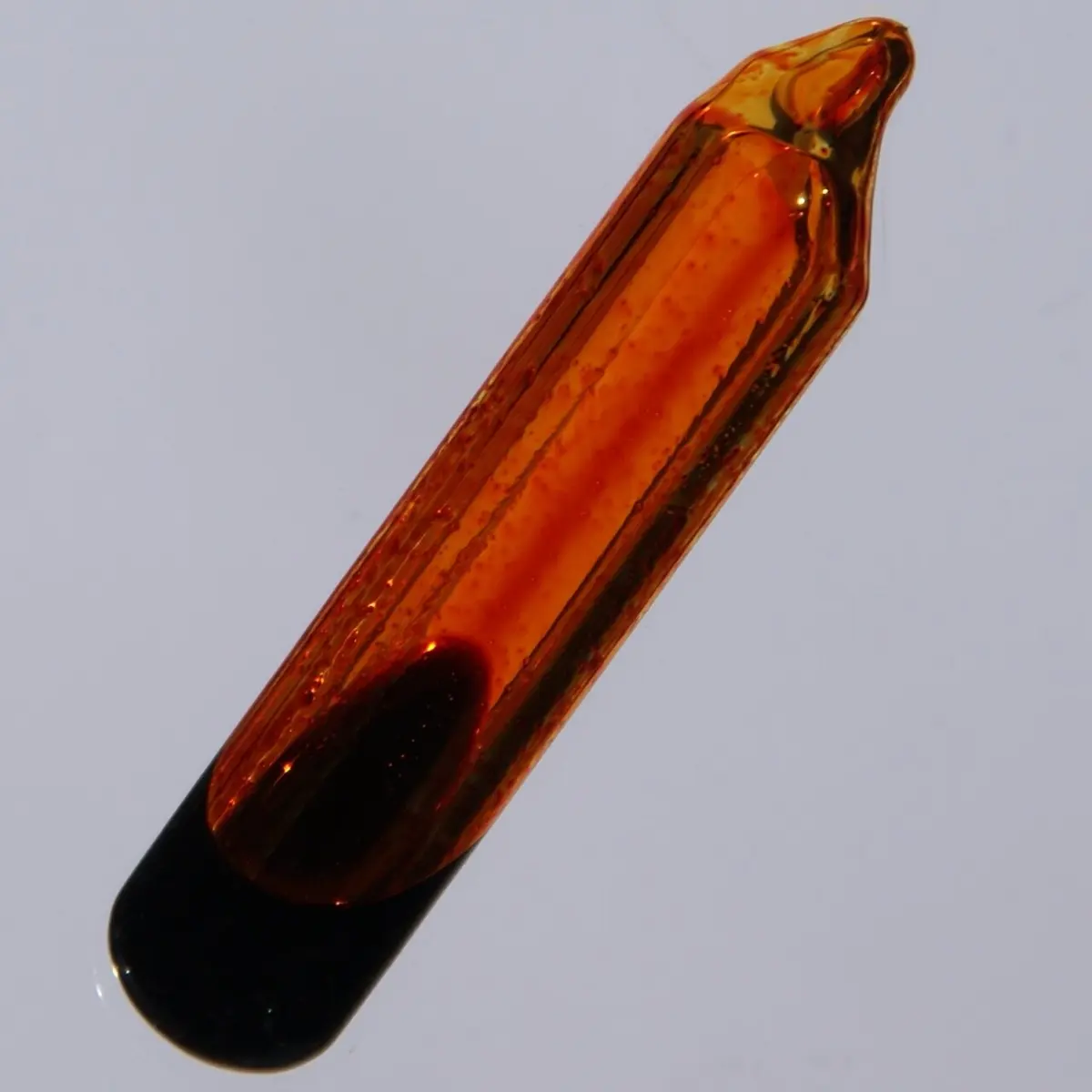
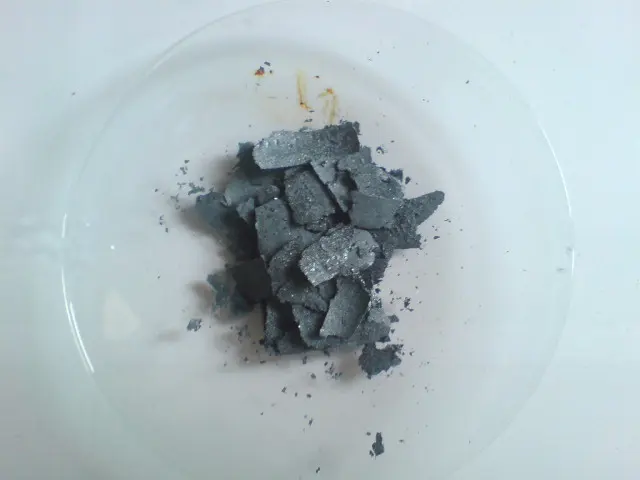
At room temperature fluorine is a pale yellow gas, chlorine a greenish-yellow gas, bromine a dark red-brown liquid giving off red-brown vapor, and iodine a shiny violet-black solid that gives a violet vapor when warmed.
9.5.1 General characteristics of halogens
1. Electronic configuration. Every halogen has seven electrons in its valence shell; the general valence shell configuration is ns² np⁵.
2. Atomicity. Halogens exist as non-polar diatomic molecules: F₂, Cl₂, Br₂, I₂, joined by a single covalent bond.
3. Electronegativity. Halogens have the highest electronegativity in their periods, because their atoms are the smallest in each period with the highest effective nuclear charge. Fluorine is the most electronegative element of all (4.0 on Pauling’s scale). Electronegativity decreases down the group: F (4.0) > Cl (3.2) > Br (3.0) > I (2.7).
4. Electron affinity. Halogens have very high electron affinities: by gaining one electron, each reaches a noble gas configuration. The electron affinity generally decreases down the group, but chlorine’s is higher than fluorine’s: Cl (349 kJ/mol) > F (328) > Br (325) > I (295). Fluorine’s small, crowded 2p subshell already holds seven electrons close together, so an incoming electron is pushed away by them (inter-electronic repulsion) more than in chlorine’s larger 3p subshell.
5. Oxidation states. All halogens show the oxidation state −1. Fluorine shows only −1 (and 0 in F₂): it is the most electronegative element, so it can never be the positive partner, and as a period 2 element it has no d orbitals to expand its octet. The other halogens have vacant d orbitals in their valence shells, so their paired electrons can be unpaired into them and they can also show positive oxidation states, +1, +3, +5 and +7, when combined with more electronegative oxygen or fluorine.
| Halogen | Oxidation states |
|---|---|
| Fluorine | −1 |
| Chlorine | −1, +1, +3, +5, +7 (also +4 and +6 in ClO₂ and Cl₂O₆) |
| Bromine | −1, +1, +3, +5, +7 (also +4 in BrO₂) |
| Iodine | −1, +1, +3, +5, +7 |
6. Ionization energy. Halogens have very high ionization energies, since they have very little tendency to lose electrons: fluorine’s, 1681 kJ/mol, is higher than every other element’s except helium’s and neon’s. It decreases down the group as the atoms get bigger.
7. Atomic radius. Halogens have the smallest atomic radii in their periods (after the noble gases), because of their high effective nuclear charge. The radius increases down the group, as does the radius of the ions: F⁻ < Cl⁻ < Br⁻ < I⁻.
8. Oxidizing nature. Halogens are powerful oxidizing agents, because they gain electrons so readily. Fluorine is the strongest oxidizing agent of all the elements. The oxidizing power decreases down the group: F₂ > Cl₂ > Br₂ > I₂.
9. Non-metallic character. Halogens are typical non-metals, because of their high electronegativity and ionization energy. The non-metallic character decreases down the group: iodine has a metallic luster, and astatine is probably a metalloid.
10. Melting and boiling points. Both rise from fluorine to iodine, F₂ < Cl₂ < Br₂ < I₂, because the bigger molecules, with more electrons, attract each other with stronger van der Waals (London) forces. So at room temperature fluorine and chlorine are gases, bromine is a liquid (one of only two liquid elements, with mercury) and iodine is a solid.
| F₂ | Cl₂ | Br₂ | I₂ | |
|---|---|---|---|---|
| State at room temperature | gas | gas | liquid | solid |
| Color | pale yellow | greenish yellow | red-brown | violet-black (violet vapor) |
| Melting point (°C) | −220 | −101 | −7 | 114 |
| Boiling point (°C) | −188 | −34 | 59 | 184 |
| X–X bond energy (kJ/mol) | 159 | 243 | 193 | 151 |
11. Reactivity. Halogens are the most reactive non-metals, because they so readily take an electron to reach a noble gas configuration. Fluorine is the most reactive element known: it attacks glass, and even the noble gas xenon. Its reactivity is helped by its weak F–F bond (159 kJ/mol: the lone pairs on the two small, close atoms repel each other), which is easy to break.
9.5.2 Comparative study of the preparation of halogens
1. By chemical oxidation of halides. Chlorine, bromine and iodine (not fluorine) can be made by oxidizing their halides (or hydrogen halides) with strong oxidizing agents such as MnO₂, KMnO₄ or K₂Cr₂O₇. With manganese dioxide and a haloacid HX:
Instead of the haloacid, a mixture of a halide salt and concentrated sulphuric acid can be used with MnO₂:
So, for each halogen:
The reaction is the same for all three, but each is collected differently: chlorine as a gas, in an upright jar; bromine, distilled off as a red-brown vapor and condensed to a liquid in a cooled receiver; iodine, as violet vapor that sublimes onto a cold surface as crystals.
With potassium permanganate, chlorine comes off even without heating:
2. By displacement. A more reactive halogen displaces a less reactive one from its halide. Chlorine oxidizes bromide ions to bromine (this is how bromine is extracted from sea water and the Dead Sea’s brines):
Chlorine and bromine both oxidize iodide ions to iodine:
Fluorine can’t be made by either method: no oxidizing agent is stronger than fluorine itself, and no halogen can displace it from a fluoride. It is made by electrolysis of potassium hydrogen fluoride (KHF₂) dissolved in liquid hydrogen fluoride, in a steel or copper cell, with fluorine released at the anode.
Which pair will react?
Pick an answer to see why.
9.5.3 Chemical properties of halogens
All the halogens are very reactive non-metals, because their molecules have low bond dissociation energies and their atoms high electronegativities and electron affinities. Fluorine is the most reactive element; the reactivity of the halogens follows the order F₂ > Cl₂ > Br₂ > I₂. The important properties of Cl₂, Br₂ and I₂ follow.
1. Action with water. Chlorine, bromine and (very slightly) iodine dissolve in water and react with it, giving two acids, a hydrohalic acid and a hypohalous acid:
The hypohalous acid is unstable and decomposes in light, giving oxygen and the hydrohalic acid:
(Fluorine is different: it oxidizes water itself, releasing oxygen, .)
Iodine is only very slightly soluble in water, but it dissolves well in potassium iodide solution, because it forms the triiodide ion:
Chlorine dissolved in water is called chlorine water: a pale greenish-yellow solution. Left standing in light, it loses its color, as its chlorine turns to HCl and HOCl and the HOCl decomposes to HCl and oxygen; old chlorine water is just dilute hydrochloric acid. Chlorine (or a compound that gives HOCl) is added to swimming pools and drinking water because the hypochlorous acid kills bacteria, viruses and parasites.
2. Action with alkalis. Halogens react with sodium or potassium hydroxide in two ways, depending on the conditions.
i. With cold, dilute alkali: a metal halide and a metal hypohalite form.
(sodium chloride and sodium hypochlorite). Bromine reacts in the same way. Sodium hypochlorite solution is the household bleach sold in shops.
ii. With hot, concentrated alkali: a metal halide and a metal halate form, because hypohalite breaks up when hot into halate and halide:
(sodium chloride and sodium chlorate). Bromine and iodine react the same way, giving bromates and iodates. Sodium chlorate is used as a weedkiller, and potassium chlorate in matches and fireworks.
In both reactions some chlorine atoms are oxidized (0 → +1 or +5) and others reduced (0 → −1): the same element is oxidized and reduced at once. Such a reaction is called disproportionation (Unit 6).
3. Action with ammonia. Chlorine and bromine oxidize ammonia. With excess ammonia, nitrogen gas forms (the HCl made reacts with more ammonia, giving white fumes of ammonium chloride):
With excess halogen, a nitrogen trihalide forms instead:
Nitrogen trichloride is a yellow, oily, dangerously explosive liquid. Iodine with ammonia gives a dark brown solid, the ammonia adduct of nitrogen triiodide, with ammonium iodide:
4. Oxidizing character. All the halogens are good oxidizing agents, because they readily accept electrons. Their oxidizing power follows F₂ > Cl₂ > Br₂ > I₂. In water, chlorine and bromine oxidize many substances; their reactions can be pictured as giving nascent oxygen from the hypohalous acid formed:
i. With hydrogen sulphide: H₂S is oxidized to yellow sulphur by all halogens.
Bromine and iodine react the same way.
ii. With sulphur dioxide: SO₂ is oxidized to sulphuric acid.
Bromine and iodine react the same way.
iii. With ferrous salts: ferrous salts (pale green) are oxidized to ferric salts (yellow-brown).
(or simply ). Bromine does the same; iodine is too weak an oxidizer to do it.
iv. With sodium thiosulphate (hypo): chlorine and bromine oxidize sodium thiosulphate to sodium sulphate, with sulphur:
But iodine, a milder oxidizer, oxidizes it only to sodium tetrathionate, Na₂S₄O₆, and its brown color disappears:
This quick, exact reaction is used to measure iodine in iodometric titrations, with starch as the indicator.
5. Bleaching action
The halogens, being good oxidizing agents, can bleach by oxidation. Fluorine is too reactive: it destroys the material itself. Iodine is too weak a bleaching agent, and bromine is only a mild one; neither is generally used. Chlorine is the strong and useful bleach among the halogens. It bleaches only in the presence of moisture, through the nascent oxygen it releases:
Its bleaching is permanent, because the colored substance is oxidized and doesn’t change back. Chlorine is used to bleach cotton and linen textiles, wood pulp and paper. It is too harsh for delicate materials such as silk and wool, which are bleached with milder agents such as hydrogen peroxide or sulphur dioxide.
Uses of halogens
| S. N. | Cl₂ | Br₂ | I₂ |
|---|---|---|---|
| 1. | to bleach paper, pulp and cotton textiles | to make ethylene dibromide, once added to leaded petrol to scavenge lead (no longer, now that leaded petrol is banned almost everywhere), and as a soil fumigant | as an antiseptic: tincture of iodine, a solution of I₂ and KI in rectified spirit, disinfects wounds |
| 2. | as a disinfectant, for drinking water and swimming pools | to make some fungicides and pesticides | in iodized salt: the body needs traces of iodine to make thyroid hormones and prevent goiter |
| 3. | to make PVC (polyvinyl chloride), solvents and many other chemicals | to make flame retardants, dyes and pool sanitizers | silver iodide (AgI) for cloud seeding, to make artificial rain |
| 4. | in the extraction of gold (chlorination of ores, historically) and to make bleaching powder | its compound AgBr in photographic film | periodic acid (HIO₄) as an oxidizing agent in organic chemistry |
9.5.4 Comparative study of the preparation, properties and uses of haloacids
The halogens form binary compounds with hydrogen, HF, HCl, HBr and HI, called hydrogen halides. They are gases, and their solutions in water are called hydrohalic acids or haloacids (halogen acids):
Preparation of haloacids
1. By the action of concentrated sulphuric acid on metal halides. In the laboratory, hydrogen chloride is made by heating common salt with concentrated sulphuric acid:
The gas is dried by passing it through concentrated sulphuric acid and collected by upward displacement of air (it is heavier than air, and very soluble in water).
This method can’t be used to make HBr and HI. They are much stronger reducing agents than HCl, so as fast as they form, they reduce the hot concentrated sulphuric acid to sulphur dioxide, and are themselves oxidized to bromine and iodine:
(HI is so strong a reducing agent that it reduces some of the acid further, to sulphur and hydrogen sulphide, which you can smell.) So HBr and HI are made from their salts with a non-oxidizing acid such as phosphoric acid:
2. Laboratory preparation of HBr and HI from red phosphorus. HBr is also made by adding bromine drop by drop to moist red phosphorus. Phosphorus tribromide forms, and is hydrolyzed by the water:
Similarly, HI is made by adding water drop by drop to a mixture of red phosphorus and iodine:
Chemical properties of the hydrogen halides
1. Reducing nature. The hydrogen halides act as reducing agents, giving up their halide ions’ electrons (2X⁻ → X₂ + 2e⁻). Their reducing power is in the order HI > HBr > HCl > HF: down the group, the H–X bond gets weaker and the halide ion bigger, so it gives up its electron more easily. HF is not a reducing agent at all.
HCl reduces strong oxidizing agents such as MnO₂, KMnO₄ and K₂Cr₂O₇, giving chlorine:
HBr and HI react in the same way, but they are strong enough to reduce weaker oxidizers too. HBr reduces concentrated sulphuric acid to sulphur dioxide:
HI reduces copper(II) salts to copper(I) (white copper(I) iodide; CuI₂ isn’t stable), ferric salts to ferrous, nitric acid to nitrogen dioxide, and sulphuric acid to sulphur dioxide, each time liberating iodine:
2. Acidic nature
Perfectly dry hydrogen halides have no effect on dry blue litmus paper. Dissolved in water, they give hydrohalic acids. HCl, HBr and HI are strong acids, completely ionized in water; HF is a weak acid, only slightly ionized:
The order of acidic strength is HI > HBr > HCl > HF. HI is the strongest because its H–I bond is the weakest and longest (the large iodine atom holds the hydrogen least firmly), so it gives up its proton most easily; and the large I⁻ ion spreads its negative charge over a larger volume, which makes it more stable. HF is weak in spite of fluorine’s high electronegativity, because the H–F bond is very strong, and the small F⁻ ion binds tightly to the H₃O⁺ and water molecules around it.
Being acids, the hydrohalic acids react with bases, active metals, metal oxides, carbonates and bicarbonates:
3. Solubility. All the hydrogen halides are extremely soluble in water: at 20 °C one volume of water dissolves about 440 volumes of HCl. They are polar molecules that react with water to give ions, and HF also forms hydrogen bonds with it. The solubility by mass increases from HCl to HBr to HI.
Hydrogen chloride is so soluble that a flask of it gives a fountain, just like ammonia’s (Figure 9.22): the gas dissolves in the first drops of water, the pressure inside falls, and the air outside pushes water up the tube. With blue litmus in the water, the fountain comes out red.
Tests for halide ions (Cl⁻, Br⁻ and I⁻)
Halide ions are tested in the laboratory with silver nitrate solution, after acidifying with dilute nitric acid (which removes carbonates, which would also give a precipitate). The precipitates are told apart by their colors and by how they behave with ammonia solution:
| Test | Cl⁻ | Br⁻ | I⁻ |
|---|---|---|---|
| With AgNO₃ solution | white (curdy) precipitate of AgCl | pale yellow precipitate of AgBr | yellow precipitate of AgI |
| Add ammonia solution | dissolves readily in dilute ammonia; it comes back on adding nitric acid | dissolves only slightly in dilute ammonia, but in concentrated ammonia | insoluble, even in concentrated ammonia |
| Reactions |
Silver halides are also sensitive to light: AgCl turns gray-violet in sunlight as silver forms (), which is why silver bromide was used in photographic film.
Uses of haloacids
| S. N. | HCl | HBr | HI |
|---|---|---|---|
| 1. | as a laboratory reagent | as a laboratory reagent | as a strong reducing agent |
| 2. | to prepare chlorine and chlorides | to prepare bromides such as KBr (medicine) and AgBr (photography) | to make iodides, some used in medicine |
| 3. | to make aqua regia, glue (from bones), and to purify common salt, clean metals and treat leather and textiles | for bromination of organic compounds | to prepare iodine and iodides |
(Hydrochloric acid is also in your stomach: about 0.5% of the gastric juice, where it helps digest proteins and kills bacteria.)
Project work
Exercise (9.5 Halogens)
A. Multiple choice questions
- Which of the following has the highest electron affinity?
Pick an answer to see why.
- What is tincture of iodine?
Pick an answer to see why.
- Select the correct order of electronegativity of the halogens.
Pick an answer to see why.
- Which property of chlorine is responsible for its bleaching action?
Pick an answer to see why.
- Pick out the correct order of acidic strength.
Pick an answer to see why.
- Choose the strongest oxidant.
Pick an answer to see why.
- Which of the following shows only one oxidation state in its compounds?
Pick an answer to see why.
- Which of the following can displace bromine from KBr?
Pick an answer to see why.
- The valence shell electronic configuration of an element X is ns² np⁵. To which group does X belong?
Pick an answer to see why.
- What is obtained when Cl₂ reacts with hot, concentrated NaOH?
Pick an answer to see why.
- Name the halogen present in rock salt.
Pick an answer to see why.
- What is the formula of horn silver?
Pick an answer to see why.
- Which gas is produced when a mixture of rock salt, manganese dioxide and concentrated sulphuric acid is heated?
Pick an answer to see why.
- Which is the correct order of oxidizing power of the halogens?
Pick an answer to see why.
- Which halogen is used in making non-stick cooking utensils?
Pick an answer to see why.
- Pick out the most common bleaching agent among the halogens.
Pick an answer to see why.
- Which halogen is commonly added to public water reservoirs and swimming pools?
Pick an answer to see why.
- Identify A⁺ and B⁻ in: HCl + H₂O → A⁺ + B⁻
Pick an answer to see why.
- What is A in: Cl⁻ + AgNO₃ → A + NO₃⁻
Pick an answer to see why.
- Which reagent is used to test for halide ions in the laboratory?
Pick an answer to see why.
B. Short answer questions
Give reasons:
- a.HCl turns moist blue litmus paper red.
- b.Chlorine has a higher electron affinity than fluorine.
- c.Halogens are never found in the free state.
- d.HI is a better reducing agent than HCl.
- e.HF is soluble in water.
Answer
Differentiate between:
- a.the oxidizing power of Cl₂ and Br₂
- b.the reducing power of HCl and HI
Answer
An element X has the electronic configuration [Ne] 3s² 3p⁵.
- a.Identify the element X.
- b.Write the bleaching action of X₂.
- c.Write one method of preparing X₂.
- d.Write any two uses of X₂.
Answer
Give an example of each:
- a.the oxidizing action of chlorine
- b.the bleaching action of chlorine
- c.the reducing property of HI
- d.the acidic nature of a hydrohalic acid
- e.the disproportionation of chlorine
Answer
Write a note on:
- a.the general characteristics of halogens
- b.the uses of haloacids
Answer
You are given three test tubes containing chloride, bromide and iodide solutions. Give a test to distinguish them.
Answer
Hydrogen chloride gas can be produced by the action of concentrated H₂SO₄ on solid NaCl.
- a.Why is HBr not produced by the same method?
- b.What is the difference between hydrogen chloride gas and hydrochloric acid?
- c.Why is hydroiodic acid more acidic than hydrochloric acid?
- d.HCl is a covalent molecule but dissolves in water. Why?
Answer
Justify these statements:
- a.HBr is a better reducing agent than HCl.
- b.HBr cannot be prepared in the same way as HCl.
- c.HF has an abnormally high boiling point compared with the other hydrogen halides.
- d.HI is a stronger acid than HCl.
- e.Drying agents such as CaO and concentrated H₂SO₄ can’t be used to dry HBr and HI.
Answer
Write what you would observe in each case.
| Column I | Column II | Result |
|---|---|---|
| HCl | moist blue litmus paper | |
| HI | AgNO₃ | |
| HBr | Zn | |
| moist Cl₂ | red rose | |
| Cl₂ | hot, concentrated NaOH |
Answer
Silver nitrate solution followed by ammonia solution is used to distinguish Cl⁻ and Br⁻ ions. What would you observe for each? Write the balanced equations.
Answer
- a.Write the balanced equation for the reaction of chlorine with cold, dilute sodium hydroxide.
- b.Write any two uses of the main product.
Answer
- a.State and explain the trend of the boiling points of the halogens down the group.
- b.How does the electronegativity of the halogens vary down the group?
Answer
C. Long answer questions
Compare the properties of HCl, HBr and HI.
Answer
Cl₂ is prepared by heating sodium chloride with concentrated sulphuric acid and MnO₂. Why can’t HBr and HI be prepared by heating bromide and iodide salts with concentrated sulphuric acid?
Answer
What happens when:
- a.excess chlorine gas reacts with ammonia?
- b.excess ammonia reacts with bromine?
- c.iodine reacts with sodium thiosulphate?
- d.bromine is added to moist red phosphorus?
Answer
Elements of group 17 are called halogens, which means salt-formers.
- a.Write one method of preparation of Cl₂.
- b.Write the action of Cl₂ with excess ammonia.
- c.How can you identify the presence of chloride? Explain with a reaction.
- d.Write the bleaching action of chlorine.
- e.Write the oxidizing character of chlorine with suitable examples.
Answer
Halogens are very active non-metals.
- a.Write the silver nitrate test to distinguish Cl⁻, Br⁻ and I⁻.
- b.Why can’t HI be prepared by heating KI with concentrated H₂SO₄?
- c.Write the action of HI with: i. CuSO₄ solution ii. acidified K₂Cr₂O₇ iii. FeCl₃
Answer
In 1774 Scheele discovered chlorine by the action of hydrochloric acid on MnO₂; the name chlorine was suggested by Davy in 1810.
- a.What does the name chlorine mean?
- b.Write the two general reactions for the preparation of X₂ (X = Cl, Br, I).
- c.Write the action of iodine with hypo.
- d.Write any two applications of chlorine.
- e.How are X₂ (Cl₂, Br₂, I₂) tested in the laboratory?
Answer
A student made these observations in the chemistry laboratory:
| Experiment | Test | Observation |
|---|---|---|
| 1 | add iodine solution to sodium thiosulphate | the yellowish-brown color of iodine disappears |
| 2 | add silver nitrate solution to sodium chloride solution | a curdy white precipitate forms |
- a.Identify the substance responsible for the loss of the iodine’s color in experiment 1.
- b.Write the balanced equation for experiment 1.
- c.Write the formula of the curdy white precipitate in experiment 2.
- d.What would you see when excess ammonia solution is added to the white precipitate?
- e.Write the balanced equation for experiment 2.
Answer
Write the order of the hydrogen halides, with justification, for:
a. boiling point b. solubility c. reducing strength d. acidic strength
Answer
9.6 Carbon
Carbon is a non-metal of group 14. It is called the element of life because its unique bonding lets it form a vast number of organic compounds, as well as inorganic ones such as carbonates and the oxides of carbon. Read more on its own page: carbon.
| Element | Carbon |
|---|---|
| Symbol | C |
| Atomic number | 6 |
| Atomic mass | 12 amu |
| Electronic configuration | 1s² 2s² 2p² |
| Group | 14 |
| Period | 2nd |
| Block | p-block |
| Oxidation states | from −4 to +4, including 0 |
| Electronegativity | 2.55 |
9.6.1 Allotropes of carbon
Carbon has more allotropes than any other element. They fall into two groups:
| Crystalline allotropes (atoms in a regular, repeating pattern) | Amorphous allotropes (no regular pattern over long distances) |
|---|---|
| diamond | coal |
| graphite | coke |
| fullerenes (C₆₀, C₇₀…) | gas carbon |
| (also graphene and carbon nanotubes, related to graphite and fullerenes) | lamp black (soot) |
| charcoal: wood (plant), animal (bone) and sugar charcoal; activated charcoal |
A. Crystalline allotropes of carbon
Allotropes of carbon with a definite, regular arrangement of atoms are crystalline allotropes.
1. Diamond
Diamond is the purest natural form of carbon and the hardest natural substance known. Most diamonds formed between 1 and 3.5 billion years ago, 150–200 km down in the Earth’s mantle, where the temperature is 1,100–1,400 °C and the pressure 45,000–60,000 atm; volcanic eruptions brought them up in a rock called kimberlite.
Structure of diamond. Each carbon atom is sp³ hybridized and bonded by strong single covalent bonds to four other carbon atoms at the corners of a regular tetrahedron. The tetrahedra are joined in every direction, making one giant three-dimensional network: a crystal of diamond is in effect one huge molecule. Every C–C bond is 154 pm (1.54 Å) long, and every bond angle 109.5°. Because so many strong covalent bonds hold the atoms together in every direction, diamond is extremely hard, with a high melting point and density.
All four valence electrons of each carbon atom are used in bonding, so there are no free electrons: diamond is a bad conductor of electricity (though a superb conductor of heat, five times better than copper, carried by the vibrations of its stiff lattice). Diamond bends light strongly and splits white light into colors; a well-cut diamond acts like a set of tiny prisms, sending light back out of its top after many reflections, which makes it sparkle.
Properties of diamond
- It is the hardest natural substance (10 on Mohs’ scale).
- Its refractive index is high, 2.42, so its critical angle is small, about 24.4°. Light entering a cut diamond is totally internally reflected again and again inside, which is why it sparkles. (Its high dispersion splits the light into flashes of color, its “fire”.)
- It is transparent to X-rays (glass imitations are not, which is one way to spot a fake).
- It has a very high melting point: at very high pressure, about 4,000 °C. (At ordinary pressure, heated without air, it turns into graphite before it can melt.)
- It has a high density, 3.51 g/cm³.
- It is insoluble in water and in all solvents.
- It is kinetically stable but thermodynamically less stable than graphite: diamond should slowly turn into graphite, but at room temperature the change is so slow that it never happens. Heated above about 1,800 °C in the absence of air, it does change:
- It is chemically very inert. It does burn in air or oxygen, at a high temperature (about 700–900 °C), giving only carbon dioxide (this is how Lavoisier showed in 1772 that diamond is carbon):
Uses of diamond
- in jewelry, because of its sparkle and fire;
- for drilling rock (in oil wells), grinding and polishing hard materials, in diamond-tipped tools and saws;
- for cutting glass and cutting other diamonds;
- (also) as windows and heat sinks in electronics and lasers, because it is transparent and conducts heat so well.
2. Graphite
Graphite is a grayish black, smooth, slippery, opaque solid, lighter than diamond (density 2.2 g/cm³). It occurs naturally (Nepal has small graphite deposits) and is also made artificially by the Acheson process, by heating coke with sand in an electric furnace:
(The silicon carbide formed first decomposes at higher temperature; the silicon boils away and leaves graphite.)
Structure of graphite. Each carbon atom is sp² hybridized, bonded covalently to three other carbon atoms in the same plane, forming flat sheets of hexagons, like chicken wire. So, unlike diamond, graphite has a two-dimensional (layered) structure. Within a sheet the C–C bond length is 142 pm (1.42 Å) and the bond angle 120°. The sheets lie 335 pm apart, held together only by weak van der Waals forces, so they slide over each other easily, which makes graphite soft and slippery. The fourth valence electron of each carbon atom (in its unhybridized p orbital) is not fixed in a bond, but delocalized over the whole sheet, so graphite is a good conductor of electricity along its layers.
Properties of graphite
- It is a good conductor of electricity.
- It leaves a mark on paper, so it is used to make pencil “leads”.
- It is lighter than diamond and slippery to the touch.
- It is insoluble in water and in other solvents.
- It is hard to set alight (it burns only when strongly heated).
- It is soft, because its layers are held only by weak van der Waals forces.
- It has a very high melting point: at ordinary pressure it doesn’t melt at all, but turns straight into vapor (sublimes) at about 3,650 °C; under pressure it melts at about 4,500 °C, higher than diamond.
- It is chemically fairly inert, but burns on strong heating to carbon dioxide: .
- It is converted into diamond at about 1,600 °C and 50,000–60,000 atm (with a metal catalyst):
Uses of graphite
- to make electrodes (in electrolysis, arc furnaces and batteries), because it conducts electricity and withstands high temperatures;
- in pencils;
- as a dry lubricant for machines working at high temperatures, where oil would burn;
- to make crucibles, pots for melting metals and for very hot chemical reactions;
- (also) as the moderator in some nuclear reactors, and in carbon fiber and graphene.
3. Fullerenes
In 1985, the British chemist Harold W. Kroto and the Americans Robert F. Curl and Richard E. Smalley, at Rice University in the USA, discovered a third crystalline allotrope of carbon, the fullerenes. The commonest is C₆₀, a cluster of 60 carbon atoms shaped like a football. It was named buckminsterfullerene, after the American architect Buckminster Fuller, whose geodesic domes it resembles, and is nicknamed the buckyball. Other fullerenes include C₇₀ (shaped like a rugby ball), C₇₆, C₈₄ and larger cages; all are made of five- and six-membered rings.
Structure of fullerene. C₆₀ is a hollow sphere of 12 pentagonal and 20 hexagonal rings, with 60 carbon atoms joined by single and double bonds. Each carbon atom is sp² hybridized (bonded to three others, but the sphere’s curve bends the bonds a little out of plane). Every pentagon is surrounded by five hexagons, and no two pentagons touch. The shape is a truncated icosahedron: an icosahedron (a solid with 20 triangular faces and 12 corners) with each of its 12 corners cut off, leaving 12 pentagons and turning the 20 triangles into hexagons; it has 60 vertices, 90 edges and 32 faces. It is among the most symmetrical molecules known.
Properties of fullerene
- It is insoluble in water but soluble in organic solvents such as benzene and toluene, giving a magenta (C₆₀) solution; unlike diamond and graphite, it is a molecular form of carbon.
- Solid C₆₀ is a semiconductor; with alkali metals it forms compounds such as K₃C₆₀, which are superconductors (no electrical resistance at all) below about 18 K (−255 °C).
- It is made by striking an electric arc between graphite electrodes in an atmosphere of helium (or argon), and dissolving the fullerenes out of the soot.
Uses of fullerene (mostly still being developed)
- in superconductors and in solar cells (as electron acceptors);
- in medicine and biology: as carriers for drugs into cells, and as antioxidants;
- in some cosmetics, as antioxidants;
- as lubricants for very small machines.
Which property is due to the delocalized electrons in graphite?
Pick an answer to see why.
B. Amorphous allotropes of carbon
Amorphous allotropes of carbon have no definite crystal shape: under X-rays they show at most tiny, disordered bits of graphite structure.
1. Coal is a combustible black or brownish black rock, formed from the remains of plants that lived hundreds of millions of years ago, buried and compressed. It is not pure carbon: anthracite, the best coal, is about 90% carbon. (Nepal has only small deposits of coal and lignite, in Dang and elsewhere.)
- Uses: as a fuel (in brick kilns and cement factories in Nepal); to make coke and coal gas; its tar and pitch, to make carbon electrodes.
2. Coke is a grayish black, hard, porous solid left behind when coal is heated strongly in the absence of air (destructive distillation of coal).
- Uses: as a smokeless fuel; as a reducing agent in metallurgy, in the blast furnace for iron.
3. Gas carbon (retort carbon) is a hard, dense form of carbon that deposits on the walls of the retorts in which coal is heated to make coal gas, and is scraped off.
- Uses: as a fuel; to make electrodes, such as the carbon rods of dry cells.
4. Lamp black is a velvety black powder made by burning carbon-rich substances, such as kerosene, petroleum, turpentine or vegetable oils, in a limited supply of air (in modern factories, a related product, carbon black, is made from oil).
- Uses: in black inks, paints, shoe polish and printer toner; in tyres, which are black because carbon black is mixed into the rubber, making it about ten times more hard-wearing.
5. Charcoal is a black, porous solid made by the destructive distillation of wood, bones or sugar. It has an enormous surface area, so it adsorbs (holds on its surface) gases and colored substances well. By its source there are three kinds:
a. Plant (wood) charcoal, from heating wood in the absence of air.
- Uses: as an adsorbent; as a fuel (for cooking and in blacksmiths’ forges); in gunpowder (with saltpeter and sulphur).
b. Animal charcoal (bone black), from heating animal bones, or blood, in the absence of air. It is only about 10% carbon; the rest is calcium phosphate from the bone.
- Uses: as an adsorbent, especially to remove colors, for example to decolorize raw cane sugar solution; to purify organic compounds; and, from its calcium phosphate, to make superphosphate of lime (a fertilizer).
c. Sugar charcoal, from heating cane sugar in the absence of air, or with concentrated sulphuric acid. It is the purest form of amorphous carbon:
Activated charcoal is charcoal (from wood, coconut shells or sugar) that has been “activated” by heating it to 800–1,000 °C with steam or certain chemicals, which opens up millions of tiny pores. One gram has a surface area of 500–1,500 m², several tennis courts, so it has the highest adsorbing power of any form of carbon.
- Uses: as an adsorbent in water filters, gas masks and cooker hoods; to remove poisons from the stomach in some poisonings (in hospital); in cleaning teeth; to decolorize solutions in the laboratory and in sugar refining.
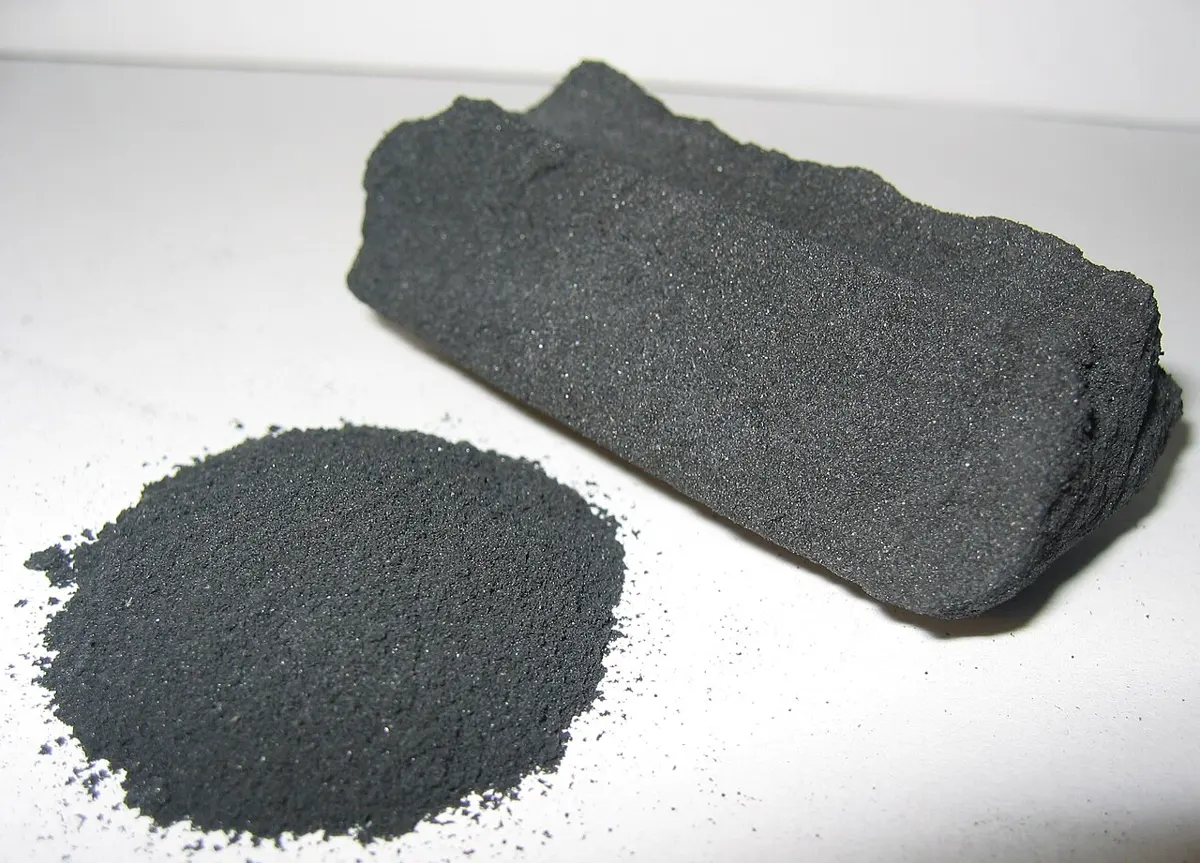
9.6.2 Carbon monoxide (CO)
When carbon-containing fuels burn in a limited supply of air (incomplete combustion), carbon monoxide forms: . It is a colorless, odorless and highly toxic gas.
CO is called the silent killer: you can’t see, smell or taste it. Breathed in, it binds to the hemoglobin of red blood cells about 200–250 times more strongly than oxygen does, forming carboxyhemoglobin, so the blood can no longer carry oxygen to the body. A person feels a headache and drowsiness, falls asleep, and may never wake. Never burn charcoal, coal or a gas heater in a closed room, never run an engine in a closed garage, and keep a window open when using a heater.
Some chemical properties of carbon monoxide:
1. Reducing action. Carbon monoxide is a powerful reducing agent: when heated it takes oxygen from many metal oxides, giving the metal.
It also reduces iodine pentoxide to iodine (a way of measuring CO in air), and Tollens’ reagent (ammoniacal silver nitrate) to metallic silver:
2. Action with metals. Carbon monoxide combines with many transition metals, such as nickel, iron and cobalt, forming metal carbonyls, in which CO molecules are bonded to the metal atom through carbon’s lone pair:
When nickel tetracarbonyl vapor is heated to about 180 °C, it decomposes, depositing very pure nickel:
This way of purifying nickel is Mond’s process (Ludwig Mond, 1890). Iron and cobalt form carbonyls too:
3. Action with non-metals. Carbon monoxide reacts with chlorine, hydrogen and sulphur.
a. With chlorine, in sunlight (or over charcoal), it gives the very poisonous gas phosgene, carbonyl chloride:
b. With hydrogen, over a catalyst of zinc oxide and chromium(III) oxide at about 300 °C and 200 atm, it gives methanol (methyl alcohol):
c. With sulphur vapor, it gives carbonyl sulphide:
Uses of carbon monoxide
- as a reducing agent in metallurgy (for iron in the blast furnace, zinc, lead);
- to make phosgene, used now to make plastics (polycarbonates and polyurethanes); it was used as a poison gas in the First World War;
- as a fuel, in water gas (CO + H₂), made by passing steam over red-hot coke, and in producer gas (CO + N₂):
- in purifying nickel by Mond’s process;
- in making methanol, and with hydrogen (as syngas) in making many other chemicals.
Project work
Exercise (9.6 Carbon)
A. Multiple choice questions
- Which of the following is a good conductor of electricity?
Pick an answer to see why.
- What is the hybridization of carbon in graphite?
Pick an answer to see why.
- What is the nature of bonding in diamond?
Pick an answer to see why.
- Which of the following gas mixtures is water gas?
Pick an answer to see why.
- What is the product of the reaction CO + Ni → ?
Pick an answer to see why.
- Which gas is produced when carbon monoxide reacts with chlorine?
Pick an answer to see why.
- Which of the following is not a crystalline allotrope of carbon?
Pick an answer to see why.
- Which feature makes graphite a good conductor?
Pick an answer to see why.
- Which element is present in a “lead” pencil?
Pick an answer to see why.
- How many pentagonal and hexagonal rings are there in C₆₀ fullerene?
Pick an answer to see why.
- Pick out the substance that is not an allotrope of carbon.
Pick an answer to see why.
- Which of the following is a truncated icosahedron?
Pick an answer to see why.
- What is the ratio of CO to H₂ in water gas?
Pick an answer to see why.
- Which compound is formed when CO combines with hemoglobin?
Pick an answer to see why.
- Identify A in:
Pick an answer to see why.
- What is the hybridization of carbon in CO?
Pick an answer to see why.
- Wood charcoal is an allotrope of which element?
Pick an answer to see why.
B. Short answer questions
Define the following terms:
a. allotrope b. allotropy c. activated charcoal d. plant charcoal e. gas carbon
Answer
List the crystalline and amorphous allotropes of carbon.
Answer
Discuss the structure, properties and uses of diamond.
Answer
Both carbon and carbon monoxide are used as reducing agents. Which is the better reducing agent, and why?
Answer
Give reasons:
- a.Graphite conducts electricity but diamond does not, though both are made of carbon.
- b.Charcoal is a better adsorbent than coal.
- c.CO is called a silent killer.
- d.Graphite is called a solid lubricant.
- e.C₆₀ is called a truncated icosahedron.
Answer
Differentiate between:
- a.diamond and graphite
- b.diamond and fullerene
- c.ordinary charcoal and activated charcoal
- d.coke and gas carbon
Answer
Show your acquaintance with the different types of charcoal and their uses.
Answer
Show your familiarity with the structure, properties and uses of fullerene.
Answer
At room temperature diamond is extremely unreactive, whereas graphite reacts more readily. Why?
Answer
Compare the structures of diamond and graphite.
Answer
C. Long answer questions
- a.Give any two reactions showing the reducing nature of CO.
- b.What happens when CO gas is:
- i.heated with cobalt?
- ii.warmed with Tollens’ reagent?
- iii.heated with sulphur?
Answer
Study the allotropes of carbon in Figure 9.35 (diamond, graphite and fullerene) and answer:
- a.Which allotrope is the hardest, and why?
- b.Which allotrope is the most reactive, and why?
- c.Which allotrope is a good conductor of electricity, and why?
- d.How is fullerene made?
- e.What is the hybridization in diamond and graphite?
Answer
CO is called a silent killer, but it does no long-term ecological damage, and it is widely used. List some uses of CO.
Answer
Diamond and graphite are both allotropes of carbon. Study their structures and answer:
- a.Why is graphite softer than diamond?
- b.What is the hybridization of carbon in graphite and in diamond?
- c.Graphite is a good conductor of electricity, but diamond is not. Why?
- d.Write two uses of each.
Answer
9.7 Phosphorus
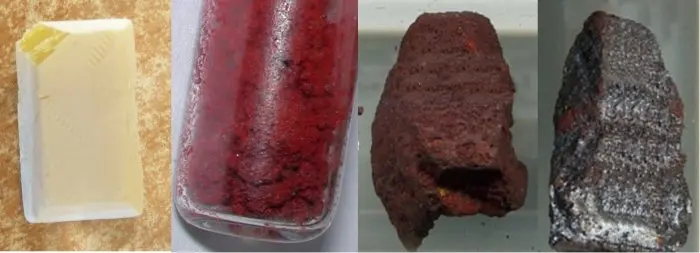
Phosphorus is a non-metal. It never occurs free in nature, because it combines so readily with oxygen. It is an essential element of all living things: it is in DNA and RNA, in ATP, the molecule that carries energy in every cell, in cell membranes, and as calcium phosphate in bones and teeth. In the combined state it is found mostly as phosphate minerals:
- phosphorite (rock phosphate): Ca₃(PO₄)₂
- fluorapatite: 3Ca₃(PO₄)₂·CaF₂ (that is, Ca₅(PO₄)₃F, the mineral of tooth enamel)
- chlorapatite: 3Ca₃(PO₄)₂·CaCl₂
| Element | Phosphorus |
|---|---|
| Symbol | P |
| Atomic number | 15 |
| Atomic mass | 31 amu |
| Molecular formula | P₄ |
| Electronic configuration | 1s² 2s² 2p⁶ 3s² 3p³ |
| Group | 15 |
| Period | 3rd |
Read more on its own page: phosphorus.
9.7.1 Allotropes of phosphorus
Like carbon, phosphorus exists in several allotropic forms:
- white (or yellow) phosphorus: P₄ molecules, each a tetrahedron of four atoms (Figure 9.40); waxy, soft, very poisonous, glows in the dark and catches fire in air at about 30 °C, so it is stored under water;
- red phosphorus: P₄ tetrahedra joined into long chains (a polymer); a red powder, far less reactive and not poisonous, stable in air;
- black phosphorus: flat, puckered layers like graphite’s; the most stable form, a flaky black solid that conducts electricity;
- violet (Hittorf’s) phosphorus: long tubes of linked cages;
- scarlet phosphorus: a finely divided, less ordered red form.
9.7.2 Phosphine gas
Phosphine, PH₃, is the most important hydride of phosphorus (as ammonia is of nitrogen). It is a colorless, very poisonous gas with a smell like rotting fish (or garlic). The molecule is pyramidal, like ammonia’s, but with a smaller bond angle, about 93.5°.
Laboratory preparation. Phosphine is made by heating white phosphorus with a concentrated solution of caustic soda (or potash), in a flask from which the air has been driven out by carbon dioxide (or another inert gas), since phosphine (with traces of P₂H₄) catches fire in air:
This is another disproportionation: phosphorus (0) goes to −3 in PH₃ and +1 in NaH₂PO₂.
Phosphine can also be made in other ways, for example from calcium phosphide and water, or from phosphonium iodide and an alkali:
(The same reaction with aluminium phosphide and moisture, , is how phosphide tablets, sold in Nepal and India for protecting stored grain from insects, work: they release phosphine slowly in the grain store. They are deadly to people too and must never be used indoors or near food that is being eaten.)
Physical properties of phosphine
- a colorless gas with the smell of rotting fish;
- slightly soluble in water;
- heavier than air (molar mass 34, against 29 for air);
- very toxic;
- pure phosphine is not spontaneously flammable (it catches fire at about 150 °C), but it becomes spontaneously flammable when it contains traces of P₂H₄ or phosphorus vapor.
Chemical properties of phosphine
1. Action with air (oxygen). Like ammonia, phosphine doesn’t support burning. Heated in air (about 150 °C), it burns, giving phosphorus pentoxide or phosphoric acid:
2. Basic nature. Phosphine has a lone pair on phosphorus, like ammonia, so it is a base, but a very weak one: it doesn’t turn moist red litmus blue. It reacts with the hydrogen halides (dry) to give phosphonium salts, as ammonia gives ammonium salts:
(, phosphonium chloride, forms only under pressure or cooled.) PH₃ is a much weaker base than NH₃: phosphorus is larger and less electronegative than nitrogen, so its lone pair is spread over a bigger volume and less available to a proton.
3. Action with chlorine. Depending on the amount of chlorine, phosphine burns in chlorine to give phosphorus trichloride or phosphorus pentachloride:
4. Reducing nature. Phosphine is a reducing agent: its phosphorus (−3) is easily oxidized.
a. It reduces silver nitrate solution to black metallic silver:
b. With copper sulphate solution, it gives a black precipitate of copper phosphide:
c. With mercuric chloride solution, it gives a brownish black precipitate of mercuric phosphide:
(Copper sulphate solution is used to absorb phosphine and so remove it from other gases.)
Uses of phosphine
- as a reducing agent;
- in making smoke screens (from the clouds of P₂O₅ smoke when it burns);
- to make phosphorus compounds such as P₂O₅, PCl₃ and PCl₅;
- in Holmes’ signals at sea;
- as a fumigant to kill insects in stored grain (released from aluminium or magnesium phosphide);
- in making semiconductors, to add (dope) phosphorus into silicon chips.
Project work
Exercise (9.7 Phosphorus)
A. Multiple choice questions
- What is the atomicity of (white) phosphorus?
Pick an answer to see why.
- What is the product of P₄ + Cl₂ → ? (with limited chlorine)
Pick an answer to see why.
- Which allotrope of phosphorus was used to make rat poison?
Pick an answer to see why.
- Which of the following makes up a Holmes’ signal?
Pick an answer to see why.
- Which allotrope of phosphorus gives phosphine with caustic alkali?
Pick an answer to see why.
- Which of the following is not true about pure phosphine?
Pick an answer to see why.
- Which gas from a Holmes’ signal catches fire by itself?
Pick an answer to see why.
- Which of the following compounds reacts with water to give PH₃?
Pick an answer to see why.
B. Short answer questions
Name the allotropes of phosphorus. Which allotrope is used to make matches, and which was used in rat poison?
Answer
Why is white phosphorus kept under water? What happens when the gas produced by boiling white phosphorus with caustic soda is passed through copper sulphate solution?
Answer
Write any two methods of preparing phosphine gas. Write its uses.
Answer
What is a Holmes’ signal? How is it produced? Write its significance.
Answer
9.8 Sulphur
Sulphur is a non-metallic element found both free (native) and combined. Under ordinary conditions it is made of octatomic molecules, S₈. Elemental sulphur is a bright yellow, crystalline solid. Native sulphur is found around volcanoes and hot springs, and in deposits under the ground; in the combined state it occurs as sulphide minerals (iron pyrites FeS₂, galena PbS, zinc blende ZnS, cinnabar HgS), sulphate minerals (gypsum CaSO₄·2H₂O, Epsom salt MgSO₄·7H₂O), and in petroleum and natural gas, from which most of the world’s sulphur is now recovered. Read more on its own page: sulphur.
| Element | Sulphur |
|---|---|
| Symbol | S |
| Atomic number | 16 |
| Atomic mass | 32.07 amu |
| Molecular formula | S₈ |
| Electronic configuration | 1s² 2s² 2p⁶ 3s² 3p⁴ |
| Valency | 2, 4, 6 |
| Group | 16 |
| Period | 3rd |
| Electronegativity | 2.5 |
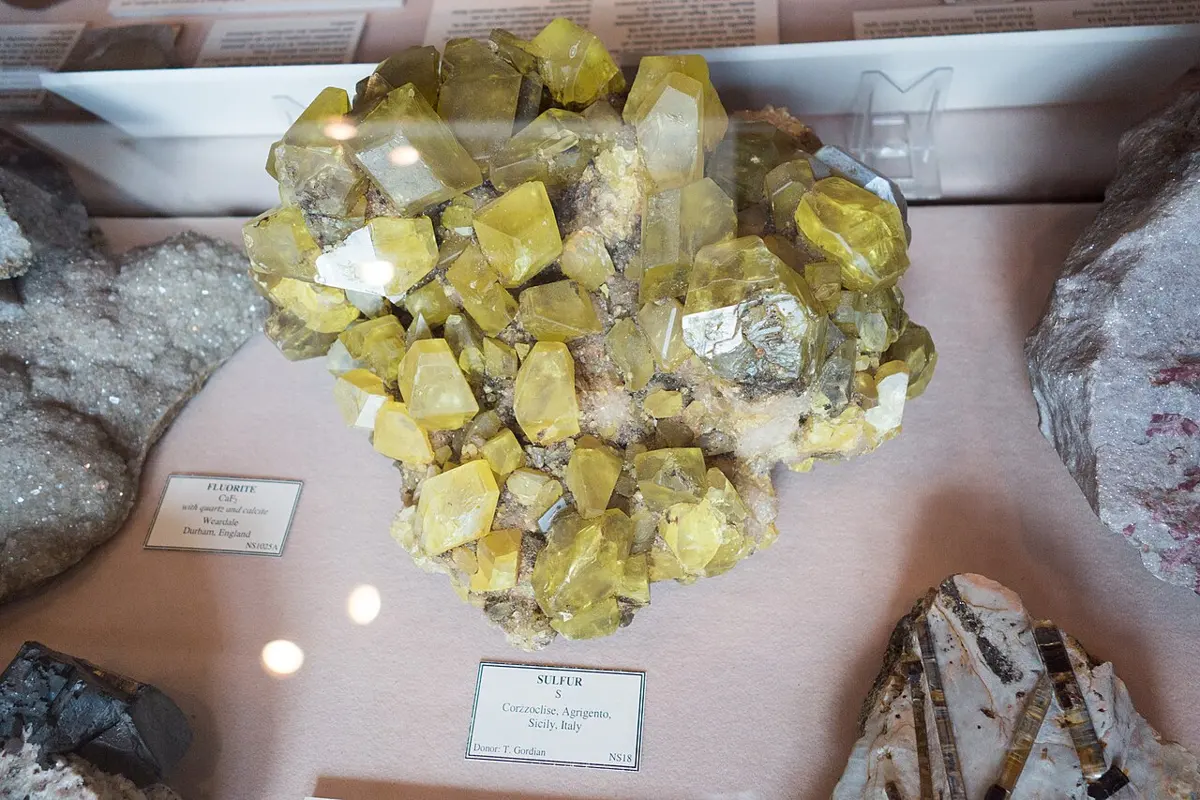
9.8.1 Allotropes of sulphur and uses of sulphur
| Crystalline allotropes | Amorphous allotropes |
|---|---|
| rhombic (α) sulphur: the stable form at room temperature, bright yellow, octahedral crystals, S₈ rings | plastic (γ) sulphur: long chains of sulphur atoms, rubbery and stretchy, made by pouring boiling sulphur into cold water; slowly turns back into rhombic sulphur |
| monoclinic (β) sulphur: S₈ rings packed differently, long needle-shaped crystals, stable only between 95.6 °C and its melting point (119 °C); turns slowly into rhombic below 95.6 °C | colloidal sulphur: very fine particles in water, made by passing H₂S into a solution of SO₂, or from thiosulphate and acid; used in medicine |
| milk of sulphur: a white, finely divided sulphur made by boiling sulphur with lime and adding hydrochloric acid; used in medicine |
The temperature 95.6 °C at which rhombic and monoclinic sulphur are equally stable is called the transition temperature: below it rhombic is stable, above it monoclinic. A substance that exists in two or more crystalline forms is said to show polymorphism.
Some uses of sulphur:
- The largest use, by far, is in making sulphuric acid.
- It is used to make gunpowder (traditionally 75% potassium nitrate, 15% charcoal and 10% sulphur, by mass) and in the match industry.
- It gives rubber its resilience and toughness in the process called vulcanization: heating rubber with sulphur cross-links its long molecules with sulphur bridges, so it stays springy in heat and cold (Charles Goodyear, 1839). Every tyre is vulcanized.
- It is used as a germicide, insecticide and fungicide: farmers in Nepal dust or spray sulphur on vegetables, grapes and apples against powdery mildew.
- It is used in making medicines (sulphur ointments for skin diseases), dyes and explosives.
- Its compounds, calcium and magnesium bisulphites (made from SO₂), are used to dissolve wood pulp in the paper industry, and SO₂ to bleach it.
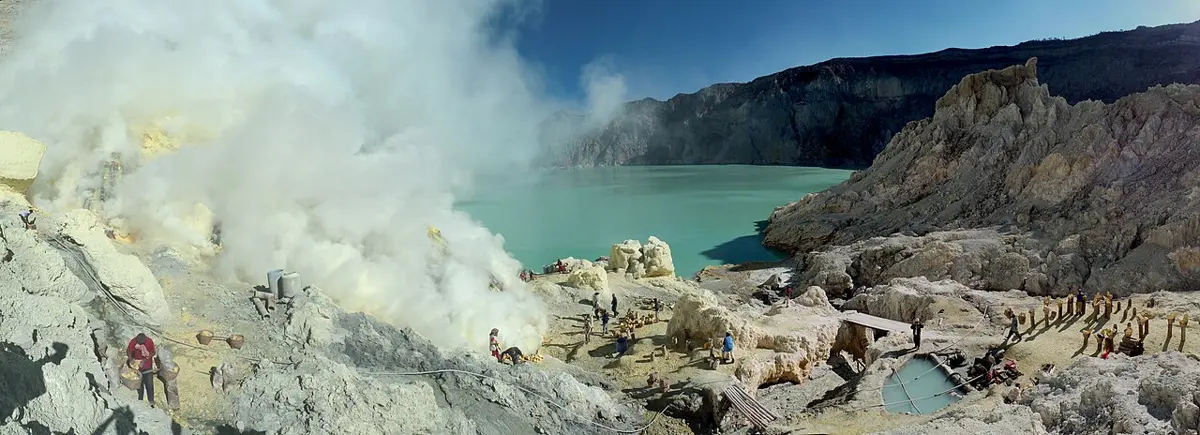
9.8.2 Hydrogen sulphide (H₂S)
When iron(II) sulphide comes in contact with dilute sulphuric acid, hydrogen sulphide gas is given off. It smells exactly like rotten eggs (rotting eggs, whose proteins contain sulphur, give it off). It is invisible, colorless and flammable, and is also called sulphuretted hydrogen or, in water, hydrosulphuric acid. It forms whenever sulphur-containing organic matter decays without air, in sewers, swamps and manure pits, and it comes out of volcanoes and some hot springs.
Preparation of hydrogen sulphide using Kipp’s apparatus
You may have used H₂S in the laboratory for the qualitative analysis of basic radicals (cations). During an analysis, H₂S is needed in small amounts again and again, so it is supplied from a Kipp’s apparatus, which gives gas whenever its tap is opened and stops making it by itself when the tap is closed. In it, H₂S is made by the action of dilute sulphuric acid on iron(II) sulphide:
Working principle of Kipp’s apparatus. A Kipp’s apparatus has two parts: a top bulb A with a long stem, and a base of two connected bulbs, B (the middle) and C (the bottom). The stem of A passes through the neck of B down to the bottom bulb C. Lumps of iron(II) sulphide are kept in the middle bulb B, on a constriction that stops them falling into C, and dilute sulphuric acid is poured into A until it fills C and rises into B, covering the iron sulphide. B has a side neck with a tap for the gas.
- With the tap open, the acid touches the iron sulphide and hydrogen sulphide forms and flows out.
- When the tap is closed, the gas still being made has nowhere to go. Its pressure in B pushes the acid down, out of B, through C, and up the stem into A. Once the acid level falls below the iron sulphide, the reaction stops.
- When the tap is opened again, the gas escapes, the pressure in B falls, the acid in A flows back down and up into B, touches the iron sulphide, and the gas forms again.
So the apparatus gives an intermittent supply of gas, on demand, without waste. It is used for other gases made from a solid and a liquid without heating, such as hydrogen (zinc and dilute acid) and carbon dioxide (marble and dilute hydrochloric acid). It is named after the Dutch pharmacist Petrus Jacobus Kipp, who made it around 1844.
Chemical properties of hydrogen sulphide
1. Acidic nature. Hydrogen sulphide is a diprotic acid. In water it ionizes in two steps, giving two series of salts, the hydrogensulphides (bisulphides) and the sulphides:
H₂S is a weak acid: it turns moist blue litmus paper only faintly red. Being acidic, it reacts with bases to give salts:
H₂S doesn’t decompose carbonates, because it is a weaker acid than carbonic acid.
2. Reducing nature. The sulphur in H₂S is in its lowest oxidation state, −2, so in reactions it can only be oxidized (usually to sulphur, 0): H₂S is a good reducing agent.
a. Acidified potassium permanganate. H₂S turns the pink-purple solution colorless (Mn²⁺, as manganese sulphate), and sulphur separates:
b. Acidified potassium dichromate. H₂S turns the orange solution green (chromium(III) sulphate), and sulphur separates:
c. Ferric salts. H₂S reduces yellow iron(III) chloride to pale green iron(II) chloride:
d. Halogens. H₂S reduces halogens to hydrogen halides:
e. Sulphur dioxide. H₂S reduces moist sulphur dioxide to sulphur:
f. Concentrated nitric acid. H₂S reduces concentrated nitric acid to nitrogen dioxide:
g. Concentrated sulphuric acid. H₂S reduces concentrated sulphuric acid to sulphur dioxide:
(This is why H₂S can’t be dried with concentrated sulphuric acid.)
3. H₂S as an analytical reagent
When H₂S is passed through a solution of a copper salt containing dilute HCl, a black precipitate of copper sulphide forms. It shows the presence of Cu²⁺ as a basic radical in the salt.
In the qualitative analysis of a salt, we find which basic radicals (cations) it contains. H₂S forms sulphides with many metal ions, and these sulphides differ in solubility and color, so they are used to separate and identify the ions:
- In acidic solution (with dilute HCl), the H⁺ ions push the equilibrium to the left, so very little S²⁻ is present. Only the least soluble sulphides precipitate: those of group II, Cu²⁺, Hg²⁺, Pb²⁺, Cd²⁺, Bi³⁺, As³⁺, Sb³⁺, Sn²⁺.
- In ammoniacal (alkaline) solution, the ammonia removes H⁺, so much more S²⁻ forms, and the more soluble sulphides of group IV, Zn²⁺, Mn²⁺, Co²⁺, Ni²⁺, precipitate too.
a. Detection of group II basic radicals. H₂S passed through an acidified solution precipitates their sulphides, each with its own color:
b. Detection of group IV basic radicals. H₂S passed through their solution made alkaline with ammonia (NH₄Cl + NH₄OH) precipitates their sulphides; the ammonia takes up the H⁺ released:
In the same way, the other groups of basic radicals are separated with the help of hydrogen sulphide.
Why does zinc sulphide precipitate from an ammoniacal solution, but not from one acidified with HCl?
Pick an answer to see why.
Uses of hydrogen sulphide
- as a reducing agent;
- as an analytical reagent in the laboratory, to separate and identify the basic radicals;
- to prepare metal sulphides, some of which are used as pigments (cadmium yellow, CdS);
- (also) in laboratories, to make hydrogen bromide and iodide free of halogen, by reducing bromine or iodine in water: .
9.8.3 Sulphur dioxide (SO₂)
Sulphur dioxide is the anhydride of sulphurous acid (H₂SO₃). It is a colorless gas with the sharp, choking smell of a burning match. It forms when sulphur, or anything containing sulphur, burns: . Naturally it comes out of volcanoes. It was first studied by Joseph Priestley in 1774, who made it by heating mercury with concentrated sulphuric acid:
(In the laboratory today, it is made by heating copper turnings with concentrated sulphuric acid, , or by adding dilute acid to a sulphite, .)
Physical properties of sulphur dioxide
- It is a colorless gas with a choking smell of burning match.
- It is heavier than air (molar mass 64, against 29 for air), about 2.2 times as dense.
- It is highly soluble in water (about 40 volumes in 1 volume of water at room temperature).
- Its melting point is −75.5 °C and its boiling point −10 °C, so it is easily liquefied.
- It is acidic in nature.
Chemical properties of sulphur dioxide
1. Acidic nature. SO₂ dissolves in water to form sulphurous acid, a weak diprotic acid; so SO₂ is called the anhydride of sulphurous acid.
Sulphurous acid exists only in solution: when the solution is boiled, sulphur dioxide is driven off again.
Being acidic, SO₂ reacts with bases to give salts:
As sulphurous acid is diprotic, its solution gives two series of salts with bases:
2. Reducing nature. In the presence of water, SO₂ is a good reducing agent; it is itself oxidized to sulphuric acid (S: +4 → +6).
a. Acidified potassium permanganate. SO₂ turns the pink-purple solution colorless (Mn²⁺):
(The three H₂SO₄ used in the first step are among the five made in the second, so they cancel out of the overall equation, leaving 2H₂SO₄ on the right.)
b. Acidified potassium dichromate. SO₂ turns the orange solution green (chromium(III) sulphate):
c. Ferric salts. SO₂ reduces yellow iron(III) sulphate to pale green iron(II) sulphate:
d. Halogens. SO₂ reduces halogens (Cl₂, Br₂, I₂) in water to hydrogen halides, and is oxidized to sulphuric acid. With bromine water, the orange color disappears:
3. Oxidizing nature. With stronger reducing agents, SO₂ acts as an oxidizing agent (S: +4 → 0 or −2).
a. With H₂S, in the presence of moisture, SO₂ oxidizes hydrogen sulphide to sulphur (and is itself reduced to sulphur):
b. With burning metals. Burning magnesium goes on burning in SO₂, and heated iron is oxidized to iron(II) oxide and iron(II) sulphide:
4. Bleaching property of sulphur dioxide
When a moist red rose is put into a gas jar full of SO₂, its red color disappears. SO₂ removes the natural color, but not for good: left in the air, the rose slowly gets its color back. Any chemical that removes the natural color of a substance, for a while or for good, is a bleach (bleaching agent). Many bleaches also kill germs, so they are used as disinfectants too. Examples of bleaches are sulphur dioxide, chlorine, sodium hypochlorite, calcium hypochlorite (bleaching powder) and hydrogen peroxide.
SO₂ bleaches in two ways:
i. Bleaching by reduction. In the presence of moisture, SO₂ gives nascent hydrogen, which reduces the colored matter to a colorless product:
This bleaching is temporary: the oxygen of the air slowly oxidizes the colorless product back into the colored one. That is why the rose regains its color, and why old newspapers (bleached with SO₂) turn yellow.
ii. Bleaching by addition. With some dyes, SO₂ adds on to the colored molecule, giving a colorless addition product:
Treated with dilute sulphuric acid, the addition product breaks down, giving off SO₂, and the color returns.
So in both ways the bleaching action of SO₂ is temporary (reversible). SO₂ is a mild bleaching agent, used for delicate materials that chlorine would damage: wool, silk, straw, cane sugar, flowers and fruits.
Uses of sulphur dioxide
- in the manufacture of sulphuric acid (by the contact process, in Unit 17);
- as a bleaching agent in the paper and sugar industries;
- as a preservative in wine, dried fruits and fruit juices (it kills microbes and stops browning; on labels, as E220 or as sulphites);
- as a disinfectant and fungicide (fumigating stores and containers);
- as a non-aqueous solvent, in its liquid form;
- as an antichlor, to remove the traces of chlorine left on fabrics bleached with chlorine;
- to make calcium bisulphite (calcium hydrogensulphite, Ca(HSO₃)₂), used to dissolve the lignin of wood pulp in making paper;
- to bleach delicate materials: straw, paper pulp, wool, silk and flowers.
9.8.4 Sulphuric acid (H₂SO₄)
Sulphuric acid is one of the most widely used industrial chemicals: to make fertilizers (above all superphosphate and ammonium sulphate), other chemicals, detergents, dyes and paints, in refining petroleum, in processing metals, in car batteries, and in treating water and waste. Over 250 million tonnes are made each year, more than any other chemical, and as industry grows the demand rises.
In early days it was made by heating green vitriol (iron(II) sulphate crystals, FeSO₄·7H₂O), so it was called oil of vitriol. Because it is made in such large amounts and used in so many industries, it is called the king of chemicals: how much sulphuric acid a country uses was long taken as a measure of its industry. Today it is made by the contact process, in four steps. Sulphur, or the ore iron pyrite (FeS₂, also called iron pyrites), is burnt in air to sulphur dioxide; the gas is purified and dried, then oxidized to sulphur trioxide on a catalyst of vanadium(V) oxide; the sulphur trioxide is absorbed in concentrated sulphuric acid, giving oleum; and the oleum is diluted with water:
The plant, its purifying towers and the conditions chosen are in Unit 17; why the second step is run as it is, by Le Chatelier’s principle, in Unit 8.
Physical properties of sulphuric acid
- It is a colorless, oily (syrupy) liquid with no smell; the concentrated acid (98%) has a specific gravity of 1.84 at 15 °C.
- It mixes with water in all proportions, giving out a great deal of heat.
- Pure sulphuric acid melts at 10.4 °C; the concentrated acid boils at about 338 °C, so it is a non-volatile acid.
- It is hygroscopic (absorbs moisture from the air), so it is used as a drying agent for gases that don’t react with it.
- In water, it turns blue litmus red.
- It is very corrosive, and causes severe burns on the skin.
Chemical properties of sulphuric acid
1. Acidic nature. Sulphuric acid is a strong dibasic (diprotic) acid. It ionizes in two steps: the first is complete, the second only partial (HSO₄⁻ is a moderately weak acid):
Being dibasic, it gives two series of salts with bases, the hydrogensulphates (bisulphates) and the sulphates:
Being non-volatile, it drives the more volatile acids out of their salts when heated: , .
2. Oxidizing nature. The sulphur in H₂SO₄ is in its highest oxidation state, +6, so sulphuric acid can act as an oxidizing agent. Hot, concentrated sulphuric acid is a fairly strong oxidizing agent; the dilute acid hardly oxidizes at all (it reacts only as an acid). The concentrated acid can be taken to give nascent oxygen, which does the oxidizing, and is itself reduced to sulphur dioxide:
a. Action with metals. Hot concentrated sulphuric acid oxidizes most metals, even copper and silver, which are below hydrogen, to their sulphates, and sulphur dioxide is given off:
(With iron, the hot concentrated acid gives iron(III) sulphate; cold concentrated acid makes iron passive, so concentrated sulphuric acid can be stored in steel tanks.)
Noble metals like platinum and gold don’t react with concentrated sulphuric acid.
Metals above hydrogen in the electrochemical series react with dilute sulphuric acid to give hydrogen:
b. Action with non-metals. Hot concentrated sulphuric acid oxidizes several non-metals, such as carbon, sulphur and phosphorus.
i. Carbon is oxidized to carbon dioxide:
ii. Sulphur is oxidized to sulphur dioxide:
iii. Phosphorus is oxidized to phosphoric acid:
c. Action with other reducing agents. Concentrated sulphuric acid oxidizes some other reducing agents, such as hydrogen bromide and iodide, and hydrogen sulphide.
i. Hydrogen halides. It oxidizes hydrogen bromide and hydrogen iodide to the halogens:
Hydrogen chloride is too weak a reducing agent: it is not oxidized by sulphuric acid. (Hydrogen iodide, the strongest, reduces it further, to sulphur and even H₂S.) This is why HBr and HI can’t be made by heating their salts with concentrated sulphuric acid, as HCl is (9.5).
ii. Hydrogen sulphide is oxidized to sulphur:
3. Dehydrating nature
Concentrated sulphuric acid has a very great affinity for water. It takes water from substances, even taking the hydrogen and oxygen out of compounds that contain no water as such, so it is widely used as a dehydrating agent in chemical reactions. Some examples:
a. Carboxylic acids. It dehydrates formic acid and oxalic acid:
b. Hydrated salts. It removes the water of crystallization from hydrated salts such as blue vitriol (CuSO₄·5H₂O), which turns white, and washing soda (Na₂CO₃·10H₂O):
(blue → white)
c. Carbohydrates. It dehydrates carbohydrates such as glucose, fructose and sucrose, leaving a black, charred mass of carbon:
(The water removed stays with the acid, as hydrates of sulphuric acid.)
4. As a precipitant. Sulphuric acid, or any soluble sulphate, gives a white precipitate with a solution of a barium salt (or a lead salt), because barium sulphate and lead sulphate are insoluble in water and in acids:
The white precipitate of barium sulphate, which doesn’t dissolve in dilute hydrochloric acid, is the laboratory test for a sulphate, and the way a sulphate is weighed in gravimetric analysis.
5. In fertilizers. More sulphuric acid goes into fertilizers than into anything else. With ammonia it gives ammonium sulphate, a nitrogenous fertilizer; with rock phosphate it gives superphosphate, a phosphatic one, in which insoluble calcium phosphate becomes soluble calcium dihydrogenphosphate that plants can take up (the phosphatic fertilizers are in Unit 17):
9.8.5 Sodium thiosulphate and its uses
Sodium thiosulphate is a white crystalline hydrated salt, Na₂S₂O₃·5H₂O. It is also called hypo, from its old name, hyposulphite of soda. It is soluble in water. (In the thiosulphate ion, one oxygen of a sulphate ion is replaced by sulphur, as the prefix thio- says.)
- It is used in iodine titrations (iodometry) in volumetric analysis: .
- It is used as an antichlor, to remove the excess chlorine left on fabrics after bleaching with chlorine.
- It is used in photography, as hypo, to fix films and prints: it dissolves the silver bromide that light hasn’t touched, so the picture no longer darkens: (John Herschel found this in 1839.)
Project work
Exercise (9.8 Sulphur)
A. Multiple choice questions
- Which of the following is used in photography?
Pick an answer to see why.
- What happens to the potassium permanganate when SO₂ gas is passed through its acidified solution?
Pick an answer to see why.
- Which of the following behaves as both an oxidizing agent and a reducing agent?
Pick an answer to see why.
- Which of the following is true for sulphur dioxide gas?
Pick an answer to see why.
- Which gas is given off when dilute H₂SO₄ is treated with zinc metal?
Pick an answer to see why.
- What is the oxidation state of S in H₂SO₄?
Pick an answer to see why.
- In the reaction what is the role of the acid?
Pick an answer to see why.
- Which of the following statements is wrong for SO₂?
Pick an answer to see why.
- Which of the following turns lead acetate paper black?
Pick an answer to see why.
- SO₂ is the acidic anhydride of which acid?
Pick an answer to see why.
- Which of the following is known as oil of vitriol?
Pick an answer to see why.
- What are the symbol and the molecular formula of sulphur?
Pick an answer to see why.
- Who first recognized sulphur as an element?
Pick an answer to see why.
- What is the shape of the H₂S molecule?
Pick an answer to see why.
- Which compound is used as a reducing bleach for paper?
Pick an answer to see why.
- What is the chemical formula of sodium thiosulphate?
Pick an answer to see why.
B. Short answer questions
Define the terms polymorphism and allotropy. List the allotropes of sulphur.
Answer
Show that sulphuric acid is a diprotic acid. Write the action of pure sulphuric acid on blue and red litmus paper.
Answer
Write the formula of hypo. Mention some uses of sulphur.
Answer
Give reasons:
- a.SO₂ acts as an oxidizing as well as a reducing agent.
- b.H₂S acts as a reducing agent.
- c.H₂SO₄ acts as an oxidizing agent.
- d.H₂SO₄ is a dehydrating agent.
Answer
Differentiate between:
- a.the bleaching actions of Cl₂ and SO₂
- b.the acidic natures of SO₂ and H₂SO₄
Answer
Describe the preparation of H₂S gas with Kipp’s apparatus. How would you confirm the acidic nature of hydrogen sulphide gas?
Answer
Explain the working principle of Kipp’s apparatus. Write its significance.
Answer
What happens when H₂S gas is passed through:
- a.acidified KMnO₄?
- b.copper sulphate solution in acidic medium?
- c.SO₂ gas?
- d.concentrated sulphuric acid?
- e.acidified lead acetate solution?
Answer
Write notes on:
- a.the use of H₂S as an analytical reagent
- b.the bleaching action of SO₂
- c.the dehydrating property of H₂SO₄
- d.SO₂ as an oxidizing and a reducing agent
Answer
List the uses of SO₂ gas.
Answer
Why is sulphuric acid called the “king of chemicals”? List the uses of sulphuric acid.
Answer
Write the molecular formula of sodium thiosulphate and mention some of its uses.
Answer
Write reactions to show sulphuric acid as:
- a.an oxidizing agent
- b.a dehydrating agent
- c.an acid
Answer
What happens when a moist red petal of a flower is kept in a jar full of SO₂ gas?
Answer
Write the action of concentrated H₂SO₄ on:
- a.sugar
- b.P₄
- c.S₈
- d.copper turnings
Answer
Write the action of H₂S on:
- a.KMnO₄ (acidified)
- b.K₂Cr₂O₇ (acidified)
- c.moist Cl₂
- d.SO₂
- e.FeCl₃
Answer
C. Long answer questions
Look at the Kipp’s apparatus in the widget above (9.8.2), set with its tap closed, and answer:
- a.Identify the apparatus and write one advantage of it.
- b.Identify the parts A, B and C.
- c.Write the balanced chemical equation for the reaction in it, used to make H₂S.
- d.With its tap closed, where is the acid? Is the reaction going on?
- e.Give one use of the gas it releases.
Answer
Complete the table with the balanced chemical equations.
| Reactant A | Reactant B | Products |
|---|---|---|
| ……… | H₂S | PbS + CH₃COOH |
| H₂S | K₂Cr₂O₇ + H₂SO₄ | ……… |
| Cl₂ | SO₂ (and water) | ……… |
| SO₂ | ……… | FeO + FeS |
| ……… | H₂SO₄ | CO + CO₂ + H₂O |
| H₂SO₄ | HNO₃ | ……… |
| SO₃ | ……… | H₂S₂O₇ |
| Cu²⁺ | H₂S (acidic medium) | ……… |
Answer
Write the products of the following reactions and balance them.
- a.C₁₂H₂₂O₁₁ + conc. H₂SO₄ → ?
- b.H₂SO₄ + P → ?
- c.H₂S + SO₂ → ?
- d.Fe₂(SO₄)₃ + SO₂ + H₂O → ?
- e.Ni²⁺ + H₂S (alkaline medium) → ?
- f.FeCl₃ + H₂S → ?
- g.KMnO₄ + H₂SO₄ + H₂S → ?
- h.FeS + H₂SO₄ → ?
Answer
Concentrated sulphuric acid is both an oxidizing agent and a non-volatile acid.
- a.Write an equation each to illustrate these two properties.
- b.Write the test for this acid in the chemistry laboratory.
- c.Write any three uses of this acid.
- d.Why is this acid called the king of chemicals?
- e.How would you dilute this acid?
Answer
Copy and complete the table:
| Column A: substance reacted with the acid | Column B: dilute or concentrated sulphuric acid | Column C: gas produced |
|---|---|---|
| chlorine | ||
| carbon monoxide | ||
| hydrogen | ||
| carbon dioxide |
Answer
Printable PDFs
- Study notes 2 pages
- Worksheet 5 pages Answer key
Quiz yourself: Materials and Chemicals We Use, Grades 5–12 →
Practice every question in the book, and keep track of the ones you miss →
A companion to your textbook, not a replacement for it: study from the book your school uses, and where the two differ, follow your teacher. Found a mistake? Please tell us.