
The binary pulsar: Einstein’s ripples
Nobel Prize in Physics, 1993: Russell A. Hulse and Joseph H. Taylor Jr.
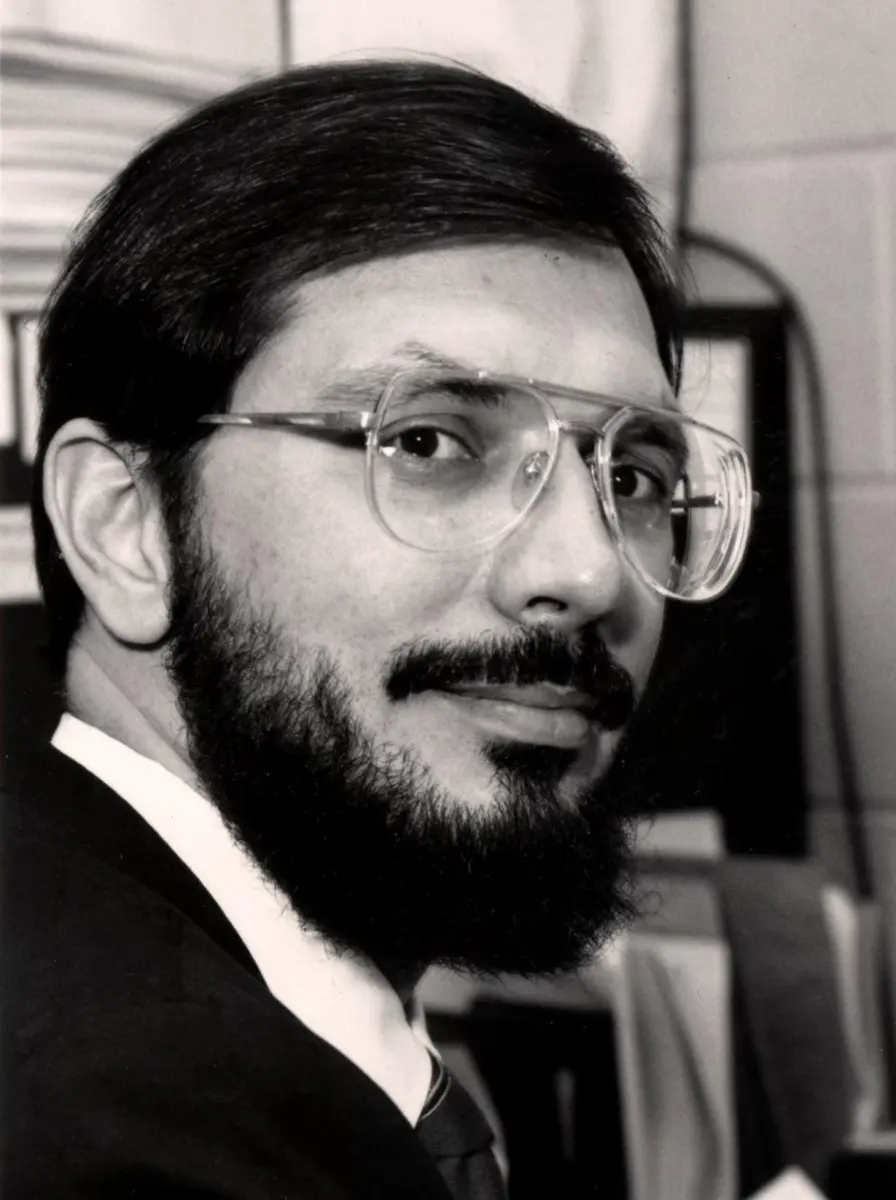
Russell A. Hulse
born 1950 in New York, USA
A student who wrote the whole search program himself, and found the binary pulsar at 23. He later left astronomy to study fusion energy.
Photo: ENERGY.GOV, Public domain

Joseph H. Taylor Jr.
born 1941 in Philadelphia, USA
As a boy he built radio aerials on the roof of the family farmhouse, and once knocked the chimney off doing it. He went on to time the binary pulsar for decades.
Photo: Betsy Devine, CC BY-SA 3.0
On a clear night in the hills of Nepal, you can see thousands of stars. Each will one day run out of fuel and die. A few of the biggest die in a giant explosion and leave behind something stranger than any star: a ball about as wide as the Kathmandu Valley, but heavier than the Sun, spinning many times a second and flashing radio waves at us like a lighthouse.
In 1974 a student, Russell Hulse, and his teacher, Joseph Taylor, found one of these spinning stars racing around another one. Over the next years, this pair showed that gravitational waves, ripples in space predicted by Albert Einstein, are real. For this they won the 1993 Nobel Prize in Physics.
The problem: testing gravity
You learn Newton’s law of gravitation in Grade 10: every mass pulls every other mass, more strongly when they are heavier and closer Grade 10: Newton’s law of gravitation. It works so well that we use it to send spacecraft to other planets.
In 1915 Albert Einstein gave a deeper explanation, his general theory of relativity. He said that a mass bends space and time around it, and other things move along the bends. Think of a heavy ball on a stretched bedsheet: it makes a dip, and a marble rolled nearby curves towards it.
For most things, Einstein’s theory and Newton’s give almost the same answer. They differ only where gravity is very strong or things move very fast. Einstein’s theory also made a strange prediction: when masses whirl around each other, they should send out ripples in space, gravitational waves, which carry energy away, the way waves spread out from a stone thrown into a pond.
But in our Solar System, gravity is weak and the planets are slow. For sixty years, Einstein’s theory had passed only a few small tests. The biggest was the planet Mercury: its oval orbit slowly turns, by a tiny extra amount that Newton could not explain and Einstein could, just 43 seconds of arc per century (a second of arc is 1/3600 of a degree). Gravitational waves from the planets were far too weak ever to be measured. Physicists needed a better laboratory: something with strong gravity, fast motion, and a very good clock.
What a pulsar is
A star like the Sun shines for billions of years. A star much heavier than the Sun ends its life in a huge explosion, a supernova Grade 9: Nova, supernova and what is left. Its center is crushed by its own gravity until even its atoms collapse. What is left is a neutron star, made almost entirely of neutrons packed as tightly as in an atom’s nucleus.
A neutron star is tiny for a star: about 20 km across, with a mass somewhat greater than the Sun’s. It is so dense that a pinhead of its matter would weigh hundreds of thousands of tonnes. Because it shrank so much, it spins very fast, like a dancer pulling in her arms.
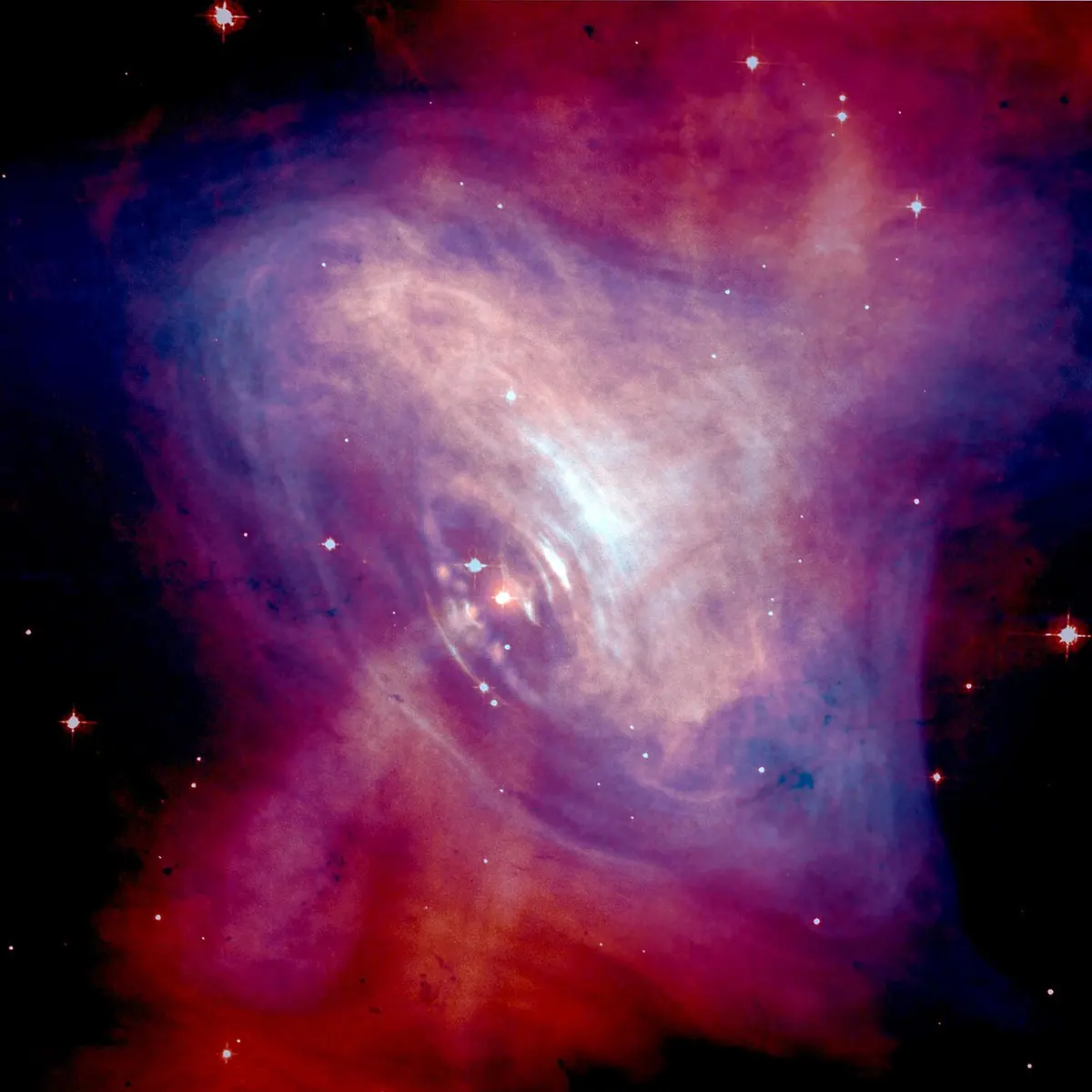
Many neutron stars send out two narrow beams of radio waves from their magnetic poles. As the star spins, the beams sweep round like the light of a lighthouse. If one sweeps over the Earth, a radio telescope picks up a short pulse each turn. We call such a star a pulsar. The first was found in 1967, in England, by Jocelyn Bell, a student, and her supervisor Antony Hewish (who received the Nobel Prize in 1974).
The pulses come with amazing regularity. A pulsar is a natural clock, as steady as the best atomic clocks we can build.
Why does a radio telescope pick up a pulsar as a series of short pulses, instead of a steady signal?
Pick an answer to see why.
Why it was hard
- Pulsars are faint. Their radio waves are very weak by the time they reach the Earth. Only a very large telescope can catch most of them.
- You don’t know where to look, or how fast. A search must try every possible pulse rate, and also correct for the way space smears the pulse (lower radio frequencies arrive slightly later). That needs a lot of computing.
- Computers were small. In 1974 a whole laboratory computer had less memory than one photo on your phone.
- Clocks must be perfect. To use a pulsar as a clock, each pulse must be timed to within millionths of a second, for years on end.
What they did, step by step
Hulse and Taylor: searching the sky (1973–1974)
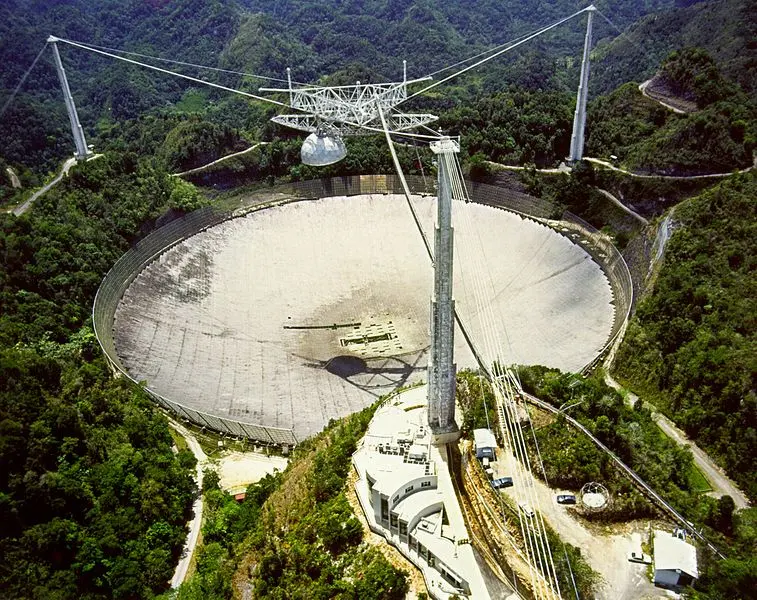
Joseph Taylor was a professor at the University of Massachusetts in the United States, and an expert on pulsars. Russell Hulse was his research student. Together they planned a search for new pulsars using the Arecibo radio telescope in Puerto Rico, then the largest in the world: a metal dish about 300 meters across, built into a hollow among hills.
- A program of his own. Hulse wrote the search program for a small computer at Arecibo, every instruction by hand, in the computer’s own code, on more than 4,000 punched cards. It had to search hundreds of thousands of combinations of pulse rate and smearing for each patch of sky.
- A year at the telescope. From December 1973 to January 1975, Hulse lived at Arecibo for long stretches, searching whenever the telescope was free. He fought radio noise from lightning, ships’ radars and even a faulty warning light on one of the telescope’s towers.
- A close call. The search found 40 new pulsars. One was picked up on 2 July 1974, so faintly that it only just passed the computer’s cut-off. A little weaker that day, and it would have been missed. It was named PSR 1913+16, from its position in the sky. It spun about 17 times a second, a pulse every 59 thousandths of a second, then the second-fastest pulsar known.
Hulse: a clock that wouldn’t keep still (August–September 1974)
- Something wrong. On 25 August Hulse measured the new pulsar’s rate more exactly, twice in one evening. The two answers differed by 27 millionths of a second, far more than they should. His reaction, he said later, was not “Eureka!” but an annoyed “Nuts, what’s wrong now?” Two days later the difference was even bigger.
- Ruling out the equipment. Perhaps his system was too slow for such a fast pulsar? He built a faster one, with a new program. On 1 and 2 September the problem was still there: during each night’s two hours of observing, the pulse rate kept changing.
- The pattern. Then he noticed that the change on the second night was the same as on the first, only 45 minutes later. Something was repeating. The pulsar was moving: going round another star, coming towards us and then going away.
- The test. Hulse set himself a rule: if this was right, the pulse rate must stop falling, reach a lowest value, and start rising again. On 16 September it did. He called Taylor over a radio link, and Taylor was soon on a plane to Puerto Rico.
How did the moving pulsar change the pulses? When it moves towards the Earth, each pulse has a little less distance to travel than the one before, so they arrive closer together. When it moves away, they arrive further apart. This is the Doppler effect, the same reason a bus horn sounds higher as the bus comes towards you and lower as it goes away (Lines that move).
From the pattern, Hulse and Taylor worked out that the pulsar went round its companion every 7¾ hours, at hundreds of kilometers per second, on an oval orbit only a few times as wide as the distance from the Earth to the Moon. The companion was invisible, but almost as heavy as the pulsar. It is probably another neutron star whose beams miss the Earth.
Taylor: timing the clock for years (1974–1978)
A clock moving round a heavy star, in strong gravity, at high speed: this was the laboratory relativity experts had dreamed of. Taylor and his colleagues timed the pulsar again and again, year after year, correcting every pulse for the Earth’s own motion round the Sun.
- The orbit turns. Like Mercury’s, the pulsar’s oval orbit slowly turns, but by about 4 degrees a year, not 43 seconds of arc per century: more than 30,000 times faster. From this and other effects, they worked out the masses. Both stars are about 1.4 times as heavy as the Sun.
- The prediction. With the masses known, Einstein’s theory says exactly how much energy the pair should lose as gravitational waves, and so how fast the orbit should shrink. As the stars lose energy, they fall closer together and go round faster: each orbit should take a little less time than the one before.
- The result. At the end of 1978, Taylor and his colleagues reported that the orbit was indeed shrinking, by the amount Einstein’s theory predicted.
How it works now
Today the binary pulsar has been timed for half a century. Each year:
- its orbit takes about 76 millionths of a second less time than the year before;
- the two stars come about 3.5 meters closer together;
- the stars race round each other at up to hundreds of kilometers per second.
These changes are tiny, but they add up. By measuring when the pulsar reaches its closest point to its companion, year after year, astronomers see it arriving earlier and earlier, and the total grows like a curve. Einstein’s theory predicts that curve exactly, and the measurements follow it: within about half a per cent in 1993, and within about 0.2 per cent today.
This was the first evidence that gravitational waves exist: not by catching them, but by seeing the energy they carry away. In about 300 million years, the two stars will spiral together and crash.
How did the binary pulsar show that gravitational waves exist?
Pick an answer to see why.
In your life today
- Relativity in your phone. The satellites that tell your phone where it is carry atomic clocks Grade 9: Global Positioning System. High above the Earth, where gravity is weaker, those clocks run slightly fast, as Einstein’s theory says, by about 38 millionths of a second a day, counting the effect of their speed too. If the system didn’t correct for it, phone maps would go wrong by kilometers within a day. The binary pulsar is one of the reasons we trust the theory that sets this correction.
- The gold in jewelry. When two neutron stars like these finally crash, they throw out heavy elements, including gold. Some of the gold in the world’s jewelry, perhaps much of it, was made that way (When dead stars collide).
What came next
- Catching the waves. In 2015 the LIGO detectors in the United States caught gravitational waves directly, from two black holes colliding (Physics 2017). In 2017 they caught waves from two neutron stars crashing, like the binary pulsar will one day, and telescopes saw the flash of light from the same crash.
- A double pulsar. In 2003 astronomers found a pair of neutron stars in which both send pulses towards the Earth. It tests Einstein’s theory even more precisely.
- A galaxy-sized detector. Pulsar timers in North America, Europe, Australia, China and India, the Indian team using the Giant Metrewave Radio Telescope near Pune, now watch dozens of very fast pulsars. In 2023 they reported evidence of slow gravitational waves, probably from giant black holes in distant galaxies, which make the pulses arrive very slightly early or late. India is also building its own LIGO detector, in Maharashtra.
- The open question. Einstein’s theory has passed every test so far. But it does not fit with quantum theory, the physics of atoms. Where would the two disagree, and what would a better theory look like? No one knows yet.
In your science books
- Grade 10: Newton’s law of gravitation, orbiting is falling, the importance of gravity in the universe and the life of a star.
- Grade 9: nova, supernova and what is left, and the Global Positioning System.
- Going further: Kepler’s laws of orbits, the Doppler shift, why gravity is so weak, and when dead stars collide.
Learn more
- The Swedish Academy’s press release, which explains the discovery, and the presentation speech (nobelprize.org).
- The Nobel lectures: Hulse’s The discovery of the binary pulsar, which tells the story of the search, and Taylor’s.
The official reason
The prize was given “for the discovery of a new type of pulsar, a discovery that has opened up new possibilities for the study of gravitation.”