
On a dry winter day, run a plastic comb through your hair a few times and hold it over some tiny scraps of paper. The scraps jump up and cling to the comb. Think about what has just happened. The whole Earth, 6 × 10²⁴ kg of rock and iron, is pulling those scraps down with its gravity. A comb charged by a few strokes through your hair pulls them up harder, and wins.
Gravity holds the Moon in its orbit and the Himalaya on the ground, yet a little static electricity beats it easily. Between two protons, the electric push is about 10³⁶ times as strong as the gravitational pull: a 1 followed by 36 zeros. This topic is about that other force, the electric force: the law it follows, how it compares with gravity, the invisible fields around charges and masses, and why, if gravity is so weak, it is gravity that rules the sky.
Charges push and pull
You learned in Grade 9 that an atom has a positive nucleus with negative electrons around it, and that charge is measured in coulombs (C): one electron carries a charge of 1.6 × 10⁻¹⁹ C Grade 9: The units of charge and current. Usually an object has exactly as many electrons as protons, and its charges cancel: it is neutral.
Rubbing can move electrons from one material to another. When you comb dry hair, electrons move from your hair onto the plastic comb. The comb ends up with extra electrons, so it is negatively charged; your hair is left short of electrons, so it is positively charged. No charge is made or destroyed: the comb gains exactly what your hair loses. This is the conservation of charge. Charge that stays put on an object like this is called static electricity.
Experiments with charged things show three rules:
- There are two kinds of charge, which Benjamin Franklin named positive and negative in the 1740s.
- Like charges repel: two negatively charged balloons push each other apart.
- Unlike charges attract: the negative comb pulls on your positive hair, which is why your hair stands up towards it.
This is the first big difference from gravity. Gravity only ever pulls. The electric force can pull or push.
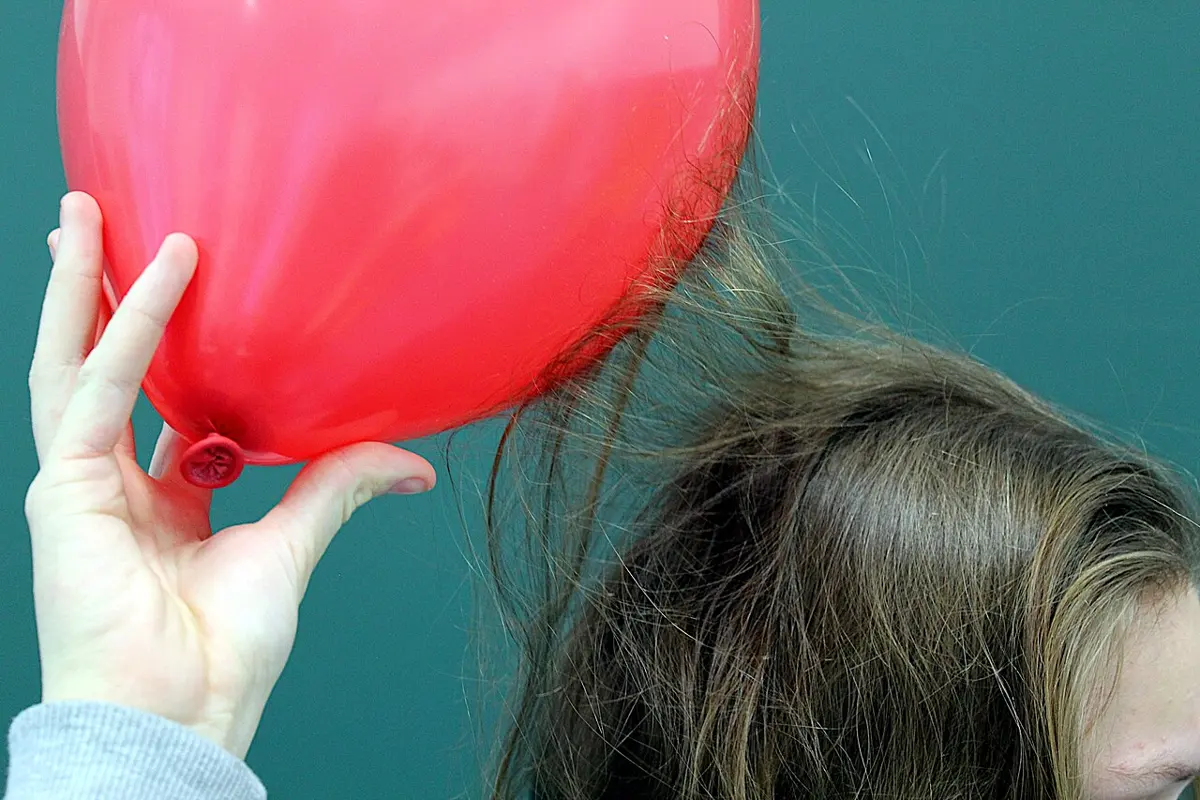
You rub a balloon on a woolen jumper. Afterwards the balloon is negatively charged. What has happened?
Pick an answer to see why.
Coulomb’s law
How strong is the push or pull between two charges? In 1785 the French engineer Charles-Augustin de Coulomb measured it. He hung a light rod from a fine wire, with a small charged ball on one end, and brought a second charged ball near it. The force between the balls turned the rod and twisted the wire, and the twist told him the size of the force. This instrument is a torsion balance; you met the same idea in Grade 10, when Cavendish used one to measure gravity’s tiny pull Grade 10: The gravitational constant, G.
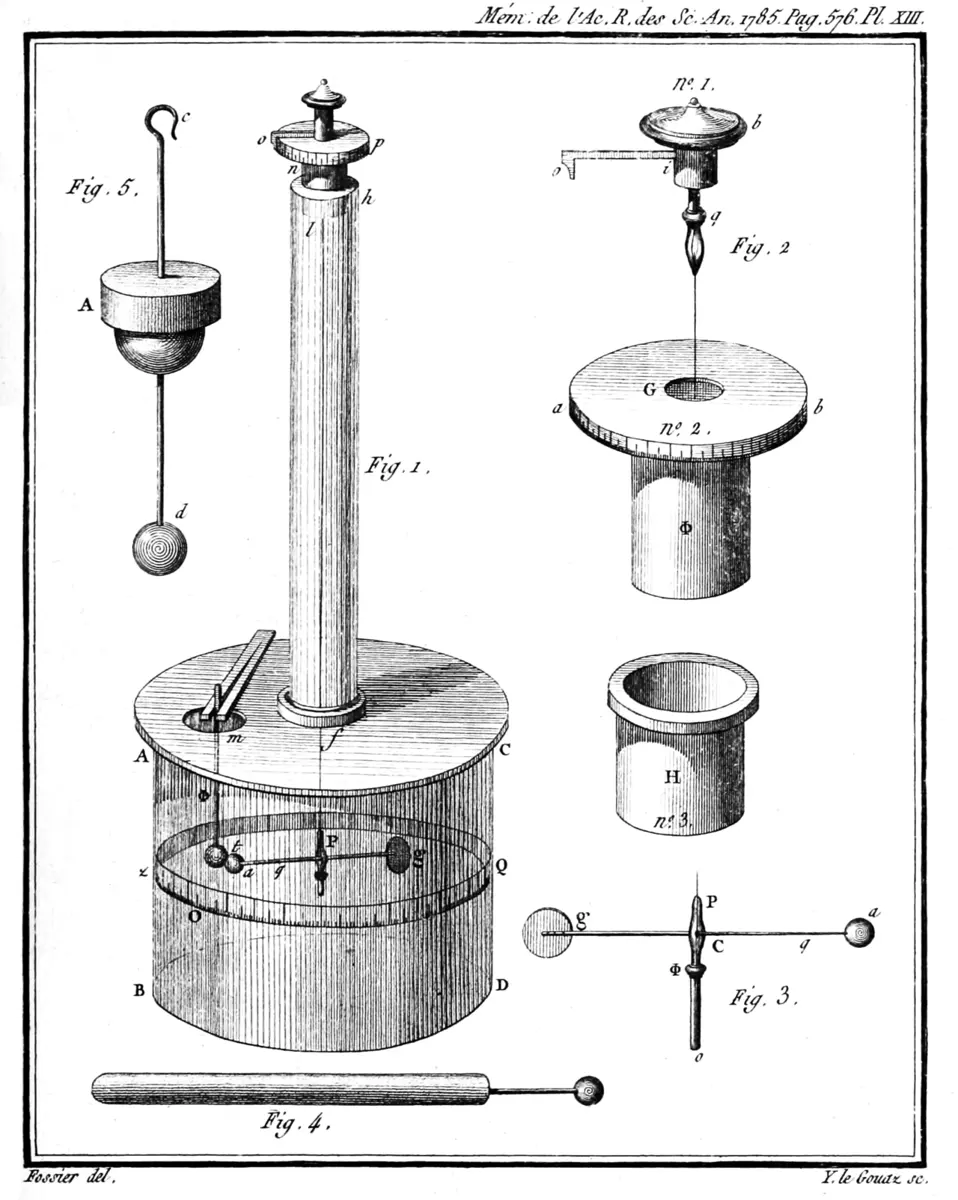
Coulomb found:
- Double the charge on one ball, and the force doubles. The force is proportional to the product of the charges.
- Double the distance between them, and the force falls to one quarter. The force is inversely proportional to the square of the distance.
Does that sound familiar? It is exactly the pattern of Newton’s law of gravitation Grade 10: Newton’s universal law of gravitation, with charge in place of mass. Written as a formula, Coulomb’s law is
where q₁ and q₂ are the two charges in coulombs, r is the distance between their centers in meters, and k is Coulomb’s constant:
(You may also see k written as ; it is the same number.) Like gravitation, the force is mutual: each charge pushes or pulls the other with the same force, along the line joining them (Newton’s third law).
Put the signs of the charges in, and the sign of F tells you which way it acts. If both charges have the same sign, q₁q₂ is positive: a push (repulsion). If they have opposite signs, q₁q₂ is negative: a pull (attraction).
Static charges are usually tiny, so we measure them in smaller units: the microcoulomb (1 µC = 10⁻⁶ C) and the nanocoulomb (1 nC = 10⁻⁹ C). A balloon rubbed on hair picks up something like a tenth of a microcoulomb (it varies a lot from balloon to balloon: take this as the size, not an exact figure).
Two charges push each other apart with a force F. If both charges are tripled and the distance is kept the same, the force becomes
Pick an answer to see why.
A positive charge and a negative charge are 10 cm apart. What happens to the force between them if the distance is changed to 5 cm?
Pick an answer to see why.
Gravity against electricity
The two laws have exactly the same shape:
| Gravitation | Electric force | |
|---|---|---|
| law | ||
| acts between | masses | charges |
| constant | G = 6.67 × 10⁻¹¹ N m²/kg² | k = 8.99 × 10⁹ N m²/C² |
| direction | always a pull | a pull (unlike charges) or a push (like charges) |
| reach | gets weaker as 1/r², never reaches zero | gets weaker as 1/r², never reaches zero |
| blocked by anything? | no | yes: a closed metal box shuts out electric forces |
Look at the two constants. k is about 10²⁰ times as big as G. That alone doesn’t settle which force is stronger, because a coulomb and a kilogram are different things. A fair test is two real particles.
So why does gravity, so incredibly weak, hold the planets in their orbits, while the electric force seems to do nothing on that scale?
Because of the minus sign. Mass only comes one way, so every kilogram of the Earth pulls on you, and the pulls of all its 10⁵⁰ or so atoms add up. Charge comes in two kinds that cancel. The Earth has almost exactly as many electrons as protons, so the pull of its protons on any charge is canceled by the push of its electrons. A planet’s electric force is nearly zero, not because the force is weak, but because it is so perfectly balanced.
The strength of the electric force is exactly what keeps everything so balanced. If some part of a body had a few spare electrons, they would push one another apart and pull in positive charge from around them until the balance was restored. Lightning and the spark from a jumper are what happens when that rebalancing is sudden.
You should find that the electric push overtakes gravity between one spare electron in 10¹⁸ (gravity still wins) and one in 10¹⁷ (the push wins): they balance at about one in 6 × 10¹⁷, and that the answer is the same for two balls, two people, or the Earth and the Moon. (The bigger the bodies, the more mass they have, but also the more electrons, in the same proportion.) Real planets are more neutral than that, so gravity wins.
Why does gravity, and not the electric force, hold the Moon in its orbit round the Earth?
Pick an answer to see why.
Fields: how a force reaches across space
The comb pulls the paper without touching it; the Earth pulls the Moon across 384,000 km of empty space. How does one thing push or pull another far away?
In the 1830s the English scientist Michael Faraday pictured it like this. A charge changes the space around it, even when nothing else is there. Bring a second charge into that space, and it feels a force. The changed space is called a field: a charge makes an electric field around it, and a mass makes a gravitational field around it. The field is there whether or not anything is there to feel it.
Gravitational field strength
You already know one field well. Hang a 1 kg mass from a spring balance anywhere in Bhaktapur, and it shows about 9.8 N; hang 2 kg, and it shows 19.6 N. The force on each kilogram is the same, 9.8 N. That force per kilogram is the gravitational field strength, g:
measured in newtons per kilogram (N/kg). It is the g you met in Grade 10 as the acceleration due to gravity, 9.8 m/s² Grade 10: Calculating g: 1 N/kg is the same as 1 m/s², since 1 N = 1 kg m/s². You also found there that at the Earth’s surface, and that it gets smaller higher up. That is the strength of the Earth’s gravitational field at a distance R from its center.
Electric field strength
The electric field is described the same way. Put a small positive test charge q at a point, and measure the force F on it. The electric field strength there is the force on each coulomb:
measured in newtons per coulomb (N/C). The field’s direction is the direction of the force on a positive charge. A negative charge in the same field is pushed the opposite way.
For a single charge Q, Coulomb’s law gives the field at a distance r: the force on the test charge is kQq/r², so
just as for a planet of mass M. Once you know the field at a point, the force on any charge put there is
and the force on any mass is F = mg. A field is a short way of saying, for every point at once, what force a charge or a mass would feel there.
Field lines
Faraday drew fields as field lines. Draw a line that, at every point, goes the way a small positive charge (or, for gravity, a small mass) would be pushed there. The rules:
- The arrows show the direction of the field: out of positive charges, into negative charges. Gravitational field lines always point into a mass, because gravity only pulls.
- Field lines start on positive charges and end on negative charges (or go off to far away). They never cross: at each point the field has only one direction.
- Where the lines are close together, the field is strong; where they spread apart, it is weak.
At a certain point, the electric field points due east. An electron is placed there. Which way is the force on it?
Pick an answer to see why.
In Figure 8.3, the field lines around a single positive charge are closest together near the charge. What does that tell you?
Pick an answer to see why.
Why the square?
Both laws have an r² underneath. That isn’t a coincidence, and the field lines show why.
Imagine the field lines leaving a charge (or going into a mass) evenly in every direction, like light from a bulb. At a distance r, all of them pass through the surface of a sphere of radius r, whose area is 4πr². At twice the distance, the same lines are shared over a sphere with four times the area, so each square meter gets a quarter as many lines: the field is a quarter as strong. At three times the distance, nine times the area, a ninth of the field.
So any field that spreads out evenly from a point in our three-dimensional space, and isn’t used up on the way, must weaken as 1/r². The light from a bulb and the sound from a firecracker spread the same way, which is why a lamp 2 m away gives a quarter of the light it gives at 1 m.
Two forces on one drop
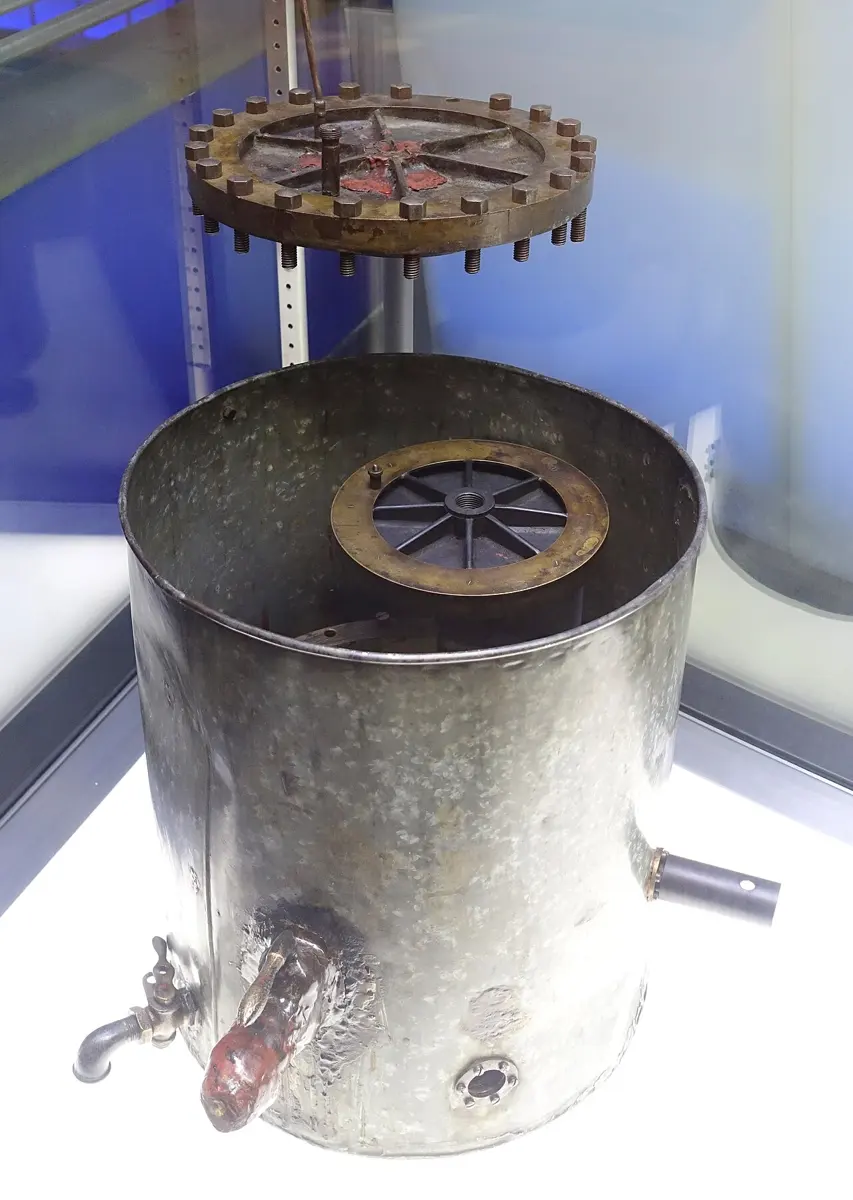
Both laws can act on the same thing at once. The most famous example is an experiment that measured the charge of a single electron.
A tiny drop of oil between the plates is pulled down by gravity with its weight, mg. If it has picked up a few spare electrons, the field pushes it up with a force qE. Turn up the voltage, and the field gets stronger, until the two forces are equal and the drop floats:
Measure the drop’s mass and the field that holds it still, and you have its charge.
Questions
Two small charged spheres attract each other with a force of 6.0 × 10⁻³ N when they are 4.0 cm apart. What is the force when they are 12 cm apart?
Pick an answer to see why.
Which is true of both the gravitational force and the electric force between two small objects?
Pick an answer to see why.
Two identical metal spheres carry charges of +6.0 µC and −2.0 µC, with their centers 30 cm apart.
- i.Calculate the force between them, and say whether it is attractive or repulsive.
- ii.The spheres are touched together, so that their charges share out equally, and then put back 30 cm apart. What is the charge on each now, and what is the new force?
Answer
- i.. A force of 1.2 N, attractive (opposite charges).
- ii.The total charge is conserved: +6.0 − 2.0 = +4.0 µC, shared equally, so each sphere has +2.0 µC. Now , repulsive, because both are now positive.
The Earth (mass 5.97 × 10²⁴ kg) and the Moon (mass 7.35 × 10²² kg) are 3.84 × 10⁸ m apart.
- i.Calculate the gravitational force between them.
- ii.Suppose the Earth and the Moon each carried an equal positive charge Q. How big would Q have to be for the electric push to cancel gravity’s pull?
- iii.Using your answer, explain why astronomers can ignore electric forces when they work out the Moon’s orbit.
Answer
- i., about 2.0 × 10²⁰ N.
- ii.The electric push must equal F, so , and Q = 5.7 × 10¹³ C.
- iii.That is a huge charge, about 3.6 × 10³² spare electrons each. A body with that much spare charge would pull in charge of the opposite sign from the gas in space around it until it was neutral again; real planets carry nothing like it. So the electric force between them is negligible, and gravity alone decides the orbit. (The Moon has about 10⁴⁹ electrons, so this would be only about one spare electron in 10¹⁷, yet still far more than it has.)
Explain, using the idea of charge, why a whole planet hardly pulls or pushes a charged balloon with its electric force, but a comb charged by a few strokes through your hair can lift scraps of paper against the gravity of the whole Earth.
Answer
A planet contains enormous numbers of positive and negative charges, but almost exactly equal numbers of each. The pull of its positive charges on the balloon is canceled by the push of its negative charges, so the total electric force is almost zero. Its mass, on the other hand, is all of one kind, and every kilogram adds its pull, so the planet’s gravity is large. The comb carries only a tiny charge, but that charge is unbalanced, and the electric force is so much stronger than gravity (about 10³⁶ times, between two protons) that even a tiny unbalanced charge a few centimeters away can beat the gravity of the whole Earth on a scrap of paper weighing a few milligrams.
A small positive charge is placed at a point P, 3.0 cm from a charge of +2.0 nC.
- i.What is the electric field strength at P, and which way does it point?
- ii.A charge of −5.0 nC replaces the small charge at P. What force does it feel, and which way?
- iii.Without calculating, what would the field strength be at 6.0 cm from the +2.0 nC charge?
Answer
- i., pointing away from the +2.0 nC charge.
- ii.F = qE = 5.0 × 10⁻⁹ × 2.0 × 10⁴ = 1.0 × 10⁻⁴ N, towards the +2.0 nC charge, because the charge is negative.
- iii.Twice the distance, so a quarter of the field: 5.0 × 10³ N/C.
The table shows the force measured between two charged balls at different distances, with the charges kept the same.
| Distance between centers (cm) | 2.0 | 3.0 | 4.0 | 6.0 |
|---|---|---|---|---|
| Force (mN) | 36 | 16 | 9.0 | 4.0 |
- i.Show that the results agree with Coulomb’s law.
- ii.Predict the force at 8.0 cm.
- iii.Each ball carries the same charge. Use the result at 2.0 cm to find it.
Hint
If F ∝ 1/r², then F × r² is the same for every row.
Answer
- i.Work out F × r² for each: 36 × 2.0² = 144; 16 × 3.0² = 144; 9.0 × 4.0² = 144; 4.0 × 6.0² = 144 (mN cm²). The product is constant, so the force is inversely proportional to the square of the distance, as Coulomb’s law says.
- ii.F = 144 ÷ 8.0² = 2.25 mN, about 2.3 mN.
- iii.F = kq²/r², so , and q = 4.0 × 10⁻⁸ C (40 nC).
In Millikan’s experiment, a drop of mass 4.9 × 10⁻¹⁵ kg is held still between the plates by a field of 1.0 × 10⁵ N/C.
- i.Draw the forces on the drop and say what is true of them.
- ii.Find the charge on the drop, and how many electrons it is.
- iii.If the field were switched off, what would happen to the drop, and why?
Answer
- i.Two forces: its weight, mg, down, and the electric force, qE, up. The drop is still, so they are equal and opposite.
- ii.q = mg/E = 4.9 × 10⁻¹⁵ × 9.8 ÷ 1.0 × 10⁵ = 4.8 × 10⁻¹⁹ C, which is 4.8 × 10⁻¹⁹ ÷ 1.60 × 10⁻¹⁹ = 3 electrons.
- iii.Only its weight would act, so it would fall. (It would quickly reach a slow, steady speed, because air resistance on such a tiny drop is large compared with its weight; Millikan used that speed to find each drop’s mass.)
Where to go next
- Why does salt melt at 801 °C but ice at 0 °C? The electric force between ions and molecules decides how hard they are to pull apart.
- Why is spider silk so strong? The strength of every material comes from electric forces between its atoms and molecules, and how they are arranged.
- How do magnets push without touching? Magnetic fields, the energy stored in fields, and how electric currents make them.
- Why do airbags save lives? Momentum and impulse: why spreading a collision over a longer time makes the force smaller.