
On 12 January 2026 an Indian PSLV rocket lifted off from Sriharikota carrying sixteen satellites. One of them was Munal, a small satellite built by Nepali school students with the Nepal Academy of Science and Technology. The rocket climbed far above the air, well into space. Then its third stage misbehaved, and the rocket fell short of the speed it needed. Every satellite on board was lost.
Height was never the problem. Getting up into space is the easy part; staying there is all about going sideways fast enough. On a clear evening you can see a satellite that got it right: the International Space Station, a bright, steady dot crossing Nepal’s sky in a few minutes, 400 km up. It isn’t floating. It is falling towards the Earth all the time, and missing. This topic uses Newton’s law of gravitation to work out exactly how fast a satellite has to go to keep missing, how long each orbit takes, and why the satellites that bring television to Nepal’s rooftops all sit at one particular height.
Falling and missing
You met the idea in Grade 10: a ball fired sideways from a high mountain falls, but if it is fast enough the round Earth curves away beneath it as fast as it falls, and it never lands (Orbiting is falling, with Newton’s cannon to play with). Everything inside a falling spacecraft falls with it, so the astronauts float Grade 10: Weightlessness. And in Grade 9 you met the three kinds of orbit, low, medium and geostationary Grade 9: Orbits of artificial satellites. Here we go further, and put numbers on it.
Start with one second of the Space Station’s flight. It moves at about 7.67 km/s, so in one second it goes 7,670 m sideways. At its height, 400 km up, gravity is weaker than on the ground: you worked out in Grade 10 that g there is 8.69 m/s² Grade 10: g decreases with height. Anything dropped there falls
in the first second. Now the Earth. It is round, so a straight line drawn level from the Space Station rises away from the Earth’s surface. Over 7,670 m, how far does the curved Earth drop below that straight line? The answer (you can check it with Pythagoras’ theorem, below) is 4.34 m. The station falls 4.35 m, and the ground curves away by 4.34 m: the same, to within the rounding of the numbers. It falls, but gets no closer to the ground. That is an orbit, in numbers.
Why doesn’t the Space Station need its engines to stay up?
Pick an answer to see why.
How fast must a satellite go?
Going round in a circle needs a pull
Whirl a stone round on a string. The stone wants to go straight (Newton’s first law), and the string keeps pulling it inwards, towards your hand, so its path bends into a circle. Let go, and it flies off in a straight line, along the direction it was moving at that moment. A bus going round a bend on a hill road is the same: the road’s grip on the tyres pulls the bus towards the inside of the bend, and you, sliding on your seat, feel thrown outwards because your body tries to go straight on.
So anything moving in a circle is being pulled towards the center all the time. Its speed may stay the same, but its direction keeps changing, so it is accelerating (Grade 9: acceleration is any change in velocity, and velocity includes direction). This acceleration towards the center of a circle is called centripetal acceleration (from Latin for “center-seeking”). How big must it be?
Look at Figure 33.1 again, for a very short time t. The station, at distance r from the Earth’s center, moves a distance vt sideways along the straight line. The straight line, the line from the station to the center, and the line from the center to the end of the straight line make a right-angled triangle. The end of the straight line is a little farther from the center than the orbit: call the extra distance d. That is how far the station must fall in time t to stay on its orbit. The end of the straight line is r + d from the center, so by Pythagoras:
For a short time, d is tiny next to r (4 m next to 6,771 km), so d² is far smaller still and can be left out:
But we also know how far something falls from rest in time t with acceleration a: Grade 10: Equations of motion. For the orbit to work, the two must be equal:
Any object going round a circle of radius r at speed v must have an acceleration of v²/r towards the center, and so, by Newton’s second law, a force mv²/r towards the center. That force is called the centripetal force.
Gravity does the pulling
For a satellite, gravity is the only force on it, so gravity must give exactly the acceleration v²/r. You know from Grade 10 how strong gravity is at a distance r from the Earth’s center: , where M is the Earth’s mass and G = 6.67 × 10⁻¹¹ N m²/kg² Grade 10: Newton’s universal law of gravitation. So for a circular orbit:
This is the orbital speed: the speed a satellite must have to go round in a circle at distance r from the center of the planet it orbits. Three things to notice:
- r is measured from the Earth’s center: the Earth’s radius plus the height above the ground.
- The farther out, the slower the orbit. Gravity is weaker there, so less speed is enough.
- The satellite’s own mass is nowhere in it. It canceled: a heavier satellite is pulled harder, but is harder to turn by just as much. A 1.3 kg CubeSat and the 420-tonne Space Station at the same height go at the same speed. So does an astronaut, and a drop of her tea, which is why they float beside the station instead of falling to its floor.
A 1,000 kg satellite and a 1 kg satellite are put into circular orbits at the same height. Which needs the greater speed?
Pick an answer to see why.
How long does one orbit take?
Once you know the speed, the time for one orbit, its period T, follows: once round the circle is a distance 2πr, so
Putting in gives the period from the distance alone:
Higher orbits take longer for two reasons at once: the way round is longer, and the satellite goes more slowly.
Why geostationary satellites are 36,000 km up
A dish on a roof in Bhaktapur stays pointed at one spot in the southern sky for years. The satellite it looks at must go round once in exactly the time the Earth takes to turn once, 23 hours 56 minutes 4 seconds (Grade 9 explains why that, and not 24 hours: Geostationary Earth Orbit), in the same direction, above the equator. Only one distance from the Earth gives that period. Nobody chose it: the law of gravitation did.
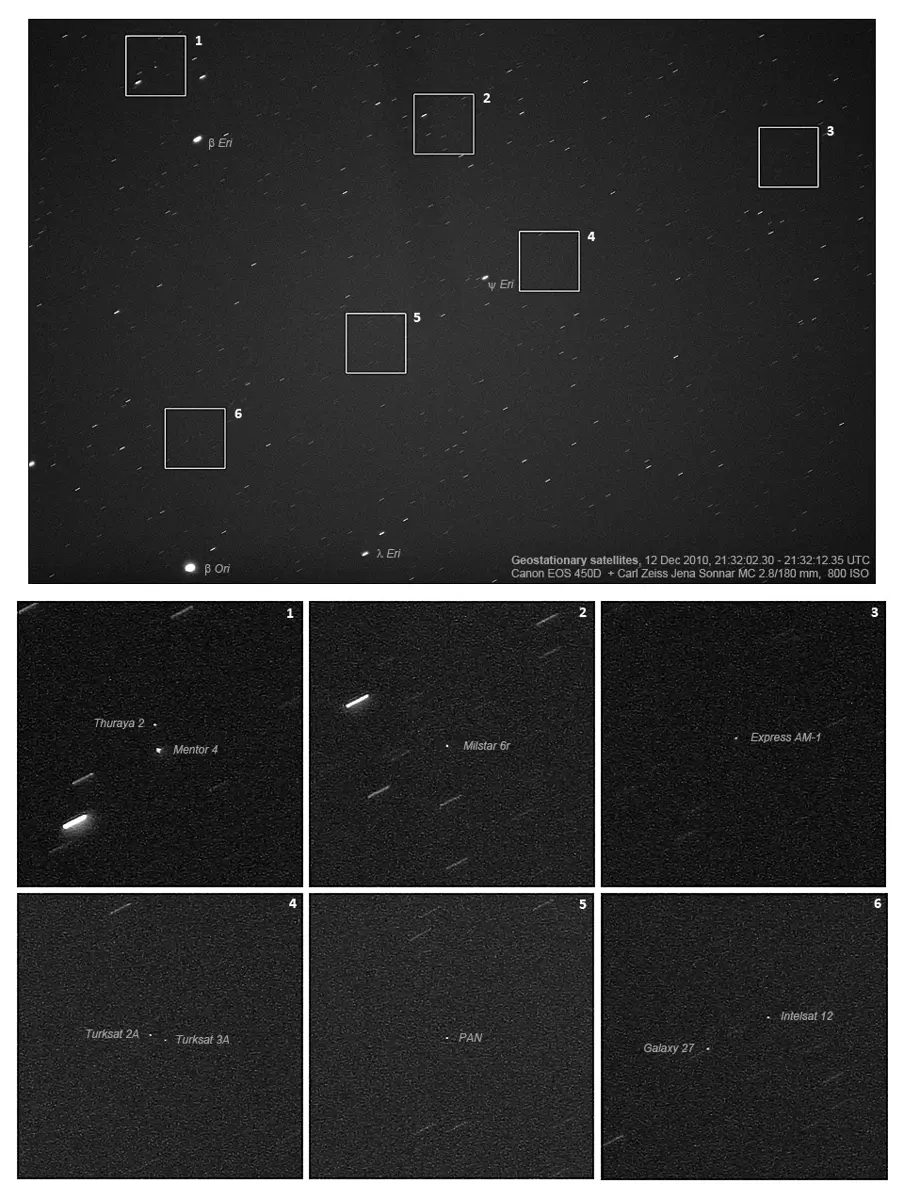
A company wants a satellite that stays above Nepal’s longitude all the time, but at only 10,000 km up, so its signal is stronger. Why won’t it work?
Pick an answer to see why.
Weighing the Earth, the Sun and Jupiter
Turn the period formula round, and it does something remarkable: it weighs whatever is in the middle. Squaring and rearranging,
Measure how far a moon is from its planet, and how long it takes to go round, and you have the planet’s mass. Nobody has ever put the Sun on a balance; this is how we know its mass.
Kepler’s three laws
The orbits so far have been circles. Real orbits are only nearly circles, and the rules they follow were found from the sky, half a century before Newton explained them.
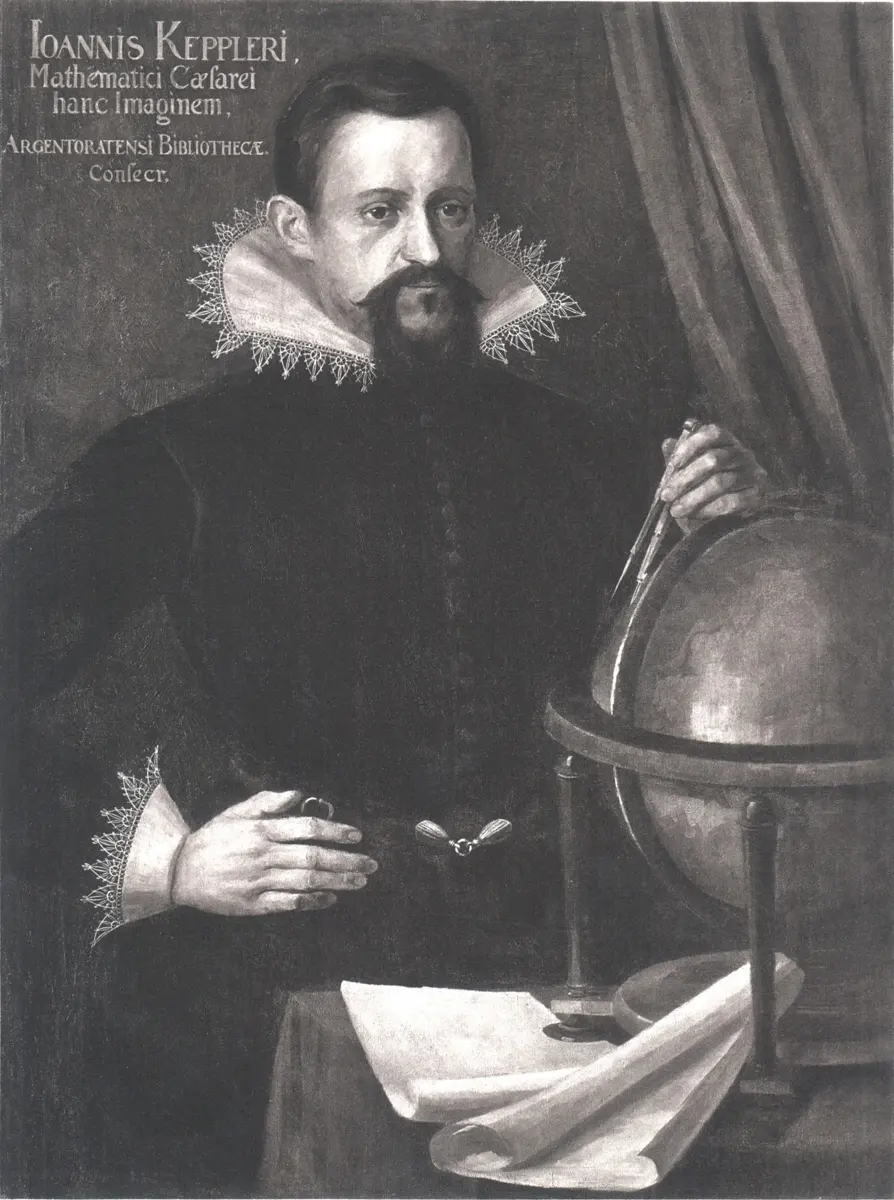
The first law: ellipses
Kepler’s first law: each planet moves in an ellipse, with the Sun at one focus.
An ellipse is a stretched circle. It has two special points inside it, its foci (one focus, two foci), and for every point on the ellipse, the distances to the two foci add up to the same total. Half the ellipse’s longest width is its semi-major axis, a; for a planet it is the average of its nearest and farthest distances from the Sun. How stretched an ellipse is, is its eccentricity, e: 0 for a circle, close to 1 for a long, thin one.
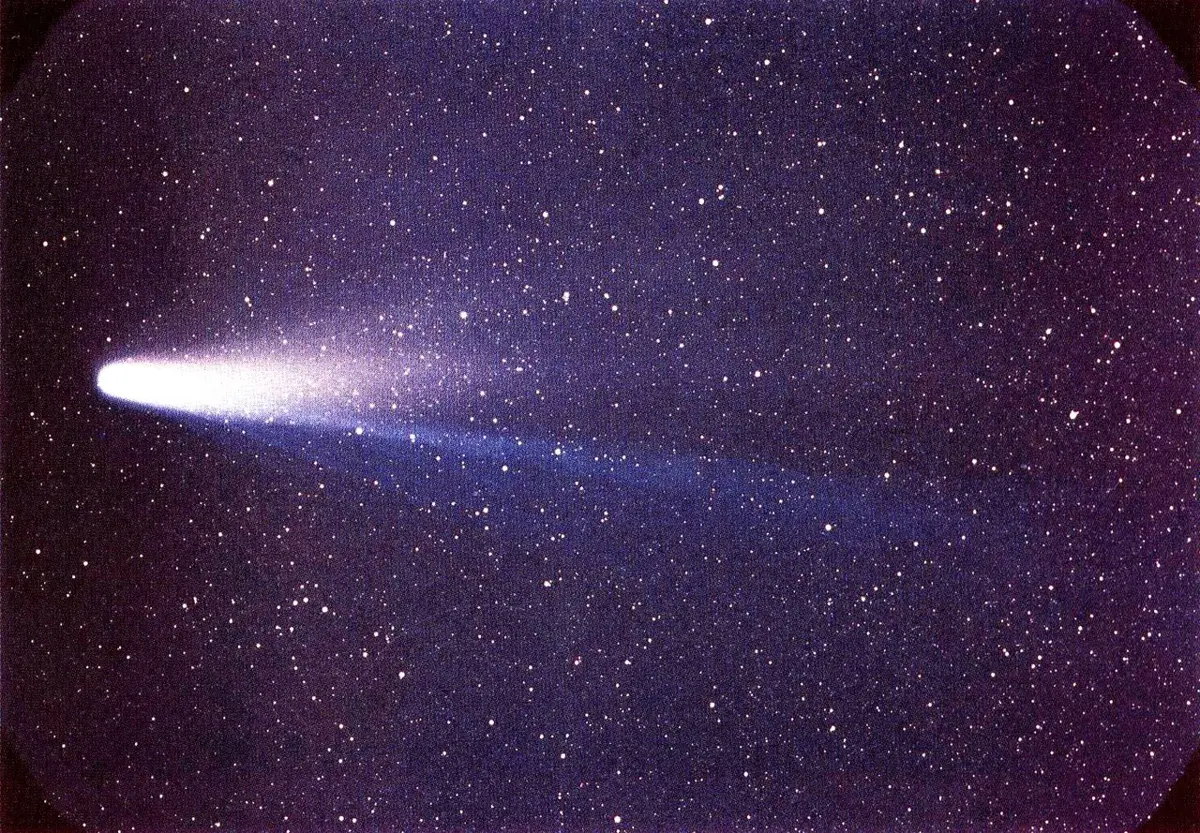
Most planets’ orbits are very nearly circles: the Earth’s eccentricity is 0.017, so its distance from the Sun changes by only about 3 %, from 147.1 million km in early January to 152.1 million km in early July. Comets have long, thin orbits: Halley’s comet (e = 0.967) swings in to 0.59 times the Earth’s distance from the Sun, inside the orbit of Venus, and out to 35 times, beyond Neptune.
The second law: equal areas in equal times
Kepler’s second law: the line from the Sun to a planet sweeps out equal areas in equal times.
On a stretched orbit, a planet near the Sun is on a short line, so it must move fast to sweep out its share of area; far away, the line is long, and a slow crawl sweeps out just as much. So a planet speeds up as it falls in towards the Sun, and slows down as it climbs away, like a ball thrown up a hill and rolling back.
Take a very short time at the nearest point, and the same short time at the farthest. Each slice swept out is then a thin triangle, of height r and base v × (the time), so equal areas mean the same value of r × v:
where r₁ and v₁ are the distance and speed at the nearest point and r₂ and v₂ at the farthest. (This is true only at those two points, where the planet moves at right angles to the line from the Sun.)
In which month does the Earth move fastest along its orbit?
Pick an answer to see why.
The third law: the period and the size of the orbit
Kepler’s third law: the square of a planet’s period is proportional to the cube of its semi-major axis, .
You already have it. For a circular orbit, squaring gives
and is the same for every planet of the Sun. Newton showed in the Principia that this is still true for an ellipse, with the semi-major axis a in place of r. With T in years and a in astronomical units (AU; 1 AU is the Earth’s average distance from the Sun, 1.496 × 10⁸ km), the Earth has T = 1 and a = 1, so for every planet T² = a³. Check it:
| Planet | a (AU) | T (years) | a³ | T² |
|---|---|---|---|---|
| Mercury | 0.387 | 0.241 | 0.058 | 0.058 |
| Venus | 0.723 | 0.615 | 0.378 | 0.378 |
| Earth | 1.000 | 1.000 | 1.000 | 1.000 |
| Mars | 1.524 | 1.881 | 3.54 | 3.54 |
| Jupiter | 5.20 | 11.86 | 141 | 141 |
| Saturn | 9.55 | 29.46 | 871 | 868 |
| Uranus | 19.22 | 84.0 | 7,100 | 7,060 |
| Neptune | 30.11 | 164.8 | 27,300 | 27,200 |
(Distances and periods from NASA JPL’s planetary data; the outer planets are off by a fraction of a percent because they tug on one another a little.)
The same law works for the Earth’s satellites, with the Earth’s mass in it in place of the Sun’s, and with an ellipse’s semi-major axis in place of the radius.
Two satellites have the same semi-major axis. One has a circular orbit, the other a stretched ellipse. Which takes longer to go round?
Pick an answer to see why.
Changing orbit
Mostly speed, not height
Getting a satellite into orbit takes energy, and you can count it as you did in Kinetic energy: the energy of motion and Gravitational potential energy: the energy of height.
Going up by speeding up
Communications satellites are rarely launched straight to 35,786 km. The rocket first puts them in a low orbit, then sends them up a transfer orbit: an ellipse that just touches the low orbit at its nearest point and the geostationary orbit at its farthest. To get on to it, the satellite fires its engine to push itself forwards, and speeds up. It then climbs, slowing down as it climbs, like a ball thrown upwards. At the top it is going too slowly to stay up there, so it fires its engine to push forwards once more, up to the geostationary speed.
Slowly falling for real
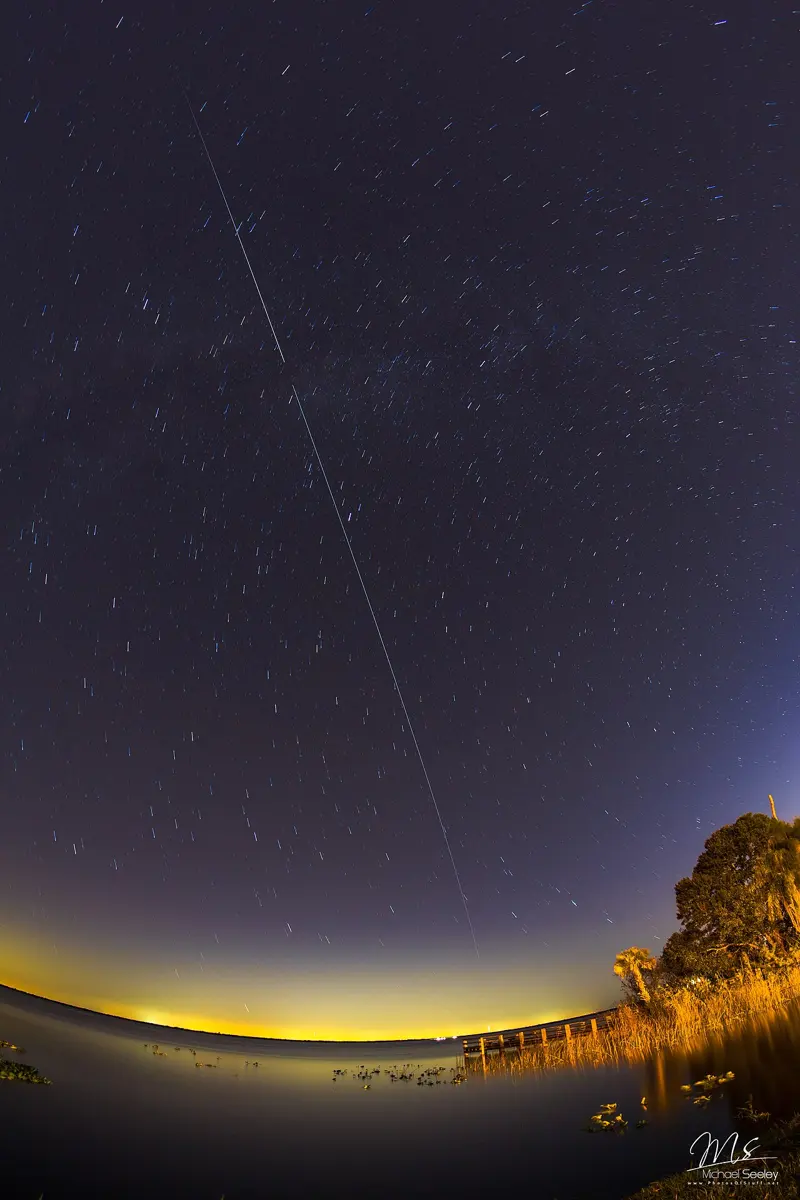
Even at 400 km there is a trace of air, a few trillionths as dense as at the ground, and the Space Station plows through it at 7.67 km/s. The drag slowly takes away its energy, and it sinks lower, where the air is thicker. Left alone, it would come down in a year or two, so every few weeks or months a spacecraft docked to it fires its engines to push it back up.
Small satellites have no engines to do that. NepaliSat-1, pushed out from the Space Station at 400 km in June 2019, sank lower and lower and burned up in the air on 4 October 2021. Nepal PQ-1, a 250 g satellite only 5 cm on a side, built by the Nepali company ORION Space with AMSAT-Nepal, was launched in January 2022 and burned up in February 2024. Satellites in geostationary orbit, far above the air, can stay up for millions of years; when one’s working life is over, its last fuel is used to move it a few hundred kilometers higher, out of everyone’s way, into a graveyard orbit.
A satellite in a low orbit loses a little energy to air drag every orbit. Over the months, it
Pick an answer to see why.
Predicting an orbit, step by step
The formulas in this topic are for circles and ellipses, with one body pulling one other. Real spacecraft feel the Earth, the Moon, the Sun, the drag of the air and their own engines all at once, and no neat formula fits. So how do space agencies know exactly where a spacecraft will be next week? They let a computer apply Newton’s law over and over, in small steps of time. Each step is simple enough to do with a calculator:
- Work out the pull of gravity on the satellite where it is now, GM/r² towards the Earth’s center.
- Change its velocity: the pull changes it by (pull × time step), in the direction of the pull.
- Move the satellite: with its new velocity, it moves (velocity × time step) in a straight line.
- Go back to step 1, from the new position.
This is a computational model: the orbit is never written down as a formula; it is built up from the law, one step at a time. The smaller the steps, the closer the answer, and the more steps a computer must do.
Questions
Satellite 1 orbits 400 km up, satellite 2 orbits 4,000 km up. Compared with satellite 1, satellite 2
Pick an answer to see why.
A planet is found going round a distant star in a circular orbit. Which measurements are enough to work out the star’s mass?
Pick an answer to see why.
Explain, using the idea of falling, why a satellite in a circular orbit needs no engine to keep going round, but a satellite 300 km up does need one now and then.
Answer
In orbit, the only force needed is gravity, which pulls the satellite towards the Earth; it is moving sideways so fast that as it falls, the curved surface of the Earth drops away beneath it just as fast, so it never gets closer. In a circular orbit, gravity always acts at right angles to the motion, so it changes the satellite’s direction but not its speed, and with no air there is nothing to slow it: it keeps going by Newton’s first law. But at 300 km there is still a trace of air. Its drag slowly takes away the satellite’s energy, and the satellite sinks lower, into thicker air, and would eventually burn up. An engine is needed now and then to push it back up.
A satellite is to orbit 1,000 km above the Earth. (GM for the Earth = 3.98 × 10¹⁴ N m²/kg, R = 6,371 km.) a. Find its orbital speed. b. Find its period. c. How many times does it go round in a day?
Answer
a. r = 6,371 + 1,000 = 7,371 km = 7.371 × 10⁶ m.
= 7.35 × 10³ m/s (7.35 km/s).
- b. = 6.30 × 10³ s = 105 minutes.
- c.In 1,440 minutes it goes round 1,440 ÷ 105 = 13.7 times.
Use Kepler’s third law. a. Jupiter is 5.20 AU from the Sun. Find its period in years. b. A dwarf planet takes 248 years to go round the Sun. What is the semi-major axis of its orbit? (This is Pluto.)
Answer
- a.T² = a³ = 5.20³ = 140.6, so T = √140.6 = 11.9 years.
- b.a³ = T² = 248² = 61,500, so a = ∛61,500 = 39.5 AU. (Pluto’s orbit is quite stretched, e = 0.25: it comes in to about 30 AU, a little inside Neptune’s orbit, and goes out to about 49 AU.)
The Moon is 3.844 × 10⁸ m from the Earth and takes 27.3 days to go round it. A geostationary satellite is 4.22 × 10⁷ m from the Earth’s center. Use Kepler’s third law (T² ∝ r³) and the Moon’s orbit to predict the satellite’s period, without using G or the Earth’s mass.
Hint
Since T² ÷ r³ is the same for both, .
Answer
About 0.99 days, 23.8 hours: one turn of the Earth, as it should be. (The small difference comes from rounding, and because the Moon’s mass adds a little to the pull in its own orbit.)
In early January the Earth is 147.1 million km from the Sun and moves at 30.3 km/s. In early July it is 152.1 million km away. a. Use Kepler’s second law to find its speed in early July. b. Explain why it is slower then.
Answer
a. At the nearest and farthest points, r₁v₁ = r₂v₂:
b. Between January and July the Earth is moving away from the Sun, against the Sun’s pull, which slows it down, just as a ball thrown upwards slows as it climbs. Between July and January it falls back in towards the Sun and speeds up again. Kepler’s second law describes this: the line from the Sun is longer in July, so the Earth needs to move less fast to sweep out the same area each day.
Nepal’s government wants to choose an orbit for two satellites. One must take sharp photos of Nepal’s glacial lakes, to warn of floods; the other must relay television to all of Nepal, all day. For each, choose a height and say what its period would be, giving the reasons for each choice. What does each choice cost?
Answer
Glacial lakes: a low Earth orbit, a few hundred km up (say 500–600 km): close, so its camera can see small details. Its period is about 95 minutes. The cost: it races over Nepal in a few minutes at a time, so it sees any one lake only now and then (once every few days on a typical orbit), and drag will bring it down within years unless it has fuel to push itself back up. (Most such satellites use a sun-synchronous orbit over the poles, which passes over each place at the same time of day.)
Television: a geostationary orbit, 35,786 km above the equator, with a period of 23 h 56 min, the same as the Earth’s turn. It stays in the same place in Nepal’s sky, so fixed dishes on every roof can point at it, and from that height it can see the whole country, and nearly half the Earth, at once. The cost: it is about 60 to 70 times farther away than the low satellite, so the signal is weaker and takes about a quarter of a second to go up and back down; and getting there takes a much bigger rocket.
Galileo found four moons of Jupiter in 1610. The innermost, Io, goes round in 1.77 days at 422,000 km from Jupiter’s center; the outermost, Callisto, at 1,883,000 km. a. Predict Callisto’s period. b. Its measured period is 16.7 days. What does the agreement show?
Answer
a. By Kepler’s third law for Jupiter’s moons,
b. Kepler found his third law for the planets going round the Sun. That it predicts the periods of moons going round Jupiter just as well shows that the same law of gravity, with a different mass in the middle, rules both: it is a universal law, not a special rule for the Sun’s family.
Where to go next
- Why Is Gravity So Weak? The pull that holds satellites up is the weakest force there is; yet it rules the sky. Compare it with the electric force, and see what a gravitational field is.
- How Long Will the Sun Shine? Weighing stars by their orbits, as you weighed the Sun here, is how astronomers found that heavier stars live far shorter lives.
- How Do We Know the Universe Is Expanding? Gravity also pulls on the whole universe. Whether the galaxies, like a rocket, can escape each other’s pull is the question at the end of Grade 10’s future of the universe.