
Let go of a pen and it falls. Throw a ball up and it comes back. Water in the Bagmati flows down from the hills to the plains, never uphill. All of these happen for one reason: the Earth pulls everything towards its center.
It isn’t only the Earth. In February 2021, NASA’s Perseverance rover arrived at Mars, and the planet’s pull dragged it down through the thin Martian air so fast that it needed a heat shield, a giant parachute and rockets to land safely. Mars pulls things towards its center too. So do the Moon and the Sun, and so do you.
This unit is about that pull, gravity: how strong it is, why it is weaker on the Moon and on Mount Everest, why a feather and a hammer fall together on the Moon, and why astronauts float in the Space Station even though the Earth is still pulling them.
Gravitation and Newton’s law
Why does an apple fall straight down?
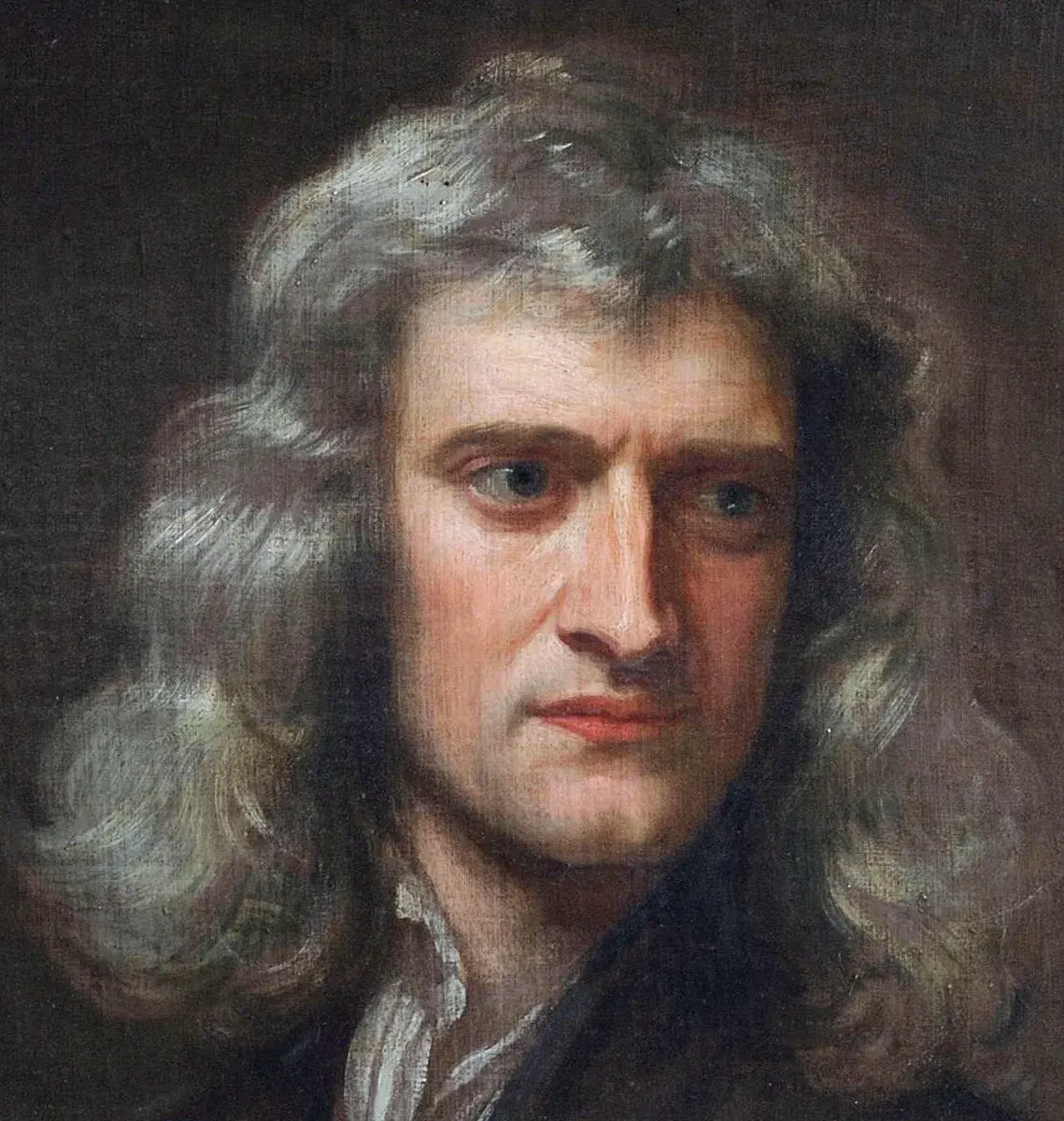
The story goes that in 1666 a young Isaac Newton was sitting in his mother’s garden in England when an apple fell from a tree. (It didn’t hit him on the head; that part was added later.) Newton wondered: why does the apple always fall straight down, towards the center of the Earth? Why not sideways, or up?
His answer: the Earth pulls the apple. Then he asked a bigger question. If the Earth’s pull reaches the top of an apple tree, and the top of a mountain, does it reach all the way to the Moon? Could the same pull that drops the apple be what keeps the Moon going round the Earth, and the planets round the Sun?
After years of work, Newton concluded that every object in the universe attracts every other object. He called this attraction gravitation, and in 1687 he published the universal law of gravitation in his book Principia.
Activity 7.1: what makes the pull stronger?
Try it yourself here. Each time you change something, the lab shows how many times bigger or smaller the force became.
Newton’s universal law of gravitation
Activity 7.1 found exactly what Newton’s law says:
The gravitational force between any two objects in the universe is directly proportional to the product of their masses and inversely proportional to the square of the distance between their centers.
Let’s turn the sentence into a formula. Say the masses are m₁ and m₂, the distance between their centers is d, and the force is F (Figure 7.2).
The force is proportional to the product of the masses:
and inversely proportional to the square of the distance:
Putting (i) and (ii) together:
To turn “is proportional to” into “equals”, we put in a constant, G:
G is the universal gravitational constant. With equation (iii), you can work out the pull between any two objects, from two marbles to two galaxies.
Two things to notice about the force:
- It is mutual: A pulls B exactly as hard as B pulls A (Newton’s third law). The Earth pulls you with your weight, and you pull the Earth with the same force.
- It is always an attraction, never a push, and it acts along the line joining the two centers.
The gravitational constant, G
What does G mean? Put m₁ = 1 kg, m₂ = 1 kg and d = 1 m into equation (iii):
So G is the gravitational force between two masses of 1 kg each, placed 1 m apart (center to center).
Its value is
That is 0.0000000000667 N: two 1 kg bags of rice a meter apart pull each other with less than a ten-billionth of a newton. No wonder you never notice it.
G has the same value everywhere: whatever the objects are made of, whatever lies between them (air, water, a wall, empty space), and anywhere in the universe. That is why it is called universal.
Two boxes are on a table. If the distance between them is made three times as large, the gravitational force between them becomes
Pick an answer to see why.
A boy of mass 50 kg stands on the Earth. Which statement is true?
Pick an answer to see why.
Worked examples
How the force changes with mass and distance
The results of Activity 7.1 come straight out of the formula. Start with two objects of masses m₁ and m₂, a distance d apart:
| What changes | Put into the formula | New force |
|---|---|---|
| One mass doubled (m₁ → 2m₁) | F₂ = 2F₁ (twice) | |
| Both masses doubled | F₂ = 4F₁ (4 times) | |
| Distance halved (d → d/2) | F₂ = 4F₁ (4 times) | |
| Distance doubled (d → 2d) | F₂ = ¼F₁ (a quarter) |
A quick way to do any of these: multiply by whatever happens to a mass, and divide by the square of whatever happens to the distance.
The distance between two objects is made half, and the mass of each is kept the same. The force becomes
Pick an answer to see why.
What gravitation does
Gravitation is the weakest force we know of, but it never cancels out (there is no “negative mass” to push back), and it reaches across any distance. So for big things, planets, stars and galaxies, it is the force in charge.
- It holds the universe together. It made the Sun, the planets and the galaxies, and it keeps the planets moving round the Sun.
- It causes the tides. The Moon is tiny compared with the Sun, but it is so much closer that its pull on the Earth’s oceans is the bigger one. The Moon pulls the side of the sea nearest it more strongly than the Earth’s center, and the Earth’s center more strongly than the far side, so the oceans bulge on both sides. As the Earth turns, most coasts get two high tides a day.
- It holds us and everything else on the ground, and brings back whatever we throw up.
Gravity and acceleration due to gravity
Gravity
The Earth, the other planets and the moons pull nearby objects towards their centers. The pull of a planet or moon on an object near it is called the force of gravity. It is also called the object’s weight.
Newton’s law says that this pull gets weaker the farther away you go, and becomes negligible very far away. So each planet and moon has a gravitational field, a region around it where its gravity can be felt.
We see the Earth’s gravity at work all day long:
- Everything has weight.
- The Earth keeps its atmosphere: gravity stops the air from escaping into space. (The Moon’s gravity is too weak to hold an atmosphere.)
- Things fall when dropped.
- Rivers flow downhill, from the Himalaya to the Terai and on to the Bay of Bengal.
- A falling object speeds up: it accelerates.
Activity 7.2: measuring the acceleration of a falling stone
Acceleration due to gravity
In Activity 7.2 the stone, once released, is pulled down by the Earth’s gravity all the way. A force that keeps acting makes an object go faster and faster: it accelerates. When air resistance is small enough to ignore, this acceleration is about 9.8 m/s².
The acceleration of a freely falling object, produced by the force of gravity, is called the acceleration due to gravity. It is written g, and its SI unit is m/s² (also written m s⁻²).
What does g = 9.8 m/s² mean? A freely falling object gains 9.8 m/s of speed every second:
| Time after letting go | 0 s | 1 s | 2 s | 3 s | 4 s |
|---|---|---|---|---|---|
| Speed | 0 m/s | 9.8 m/s | 19.6 m/s | 29.4 m/s | 39.2 m/s |
| Distance fallen | 0 m | 4.9 m | 19.6 m | 44.1 m | 78.4 m |
An object thrown straight up does the opposite: it loses 9.8 m/s every second until its speed is zero at the top, and then it falls back down.
Activity 7.3: paper, paper ball and stone
Try the same race on the screen, with the air on and off.
The feather and coin experiment
The same thing can be shown on Earth, by taking the air away.
A long glass tube is connected to a vacuum pump. A feather and a coin lie at the bottom (Figure 7.8).
- With air in the tube, turn it quickly upside down. The coin falls fast; the feather floats down slowly.
- Pump the air out, then turn the tube upside down again. The feather and the coin fall together, side by side.
Why? With air in the tube, the feather’s large, fluffy surface meets a lot of air resistance for its tiny weight, which slows it down. The coin is heavy for its size, so air hardly slows it. With no air, there is no air resistance, and both fall with the same acceleration, g.
Conclusion of the feather and coin experiment: in the absence of air resistance, all objects fall with the same acceleration. The value of g does not depend on the mass of the falling object.
A cricket ball (160 g) and a table-tennis ball (under 3 g) are dropped together from the top of a three-storey building. Which lands first?
Pick an answer to see why.
Calculating g
Why should a heavy stone and a light one fall with the same acceleration? Newton’s two laws together give the answer.
Suppose an object of mass m is on the surface of a planet of mass M and radius R. By the law of gravitation, the planet pulls it with a force
This force gives the object an acceleration g. By Newton’s second law (F = ma, with a = g):
Both are the same force, so (i) = (ii):
The object’s mass m is on both sides, so it cancels:
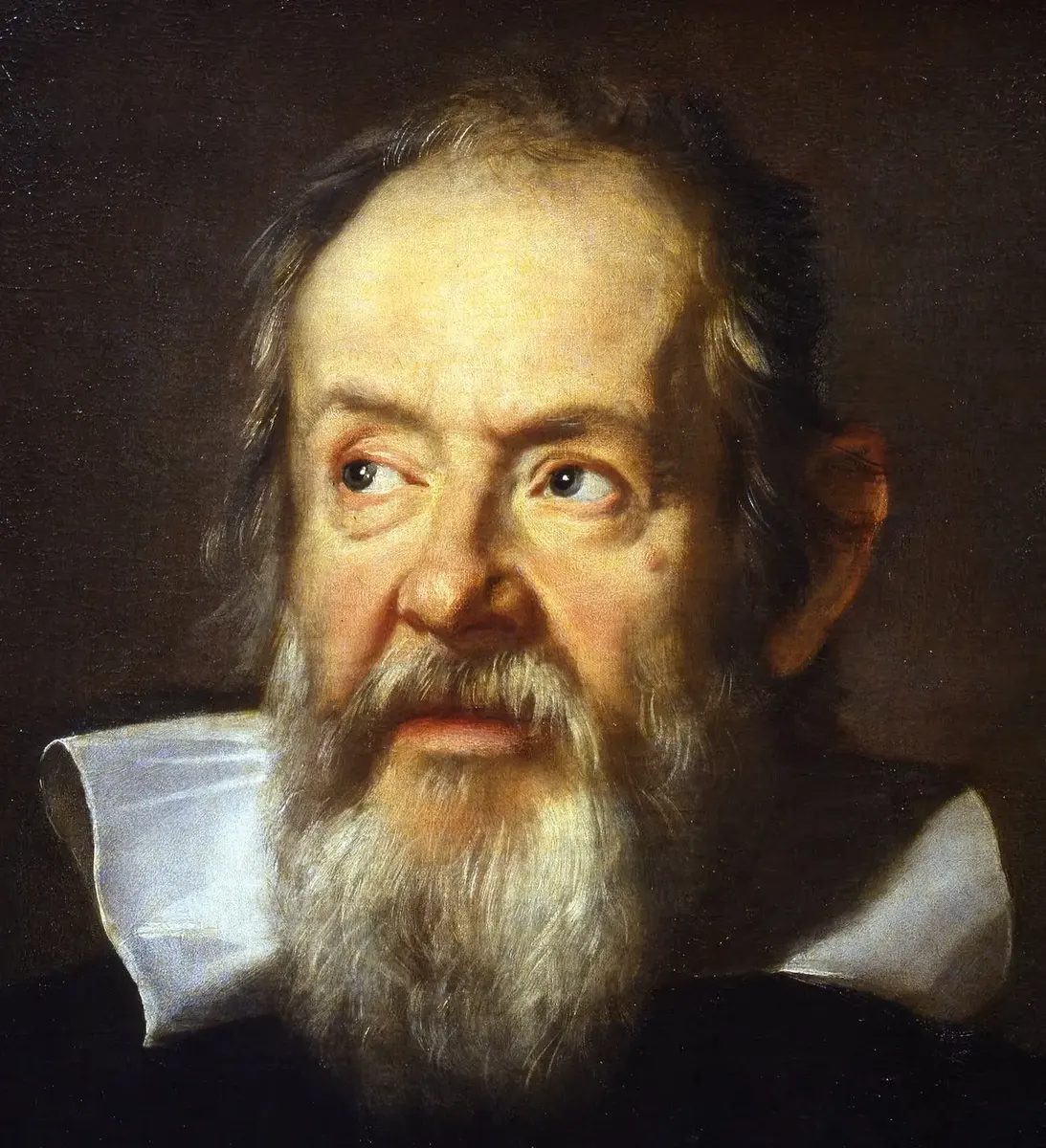
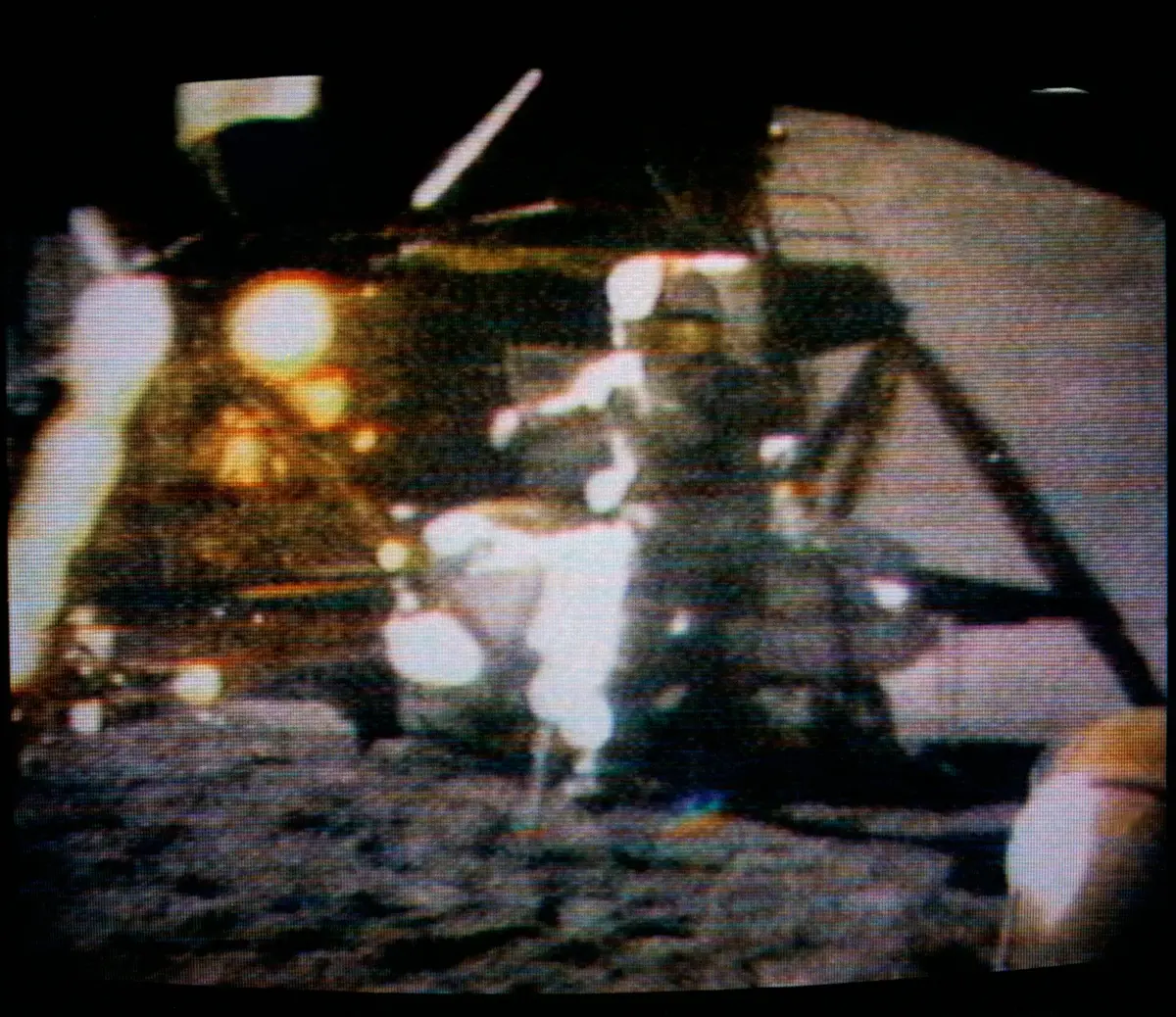
This is the formula for the acceleration due to gravity, and look what is not in it: the mass of the falling object. g depends only on the planet: its mass M and its radius R. That is exactly what Galileo, the feather and coin, and David Scott found.
A heavy stone is pulled harder than a light one, but it is also harder to speed up, by exactly the same factor. The two effects cancel.
Mass and radius both matter
Since G and M are fixed for a planet, equation (iii) says
g is inversely proportional to the square of the radius. A bigger mass makes g bigger; a bigger radius makes it smaller, and the radius counts twice (squared).
Jupiter shows both at work. Its mass is about 319 times the Earth’s, but its radius is about 11 times the Earth’s. So its g is
only 2.6 times the Earth’s, not 319 times. Its huge mass is spread out, and its surface is far from its center.
A planet has the same mass as the Earth but twice its radius. What is g on its surface?
Pick an answer to see why.
Why g is different in different places on the Earth
The Earth isn’t a perfect ball. It spins once a day, and the spin has made it bulge at the equator and flatten slightly at the poles. The radius at the equator is about 6378 km; at the poles it is about 6357 km, 21 km less.
Since g ∝ 1/R², g is larger at the poles, where R is smaller:
| Place | Distance from the center | g |
|---|---|---|
| Equator | about 6378 km | 9.78 m/s² |
| Poles | about 6357 km | 9.83 m/s² |
| Average, used in calculations | 6371 km | 9.81 m/s² (often rounded to 9.8) |
So a stone dropped at the North Pole falls a little faster than one dropped in Kenya or Indonesia, on the equator.
g decreases with height
The farther you are from the Earth’s center, the weaker its pull. On the surface, at distance R from the center, . At distance d from the center:
A satellite at a height h above the surface is at a distance d = R + h from the center, so
Since (R + h)² is bigger than R², g₁ is smaller than g on the surface.
On a mountain, too, g is a little less than at its foot, because the top is farther from the Earth’s center. But the difference is small, because even Everest is tiny next to the Earth.
Where would a stone fall with the largest acceleration?
Pick an answer to see why.
Mass and weight
Mass
The mass of an object is the quantity of matter in it. Its SI unit is the kilogram (kg), and it is a scalar quantity (it has size but no direction).
A 1 kg lump of iron has 1 kg of iron in it whether it is on the Earth, in the Space Station, on the Moon or on Mars. Mass does not depend on the place. Every particle of matter, even an electron, has some mass (never zero), and so even the smallest mass feels the pull of gravity.
Weight
The Earth pulls everything on its surface towards its center. The weight of an object is the force of gravity acting on it. Since weight is a force:
- its SI unit is the newton (N);
- it is a vector quantity (it has a direction): it always points towards the center of the planet or moon.
Weight is measured with a spring balance: the object pulls a spring down, and the stretch of the spring shows the force.
By Newton’s second law, the force of gravity on an object of mass m, which gives it an acceleration g, is
So the weight depends on two things: the object’s mass and g at that place.
- Weight is proportional to mass (with g the same): . A 10 kg sack of rice weighs 98 N; a 20 kg sack weighs 196 N. To lift something, you have to pull up with at least its weight, which is why a big stone is harder to lift than a small one.
- Weight is proportional to g (with the mass the same): . So the same object weighs a little less where g is smaller: at the equator, on a mountain top, on the Moon.
Weight on other worlds
On the Moon, g is about one sixth of the Earth’s, , so everything weighs about 6 times less.
That has some fun results. With the same leg muscles, you could jump about 6 times higher on the Moon. A weightlifter could lift about 6 times the mass she lifts on Earth, because the same muscles produce the same upward force, and on the Moon that force holds up six times the mass.
Here is the weight of a 50 kg student around the Solar System, using W = mg:
| Place | g (m/s²) | Weight of 50 kg (N) |
|---|---|---|
| Moon | 1.62 | 81 |
| Mercury | 3.70 | 185 |
| Mars | 3.71 | 185.5 |
| Venus | 8.87 | 443.5 |
| Earth | 9.81 | 490.5 |
| Jupiter | 24.8 | 1240 |
(The values are from NASA’s planetary fact sheets.)
| Mass | Weight |
|---|---|
| The quantity of matter in an object. | The force of gravity on an object. |
| SI unit: kilogram (kg). | SI unit: newton (N). |
| Scalar: no direction. | Vector: points towards the center of the planet. |
| The same everywhere. | Changes with g: less at the equator, on mountains, on the Moon. |
| Never zero. | Can be zero: a balance falling freely reads zero (weightlessness), and far out in space, far from any planet or star, weight is almost zero. |
| Measured with a beam balance. | Measured with a spring balance. |
An astronaut of mass 70 kg goes from the Earth to the Moon. On the Moon, his
Pick an answer to see why.
Free fall
In Activity 7.3, the paper ball and the stone fell together because air hardly slowed them. When the only force acting on a falling object is gravity, it falls with acceleration g.
An object falling under the influence of gravity alone, with nothing else acting on it, is said to be in free fall. The acceleration of an object in free fall is g.
In real life, air gets in the way. Air rubs against a falling object (air resistance, a kind of friction that depends on the object’s shape and size), and air gives every object a tiny upthrust, the buoyant force you will meet in the unit on pressure. Both act upwards against gravity. So true free fall happens only in a vacuum. On the Moon, which has no air, every falling object is in free fall. On Earth, a stone or a paper ball falling a few meters is so little affected by air that we treat it as free fall.
Activity 7.6: making a parachute
Why parachutes, hailstones and seeds come down gently
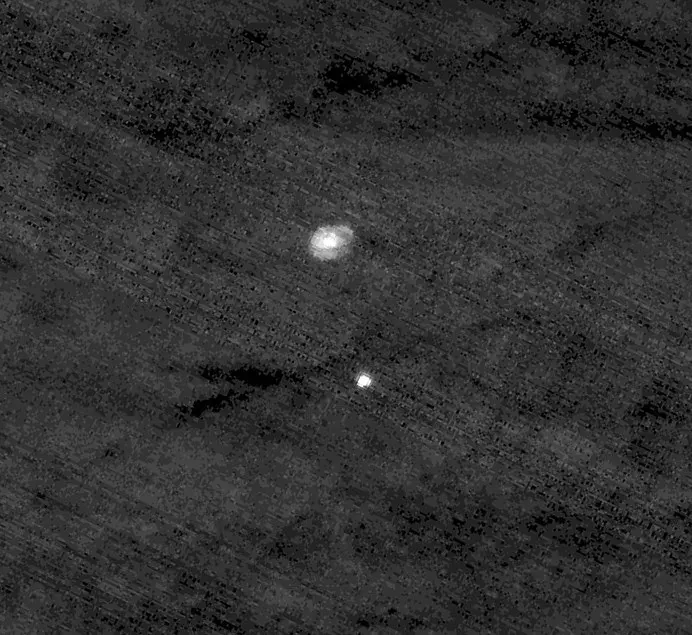
Think of the model parachute of Activity 7.6, let go from rest. Its weight W pulls it down, and the air pushes up on the canopy with a force R, the air resistance. The faster it falls, the harder the air pushes. So:
- At first it is slow, R is small, and the weight wins: it speeds up.
- As it speeds up, R grows.
- Soon R equals the weight. The two forces balance, the net force is zero, and so the acceleration is zero. From then on it falls at a steady speed, called the terminal velocity.
A real skydiver falls for a while before she opens her parachute, so she is already going fast, about 55 m/s (200 km/h). When the big canopy opens, R is suddenly much bigger than her weight: the net force points up, and she slows down, until R = W again. Either way, she ends at the same steady speed, the parachute’s terminal velocity of about 5 m/s: a safe landing speed, like jumping off a table. So falling with a parachute is not free fall: air resistance is doing the important work.
Hailstones work the same way. A hailstone from a cloud 2 km up would hit the ground at about 200 m/s if it fell freely, over 700 km/h, as fast as a jet airliner. Air resistance holds it to a steady speed instead: about 10 to 30 m/s for most hailstones. That is still enough to dent cars and ruin a field of wheat, but far less harmful than without air.
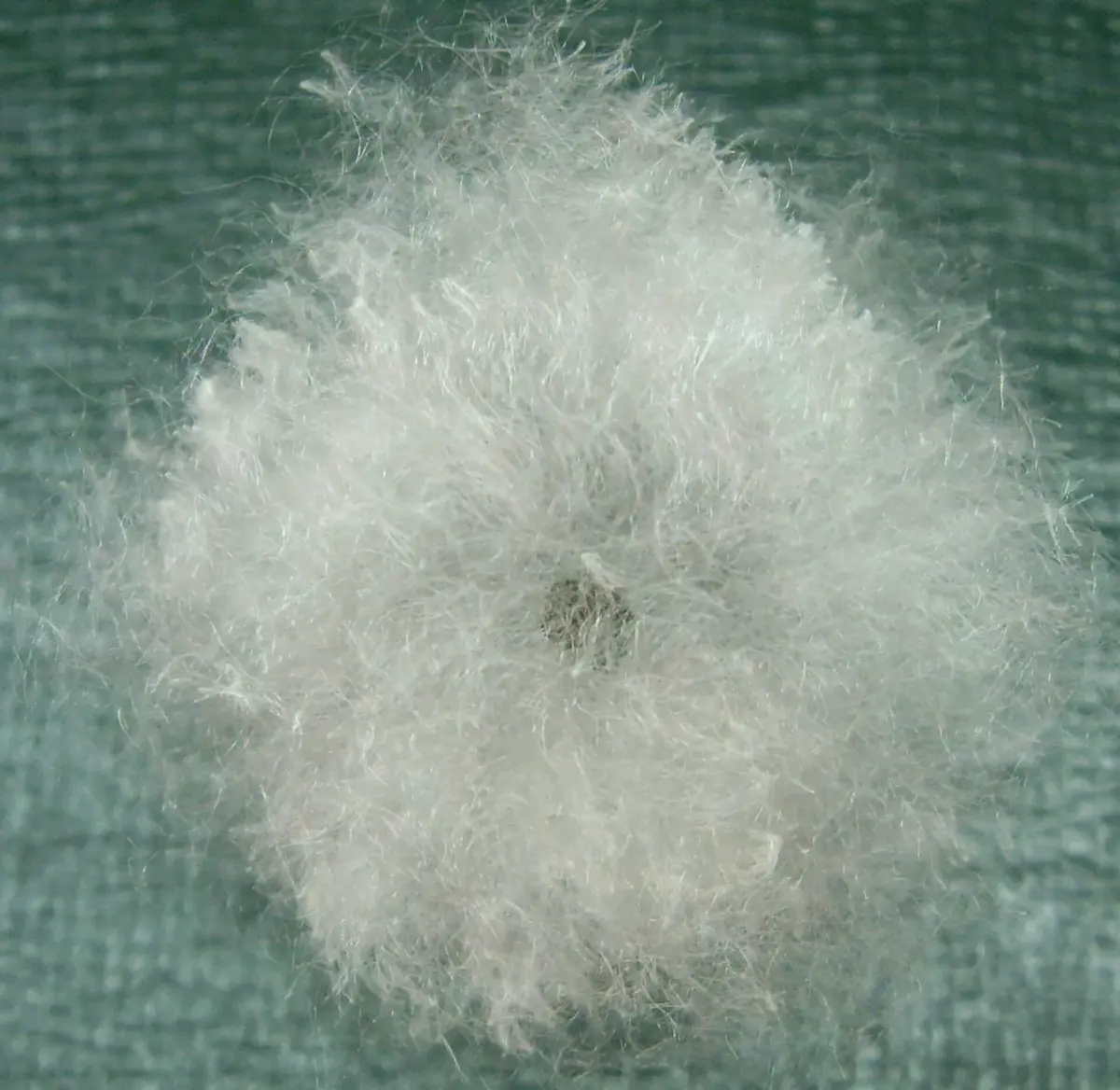
Seeds use the air too. The seeds of simal (the silk-cotton tree) hang in a tuft of white fluff, and sal seeds have wings like a little fan. Their large surface makes air resistance big compared with their weight, so they drift down slowly, and the wind carries them far from the parent tree before they land. Dandelion and kapok seeds work the same way.
Activity 7.7: weightlessness
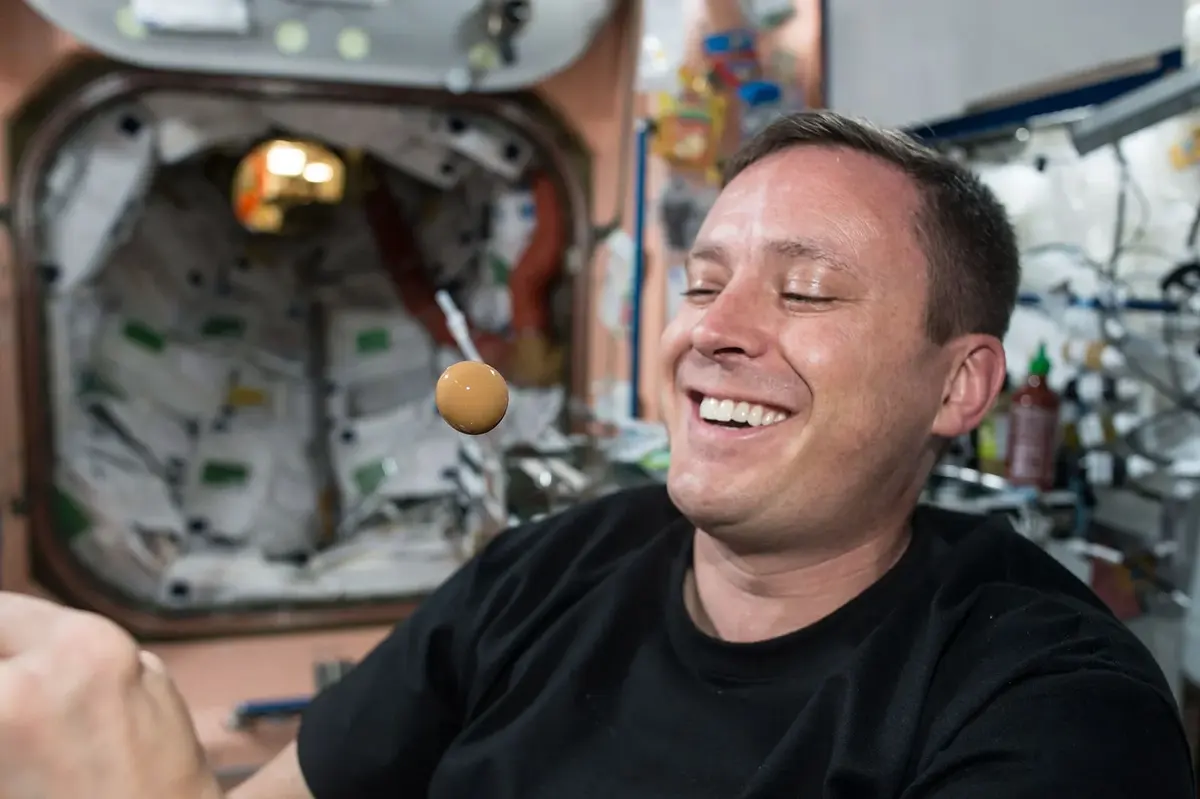
When an object is in free fall, it presses on nothing and pulls on nothing: a spring balance falling with it reads zero. It seems to have no weight. This is called weightlessness.
Orbiting is falling
But if the Space Station is falling, why doesn’t it hit the ground? Newton answered that too, with a thought experiment. Imagine a cannon on top of a very high mountain, firing horizontally:
- A slow ball curves down and lands near the mountain.
- A faster ball lands farther away.
- Fire fast enough, and the ball curves down exactly as fast as the round Earth curves away beneath it. It keeps falling, but never comes any closer to the ground. It is in orbit.
The Space Station moves at about 7.7 km/s, going round the Earth once every 92 minutes, so the astronauts see about 16 sunrises a day. It is falling towards the Earth all the time, and missing it all the time. Everything inside falls with it, so everything floats. You can see where it is right now on our Space Station tracker; on a clear evening it often passes over Nepal as a bright, fast, steady dot.
A girl stands on a bathroom scale inside a lift. The cable snaps and the lift falls freely. While it falls, the scale reads
Pick an answer to see why.
Equations of motion for free fall
In Grade 9 you met the equations of motion for an object moving with uniform acceleration a. A freely falling object moves with uniform acceleration g, so the same equations work: just put g in place of a, and h (height) in place of s.
| For objects in linear motion | For objects in free fall |
|---|---|
Here u is the starting velocity, v the velocity after time t, and h the height fallen (or risen).
Two rules for the signs:
- An object dropped (let go, not thrown) starts with u = 0.
- For an object thrown up, gravity slows it down, so its acceleration is opposite to its motion: use g = −9.8 m/s². At the highest point, its velocity is momentarily v = 0.
Exercise
1. Choose the correct option
a. What is the relation between the distance d between two objects and the gravitational force F between them?
Pick an answer to see why.
b. What happens to the gravitational force between two objects when the mass of each is doubled?
Pick an answer to see why.
c. The gravitational force between two objects on the Earth is 60 N. What is the gravitational force between the same two objects on the Moon (at the same distance apart)?
Pick an answer to see why.
d. Which one of these statements is correct?
Pick an answer to see why.
e. At which of these places do you weigh the most?
Pick an answer to see why.
f. The radius of the Earth is 6371 km and an object weighs 800 N on the Earth’s surface. What does it weigh at a height of 6371 km above the surface?
Pick an answer to see why.
g. A celestial body has twice the mass and twice the radius of the Earth. What is g on it?
Pick an answer to see why.
h. A man weighs 750 N on the Earth. What does he weigh on the Moon? (g on the Moon = 1.63 m/s², on the Earth 9.8 m/s²)
Pick an answer to see why.
i. Planet B has twice the mass of planet A and half its radius. Planet C has half the mass of planet A and twice its radius. An object weighs W₁ on A, W₂ on B and W₃ on C. Which order is correct?
Pick an answer to see why.
j. Watching a freely falling object second by second, which is true?
Pick an answer to see why.
2. Differentiate between
The gravitational constant G and the acceleration due to gravity g
Answer
| Gravitational constant (G) | Acceleration due to gravity (g) |
|---|---|
| The force between two 1 kg masses placed 1 m apart. | The acceleration of a freely falling object caused by gravity. |
| Its value, 6.67 × 10⁻¹¹ N m²/kg², is the same everywhere in the universe. | Its value changes from place to place: 9.78 m/s² at the equator, 9.83 at the poles, 1.62 on the Moon. |
| SI unit: N m²/kg². | SI unit: m/s². |
| It is a constant of proportionality in Newton’s law. | It is given by g = GM/R², which depends on the planet’s mass and radius. |
Mass and weight
Answer
| Mass | Weight |
|---|---|
| The quantity of matter in an object. | The force with which a planet or moon pulls the object towards its center. |
| SI unit: kg. | SI unit: N. |
| Scalar quantity. | Vector quantity (towards the center of the planet). |
| Remains the same everywhere. | Changes from place to place, as g changes (W = mg). |
| Can never be zero. | Can be zero (in free fall, and far out in space). |
| Measured with a beam balance. | Measured with a spring balance. |
3. Give reasons
The acceleration due to gravity is not the same in all parts of the Earth.
Answer
g = GM/R², so g depends on the distance from the Earth’s center. The Earth is not a perfect sphere: it is flattened at the poles and bulges at the equator, so places at the poles are closer to the center than places at the equator. Mountain tops are farther from the center than the plains. So g differs from place to place: about 9.83 m/s² at the poles, 9.78 m/s² at the equator, and a little less on high mountains. (The Earth’s spin also reduces g slightly at the equator.)
Jumping from a great height may cause more injury.
Answer
A falling body keeps speeding up: from v² = u² + 2gh with u = 0, its speed on landing is v = √(2gh), which is larger the greater the height. A larger speed has to be brought to zero in the same short moment of hitting the ground, which needs a much larger force on the body (the change of momentum is larger), so the injury is greater. From 1 m you land at 4.4 m/s; from 5 m at 9.9 m/s.
The mass of Jupiter is about 319 times the Earth’s, but its acceleration due to gravity is only about 2.6 times the Earth’s.
Answer
g = GM/R² depends on the radius as well as the mass, and on the square of the radius. Jupiter’s radius is about 11 times the Earth’s, so R² is 121 times as large. So its g is 319/121 ≈ 2.6 times the Earth’s: the effect of its huge mass is largely canceled by its huge size.
Of two objects dropped from the same height, one in the polar region and one in the equatorial region, the one in the polar region falls faster.
Answer
The Earth is flattened at the poles, so the polar regions are closer to the Earth’s center than the equator. Since g ∝ 1/R², g is larger at the poles (9.83 m/s²) than at the equator (9.78 m/s²). With a larger acceleration, the object at the pole speeds up faster and reaches the ground first.
Of two sheets of paper, one is crushed into a ball. If both are dropped together in air, the paper ball falls faster.
Answer
Both have the same mass and weight, but the flat sheet has a much larger surface facing the air, so it meets much more air resistance, which slows it down. The ball is compact, so air resistance on it is small, and it falls almost freely. So the ball reaches the ground first.
A marble and a feather dropped together in a vacuum reach the ground at the same time.
Answer
In a vacuum there is no air resistance, so both fall freely with acceleration g. Since g = GM/R² does not depend on the mass of the falling object, the marble and the feather speed up at the same rate and land together.
As you climb Mount Everest, the weight of the goods you carry decreases.
Answer
As you climb, you move farther from the Earth’s center, so g = GM/(R+h)² decreases (from about 9.81 m/s² at sea level to about 9.78 m/s² at the summit). Weight W = mg, so with the same mass, the weight decreases a little. (Only by about 0.3%: the load won’t feel lighter, because the climber gets tired and the air is thin!)
It is difficult to lift a big stone, but easy to lift a small one.
Answer
To lift a stone, you must pull up with a force at least equal to its weight. Weight W = mg, and at the same place g is the same, so weight is proportional to mass. A big stone has more mass, so more weight, and needs a bigger force to lift.
The mass of an object stays the same, but its weight changes from place to place.
Answer
Mass is the quantity of matter in the object, which doesn’t change when the object is moved. Weight is the force of gravity on it, W = mg, and g changes with place (the poles, the equator, mountain tops, the Moon). So the weight changes while the mass stays the same.
You get a strange, sinking feeling in your stomach as you come down on a rote ping (Ferris wheel).
Answer
As the seat moves down over the top of the wheel, it accelerates downwards. You fall with it, nearly freely, so the seat presses up on you much less than usual: you are partly weightless. Your organs, normally held up by your body, also press less on each other, and that is the strange, floating feeling in your stomach.
4. Answer these questions
What is gravity?
Answer
Gravity (the force of gravity) is the force with which a planet, moon or star pulls an object towards its center. The Earth’s gravity is what gives objects their weight and makes them fall.
State Newton’s universal law of gravitation.
Answer
Every object in the universe attracts every other object with a force that is directly proportional to the product of their masses and inversely proportional to the square of the distance between their centers: .
Write the nature of the gravitational force.
Answer
- It is always attractive, never repulsive.
- It acts between all objects with mass, anywhere in the universe.
- It is mutual: the two objects pull each other with equal and opposite forces.
- It acts along the line joining the centers of the two objects.
- It is very weak for small objects, but very large for planets and stars.
- It acts across any distance, even through empty space, and doesn’t depend on the material between the objects.
Define the gravitational constant G.
Answer
G is the gravitational force between two objects of mass 1 kg each whose centers are 1 m apart. Its value is 6.67 × 10⁻¹¹ N m²/kg².
Under what conditions is the gravitational force equal to the gravitational constant (F = G)?
Answer
When m₁ = m₂ = 1 kg and d = 1 m: then .
(More generally, whenever m₁m₂/d² = 1.)
Write two effects of the gravitational force.
Answer
- It keeps the planets moving round the Sun, and the Moon round the Earth.
- The Moon’s gravitational pull causes the tides in the oceans.
Show mathematically how the gravitational force between two objects changes when the mass of each is doubled and the distance between them is made one fourth.
Answer
At first: .
New masses 2m₁ and 2m₂; new distance d/4:
The force becomes 64 times as large.
What is gravitational force?
Answer
The gravitational force (gravitation) is the force of attraction between any two objects in the universe because of their masses. For example, the force between the Sun and the Earth, or between two stones.
Define the acceleration due to gravity.
Answer
The acceleration produced in a freely falling object by the force of gravity is called the acceleration due to gravity (g). On the Earth’s surface it is about 9.8 m/s².
What is free fall? Give two examples.
Answer
Free fall is the motion of an object falling under the force of gravity alone, with no other force (such as air resistance) acting on it.
Examples:
- i.the hammer and the feather dropped on the Moon, where there is no air;
- ii.the coin and the feather in a tube with the air pumped out.
Very nearly free fall: a stone dropped from a short height; the Space Station, and the astronauts in it, orbiting the Earth.
Under what conditions is an object said to be in free fall?
Answer
When the only force acting on it is gravity: there is no air resistance or upthrust (as in a vacuum, or where air resistance is negligible), and nothing holds it up or pushes it. Its acceleration is then g.
Write the conclusions of the feather and coin experiment.
Answer
- In air, the coin falls faster than the feather, because air resistance slows the feather much more.
- In a vacuum, the feather and the coin fall together.
- So, without air resistance, all objects fall with the same acceleration: g does not depend on the mass of the falling object.
What is weightlessness?
Answer
Weightlessness is the state of an object in free fall, in which it presses on nothing and a spring balance falling with it reads zero, so it seems to have no weight. Gravity still acts on it, but everything around it falls with the same acceleration. Astronauts in an orbiting spacecraft are weightless.
Mention any four effects of the force of gravity.
Answer
- Every object has weight.
- The Earth holds its atmosphere.
- Objects fall to the ground when dropped, and things thrown up come back down.
- Rivers and streams flow downhill.
(Also: falling objects accelerate; rain falls; we stay on the ground.)
Prove that the acceleration due to gravity of the Earth is inversely proportional to the square of its radius (g ∝ 1/R²).
Answer
Let an object of mass m be on the surface of the Earth, of mass M and radius R. By Newton’s law of gravitation, the force on it is …(i).
This force gives it an acceleration g, so by Newton’s second law, …(ii).
From (i) and (ii): , so .
G is a constant, and the mass M of the Earth is fixed, so .
Mention the factors that affect the acceleration due to gravity.
Answer
From g = GM/(R + h)²:
- The mass of the planet or moon (more mass, larger g).
- The radius of the planet (larger radius, smaller g), so on Earth the shape: g is larger at the poles than at the equator.
- The height above the surface (higher, smaller g).
Also, slightly, the Earth’s spin (it reduces g at the equator) and the density of the rocks below. It does not depend on the mass of the falling object.
The acceleration due to gravity on the Earth’s surface is 9.8 m/s². What does this mean?
Answer
It means that a freely falling object near the Earth’s surface gains a speed of 9.8 m/s every second (and an object thrown straight up loses 9.8 m/s every second). It also means the Earth pulls each kilogram of mass with a force of 9.8 N.
The mass of the Moon is about 1/81 of the Earth’s, and its radius about 1/3.7 of the Earth’s. If the Earth were squeezed to the size of the Moon (keeping its mass), what would happen to its g? Show by calculation.
Hint
Only the radius changes: R becomes R/3.7.
Answer
Now: . Squeezed: the mass M is the same, and the radius is R/3.7:
g would become about 13.7 times as large: 13.7 × 9.8 ≈ 134 m/s². (The Moon’s mass, 1/81 of the Earth’s, isn’t needed: the question keeps the Earth’s mass. For comparison, the Moon’s own g is , about a sixth of the Earth’s.)
At a point in outer space, a 1 kg object falls with an acceleration due to gravity of 2 m/s². What is the acceleration due to gravity of a 10 kg object at the same point? Justify.
Answer
Also 2 m/s². The acceleration due to gravity at a point is g = GM/d², which depends only on the mass M of the body pulling and the distance d from its center, not on the mass of the falling object. The 10 kg object is pulled 10 times harder, but it is also 10 times harder to speed up, so its acceleration is the same.
A man measures the mass and the weight of an object first in the mountains and then in the Terai. Compare his results.
Answer
The mass will be the same in both places, as the amount of matter doesn’t change.
The weight will be slightly less in the mountains than in the Terai, because the mountains are farther from the Earth’s center, so g is smaller there, and W = mg.
A student suggests a trick to make a profit: buy oranges in the mountains and sell them in the Terai at the same price per kilogram. If a beam balance is used to weigh them, would his trick work? Explain scientifically.
Answer
No, it would not work. A beam balance compares the object with standard masses on the other pan. Moving to the Terai, g increases for the oranges and for the standard masses by exactly the same factor, so the beam balances at the same reading. A beam balance measures mass, which doesn’t change, so 10 kg bought is 10 kg sold, and there is no profit.
(With a digital scale it would be different. A digital or spring scale measures weight and shows it as kilograms. In the mountains, where g is a little smaller, the oranges press less and read slightly lighter; in the Terai the same oranges read slightly heavier, so the trick would “work”, but only by about 0.1% for a 3000 m difference in height: about 10 g on 10 kg. And a scale set up for one place should be adjusted for another.)
How is it possible to land safely when jumping from an airplane with a parachute? Is it possible to land safely on the Moon the same way? Explain.
Answer
When the parachute opens, its large canopy meets a large air resistance, which grows with speed. Soon the air resistance becomes equal to the parachutist’s weight. The net force is then zero, so the acceleration is zero, and the parachutist falls at a small, steady speed (the terminal velocity, about 5 m/s), which allows a safe landing.
On the Moon, it isn’t possible: there is no atmosphere, so there is no air resistance. The parachute can’t slow the fall; the astronaut would be in free fall, keep speeding up, and hit the surface fast. (Spacecraft land on the Moon using rockets.)
For an object moving on the Earth, the acceleration is inversely proportional to its mass; but for an object falling towards the Earth, the acceleration doesn’t depend on its mass. Why?
Answer
By Newton’s second law, a = F/m: for a fixed force, a bigger mass gets a smaller acceleration. But in a fall, the force is not fixed: it is the weight, F = mg, which is itself proportional to the mass. A heavier object is pulled harder in exact proportion to its mass, so a = mg/m = g: the mass cancels, and every object falls with the same acceleration.
5. Solve these problems
Use G = 6.67 × 10⁻¹¹ N m²/kg².
The masses of two objects A and B are 20 kg and 40 kg. If the distance between their centers is 5 m, calculate the gravitational force between them.
Answer
F = 2.13 × 10⁻⁹ N
Calculate the gravitational force between the two spheres shown in Figure 7.17.
Hint
d is between the centers: add both radii to the 5 m gap.
Answer
Given: m₁ = 5 kg, radius 10 cm = 0.10 m; m₂ = 2.5 kg, radius 5 cm = 0.05 m; gap between the surfaces 5 m.
Distance between the centers: d = 0.10 + 5 + 0.05 = 5.15 m.
F = 3.14 × 10⁻¹¹ N. (Using 5 m by mistake gives 3.34 × 10⁻¹¹ N.)
The masses of the Sun and Jupiter are 2 × 10³⁰ kg and 1.9 × 10²⁷ kg. If the distance between them is 7.8 × 10⁸ km, calculate the gravitational force between them.
Answer
d = 7.8 × 10⁸ km = 7.8 × 10¹¹ m.
F = 4.17 × 10²³ N.
The gravitational force between the Earth and the Moon is 1.98 × 10²⁰ N. If the distance between them is 3.84 × 10⁵ km and the mass of the Earth is 5.972 × 10²⁴ kg, calculate the mass of the Moon.
Answer
d = 3.84 × 10⁸ m. From :
m₂ = 7.33 × 10²² kg, the Moon’s mass (7.34 × 10²² kg, the small difference coming from rounding).
The gravitational force between the Earth and the Sun is 3.54 × 10²² N. If the masses of the Earth and the Sun are 5.972 × 10²⁴ kg and 2 × 10³⁰ kg, what is the distance between them?
Answer
d = 1.5 × 10¹¹ m (150 million km: the distance light covers in about 8⅓ minutes).
The mass of the Moon is 7.342 × 10²² kg, and the average distance between the Earth and the Moon is 384,400 km. Calculate the gravitational force of the Moon on each kilogram of water on the Earth’s surface.
Answer
(The water is on the Earth, so we use the center-to-center distance.)
m₁ = 7.342 × 10²² kg, m₂ = 1 kg, d = 384 400 km = 3.844 × 10⁸ m.
F = 3.31 × 10⁻⁵ N on every kilogram: about 300,000 times weaker than the Earth’s pull, yet over a whole ocean it is enough to raise the tides.
The mass of the Moon is 7.342 × 10²² kg and its radius is 1737 km. Calculate its acceleration due to gravity.
Answer
R = 1.737 × 10⁶ m.
g = 1.62 m/s².
The mass of the Earth is 5.972 × 10²⁴ kg and the diameter of the Moon is 3474 km. If the Earth were squeezed to the size of the Moon, how many times would g on this new Earth be compared with the real Earth? (Radius of the Earth: 6371 km.)
Answer
The mass is the same; the radius changes from 6371 km to 3474 ÷ 2 = 1737 km.
Since g ∝ 1/R²:
g would be about 13.45 times as large: about 132 m/s².
The mass of Mars is 6.4 × 10²³ kg and its radius is 3389 km. Calculate its acceleration due to gravity. What does a 200 kg object weigh on Mars?
Answer
R = 3.389 × 10⁶ m.
W = mg = 200 × 3.72 = 743 N.
g on the Earth is 9.8 m/s². Jupiter’s mass is 319 times the Earth’s and its radius 11 times the Earth’s. Calculate g on Jupiter. What does a 100 kg object weigh there?
Answer
W = mg = 100 × 25.84 = 2584 N.
The mass of the Earth is 5.972 × 10²⁴ kg and its radius is 6371 km. Calculate g at the height of the GPS satellite in Figure 7.18.
Answer
d = R + h = 6371 km + 20 200 km = 26 571 km = 2.6571 × 10⁷ m.
g₁ = 0.56 m/s². The satellites that find your position on a phone map are in a place where g is only one seventeenth of what it is on the ground.
The mass of the Earth is 5.972 × 10²⁴ kg and its radius is 6371 km. Mount Everest is 8848.86 m above sea level. Calculate the weight of a 10 kg object on the summit.
Answer
d = 6 371 000 + 8848.86 = 6 379 848.86 m = 6.3798 × 10⁶ m.
W = mg₁ = 10 × 9.786 = 97.86 N. At sea level it would be 98.14 N.
g on Mars is 3.75 m/s². How much mass can a weightlifter lift on Mars if she can lift 100 kg on the Earth? (g on the Earth = 9.8 m/s²)
Answer
She can exert the same force in both places, so the weight lifted is the same:
m = 261.33 kg
A stone is dropped from a bridge into a river, and the sound of it hitting the water is heard 2.5 s later. Calculate the height of the bridge above the water. (g = 9.8 m/s²)
Answer
u = 0, t = 2.5 s.
h = 30.6 m (ignoring the short time the sound takes to travel up).
A stone is dropped from a height of 15 m. How long does it take to reach the ground, and with what velocity does it hit the ground?
Answer
u = 0, h = 15 m, g = 9.8 m/s².
Time:
Velocity: (or m/s).
t = 1.75 s, v = 17.15 m/s
A cricket ball is thrown vertically upwards with a velocity of 15 m/s. What maximum height does it reach?
Answer
u = 15 m/s; at the top v = 0; going up, g = −9.8 m/s².
h = 11.48 m.
Worksheet: Motion and Force: gravitation and gravity (PDF, 4 pages)
Worksheet: Motion and Force: mass, weight and free fall (PDF, 4 pages)
Practice every question in the book, and keep track of the ones you miss →