
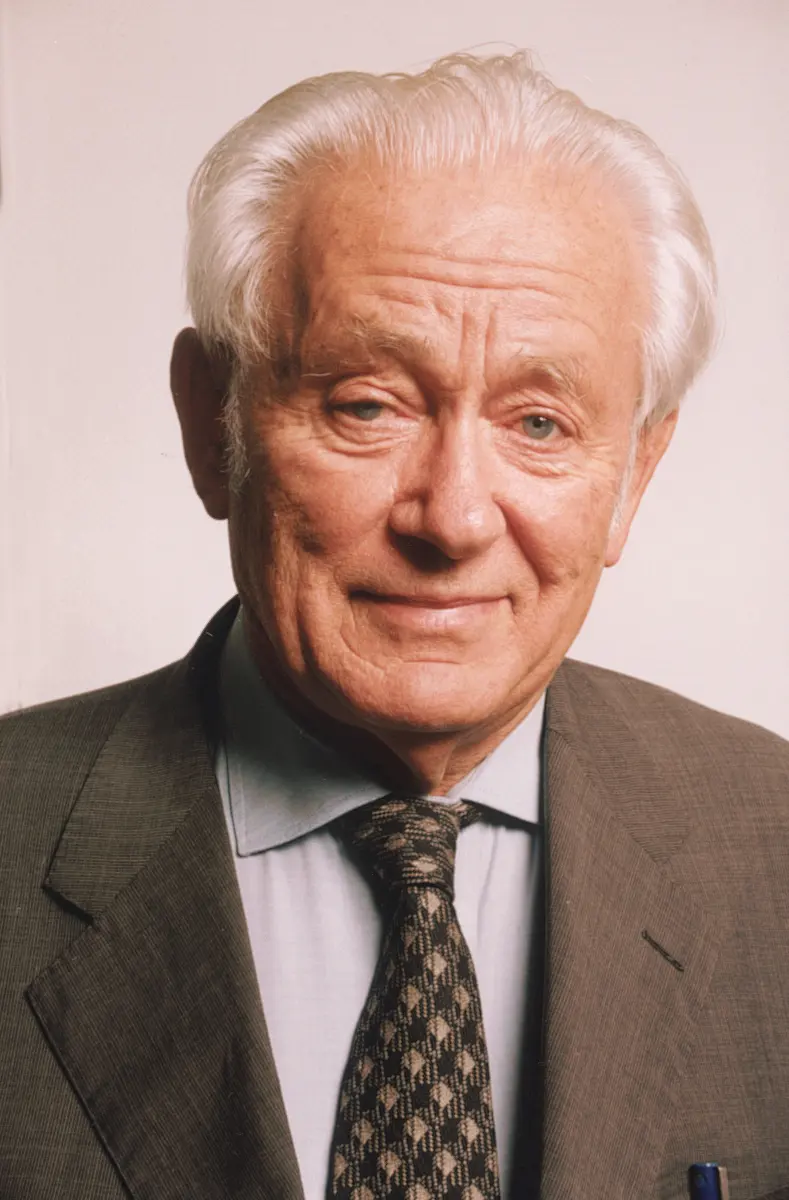
Georges Charpak
1924–2010, born in Poland
A boy who came to Paris at seven, survived a Nazi prison camp, and became one of the great inventors of physics.
Hold out your hand. Roughly once a second, a tiny particle from space, a muon, shoots straight through it. Cosmic rays hitting the top of the atmosphere make showers of these particles, and they rain down on everything, all the time. You feel nothing, and you will never see one.
Physicists want to see particles like these, and the even rarer ones made when particles are smashed together in giant machines. For that they need detectors: instruments that notice an invisible particle passing and say exactly where it went. In 1992 the Nobel Prize in Physics went to Georges Charpak, who invented the multiwire proportional chamber, a detector that sends the path of each particle straight into a computer. It made experiments about a thousand times faster.
The problem: pictures of invisible things
Since the 1930s, physicists have built accelerators, machines that speed up particles such as protons or electrons and crash them into each other or into a target. The crash makes new particles fly out, “like the sparks from fireworks”, as the Nobel presentation speech put it. By measuring the paths, or tracks, of these particles, physicists learn what matter is made of and how its parts push and pull on each other.
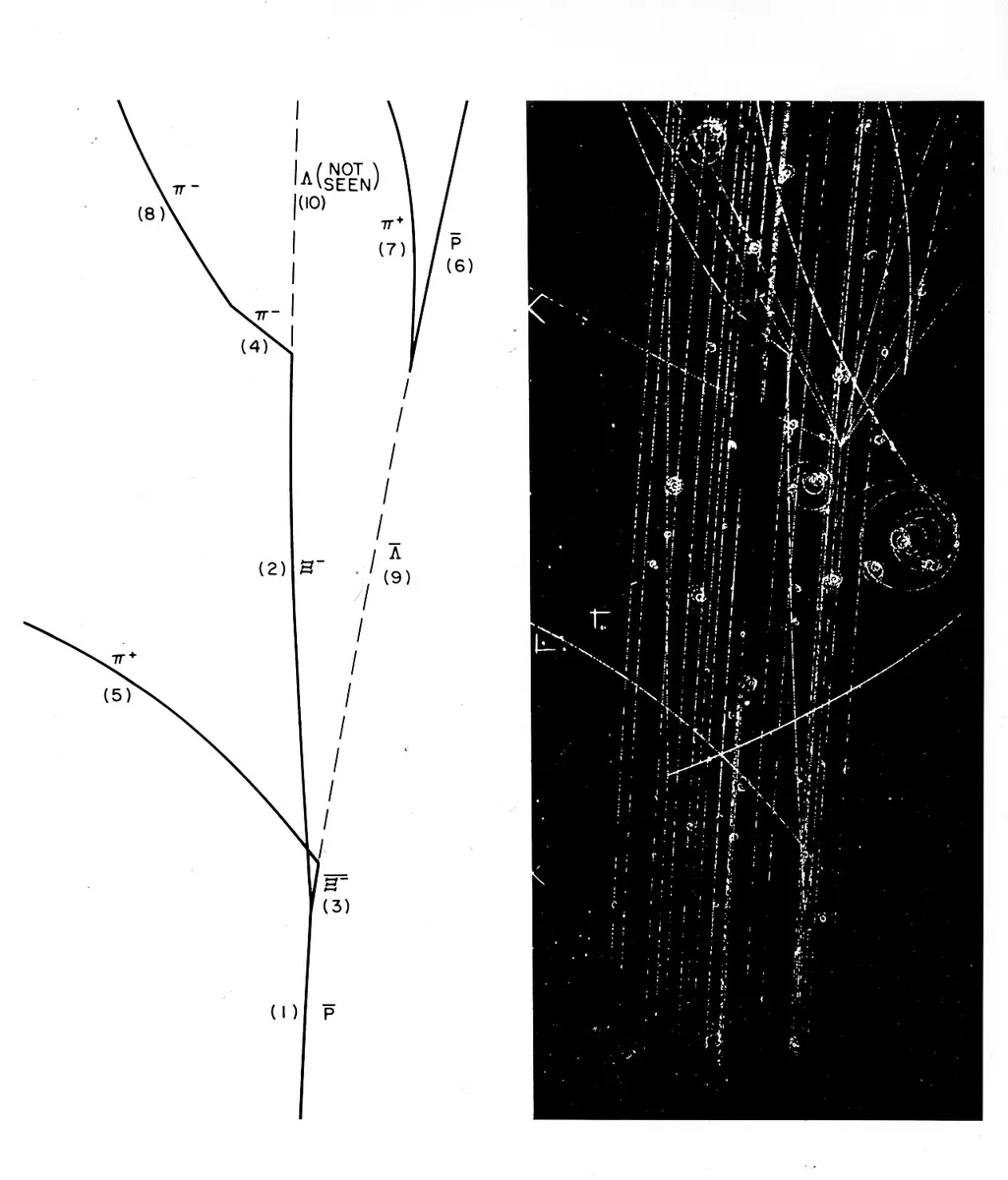
For a long time the tracks were caught on photographs.
- In a cloud chamber (Nobel Prize 1927), a particle leaves a line of tiny droplets in a cold, damp gas, like the trail of an airplane high in the sky.
- In a bubble chamber (Nobel Prize 1960), a particle leaves a line of tiny bubbles in a liquid that is just about to boil.
Cameras photographed the trails, and then people measured every track on every photo, by hand, with special viewing tables. It was slow. A bubble chamber could take only about one picture a second, and there were millions of pictures.
Worse, the interesting events are rare. Sometimes only one crash in a billion is the kind physicists are looking for. You cannot photograph a billion crashes and look through them all.
Why were photographs not good enough for the experiments of the 1960s?
Pick an answer to see why.
How a particle can make an electric signal
A fast particle with an electric charge does something useful as it passes through a gas. It knocks electrons off some of the gas atoms. Each atom that loses an electron becomes a positive ion Grade 9: ions. So the particle leaves behind a thin trail of free electrons and positive ions, a little like the trail of crumbs left by someone eating as they walk. This is called ionization.
The trouble is that a trail holds only a few hundred electrons at most: far too little electric charge to measure. The trick, known since Hans Geiger’s tube in 1908, is to multiply them.
- Stretch a very thin wire through the gas and connect it to a high positive voltage, a few thousand volts.
- The free electrons are pulled towards the wire. Close to a very thin wire, the electric pull becomes very strong.
- Near the wire, each electron speeds up so much that when it hits a gas atom, it knocks out another electron. Now there are two; they each knock out another; then four, eight, sixteen… This runaway is called an avalanche, like one stone on a mountainside setting off many more.
- In a tiny fraction of a second, a few electrons have become many thousands or more, enough to make a small electric pulse on the wire that electronics can detect.
If the voltage is set just right, the size of the pulse is in proportion to the charge the particle left behind. That is why such a tube is called a proportional counter. A Geiger counter, which clicks near radioactive material Grade 9: radioactive emission, works the same way at a higher voltage.
But a counter tube is about a centimeter wide. It can tell you only that a particle passed somewhere inside it: “somewhere in this centimeter”. To follow a track you need much finer positions, over areas the size of a wall.
Why it was hard
- Many wires close together. The obvious idea was to put many thin wires side by side, each as its own counter. But most physicists expected that wires a few millimeters apart would spoil each other: a pulse on one wire would make false pulses on its neighbors.
- One amplifier for every wire. A chamber with thousands of wires needs thousands of amplifiers, the small circuits that strengthen each pulse. In the 1950s they would have been bulky and expensive.
- A flood of information. A fast detector produces far more numbers than people can write down. It needs a computer to read them, and in the 1960s computers were just becoming common in laboratories.
What Charpak did, step by step
- 1924–1945, a hard start. Georges Charpak was born in 1924 in Dąbrowica, then in Poland and now in Ukraine. His family moved to Paris when he was seven. During the Second World War he joined the French Resistance, which fought the German occupation. He was arrested in 1943, and in 1944 sent to Dachau, a Nazi concentration camp, where he stayed until it was freed in 1945.
- 1945–1954, becoming a physicist. He studied at the École des Mines, a school for mining engineers in Paris, and became a French citizen in 1946. He then did research in nuclear physics in the laboratory of Frédéric Joliot-Curie, Marie Curie’s son-in-law, and earned his doctorate in 1954.
- 1959, CERN. He joined CERN, the European laboratory for particle physics near Geneva in Switzerland, where he worked until 1991. There he spent years developing new detectors.
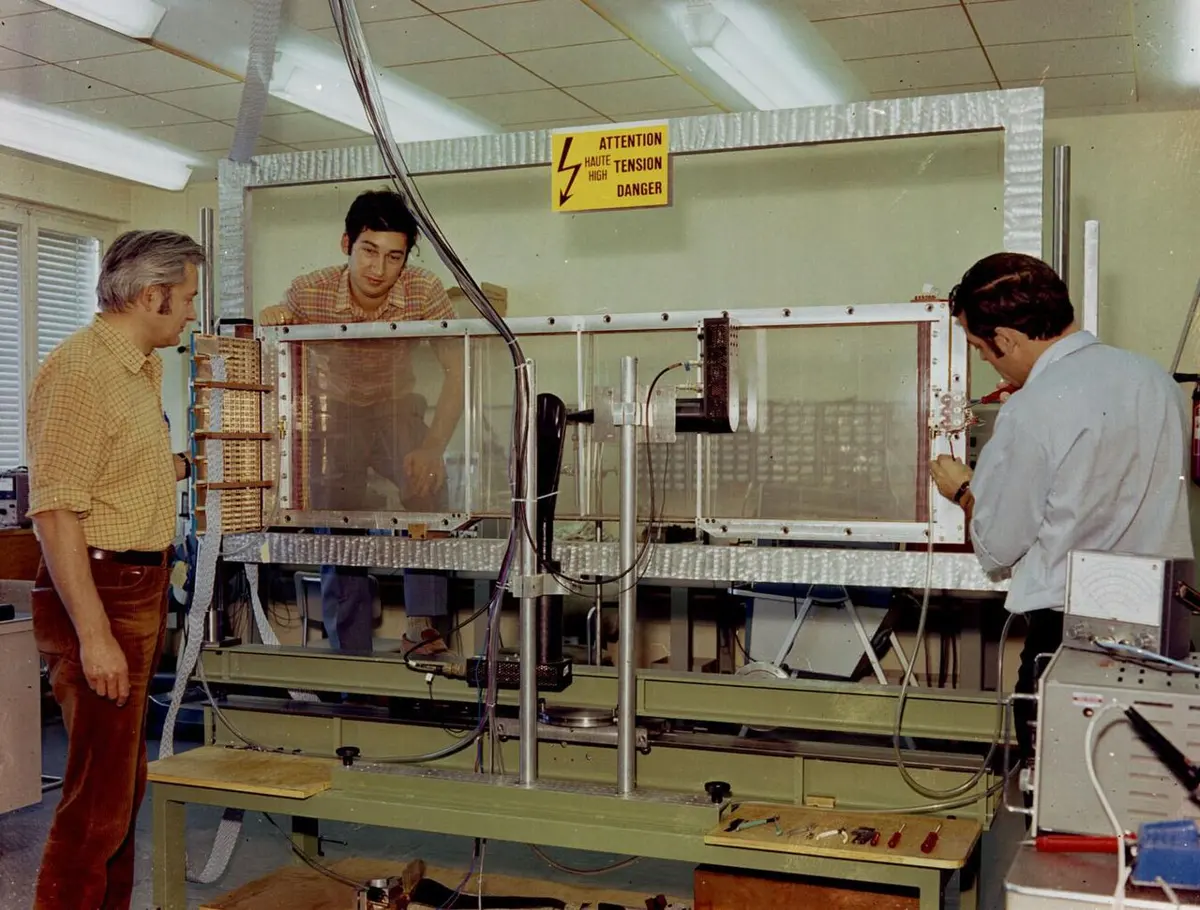
- 1968, the wire chamber. Charpak built a chamber with a whole flat plane of thin wires, about 2 mm apart, between two flat metal sheets about 2 cm apart, all in a box of gas. Against what most people expected, he showed that each wire works as its own proportional counter. A pulse appears on the wire nearest the particle’s path, so the position is known to about a millimeter.
- Fast, and straight into a computer. Each wire has its own small amplifier, made possible by the new transistors of the 1960s. Each wire can count several hundred thousand particles a second. The signals go straight into a computer, which can be told to keep only the rare, interesting crashes. Compared with photographs, data could be collected about a thousand times faster.
- Even finer: timing the drift. Charpak and his colleagues then measured how long the electrons took to drift to the wire. Electrons drift at a steady speed, so the time tells the distance. These drift chambers find a track to better than a tenth of a millimeter.
In a multiwire chamber, how does the computer know where the particle crossed?
Pick an answer to see why.
How the tracks are followed now
One plane of wires gives one point. To follow a whole track, physicists put many chambers one behind another, like the pages of a book. The particle passes through all of them, and each gives a point. The computer joins the points into a line.
Each plane usually has a second layer of wires, or of metal strips, running the other way, so each point is known across and up and down. And the whole detector sits inside a strong magnet. A moving charged particle is pushed sideways by a magnetic field, so its track curves. A fast particle, carrying a lot of momentum, curves only a little; a slow one curves a lot. So from the curve the computer works out how fast the particle was going, and from which way it bends, whether its charge is positive or negative.
Wire chambers were used in many great discoveries. When the charm quark was discovered in 1974 (Nobel Prize 1976), several multiwire chambers were part of the detector. When the W and Z particles, which carry the weak force, were discovered at CERN in 1983 (Nobel Prize 1984), wire chambers tracked the particles. When the Nobel Prize was given in 1992, the presentation speech said that the multiwire chamber was used, in some form, in almost every experiment in particle physics.
In your life today
- Low-dose X-rays. A wire chamber can count single X-ray photons, so an X-ray picture can be made with much less radiation. In 1989 Charpak started a company, Biospace, to bring his detectors into medicine. Its EOS system X-rays a person standing up, from head to foot, front and side at once, with a much smaller dose than an ordinary X-ray. Hospitals use it for children with a curved spine (scoliosis), who need X-rays again and again as they grow Grade 9: X-rays.
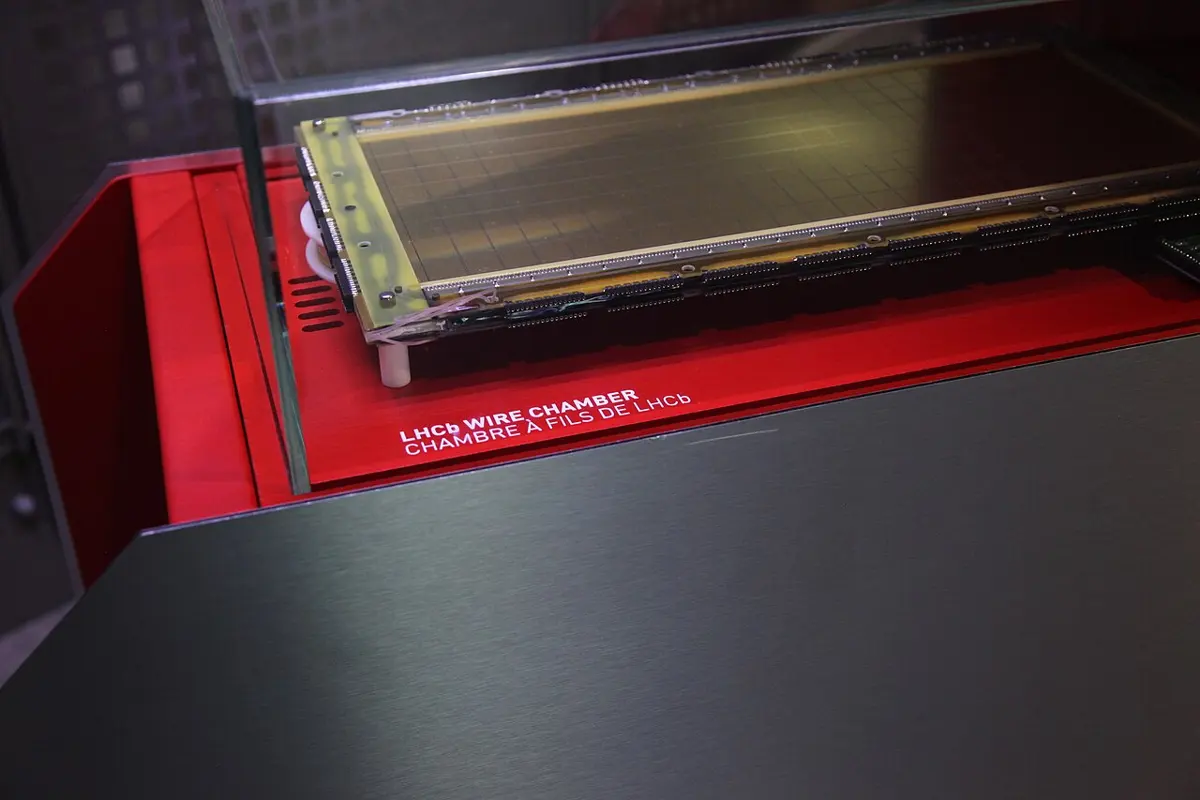
- The Higgs boson. The detectors at CERN that found the Higgs boson in 2012 still include large gas chambers descended from Charpak’s, mainly to track muons, the same particles that pass through your hand.
- Learning science by doing it. In 1996 Charpak started La main à la pâte (“hands in the dough”) in France, to get primary school children doing real experiments and asking their own questions instead of copying notes. He also wrote a book, with Henri Broch, showing children how to test claims of magic and the paranormal. That is the same idea as a hands-on science center: you learn science by trying it.
What came next
- Silicon detectors. Closest to the crash, today’s detectors use thin wafers of silicon cut into millions of tiny pixels, like the sensor in a phone camera but able to feel particles. They are even more precise than wires, but too expensive to cover areas the size of a building, so gas detectors still do that job.
- Wires without wires. In 1997 Fabio Sauli, one of Charpak’s colleagues at CERN, invented the gas electron multiplier: a thin plastic sheet, coated with metal and pierced by tiny holes, where the avalanches happen instead of around wires.
- What are we still looking for? Most of the matter in the universe seems to be invisible dark matter, which does not shine and has never been caught in a detector. Physicists are building ever more sensitive detectors, deep underground, to try. Nobody yet knows what it is.
A detector sits in a magnetic field. Two particles with the same charge enter it. One track is almost straight; the other curves tightly. Which particle had more momentum?
Pick an answer to see why.
In your science books
- Grade 8: the particles inside an atom.
- Grade 9: the structure of an atom, ions, radioactive emission, electric current and X-rays.
- Going further: what happens inside a nucleus when it decays.
Learn more
- The Nobel Prize’s press release, which explains the wire chamber with a diagram.
- Georges Charpak’s Nobel lecture, Electronic imaging of ionizing radiation with limited avalanches in gases.
The official reason
The prize was given “for his invention and development of particle detectors, in particular the multiwire proportional chamber.”