
The quantum Hall effect: nature’s own ohm
Nobel Prize in Physics, 1985: Klaus von Klitzing

Klaus von Klitzing
born 1943 in what is now Poland
His family fled west at the end of the Second World War, when he was a baby. He saw something exact in measurements that others, himself included, had already made and passed over.
When a shopkeeper weighs rice, how do we know the scale is right? The scale is checked against standard weights. Those weights were checked against better ones, and so on, up a chain that ends at a single standard that everyone agrees on.
Electricity needs standards too. Every meter that measures resistance, current or voltage must be checked against something. For most of the 20th century, the standard of resistance was a coil of special wire, kept with great care in a national laboratory. But a wire changes, very slowly, as the years pass.
In 1980, Klaus von Klitzing found that nature itself provides a resistance that never changes: about 25,813 ohms, the same in every laboratory, in every sample, and fixed only by two of the most basic numbers in physics. He was given the Nobel Prize in Physics in 1985, only five years later.
The problem: a standard that drifts
Resistance is how much a material holds back an electric current. By Ohm’s law, it is the voltage across a conductor divided by the current through it, R = V/I, measured in ohms (Ω).
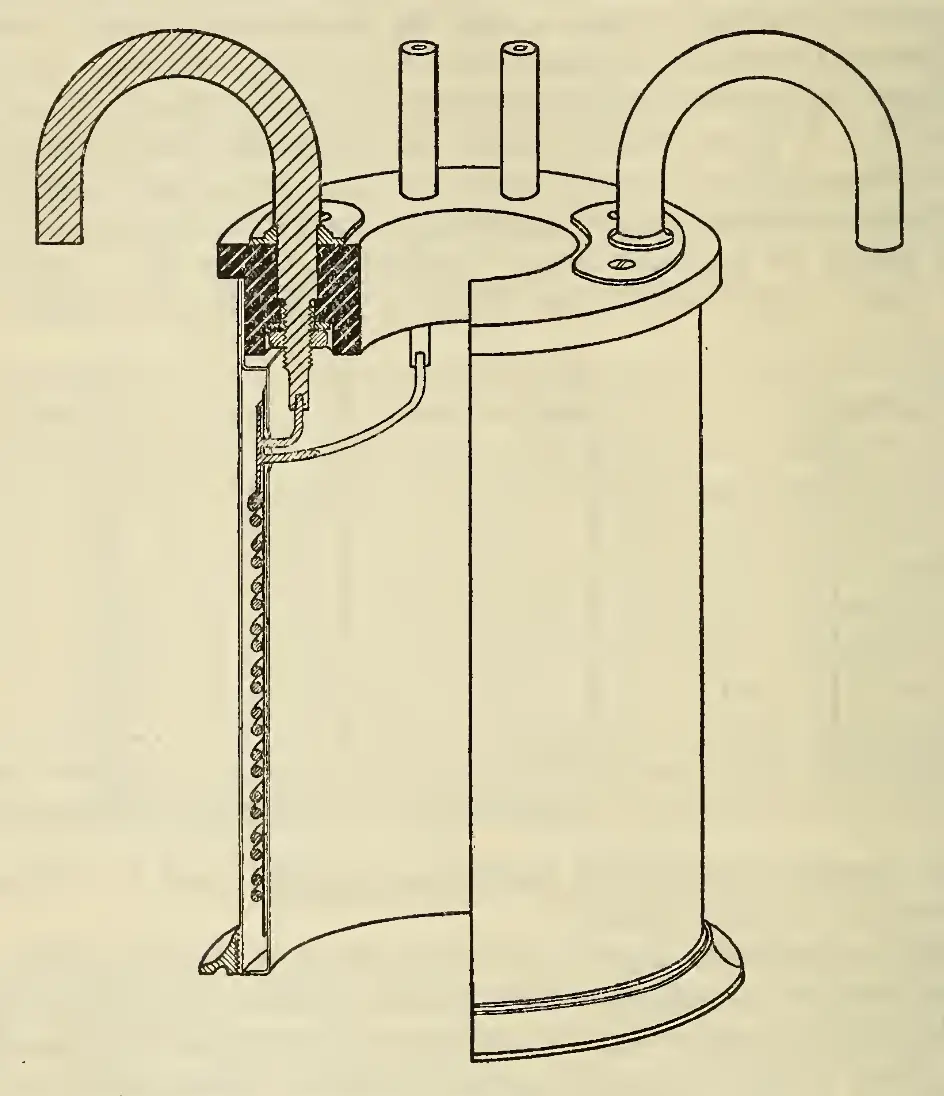
Defining the ohm was always awkward. From 1893, the “international ohm” was the resistance of a column of mercury 106.3 cm long, of a fixed mass, at 0 °C. Later, national laboratories kept their ohm in sets of carefully made wire resistors, sealed in cans and kept at a steady temperature.
These resistors were very good, but not perfect. Their resistance crept up or down by tiny amounts each year, and the resistors in different countries slowly disagreed. Nobody could tell exactly how much, because there was nothing better to check them against.
How the Hall effect works
Von Klitzing’s discovery came from an old experiment, first done in 1879 by Edwin Hall, a student in the United States.
Push a current along a thin, flat strip of metal. The current is a stream of electrons drifting along the strip. Now put the strip in a magnetic field that goes straight through it. A magnetic field pushes sideways on a moving charge (the same push that turns an electric motor). So the electrons are pushed towards one edge of the strip.
Electrons pile up on that edge, making it negative, while the other edge is left positive. A small voltage appears across the strip, from one edge to the other. This is the Hall voltage. Hall first measured it with a thin strip of gold leaf.
Divide the Hall voltage by the current and you get the Hall resistance. In an ordinary strip, the stronger the magnetic field, the bigger the Hall resistance, in a smooth straight line. Engineers use this every day: a Hall sensor measures a magnetic field by measuring its Hall voltage.
A current flows along a strip in a magnetic field. Why does a voltage appear across the strip, from edge to edge?
Pick an answer to see why.
Why it was hard
Von Klitzing’s samples were not ordinary strips. Three extreme things had to come together.
- A flat world for electrons. He used a kind of transistor, the switch inside every computer chip, made of silicon. Inside it, the electrons that carry the current are trapped in a layer only about 10 nanometers thick (a hundred-thousandth of a millimeter), right at the surface of the silicon. They can move along the layer but not up or down out of it. Physicists call this a two-dimensional electron gas. Making such layers smooth and pure enough took the best skills of the chip industry.
- Extreme cold. The samples were cooled to about −270 °C, only a couple of degrees above absolute zero, the coldest temperature possible. At this temperature the atoms of the crystal hardly shake, so they rarely knock the electrons off course.
- A huge magnetic field. About 14 tesla: hundreds of thousands of times stronger than the Earth’s magnetic field. Fields this strong were only found at a few special laboratories, such as the high magnetic field laboratory in Grenoble, France.
In such a strong field, the electrons don’t just drift. Each one is swung round in a tiny circle. And here quantum physics takes over: just as an electron in an atom can only have certain energies, an electron circling in a magnetic field can only have certain fixed energies. Its possible energies are like the rungs of a ladder, called Landau levels (after the Soviet physicist Lev Landau, who worked them out in 1930).
What he did, step by step
Klaus von Klitzing studied physics in Braunschweig, in West Germany, and then worked at the University of Würzburg on how materials behave in strong magnetic fields.
- 1975, a prediction. A group in Japan, Tsuneya Ando and his colleagues, worked out that in a two-dimensional electron gas, the Hall resistance should come in steps, at values set by two of nature’s constants. But they expected this to be only roughly true, because real samples have faults and impurities.
- 1978, steps that nobody noticed. Von Klitzing and Thomas Englert measured the Hall effect in silicon transistors. Their graphs already showed flat steps. Others in Japan saw them too. Nobody looked at how exact the steps were.
- February 1980, Grenoble. Working at the high magnetic field laboratory, with very good samples made by Gerhard Dorda (at the company Siemens) and Michael Pepper (at Cambridge), von Klitzing kept the magnetic field fixed and changed the number of electrons in the layer, using the transistor’s control voltage. The Hall resistance did not rise smoothly. It went up in flat steps, and on each flat step the ordinary resistance along the strip fell almost to zero.
- The exact numbers. He worked out the value of each step and found that it was exactly 25,813 ohms divided by a whole number: 25,813 Ω, 12,906 Ω, 8,604 Ω, 6,453 Ω … His first careful measurements already agreed to within 3 parts in a million. And the values did not depend on the size or shape of the sample or on its impurities.
- The meaning. The number 25,813 Ω is not a property of silicon at all. It is h/e²: Planck’s constant h (the basic number of quantum physics) divided by the square of the charge of one electron e. Any sample, anywhere, would give the same steps.
On one of von Klitzing’s flat steps, two Landau levels were filled and the Hall resistance was 12,906 Ω. What is it on the step where only one level is filled?
Pick an answer to see why.
How it works now
Why are the steps so exact, in a real sample full of faults? The full answer needs advanced physics, but here is the simple picture that physicists use.
In the strong field, each electron in the middle of the strip moves round and round in a tiny circle. It doesn’t travel along the strip at all. But at the edges, an electron hits the edge before it can finish its circle. It bounces and starts another circle, then hits the edge again. So it skips along the edge, in one direction only: one way along one edge, the other way along the other edge.
An electron skipping along an edge can’t turn back, even when it meets a fault in the crystal: it simply skips round it. So it loses no energy, and the resistance along the strip is zero. Each filled Landau level adds one more “lane” along the edges, and each lane carries current in exactly the same amount, set only by h and e. With one lane, the Hall resistance is h/e²; with two lanes, half of that; with three, a third. Faults in the sample don’t spoil the steps. They even help, by trapping stray electrons, which makes the flat steps wider.
In 1982, physicists including David Thouless showed that the whole number counting the lanes is a topological number: like the number of holes in a doughnut, it cannot change a little bit, only jump by a whole one. This idea later earned its own Nobel Prize in Physics 2016.
In your life today
- The ohm itself. From 1 January 1990, laboratories around the world have used the quantum Hall effect to keep the ohm, with the agreed value 25,812.807 Ω. Since 2019, when the SI units were redefined so that h and e have fixed, exact values, h/e² = 25,812.807 45… Ω exactly. Every careful electrical measurement, anywhere, can be traced back step by step to a quantum Hall standard.
- The kilogram. Also since 2019, the kilogram is defined through Planck’s constant. It is measured with a Kibble balance, which weighs a mass against an electrical force. Measuring that force needs exact standards of voltage and resistance, and the resistance comes from the quantum Hall effect.
- Hall sensors. The ordinary Hall effect, without the steps, is all around you. Many phones and laptops have a Hall sensor that notices the small magnet in a flip cover or lid and turns the screen off. Hall sensors count the turns of a computer fan, of a car’s wheels and of an electric scooter’s motor.

What came next
- Steps at fractions. In 1982, Daniel Tsui, Horst Störmer and Arthur Gossard found steps at fractions such as one third, in even cleaner samples at even lower temperatures. There, the electrons act together as if they were particles with a third of an electron’s charge. That discovery won the Nobel Prize in Physics 1998.
- Graphene. In 2007, the quantum Hall effect was seen at room temperature in graphene, a sheet of carbon one atom thick, though only in an enormous magnetic field. Graphene standards now work in weaker fields and less cold, which makes them easier to use.
- Without a magnet. In 2013 a team in China saw the steps with no magnet at all, in a special magnetic material. Could a quantum Hall standard one day work at room temperature, with no magnet and no deep cold, small enough to sit inside an ordinary meter? That is still an open question.
In your science books
- Grade 9: electric current and what is moving, Ohm’s law, electric resistance and the ohm in fundamental units.
- Grade 9: scientific measurement, why units need standards.
- Grade 10: the motor effect, the same sideways push on a current in a magnetic field, and fundamental and derived units.
- Going further: Einstein’s packets of light, where Planck’s constant first appears.
Learn more
- The Nobel Prize’s press release for 1985, with a graph of the steps.
- Von Klitzing’s Nobel lecture, The quantized Hall effect (nobelprize.org).
The official reason
The prize was given “for the discovery of the quantized Hall effect.”