
The W and Z: catching the weak force
Nobel Prize in Physics, 1984: Carlo Rubbia and Simon van der Meer
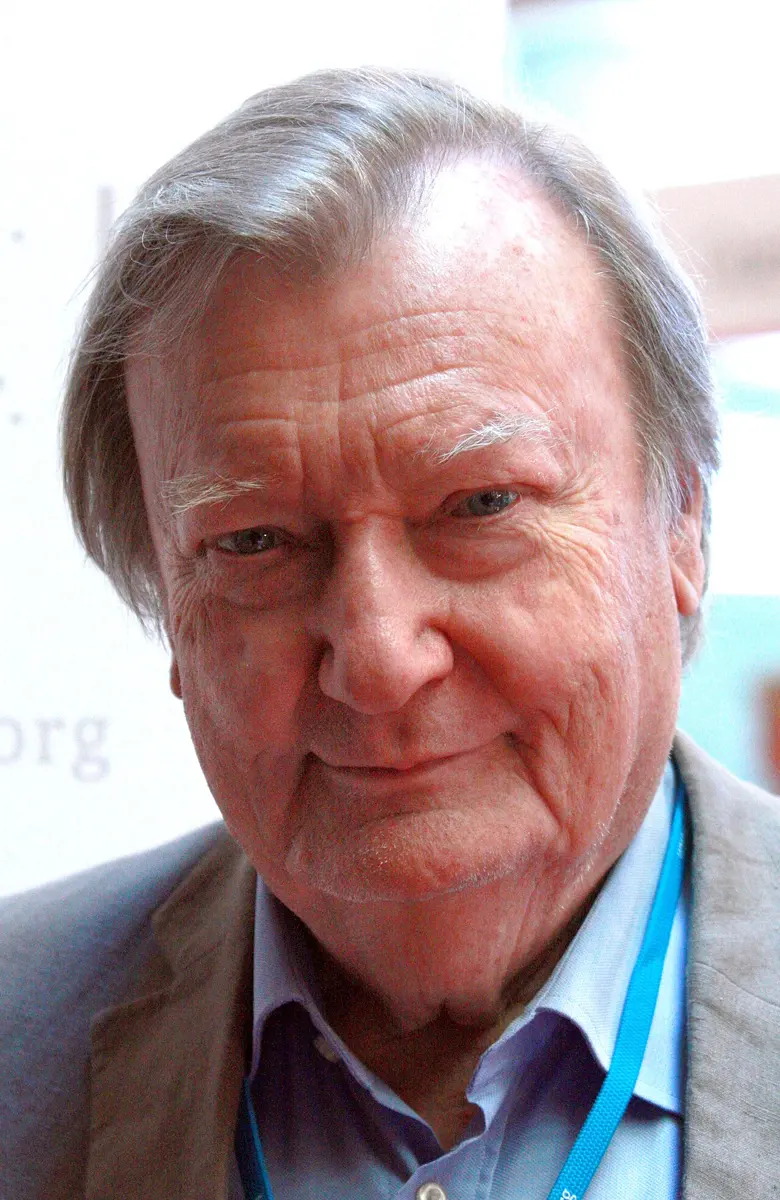
Carlo Rubbia
born 1934 in Italy
He failed the entrance test for the university he wanted, and got in only because someone else gave up their place. He became famous for his energy, and for persuading people that impossible-sounding projects could be done.
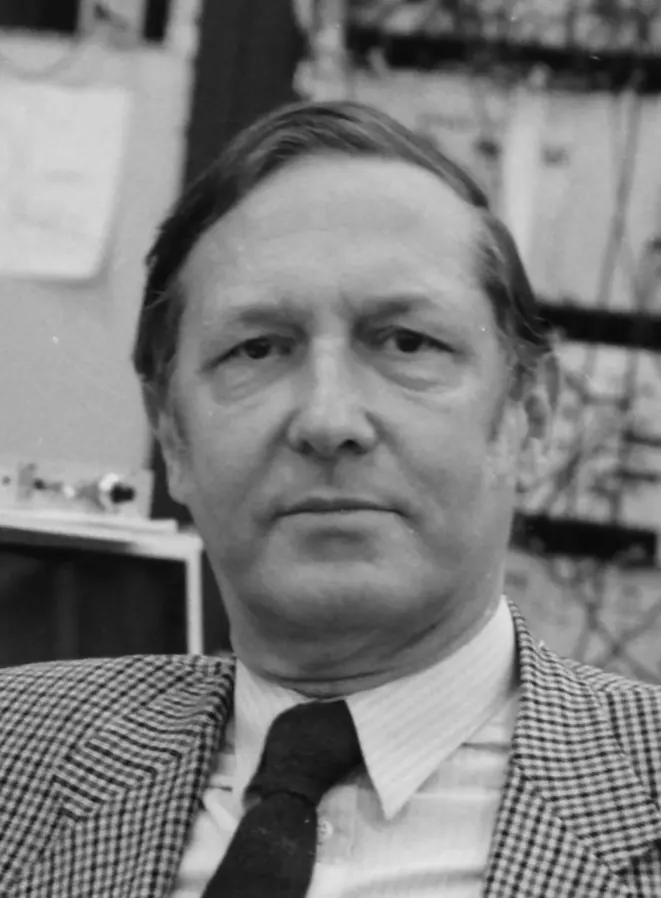
Simon van der Meer
1925–2011, born in the Netherlands
An engineer without a doctorate, who said his “slightly amateur approach” to physics, with lots of practical experience, may have helped him.
The Sun has shone for about four and a half billion years, and it will go on for billions more. It doesn’t burn out quickly because one of the steps that powers it is very, very slow. That step is controlled by a force most people have never heard of: the weak nuclear force.
You know the other forces well. Gravity holds you to the ground. The electromagnetic force holds atoms together and lights your room. Each force, physicists believed, is carried by messenger particles. For electromagnetism the messenger is the photon, the particle of light. The weak force should have messengers too, called W and Z, but nobody had ever seen one. They were too heavy to make.
In 1983, a team at CERN, Europe’s laboratory for particle physics near Geneva, found them. The 1984 Nobel Prize in Physics went to Carlo Rubbia, who had the idea and led the experiment, and Simon van der Meer, whose invention made it possible.
The problem: messengers too heavy to make
What the weak force does
The weak force can do something no other force can: it can change one kind of particle into another. In beta decay, a neutron inside a nucleus turns into a proton, and an electron and a tiny particle called a neutrino shoot out (Beta decay).
In the Sun, the first step of fusion needs the weak force too. Two protons can only join if one of them turns into a neutron Grade 9: Nuclear fusion. Because the weak force is so weak, this happens rarely, so the Sun burns its fuel slowly. That slowness gives us billions of years of steady sunlight.
Messengers
How can a force act across a gap? Imagine two people in boats on Phewa Lake, throwing a heavy ball back and forth. Each throw and each catch pushes the boats apart. In physics, forces between particles work a little like this: the particles exchange messengers. The photon is the messenger of the electromagnetic force.
In the 1960s, Sheldon Glashow, Abdus Salam and Steven Weinberg worked out a theory joining the electromagnetic and weak forces into one. It said the weak force has three messengers: W⁺, W⁻ (with a positive or negative charge) and Z⁰ (no charge). They shared the 1979 Nobel Prize for it (the story of their prize). The theory also said that the W and Z must be very heavy, almost 100 times as heavy as a proton. That is why the weak force is weak and works only over tiny distances: a heavy messenger can’t be thrown far.
The theory had passed some tests. But to be sure, someone had to make a W or a Z and see it.
Why does the Sun need the weak force to shine?
Pick an answer to see why.
How to make a particle out of energy
Einstein’s famous equation, E = mc², says that energy can turn into mass (Mass into energy). So if you smash particles together hard enough, the energy of their motion can turn into new particles that weren’t there before. To make a W, you need a collision with at least the energy locked up in a W’s mass.
There are two ways to smash particles:
- Fire a fast beam at a fixed target, a block of metal. This wastes most of the energy, which goes into knocking the pieces forwards, like a fast bus hitting a parked car: both roll on down the road.
- Fire two beams head-on. Like two buses of the same speed meeting head-on, everything stops, and all the energy is free to make something new.
There is a second catch. A proton is not a single solid ball. It is made of three smaller particles called quarks. To make a W, a quark from one particle must meet an antiquark, its antimatter twin, from the other, and each carries only part of its particle’s energy. So to make particles 100 times as heavy as a proton, each beam needed hundreds of times a proton’s mass in energy. In 1976 no machine in the world could do that head-on.
Why is it better to collide two beams head-on than to fire one beam at a fixed target?
Pick an answer to see why.
Why it was so hard
Rubbia’s idea, in 1976, was to take CERN’s biggest accelerator, the Super Proton Synchrotron (SPS), a ring 6.9 km round, and send protons round it one way and antiprotons the other way, so that they would meet head-on.
An antiproton is the antimatter twin of a proton: the same mass, but a negative charge. Because its charge is opposite, the same magnets bend it the opposite way, so both beams can share one ring.
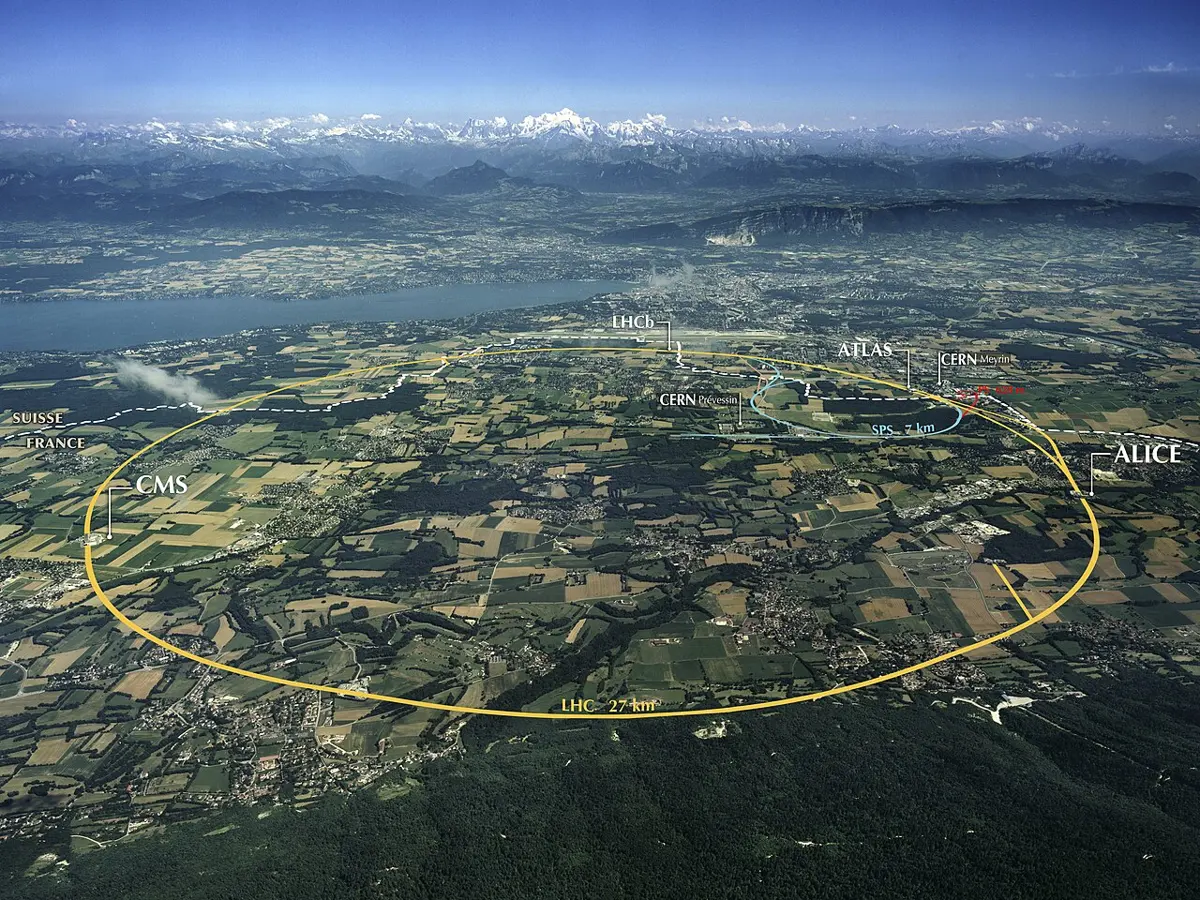
But there were three big problems.
- Antiprotons don’t exist on Earth. They have to be made, by hitting a metal target with fast protons. Each burst gives only a few antiprotons, and they fly out in a messy, spread-out cloud, all at slightly different speeds and directions. A beam like that is useless in a collider: the two beams would just miss each other.
- You need enormous numbers. The Royal Swedish Academy worked out that to make about ten W or Z particles, you needed about a billion collisions. That needed several hundred billion antiprotons going round the ring together, collected from hundreds of thousands of bursts and packed tightly into a narrow beam.
- The W and Z vanish at once. A W lives for about 3 × 10⁻²⁵ seconds before it breaks up. Nobody can ever see one directly; you can only catch the pieces it breaks into, among the debris of billions of ordinary collisions.
What they did, step by step
Van der Meer: cooling a beam
In 1968, Simon van der Meer, an engineer at CERN, had an idea he called stochastic cooling (“stochastic” means “random”). He didn’t follow it up at the time, because he thought it would be too slow for the machine he was working on. In 1974, others tried it on a proton beam at CERN, and it worked.
Here is the idea. In a storage ring, particles go round and round, each wandering a little off the center line. At one point on the ring, a sensor called a pickup measures how far, on average, the particles passing it are off center. Its electric signal is sent straight across the ring, by a shortcut, to a kicker on the far side. The signal arrives just as the same particles get there, and the kicker gives them a small push back towards the center (Figure 2).
Each push is tiny and imperfect, because the pickup sees many particles at once. But the particles go round the ring very many times every second, and the pushes add up. After many millions of turns, the messy cloud has become a tight, dense beam. Physicists call this “cooling”, because the particles’ random, jiggling motion is reduced, just as in a cooler gas.
- 1977–78: the test. A small test ring at CERN proved that stochastic cooling could gather antiprotons.
- 1979–80: the Antiproton Accumulator. Van der Meer led, with Roy Billinge, the building of a new ring, the Antiproton Accumulator, which collected the antiprotons from burst after burst and cooled them, for a day or more, into one dense beam. It increased the number of antiprotons that could be stored several hundred thousand times.
Rubbia: the collider and the detector
Carlo Rubbia had spent his life studying the weak force. In 1976, with the American physicists David Cline and Peter McIntyre, he proposed the proton–antiproton collider. Rubbia argued for it with great energy until CERN’s management agreed that it could be done. At the prize ceremony, a former Nobel laureate was quoted as saying: “van der Meer made it possible, Rubbia made it happen.”
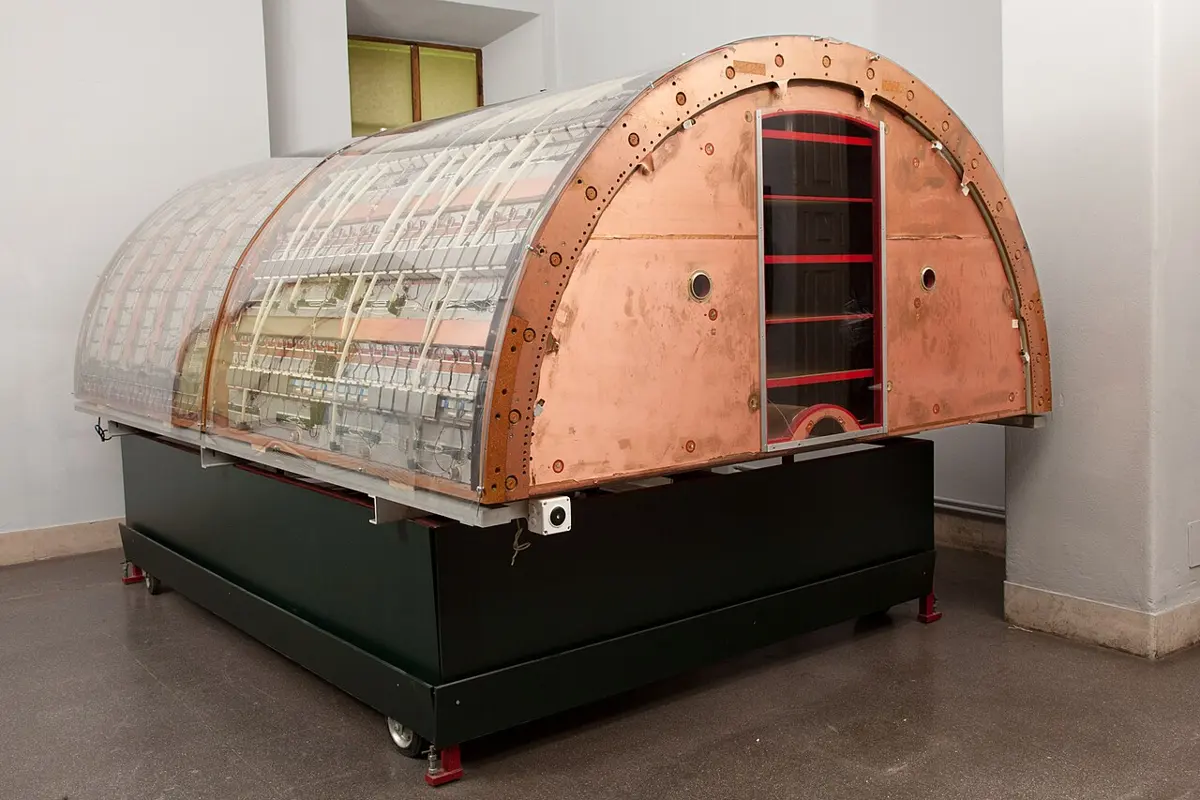
- 1978: a detector. Rubbia led a team of more than 100 physicists from many countries that designed and built a huge detector, called UA1, around one collision point. A second team, led by Pierre Darriulat, built another detector, UA2, to check the results independently.
- 1981: first collisions. In the summer of 1981 the first protons and antiprotons met head-on in the SPS. The experiments began that November.
- January 1983: the W. On 25 January 1983, CERN announced the W. UA1 had found six collisions with the signs of a W; UA2 had found four.
- May 1983: the Z. A few months later, both teams found the Z.
How a W was caught
A W breaks up almost at once. One way it can break up is into an electron and a neutrino, which fly out in opposite directions.
In a detector, most collisions spray particles forwards and backwards, close to the line of the beams. A W shows up as something unusual: a single, very fast electron shooting out sideways, leaving a straight, stiff track and a big blob of energy in the detector’s outer layer. The neutrino goes through the detector without leaving any trace at all. But it can still be found. Before the collision nothing was moving sideways, so all the sideways pushes after it must balance. If the electron’s big push sideways is not balanced by anything you can see, an invisible neutrino must have carried away the other side (Figure 4).
By measuring the energies of the pieces, the teams worked out the masses, close to what the theory had said. Today’s best measurements give about 86 times the mass of a proton for the W, and about 97 times for the Z.
A neutrino leaves no track in a detector. How did the UA1 team know one was there?
Pick an answer to see why.
In your life today
- Sunlight. Every day of sunshine depends on the slow weak-force step in the Sun’s core, the step that the W makes happen.
- Medicine. Some hospital scans, called PET scans, use radioactive substances that give out positrons (anti-electrons) by a kind of beta decay, a weak-force process. The positrons are used to make pictures of the inside of the body.
- Cooling beams. Van der Meer’s stochastic cooling was used to collect antiprotons at Fermilab in the United States, where the top quark was found in 1995, and it is still used at other machines today. CERN still makes antiprotons and slows them down to make antihydrogen, atoms of antimatter.
- The web. CERN, where all this happened, is also where the World Wide Web was invented, in 1989, so that its physicists could share information.
- Nepal and CERN. In 2017 Nepal signed a cooperation agreement with CERN, which lets students and scientists from Nepal take part in its schools and research programs.
What came next
- Millions of Zs. From 1989 CERN’s next collider, LEP, made millions of Z particles. By measuring them very precisely, physicists showed that there are exactly three kinds of light neutrino.
- The Higgs boson. The theory that predicted the W and Z also needed one more particle to give them their mass. It was found at CERN’s Large Hadron Collider in 2012 (the story of the Higgs prize).
- Rubbia led CERN as its Director-General from 1989 to 1993.
- An open question. In 2022 a team in the United States reported a W slightly heavier than the theory allows. Later measurements at CERN found a mass that agrees with the theory. Is there something new hiding in the W’s mass, or was one measurement off? Physicists are still checking.
In your science books
- Grade 9: radioactivity, nuclear fusion and the structure of the atom.
- Grade 10: the magnetic effect of electric current and the motor effect, how magnets steer moving charges.
- Going Further (9–12): beta decay, mass into energy, fusion in the stars and why gravity is so weak.
Learn more
- The Royal Swedish Academy of Sciences’ press release and the presentation speech (nobelprize.org).
- The laureates’ Nobel lectures: Rubbia and van der Meer.
- Glashow, Salam and Weinberg’s prize, the theory that predicted the W and Z.
The official reason
The prize was given “for their decisive contributions to the large project, which led to the discovery of the field particles W and Z, communicators of weak interaction.”