
Heisenberg and the new rules for atoms
Nobel Prize in Physics, 1932: Werner Heisenberg
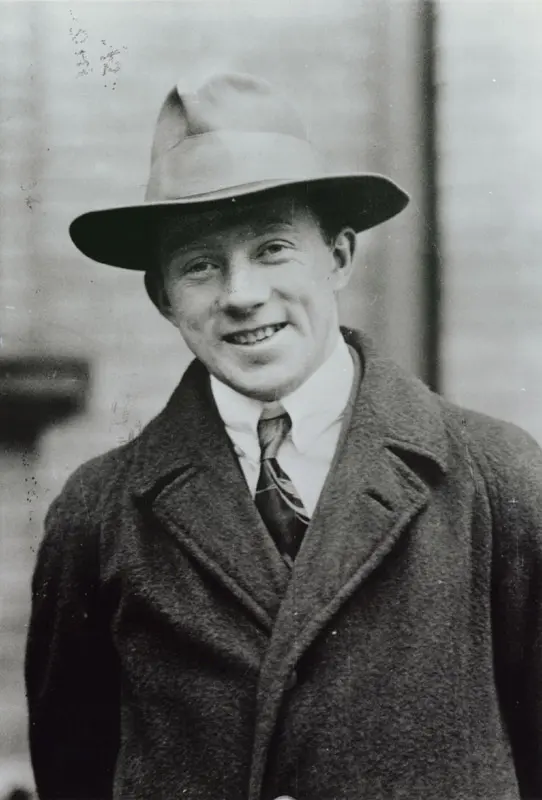
Werner Heisenberg
1901–1976, born in Germany
A fine pianist and a keen mountain walker. He was 23 when he found the new rules, and a professor in his mid-twenties.
Photo: Unknown author, Public domain
Sprinkle a pinch of salt into the flame of a gas stove and the flame flashes yellow. Copper turns a flame green; the red of Tihar fireworks comes from strontium. Every element gives out its own set of colors, as exact as a fingerprint. Why should an atom of sodium make only that one yellow, and not orange or green?
By the early 1920s nobody could answer that: the laws that worked so well for falling stones and planets were failing inside the atom. In 1925 a 23-year-old German physicist, Werner Heisenberg, wrote down new rules. They are called quantum mechanics, and they explain how atoms, light and electrons really behave. His Nobel Prize in Physics, for 1932, was for creating them.
The problem: atoms that broke the rules
By 1911 scientists knew that an atom has a tiny, heavy nucleus with a positive charge, and light, negative electrons around it. It looked like a little solar system, with the electrons going round the nucleus like planets round the Sun.
But there was a serious problem. According to the laws of electricity, an electron moving in a circle should give out light all the time, lose energy, and spiral into the nucleus in a tiny fraction of a second. Atoms should collapse. They don’t.
In 1913 the Danish physicist Niels Bohr made a bold guess (Bohr’s Nobel Prize, 1922). Electrons, he said, can travel only in certain orbits, called shells, each with a fixed energy. In these orbits they give out no light. Light comes out only when an electron jumps from a higher shell to a lower one Grade 9: Shells and their energy.
Bohr’s model worked beautifully for hydrogen, with one electron. But it failed for helium, with two, and for almost everything else; it couldn’t say how bright each color should be; and nobody knew why only certain orbits were allowed. By 1924 physicists were patching each failure with new rules that didn’t fit together.
Atoms speak in light
Heat a gas, or pass electricity through it, and it glows. Pass that glow through a prism, and instead of a rainbow you see a few thin, bright, colored lines: a line spectrum (Why each element has its own lines). Hydrogen gives a red line, a blue-green line and two violet ones, at wavelengths of 656, 486, 434 and 410 nanometers (a nanometer is a millionth of a millimeter).
Each line comes from electrons dropping from one energy level to a lower one. The electron gives out the energy it loses as one packet of light, a photon. A bigger drop gives a photon with more energy, which means bluer light; a smaller drop gives redder light.
So each line carries two pieces of information that can be measured:
- its color (wavelength), which tells you the energy difference between the two levels;
- its brightness, which tells you how often electrons make that particular jump.
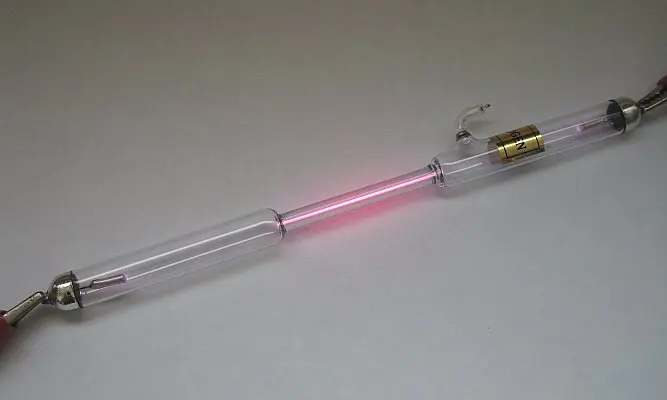
In a hydrogen tube, what decides the color of each line of light?
Pick an answer to see why.
Why it was hard
Everyone was trying to work out exactly how the electrons moved in their orbits. That is how physics had always worked: find the path, and you know everything.
Heisenberg noticed something simple and deep. Nobody had ever seen an electron’s orbit. No experiment could measure one. An atom is about a ten-millionth of a millimeter across, and anything you use to look inside it disturbs it. What experiments did measure were the lines: their colors and brightnesses. And every line belongs to two levels at once, the one the electron starts from and the one it lands on, not to one orbit.
Perhaps, he thought, the trouble was that physicists were trying to describe something that can’t be observed at all.
What he did, step by step
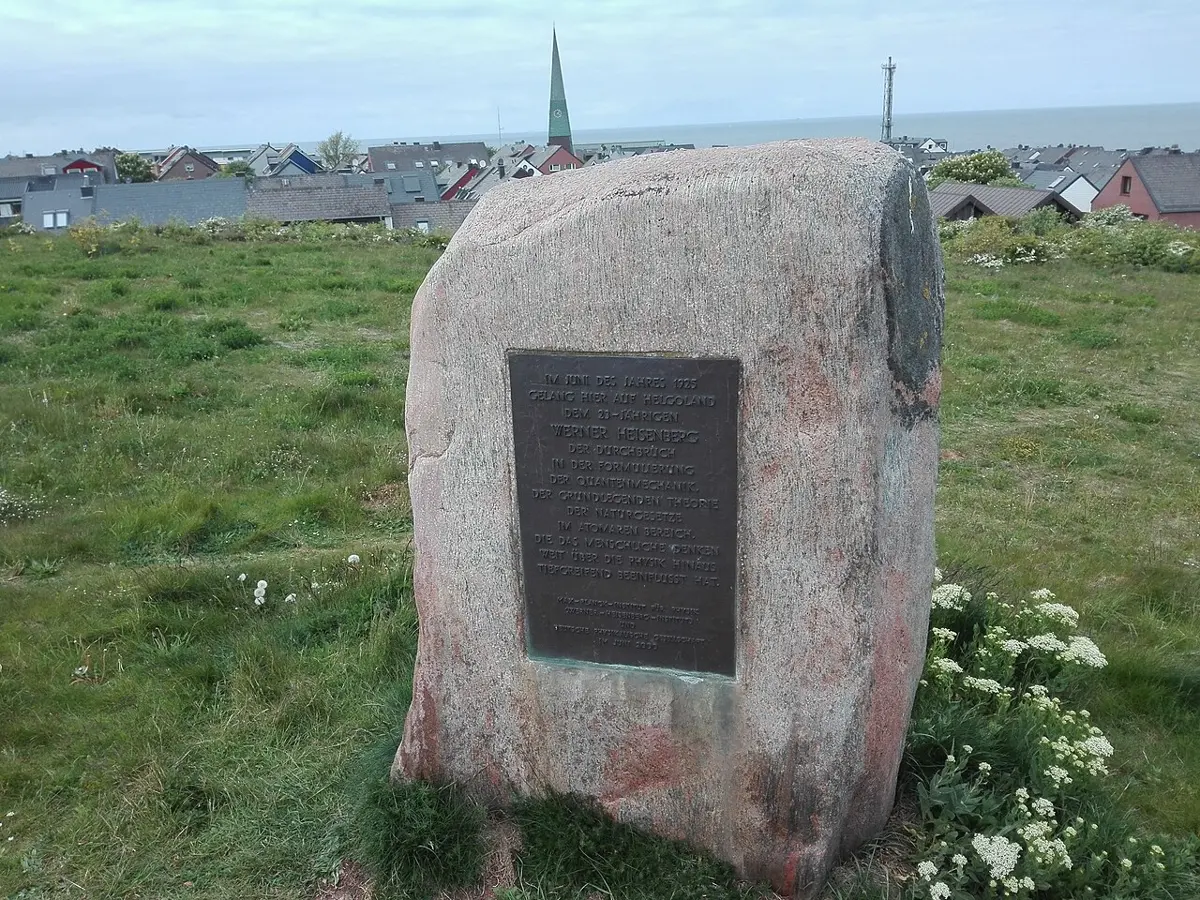
Helgoland, June 1925
Heisenberg was working in Göttingen, in Germany, as the assistant of the physicist Max Born, after a year with Bohr in Copenhagen.
- An island with no pollen. In June 1925 he had such bad hay fever (an allergy to pollen) that his face swelled up. He went to Helgoland, a small rocky island in the North Sea with hardly any plants, to recover, and worked there on the atom.
- Only what can be measured. He decided to throw away the orbits altogether and to use only quantities that can be observed. Since each line belongs to a pair of levels, he wrote the numbers in tables, with a row for each starting level and a column for each level the electron lands on. Each entry in the table belongs to one jump.
- Strange arithmetic. To calculate with these tables, he had to work out how to multiply one table by another. He found a rule that worked, but it had a very odd feature: the order mattered. Table A times table B did not give the same answer as table B times table A. With ordinary numbers, 3 × 5 and 5 × 3 are the same. With his tables, they weren’t.
- Energy is kept. Late one night he checked whether his new rules kept energy constant, as every law of physics must. They did. He later wrote that he was too excited to sleep, and at dawn he climbed a rock by the sea and waited for the sunrise.
- July 1925. Back in Göttingen, unsure whether his strange mathematics made sense, he gave his paper to Born. Born recognized the tables: mathematicians call them matrices. With Born and another young physicist, Pascual Jordan, Heisenberg worked out the full theory by the end of 1925. It is called matrix mechanics.
- 1926, it works. Early in 1926 Heisenberg’s friend Wolfgang Pauli used the new rules to calculate the lines of hydrogen, and got them right. In the same year the Austrian physicist Erwin Schrödinger found a completely different-looking theory using waves. It was soon shown that the two theories give the same answers; both are quantum mechanics. Schrödinger shared the Physics Prize for 1933 with the British physicist Paul Dirac.
1927: the uncertainty principle
In Copenhagen in early 1927, Heisenberg asked what his strange arithmetic meant. His answer is the most famous idea in quantum mechanics.
To find out where an electron is, you must look at it with light, which bounces off it into a microscope. But light comes in photons, and each photon gives the electron a kick.
- To see where the electron is sharply, you need light of a short wavelength, because light can’t show details smaller than its wavelength. But short-wavelength photons carry a lot of energy, so they kick the electron hard and change its speed by a lot, in a way you can’t know.
- Use long-wavelength light and the kick is gentle, but now the picture is blurred and you don’t know exactly where the electron is.
This is the uncertainty principle: the more exactly you know where a particle is, the less exactly you can know how fast it is moving, and the other way round. It is not a fault of our instruments. Even a perfect instrument can’t beat it, because the particle itself does not have an exact position and an exact speed at the same moment. For a particle of mass m:
(uncertainty in position) × (uncertainty in speed) is at least h ÷ (4πm)
Why does the uncertainty principle matter for an electron, but not for a cricket ball?
Pick an answer to see why.
Two kinds of hydrogen
The Nobel committee singled out one prediction. A hydrogen molecule, H₂, has two protons (the nuclei of the two atoms). Each proton spins, a little like a top, which makes it a tiny magnet. Quantum mechanics says the two can line up in only two ways: spinning the same way, or opposite ways.
In 1927 Heisenberg (and, at the same time, the German physicist Friedrich Hund) worked out that this splits ordinary hydrogen gas into two kinds, orthohydrogen (spins the same way) and parahydrogen (spins opposite). Quantum rules allow three ways of being “ortho” but only one of being “para”, so at room temperature hydrogen is about three parts ortho to one part para: 75% and 25%. Para has slightly less energy, so in very cold hydrogen almost all of it slowly becomes para.
The two kinds react the same way, but they store heat differently, which explained a puzzle about warming hydrogen gas measured in 1912. In 1929 two German chemists, Karl Friedrich Bonhoeffer and Paul Harteck, made almost pure parahydrogen, and Heisenberg was proved right.
How it works now
Quantum mechanics is no longer a strange new idea. It is the base of all of chemistry and electronics.
- Why atoms have shells. The rule that a shell holds at most 2n² electrons Grade 8: Bohr and Bury’s rule, and the subshells s, p, d and f Grade 10: Shells, subshells and orbitals, come out of quantum mechanics. So does the shape of the periodic table.
- Why atoms bond. Quantum mechanics explained why two hydrogen atoms share their electrons and hold together (Pauling’s Nobel Prize, 1954).
- An orbital is not an orbit. Instead of a path, quantum mechanics gives a cloud showing where the electron is likely to be: an orbital.
In your life today
- Every chip and every LED. The transistors in your phone’s chips, the LEDs in its screen and torch (Blue LEDs, 2014), and the solar panels on Nepal’s rooftops were all designed with quantum mechanics.
- Lasers in barcode scanners and fiber-optic cables work because electrons jump between fixed levels (Lasers, 1964).
- MRI scanners in hospitals use the spins of the protons in your body, the same spins that make ortho- and parahydrogen.
- Rocket fuel. When hydrogen is cooled to a liquid, orthohydrogen slowly turns into parahydrogen and gives out heat, which can boil away up to half of the liquid. So the factories that make liquid hydrogen for rockets use a catalyst to turn it into parahydrogen first.

What came next
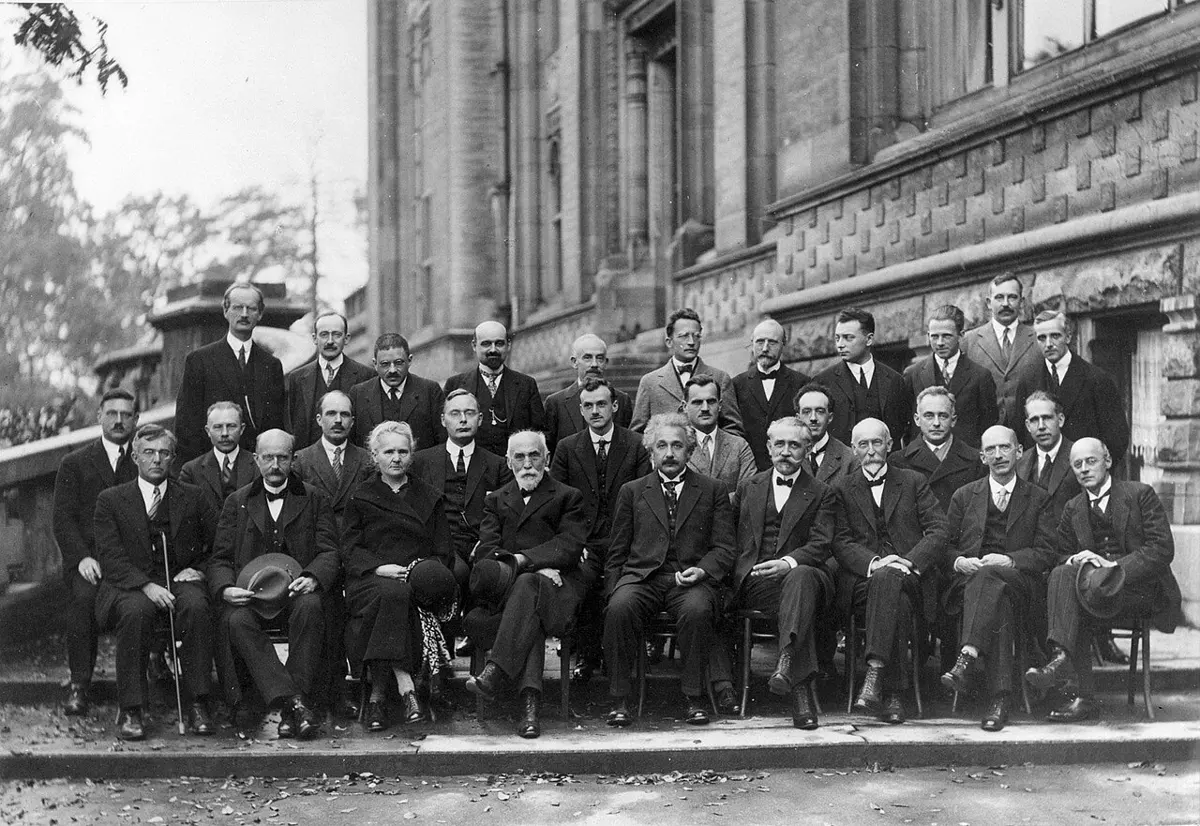
- Probability. Born showed that quantum mechanics gives only the chances of each result. You can say that half the atoms in a sample of a radioactive element will have decayed after a certain time, but never which ones. Born received the Nobel Prize in Physics in 1954 for this. Einstein never accepted it. “I, at any rate, am convinced that He does not throw dice,” he wrote to Born in 1926.
- The war. During the Second World War Heisenberg led much of Germany’s research on nuclear energy. Germany did not come close to building a bomb, and how much he tried, and what he understood, is still argued about by historians.
- Quantum computers. Engineers now build computers that use the strangest parts of quantum mechanics on purpose. Whether they can be made big and reliable enough to be useful is an open question that companies and universities are racing to answer.

In your science books
- Grade 8: Bohr and Bury’s 2n² rule.
- Grade 9: shells and their energy; allotropes and allotropy; hydrogen gas; the electromagnetic spectrum.
- Grade 10: shells, subshells and orbitals.
- Going Further: What are stars made of? (line spectra) and Is light a wave or a stream of particles?.
Learn more
- The presentation speech: Award ceremony speech, 1932 and 1933 (nobelprize.org).
- Heisenberg’s Nobel lecture: The development of quantum mechanics.
The official reason
The prize was given “for the creation of quantum mechanics, the application of which has, inter alia, led to the discovery of the allotropic forms of hydrogen.”