
Energy in packets: how quantum physics began
Nobel Prize in Physics, 1918: Max Planck
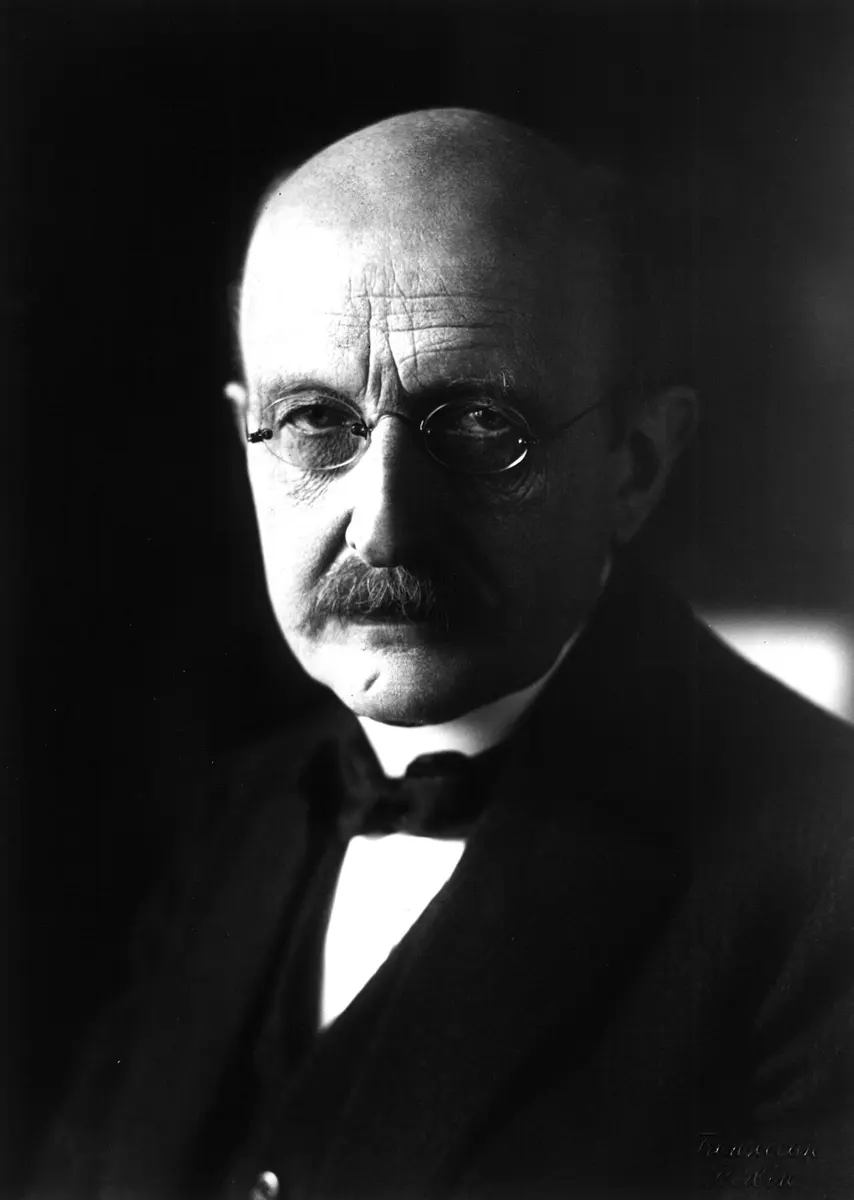
Max Planck
1858–1947, born in Germany
A careful, old-fashioned professor who did not want a revolution, and started one. He was also a fine pianist.
Photo: Transocean, Berlin, Public domain
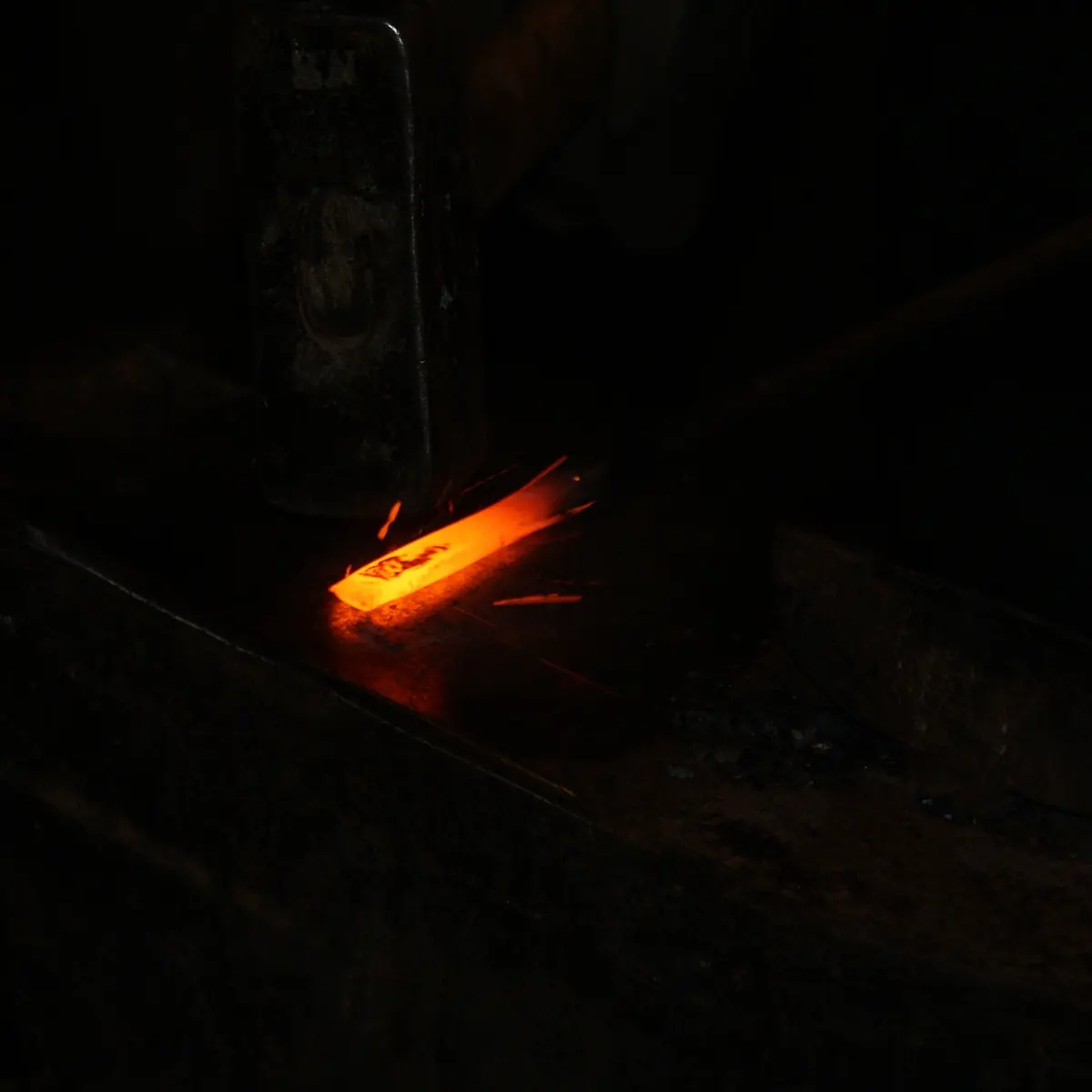
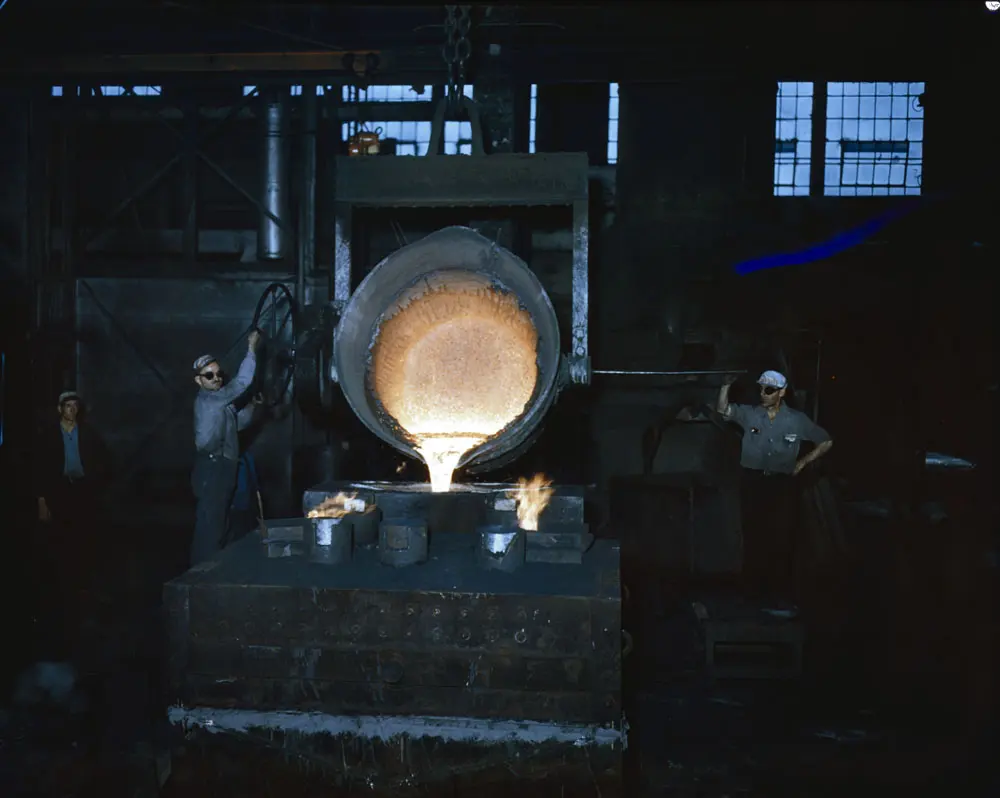
Watch a blacksmith at work. An iron rod pushed into the fire first goes dull red, then bright orange, then yellow, and if the fire is hot enough, almost white. The blacksmith reads the color to know when the iron is ready to hammer. The coil of an electric heater does the same: dark when cold, glowing red when hot.
Why should the color of a hot thing depend on its temperature, and not on what it is made of? Around 1900 this looked like a small, tidy question. Answering it turned physics upside down. In 1900 the German physicist Max Planck found that the answer only works if energy comes in tiny packets. That idea is the start of quantum physics, and it won him the Nobel Prize in Physics for 1918.
The problem: the colors of hot things
Everything gives out radiation all the time. A cup of tea, your hand, the walls of your room all give out infrared radiation, which you can’t see but can feel as warmth near a fire Grade 8: Radiation. The hotter a thing is, the more radiation it gives out. When it gets to about 500–600 °C, some of that radiation is visible light: the thing starts to glow, at first a deep red.
In 1859–60 the German physicist Gustav Kirchhoff noticed something odd. Imagine a perfectly black body: an object that soaks up every bit of light that falls on it and reflects none. Kirchhoff showed that when such a body is heated, the light it gives out depends only on its temperature, not on what it is made of. Black iron and black clay at the same temperature glow almost exactly the same.
You can make an almost perfect black body: a closed box, blackened inside, with a tiny hole. Light that goes in at the hole almost never finds its way out again, so the hole looks perfectly black, and when the box is heated, the light coming out of the hole is pure “black-body” light. In 1898, scientists in Berlin built such a box of platinum to measure that light very carefully.
The question was simple: what formula gives the brightness of each color at each temperature? Kirchhoff said the answer was well worth looking for. For forty years, nobody found it.
How a hot object glows
Split the light of a hot object into its colors with a prism Grade 10: Dispersion of light, measure how bright each wavelength is, including the infrared and ultraviolet we can’t see, and draw a graph. You get a hill, like those in Figure 2.
Scientists measure these temperatures in kelvin (K). One kelvin is the same size step as one degree Celsius, but the scale starts at absolute zero, so 0 °C is 273 K Grade 10: Thermal energy, heat and temperature.
Two things happen as a body gets hotter:
- It gives out much more light of every color. (Double the temperature, and the total energy given out goes up sixteen times.)
- The peak of the hill, the brightest wavelength, moves to shorter wavelengths: from the infrared, to red, to yellow, towards blue.
That is the blacksmith’s fire. Cool iron gives out only infrared. Hotter iron adds a little red, then orange and yellow, and a mixture of all the colors looks white.
A piece of iron is heated slowly in a fire. In what order does it glow?
Pick an answer to see why.
Why it was hard: two half-answers
By 1900 there were two formulas, and each was right only for half the picture.
- In 1896, Wilhelm Wien found a formula that fitted the short-wavelength side of the hill well. But at long wavelengths, in the far infrared, careful measurements showed that it gave too little light.
- In 1900, the British physicist Lord Rayleigh used the ordinary physics of his day, the physics of Newton and of waves, to work out the long-wavelength side. His answer fitted there. But followed all the way through (as Rayleigh, James Jeans and Albert Einstein did by 1905), the same physics had a terrible flaw: it said that the shorter the wavelength, the more light there would be, without end. A warm stove would blast out ultraviolet rays and X-rays. That is the dashed line in Figure 2, and it is plainly wrong: you don’t get sunburnt sitting near a fire.
Something in the physics of the time was wrong, and nobody knew what.
What Planck did, step by step
Max Planck: a lucky guess, then a desperate idea
Max Planck, aged 42, was a professor at Berlin University and an expert on heat. He had worked on black-body light since the 1890s, and believed Wien’s formula was right.
- 1900: new measurements. Two teams of experimenters in Berlin, first Otto Lummer and Ernst Pringsheim, then Heinrich Rubens and Ferdinand Kurlbaum, measured the far infrared better than anyone had. Wien’s formula failed there.
- 7 October 1900, an evening visit. Rubens and his wife came to the Plancks’ house, and Rubens told Planck about the new results. After his guests left, Planck found a new formula that joined the two half-answers together, and sent it to Rubens on a postcard, which reached him the next day.
- 19 October 1900, the formula. Planck showed his formula to the German Physical Society in Berlin. Rubens compared it with all his measurements and found it fitted at every wavelength. It still fits today.
- Weeks of the hardest work of his life. A formula that fits is not yet an explanation. Planck wanted to know why it was right. The only way he could make the mathematics work was a strange assumption: the tiny vibrating charges in the hot wall could only take in or give out energy in fixed packets. He called each packet a quantum (plural quanta, from the Latin for “how much”).
- 14 December 1900: the packets. Planck presented his explanation to the society. This date is often called the birthday of quantum physics. Years later he called what he had done “an act of desperation”: he had tried everything else first.
Planck said that the energy of one packet is
where f is the frequency of the vibration (how many times it vibrates each second) and h is a new, tiny number, now called Planck’s constant. Planck worked it out from the measurements as 6.55 × 10⁻³⁴ J s; today’s value is 6.626 × 10⁻³⁴ J s. It is so small that everyday packets are far too tiny to notice, which is why nobody had noticed them.
Why packets explain the hill
In a hot wall there are countless tiny vibrations, some slow and some fast. The heat is shared out among them, and each gets, roughly, a certain share of energy (the dashed line in Figure 3).
- A slow vibration has a low frequency, so each of its packets is small. The heat can easily give it one packet, or two, or ten. So the wall gives out plenty of infrared and red light.
- A fast vibration has a high frequency, so each of its packets is big. Often its share of the heat is not enough for even one packet, and since it can’t have half a packet, it gets nothing. So very little ultraviolet comes out. That is why the hill comes back down on the short-wavelength side, instead of going up for ever.
- Make the wall hotter, and each share of energy is bigger, so higher frequencies can now get a packet. The hill moves towards shorter wavelengths, just as the measurements showed.
The old physics went wrong because it allowed any amount of energy, however small. Then even the fastest vibrations got their share, and since there are far more ways to vibrate fast than slow, the ultraviolet ran away to infinity.
Why does a hot stove give out plenty of infrared but almost no ultraviolet?
Pick an answer to see why.
At first Planck thought the packets were just a mathematical trick, and for years he hoped to explain his formula without them. Nobody ever has.
How it works now: reading temperature from color
Planck’s formula lets you find the temperature of anything from its light, without touching it: measure where its light is brightest, or compare its color with the black-body colors in Figure 4.
- Stars. Look at Orion on a winter night in Nepal. Betelgeuse, at its top left, is orange-red: its surface is about 3,600 K. Rigel, at its bottom right, is blue-white, about 12,000 K. Astronomers find the temperature of stars this way (Reading the stars).
- The Sun. Its light peaks in the visible band, near green-blue, which tells us its surface is about 5,800 K Grade 9: Some facts about the Sun.
- Infrared thermometers. The thermometer pointed at your forehead at a clinic measures the infrared from your skin and works out your temperature from it Grade 10: Radiation (infrared) thermometer.
In your life today
- Light bulbs. Look at the box of an LED bulb in a shop in Nepal: it will say something like “warm white, 2700 K” or “daylight, 6500 K”. This color temperature means the bulb’s light looks like a black body at that temperature, straight from Planck’s curves. A warm, yellowish 2700 K bulb looks like the old filament bulbs; 6500 K is bluish, like daylight.
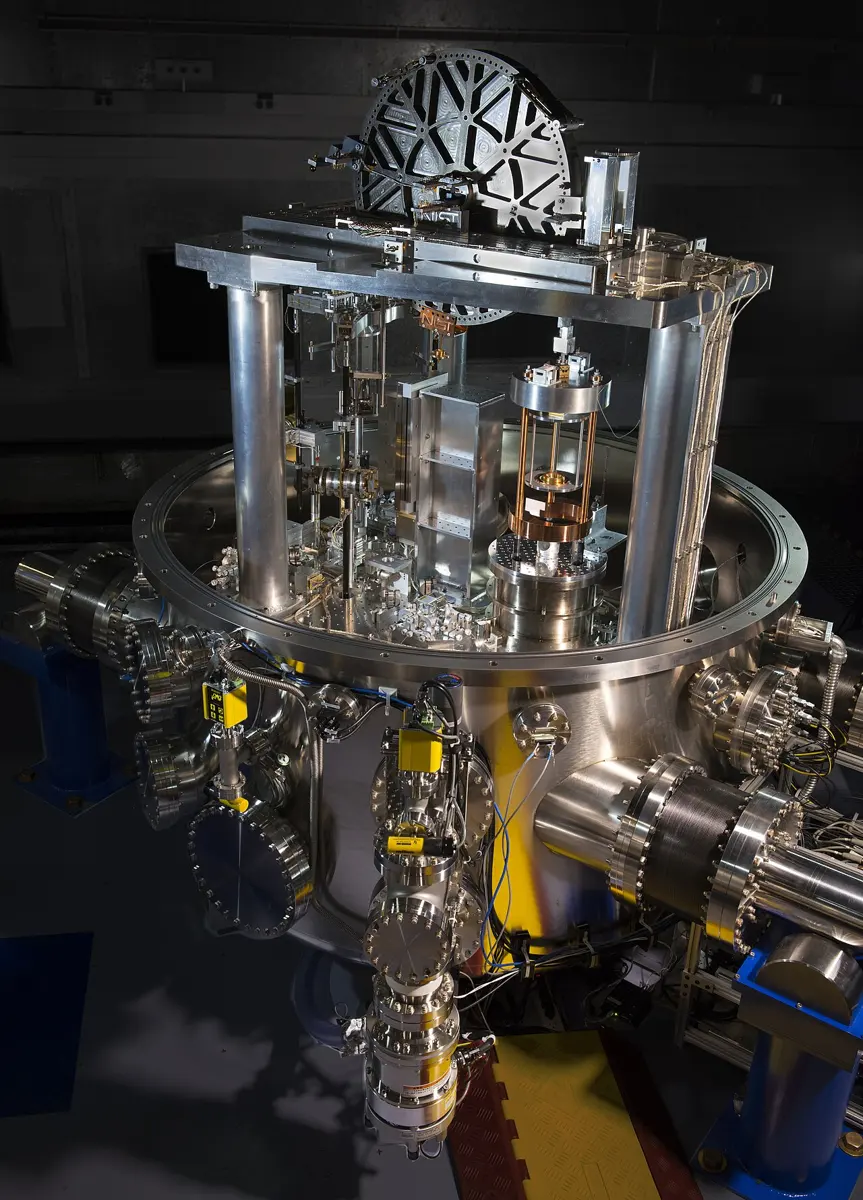
- The kilogram. Since 20 May 2019, the kilogram itself is defined using Planck’s constant, fixed at exactly 6.626 070 15 × 10⁻³⁴ J s. Before that it was a lump of metal in Paris Grade 10: Fundamental units.
- Everything quantum. Solar panels, LEDs (Blue LEDs), lasers and every chip in your phone work because energy comes in packets.
What came next
Planck’s packets did not stay a trick for long.
- 1905, light itself in packets. Albert Einstein went further than Planck: not only do the vibrations give out energy in packets, light itself travels in packets, later called photons. This explained how light knocks electrons out of metals, and won Einstein the Nobel Prize for 1921 (Einstein’s packets of light).
- 1913, atoms. Niels Bohr used h to explain why each element gives out its own colors of light: its electrons can only have certain energies (Bohr’s atom).
- 1925–1927, quantum mechanics. A new physics of atoms was built, with h at its heart. It is the most precisely tested theory in science.
Planck’s own later life was hard. His elder son was killed in the First World War and both his daughters died in childbirth. He stayed in Germany under the Nazis, trying to protect its science while opposing the persecution of Jewish scientists. His house in Berlin was destroyed by bombing, and in January 1945 his son Erwin was executed for his part in a plot to kill Hitler. Planck died in 1947, aged 89. Germany’s main research society, which he had led, is now named after him: the Max Planck Society, with more than 80 institutes.
An open question: nobody knows why Planck’s constant has the size it has. Together with the speed of light and the strength of gravity, h sets the size of the Planck length, about 1.6 × 10⁻³⁵ m, far smaller than an atom. Many physicists think that at that size space and time themselves may come in packets. Nobody has yet found a way to test it.
In your science books
- Grade 8: radiation and the color of an object and radiation.
- Grade 9: the electromagnetic spectrum, infrared rays and some facts about the Sun.
- Grade 10: fundamental units (the kilogram and Planck’s constant), heat and temperature, the infrared thermometer and dispersion of light.
- Going Further: what stars are made of, Einstein’s packets of light and one photon at a time.
Learn more
- The presentation speech, given on 1 June 1920: Planck’s prize for 1918 was held over a year and announced in November 1919 (nobelprize.org).
- Planck’s Nobel lecture, The genesis and present state of development of the quantum theory (2 June 1920), in which he tells the story of 1900 himself.
The official reason
The prize was given “in recognition of the services he rendered to the advancement of Physics by his discovery of energy quanta.”