
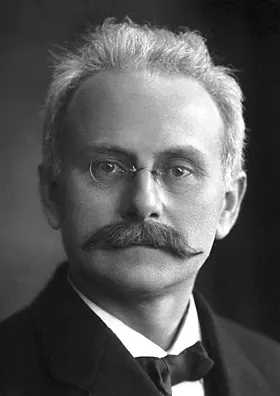
Johannes Stark
1874–1957, born in Germany
A brilliant and stubborn experimenter who built his own apparatus and trusted it more than anyone’s theory. Later in life he used his fame to serve the Nazis.
Photo: A. B. Lagrelius & Westphal, Stockholm, Public domain
Stand beside the road when an ambulance rushes past. As it comes towards you, its siren sounds high; the moment it passes, the sound drops lower. The siren itself never changed. Only its movement towards you, then away from you, changed what you heard. This is called the Doppler effect.
Light does the same thing. Light from something coming towards you becomes slightly bluer; light from something moving away becomes slightly redder. Astronomers had seen this in starlight in the 1800s. But nobody had ever seen it in light made on Earth, because nothing on Earth that gives out light moves fast enough. In 1905 a German physicist, Johannes Stark, did it, with atoms racing through a glass tube. In 1913 he found something even stranger: an electric field can split the colors that atoms give out. He won the Nobel Prize in Physics for 1919 for both.
The problem: what the colors of atoms were hiding
Heat a gas, or pass electricity through it, and it glows. Look at the glow through a prism and you don’t see a rainbow. You see a few sharp, bright lines of color with darkness between them. This is the gas’s line spectrum. Each element has its own set of lines, like a fingerprint. Hydrogen, the simplest atom, gives a red line, a blue-green line and two violet ones that we can see.
By 1900 physicists suspected that these lines were messages from inside the atom. One way to read them is to disturb the atom and watch how its lines change.
In 1896 the Dutch physicist Pieter Zeeman did this with a magnet: in a strong magnetic field, each line split into two or three lines close together. It won the Nobel Prize in 1902.
So the next question was obvious: what does an electric field do? An electric field is the region around electric charges where another charge feels a push or a pull, like the space around a comb you have rubbed on your hair. Atoms are made of charges, so a field should pull on them. But in 1901 the German theorist Woldemar Voigt calculated that the change would be far too small to measure, and for years searches found nothing.
In the Doppler effect, why does an ambulance’s siren sound higher as it comes towards you?
Pick an answer to see why.
Canal rays: a beam of fast atoms
Stark’s tool for both discoveries was a strange kind of ray found in 1886 by Eugen Goldstein in Berlin.
Take a glass tube, pump out almost all the air, and leave a little hydrogen gas inside. Put a metal plate at each end and connect a supply of several thousand volts: the gas glows. The negative plate is the cathode, the positive one the anode. Now make the cathode a metal disc with holes in it, across the middle of the tube.
Goldstein saw a glow coming out through the holes, on the far side of the cathode, traveling away from the anode. Because the rays came through little channels (Kanäle in German), he called them canal rays.
The voltage tears electrons off some gas atoms, leaving positive ions: atoms that have lost an electron Grade 9: ions. They are pulled hard towards the negative cathode, and some shoot straight through the holes and keep going. Wilhelm Wien and J. J. Thomson showed that canal rays are mostly positive atoms, moving very fast, which glow as they crash into the gas.


What Stark did, step by step
1905: the Doppler effect in light from atoms
Stark had a clever idea in 1902. Canal rays are glowing atoms moving at hundreds of kilometers every second, so their light should show the Doppler effect.
- 1905, the experiment. Stark built a canal-ray tube filled with hydrogen and pointed a spectrograph at it (a spectroscope that photographs the spectrum on a glass plate). First he looked at the beam from the side. The hydrogen lines were where they always are. Then he looked along the beam, with the atoms flying towards the spectrograph.
- What he saw. Beside each hydrogen line, a new line appeared, a little broader, shifted towards the violet end. When he looked at the beam from behind, with the atoms going away, the new line appeared on the red side instead.
- What it meant. The line in its usual place came from slow atoms in the gas; the shifted line from the fast canal-ray atoms. It was the first Doppler effect seen in light from a source on Earth. The gap told Stark how fast the atoms were going, and the line was broad because they did not all move at the same speed.
The size of the shift follows a simple rule: the line moves by the same fraction of its wavelength as the atom’s speed is of the speed of light.
1913: an electric field splits the lines
Stark never believed Voigt’s gloomy calculation. He thought a strong enough field should change an atom’s light clearly.
- A strong field in a glowing gas. Behind the cathode of a canal-ray tube, Stark placed a second metal plate only a few millimeters away, with a very high voltage between the two. The canal rays glowed right in that narrow gap, where the field was enormous: up to about 31,000 volts per centimeter. (The socket in your wall gives 230 volts. Imagine more than a hundred times that across the width of your fingernail.)
- October 1913, the result. His very first photographs showed the hydrogen lines spread out and split into several lines. Each line split in its own way. When he studied it carefully, the red line of hydrogen turned out to split into nine lines, spread evenly on both sides of its usual place.
- More than anyone expected. Voigt’s theory had expected each line to split into just two, by an amount too small to see. Stark said later that it showed “how much richer and more original are the works of Nature than the ideas of Man”.
This splitting is now called the Stark effect. In Italy it is called the Stark–Lo Surdo effect, because the Italian physicist Antonino Lo Surdo saw the same splitting at almost the same time, in 1913, in his own experiments with fast-moving atoms. Stark always refused to share the credit.

What did Stark discover in 1913?
Pick an answer to see why.
Why the split lines mattered: a test for the atom
In the same year, 1913, the Danish physicist Niels Bohr published a new picture of the hydrogen atom: an electron that may only move on certain fixed orbits, each with its own energy. The atom gives out light when its electron jumps down from one orbit to a lower one, and the color depends on the size of the jump (shells and their energy; read the whole story on our Bohr page).
Stark’s result was a hard test for this picture. In 1916 Karl Schwarzschild and Paul Epstein each used Bohr’s ideas to calculate how an electric field should split hydrogen’s lines, and their answers matched Stark’s photographs closely. When Stark received his prize, the Swedish Academy called that theory “one of the strongest pillars” of the new picture of the atom.
Strangely, Stark himself never accepted Bohr’s theory. In his own Nobel lecture he said he could not believe it, even though it explained his discovery.
How it works
Why should an electric field change an atom’s colors? Here is a simple picture, true enough for now.
An atom is a tiny positive nucleus with negative electrons around it Grade 8: structure of an atom. An electric field pulls positive charges one way and negative charges the other. So in a strong field the electrons are pulled slightly to one side and the nucleus slightly to the other: the atom is stretched a little out of shape.
In a stretched atom the energy “steps” that the electron jumps between change. In hydrogen, states that had exactly the same energy now have slightly different energies, some a little higher, some a little lower: one step has become several close together. So one jump, which gave one color, now gives several colors very close together. The stronger the field, the further apart they spread.
So the two discoveries are really different:
| Doppler effect (1905) | Stark effect (1913) | |
|---|---|---|
| What causes it | the atom moving towards or away from you | a strong electric field on the atom |
| What happens to a line | it moves towards violet or red | it splits into several lines |
| What it tells you | how fast the atom is moving | how strong the electric field is, and how the atom is built |
A scientist sees one hydrogen line become three lines close together. Which cause fits best?
Pick an answer to see why.
In your life today
- Speed and weather radar. A police radar gun catches radio waves bouncing back from a car. A car coming towards it shifts their frequency up, as Stark’s atoms shifted their light, and the shift gives the speed. Weather radar measures the speed of raindrops in a storm the same way.
- Hospitals. A Doppler ultrasound scan measures how fast blood is flowing through a baby’s heart or a narrowed vein, from the shift in the echoes of very high-pitched sound Grade 9: ultrasound.
- The stars and the universe. Astronomers find a star’s speed towards or away from us from the Doppler shift of its spectral lines. Galaxies’ light is shifted to the red, which shows that the universe is expanding Grade 10: Hubble’s study.
- The internet. Much of the light that carries the internet through optical fibers is switched on and off by tiny devices that use a form of the Stark effect: a voltage across a very thin layer of semiconductor shifts the color of light it absorbs, so the layer turns dark or clear, billions of times every second Grade 10: optical fibers in telecommunication.

What came next
- Measuring the unmeasurable. The Stark effect lets scientists measure electric fields where no meter could go: inside the glowing gas of a lamp, in the hot gas around stars, and in very dense stars called white dwarfs, where crowded charged particles blur the lines. The broader the lines, the more crowded the gas.
- Fusion power. Scientists trying to make energy as the Sun does heat hydrogen in huge ring-shaped machines held by magnets. To map the magnetic field inside, they fire in a beam of very fast hydrogen atoms, a modern canal ray. Moving so fast through the magnetic field, the atoms feel an electric field, and their light is both Doppler-shifted and Stark-split: both of Stark’s discoveries at work together. Whether such a machine can ever give out more energy than it uses, cheaply enough to light cities, is still an open question.
In your science books
- Grade 8: the structure of an atom, positive nucleus and negative electrons.
- Grade 9: ions, what canal rays are made of; shells and their energy; the electromagnetic spectrum.
- Grade 10: dispersion of light, splitting light with a prism; Hubble’s study and redshift.
- Going further: why each element has its own lines and light that has been stretched, the Doppler effect in starlight.
Learn more
- The Swedish Academy’s presentation speech (nobelprize.org).
- Stark’s Nobel lecture, Structural and spectral changes of chemical atoms, given on 3 June 1920.
The official reason
The prize was given “for his discovery of the Doppler effect in canal rays and the splitting of spectral lines in electric fields.”