
NMR: listening to the atoms in a molecule
Nobel Prize in Chemistry, 1991: Richard R. Ernst
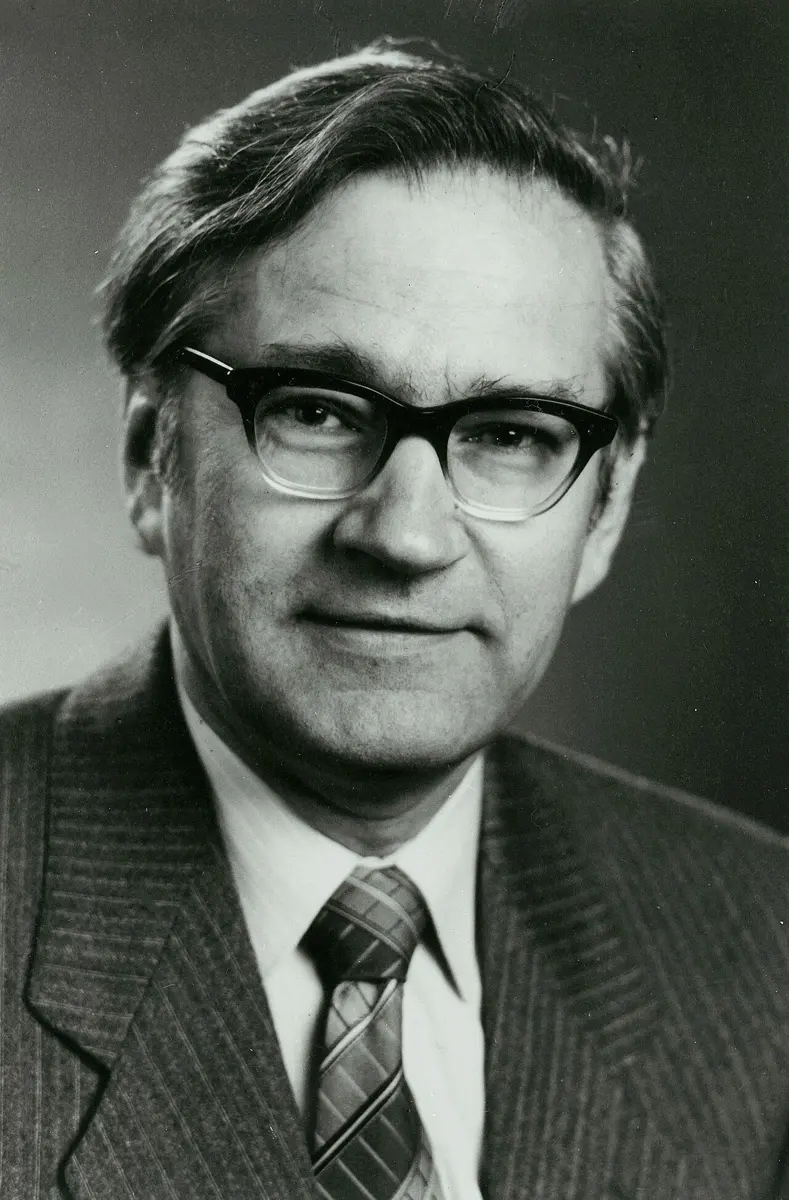
Richard R. Ernst
1933–2021, born in Winterthur, Switzerland
He called himself a tool-maker rather than a scientist. A short visit to Nepal in 1968 began his lifelong love of thangka paintings.
Suppose a chemist hands you a little white powder. Is it the medicine on the label, or something cheaper? Is it pure? Chemists answer questions like these every day, and their most important tool for it is a machine called an NMR spectrometer. It puts a few drops of a solution into a very strong magnet, sends in radio waves, and listens to the answers that come back from the atoms.
In the 1950s that machine was slow and could only hear loud signals. Richard Ernst changed it twice: first he made it ten to a hundred times more sensitive, and then he taught it to spread its signals out into maps. For this he received the 1991 Nobel Prize in Chemistry, alone.
The problem: a machine that could barely hear
Every molecule is built from atoms joined by bonds Grade 9: Covalent bond. A molecular formula such as C₂H₆O tells you which atoms there are, but not how they are joined. Two very different substances can share the same formula: C₂H₆O can be ethanol, the alcohol in hand sanitizer, or dimethyl ether, a gas. To know what you have, you need to know the structure: which atom is joined to which.
In 1945 and 1946 two teams of physicists in the United States, led by Felix Bloch and Edward Purcell, discovered nuclear magnetic resonance, or NMR. (They shared the Nobel Prize in Physics in 1952.) Soon chemists found that NMR could show how the hydrogen atoms in a molecule are arranged, and by the late 1950s companies were selling NMR machines to chemists.
But NMR had one great weakness, which the chemist who presented the prize in 1991 called its “Achilles heel”: the signals were very weak. You needed a lot of substance, and rarer atoms, such as the carbon-13 in every carbon compound, could hardly be heard at all.
How NMR works
Tiny magnets in every nucleus
The nucleus of a hydrogen atom is a single proton Grade 9: Structure of an atom. A proton behaves like a tiny bar magnet, a compass needle far too small to see. In an ordinary sample, these needles point every which way.
Put the sample inside a very strong magnet, and each needle must take one of only two positions: with the magnet’s field, or against it. Pointing with the field takes slightly less energy, so slightly more of them do. Only slightly: out of every 100,000 hydrogen nuclei, only two or three more point with the field than against it. That tiny difference is all the signal there is, and it is why NMR is so weak.
Now send in radio waves Grade 9: Radio waves. If their frequency is exactly right, the needles soak up their energy and flip. Afterwards they swing round the field like spinning tops, and as they swing they send out a faint radio signal of their own. A coil of wire around the sample picks it up, just as a moving magnet makes a current in a coil Grade 10: Electromagnetic induction. This is the resonance in the name: like a swing that only goes high if you push it at its own rhythm, each nucleus answers only its own frequency.
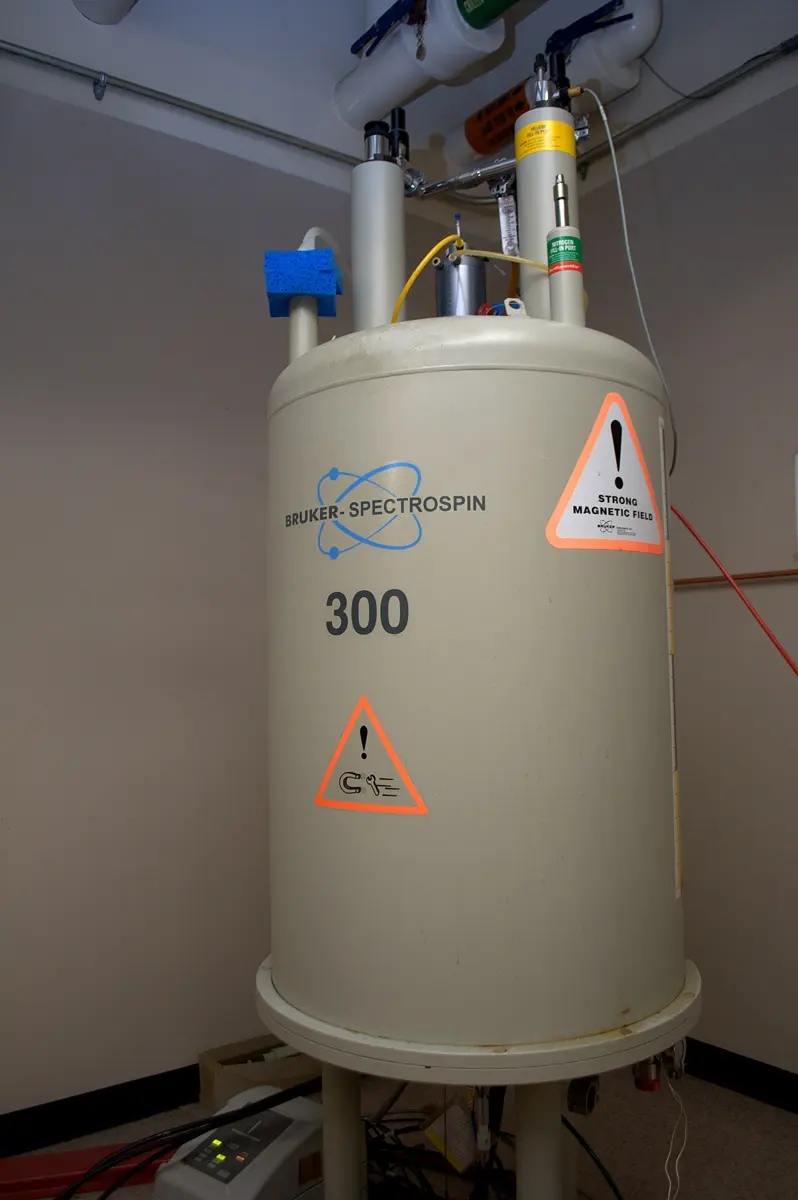
How strong is the magnet? In a typical lab NMR machine today, the hydrogen nuclei answer at 300 to 600 megahertz, a little above the FM radio band (88–108 MHz). The magnet that does this is roughly 150,000 to 300,000 times stronger than the Earth’s magnetic field, the field that turns a compass Grade 8: Geomagnetism.
Each hydrogen has its own address
Here is what makes NMR useful to chemists. The electrons around a nucleus shield it a little from the big magnet, and how much depends on its neighbors. A hydrogen joined to an oxygen feels a slightly different field from one joined to a carbon. So each kind of hydrogen in a molecule answers at a slightly different frequency, like houses on a street, each with its own number.
Ethanol, CH₃–CH₂–OH, has hydrogens in three different places: three in the CH₃ group, two in the CH₂ group, and one in the OH group Grade 10: Ethanol. Its NMR spectrum, a graph of how strongly the sample answers at each frequency, shows three peaks, and their sizes are in the ratio 1 : 2 : 3, the number of hydrogens of each kind. Dimethyl ether, CH₃–O–CH₃, has all six hydrogens in the same kind of place, and gives a single peak. The same formula, but NMR tells them apart at a glance. This was first seen for ethanol in 1951.
Ethanol (CH₃–CH₂–OH) gives three NMR peaks. Why three?
Pick an answer to see why.
Why it was hard
- The signal is tiny. Only a few nuclei in 100,000 make the signal, so it is barely louder than the random electrical noise in the machine. Weak peaks were lost in the hiss.
- Listening was slow. Early machines found the peaks the way you might tune an old radio: they changed the frequency slowly from one end to the other and listened at each step. One spectrum took several minutes, and most of that time was spent listening where there was nothing to hear.
- Big molecules were a jumble. A protein has thousands of hydrogens. Their peaks piled on top of one another until the spectrum was one long, meaningless ridge.
There is a well-known way to beat noise: record many times and add the recordings. The real signal is the same each time, so it adds up; the noise is random, so it partly cancels. Adding 100 recordings makes the signal stand out 10 times more clearly. But with each slow sweep taking minutes, 100 sweeps took hours, and 10,000 took weeks.
What he did, step by step
Ernst and Anderson: one pulse instead of a sweep
Richard Ernst grew up in Winterthur, Switzerland. As a boy he found a box of old chemicals in the attic and tried “all conceivable reactions” with them, some ending in explosions. He studied chemistry at the ETH in Zurich, built electronics for NMR machines for his doctorate, and in 1963 went to work for Varian, an American company in Palo Alto, California, that made NMR machines.
- 1964, the idea. His colleague Weston Anderson suggested a different way to listen. Instead of sweeping slowly across all the frequencies, hit the sample with one short, strong pulse of radio waves, which contains all the frequencies at once. Every kind of nucleus is set swinging together, and the coil records them all together, for about a second.
- 1964, the first experiments. Ernst did them in the summer, while Anderson was away on a long business trip. The result was a wobbly signal fading away, a jumble of all the answers mixed together.
- Untangling the jumble. To turn the jumble into a spectrum, Ernst used a mathematical method called the Fourier transform, invented by the French mathematician Joseph Fourier in the early 1800s. It finds which frequencies are mixed together in a signal, and how strong each one is. A small computer attached to the machine did the sums.
- Adding pulses. One pulse and one recording took about a second, so in the time of one old sweep, the machine could record hundreds of pulses and add them up. NMR became ten times, and sometimes a hundred times, more sensitive.
- 1966, publication. Their paper was turned down twice by a leading chemistry journal before an instruments journal printed it in 1966. Varian didn’t build a machine using it. In 1969 a rival company, Bruker, showed the first one on sale. Within a few years almost every NMR machine worked this way.
How did pulses make NMR more sensitive?
Pick an answer to see why.
Ernst at ETH: from a line to a map
In 1968 Ernst went home to Switzerland, traveling through Asia on the way, and became a teacher and researcher at the ETH in Zurich.
- 1971, an idea from Belgium. At a summer school in Yugoslavia, the Belgian physicist Jean Jeener proposed using two pulses with a gap between them, and changing the gap step by step. Ernst’s first research student was in the audience and brought the idea back.
- 1974–1976, the first two-dimensional spectra. Ernst and his group worked out the theory, tried it, and showed that it worked. Each pulse sequence gives a fading signal; changing the gap changes the signal; and a Fourier transform done twice turns the whole set into a map with two frequency directions instead of one line.
- 1975, pictures of the body. Ernst saw that the same trick could also make pictures, by using magnetic fields that change from place to place. His group’s method, called Fourier imaging, became the basis of how most hospital MRI scanners make their pictures today. (Other scientists made the first MRI pictures; two of them received the Nobel Prize in 2003: see Medicine 2003.)
- From 1976, proteins. Ernst worked for ten years with his ETH colleague Kurt Wüthrich, who used two-dimensional NMR to find the shapes of proteins dissolved in water (Chemistry 2002).
How it works now
Why does a map help? The press release used a picture that suits Nepal. Look at the Himalaya from Kathmandu and you see a skyline: peaks one behind another, some hidden by others in front. Fly over them in a plane and you see the same mountains as a map, each one in its own place.
A one-dimensional spectrum is the skyline. In a big molecule, many peaks fall at nearly the same frequency and hide each other. A two-dimensional spectrum is the map. Every ordinary peak appears as a dot along the diagonal, and extra dots off the diagonal, called cross peaks, show which hydrogens are near neighbors in the molecule. Two peaks hidden behind each other in the skyline can have their cross peaks in quite different places on the map, so they can be told apart.
By choosing different pulses and gaps, chemists can ask different questions: which atoms are joined by bonds, which are close together in space, which are swapping places. A modern NMR machine has dozens of such experiments built in, and many go to three dimensions or more. Almost all of them start from Ernst’s two ideas: a pulse, then a Fourier transform.
In your life today
- Medicines. Chemists who make a new medicine use NMR to check they have made the right molecule, and that it is pure. The tablets you buy were checked this way when the medicine was developed.
- MRI scans. An MRI scanner is NMR of the hydrogen in the water and fat of your body. Many hospitals in Nepal have one. It shows soft parts such as the brain, the spine and torn knee ligaments, without X-rays, and the way most scanners make their pictures comes from Ernst’s Fourier imaging.
- Food. Laboratories use NMR to check whether honey or fruit juice has been mixed with cheap sugar syrup, because the molecules give themselves away.
- Thangkas. In 1968, on his way home from America, Ernst spent a short time in Nepal. It began what he called an “insatiable love” for Tibetan Buddhist scroll paintings, thangkas. He collected them for the rest of his life and later used scientific methods to study their paints, to learn where and when they were made.

What came next
- Bigger magnets. The strongest NMR magnets now make hydrogen answer at 1.2 gigahertz, four times the frequency of the 300 MHz machine in the photo, and spread the peaks out further.
- Small machines. Benchtop NMR machines, the size of a microwave oven, use ordinary permanent magnets and no liquid helium. They are less sensitive, but cheap enough for a school or a factory.
- Still not sensitive enough. Even today NMR hears only a few nuclei in 100,000, and needs much more sample than many other methods. Scientists are trying ways to line up far more of the tiny magnets before measuring, for a moment, so the signal is thousands of times stronger. Making that work for everyday samples, and inside the body, is an open problem.
In your science books
- Grade 8: geomagnetism, the Earth’s much weaker magnetic field.
- Grade 9: the structure of an atom, covalent bonds, radio waves and using waves to look inside the body.
- Grade 10: the electromagnet, electromagnetic induction (how the coil picks up the signal), and ethanol.
- Going further: what a formula tells you, and how other kinds of spectrum tell us what the stars are made of.
Learn more
- The Swedish Academy’s press release, which explains pulse and two-dimensional NMR, and the presentation speech, with the piano (nobelprize.org).
- Ernst’s Nobel lecture and his autobiography, written at the time of the prize.
The official reason
The prize was given “for his contributions to the development of the methodology of high resolution nuclear magnetic resonance (NMR) spectroscopy.”