
How an electron jumps between molecules
Nobel Prize in Chemistry, 1992: Rudolph A. Marcus
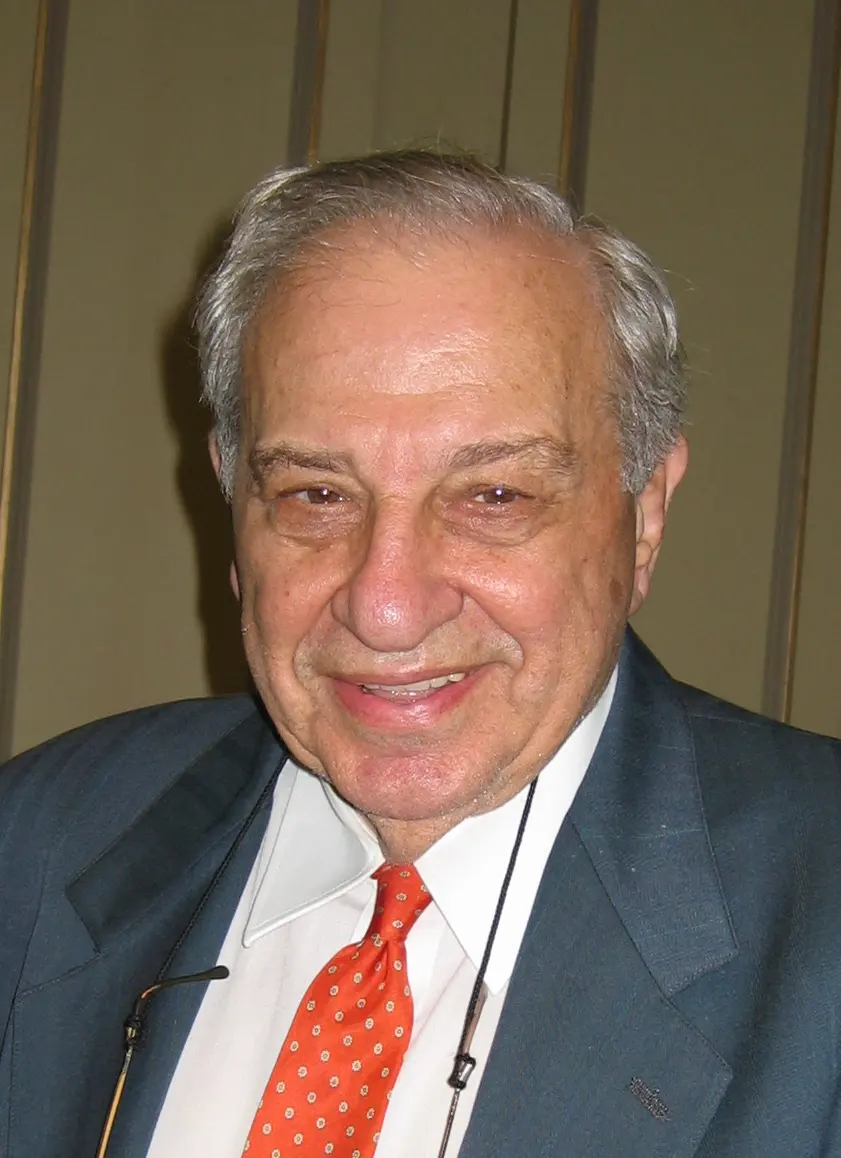
Rudolph A. Marcus
1923–2026, born in Canada
He began as an experimenter who kept breaking the glass apparatus, then switched to theory, where only a pencil could break. He was still working at Caltech after his 100th birthday.
A green leaf in the sun, a battery in your phone, an iron roof slowly turning brown with rust: they look like three completely different things. But in all three, the same small event happens again and again. An electron leaves one atom or molecule and jumps to another.
It is the simplest reaction in chemistry: no bonds break, no new bonds form, one tiny particle just changes places. And yet some of these jumps happen in less than a billionth of a second, while others take hours. In the 1950s nobody could say why. Rudolph Marcus worked it out with pencil and paper, and in 1992 he was given the Nobel Prize in Chemistry for it.
The problem: a jump that should be easy
You already know that atoms can lose or gain electrons and become ions Grade 9: Ion. When an electron moves from one particle to another, two things happen at once. The particle that loses the electron is oxidized; the one that gains it is reduced. A reaction like this is called a redox reaction (from reduction and oxidation).
Iron is a good example. You learned that iron has a variable valency: it can form two ions, Fe²⁺ (ferrous, iron(II)) and Fe³⁺ (ferric, iron(III)) Grade 9: Variable valency. Put both in water, and an Fe²⁺ ion can hand one electron to an Fe³⁺ ion:
The two sides are the same! Nothing has really changed, so you can’t see the reaction happen. But after the Second World War, chemists had a new tool: radioactive tracers. Make some of the iron radioactive, and you can follow which ions it ends up in, like putting a colored tag on one runner in a race.
When they did this, they got a surprise. The electron swap between the two kinds of iron ion was slow: in their experiments it took hours. Other swaps, between larger ions, were much faster. Why should one electron take so long to move? An electron is very light: an iron atom is about 100,000 times heavier. As the 1992 Nobel presentation put it, how could the slowness of something so light be explained?
In the reaction Fe²⁺ + Fe³⁺ → Fe³⁺ + Fe²⁺, what moves from one ion to the other?
Pick an answer to see why.
How an electron jumps
The answer lies not in the electron, nor even in the iron, but in the water around it.
Every ion wears a coat of water
A water molecule is polar: its oxygen end is slightly negative and its hydrogen ends slightly positive (Molecules with charged ends). So a positive ion in water pulls the oxygen ends of the nearby water molecules towards itself. An iron ion holds six water molecules close around it, like a coat, and more water further out, loosely lined up.
The two ions wear different coats. Fe³⁺ has more positive charge and is smaller, so it pulls its water tighter and closer. Fe²⁺ holds its coat looser.
The electron is too quick for the water
An electron moves so fast that, while it jumps, the heavy water molecules have no time to move at all. A water molecule is about 33,000 times heavier than an electron. This idea, that a light electron changes place while the heavy atoms around it stay frozen, had long been used to explain how molecules absorb light. It is called the Franck–Condon principle. In 1952 the American chemist Willard Libby suggested that it applies to the iron ions too.
Think about what that means. If the electron jumped at an ordinary moment, the new Fe³⁺ would find itself inside the loose coat of an Fe²⁺, and the new Fe²⁺ inside the tight coat of an Fe³⁺. Both coats would be wrong, and a wrong arrangement has more energy than a right one. But energy can’t come from nowhere. Where would it come from, in the dark, with no light shining in?
Marcus: wait for the right moment
This is the gap Marcus noticed in 1955. His answer was that the water is never still. At room temperature the molecules are always jiggling and turning, because of heat. Now and then, by pure chance, both coats jiggle into an in-between shape, the same for both ions. At that moment the energy is the same whether the electron is on one ion or the other. Then, and only then, the electron can jump, without breaking any rule: the water doesn’t move during the jump, and no energy is needed from outside. Afterwards each coat settles into the right shape for its new ion (Figure 1).
It is a bit like stepping from one boat to another on a choppy river. You can’t step across whenever you like. You wait until the waves happen to bring both decks to the same height, then step.
Reaching that in-between shape takes energy, borrowed from the jiggling. That is the energy barrier of the reaction, the same idea as the activation energy of the reactions in Grade 10 Grade 10: Why reactions happen at all. The higher the barrier, the rarer the right moment, and the slower the reaction. For the small iron ions, the two coats are very different, so the barrier is high and the swap is slow. For large ions, the charge is spread over a bigger body, the coats hardly change, and the swap is fast.
According to Marcus, why is the electron swap between Fe²⁺ and Fe³⁺ in water slow?
Pick an answer to see why.
Why it was hard
Chemists around 1950 could measure an energy barrier, from how fast a reaction went, but calculating one was almost impossible. Here it was even harder than usual: the barrier did not belong to one bond between two atoms but to the positions of hundreds of water molecules around two ions, all moving at once.
Marcus happened to be ready for it. Just before, he had written two papers on how charged molecules affect the water around them, and to do so he had taught himself electrostatics, the science of charges at rest.
What Marcus did, step by step
- 1955, the question. By chance he came across a set of papers from a 1952 meeting on electron transfer, including Libby’s. He felt the idea was right but the calculation wrong: Libby’s picture broke the rule that energy is conserved. The next month, he said later, was “an especially busy one”.
- 1956, the first theory. He worked out the size of the energy barrier from simple, measurable things: the sizes and charges of the ions, the distance between them, and electrical properties of the water.
- Late 1950s to 1965, the general theory. He added the energy needed to stretch or squeeze the bonds inside the reacting particles, and found two simple equations that experimenters could test. One, the cross relation, predicts how fast an electron jumps between two different partners from how fast each one swaps electrons with its own kind. Chemists all over the world began testing it, and it worked.
- Around 1960, the strange prediction. The equations said something no chemist believed: if a reaction gives out too much energy, it should go slower, not faster. This became known as the inverted region (below).
- 1965. Marcus suggested that some reactions that give out light, called chemiluminescence or “cold light”, happen because of the inverted region.
- 1984, proof. The clearest proof came from John Miller, Lionel Calcaterra and Gerhard Closs, in the United States. They built molecules with an electron giver and an electron taker held at a fixed distance by a stiff bridge, changed how far “downhill” the jump was, and saw the jump slow down at the far end, just as predicted, almost 25 years after Marcus had said it. (The Nobel committee’s papers speak of the late 1980s, when more examples were found in other laboratories.)
How it works now: two bowls
Marcus drew his idea as two curves, and chemists still draw it this way.
Imagine all the possible arrangements of the water around the two ions laid out along a line, from “perfect for the electron on the first ion” on the left to “perfect for the electron on the second ion” on the right. Now plot the energy for each arrangement.
- With the electron before the jump, the energy is lowest on the left and rises on both sides: a bowl (in mathematics, a parabola).
- With the electron after the jump, there is a second bowl, the same shape, lowest on the right.
The electron can only jump where the two bowls cross, because only there is the energy the same before and after. The height of the crossing above the bottom of the first bowl is the energy barrier (Figure 3).
The energy needed to rearrange everything from one bowl’s best shape to the other’s is called the reorganization energy, written with the Greek letter λ (lambda). How far the second bowl sits below the first is the reaction’s driving force: how much energy the reaction gives out.
Now move the red bowl down, step by step. At first the crossing slides down, the barrier gets smaller, and the jump gets faster: just what every chemist expected. But once the red bowl is λ lower, the crossing is at the very bottom of the blue bowl. Move it lower still, and the crossing starts to climb up the other side. The barrier grows again, and the jump gets slower, even though the reaction gives out more energy. That is the inverted region (Figure 4).
Marcus put this in one short equation, where ΔG‡ is the barrier and ΔG° is the energy change of the reaction (negative when energy is given out):
Try it with λ = 4 (in any energy unit). For two iron ions, ΔG° = 0 and the barrier is 16 ÷ 16 = 1, a quarter of λ (case A). With ΔG° = −4, the top is 0, and there is no barrier (B). With ΔG° = −8, the top is (−4)² = 16 again, and the barrier is back to 1 (C).
In case C of Figure 3, the products are far below the reactants. Why is the jump slower than in case B?
Pick an answer to see why.
In your life today
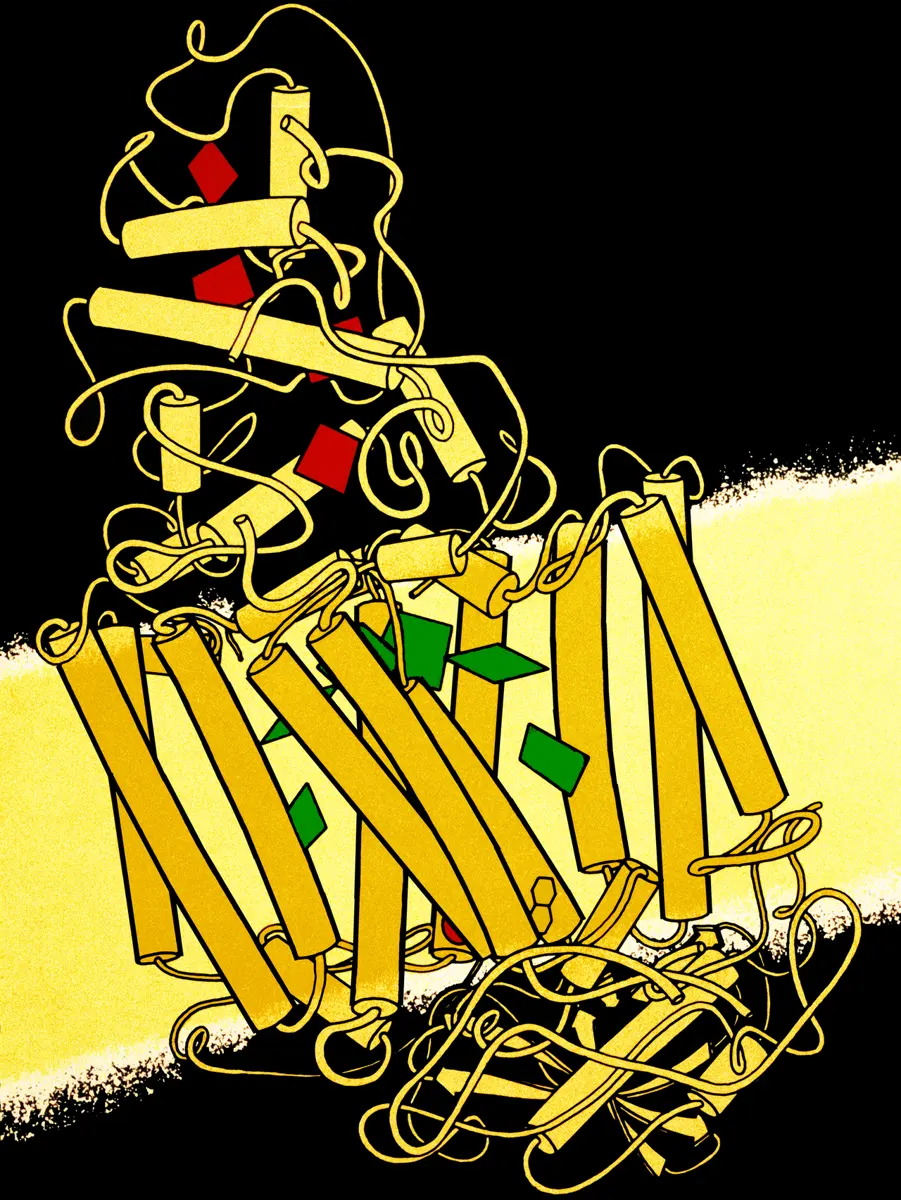
- Photosynthesis. When light hits a leaf, it gives its energy to chlorophyll, and an electron is passed along a chain of molecules held in a protein called the reaction center. The first jump takes about 3 trillionths of a second (3 picoseconds). The danger is that the electron jumps back, wasting the energy as heat. That backward jump is very far downhill, deep in the inverted region, which makes it slow. In his Nobel lecture Marcus mentioned the idea that this is one reason the reaction center wastes so little of the light’s energy.
- Your own cells. The energy from your food is released as electrons are passed down a chain of molecules in your cells, one jump at a time, to oxygen (Where does the energy come from?).
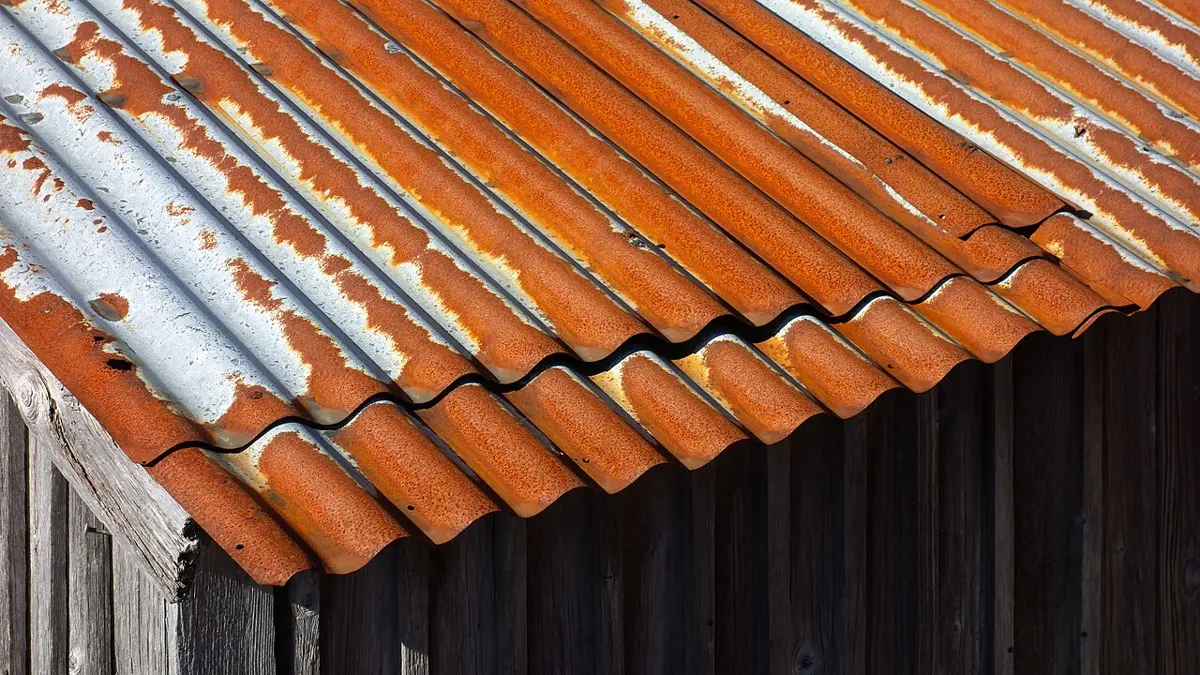
- Rust. When iron rusts, electrons leave the iron and end up with oxygen. The same rules decide how fast each step goes. Rust slowly eats the tin roofs of many houses in Nepal.
- Batteries and solar cells. Engineers designing them use Marcus’s ideas to make the electron jumps they want fast and the ones they don’t want slow.
What came next
- Electrons through proteins. Chemists such as Harry Gray in the United States fixed electron givers to chosen places on proteins and measured how fast an electron jumps across different distances, up to more than a nanometer. Marcus’s theory, extended, explains the results.
- Artificial photosynthesis. Many laboratories are trying to build molecules that do what a leaf does: catch sunlight, separate the charges, and use them to make a fuel such as hydrogen. Getting the forward jumps fast and the backward jumps slow is the whole game, and Marcus’s bowls are the rules. Nobody has yet built one cheap and lasting enough to compete with solar panels. This is an open problem.
In your science books
- Grade 9: ions, cations and variable valency, with iron’s two ions.
- Grade 10: why reactions happen at all (activation energy), single displacement reactions, and light and the rate of reaction.
- Going further: molecules with charged ends (why water clings to ions), heat and reaction speed, energy diagrams, and the packet that rusts.
Learn more
- The Nobel Prize’s press release for 1992, with the parabola of the inverted region.
- Marcus’s Nobel lecture, Electron transfer reactions in chemistry: theory and experiment, and his own life story (nobelprize.org).
The official reason
The prize was given “for his contributions to the theory of electron transfer reactions in chemical systems.”