
RNA interference: switching genes off
Nobel Prize in Physiology or Medicine, 2006: Andrew Fire and Craig Mello
-
Andrew Fire
born 1959 at Stanford, California, USA
He went to university at 16 and finished a degree in mathematics at 19, before switching to biology and to a tiny worm.

Craig Mello
born 1960 in New Haven, Connecticut, USA
His father studied fossils, and family trips to hunt for them made him sure, as a small child, that he would be a scientist.
Photo: Bengt Oberger, CC BY-SA 4.0
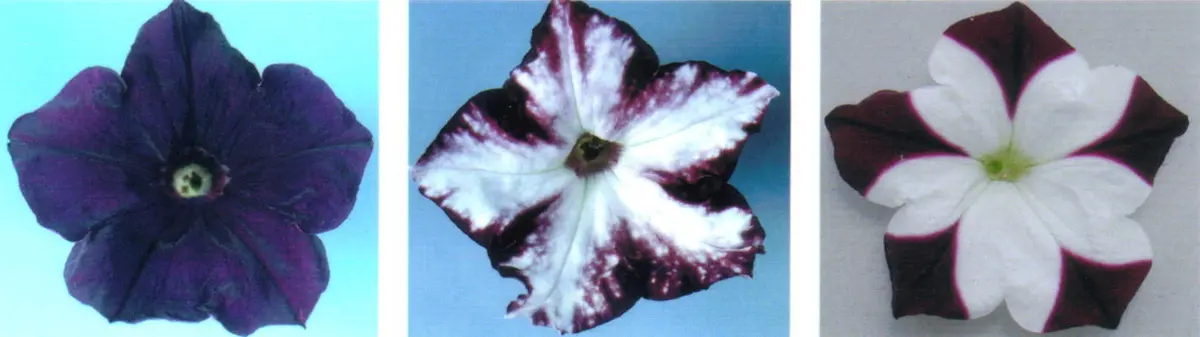
Petunias are among the most popular flowers in pots and gardens. Around 1990, plant scientists tried to make purple petunias an even deeper purple. They gave the plants an extra copy of the gene that makes the purple color. Surely more of the gene would mean more color?
Instead, many of the flowers came out with white patches, and some were completely white. The extra gene had not added color; it had switched off both itself and the plant’s own color gene. Nobody could explain it.
The answer came in 1998, from two scientists studying a worm one millimeter long. Andrew Fire and Craig Mello found that a particular kind of RNA, double-stranded RNA, can silence the gene that it matches. They called it RNA interference, and in 2006 it won them the Nobel Prize in Physiology or Medicine.
The problem: how to switch off one gene
Every cell uses its genes in the same way. A gene in the DNA is first copied into a messenger RNA (mRNA), a single strand of RNA letters (A, U, G and C), which carries the recipe out of the nucleus. On the ribosomes, the mRNA is read and the protein is built Grade 10: RNA. How the first copying step works won the Nobel Prize in Chemistry the same year, 2006 (Watching a cell copy a gene).
By the 1990s scientists could read many genes, but they often had no idea what the protein of a gene did. The best way to find out is to switch the gene off and see what goes wrong. That was very hard to do in animals.
One idea looked promising: antisense RNA. RNA letters pair up just as DNA letters do: A with U, G with C. So you can make a strand that is the mirror image of an mRNA, letter for letter. The two should stick together, and an mRNA with a strand stuck to it should not be able to make its protein.
- The mRNA itself, the strand that carries the recipe, is called the sense strand.
- Its mirror image, which sticks to it, is the antisense strand.
Antisense RNA sometimes worked well in plants. In animals the results were confusing: sometimes it worked, sometimes not, and experiments could not be repeated. Odder still, in worms the “sense” RNA, which should not stick to anything and was used only as a control, sometimes switched the gene off too.
An mRNA has the letters A U G G C U. Which strand is its antisense partner, able to pair with it letter for letter?
Pick an answer to see why.
The worm
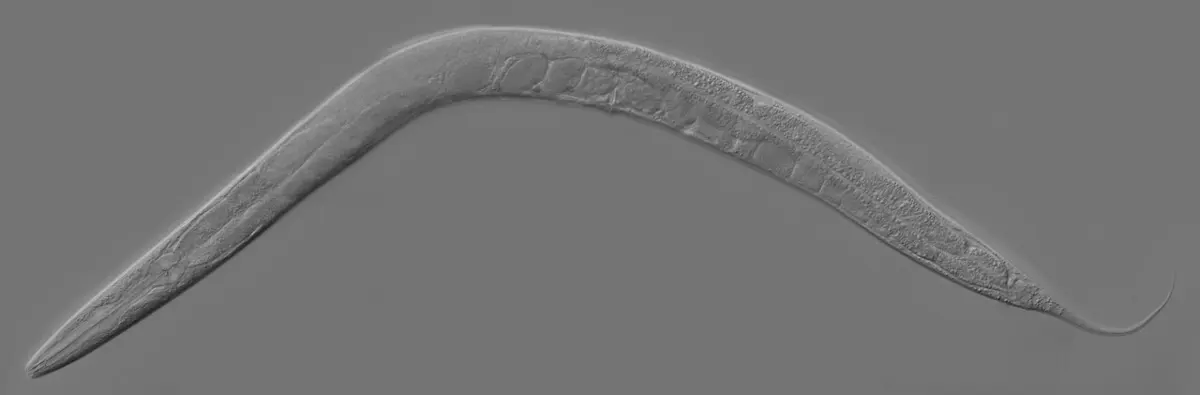
Fire and Mello worked with a tiny roundworm called Caenorhabditis elegans, or C. elegans. It is about 1 millimeter long, it lives in soil and eats bacteria, and its body is transparent, so you can watch its cells under a microscope. An adult has fewer than a thousand body cells, and a new generation grows up in a few days. It belongs to the same group of animals as the roundworms that live in people’s intestines Grade 10: Nemathelminthes, but it is harmless.
To put RNA into a worm, they injected it with a very fine glass needle into the worm’s gonad, the part that makes its eggs. Whatever happened to the gene could then be seen in the worm’s offspring.
Why it was hard
The trouble with the earlier experiments was that nobody knew exactly what was in the tube. To make RNA in the laboratory, scientists use an enzyme that copies a piece of DNA into RNA. Mostly it makes the strand they want, but it also makes small amounts of other RNA, including a little of the opposite strand. A few strands of each kind can find each other and pair up.
Fire and Mello suspected that this accidental, unwanted part was what really mattered. To test it, they had to make each kind of RNA as pure as possible and compare them carefully, one at a time.
What they did, step by step
Fire worked in Baltimore and Mello in Worcester, Massachusetts, hundreds of kilometers apart. They had become friends while both were developing ways to put new DNA into worms, sharing ideas in long telephone calls.
- A gene you can see. They chose a gene called unc-22, which makes a protein in the worm’s muscles. Worms with too little of this protein twitch, an easy sign to spot.
- Three injections. They injected worms with sense RNA for unc-22: the offspring moved normally. They injected antisense RNA: at most a weak effect. Then they mixed the two, so that the sense and antisense strands paired up into double-stranded RNA, and injected that. The offspring twitched, just like worms with a broken unc-22 gene.
- Far stronger. The double-stranded RNA was at least 100 times more powerful than either strand alone. Just a few molecules per cell were enough. Something in the cell had to be multiplying the effect, which suggested that enzymes were involved.
- Where the mRNA went. With another gene, active in the worm’s embryos, they stained the embryos to show its mRNA. After antisense RNA the stain was a little weaker. After double-stranded RNA it was gone: the mRNA had been destroyed.
- February 1998. They published their results in the journal Nature. Double-stranded RNA switched off only the gene it matched, and no other. It had to match the finished mRNA, not the parts of the gene that are cut out of it. And the effect spread from cell to cell, and even passed to the worm’s offspring.
- Later in 1998. The two teams found that you don’t even need a needle. Fire’s team fed worms bacteria that make the double-stranded RNA, and Mello’s team soaked worms in it. Either way, the gene was switched off.
In Fire and Mello’s experiment, which injection made the worms’ offspring twitch?
Pick an answer to see why.
How RNA interference works
Over the next few years, scientists in many laboratories worked out the machinery that Fire and Mello had predicted.
- Dicer cuts. An enzyme called Dicer chops the long double-stranded RNA into short pieces, each about 21 letters long.
- One strand becomes a guide. Each short piece is loaded into a group of proteins called RISC. RISC throws away one strand and keeps the other as its guide.
- Search and cut. RISC moves through the cell. When its guide meets an mRNA with the matching letters, it pairs with it, and RISC cuts the mRNA in two.
- No protein. The cut mRNA is broken down, so no protein is made from it. RISC lets go and moves on to the next matching mRNA. One guide can destroy many mRNAs, which is why so few molecules were needed.
Now the white petunias make sense. The plants had so much RNA from the color gene that some of it ended up double-stranded. That set off RNA interference, which destroyed the mRNA from the extra gene and from the plant’s own color gene, because their letters matched.
Why cells have it
RNA interference was not invented for laboratories. It is found in fungi, plants and animals, including us.
- A defense against viruses. Many viruses make double-stranded RNA inside the cells they infect, and healthy cells normally don’t. In plants, insects and worms, RNA interference chops up the virus’s RNA and stops the infection.
- Guarding the DNA. Some pieces of DNA, called jumping genes, can copy themselves into new places, where they can break other genes. RNA interference helps keep them quiet.
- Fine-tuning our own genes. Our DNA carries hundreds of genes for tiny RNAs called microRNAs, which fold back on themselves into short double-stranded hairpins. They use the same machinery to turn down the genes they match, and help decide how much of each protein a cell makes. Their discovery won the Nobel Prize in 2024 (microRNA: the tiny brakes on our genes).
Why can RNA interference protect a plant against a virus?
Pick an answer to see why.
In your life today
- A tool for every laboratory. Today, to find out what a gene does, scientists can make a short double-stranded RNA that matches it and put it into cells. Within days that gene’s protein is gone. RNA interference has been used to test thousands of human genes, one by one.
- Medicines. It took 20 years to turn the discovery into medicines, mainly because it is hard to get RNA into the right cells: in the blood it is quickly broken down. The first RNA interference medicine, patisiran, was approved in the USA in August 2018. It treats a rare inherited disease in which a faulty liver protein builds up and damages the nerves; the medicine silences the gene for that protein. Others followed. Inclisiran, approved in the USA in 2021, lowers “bad” cholesterol in the blood by silencing a gene in the liver, with just two injections a year once treatment is under way.
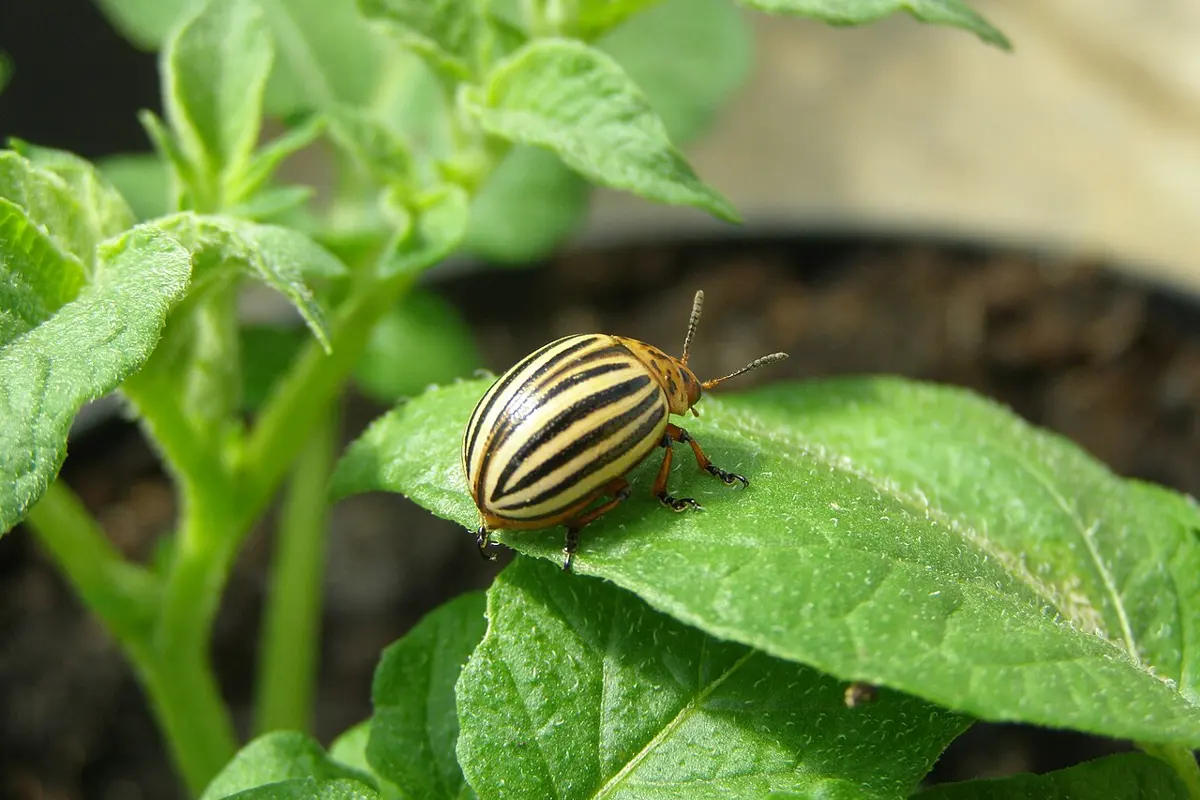
- Crops. In 2023 the USA approved the first spray made of double-stranded RNA to protect a crop. It is sprayed on potato plants, and kills the Colorado potato beetle, an insect pest, when the beetle eats the leaves, by silencing a gene the insect needs to live.
What came next
- Many more genes, many more diseases. More RNA interference medicines are being tested, for diseases of the liver, the kidneys, the heart and the eyes.
- The open question. How can we deliver short RNAs safely to any organ we choose? If that can be solved, almost any disease caused by a harmful protein could be treated by switching off its gene.
In your science books
- Grade 8: ribosomes and viruses.
- Grade 10: DNA, RNA, the roundworms (Nemathelminthes) and genetic technology.
- Going further: How does a gene make a protein? and How does one cell become a whole person?
Learn more
- The Nobel Prize’s own explanation: RNA interference (nobelprize.org).
- The two laureates’ Nobel lectures: Fire and Mello.
The official reason
The prize was given “for their discovery of RNA interference - gene silencing by double-stranded RNA.”