
Neutrinos change, so they have mass
Nobel Prize in Physics, 2015: Takaaki Kajita and Arthur B. McDonald
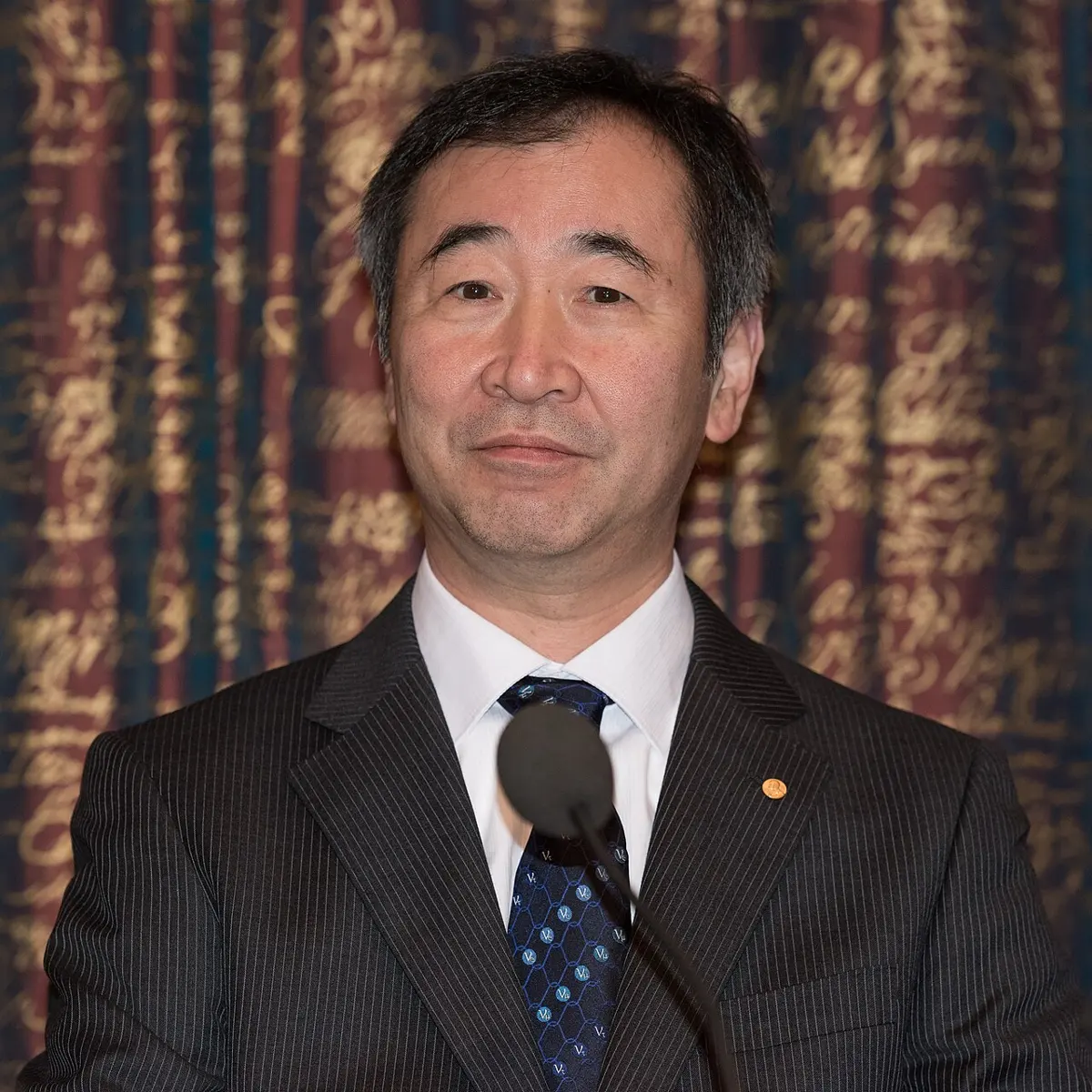
Takaaki Kajita
born 1959 in Higashimatsuyama, Japan
He grew up among rice fields and spent his school years on Japanese archery. He found the first clue to his discovery while still a young researcher on a one-year contract.
Photo: Bengt Nyman, CC BY-SA 4.0
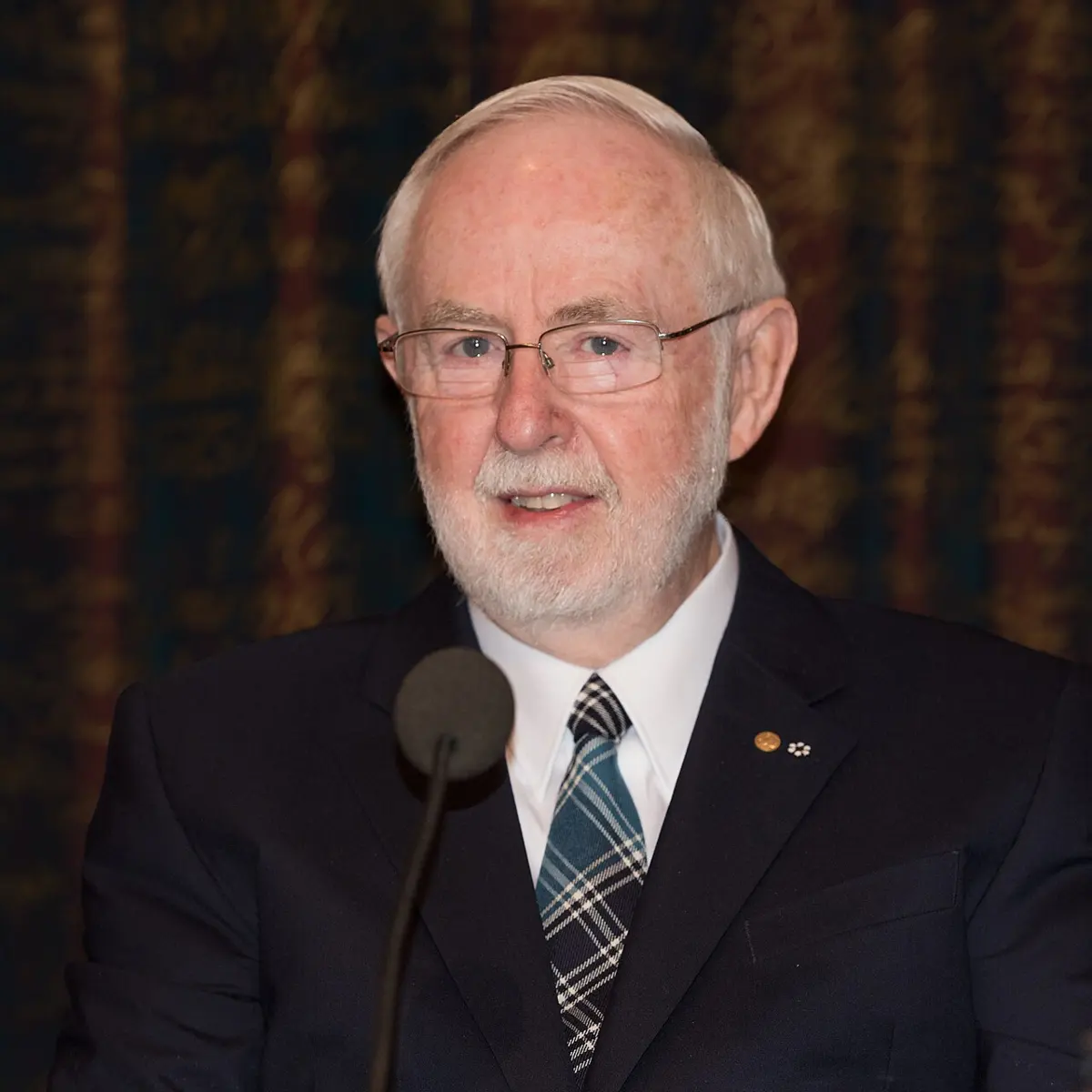
Arthur B. McDonald
born 1943 in Sydney, Nova Scotia, Canada
He led a team from three countries that built a detector two kilometers down a working nickel mine.
Photo: Bengt Nyman, CC BY-SA 4.0
Hold up your thumb. Every second, about 60 billion tiny particles from the Sun pass through each square centimeter of it. They go through you, through the ground, through the whole Earth, and out the other side. At night they come up through your bed. You never feel them, because they almost never hit anything.
These particles are neutrinos. For seventy years after they were first imagined, scientists thought they had no mass at all. The 2015 Nobel Prize in Physics went to Takaaki Kajita and Arthur McDonald, whose teams found that neutrinos change from one kind into another as they travel. That is only possible if they have some mass.
The problem: the missing neutrinos
A particle almost nobody believed in
In 1930 the Austrian physicist Wolfgang Pauli had a problem with beta decay, the kind of radioactivity in which a nucleus throws out an electron (Beta decay). Some energy seemed to vanish each time. Pauli suggested that a tiny, uncharged particle was carrying it away unseen. He was not proud of the idea. He is said to have joked: “I have done a terrible thing, I have postulated a particle that cannot be detected.”
He was nearly right. A neutrino has no electric charge, travels at almost the speed of light, and passes through matter as if it were empty space. It took until 1956 for two Americans, Frederick Reines and Clyde Cowan, to catch neutrinos for the first time, beside a nuclear reactor.
Neutrinos are everywhere. After particles of light, they are the commonest particles in the universe. Most of the ones reaching the Earth are made in the core of the Sun, where hydrogen nuclei join to make helium Grade 9: Nuclear fusion.
Two thirds missing
Scientists can work out how many neutrinos the Sun should make. From the 1960s, they built detectors deep underground to count them. The American chemist Raymond Davis was first (his story). Every detector found the same thing: up to two thirds of the expected neutrinos were missing.
Where had they gone? Some thought the theory of the Sun was wrong. Some thought the detectors were wrong. A few had a stranger idea.
How it works: three kinds of neutrino
Neutrinos come in three kinds, which physicists call flavors:
- the electron-neutrino;
- the muon-neutrino;
- the tau-neutrino.
Each kind goes with a charged partner: the electron, and two heavier, short-lived cousins of the electron called the muon and the tau. When a neutrino does hit something, it usually turns into its partner, so the partner tells you which kind of neutrino arrived.
The Sun makes only electron-neutrinos. The early detectors could catch only electron-neutrinos too. So here was the strange idea: perhaps, on the way from the Sun, many electron-neutrinos turn into muon- or tau-neutrinos, which the detectors simply could not see.
Why could the early detectors have missed many of the Sun’s neutrinos, even if the Sun was making exactly the expected number?
Pick an answer to see why.
Why it was hard
- Neutrinos almost never hit anything. Of the 60 billion or so that cross each square centimeter every second, a detector holding a thousand tonnes catches only a few a day. So detectors must be huge.
- Everything else looks like a neutrino. Cosmic rays, fast particles from space, rain down on the Earth all the time, and natural radioactivity in rock, air and dust gives off flashes too. Detectors are buried a kilometer or more underground, where rock stops cosmic rays but not neutrinos, and built of extremely clean materials.
- You must know which kind arrived. Showing that neutrinos change kind means telling the kinds apart, or counting all of them at once, and no detector before the 1990s could do either well.
What they did, step by step
Kajita: more neutrinos from above than from below
Takaaki Kajita joined Masatoshi Koshiba’s group at the University of Tokyo as a student in 1981 and helped build Kamiokande, a tank of 3,000 tonnes of pure water in a mine at Kamioka, in the mountains of central Japan.
- 1986–1988, a first clue. Cosmic rays hitting the air high above the Earth make neutrinos, mostly muon-neutrinos. Studying these in Kamiokande’s data, Kajita found too few muon-neutrinos. At the time he was on a short contract, not sure of his next job.
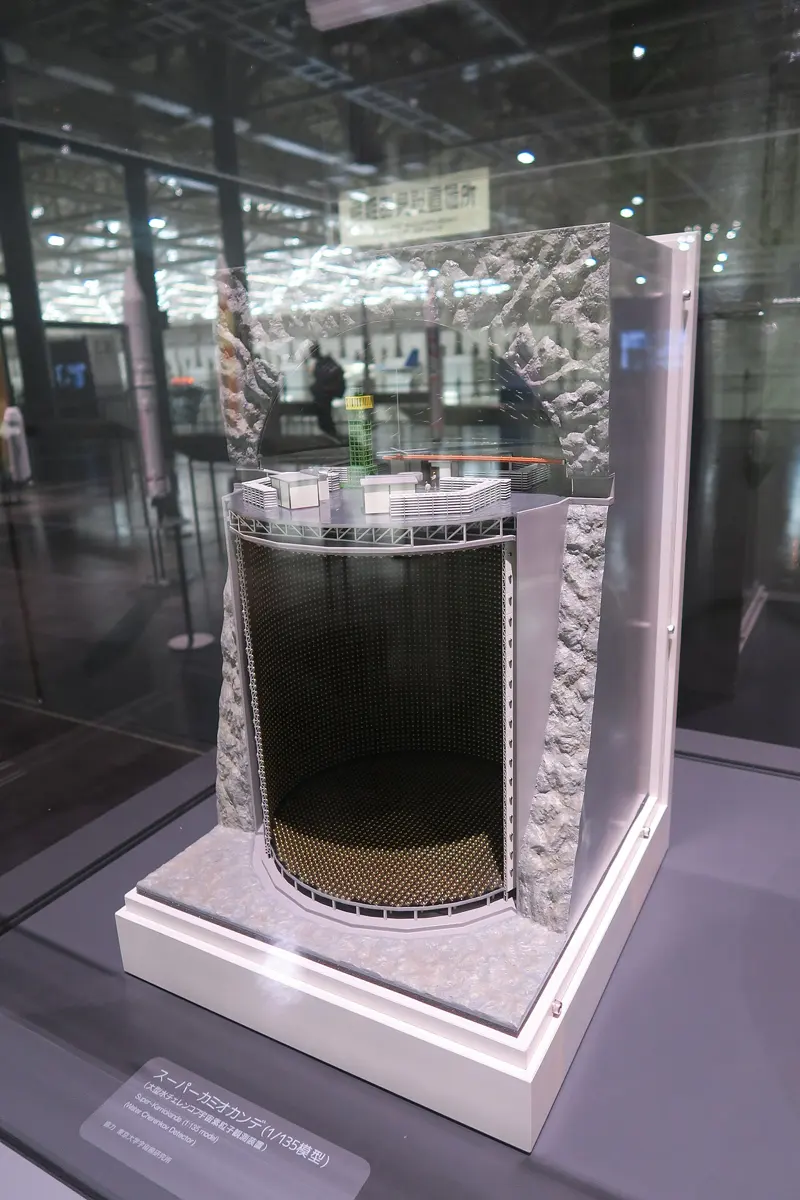
- 1996, a giant detector. Super-Kamiokande started on 1 April 1996, 1,000 m under a mountain: a steel tank about 40 m high and as wide, holding 50,000 tonnes of extremely pure water, lined with more than 11,000 light detectors, each half a meter across. The water is so clear that light goes 70 m before it fades to half, against a few meters in a swimming pool.
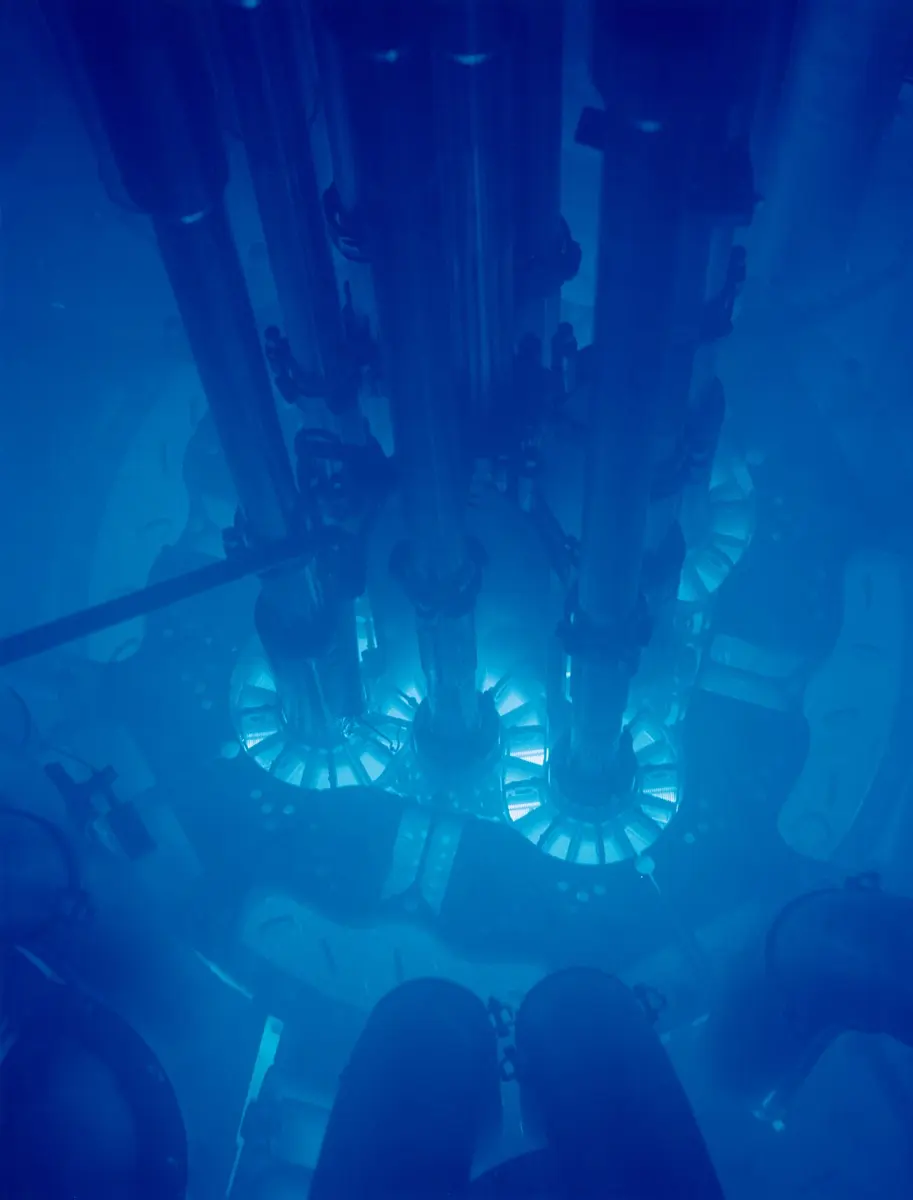
- How it sees. When a neutrino hits the water, it makes a fast charged particle: a muon from a muon-neutrino, an electron from an electron-neutrino. Light in water travels at only about three quarters of its speed in empty space Grade 10: Refractive index, and the particle goes faster than that. So it gives off a cone of faint blue light, called Cherenkov light, a little like the bow wave of a boat. A muon makes a sharp ring of light on the wall; an electron makes a fuzzy one. The ring’s position shows which way the neutrino was going.
- The up–down test. Cosmic rays hit the air all round the Earth, so the same number of muon-neutrinos should arrive from above as from below. The Earth is no barrier to them. But the ones from above had traveled only a few dozen kilometers, from the air overhead. The ones from below had come about 13,000 km, through the whole planet.
- 5 June 1998, the answer. At a conference in Takayama, Japan, Kajita presented the result: from below came only about half as many muon-neutrinos as from above. The electron-neutrinos were as expected from both directions. So muon-neutrinos on the long trip had changed into the third kind, tau-neutrinos, which Super-Kamiokande could hardly see.
McDonald: counting all three kinds at once
Kajita’s result was strong, but it was about neutrinos made in the air. Was the same thing happening to the neutrinos from the Sun? That needed a detector that could count all three kinds.
- 1984, an idea. Herb Chen, an American physicist, saw that heavy water could do it. In heavy water, each hydrogen atom has an extra neutron in its nucleus. This form of hydrogen is called deuterium, an isotope of hydrogen Grade 10: Isotopes. A deuterium nucleus (one proton, one neutron) can be hit by neutrinos in two useful ways. In one, only an electron-neutrino can do it: it turns the neutron into a proton and makes an electron. In the other, any kind of neutrino can knock the nucleus apart into its proton and neutron.
- Borrowed water. Canada had large stores of heavy water for its nuclear power stations, and its atomic energy company agreed to lend 1,000 tonnes of it, worth hundreds of millions of dollars.
- 1989, McDonald leads. Chen died of leukemia in 1987. Arthur McDonald, a Canadian physicist then at Princeton in the USA, moved to Queen’s University in Canada in 1989 and became the director of the project, with teams from Canada, the USA and Britain.
- The build. The Sudbury Neutrino Observatory (SNO) was built 2 km down the Creighton nickel mine in Ontario, Canada: a clear acrylic sphere 12 m across holding the heavy water, watched by about 9,500 light detectors, in a cavern of ordinary water. Everything had to be so clean that a speck of dust’s radioactivity would not fake a signal. Workers and visitors showered before going in.
- 1999–2002, the count. SNO started in 1999. It caught about three of the Sun’s neutrinos a day. In 2001 it reported that electron-neutrinos were only about one third of the expected number. In 2002, counting all three kinds together, it found the full number the theory of the Sun predicted.
So the Sun was making just as many neutrinos as expected. Two thirds of them had changed kind on their 150 million km journey to the Earth.
SNO found that electron-neutrinos were a third of the prediction, but all three kinds together matched it. What does this show?
Pick an answer to see why.
How it works: why changing needs mass
How can a particle change what it is? The answer comes from quantum physics, which says that tiny particles also behave like waves.
A neutrino of one kind, say an electron-neutrino, is really a mixture of three waves, each belonging to a slightly different mass. Think of three friends walking side by side, each with a slightly different length of stride. At the start they are perfectly in step. After a while they drift out of step, and later back in again. In the same way, the three waves begin in step, as an electron-neutrino, then drift apart as they travel. How they line up at any place decides which kind of neutrino you are most likely to catch there. Along the way, the neutrino swings back and forth between kinds. This is called neutrino oscillation.
The drifting happens only because the three waves belong to different masses. If all three had the same mass (for example, zero), they would stay in step forever and a neutrino could never change. So neutrinos must have mass.
That mass is tiny: less than a millionth of an electron’s, and nobody has measured it exactly. But there are so many neutrinos that, all together, they may weigh about as much as all the visible stars in the universe.
In your life today
- Neutrinos through you. Right now, tens of billions of neutrinos are passing through each square centimeter of you, from the Sun, from cosmic rays in the air, and from the rocks under your feet. Your own body makes about 5,000 a second, from the radioactive form of potassium in it, the same potassium you get from bananas and potatoes.
- The Sun is fine. The missing neutrinos had worried scientists for thirty years. The counts now match the theory of how fusion powers the Sun Grade 9: Nuclear reaction in the Sun, which the Sun will keep doing for about 5 billion more years (The Sun’s future).
- The blue glow. The Cherenkov light that Super-Kamiokande sees is the same glow that makes the water around a nuclear reactor’s core shine blue.
What came next
- Neutrinos made on purpose. Since 2010 an experiment called T2K has fired a beam of muon-neutrinos 295 km under Japan, from Tokai to Super-Kamiokande, to measure the changing precisely. Neutrinos from nuclear reactors have been found to change too.
- Bigger detectors. Hyper-Kamiokande, several times bigger than Super-Kamiokande, is being built nearby, and there are new detectors in China and the USA. Neutrinos from the rocks inside the Earth are now being used to measure where the Earth’s inner heat comes from (Particles from inside the Earth).
- Open questions. What exactly is each neutrino’s mass, and which of the three is heaviest? Is a neutrino its own antiparticle? Do neutrinos and antineutrinos change in slightly different ways? If they do, it might help explain one of the biggest puzzles in science: why the Big Bang left behind a universe of matter at all.
Which of these is NOT yet known about neutrinos?
Pick an answer to see why.
In your science books
- Grade 9: nuclear fusion and the nuclear reaction in the Sun, which make the Sun’s neutrinos; nova, supernova and what is left.
- Grade 10: refractive index (why light is slower in water) and isotopes.
- Going further: beta decay, where the neutrino was first imagined, and a message from the core, today, the Sun’s neutrinos.
- The Nobel Prize of 2002: Davis and Koshiba catch the first neutrinos from the Sun and a supernova.
Learn more
- The Nobel Prize’s own explanation: The chameleons of space (nobelprize.org).
- The Nobel lectures: Kajita and McDonald.
The official reason
The prize was given “for the discovery of neutrino oscillations, which shows that neutrinos have mass.”