
Every morning the Sun comes up over the hills around the Kathmandu Valley, and it has done so, as far as anyone can tell, for as long as there have been hills. The sunlight that dries the rice on the rooftops of Bhaktapur, grows the forests and fills the rivers that turn Nepal’s turbines has been arriving for billions of years, never once switched off.
But nothing burns for ever. A fire runs out of wood; a lamp runs out of oil. The Sun is burning something too. So how long has it been shining, how much longer can it go on, and how could anyone possibly know? The answers come from a few clever calculations, from the light of other stars, and from a strange particle that passes straight through you, and through the whole Earth, in their billions every second.
Not a fire
You learned in Grade 9 that the Sun gives out 3.8 × 10²⁶ J of energy every second Grade 9: Some facts about the Sun. Before anyone knew about nuclear fusion, the obvious guess was that the Sun was burning, like coal in a stove. Let’s test that.
But the Sun is far older than 4,000 years. The oldest rocks on the Earth are about 4 billion years old, and there are fossils of living things about 3.5 billion years old. The oldest grains in meteorites, the leftovers from when the Sun and the planets formed, are 4.57 billion years old, measured by the radioactive atoms in them (How Old Is the Earth?, a later topic, shows how). So the Sun has been shining, much as it does today, for about four and a half billion years. No chemical fuel could do that.
A tank of hydrogen
You know how the Sun really works from Grade 9: in its core, hydrogen nuclei fuse, step by step, into helium Grade 9: Nuclear reaction in the Sun. The helium made is lighter than the hydrogen that went in, by about 0.7 %, and the missing mass has become energy, by E = mc² (How much energy? Mass into energy). With that, you can work out how fast the Sun uses its fuel, and how long the fuel will last.
Six hundred million tonnes a second sounds as if the Sun must run out soon. But the Sun is enormous. And it can’t burn all of it: fusion happens only in the core, the innermost quarter of the Sun’s radius, where the temperature (about 15 million K) and the squeeze are great enough. The hydrogen in the outer layers never gets there. Detailed models of the Sun show that by the time the core’s hydrogen is used up, about a tenth of the Sun’s mass will have been turned into helium.
That is the Sun’s main-sequence lifetime: the time a star spends steadily fusing hydrogen in its core, the long, calm middle of its life. The Sun is 4.6 billion years into its 10 billion: roughly halfway.
Why will the Sun stop shining steadily long before all its hydrogen has been used?
Pick an answer to see why.
From the core to your skin
The energy made in the core today won’t reach you for a very long time. On its way out, it crosses the Sun’s layers (Activity 12.1 in Grade 9 shows them), and each one passes it on in its own way.
In the radiative zone, the gas is so dense that light can’t travel far. A packet of energy, a photon, goes only a tiny distance, from a fraction of a millimeter deep inside to a few millimeters near the top of the zone, before an atom or an electron absorbs it or knocks it in a new direction. Each time, it is equally likely to head back inwards as out. So the energy doesn’t stream outwards; it wanders, like a person lost in a crowd, taking a random step at a time. A path like this is called a random walk.
The widget shows the rule for a random walk: to get R steps from where you started, you need about R² steps. Double the distance, and the walk takes four times as long. For the Sun, that makes the trip astonishingly slow.
The real steps are shorter deep inside the Sun, where the gas is densest, and longer near the top of the radiative zone. Careful calculations that allow for this give about 170,000 years for the energy to work its way out through the radiative zone (estimates range from tens of thousands to a few hundred thousand years, because they depend on exactly how dense and opaque the Sun’s insides are). So the sunlight warming you today set off from the core long before the first farmers planted a seed.
In the outer 30 % of the Sun, the convective zone, the gas is cool enough to be more opaque still, so radiation can hardly get through at all. Instead the gas itself carries the energy: hot gas rises, gives up its heat at the surface, cools and sinks again, as water does in a pot of boiling dal. This is much faster: the energy crosses the convective zone in weeks to months. You can see the tops of the rising columns on the surface as bright granules, typically about as wide as Nepal is long, with darker, cooler gas sinking down the narrow lanes between them.
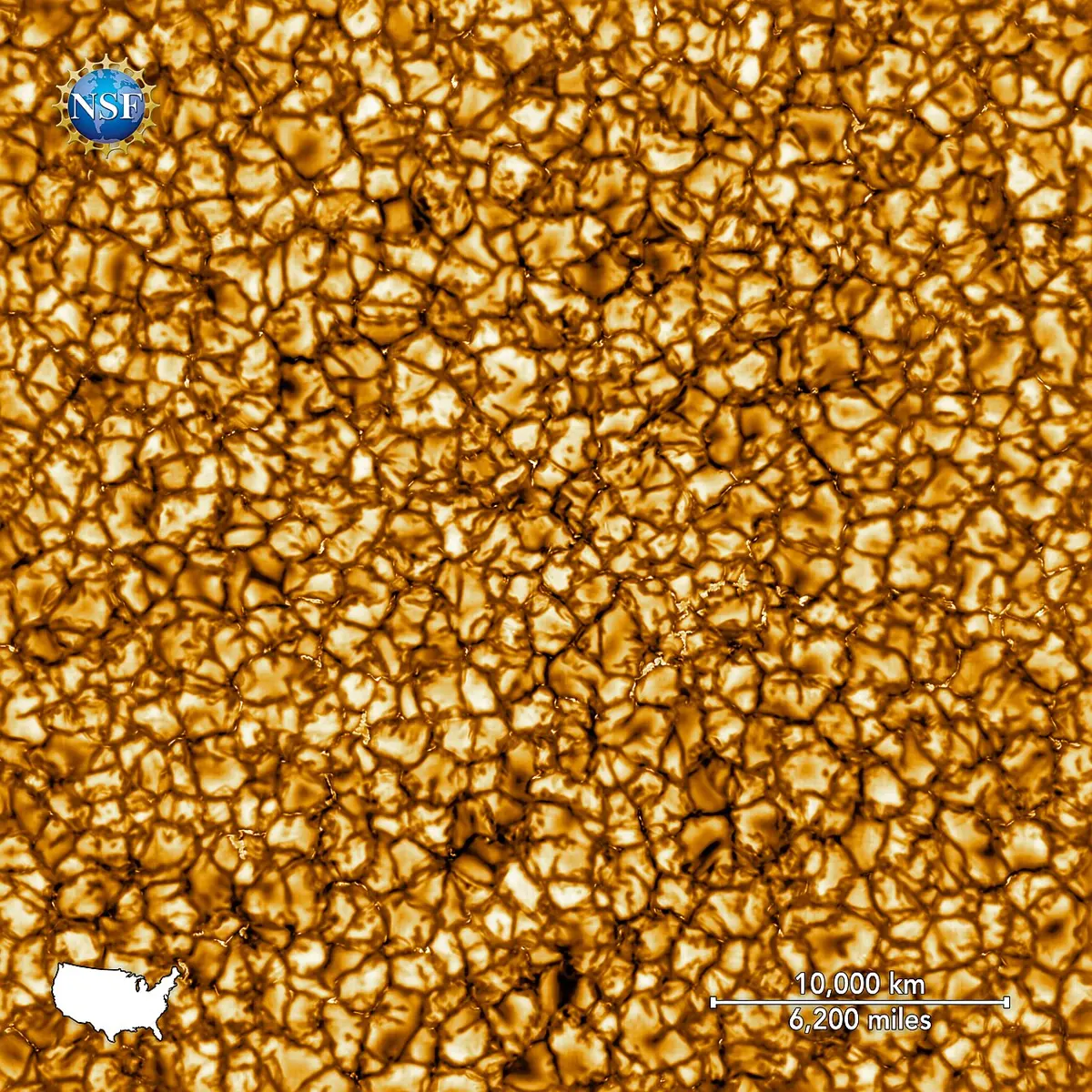
At the photosphere, the visible surface, at about 5,800 K, the gas finally becomes thin enough for light to escape. From there it flies straight through empty space at 3.0 × 10⁸ m/s, and reaches the Earth, 1.5 × 10¹¹ m away, in 500 seconds: 8 minutes 20 seconds. When it lands on your skin, the light is absorbed and becomes heat in you.
Follow the energy all the way and you have an energy model of the kind you built in Building an energy model: mass in the core becomes the energy of fast-moving particles and gamma rays; it travels outwards as radiation, then as the motion of hot gas, then as light again; and at the end it warms the Earth, grows its plants and drives its weather. At every stage, the amount of energy stays the same.
A photon takes 8 minutes 20 seconds to cross the 150 million km to the Earth. Why does the energy take so much longer, over 100,000 years, to cross the 700,000 km inside the Sun?
Pick an answer to see why.
A message from the core, today
Since the light we see left the core so long ago, how do we know the core is still burning? Fusion has one more product that the grade books leave out: every time four protons become a helium nucleus, two neutrinos are made. A neutrino is a particle with almost no mass and no charge, which hardly ever hits anything. Neutrinos fly straight out of the Sun in about 2 seconds, and reach the Earth 8 minutes 20 seconds later.
Bigger stars, shorter lives
The Sun’s 10 billion years comes from a calculation. How do we know the calculation is right? We can’t wait 10 billion years. Instead, we look at other stars, which are at every stage of their lives, and of every mass.
You met this in Grade 9: stars differ mainly because of their mass, and heavy stars burn out fast Grade 9: The color of a star. Now for the numbers. Many stars come in pairs that orbit each other, and from the size and speed of their orbits, astronomers can weigh them, using Newton’s law of gravitation. From how bright they look and how far away they are, they can work out how much energy each gives out every second, its luminosity. Put the two together, for hundreds of stars, and a pattern appears: a heavier star is far brighter. A star with twice the Sun’s mass is about 20 times as bright; a star with ten times the mass, many thousands of times.
That decides how long a star lives. A star with twice the Sun’s mass has twice the fuel, but burns it 20 times as fast, so it lasts about 2 ÷ 20 = a tenth as long as the Sun.
The smallest stars, red dwarfs like Proxima Centauri, are so dim that their fuel lasts for hundreds of billions of years, even trillions: they stir their whole insides and use almost all their hydrogen. The universe is 13.8 billion years old, so no red dwarf has ever died of old age.
There is a second check, and it is beautiful. In a star cluster, a few hundred or thousand stars were born together from one cloud, so they are all the same age. In a young cluster, stars of every mass are still shining steadily. In an older one, the heaviest stars are missing from the main sequence: they have already swollen into giants or died. The older the cluster, the lower the mass at which this cut-off comes, exactly as the lifetimes predict. Clusters of every age, from a few million years to over 10 billion, fit the same pattern.
Star P has 3 times the Sun’s mass; star Q has half the Sun’s mass. Which will shine longer, and why?
Pick an answer to see why.
The Sun’s future
Now we can tell the Sun’s life story, from the calculations and from all the stars seen at each stage. Grade 9 and Grade 10 gave the outline (Death of a star and The life of a star): red giant, then a white dwarf. Here are the numbers, from a detailed model of the Sun by Klaus-Peter Schröder and Robert Smith (2008).
Even in its calm middle age, the Sun is not quite steady. As helium builds up in the core, the core shrinks and heats up, and fusion runs a little faster. The young Sun was only about 70 % as bright as today; it is getting about 1 % brighter every hundred million years. That sounds slow, but in about a billion years the Sun will be some 10 % brighter, enough to make the Earth hot enough for its oceans to start evaporating away. Life on Earth has a long future, but not one as long as the Sun’s.
About 5.4 billion years from now, the core’s hydrogen will be gone. Hydrogen will go on fusing in a shell around the dead helium core, and the Sun’s outer layers will swell and cool. Over the following two billion years it will grow into a red giant: at its biggest, about 7.6 billion years from now, 256 times its present radius and 2,700 times as bright, and the strong wind blowing from it will have carried away a third of its mass.
Mercury and Venus will be swallowed. As the Sun loses mass, its grip on the planets weakens and their orbits grow, so the Earth will move outwards; but the drag of the Sun’s swollen outer layers will probably pull it in. Schröder and Smith calculated that the Earth will most likely be swallowed too.
Then the core, at 100 million K, starts fusing helium into carbon and oxygen. That lasts only about 130 million years. In the end the Sun puffs its outer layers off as a glowing planetary nebula, and its core is left as a white dwarf: just over half the Sun’s present mass, packed into a ball about the size of the Earth, cooling for ever. That is the life span of a star like the Sun: about 10 billion years of steady shining, a little over 2 billion years of swelling and dying, and then a long, slow fading.
A restless Sun
From far away the Sun looks perfectly steady. Close up, it is anything but. Look at it with a safely filtered telescope and you will usually see dark spots on it.
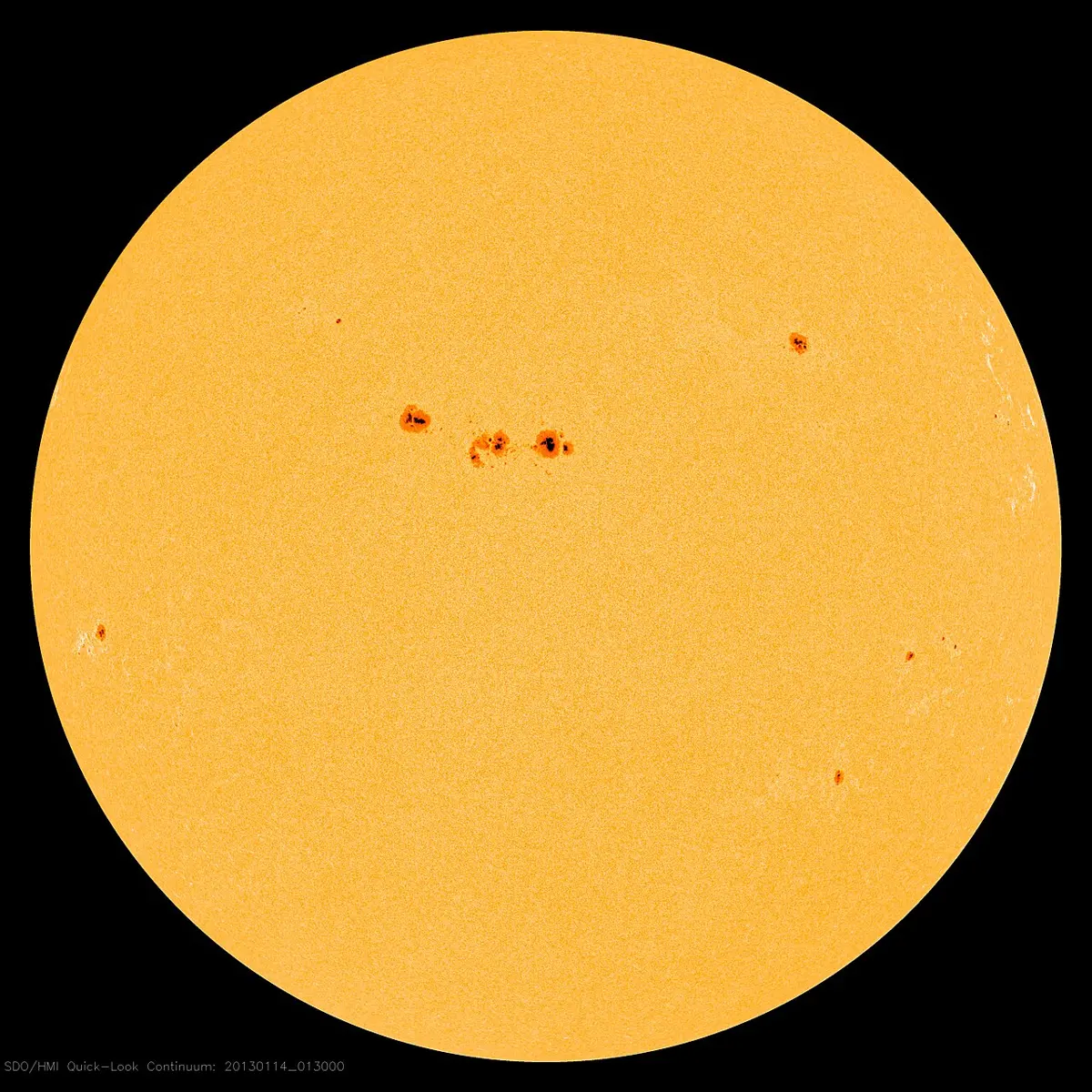
Sunspots are places where the Sun’s magnetic field is very strong, thousands of times stronger than the Earth’s. The field holds back the rising hot gas, so the spot is cooler, about 3,800 K instead of 5,800 K. It is still hotter than any furnace on the Earth, and glows brightly; it only looks dark next to the even brighter surface around it. Spots last from a few days to a few months.
From 1610 Galileo and others, with the first telescopes, watched sunspots move across the Sun from day to day, and realized that the Sun turns, about once every 25 days at its equator. In 1843 the German amateur astronomer Heinrich Schwabe, who had looked at the Sun on every clear day for 17 years (hoping to spot a planet passing in front of it), noticed that the number of spots rose and fell, over about ten years. Astronomers have counted sunspots ever since, and with older observations, the yearly counts go back to 1700. Now you can find the pattern yourself.
The number of spots goes up and down in the sunspot cycle, or solar cycle, on average about 11 years long. Measured from one minimum to the next, single cycles have lasted from 9 to 14 years (from peak to peak, from 7 to 17), and some peaks are three times as high as others. The cycles are numbered from the one that peaked in 1761. Cycle 25 reached its peak in October 2024; the spots are now (as of 2026) becoming fewer, towards the next minimum around 2030.
Cycle 25 reached its peak in late 2024. Around when would you expect the peak of cycle 26?
Pick an answer to see why.
Does the Sun’s brightness change?
Satellites have measured the Sun’s total output since 1978. At the top of the Earth’s air, about 1,361 W reach each square meter facing the Sun, and over a sunspot cycle that goes up and down by only about 0.1 %, about 1 W/m². Surprisingly, the Sun is slightly brighter when it has more spots: the dark spots come with even larger bright patches around them.
Over centuries, the cycles change too. From 1645 to 1715 almost no sunspots were seen at all, a quiet spell called the Maunder minimum. It came during one of the coldest parts of the Little Ice Age, when glaciers grew in the Alps and rivers in Europe froze over in winter. A quieter, slightly dimmer Sun probably played a part, alongside large volcanic eruptions, which scientists think mattered more; how much each contributed is still debated. You read in Grade 10 that changes in the Sun can affect the climate Grade 10: Causes of climate change; but the Sun has not got brighter since satellites started measuring it, so it can’t be causing today’s warming.
Space weather
Around sunspots, the twisted magnetic fields store huge amounts of energy, and sometimes they snap into a new shape and let it go. A solar flare is a sudden flash, from a few minutes to hours long, brightest in X-rays. A coronal mass ejection (CME) is a cloud of about a billion tonnes of the Sun’s outer gas, with its magnetic field, blown into space at hundreds to a few thousand kilometers per second. Both are far more common near the peak of the sunspot cycle.
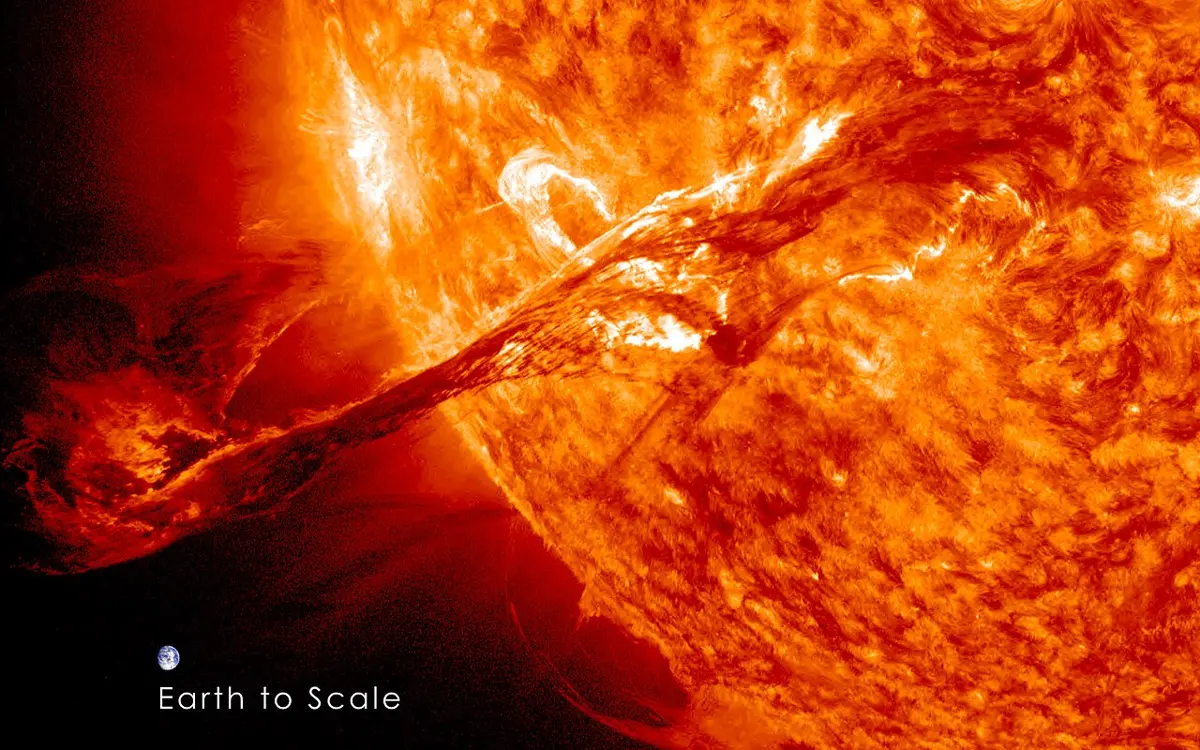
The X-rays from a flare reach the Earth in 8 minutes 20 seconds, and can upset radio signals on the side of the Earth facing the Sun. A CME arrives one to three days later. When it hits the Earth’s magnetic field, it shakes it, causing a geomagnetic storm. The Sun’s changing activity and its effects on the Earth are called space weather, and like the weather, it is now forecast. Spacecraft between the Earth and the Sun watch for storms coming, among them India’s Aditya-L1, which has watched the Sun from 1.5 million km away since January 2024.
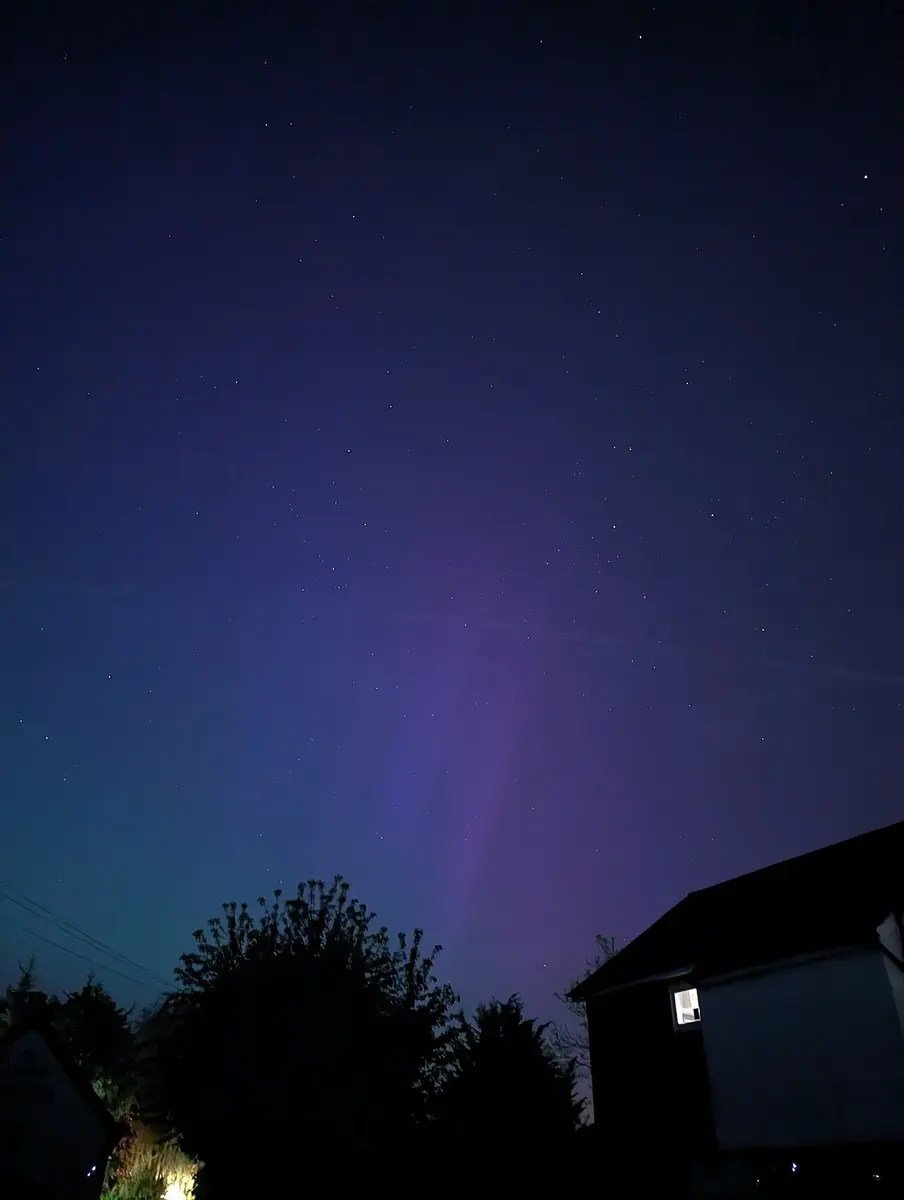
A storm’s most beautiful effect is the aurora: the charged particles stream down along the Earth’s magnetic field near the poles and make the air glow, green and red, as a gas glows in a tube. Its harmful effects come from the changing magnetic field, which drives electric currents through anything long that conducts: power lines, pipelines and old telegraph wires. Satellites suffer too.
| When | What happened |
|---|---|
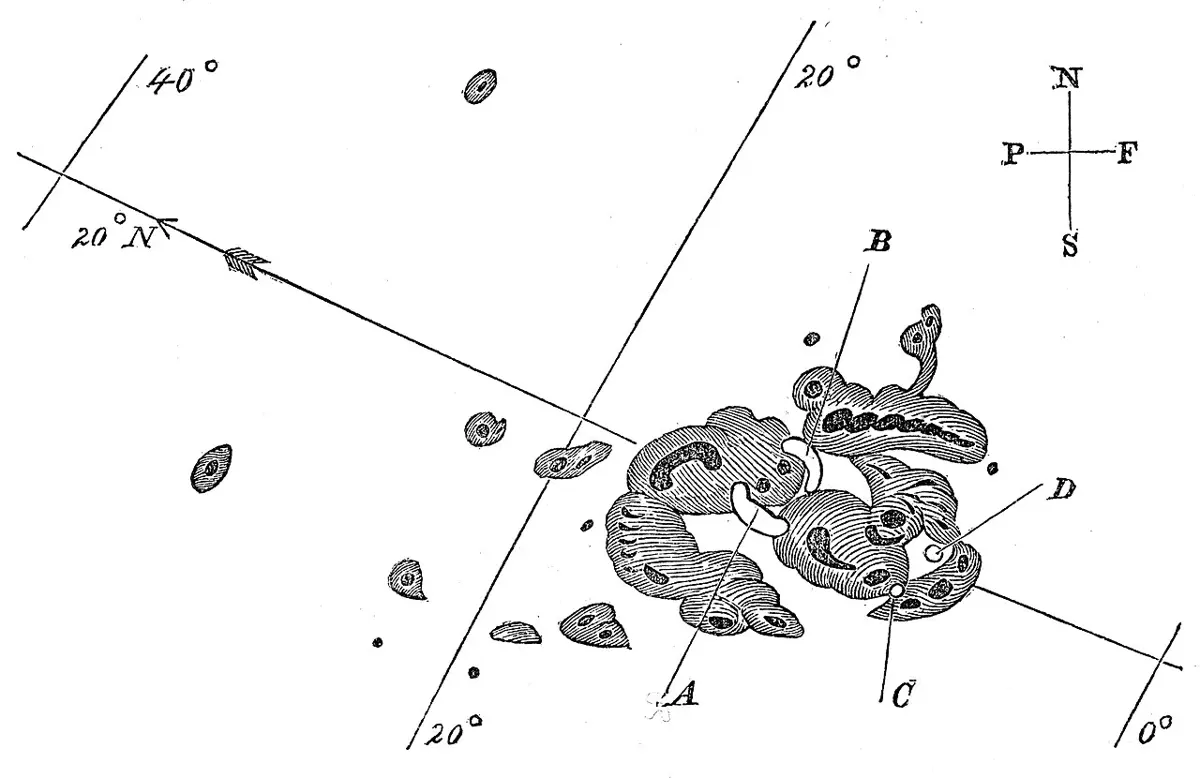
| 1 September 1859 | The Carrington event. Richard Carrington, drawing sunspots in England, saw two bright white flashes on the Sun. Seventeen hours later the biggest storm on record hit: telegraph wires sparked and some telegraph operators got shocks, and auroras were seen as far south as Cuba and Hawaii. |
| 13 March 1989 | A storm drove currents through the power lines of Quebec, in Canada. In 90 seconds the whole grid shut down: six million people were without electricity for nine hours, on a cold March night. |
| February 2022 | A modest storm warmed and puffed up the Earth’s upper air, and the extra drag brought down about 40 of 49 Starlink satellites just launched. |
| 10–11 May 2024 | The strongest storm for twenty years. Auroras were seen across Europe and North America, and cameras at the Indian Astronomical Observatory at Hanle, in Ladakh, in the Himalaya north-west of Nepal, recorded a red aurora glowing over the mountains. |
Light from a flare reaches the Earth in about 8 minutes, but the storm from its CME arrives a day or more later. Why?
Pick an answer to see why.
Questions
Which of these stars will have the longest life?
Pick an answer to see why.
A star has 4 times the Sun’s mass and is about 300 times as bright. Using the Sun’s life as 10 billion years, estimate its life. Explain why it is so much shorter than the Sun’s, although the star has more fuel.
Answer
About 130 million years. The star has 4 times the Sun’s fuel, but it uses it 300 times as fast: the much greater weight of its outer layers squeezes its core harder and makes it hotter, so fusion there runs far faster. Fuel ÷ rate = 4 ÷ 300 of the Sun’s life, about a seventy-fifth.
Describe the journey of the energy given out by one fusion reaction in the Sun’s core until it warms your hand. For each stage, say how the energy is carried and roughly how long it takes.
Answer
- In the core: a little mass disappears in fusion and becomes energy (E = mc²), as the speed of the particles made and as gamma rays.
- Radiative zone: the energy is carried by radiation, absorbed and given out again in random directions countless times, a random walk; this takes over 100,000 years (about 170,000 by careful estimates). On the way the radiation changes from gamma rays to X-rays, ultraviolet and visible light.
- Convective zone: the energy is carried by the motion of hot gas, rising to the surface and sinking when cooled (convection), in weeks to months.
- Photosphere to Earth: it leaves as light (and infrared and ultraviolet) and crosses space in a straight line at 3.0 × 10⁸ m/s, taking 8 minutes 20 seconds.
- Your hand: the light is absorbed and becomes thermal energy, the motion of the particles in your skin.
List three pieces of evidence that the Sun is powered by nuclear fusion, and will last about 10 billion years in all.
Answer
Any three of:
- The Sun’s age: meteorites and Earth rocks show the Sun has shone for about 4.6 billion years. Chemical burning would last only thousands of years, and shrinking under gravity only tens of millions; only fusion gives out enough energy.
- Neutrinos: detectors deep underground catch the neutrinos that fusion makes, arriving from the Sun’s direction at the rate fusion predicts (once their changing type is allowed for). They show fusion is happening in the core now.
- Other stars: weighing stars in pairs shows that brightness rises steeply with mass. The lifetimes this gives, fuel ÷ rate, fit what is seen: heavy, bright blue stars are found only where stars are still forming, and in star clusters the heaviest stars have gone first, at the masses the model predicts for each cluster’s age.
- The numbers fit: the Sun’s output and E = mc² give its fuel use, about 600 million tonnes of hydrogen per second, and the core’s fuel lasts about 10 billion years: consistent with its age of 4.6 billion.
A sunspot is at about 3,800 K; the rest of the surface is at about 5,800 K. The energy a hot surface gives out per square meter is in proportion to its temperature (in kelvin) to the power 4. a. What fraction of the energy per square meter of the surroundings does a sunspot give out? b. Why does it look dark, although it is hotter than molten iron?
Answer
a.
A sunspot gives out only about a fifth as much energy per square meter.
b. It is still very bright, and would glow dazzlingly on its own. But in a photograph exposed for the brilliant surface around it, something five times dimmer looks dark. Our eyes and cameras judge brightness by comparison.
Use the sunspot widget, or the peak years: cycle 1 peaked in 1761 and cycle 25 in 2024. a. Work out the average length of a cycle. b. Why can’t you use this to say exactly when the cycle after next will peak?
Answer
- a.From the peak of cycle 1 to the peak of cycle 25 is 24 cycles, over 2024 − 1761 = 263 years: 263 ÷ 24 = 11.0 years per cycle.
- b.It is only an average. Single cycles have lasted from about 9 to 14 years from minimum to minimum, and from 7 to 17 from peak to peak, and some cycles are much stronger than others. The Sun’s magnetic field, which drives the cycle, is not a clock; the best forecasts look at the field near the Sun’s poles at each minimum.
In about 7.6 billion years the Sun will be a red giant with a radius 256 times its present one, 696,000 km. The Earth is 150 million km from the Sun today. How big will the red giant be, compared with the Earth’s present orbit? What does this suggest will happen to the Earth?
Answer
Radius = 256 × 696,000 km = 1.78 × 10⁸ km = 178 million km. That is more than the Earth’s present distance of 150 million km (1.2 times as far). So the Sun’s surface would reach beyond the Earth’s present orbit. As the Sun loses mass the Earth’s orbit will grow a little, but the drag of the Sun’s outer layers will probably pull the Earth in: it will most likely be swallowed and destroyed. (Long before then, in about a billion years, the brightening Sun will already have made the Earth too hot for oceans.)
Where to go next
- How old is the Earth? The 4.6 billion years in this topic comes from radioactive clocks in meteorites, Moon rocks and tiny crystals. How they are read.
- Where did the atoms in your body come from? The Sun turns hydrogen into helium; bigger stars go much further. How the carbon, oxygen and gold around you were made in stars.
- How do we know the universe is expanding? The stars live and die inside a universe that has its own history. The evidence that it began 13.8 billion years ago.