
Tools made of light
Nobel Prize in Physics, 2018: Arthur Ashkin, Gérard Mourou, and Donna Strickland
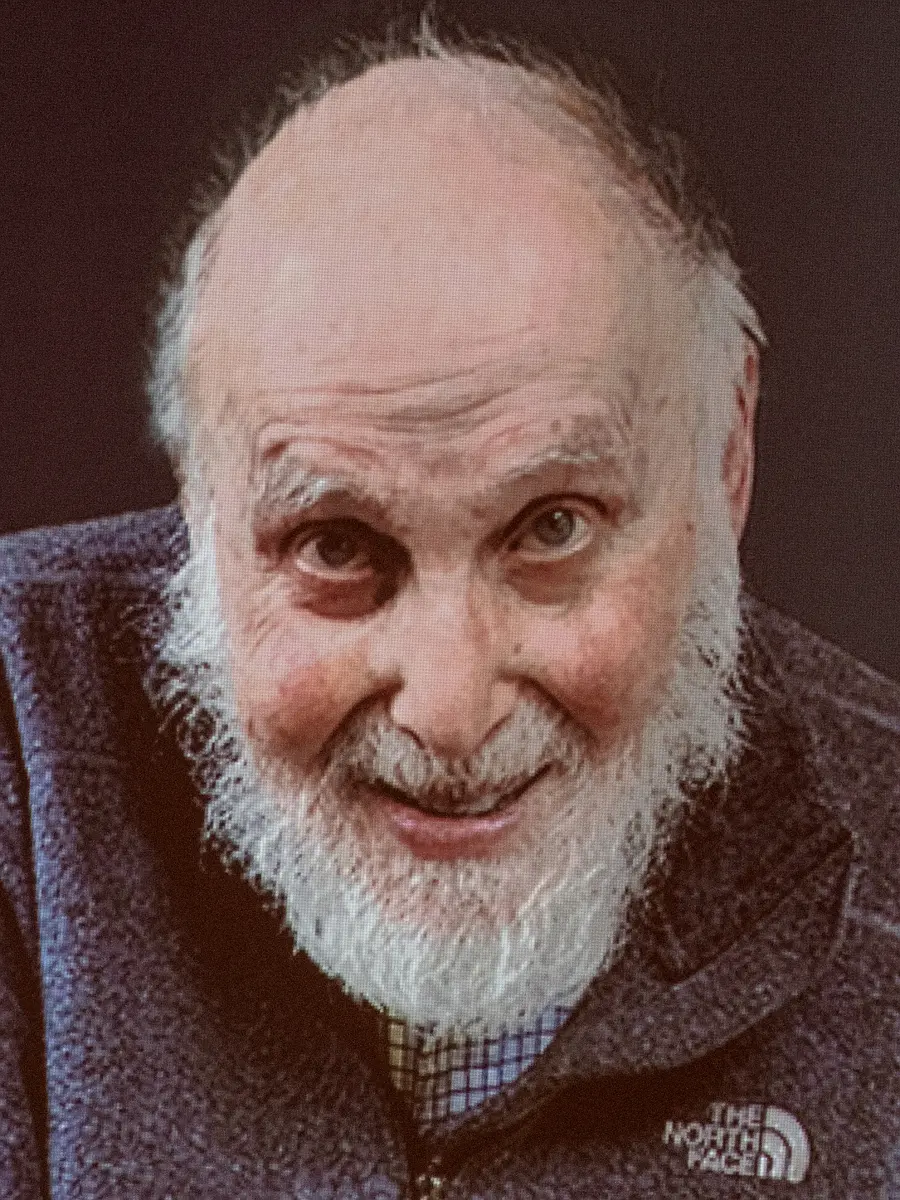
Arthur Ashkin
1922–2020, born in the United States
He worked at a telephone company’s research laboratory. At 96 he was the oldest person ever to win a Nobel Prize, until a year later.
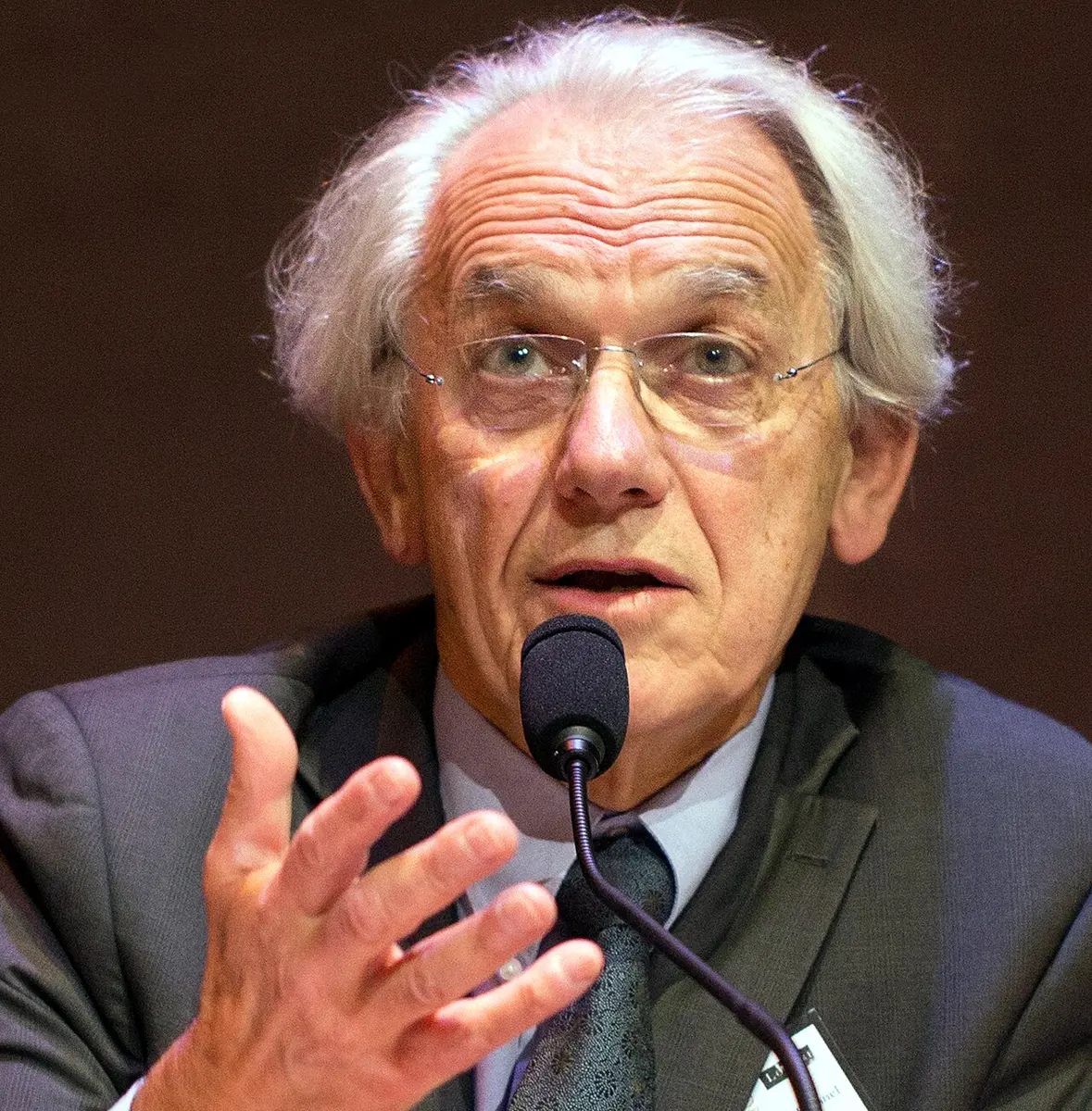
Gérard Mourou
born 1944 in France
A laser scientist who got the idea for his prize from a magazine article about radar.
Photo: Jérémy Barande, CC BY-SA 2.0

Donna Strickland
born 1959 in Canada
Mourou’s student. The prize was for her very first scientific paper. She was the third woman ever to win the Nobel Prize in Physics.
Stand in the sunshine and your skin feels warm: sunlight carries energy. What you can’t feel is that sunlight also pushes. The push of all the sunlight falling on a whole square meter is roughly the weight of a single grain of sand. Too small to notice. But for something very small, such as a single living cell, a push from light can be large.
In 2018 the Nobel Prize in Physics went to two inventions that turned laser light into tools. Arthur Ashkin made optical tweezers, which use light to pick up and hold tiny things, even living bacteria, without touching them. Gérard Mourou and Donna Strickland found how to make laser flashes that are extremely short and extremely strong. Today their flashes help eye surgeons operate on millions of people every year.
The problem: tools too big, flashes too weak
Too small to hold. A bacterium is about a thousandth of a millimeter long. Inside a cell, the tiny “machines” that carry loads, copy DNA and build proteins are a thousand times smaller still. Scientists could see some of them in a microscope, but they couldn’t pick one up, hold it still or measure how hard it pulled. Metal tweezers are millions of times too big, and they would crush a cell.
Too weak to be useful. The first laser was built in 1960. A laser gives a narrow, bright beam of light of one color, and it can give its light in short pulses, or flashes. Scientists wanted the flashes shorter, to “photograph” very fast events, and stronger, to study what very intense light does to matter. But by the mid-1980s they were stuck. A laser makes a pulse stronger by passing it through an amplifier, a crystal that adds energy to it. A short pulse that was made too strong burnt and cracked the amplifier itself.
How light can push
You learned that light comes in tiny packets of energy called photons (Photons). Each photon also carries a tiny amount of momentum, the “quantity of motion” that a moving ball or bus has (Momentum). When light is absorbed, reflected or bent, its momentum changes, and by Newton’s third law the object that changed it gets an equal push the other way Grade 9: Newton’s third law.
Think of a tiny clear bead of plastic in water, with a laser beam shining on it. The bead acts like a little lens: light passing through it is bent Grade 10: Refraction of light.
- If the beam is brighter on one side of the bead than the other, more light is bent on the bright side. The push back on the bead is then stronger from that side, and the bead is pulled towards the brightest part of the beam.
- A laser beam is brightest along its middle. So the bead is pulled into the middle of the beam and held there.
- Now focus the beam with a strong lens. The brightest place of all is the tiny point where the light comes to a focus. The bead is pulled into that point and stays there, held in all three directions. Move the beam, and the bead follows.
That is an optical tweezer: a trap made of light.
Why is a tiny bead pulled towards the brightest part of a laser beam?
Pick an answer to see why.
What they did, step by step
Arthur Ashkin: tweezers made of light (1960s–1987)
Ashkin worked at Bell Laboratories, the research laboratory of the American telephone company, near New York.
- The 1960s: could light push things? Soon after the first laser was built, Ashkin started wondering whether its light could move small objects.
- 1970: pushed and pulled. He shone a laser on tiny clear beads, about a thousandth of a millimeter across, floating in water. The light pushed them along, as he expected. But he also saw something unexpected: the beads were pulled into the middle of the beam.
- 1986: the trap. After years of work, he focused the beam with a strong lens and found that a bead was held at the focus, in all directions. The optical tweezers were born.
- 1987: a lucky mess. Ashkin was trying to trap tiny viruses. He left a sample open overnight, and by morning it was full of bacteria that had got in and grown. Looking in his microscope, he saw that the bacteria were caught in the trap too. His green laser light killed them, so he changed to infrared light, which they don’t absorb much. Now they stayed alive and even divided inside the trap. He could even reach inside living cells and move things there without breaking the cell.
Gérard Mourou and Donna Strickland: stretch, strengthen, squeeze (1983–1985)
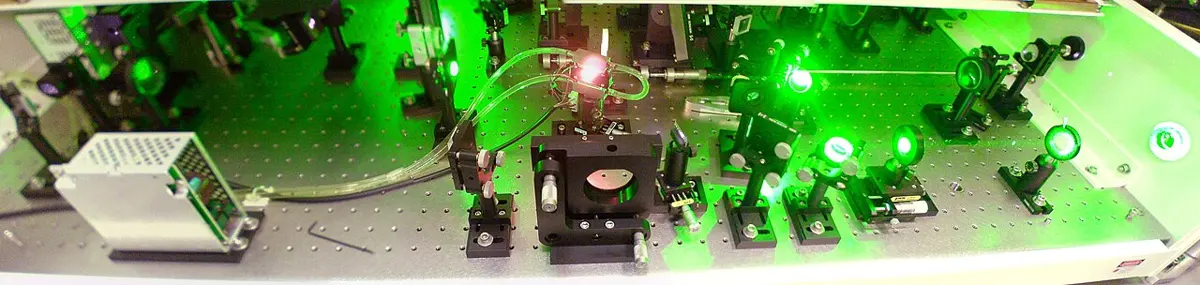
In the 1980s Gérard Mourou, from France, was a professor at the University of Rochester in the USA. Donna Strickland, from Canada, came there as a student. She liked the laser laboratory, lit up by red and green beams like a string of festival lights.
- The idea. Mourou had read an article about radar. To send out a strong radio pulse without damaging the equipment, radar stretches the pulse out in time first. Could the same trick work with light?
- Stretch. A laser pulse is a mixture of colors (every very short pulse is). Strickland sent the pulses through a long optical fiber: a thin glass thread that guides light Grade 10: Optical fibers. In glass, the colors travel at slightly different speeds Grade 10: Dispersion of light, so the red end of the pulse came out first and the blue end last. The pulse was now much longer, and so much weaker at any moment. A pulse whose color changes from beginning to end like this is called chirped, like the rising chirp of a bird.
- Strengthen. The long, weak pulse could then be amplified safely, without burning the amplifier.
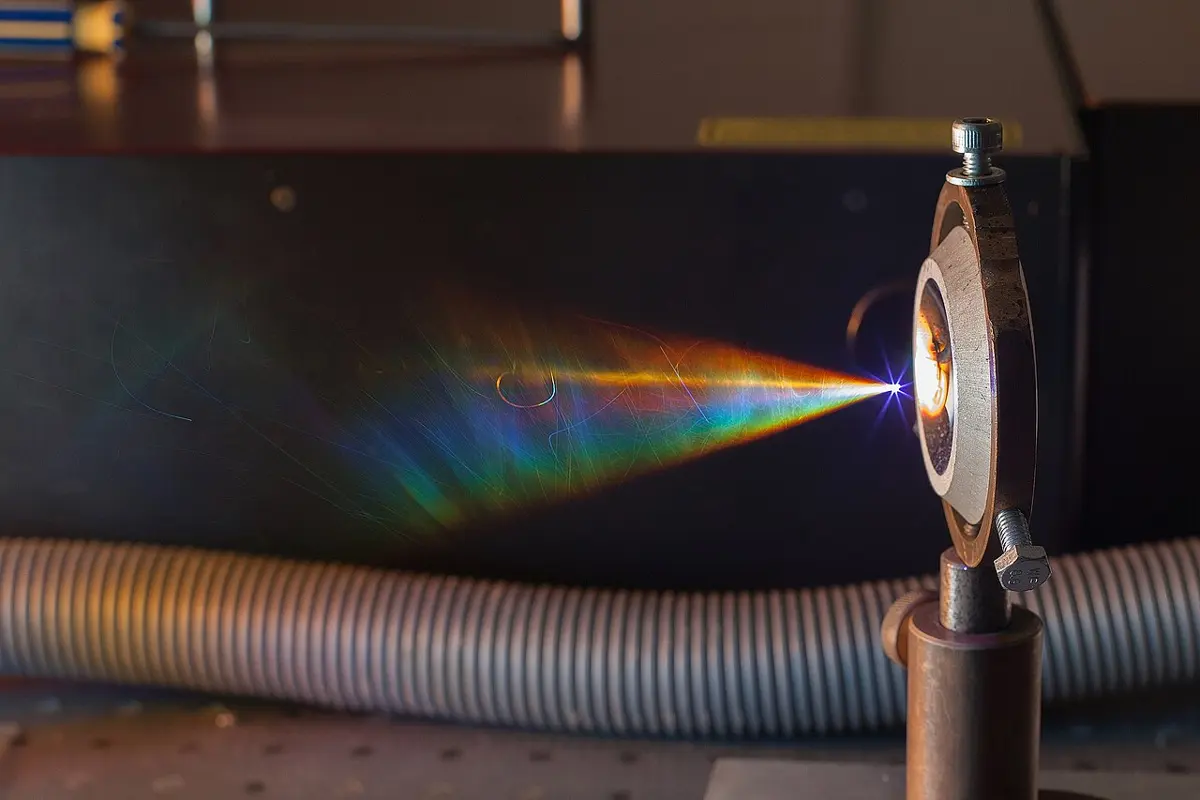
- Squeeze. Finally, the pulse was sent to a compressor, a pair of gratings (glass surfaces ruled with thousands of fine lines, which spread colors apart, like the rainbow on a CD). The gratings sent the red light on a longer path than the blue, so the blue end caught up with the red. All that energy arrived together again, in a pulse as short as before, but far stronger.
- 1985. It worked. Their article was published in December 1985. The method is called chirped pulse amplification, or CPA.
In chirped pulse amplification, why is the pulse stretched before it is amplified?
Pick an answer to see why.
How it works now
Optical tweezers
Optical tweezers are now ordinary tools in biology laboratories. With them scientists can:
- watch molecular machines work. A protein called kinesin carries loads along the thin rods inside a cell, like a tiny walker on a rope. Holding a bead stuck to it, scientists measured each of its steps: about 8 nanometers (8 millionths of a millimeter) at a time.
- stretch DNA to see how strong and springy it is, and watch the proteins that copy it;
- sort cells: with a computer splitting one beam into many, thousands of traps at once can separate, for example, healthy blood cells from cells infected with malaria.
Laser flashes
CPA lasers make pulses lasting a few femtoseconds. A femtosecond is a millionth of a billionth of a second (10⁻¹⁵ s). In one femtosecond, light, the fastest thing there is, travels only about 0.3 thousandths of a millimeter.
- A camera for molecules. Pulses this short can “photograph” atoms moving during a chemical reaction, which once looked instant.
- A cleaner cut. A femtosecond pulse is over before heat can spread, so it cuts or drills a tiny, clean hole without burning the material around it.
- The strongest light ever. CPA is behind every very powerful laser. On 7 March 2019, a laser of the Extreme Light Infrastructure in Măgurele, Romania, a project Mourou started, reached 10 petawatts (10 × 10¹⁵ W).
In your life today
- Eye surgery. In the most common laser operation to correct short sight, LASIK, a femtosecond laser makes a very thin, precise cut in the clear front of the eye, the cornea, to open a flap; a second, ultraviolet laser then reshapes the cornea underneath Grade 10: Laser eye surgery. In a newer method, called SMILE, the femtosecond laser does the whole job through a tiny opening. Femtosecond lasers are also used in some cataract operations. In 2019 the Tilganga Institute of Ophthalmology in Kathmandu became the first eye hospital in Nepal to use one for cataract surgery.
- Medical parts. The tiny metal tubes called stents, which surgeons put inside blocked blood vessels to hold them open (as after a heart attack), are often cut with ultrashort laser pulses.
- Research. Optical tweezers and femtosecond lasers are used in laboratories that study cells, medicines, materials and new kinds of solar cells.
What came next
- Even shorter. CPA lasers led to pulses lasting attoseconds, a thousand times shorter than a femtosecond, short enough to follow electrons moving inside atoms. That work won the Nobel Prize in Physics in 2023.
- Lasers as accelerators. Very intense laser pulses can push electrons and protons to high speeds over a few centimeters, a job that now needs machines tens or hundreds of meters long. Scientists hope one day to make small, cheaper machines for treating cancer with beams of protons.
An open question: what happens to empty space itself in light even stronger than today’s? Physicists predict that light intense enough could turn energy into pairs of particles out of nothing but the vacuum. No laser is yet strong enough to see it.
In your science books
- Grade 9: Newton’s third law of motion, electric power, infrared rays and visible light.
- Grade 10: refraction of light, optical fibers, dispersion of light, lenses and their focus and laser eye surgery.
- Going Further: Momentum and Einstein’s packets of light (photons).
Learn more
- The Nobel Prize’s own explanation: Tools made of light (nobelprize.org).
- The three laureates’ Nobel lectures: Ashkin, Mourou and Strickland.
The official reason
The prize was given “for the optical tweezers and their application to biological systems.”
The prize was given “for their method of generating high-intensity, ultra-short optical pulses.”