
The Higgs field: where mass comes from
Nobel Prize in Physics, 2013: François Englert and Peter Higgs
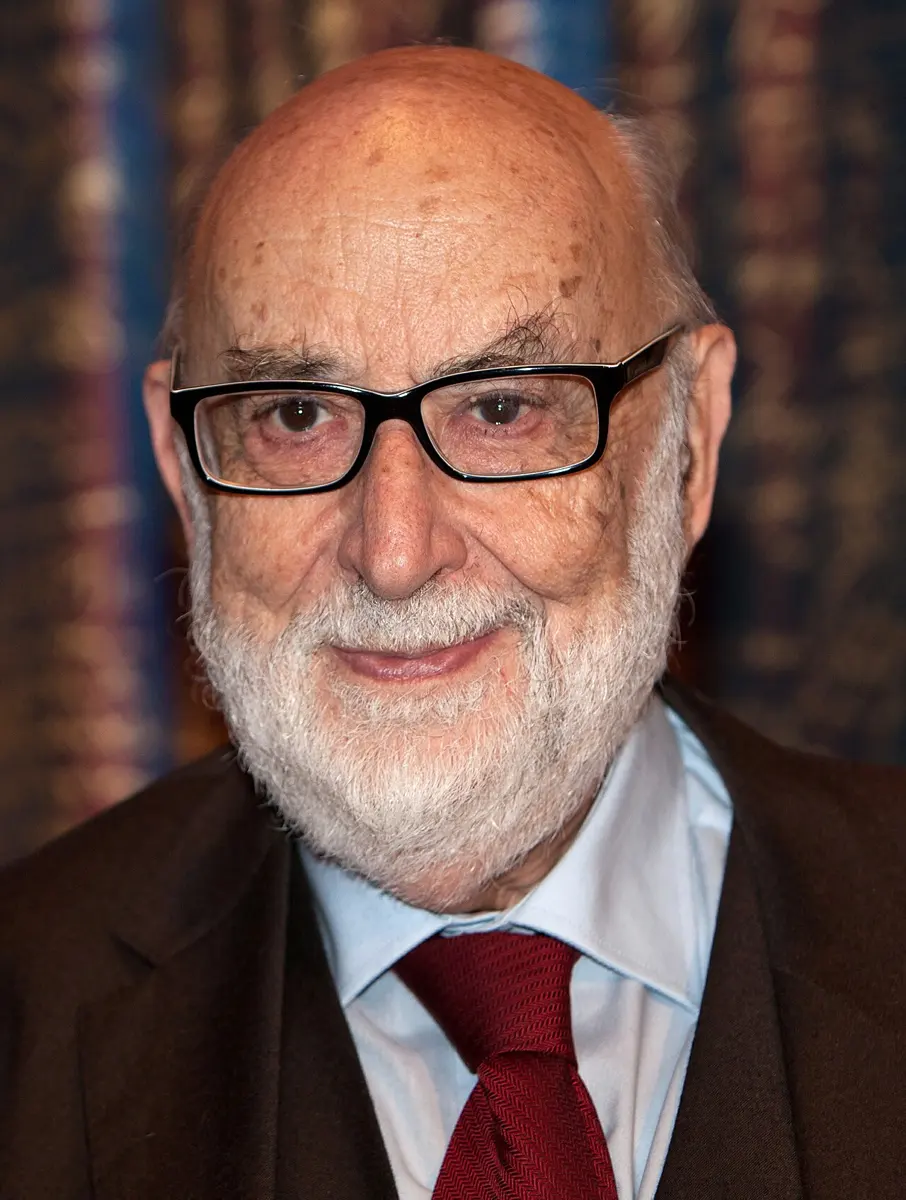
François Englert
1932–2026, born in Belgium
As a Jewish child he survived the Second World War hidden in Belgian villages by people who did not even know him. He worked out the idea with his friend Robert Brout, who died in 2011, a year before it was confirmed.
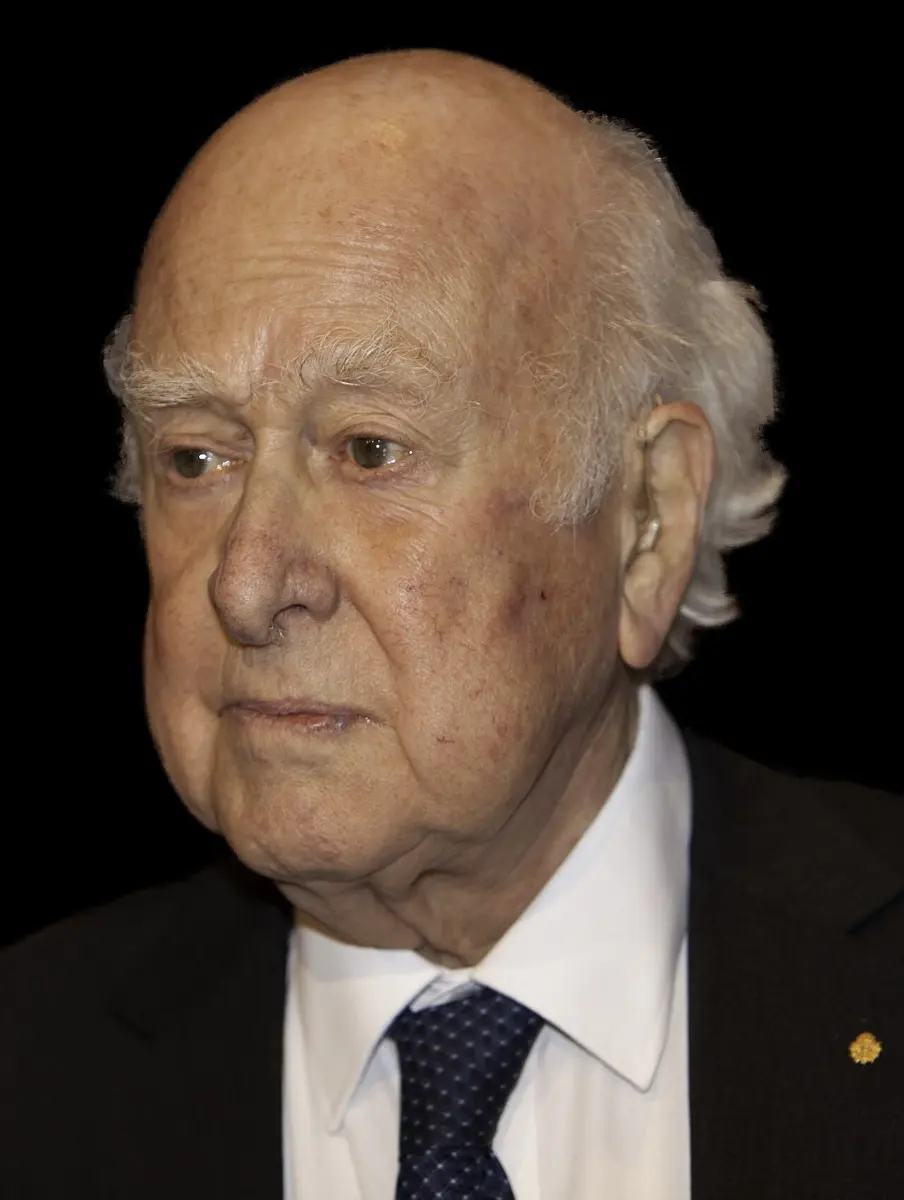
Peter Higgs
1929–2024, born in Britain
A shy theorist in Edinburgh who never owned a mobile phone. He waited 48 years to see his particle found.
Push an empty bicycle and it moves easily. Push a bicycle loaded with two sacks of rice and it is much harder to get going, and much harder to stop. The loaded bicycle has more mass. Mass is how much something resists being speeded up or slowed down Grade 9: Inertia.
But where does mass come from in the first place? Everything is made of tiny particles. Why do these particles have any mass at all? In 1964 two teams of physicists, François Englert with Robert Brout in Brussels, and Peter Higgs in Edinburgh, gave an answer: an invisible field fills the whole universe, and the smallest particles get their mass from it. Nearly fifty years later, in 2012, the particle that their idea predicted was found at CERN, near Geneva in Switzerland. In 2013 Englert and Higgs won the Nobel Prize in Physics.
The problem: a theory that said particles had no mass
You know that an atom has a nucleus of protons and neutrons, with electrons around it Grade 8: Comparing the subatomic particles. By the 1960s physicists had found that protons and neutrons are made of still smaller particles, later named quarks. As far as anyone can tell, electrons and quarks are not made of anything smaller. They are elementary particles.
Physicists think of each force as carried by particles of its own. The electric and magnetic force is carried by photons, the particles of light. The weak force, which causes some kinds of radioactivity and helps the Sun to shine, is carried by particles called W and Z.
In the early 1960s physicists were building one theory to describe these particles and forces. It was beautiful and it worked well, with one huge problem: its rules said that every particle should have no mass, like the photon. A particle with no mass always flies at the speed of light. It could never be held in an atom. If electrons had no mass, there would be no atoms, no molecules, no planets and no people.
And the theory had to explain the weak force. A force carried by massless particles reaches far, like the electric force. The weak force acts only over a tiny distance, much less than the width of a nucleus. That meant its W and Z particles must be heavy. The rules said they couldn’t be.
Why did physicists in the early 1960s think the W and Z particles must be heavy?
Pick an answer to see why.
How a field can give mass
You already know one field: the Earth’s gravitational field. It fills the space around the Earth and pulls on anything with mass, even though nothing touches it (Fields: how a force reaches across space). Physicists now describe every particle as belonging to a field that fills all space: there is an electron field, a photon field, and so on. A particle is a small ripple, a little bundle of energy, traveling through its field.
Englert, Brout and Higgs suggested one more field, now called the Higgs field. It is different from all the others in one way. Other fields fade to nothing in empty space. The Higgs field never switches off. Even in a perfect vacuum, between the galaxies, it is there, everywhere, all the time. We don’t notice it, the way a fish doesn’t notice water.
Particles moving through the universe are always moving through this field, and they interact with it by different amounts:
- A photon does not interact with it at all, so it has no mass and flies at the speed of light.
- An electron interacts with it a little, so it is light.
- The heaviest quark, the top quark, interacts with it very strongly, so it is very heavy: as heavy as a whole atom of gold.
The W and Z particles get their mass the same way. And the theory keeps all its beauty: its rules are still true, but the Higgs field hides them. Very soon after the Big Bang, the Higgs field settled into the state it has today, and from then on the particles had mass.
Here is a picture that helps. Imagine a crowded mela at Dashain. A stranger walks across the ground easily: nobody stops him. Then a famous cricketer tries to cross it. People crowd round him at every step, and he can’t speed up or slow down quickly. He behaves as if he were much heavier. The crowd is the Higgs field; how much a particle is “crowded” is how much mass it has.
The particle that proves the field
How could anyone check that an invisible field fills all space? Higgs pointed out the way in 1964. If the field is real, it should be possible to make it ripple, the way you make a ripple on a still pond by throwing in a stone. A ripple in the Higgs field would be a new particle: the Higgs particle, or Higgs boson. (A boson is one of the two great families of particles. It is named after the Indian physicist Satyendra Nath Bose, who worked in Dhaka and Kolkata.)
There were two big difficulties.
- It is heavy. To make a particle you need energy, because energy and mass are two forms of the same thing: Einstein’s (Mass into energy). Nobody knew the Higgs particle’s mass, but it was clear it would take an enormous amount of energy, packed into a tiny space.
- It doesn’t last. A Higgs particle breaks up into other particles in about a ten-thousandth of a billionth of a billionth of a second (about 10⁻²² s). Nobody can ever see one directly. You can only catch the particles it breaks into, and work backwards.
What they did, step by step
Englert and Brout: Brussels
François Englert trained as an engineer and then a physicist in Brussels. In 1959 he went to Cornell University in the United States to work with Robert Brout, an American physicist. They became close friends, and when Englert went home in 1961, Brout moved to Brussels too, and later became Belgian.
- Early 1960s. They studied how a field can settle in a state that hides the symmetry of its own rules, an idea that the Japanese-American physicist Yoichiro Nambu had brought into particle physics.
- 1964, the paper. They showed how a field filling all space could give mass to the force-carrying particles without breaking the theory. Their paper was published in Physical Review Letters on 31 August 1964.
Higgs: Edinburgh
Peter Higgs was born in Newcastle, in the north of England, and in 1960 became a lecturer at the University of Edinburgh in Scotland.
- July 1964, the first paper. Working alone, he sent a short paper on the same problem to the journal Physics Letters, which published it.
- The rejection. The same journal rejected his second paper, saying it had no obvious relevance to physics.
- The new particle. Higgs added a few sentences pointing out that his theory predicted a new, heavy particle, and sent the paper to Physical Review Letters, which published it in October 1964. That prediction is why the particle carries his name.
Later in 1964 three more physicists in London, Gerald Guralnik, Carl Hagen and Tom Kibble, published the same idea. Physicists often call it the Brout–Englert–Higgs mechanism.
CERN: the biggest machine ever built
The idea fitted so well that it became part of the Standard Model, the theory of all known particles and forces except gravity. When the W and Z particles were found at CERN in 1983, with the masses the theory said, it was clear something like the Higgs field must exist. But for decades no machine was powerful enough to make its particle.
- 2008, the LHC. CERN finished the Large Hadron Collider (LHC), a ring-shaped tunnel 27 km round, about 100 m under the fields on the border of France and Switzerland. Inside it, two beams of protons travel in opposite directions at 99.99999% of the speed of light, guided by giant superconducting magnets cooled to −271 °C, colder than outer space.
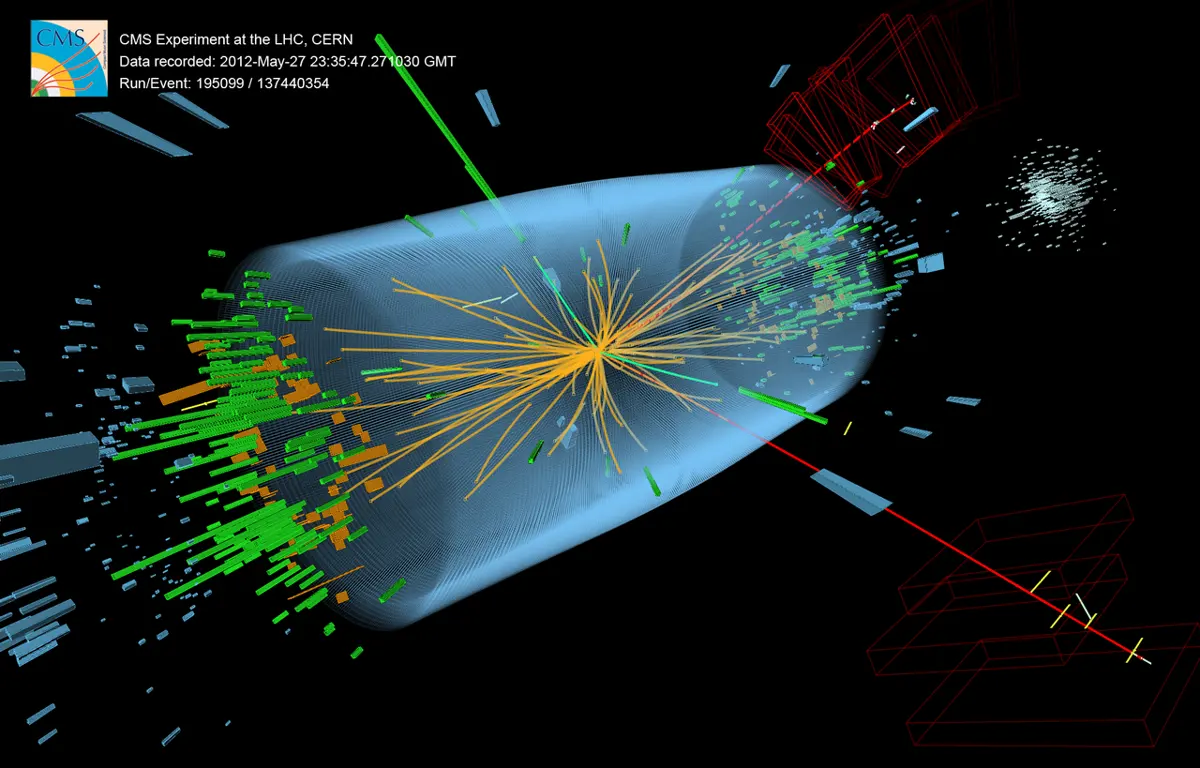
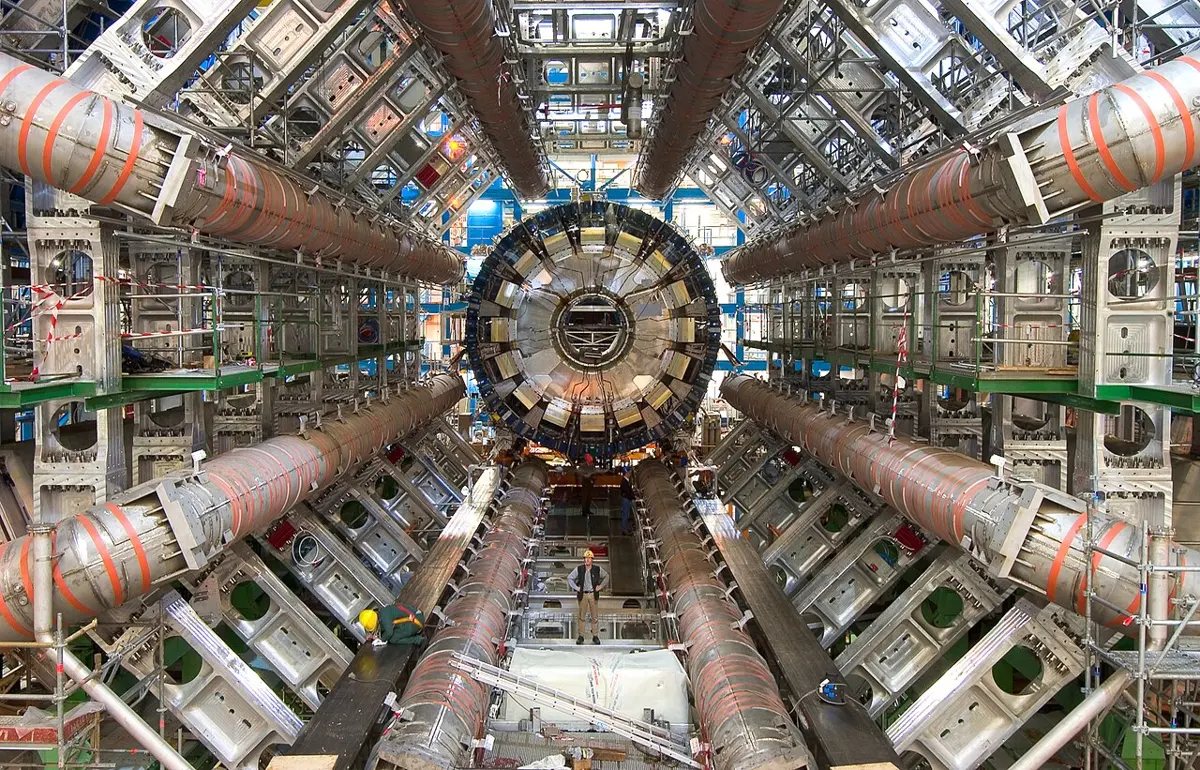
- 2010–2012, the collisions. At four points the beams cross, and protons smash into each other up to 40 million times a second. Around two of these points stand the giant detectors ATLAS and CMS, each built and run by about 3,000 scientists from all over the world. Most collisions are glancing blows; only very rarely does one make a Higgs particle.
- 4 July 2012, the announcement. Both teams announced that they had found a new particle with a mass of about 125 GeV, about 130 times the mass of a proton. Higgs and Englert, who had never met before, were both in the audience at CERN. Higgs said it was an incredible thing that it had happened in his lifetime.
- 8 October 2013, the prize. After more data had shown that the new particle behaved as the Higgs particle should, the Nobel Prize went to Englert and Higgs. Brout had died in 2011, and the prize is never given after death.
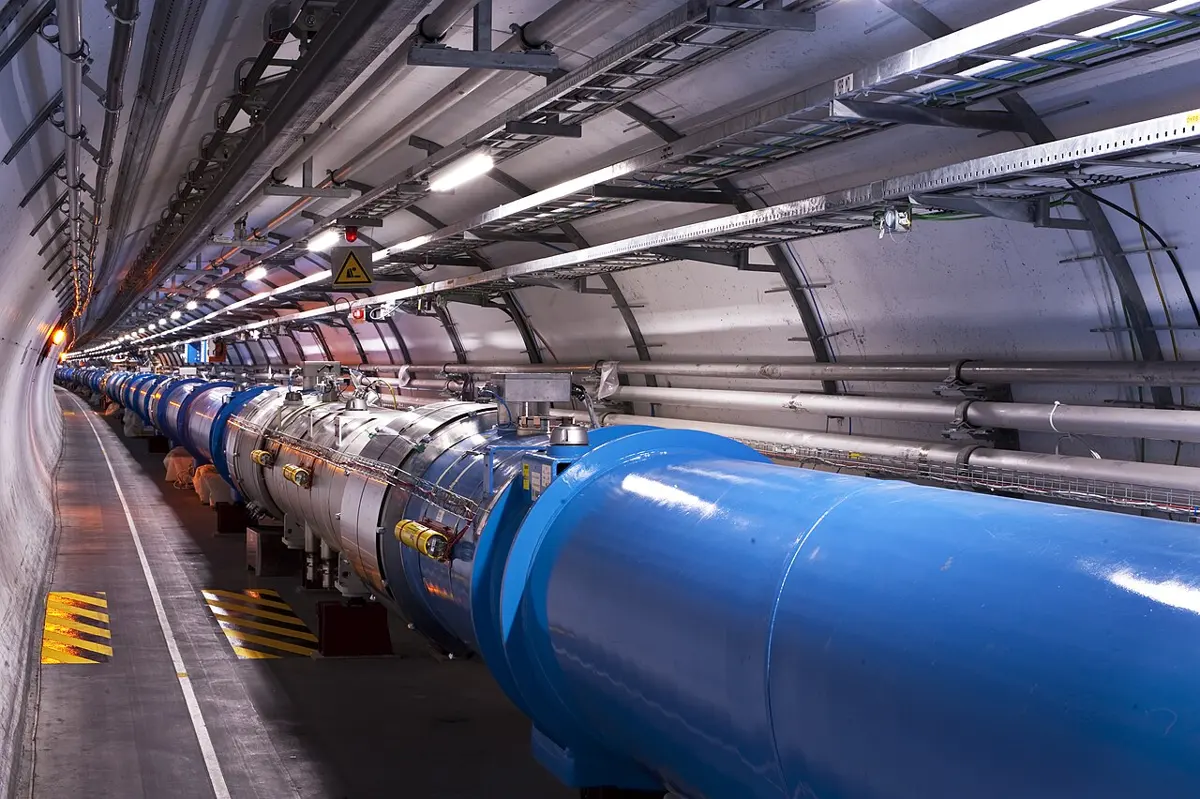
Why did finding the Higgs particle need such a huge machine?
Pick an answer to see why.
How it was found: a small bump
A Higgs particle can break up in several ways. One of the clearest is into two photons, two flashes of very energetic light. Many other collisions also make pairs of photons, so you can never say “this pair came from a Higgs.”
So the scientists did something clever. For every pair of photons, they worked out what mass a single particle would need to have to make that pair. Most pairs come from other processes, and their masses are spread smoothly over a wide range. But if a particle of one exact mass exists, it adds extra pairs at that mass, and the graph gets a small bump.
Bumps can also come from chance, like a run of sixes on a dice. So the teams waited until the bump was so big that the chance of it being luck was less than about one in three million. That is the standard physicists use before they say “discovery”. Both ATLAS and CMS, working separately with different detectors, reached it in the summer of 2012, and both saw the same mass.
In your life today
The Higgs particle has no direct use, and probably never will: it lasts too short a time. But the hunt for it changed your life in other ways.
- The World Wide Web. A British scientist at CERN, Tim Berners-Lee, invented the web in 1989 so that physicists around the world could share their results. CERN gave it to the world free.
- Hospitals. The superconducting magnets developed for particle accelerators are cousins of those in MRI scanners. Small particle accelerators are used to treat cancer, and to make the radioactive medicines for PET scans.
- Nepal and CERN. In 2017 Nepal signed a cooperation agreement with CERN, so that Nepali students and scientists can take part in its schools and programs.
What came next
- Measuring it. Since 2012 the LHC has made millions more Higgs particles. Every measurement so far matches what the Standard Model says, with no surprises yet.
- Dark matter. The Standard Model describes only about a fifth of all the matter in the universe. The rest is dark matter, which we know by its gravity but have never caught. Some physicists hope that the Higgs particle could be a link to it.
- The next machine. The LHC is being upgraded, from about 2030, to make many more collisions. Physicists are also planning a much bigger ring, about 90 km round, to study the Higgs particle in detail.
An open question: why does each particle interact with the Higgs field by the amount it does? Nobody knows why the top quark is about 340,000 times heavier than the electron. The Higgs field explains how particles get their masses, but not why they are the masses they are.
In your science books
- Grade 8: the subatomic particles and the Big Bang theory.
- Grade 9: mass and inertia.
- Grade 10: mass and weight and the Big Bang theory.
- Going Further: fields: how a force reaches across space, mass into energy and what is inside a nucleus.
Learn more
- The Nobel Prize’s own explanation: Here, at last! (nobelprize.org), with the presentation speech.
- The Nobel lectures of Englert and Higgs.
The official reason
The prize was given “for the theoretical discovery of a mechanism that contributes to our understanding of the origin of mass of subatomic particles, and which recently was confirmed through the discovery of the predicted fundamental particle, by the ATLAS and CMS experiments at CERN's Large Hadron Collider.”