
Two forces that turned out to be one
Nobel Prize in Physics, 1979: Sheldon Glashow, Abdus Salam, and Steven Weinberg
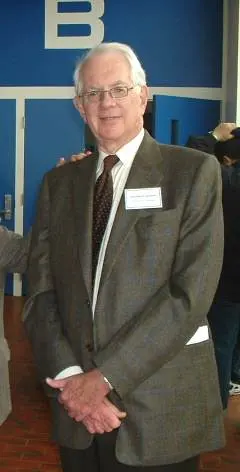
Sheldon Glashow
born 1932 in the United States
The son of a plumber. He and Steven Weinberg were in the same class at school, and taught each other physics on the New York subway.
Photo: Luboš Motl - Lumidek, Public domain
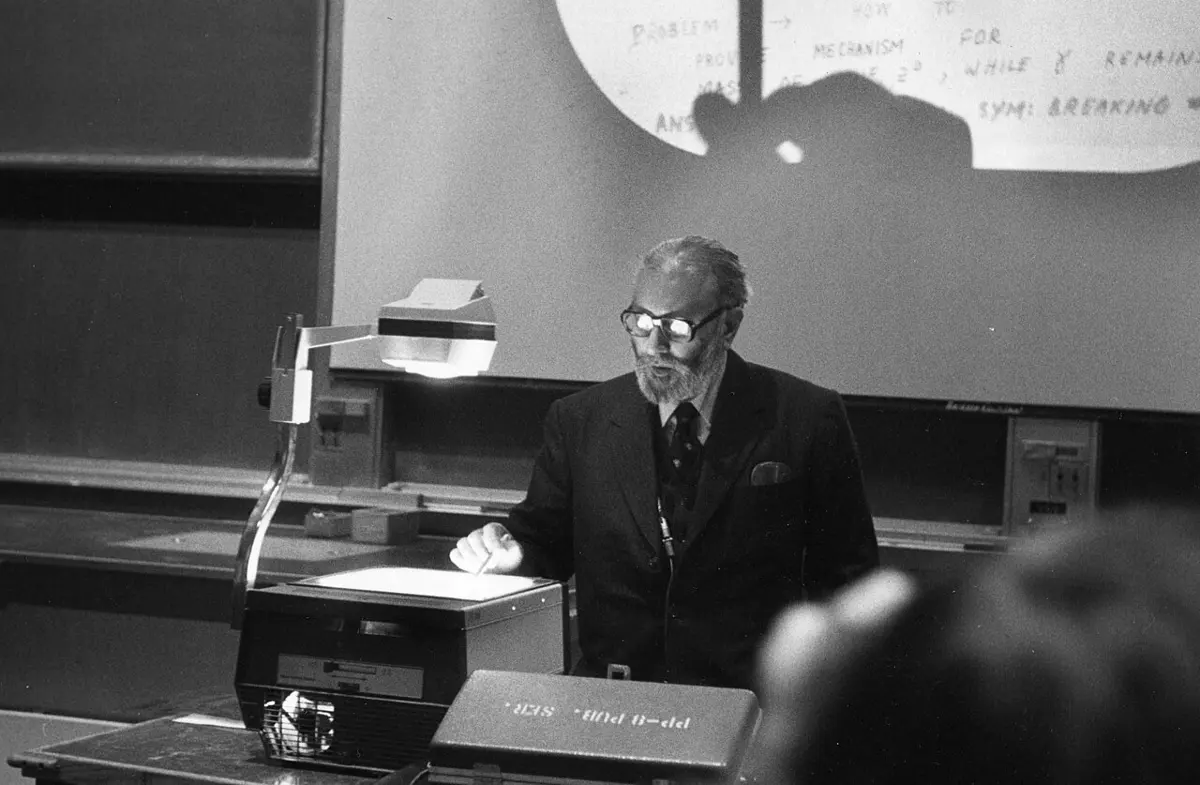
Abdus Salam
1926–1996, born in Jhang, in today’s Pakistan
At 14 he got the highest marks ever recorded in the Punjab University’s entrance examination. He gave his prize money to help young physicists from poor countries.
Photo: Emilio Segrè, AIP Emilio Segrè Visual Archives, CC BY 4.0
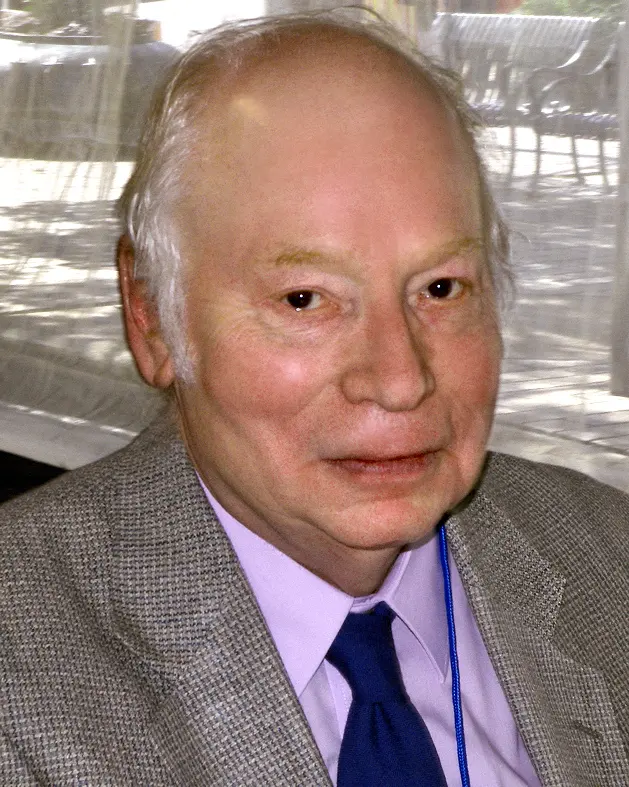
Steven Weinberg
1933–2021, born in the United States
He found the theory’s final form in 1967 and later wrote a famous popular book about the first three minutes of the universe.
Photo: Larry D. Moore, CC BY 4.0
Rub a plastic comb on your hair and it picks up bits of paper. Bring a magnet near a compass and the needle swings. Two hundred years ago, these seemed like two different forces. Today you learn in Grade 10 that they are one: an electric current makes a magnetic field, and a moving magnet makes a current Grade 10: Electromagnetic induction. Electricity and magnetism are two faces of one force, electromagnetism.
In the 1960s three physicists, working separately, showed something even more surprising: electromagnetism and a force hidden inside atomic nuclei, the weak force, are also two faces of one force. Experiments proved them right, and in 1979 Sheldon Glashow, Abdus Salam and Steven Weinberg shared the Nobel Prize in Physics.
The problem: four forces, not one
Every push and pull in nature comes from one of just four basic forces.
- Gravity holds you on the ground and the Moon round the Earth. It reaches across the whole universe.
- Electromagnetism holds electrons in atoms and atoms in molecules. Every touch, every chemical reaction, every spark of lightning and every ray of light is electromagnetism. It too reaches far.
- The strong force holds the protons and neutrons of a nucleus together, even though the protons repel each other.
- The weak force can turn a neutron into a proton, or a proton into a neutron. It acts only over a tiny distance, less than the width of a proton.
Physicists like to find one cause behind things that look different. Newton showed that the falling apple and the orbiting Moon obey the same gravity. In the 1860s James Clerk Maxwell joined electricity and magnetism into one theory, and showed that light is a wave of electromagnetism. Could the four forces be fewer?
Which force holds the electrons of an atom round its nucleus?
Pick an answer to see why.
What the weak force does
You may never have heard of the weak force, but without it the Sun would not shine.
It changes one particle into another
Some nuclei are radioactive: they break down by themselves and give out radiation. In one kind, called beta decay, a neutron in the nucleus turns into a proton. It throws out an electron and a tiny, almost massless particle called an antineutrino (Beta decay). The nucleus becomes a different element. Carbon-14, which archaeologists use to find the age of old bones and wood, decays this way into nitrogen.
The neutron has no charge. The proton is positive and the electron negative. So in beta decay the charge moves: the neutral neutron becomes a positive proton, and the negative charge leaves with the electron.
It lights the Sun
The Sun shines by fusion: hydrogen nuclei (single protons) join to make helium (Fusion). But helium has neutrons, and the Sun starts with only protons. The very first step joins two protons, and the weak force must turn one of them into a neutron. Because the weak force is so weak, this step is very slow. That is lucky for us: it makes the Sun burn its hydrogen slowly, over about ten billion years, long enough for life to appear on Earth.
Each of these first steps also makes a neutrino, a particle with no charge and almost no mass, which flies straight out of the Sun. About 65 billion of the Sun’s neutrinos pass through every square centimeter of your body every second, day and night. Almost all of them go straight through the whole Earth without touching anything.
Why joining them was hard
At first sight the two forces could not be more different.
| Electromagnetism | Weak force | |
|---|---|---|
| How far it reaches | across the universe | less than the width of a proton |
| How strong | strong | far weaker, even inside a nucleus |
| What it does | pushes and pulls charges | changes one kind of particle into another |
| Its messenger | the photon, with no mass | ? |
Physicists describe every force as carried by messenger particles. Two electrons repel each other by passing photons, particles of light, between them. A photon has no mass, so it travels at the speed of light and can reach any distance. That is why the electric force reaches so far.
If the weak force has messengers too, they must be very heavy. A heavy messenger can be borrowed for only a very short time, so it can travel only a very short distance before it must be paid back. That would explain why the weak force reaches only across a nucleus. But the mathematics of the 1960s said that messengers like these had to be massless, like the photon.
What they did, step by step
1. Glashow: the pattern (1961)
Sheldon Glashow grew up in New York. He went to the Bronx High School of Science, where one of his classmates was Steven Weinberg; they went on to the same university, Cornell.
- 1958, the lost paper. As a PhD student at Harvard he and his teacher, Julian Schwinger, planned to write about joining the weak and electromagnetic forces. One of them lost the first draft, and that was that.
- 1958–1961, the pattern. Working in Copenhagen, he found the mathematical pattern for a joined theory. It needed four messengers: the photon, two charged weak messengers, now called W⁺ and W⁻, and a new, neutral one, now called Z⁰ (“zero” for no charge).
- The problem left. To make the W and Z heavy he had to put their masses in by hand, which spoiled the mathematics. The theory gave nonsense answers for some calculations.
2. Weinberg and Salam: the mass from a field (1967–1968)
In 1964 Peter Higgs and others had shown how a field filling all space can give mass to messenger particles without spoiling the rules (that discovery won the Nobel Prize in 2013).
- 1967, Weinberg. Steven Weinberg, then visiting the Massachusetts Institute of Technology, put Glashow’s pattern and the Higgs field together. The field gives the W and Z their large mass and leaves the photon with none. His three-page paper, “A Model of Leptons”, became one of the most cited papers in physics.
- 1968, Salam. Abdus Salam, in London, found the same theory on his own and presented it at a meeting in Sweden in 1968.
- The prediction. The theory said the W and Z would be very heavy, roughly a hundred times as heavy as a proton. And it predicted something nobody had seen: a neutral current (below).
- 1971, the proof that it works. Two Dutch physicists, Gerard ’t Hooft and Martinus Veltman, showed that the theory gives sensible answers to every calculation. They won the Nobel Prize in 1999.
The test: a neutral current
The new theory made a prediction that could be checked.
In beta decay, the weak force changes the particles and moves charge from one to another: a neutron becomes a proton, and out comes an electron. Physicists call this a charged current, carried by a W.
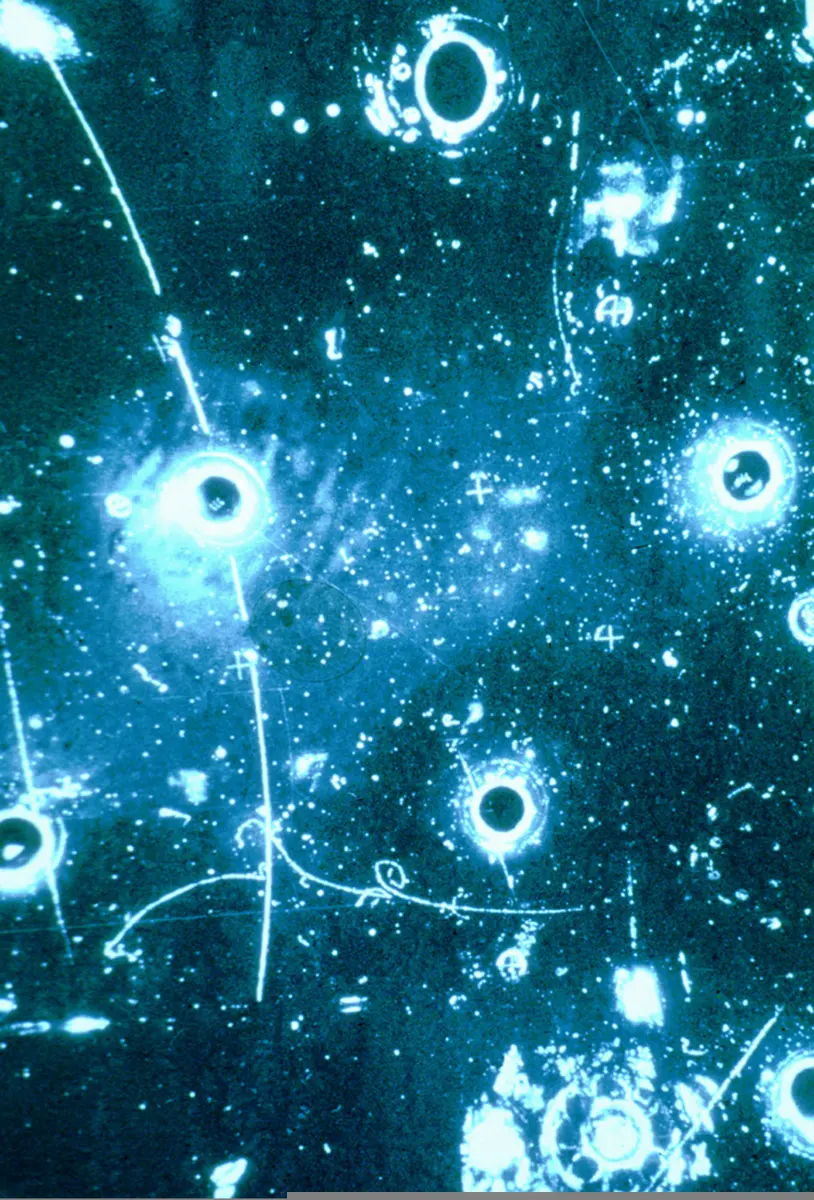
The theory said there should also be a second kind of weak interaction, carried by the Z, in which nothing changes. A neutrino could hit an electron or a nucleus, give it a push, and fly on, still a neutrino. The other particle would stay what it was too. This is a neutral current. Nobody had ever seen one.
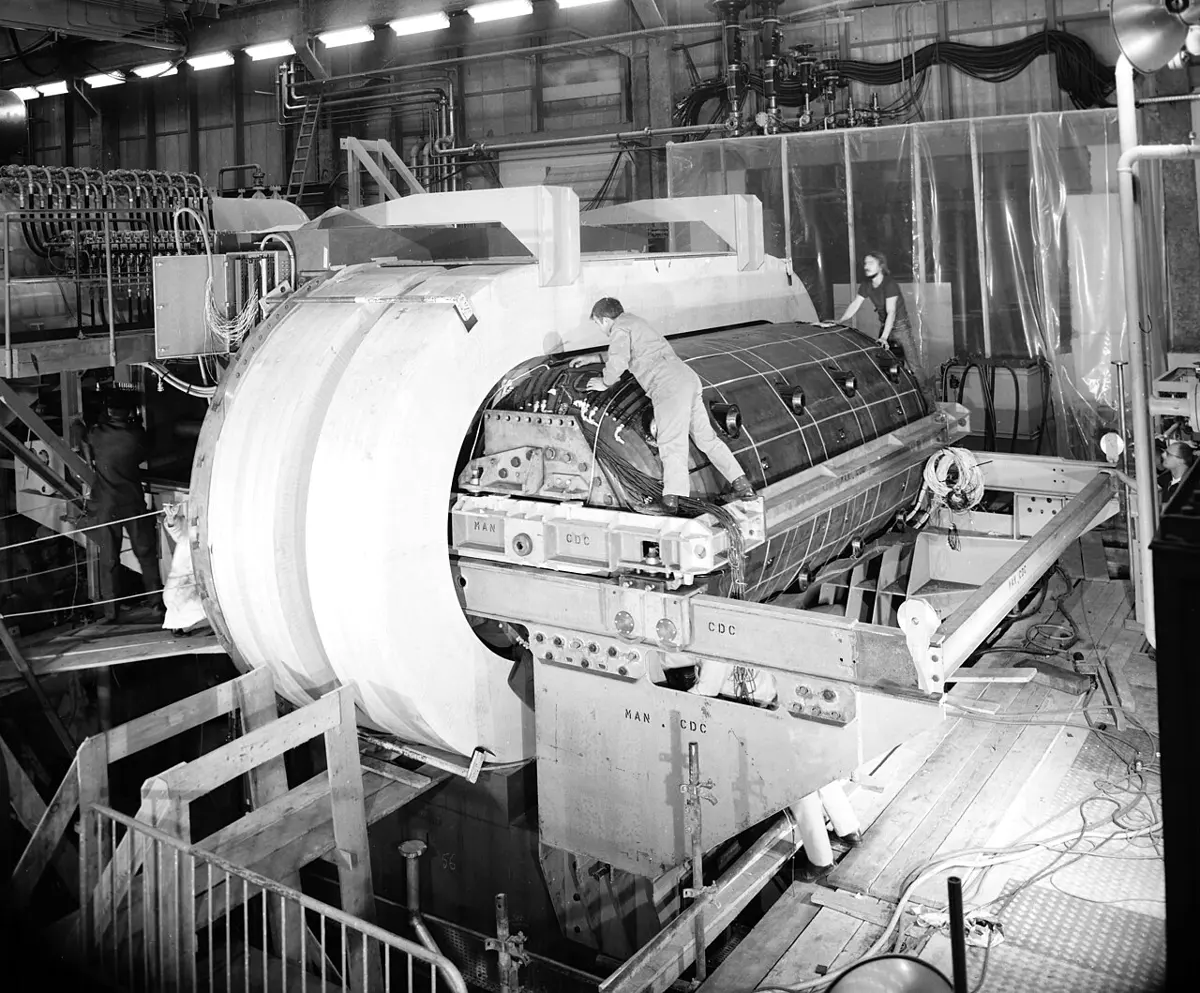
- 1973, Gargamelle. At CERN, near Geneva, a huge bubble chamber called Gargamelle was hit by beams of neutrinos. A bubble chamber is a tank of liquid that is just about to boil; a charged particle passing through leaves a trail of tiny bubbles, which is photographed. Neutrinos have no charge and leave no trail. The physicists searched a huge number of photographs for an electron or a spray of particles that started out of nothing, pushed by an invisible neutrino that went on its way. They found them. The neutral current was real.
- 1978, Stanford. An experiment in the United States, firing electrons at heavy hydrogen, found a tiny effect of the weak and electromagnetic forces working together, of just the size the theory predicted.
- 1979, the prize. The prize went to the three theorists.
- 1983, the messengers. At CERN, the W and Z particles themselves were made at last, by colliding protons with antiprotons. The W weighed about 86 proton masses and the Z about 97, just as the theory said. (That discovery won Carlo Rubbia and Simon van der Meer the Nobel Prize in 1984.)
What was special about a neutral current?
Pick an answer to see why.
How it works: one force at high energy
Why do the two forces look so different today, if they are really one?
The answer is the Higgs field. At the enormous temperatures just after the Big Bang, more than about a million billion degrees, the W, Z and photon were all alike, all massless. The weak force was then as strong and as far-reaching as electromagnetism: there was just one electroweak force Grade 10: The Big Bang. As the universe cooled, within about a millionth of a millionth of a second, the Higgs field settled into its present state. The W and Z became heavy, and their force became short-range and weak. The photon stayed massless.
Here is a picture. Water, steam and ice are one substance, but they behave very differently. In the same way, one force can look like two, depending on the conditions. In particle accelerators today, at energies above about 100 times a proton’s mass, the weak and electromagnetic forces are seen to be of about the same strength, as the theory says.
In your life today
The electroweak theory has no everyday gadget of its own. But the weak force it describes is all around you.
- Sunlight. The Sun’s fusion could not even start without the weak force turning a proton into a neutron in its core. Every ray of sunlight depends on it.
- Dating the past. Carbon-14 dating, which works by beta decay, tells archaeologists the age of old wood, bones and cloth.
- Medicine. Many radioactive substances used in hospitals to trace and treat diseases decay by the weak force.
- The Standard Model. The electroweak theory became one half of the Standard Model, the theory of all known particles and forces except gravity. Every test so far, including the discovery of the Higgs particle in 2012, has agreed with it.
What came next
- The strong force. In the 1970s physicists found that the strong force works in a similar way, with its own messengers, called gluons. Glashow and others suggested that at still higher energies the strong force might join the electroweak one in a grand unified theory. If so, protons might decay, very slowly; huge experiments, such as one in a mine in Japan, have watched for it for decades and seen none yet.
- Neutrinos with mass. In 1998 experiments showed that neutrinos have a tiny mass, smaller than anyone expected. That discovery won the Nobel Prize in 2015.
- Gravity. Gravity has never been joined to the other three. The theories of the very large (Einstein’s gravity) and the very small (the Standard Model) don’t fit together yet.
An open question: are all four forces really faces of one single force, as electricity and magnetism turned out to be? Nobody knows.
In your science books
- Grade 8: the particles in an atom.
- Grade 10: the magnetic effect of electric current and electromagnetic induction (electricity and magnetism as one force), and the Big Bang theory.
- Going Further: beta decay, fusion, how a force reaches across space and the Sun’s tank of hydrogen.
Learn more
- The Nobel Prize’s own explanation: the press release and the presentation speech (nobelprize.org), with John Updike’s poem.
- The Nobel lectures of Glashow, Salam and Weinberg.
The official reason
The prize was given “for their contributions to the theory of the unified weak and electromagnetic interaction between elementary particles, including, inter alia, the prediction of the weak neutral current.”