
Reading atoms with lasers and X-rays
Nobel Prize in Physics, 1981: Nicolaas Bloembergen, Arthur L. Schawlow, and Kai M. Siegbahn
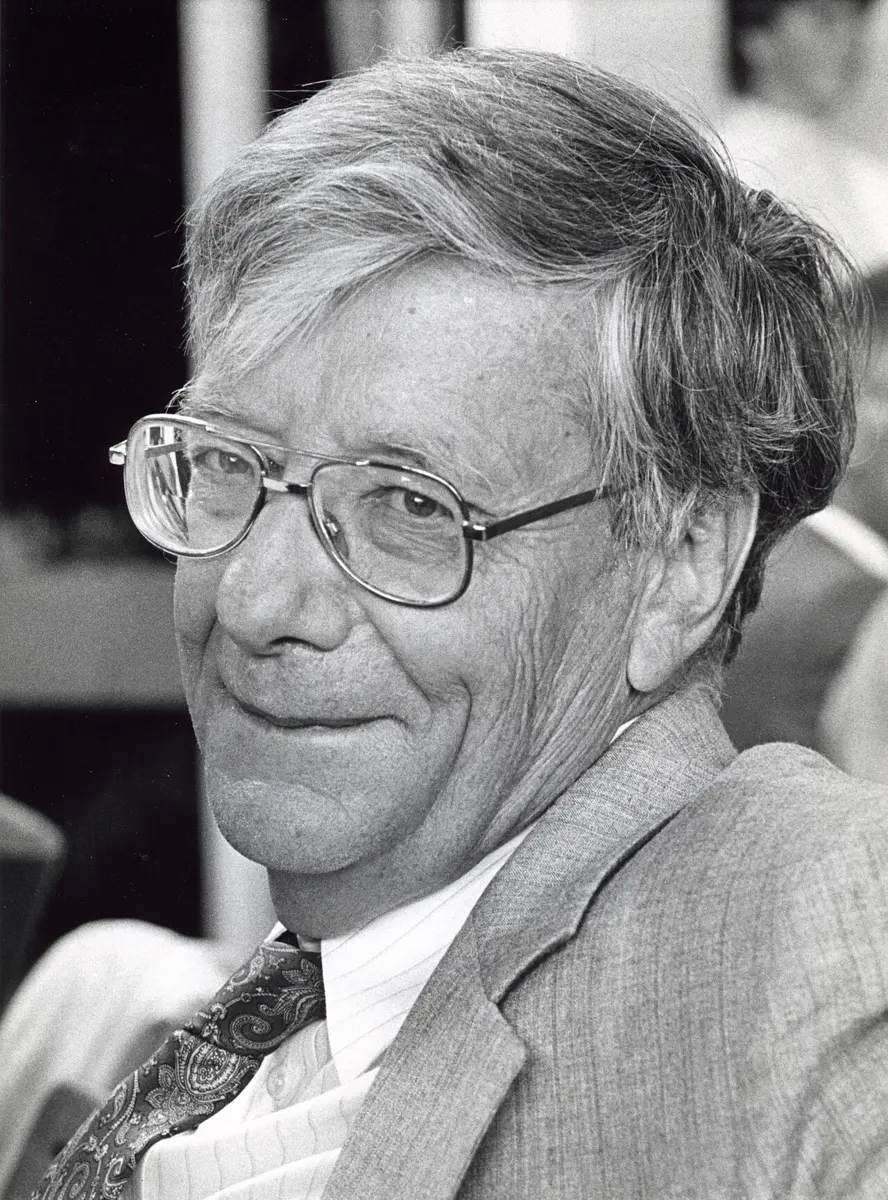
Nicolaas Bloembergen
1920–2017, born in the Netherlands
During the Second World War he hid from the Nazis indoors, eating tulip bulbs to fill his stomach and reading physics by the light of an oil lamp.
-
Arthur L. Schawlow
1921–1999, born in the United States
He grew up in Canada, too poor to study the radio engineering he wanted, and took a scholarship in physics instead. He married the sister of Charles Townes, his partner in inventing the laser.
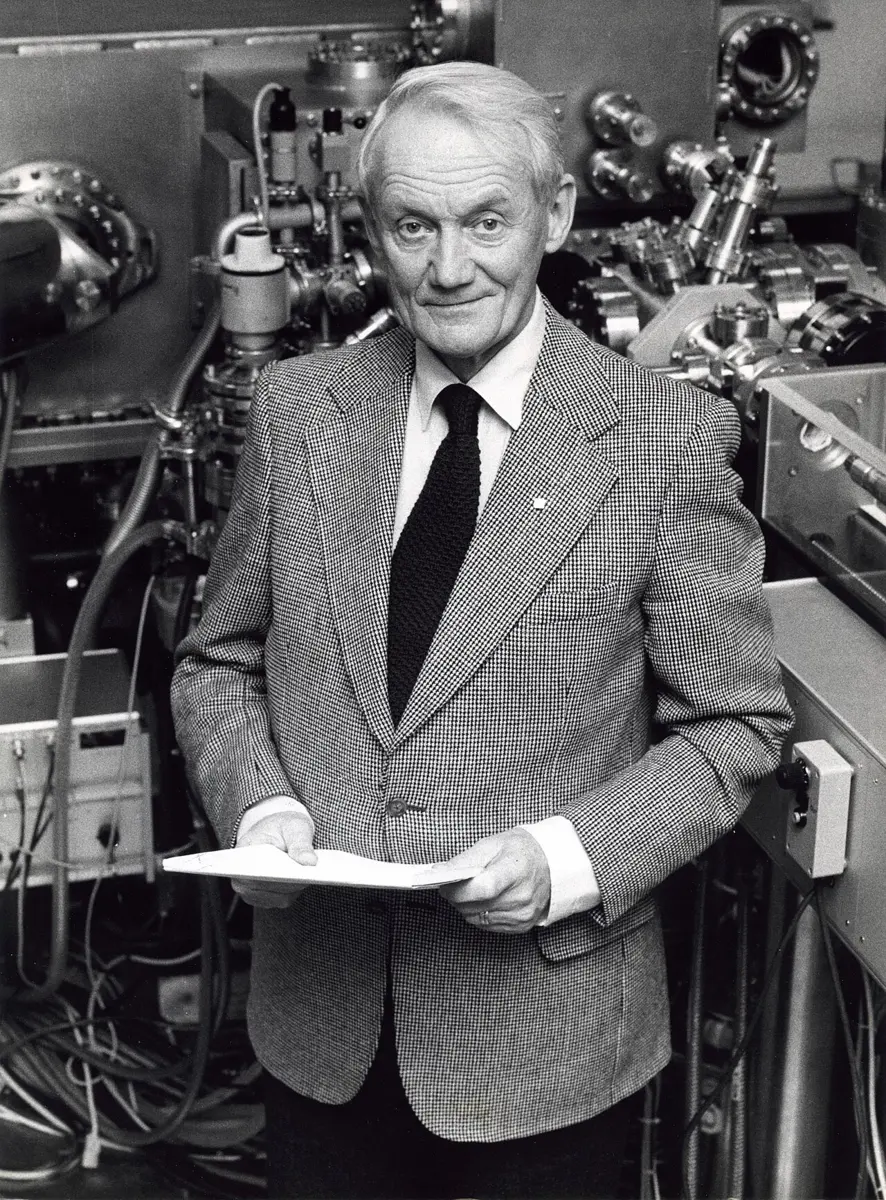
Kai M. Siegbahn
1918–2007, born in Sweden
His father, Manne Siegbahn, won the Nobel Prize in Physics in 1924 for studying atoms with X-rays. The son went on to study them with electrons.
Photo: Jan Collsiöö, CC BY-SA 3.0 nl
When salty water from a pot of rice or dal boils over onto a gas stove, the blue flame suddenly flashes bright yellow. That yellow is a fingerprint. It comes from sodium, one of the two elements in common salt, and no other element gives out exactly that color.
Every element gives out and takes in light of its own exact colors. By reading these colors, scientists can tell what something is made of, even a star they will never visit. This reading of light is called spectroscopy. In 1981 the Nobel Prize in Physics went to three scientists who made it far sharper: Nicolaas Bloembergen and Arthur Schawlow, who did it with lasers, and Kai Siegbahn, who did it with electrons instead of light.

The problem: blurred fingerprints
When white light passes through a prism, it spreads out into a rainbow of colors, a spectrum Grade 10: Dispersion of light. The light from a hot gas, like sodium in a flame, is different: it has only a few bright lines of particular colors. Each element has its own set of lines (Why each element has its own lines).
The lines come from the electrons in the atom. Electrons can only have certain fixed amounts of energy, which we picture as shells Grade 9: Shells and their energy. When an electron drops from a higher shell to a lower one, the atom gives out a tiny packet of light, a photon, whose color matches exactly the energy difference. When the atom takes in a photon of that same color, the electron jumps up. So the lines are a map of the atom's energy levels.
By 1960 scientists wanted to read this map in fine detail, and they had two problems:
- The lines were blurred. The atoms in a gas rush about at hundreds of meters per second. An atom moving towards the light sees it slightly bluer; one moving away sees it slightly redder, just as the siren of an ambulance sounds higher as it comes towards you. This Doppler effect smears each line out, hiding its fine detail (Lines that move).
- The inner electrons were hard to reach. Visible light shows only the outer electrons, the ones that take part in chemistry. The electrons in the inner shells are held far more tightly. Reaching them needs X-rays, and the methods of the time gave only rough answers.
Why are the spectral lines of a hot gas blurred?
Pick an answer to see why.
A new tool: the laser
In 1958 Arthur Schawlow and Charles Townes showed how to build a laser, and the first one shone in 1960 (the laser's story is the 1964 prize: Masers and lasers). A laser's light is very different from a bulb's:
- it is one pure color, much purer than any flame;
- its waves march in step, so it makes a narrow, straight beam;
- it can be extremely bright.
From the late 1960s, lasers that could be tuned, their color turned smoothly like the knob of a radio, began to appear. A tuned laser can be set to exactly the color of one line, and moved across it slowly to see every detail.
Why it was hard
Even with a laser, the Doppler blur stays: the atoms in the gas are still moving. And lasers came only in a few colors, set by the material inside them, so many lines couldn't be reached at all. For the inner electrons, the X-ray method knocked electrons out of a sample, but most of them bumped into other atoms on their way out and lost energy at random, which smeared the results.
What they did, step by step
Schawlow: lines without the blur
- The poor student. Schawlow was born in New York in 1921 and grew up in Toronto, Canada, during the Great Depression. His family couldn't pay for university. He won a scholarship, but only in physics, not the radio engineering he wanted. “It now seems to me to have been a most fortunate chance,” he wrote.
- 1949–1951: with Townes. At Columbia University in New York he worked with Charles Townes, the inventor of the maser, and married Townes's youngest sister, Aurelia.
- 1958: the laser. Working at Bell Telephone Laboratories, he and Townes published how to make an “optical maser”, a laser.
- 1961: Stanford. He became a professor at Stanford University in California, and set out to use lasers to study atoms.
- Early 1970s: beating the blur. With Theodor Hänsch and others, he used a clever trick, saturation spectroscopy (Figure 2). A strong laser beam and a weak one are sent through the gas from opposite sides. Only the atoms standing still (or moving sideways) are hit by both beams, and they show up as a sharp mark exactly at the true color. Lines appeared up to a hundred times sharper than before.
- 1972: hydrogen. They used it on hydrogen, the simplest atom, and saw the fine details hidden in its red line. This let them measure the Rydberg constant, a basic number that sets the colors of all hydrogen's lines, more accurately than ever before.
Bloembergen: when light changes color
- Hiding from the war. Bloembergen was born in Dordrecht, in the Netherlands, in 1920. When the Nazis closed his university in 1943, he spent two years hiding indoors.
- 1945: to America. At Harvard University he helped build the first equipment to study nuclear magnetic resonance (NMR), how the nuclei of atoms behave like tiny magnets. His explanation of it, published in 1948, is still used every day, because NMR is how the hospital MRI scanner sees inside the body.
- 1961: a new kind of optics. At the University of Michigan, scientists shone the deep red light of a powerful laser into a crystal of quartz. Out came a tiny amount of ultraviolet light, at exactly half the wavelength (twice the frequency) of the red. The photo showed it as a tiny dot, but when the result was printed in a journal, someone preparing the picture took the dot for a speck of dirt and removed it.
- 1962: the rules. Bloembergen and his team worked out the general theory. Ordinary light is too weak to change a material much. But a laser's light is so strong that it shakes the electrons in a crystal hard, and they wobble unevenly, giving out new colors: twice the frequency, or sums and differences of the frequencies of two or three beams mixed together. This is nonlinear optics, and Bloembergen is called its founder.
- New colors. With these rules, lasers could be turned into almost any color, far into the ultraviolet and infrared, opening up the lines that no laser could reach before. A form of light mixing called CARS can even measure what is in a flame, and how hot it is, from outside.
A laser gives out infrared light of wavelength 1064 nm. A crystal doubles its frequency. What wavelength comes out?
Pick an answer to see why.
Siegbahn: reading the inner electrons
- A family business. Kai Siegbahn was born in Lund, Sweden, in 1918. His father Manne Siegbahn had won the Nobel Prize in Physics in 1924 for measuring the X-rays that atoms give out. Kai became a professor at Uppsala University in 1954.
- Measuring electrons exactly. For years he built ever finer instruments to measure the energy of electrons shot out by radioactive atoms. Around 1950 he wondered: could such an instrument read the electrons that X-rays knock out of a solid?
- The idea. When an X-ray photon hits an atom, it can knock out even an inner electron. The photon's energy pays two bills: the energy needed to free the electron (its binding energy) and the speed the electron flies off with. Measure the electron's energy, subtract it from the photon's, and you have the binding energy (Figure 4). This is the photoelectric effect that Einstein explained in 1905 (The photoelectric effect).
- 1957: sharp lines. With Carl Nordling and Evelyn Sokolowski, his instrument was so precise that among the smeared-out electrons it found sharp, narrow lines: electrons that had escaped without losing any energy. Each line belonged to one shell of one element. They measured the binding energies of the electrons of many elements, more accurately than ever before.
- The chemical shift. Then came a surprise. The same atom gave slightly different energies depending on what it was joined to. In sodium thiosulphate, a compound with two sulphur atoms bonded differently, the sulphur gave two lines. An atom whose electrons are pulled away by a greedy neighbor, like oxygen or fluorine, holds its remaining electrons more tightly. So the method shows not only which atoms are present, but how they are bonded. Siegbahn named it ESCA, electron spectroscopy for chemical analysis.
In your life today
- Green laser pointers use frequency doubling, Bloembergen's nonlinear optics. So do many lasers in factories and laboratories, and some in eye surgery Grade 10: Laser eye surgery.
- MRI scanners in hospitals in Kathmandu and across Nepal rely on the nuclear magnetic resonance that Bloembergen helped explain as a young man.
- Measuring gases. Tuned lasers sense tiny amounts of gases such as methane or carbon dioxide in the air by the exact colors they absorb, from factory chimneys, gas leaks and even from satellites.
- Surfaces. Only electrons from the top few layers of atoms escape without losing energy, so ESCA (today often called XPS) is a standard way to check the surfaces of computer chips, solar panels, medical implants and the catalysts that clean car exhaust.
What came next
- Rulers for light. Hänsch, Schawlow's colleague, went on to build the frequency comb, a way of measuring the color of light extremely precisely, and shared the 2005 Nobel Prize in Physics for it (Light as particles, and a ruler for color).
- Shorter and shorter flashes. Mixing laser light in gases gives very high harmonics, far into the ultraviolet, in flashes so short they can follow electrons moving inside atoms: the 2023 Nobel Prize in Physics (Attosecond flashes: a camera for electrons).
- How big is a proton? Laser measurements of hydrogen's lines also tell the size of the proton at its center. In 2010 a new measurement gave a size about 4% smaller than everyone expected. Most newer measurements agree with the smaller size, but scientists are still checking why the older ones were different.
In your science books
- Grade 9: shells and their energy, the electromagnetic spectrum and X-rays.
- Grade 10: dispersion of light and laser eye surgery.
- Going Further: why each element has its own lines, lines that move and the photoelectric effect.
Learn more
- The Nobel Prize's announcement: press release (nobelprize.org).
- The Nobel lectures: Bloembergen, Schawlow and Siegbahn.
The official reason
The prize was given “for their contribution to the development of laser spectroscopy.”
The prize was given “for his contribution to the development of high-resolution electron spectroscopy.”