
How stars live, die and make the elements
Nobel Prize in Physics, 1983: Subrahmanyan Chandrasekhar and William A. Fowler
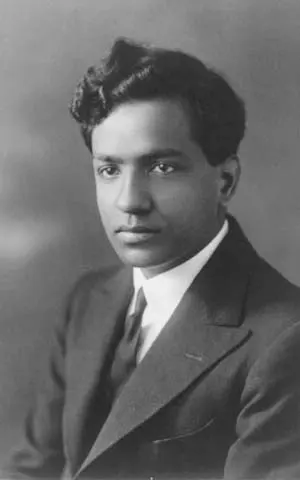
Subrahmanyan Chandrasekhar
1910–1995, born in British India (now Pakistan)
Known to everyone as “Chandra”, he was born in Lahore and studied in Madras. He was the nephew of C. V. Raman, who won the Nobel Prize in Physics in 1930.
Photo: AIP, Public domain
-
William A. Fowler
1911–1995, born in the United States
He grew up in a railway town in Ohio and loved steam engines all his life. He spent his whole career at the California Institute of Technology, measuring in the laboratory the reactions that happen inside stars.
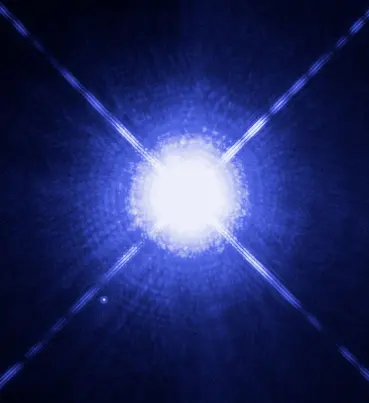
On a clear winter evening in Nepal, look south-east after dark for the brightest star in the sky, Sirius. Next to it, too faint for your eyes, is a tiny companion called Sirius B. It has about as much mass as the whole Sun, squeezed into a ball smaller than the Earth. A teaspoonful of it would weigh more than ten tonnes, as much as two or three elephants.
Sirius B is a white dwarf, the leftover core of a star that has died. How small can such a star be squeezed? And where did the stuff it is made of, carbon and oxygen, come from in the first place?
The 1983 Nobel Prize in Physics went to two scientists who answered questions like these. Subrahmanyan Chandrasekhar showed that a white dwarf can't be heavier than about 1.4 times the Sun. Heavier dead stars must collapse further, into something even stranger. William Fowler measured, in his laboratory, the nuclear reactions by which stars build the elements, and with three colleagues explained where almost every element in the universe was made.
The problem: what keeps a star up, and what happens when it can't?
A star is a huge ball of gas, mostly hydrogen, held together by its own gravity Grade 10: gravity in the universe. Gravity pulls every part of it towards the center. Why doesn't it simply fall in on itself?
Because the center is incredibly hot: in the Sun, about 15 million °C. Hot gas pushes outwards, and this push balances gravity's pull, like a balloon whose air holds it up against the squeeze of its rubber skin.
The heat comes from nuclear fusion. In the core, hydrogen nuclei crash together so hard that they join to make helium. A tiny amount of mass disappears in each reaction and becomes a great deal of energy. In 1939 Hans Bethe worked out how this happens in the Sun (Nobel Prize in Physics, 1967).
But fuel runs out. When the hydrogen in the core is used up, nothing holds gravity back for a while, and the core shrinks and heats up. What then? In the 1920s nobody knew. Two questions were open:
- When a star has burnt all it can, what is left, and what holds it up?
- Hydrogen and helium are almost all the universe has. Where did all the other elements come from: the carbon in your food, the oxygen you breathe, the calcium in your bones, the iron in your blood?
How a dead star holds itself up
In 1926 the British physicist Ralph Fowler (no relation of William Fowler) found the answer to the first question for white dwarfs. In a white dwarf the atoms are crushed together so tightly that their electrons are no longer held by single atoms. They form a crowd of free electrons among the nuclei.
The new quantum physics says that no two electrons can be in exactly the same state. Squeeze them together and they are forced into faster and faster motion, like passengers in a bus so full that each new one must squeeze into a smaller gap. This crowding makes a pressure, called electron degeneracy pressure, that doesn't need heat. So a white dwarf can stay up even after it has gone cold.
Why it was hard
Nobody can visit a star or do experiments in one. The scientists had only two things to work with: what telescopes show (how bright a star is, its color, and, for a star with a partner like Sirius B, its mass), and the laws of physics, worked out on Earth.
And the laws needed were new. Quantum physics was only a few years old. Einstein's relativity, which matters when things move nearly as fast as light, had never been joined with quantum physics to describe a star.
For the second question, the problem was even harder. Fusion reactions inside stars are slow and rare at the energies found there. To understand them you must measure, on Earth, reactions that might happen once in billions of collisions.
What they did, step by step
Chandrasekhar: the heaviest a white dwarf can be
- 1930: on the ship. Chandra, aged 19, had just finished his degree at Presidency College in Madras (now Chennai). He sailed to England to study at Cambridge, with Ralph Fowler as his supervisor. On the long voyage he worked on white dwarfs.
- Adding relativity. He saw something others had missed. In a heavy white dwarf the electrons are squeezed so hard that they move at nearly the speed of light. But nothing can go faster than light. So, however hard gravity squeezes, the electrons' push can't keep growing fast enough to match it.
- The limit. His calculations showed a surprising result: the heavier a white dwarf, the smaller it is (Figure 1). At about 1.4 times the Sun's mass, the size falls to zero. No white dwarf can be heavier than this. Today it is called the Chandrasekhar limit.
- 1931–1935: the papers. He published the full theory in a series of papers. In 1929–30, Edmund Stoner and Wilhelm Anderson had found a similar limit for a simpler model of a star, but Chandra's was worked out for a real star, from the center to the surface.
- January 1935: the clash. Chandra presented his results at a meeting of the Royal Astronomical Society in London. Straight after his talk, Arthur Eddington, the most famous astronomer in Britain, rose and mocked the idea. If Chandra was right, a heavy dead star would go on collapsing for ever, and Eddington thought "there should be a law of Nature to prevent a star from behaving in this absurd way". Many physicists privately thought Chandra was right, but few said so in public.
- 1937: a new home. Chandra moved to the University of Chicago, where he stayed for the rest of his life. He left white dwarfs behind and, every ten years or so, took up a new field of astrophysics, solved its main problems, and wrote a book on it.
According to Chandrasekhar's calculation, what happens to a white dwarf if you add more mass to it?
Pick an answer to see why.
Was he right?
It took decades to find out. In 1967 Jocelyn Bell Burnell found the first pulsar, a spinning neutron star: what is left when a dead core heavier than Chandra's limit collapses until its electrons are pushed into the nuclei. A neutron star holds more than the Sun's mass in a ball about 20 km across. Heavier still, a dead core can collapse into a black hole. And no white dwarf has ever been found heavier than Chandra's limit.
Fowler: measuring the reactions of the stars
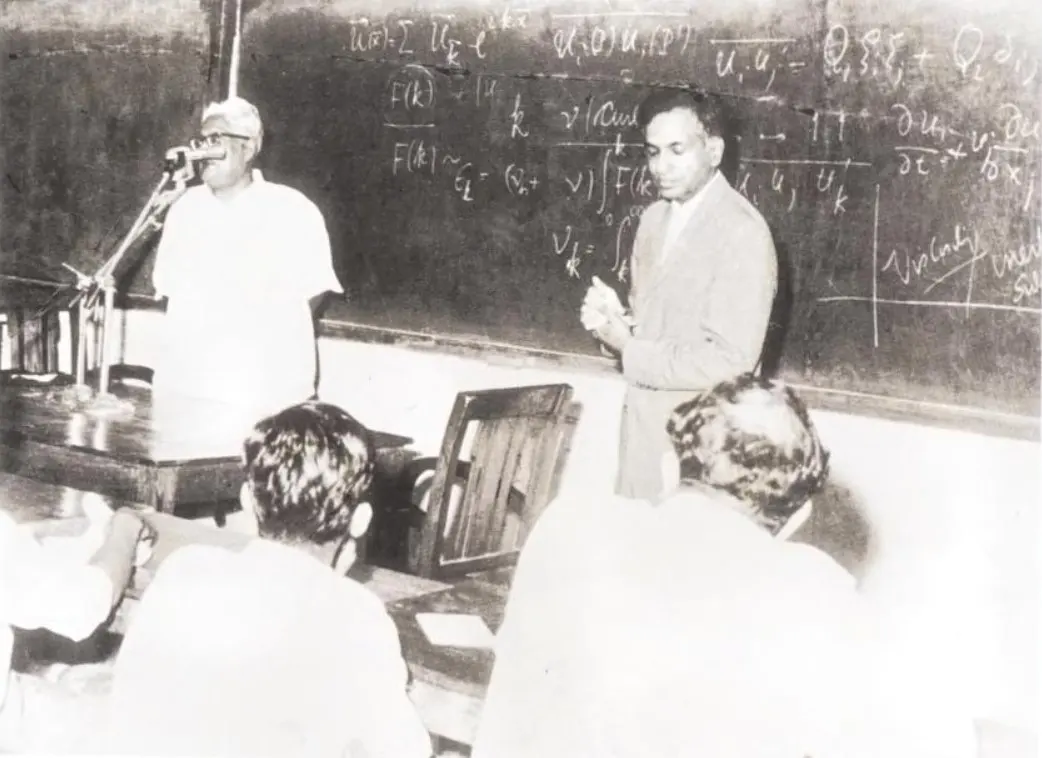
- The young engineer. William Fowler grew up in Lima, Ohio, a railway town, where he spent his childhood watching steam engines. He studied engineering physics, then came to the California Institute of Technology (Caltech) in 1933, to its Kellogg Radiation Laboratory, and stayed there for the rest of his career.
- After 1945: the laboratory of the stars. After the Second World War, Fowler and his colleagues decided to use their particle accelerators, machines that fire nuclei at other nuclei, to measure the nuclear reactions that happen inside stars. They called this new field nuclear astrophysics.
- 1953: the carbon puzzle. Helium nuclei can join to make carbon, but by the physics of the time it should hardly ever happen: stars should make almost no carbon. Yet carbon is common, and we are made of it. The British astronomer Fred Hoyle came to Fowler's laboratory and said that the carbon nucleus must have a special energy level that makes the reaction easy, at about 7.7 MeV. Fowler's team doubted it, but a young physicist, Ward Whaling, looked, and found it, just where Hoyle had said (helium into carbon).
- 1954–55: Cambridge. Convinced, Fowler spent a year in Cambridge, England, working with Hoyle and two young astronomers, Margaret Burbidge and Geoffrey Burbidge.
- 1957: one paper, all the elements. The four of them published a paper of more than a hundred pages, “Synthesis of the Elements in Stars”. It showed how all the elements from carbon to uranium could be built inside stars, starting from the hydrogen and helium made in the Big Bang Grade 10: the Big Bang. Astronomers still call it B²FH, from the authors' initials. The Canadian Alastair Cameron reached the same ideas on his own that same year.
- The next thirty years. Fowler and his team measured the speed of hundreds of nuclear reactions, so that astronomers could calculate exactly how fast each element is made in a star.
How it works now
Put Chandra's and Fowler's work together and you get the life story of a star (Figure 4). What happens at the end depends on the star's mass.
- Hydrogen to helium. Every star spends most of its life fusing hydrogen into helium in its core. The Sun has been doing this for about 4.6 billion years.
- Helium to carbon and oxygen. When the hydrogen in the core runs out, the core shrinks and heats up to about 100 million °C. Now helium can fuse into carbon, by Hoyle's reaction, and carbon and helium make oxygen.
- A Sun-like star stops there. In about 5 billion years the Sun will swell into a red giant, then puff off its outer layers and leave a white dwarf of carbon and oxygen, like Sirius B.
- Heavy stars go on. In a star more than about eight times the Sun's mass, the core gets hot enough to fuse carbon, then neon, oxygen and silicon, each fuel burning faster than the last, until the core is iron. Fusing iron gives out no energy, so the burning stops (why fusion stops at iron).
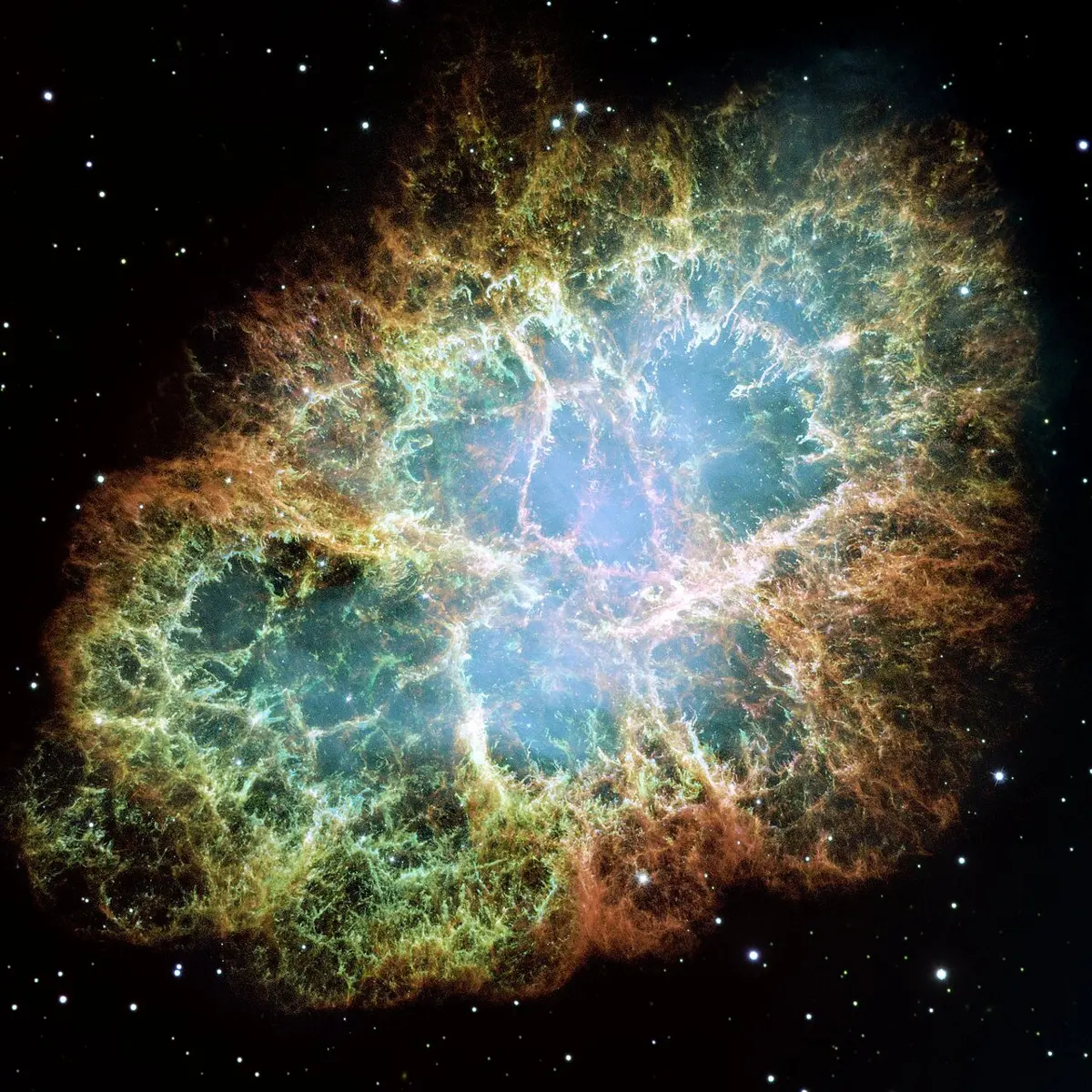
- Collapse. When the iron core grows past Chandra's limit, nothing can hold it up. It collapses in less than a second, and the star blows apart as a supernova, scattering its elements into space.
- Heavier than iron. Elements heavier than iron are made when nuclei catch neutrons: slowly, inside giant stars, or very quickly, in violent explosions.
The scattered gas mixes into clouds, and new stars and planets form from them. The Sun and Earth formed 4.6 billion years ago from a cloud that already held the elements of many earlier stars.
Why does a heavy star's core stop making energy when it is made of iron?
Pick an answer to see why.
In your life today
- You are made of stardust. Apart from the hydrogen, which is left over from the Big Bang, nearly every atom in your body was made inside stars: the carbon in your muscles, the oxygen in your water, the calcium in your bones and the iron in your blood (what you are made of).
- Gold and silver. The gold in a necklace and the silver in a coin were made by catching neutrons inside stars, much of it in exploding or colliding stars, long before the Earth formed.
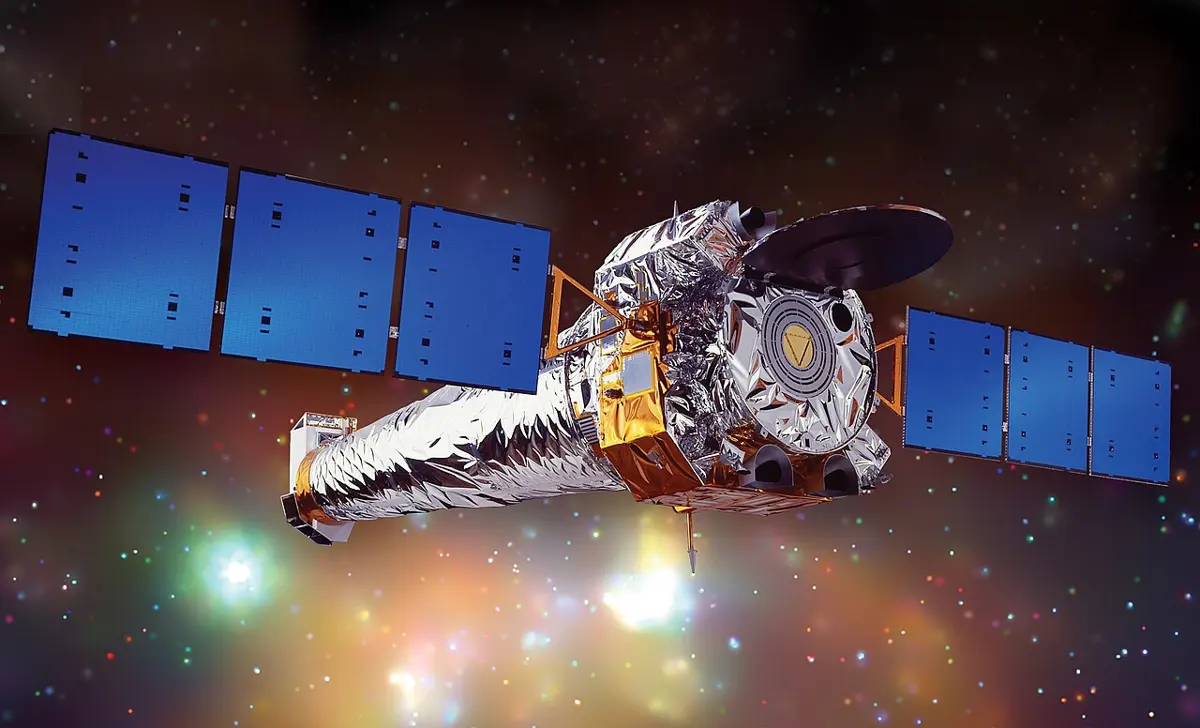
- Chandra in space. In 1999 NASA launched the Chandra X-ray Observatory, named after him, which still studies white dwarfs, neutron stars, black holes and the remains of supernovae.
- Measuring the universe. When a white dwarf in a pair of stars pulls in gas from its partner and is pushed past Chandra's limit, it explodes in a particular kind of supernova, always about equally bright. Astronomers use these as "standard lamps" to measure distances across the universe. That is how they found, in 1998, that the universe's expansion is speeding up (Nobel Prize in Physics, 2011).
What came next
- Colliding neutron stars. In 2017, detectors on Earth caught the ripples in space (gravitational waves) from two neutron stars crashing together, and telescopes then saw the glow of freshly made heavy elements. Many astronomers now think that much of the universe's gold was made in such crashes; how much, compared with supernovae, is still argued about.
- Black holes. Chandra himself spent the 1970s working out the mathematics of black holes. In 2019 astronomers made the first picture of the shadow of a black hole, and in 2020 the Nobel Prize in Physics went for black hole research.
- An open question. Exactly how does a supernova explode? When the core collapses, most of its energy escapes as tiny particles called neutrinos. Computers have only recently been able to show how enough of that energy reaches the outer layers to blow the star apart, and the details are still being worked out.
In your science books
- Grade 9: the life cycle of stars, the death of a star and nova, supernova and what is left.
- Grade 10: gravity in the universe, the life of a star and the Big Bang theory.
- Going Further (9–12): where did the atoms in your body come from?, including catching neutrons; bigger stars, shorter lives and the Sun's future.
Learn more
- The Royal Swedish Academy of Sciences’ press release, the presentation speech and the speed read (nobelprize.org).
- The Nobel lectures: Chandrasekhar, “On stars, their evolution and their stability”, and Fowler, “Experimental and theoretical nuclear astrophysics”.
The official reason
The prize was given “for his theoretical studies of the physical processes of importance to the structure and evolution of the stars.”
The prize was given “for his theoretical and experimental studies of the nuclear reactions of importance in the formation of the chemical elements in the universe.”