
The point where liquid and gas become one
Nobel Prize in Physics, 1982: Kenneth G. Wilson
-
Kenneth G. Wilson
1936–2013, born in the United States
The son of a Harvard chemist, he went to Harvard at 16 and ran the mile for its athletics team. He chose Cornell University partly because it was in the countryside and had a good folk-dancing group.
A pressure cooker cooks dal fast because the steam trapped inside raises the pressure, and at a higher pressure water boils at a higher temperature: about 120 °C instead of 100 °C. Raise the pressure further and the boiling point keeps rising. But this can't go on for ever. At 374 °C, under a pressure about 218 times that of the air around you, something strange happens: water and steam become the same thing. There is no more boiling, no surface between liquid and gas, just one fluid.
This is called a critical point. Near it, materials behave in strange ways, and for nearly a hundred years physicists couldn't explain why. In 1982 the Nobel Prize in Physics went to Kenneth Wilson, who found a way to calculate what happens there, and in doing so gave physics a new way of thinking.
The problem: changes of state, and a strange point
Ice, water and steam are three states of the same substance. Physicists call them phases, and the change from one to another, such as melting or boiling, a phase transition. You know that a liquid boils when its molecules move fast enough to push bubbles of vapor open against the pressure above it Grade 10: boiling below 100 °C. So the higher the pressure, the higher the boiling point.
Draw that as a graph and you get water's boiling curve (Figure 1). Above the curve, water is a liquid; below it, a gas. But the curve doesn't go on for ever. It stops, at the critical point.
Why does it stop? As you heat water in a sealed, strong container, the liquid expands and gets less dense, while the steam above it is squeezed and gets denser. At the critical point the two densities become equal. Liquid and gas are now the same, and the surface between them disappears.
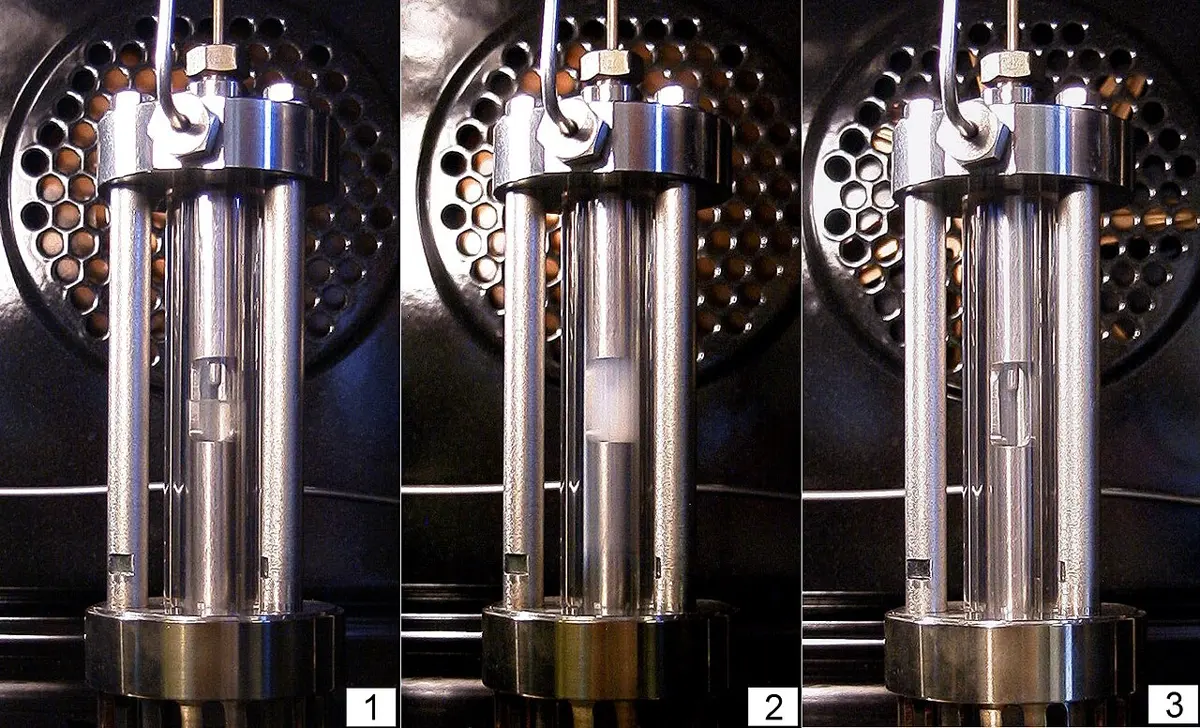
The Irish chemist Thomas Andrews first studied this carefully in 1869, with carbon dioxide, whose critical point is only about 31 °C. As he warmed a sealed glass tube of it, the line between liquid and gas grew faint and vanished. Close to that point, the clear fluid turned milky, as if a cloud had formed inside it. This is called critical opalescence.
Magnets have a critical point too. Heat a magnet made of iron to 770 °C, and it stops being a magnet Grade 8: demagnetization by heating. Pierre Curie studied this in 1895, and the temperature is now called the Curie temperature.
What happens to the boiling point of water as the pressure is raised?
Pick an answer to see why.
What happens near a critical point
Water below its critical point is not perfectly smooth inside. Molecules are always moving (particles that never stop), and here and there, for a moment, they crowd together into a tiny drop of denser fluid, or spread apart into a tiny bubble of thinner fluid. These short-lived changes are called fluctuations.
Far from the critical point, they are tiny, a few molecules across. But as you get closer, they grow. Drops and bubbles of every size appear, from a few molecules across to sizes you could almost see, all at once, constantly forming and vanishing. When some are as big as the wavelength of light, they scatter light the way the droplets of a cloud do. That is why the fluid looks milky.
A magnet is similar. Each iron atom acts like a tiny magnet, and neighboring atoms like to point the same way Grade 8: molecular theory of magnetism. Heat jiggles them about. When the magnet is cold, most of them point the same way, and the iron is a magnet. When it is hot, they point every which way, and it isn't. At the Curie temperature, there are patches pointing the same way of every size, from a few atoms to the whole piece of iron.
Numbers that came out wrong
Physicists can measure exactly how things change near a critical point. For example, as you warm a liquid towards its critical point, the difference between the densities of the liquid and the gas shrinks to zero. How fast it shrinks is described by a number called a critical exponent.
Theories had been made for both: by Johannes van der Waals for liquids and gases (Nobel Prize in Physics, 1910), by Pierre Weiss for magnets, and in 1937 a general one by Lev Landau (Nobel Prize, 1962). They all predicted the same exponent: ½. But measurements kept giving about ⅓.
And there was a second surprise. In 1945 the chemist Edward Guggenheim plotted measurements for eight quite different substances, among them argon, nitrogen, oxygen and methane. Near their critical points, they all followed the same curve, with the same exponent of about ⅓. Later measurements showed that magnets like iron follow the same kind of rules. Very different materials behave identically near their critical points. This is called universality, and nobody could explain it.
What is “universality” near a critical point?
Pick an answer to see why.
Why it was hard
Most problems in physics have one size that matters. To understand a sound wave, you think about its wavelength; to understand an atom, about the size of the atom. Near a critical point, fluctuations of every size matter at once, from single molecules to drops visible to the eye: in the words of the Nobel committee, from about a centimeter to less than a millionth of a centimeter. Each size affects the others.
The old theories made their wrong predictions because they averaged the fluctuations away, as if every molecule felt only the average pull of all the others. That works far from the critical point. Near it, the fluctuations are the whole story.
And you can't just let a computer follow every molecule. A single drop of water holds about two thousand million million million molecules (2 × 10²¹).
What they did, step by step
Clues from others
- 1944: an exact answer, in a flat world. Lars Onsager (Nobel Prize in Chemistry, 1968) solved exactly a simple model of a magnet: a flat grid of tiny magnets, each pointing up or down. His answer showed that the old theories really were wrong near the critical point. But it worked only for a flat, two-dimensional grid, and his method couldn't be extended to the real three-dimensional world.
- 1960s: patterns. Benjamin Widom, Michael Fisher and others found patterns linking the different critical exponents to each other, though not why they had the values they did.
- 1966: blocks. Leo Kadanoff had a bold idea. Near the critical point, why not group the tiny magnets into blocks, and treat each block as one bigger magnet? If the blocks behave like the original magnets, only bigger, that would explain why the picture looks the same at every size. But he couldn't turn the idea into a calculation.
Wilson: zooming out, one step at a time
- The background. Wilson trained as a particle physicist, under Murray Gell-Mann at the California Institute of Technology, and moved to Cornell in 1963. There he spent years working, mostly on his own, on a method from particle physics called the renormalization group: a way of seeing how a theory changes when you look at it on a larger scale.
- 1971: the breakthrough. In two papers, Wilson turned Kadanoff's idea into a method that works. Instead of attacking all the sizes at once, he broke the problem into a series of simpler steps. Each step “zooms out” a little: replace small groups of particles by one, and work out the new, simpler rules that the bigger units follow. Then do it again, and again (Figure 3).
- What the steps show. Below the critical temperature, zooming out makes the rules flow towards “all point the same way”: a magnet, or a liquid. Above it, they flow towards “completely random”: no magnet, a gas. Exactly at the critical temperature, the rules stop changing: the picture looks the same at every zoom. From how the rules change near that point, the critical exponents can be calculated.
- Why universality happens. With each step, most details of the material, such as the exact strength of the forces between molecules, fade away. Only a few things survive: how many dimensions space has (1, 2 or 3), and how many directions the “order” can point (up or down for a simple magnet; liquid or gas for a fluid). So a fluid and a simple magnet in three dimensions end up with the same exponents.
- 1972: numbers. With Michael Fisher, Wilson found a clever way to calculate the exponents: work them out in an imaginary world of four dimensions, where the old theories happen to be right, and then correct step by step towards three. Their paper was called “Critical exponents in 3.99 dimensions”. The answers matched the experiments.
How it works now
Wilson's method is now one of the basic tools of physics. Physicists sort critical points into universality classes: families that share the same exponents. Water's critical point, carbon dioxide's, a mixture of two liquids at the temperature where they stop separating, an alloy whose atoms stop arranging themselves in order, and a simple magnet are all in the same class. Calculations by Wilson's method, and computer simulations that use it, agree closely with careful measurements.
The deeper lesson is about scale. Wilson showed how to connect the physics of small things to the physics of large ones, one step at a time, and why most small details don't matter at large scales. That is why physics works at all: you can understand the flow of water without knowing everything about water molecules.
In your life today
- Decaffeinated coffee. Carbon dioxide above its critical point (31 °C and about 73 times sea-level pressure) is a supercritical fluid: it flows into things like a gas, but dissolves things like a liquid. It is used to wash the caffeine out of coffee beans, and the stains out of clothes, without harmful solvents.
- Power stations. Many modern coal-burning power stations heat their water above its critical point. The steam turbines then get more electricity from each kilogram of fuel.
- Magnets. Every magnet weakens as it warms towards its Curie temperature. Engineers who design the motors of electric vehicles and the magnets in loudspeakers must keep them cool enough.
- Computers in science. Wilson's push for supercomputers helped make computer simulation a third way of doing science, beside experiment and theory: weather forecasts, earthquake studies and the design of new medicines all depend on it.
What came next
- The mass of the proton. Wilson also invented lattice gauge theory (1974): a way to calculate the forces between quarks, the particles inside protons and neutrons, on a grid of points in space and time. With today's supercomputers, physicists use it to calculate the mass of the proton from the laws of the quarks, and the answer agrees with experiment.
- Turbulence, still unsolved. The swirling of water in a river, or of air in monsoon clouds, also involves whirls of every size at once, from the whole storm down to tiny eddies. The Nobel committee hoped Wilson's ideas would solve it. They have helped, but a full theory of turbulence is still one of the great open problems of physics.
In your science books
- Grade 8: the molecular theory of magnetism and demagnetization by heating.
- Grade 10: boiling below 100 °C (why boiling depends on pressure) and pressure in liquids and air.
- Going Further (6–8): particles that never stop and the same model for every pure substance.
- Going Further (9–12): what melting and boiling really do and evaporation and vapor pressure.
Learn more
- The Royal Swedish Academy of Sciences’ press release and the presentation speech (nobelprize.org).
- Wilson's Nobel lecture, “The renormalization group and critical phenomena”.
The official reason
The prize was given “for his theory for critical phenomena in connection with phase transitions.”