
Matter, antimatter and a broken mirror
Nobel Prize in Physics, 1980: James W. Cronin and Val L. Fitch
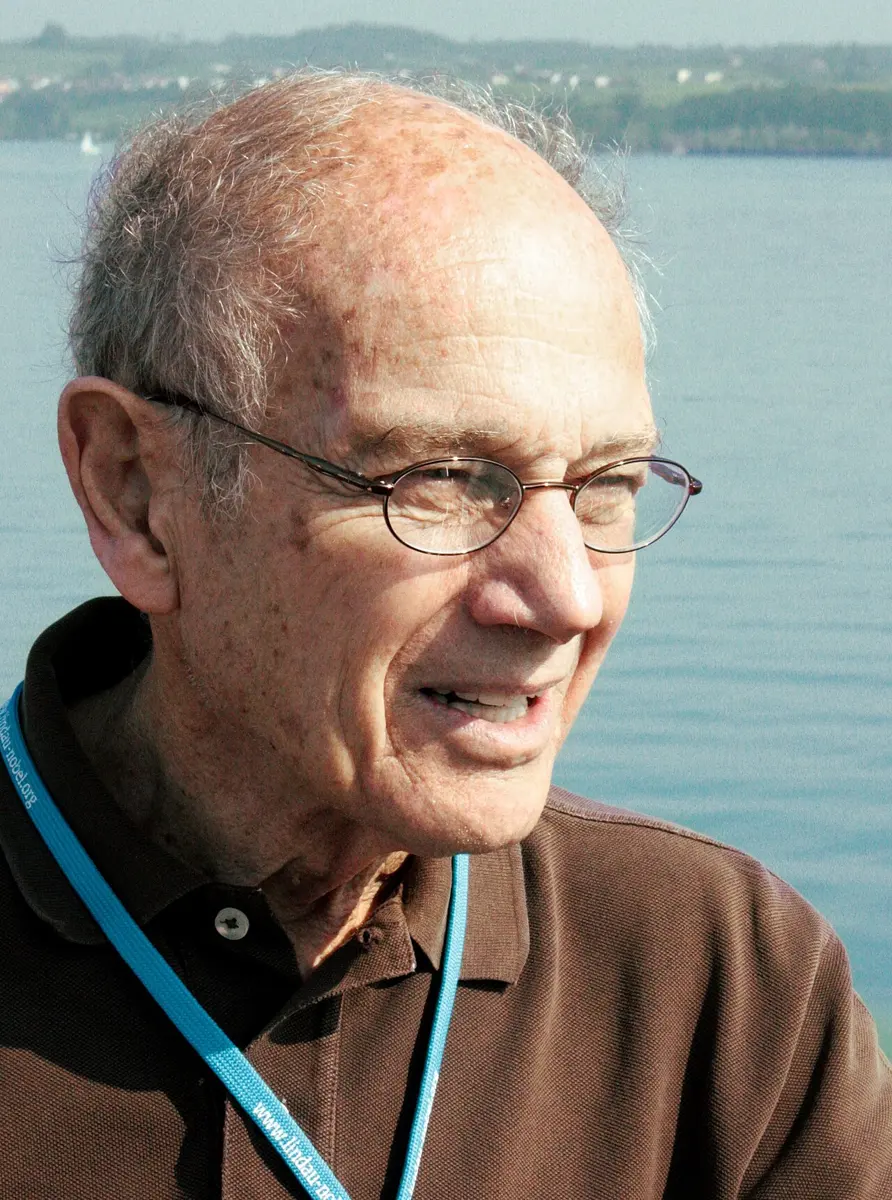
James W. Cronin
1931–2016, born in the United States
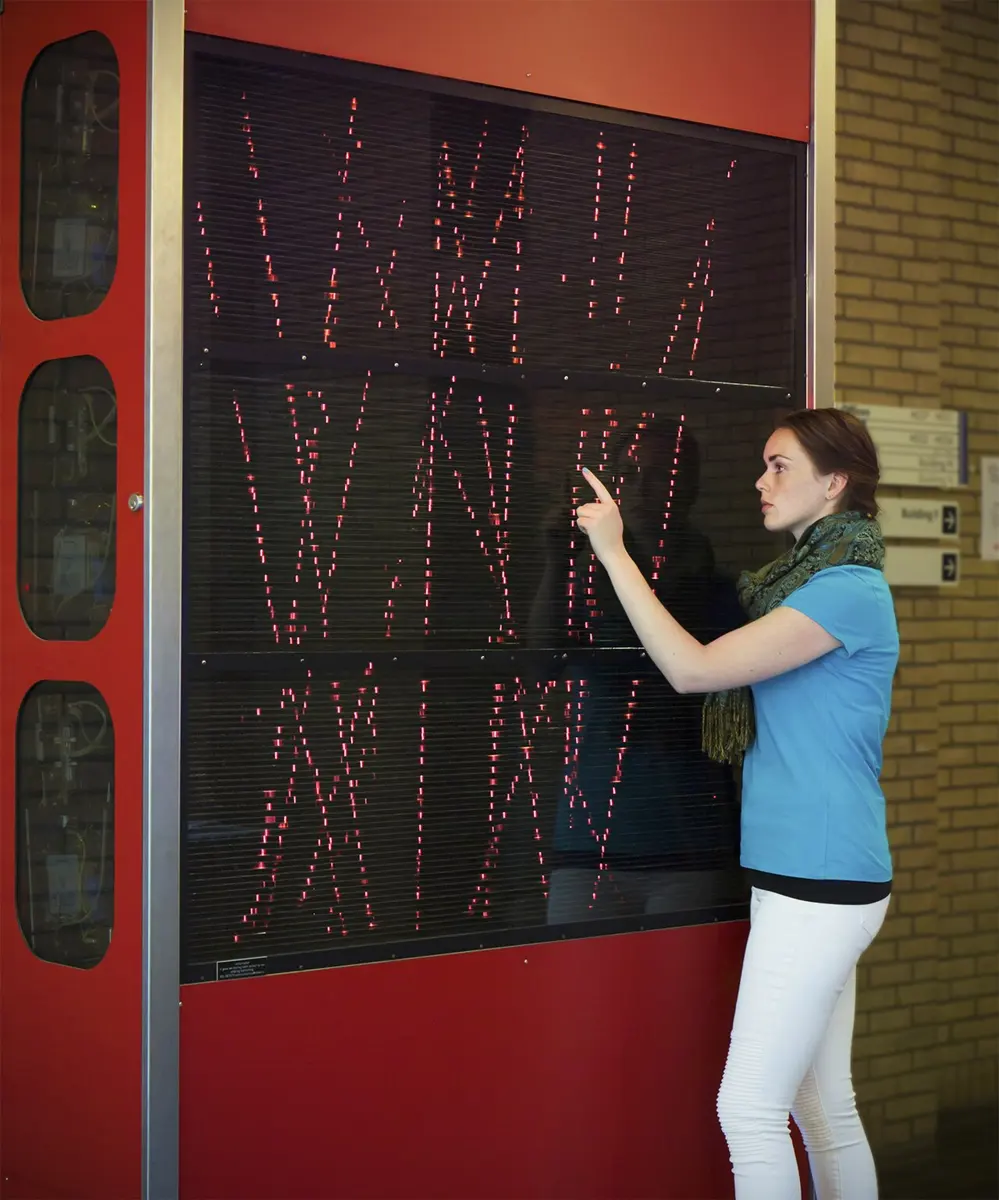
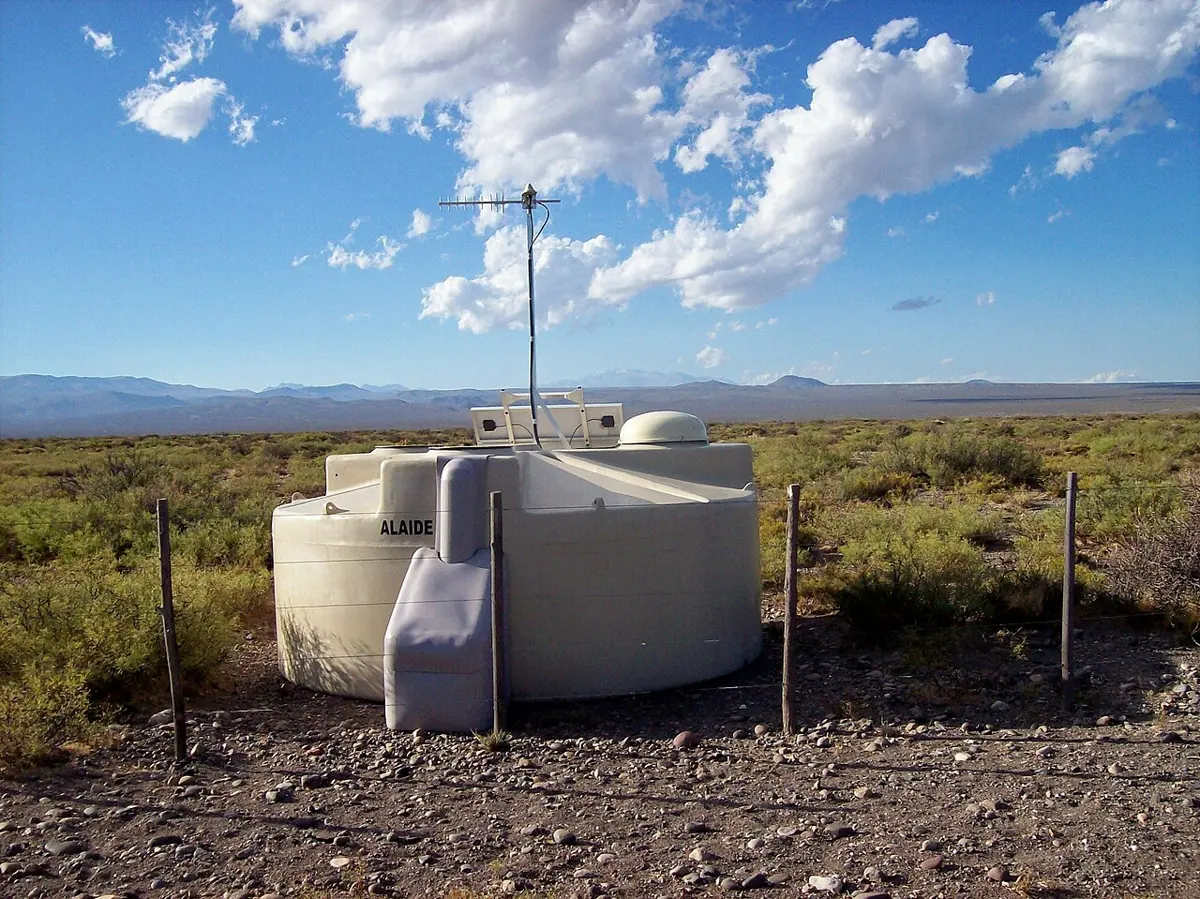
The son of a teacher of Latin and Greek. In later life he helped start a giant observatory in Argentina to catch the most energetic particles from space.
Photo: Markus Pössel ( Mapos ), CC BY-SA 3.0
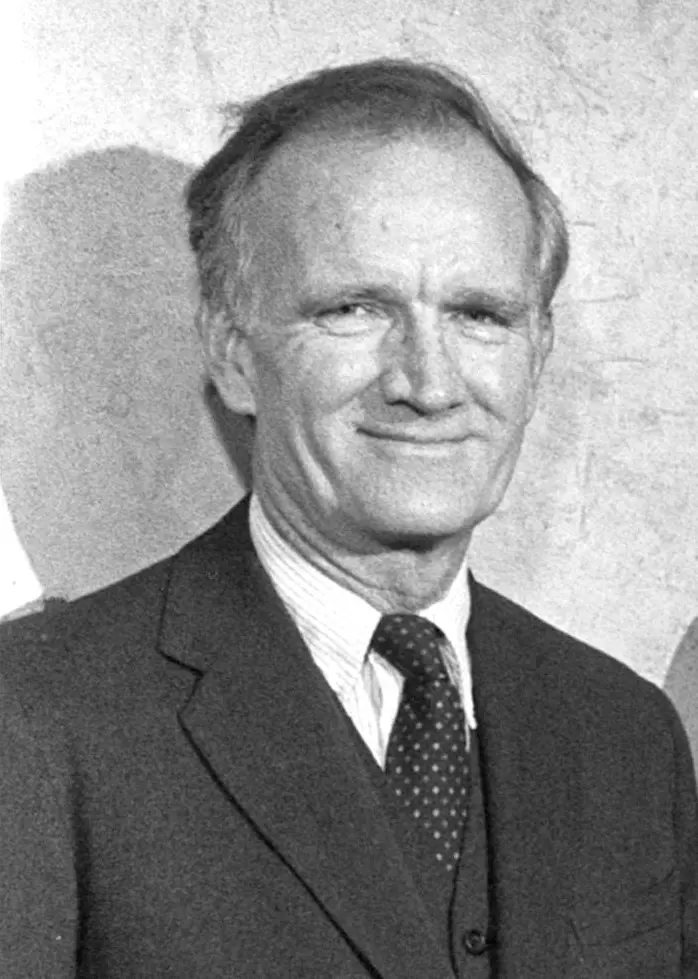
Val L. Fitch
1923–2015, born in the United States
He grew up on a cattle ranch in Nebraska, and learned his physics as a young soldier at Los Alamos during the Second World War.
Photo: ENERGY.GOV, Public domain
Hold up your right hand in front of a mirror. The hand in the mirror looks like a left hand. Now imagine a whole world in the mirror: people, clocks, cars, all reversed. Would that world work by the same laws of nature as ours? For a long time, physicists were sure the answer was yes.
There is a stranger kind of “mirror” too: one that swaps every particle of ordinary matter for its opposite, antimatter. And a third: running the film of the world backwards in time. In 1964, James Cronin and Val Fitch found that nature does not look exactly the same in these mirrors. The difference was tiny: about 2 times in 1,000. But it may be the reason that the universe, and you, exist at all. They won the 1980 Nobel Prize in Physics.
The problem: a universe with too much matter
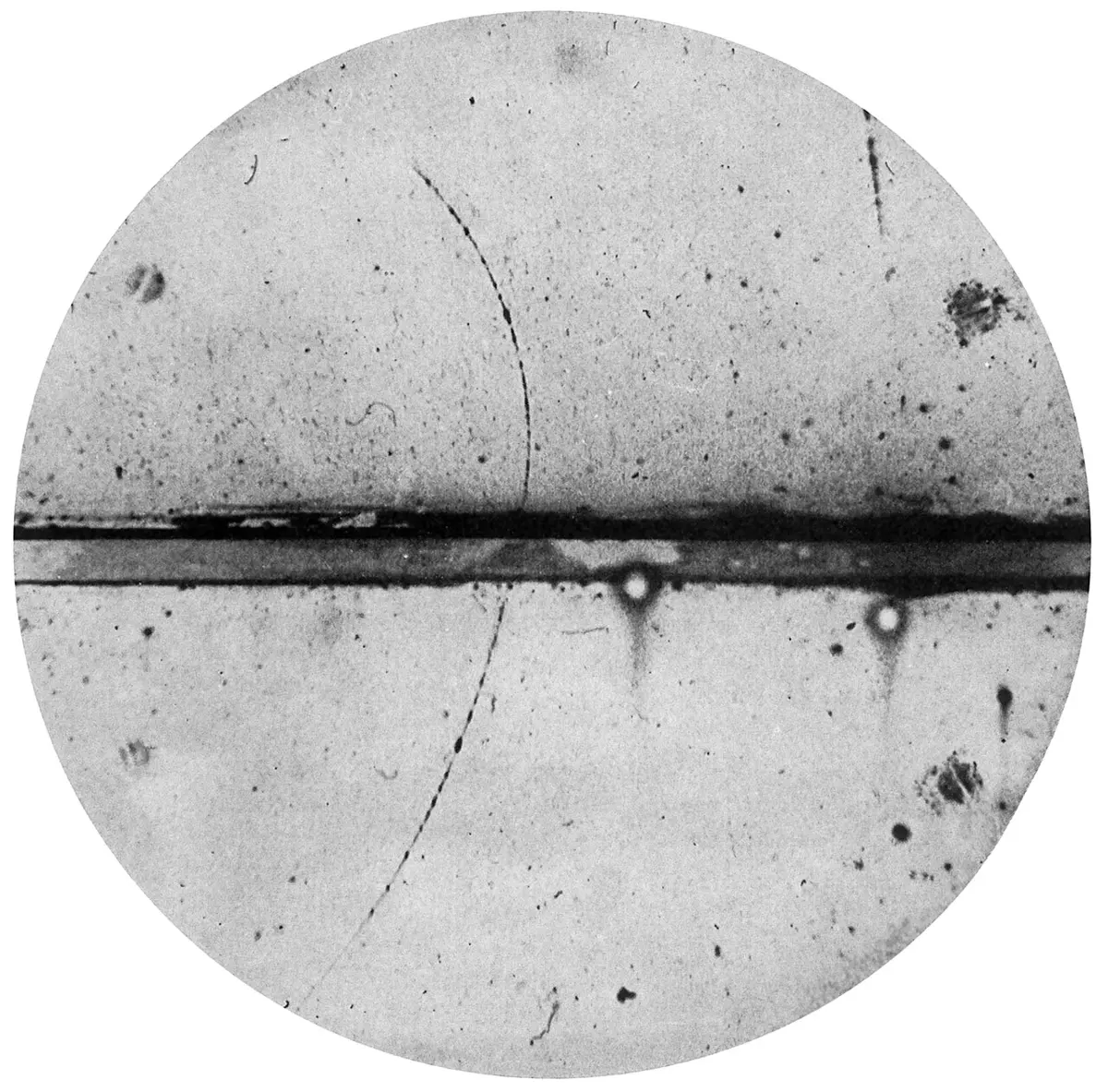
In 1932 the American physicist Carl Anderson photographed a particle that was exactly like an electron but with a positive charge: the positron Grade 9: positrons in the Sun. It was the first piece of antimatter ever seen. Physicists soon understood that every particle has an antiparticle: the same mass, but the opposite charge. A proton has the antiproton, a neutron the antineutron.
When a particle meets its antiparticle, both vanish in a flash of energy, often as gamma rays. And when energy is turned into matter, in a particle accelerator or a cosmic ray hitting the air, it always makes particles and antiparticles in equal numbers.
That raises a huge question. The universe began in the Big Bang Grade 10: the Big Bang theory, when energy was turned into matter. If it made matter and antimatter in exactly equal amounts, they should have destroyed each other completely, leaving only light. There would be no stars, no planets and no people. But when we look out at space, we see matter everywhere, and almost no antimatter. Somewhere, somehow, nature must have favored matter, just a little.
A particle meets its own antiparticle. What happens?
Pick an answer to see why.
Three mirrors
Physicists like to test the laws of nature with symmetries: things you can change while the laws stay the same. Three of them matter here.
- The mirror (P). Swap left and right, as in an ordinary mirror. Physicists call this parity, P.
- The antimatter swap (C). Swap every particle for its antiparticle: electrons for positrons, protons for antiprotons. This is called charge conjugation, C, because every charge is reversed.
- Running backwards (T). Play the film of a process backwards in time: time reversal, T.
For the forces of everyday life, electricity, magnetism and gravity, all three mirrors work perfectly: the reflected world would obey exactly the same laws.
Then came a shock. In 1956 two young Chinese physicists working in the United States, Tsung-Dao Lee and Chen Ning Yang, pointed out that nobody had ever tested the mirror for the weak force, the force behind radioactive decay. Early in 1957 Chien-Shiung Wu tested it, with radioactive cobalt atoms cooled almost to absolute zero. The electrons from the decaying cobalt shot out mostly in one direction and not the other: the mirror image of her experiment would not happen in our world. The weak force can tell left from right. Lee and Yang won the Nobel Prize that same year.
But physicists found comfort. If you use the mirror and the antimatter swap together (CP), the weak force seemed to behave perfectly again. A mirror image of a decay, made of antimatter, would happen exactly as the real one. Nature still seemed fair between matter and antimatter, as long as you also swapped left and right.
Before 1964, which double mirror did physicists believe the weak force always obeyed?
Pick an answer to see why.
Kaons: particles that are half matter, half antimatter
To test CP, Cronin and Fitch chose a strange little particle, the neutral kaon (or neutral K-meson). Kaons were first seen in 1947 in photographs of cosmic rays, and by the 1950s accelerators could make them in large numbers. A kaon lives far less than a millionth of a second, then breaks up (decays) into lighter particles called pions.
The neutral kaon is special. It has no charge, and it can turn into its own antiparticle and back again. The physicists Murray Gell-Mann and Abraham Pais worked out in 1955 what that means: the kaons that come out of an accelerator are really a mixture of two kinds, each half matter and half antimatter.
- A short-lived kind, which decays into two pions. It travels only a few centimeters before decaying.
- A long-lived kind, which lives hundreds of times longer and decays into three pions. It travels many meters.
If CP were a perfect symmetry, the rule would be strict: the long-lived kaon could never decay into just two pions.
What they did, step by step
Val Fitch had grown up on a cattle ranch in Nebraska. As a soldier in the Second World War he was sent to Los Alamos, where he worked as a technician on the atomic bomb project and met many of the great physicists. James Cronin, eight years younger, had been taught at the University of Chicago by Enrico Fermi. They met at Brookhaven National Laboratory, near New York, and in 1958 Fitch brought Cronin to Princeton University. With two younger colleagues, James Christenson and René Turlay, they planned the experiment.
- June 1963, the machine. Brookhaven’s new accelerator, the AGS, smashed protons into a metal target, making showers of particles. The charged ones were swept away by magnets, leaving a beam of neutral kaons.
- Waiting for the short-lived ones to die. They placed their detector far enough down the beam that all the short-lived kaons had already decayed. Only long-lived kaons reached it. They flew through a long bag of helium gas, which is so thin that the kaons hardly hit anything.
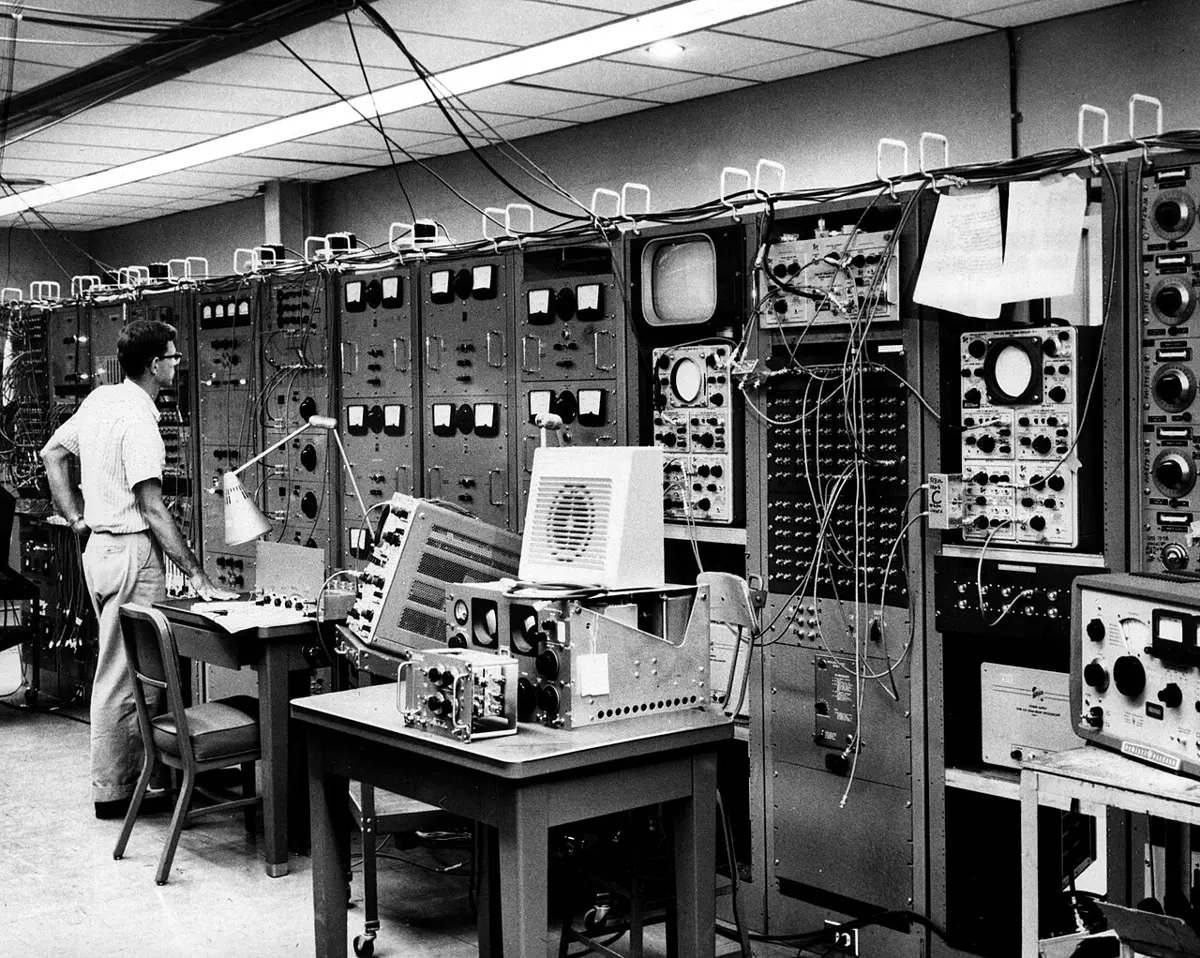
- The detector. A long-lived kaon that decays makes two or three charged pions. Two “arms” on either side of the beam caught them. Each had spark chambers: stacks of metal plates, where a passing charged particle sets off a line of sparks. The sparks were photographed, and a magnet in each arm bent the tracks, showing each pion’s speed and direction.
- Looking for the forbidden. If a kaon breaks into two pions, nothing else carries any momentum away. So the two pions’ momenta add up to point exactly along the beam, and together they carry exactly the mass of one kaon. If there are three pions and only two are caught, the sum usually points off to one side. In the photographs of about 22,700 decays, they found about 45 that pointed exactly along the beam: two-pion decays, forbidden by CP. That is about 1 in 500.
- 1964, doubt. At first they did not believe it themselves. They spent nearly half a year trying to find another explanation, a fault in the apparatus or some known effect, and failed. In the summer of 1964 they published it.
How it changed physics
The result meant that nature is not exactly fair between matter and antimatter, even when you swap left and right as well. And it meant something more. A deep rule of physics says that doing all three mirrors together, CPT, must always leave the laws unchanged. If CP is broken, then T must be broken too, to make up for it. So for these tiny particles, the laws of nature are not quite the same forwards and backwards in time.
It also answered a puzzle once thought impossible. Suppose you could talk by radio to scientists on a distant planet, and wanted to know whether their planet is made of matter or antimatter, before you visit (if it’s antimatter, you would both be destroyed when you shook hands). Before 1964 there was no experiment you could describe to them that would tell. After it, there was. Long-lived kaons decay slightly more often into a positron than into an electron, by about 3 in 1,000. Tell them: “The particle that comes out slightly more often has the same charge as the centers of our atoms.” If they find the opposite, stay at home.
In your life today
This discovery won’t change your phone or your food. Its importance is bigger than that: it is one of the few clues we have to why anything exists.
In 1967 the Russian physicist Andrei Sakharov listed what the early universe would need, to end up with more matter than antimatter. One of his conditions was exactly what Cronin and Fitch had found: CP must be broken. Scientists now think that in the very early universe, for every billion particles of antimatter, there were about a billion and one particles of matter. The billions destroyed each other and became light. The one extra in a billion became the stars, the Earth, the Himalaya, and the atoms of your body (where the atoms in your body came from).
Most of the light from all that destroying is still around us: it is the faint cosmic microwave background, the afterglow of the Big Bang, which fills the whole sky.
What came next
- Why CP is broken. In 1973 two young Japanese physicists, Makoto Kobayashi and Toshihide Maskawa, showed that CP violation would follow naturally if there were at least three families of quarks, when only two were known. The third family was found later (the bottom quark in 1977, the top in 1995), and they won the Nobel Prize in 2008.
- More cracks. CP violation has since been found in other particles: in B mesons in 2001, in particles with a charm quark in 2019, and in 2025, at CERN’s LHCb experiment, for the first time in baryons, the family that protons and neutrons belong to.
- Not enough. Here is the open question. All the CP violation we have measured is far too small to explain why the universe has so much matter. There must be some other source we haven’t found yet. Physicists are now searching for it in neutrinos, ghostly particles that pass through the Earth, with giant detectors in Japan and the United States. Is the reason we exist hidden there?
In your science books
- Grade 9: the structure of an atom, radioactive elements and radioactive emission, the positron in the nuclear reaction in the Sun, and how the universe began.
- Grade 10: the Big Bang theory and what the universe is made of.
- Going further: beta decay and where the atoms in your body came from.
Learn more
- The Nobel Prize’s summary of the 1980 Physics prize, with the press release and the speech at the ceremony (nobelprize.org).
- The two Nobel lectures: Fitch, “The discovery of charge-conjugation parity asymmetry” and Cronin, “CP symmetry violation: the search for its origin”.
The official reason
The prize was given “for the discovery of violations of fundamental symmetry principles in the decay of neutral K-mesons.”