
A tiny worm and the cells told to die
Nobel Prize in Physiology or Medicine, 2002: Sydney Brenner, H. Robert Horvitz, and John Sulston
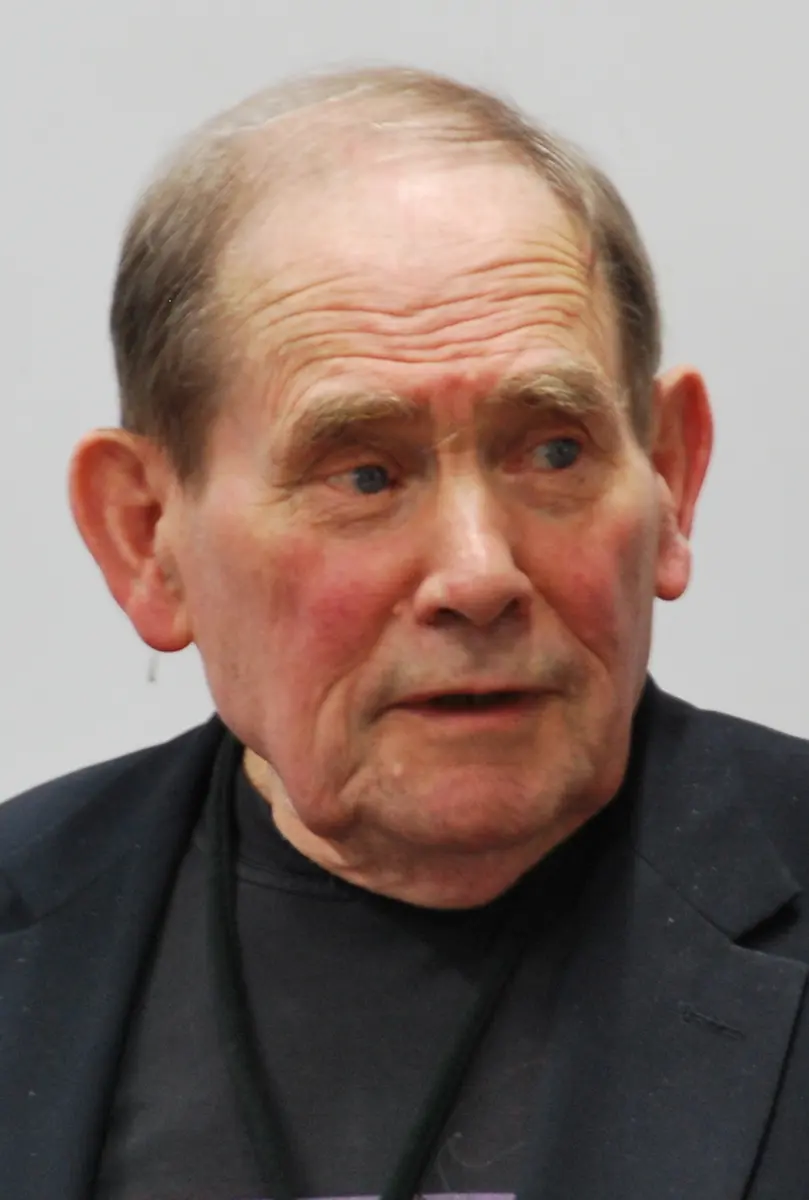
Sydney Brenner
1927–2019, born in Germiston, South Africa
A cobbler’s son who started university at 15. Before the worm, he had helped discover messenger RNA, the copy a cell makes of a gene.
-
H. Robert Horvitz
born 1947 in Chicago, United States
He studied mathematics at university and came to biology late. In his first year of biology he felt, he said, “like a fish out of water”.
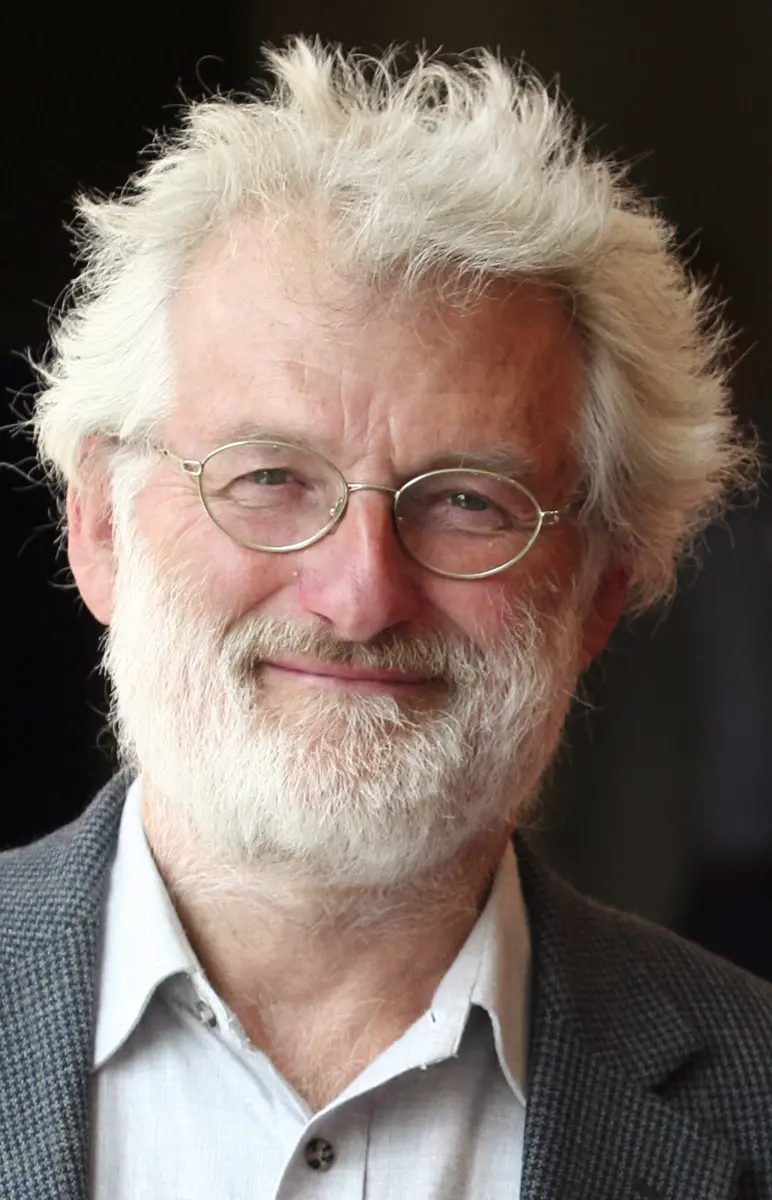
John Sulston
1942–2018, born in Fulmer, England
He spent about ten years watching worm cells divide. Later he led Britain’s part of the Human Genome Project and fought to keep our DNA sequence free for everyone.
Photo: Arienette22, CC BY-SA 3.0
Look at your hands. Before you were born, when you were about the size of a bean, your hands were little paddles, with the fingers joined by a web of skin. Then, over a few days, the cells of that web died, all at the right time and in the right place, and your fingers came apart.
Those cells did not die because something went wrong. They died because they were told to. The 2002 Nobel Prize in Physiology or Medicine went to three scientists who found how cells are told to die, by studying a worm about 1 mm long: Sydney Brenner, John Sulston and Robert Horvitz.
The problem: too many cells to follow
You started life as one cell, a fertilized egg about a tenth of a millimeter across. It divided into two, then four, then eight, and today your body has roughly 30 million million cells (a 2016 estimate), of hundreds of different kinds: nerve, muscle, skin, blood and more Grade 8: cells, tissues and organs.
How does one cell know to become a nerve cell, and its neighbor a muscle cell? How does a body end up with the right number of each? In the 1960s, biologists knew these were among the biggest questions in biology, but a human body, or even a mouse, has far too many cells to follow. Nobody could watch an embryo and say where every cell came from.
People also knew that some cells die as an animal grows. A tadpole loses its tail as it turns into a frog. A baby’s brain makes far more nerve cells than it keeps. But most scientists thought of cell death as something that just happens when cells are damaged or worn out, not as part of the plan.
How it works: a family tree of cells
Every cell in your body comes from the egg by cell division Grade 10: mitosis: one cell becomes two. So every cell has a mother cell, a grandmother cell, and so on back to the egg. Drawn out, this is a family tree of cells, called a cell lineage.
If you could draw the whole family tree for an animal, you could ask: which cells become nerves? Which divide again? Which die? And when a gene is damaged, which part of the tree goes wrong?
What is a cell lineage?
Pick an answer to see why.
Why it was hard
To draw a cell lineage, you need an animal that:
- has few cells, so the tree is small enough to draw;
- is see-through, so you can watch the cells divide inside the living animal;
- grows fast and breeds easily, so you can study many generations;
- can have its genes changed, so you can see what each gene does.
Mice, frogs and fruit flies all fail one test or another. Sydney Brenner, at the Laboratory of Molecular Biology in Cambridge, England, went looking for a better animal in the early 1960s.
What they did, step by step
Brenner: choosing the worm
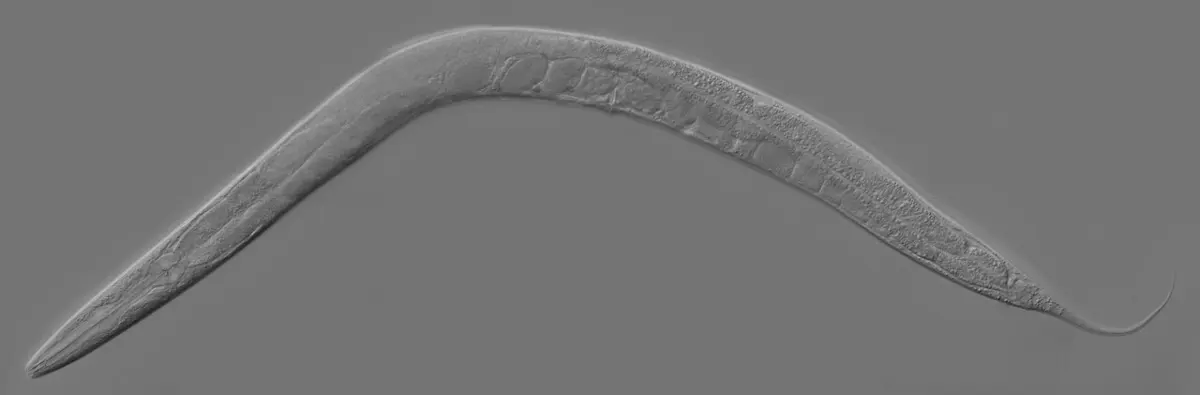
- Early 1960s, the choice. Brenner chose a tiny roundworm, or nematode, called Caenorhabditis elegans (say “see-no-rab-DYE-tis ELL-eh-gans”; scientists just say “C. elegans”). It lives in soil and rotting fruit and eats bacteria. It is about 1 mm long, see-through, and grows from egg to adult in about three days. It is a distant cousin of the roundworms that can live in people’s guts Grade 10: Nemathelminthes, but it is harmless and lives on its own.
- 1974, the genes. Brenner showed that he could damage the worm’s genes on purpose with a chemical, EMS, and then breed worms with changes, or mutations Grade 9: mutation. Each mutation changed the worm in one way: a worm that moved oddly, or was short and fat. By finding which gene was damaged, he could learn what that gene does.
Many people joked about “Sydney’s worm”. Brenner was sure that this small animal would answer big questions.
Sulston: watching every cell
John Sulston joined Brenner’s group in 1969. Using a microscope that makes the see-through cells stand out, he watched living worms for hours at a time and drew, by hand, every cell as it divided, moved, or changed.
- 1976, the first branch. Sulston published the lineage of part of the worm’s nervous system. He found something surprising: it was exactly the same in every worm. The same cell divided at the same time, and its daughters became the same kinds of cells.
- Cells that always die. Sulston saw that some cells, right after they were born, shrank and disappeared. And it was always the same cells, in every worm. In all, the worm makes 1,090 cells, and exactly 131 of them die, leaving 959 in the adult (not counting its eggs and sperm). The deaths were part of the plan.
- 1977 and 1983, the whole tree. With colleagues, including Robert Horvitz, Sulston finished the lineage of the young worm after hatching (1977) and then, hardest of all, of the embryo inside the egg (1983). For the first time, the complete family tree of an animal was known, cell by cell.
- The first death gene. Sulston found a worm with a mutation in a gene called nuc-1. In these worms the cells still died, but the DNA of the dead cells was not broken up. So genes were at work even in clearing up a dead cell.
Why was it so important that the worm’s cell lineage was the same in every worm?
Pick an answer to see why.
Horvitz: finding the death genes
Robert Horvitz came to Cambridge from the United States in 1974 and worked on the lineage with Sulston. Then, in his own laboratory at the Massachusetts Institute of Technology (MIT), he went hunting for the genes that decide whether a cell dies.
- 1986, the killers. Horvitz found worms in which the 131 cells did not die. They had mutations in one of two genes, which he called ced-3 and ced-4 (“ced” stands for “cell death”). Without them, the cells meant to die stayed alive. So these genes don’t just clean up; they carry out the death.
- The guard. Later he found a third gene, ced-9, that does the opposite: it protects a cell from dying by holding back the other two. In a worm without ced-9, cells that should live died too, and the worm did not survive.
- The same genes in us. Horvitz showed that people have a gene like ced-3. Then it turned out that ced-9 matches a human gene called BCL-2, and ced-4 one called APAF-1. The machinery that kills cells in a worm is the same machinery that kills cells in us, even though worms and people last shared an ancestor more than 500 million years ago.
How it works now
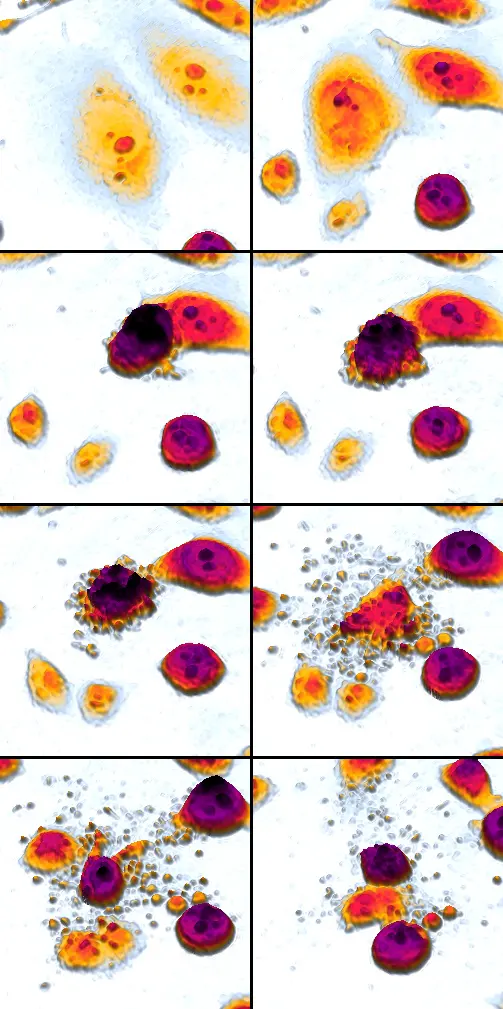
Today this planned cell death is called programmed cell death, or apoptosis (say “a-pop-TOE-sis”, from the Greek for leaves falling from a tree). The name was given in 1972 by three scientists working in Scotland who had seen dying cells under the microscope; the worm showed that genes control it.
A cell that is told to die does it neatly. It shrinks, its DNA is cut into pieces, and it breaks into small packets wrapped in skin, which neighboring cells swallow up. Nothing spills out, so the body around it is not harmed.
- Building the body. Programmed cell death shapes us before birth: it removes the web between fingers and toes, and the extra nerve cells in the brain.
- Keeping the balance. Every day your body loses, and replaces, hundreds of billions of cells. New cells are made by division; old or unwanted ones are removed by programmed death (keeping the balance).
- Guarding against damage. A cell whose DNA is badly damaged, or which is infected by a virus, can be told to kill itself before it does harm.
In your life today
- Your body. The separate fingers on your hands, and the wiring of your brain, were shaped by programmed cell death before you were born.
- Cancer. A cancer cell is often a cell that should have died but didn’t: it has broken its own death switch, for example by making too much of the guard, BCL-2. In 2016 the first medicine that blocks BCL-2, venetoclax, was approved in the United States for a blood cancer. It lets the cancer cells’ own death program run again. Many other cancer treatments, including radiation, work partly by pushing damaged cells into programmed death.
- Too much death. In a stroke, a heart attack, and brain diseases such as Alzheimer’s, too many cells die. Scientists are searching for ways to protect them.
- The worm itself. Thousands of laboratories around the world now study C. elegans. It was the first animal to have all its DNA read (1998), and the wiring of all its 302 nerve cells is known.
Why might a cancer cell survive when it should die?
Pick an answer to see why.
What came next
The worm’s three genes turned out to be the start of a large family. People have many proteins like BCL-2, some that protect and some that kill, and a whole set of caspases. Scientists are now designing medicines that tip the balance in cancer cells towards death, while leaving healthy cells alone.
Sulston’s way of working, reading every cell and later every letter of DNA and sharing it all freely, also changed biology. He went on to lead Britain’s part of the Human Genome Project, which read the human DNA sequence and made it free for anyone to use.
An open question remains: how does a cell weigh up all the signals it receives, some telling it to live and some to die, and decide? Getting that decision wrong, in one direction or the other, lies behind many diseases.
In your science books
- Grade 8: the cell and cells, tissues and organs.
- Grade 9: mutation and tissues.
- Grade 10: roundworms (Nemathelminthes), cell division and mitosis and DNA.
- Going further: from one cell to trillions, same DNA, different cells, the balance and proteins do the work.
Learn more
- The Nobel Prize’s own summary: press release (nobelprize.org).
- The Nobel lectures: Brenner, “Nature’s gift to science”, Horvitz and Sulston.
The official reason
The prize was given “for their discoveries concerning genetic regulation of organ development and programmed cell death.”