
The clock that tells a cell when to divide
Nobel Prize in Physiology or Medicine, 2001: Leland H. Hartwell, Tim Hunt, and Paul Nurse
-
Leland H. Hartwell
born 1939 in the USA
As a boy he collected lizards and snakes. A book said lizards have no teeth; a big lizard bit his thumb, and he learned not to believe everything he read.
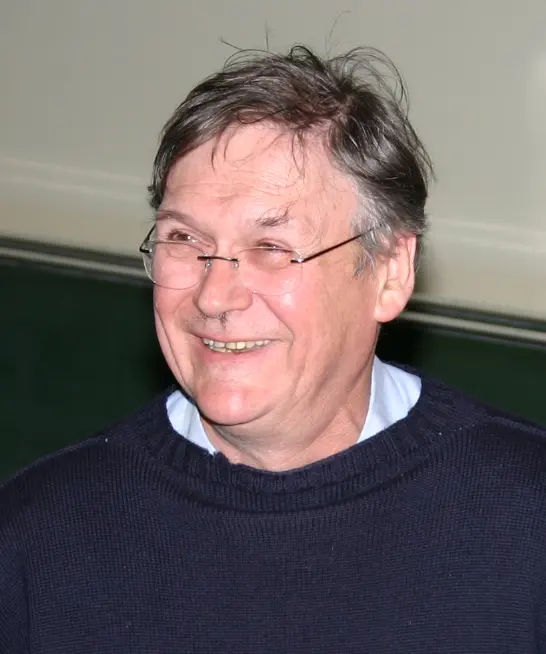
Tim Hunt
born 1943 in the United Kingdom
He found cyclin in sea urchin eggs, during a summer spent teaching a course at a seaside laboratory in the USA.
Photo: Machmit ( Machmit ), CC BY-SA 3.0
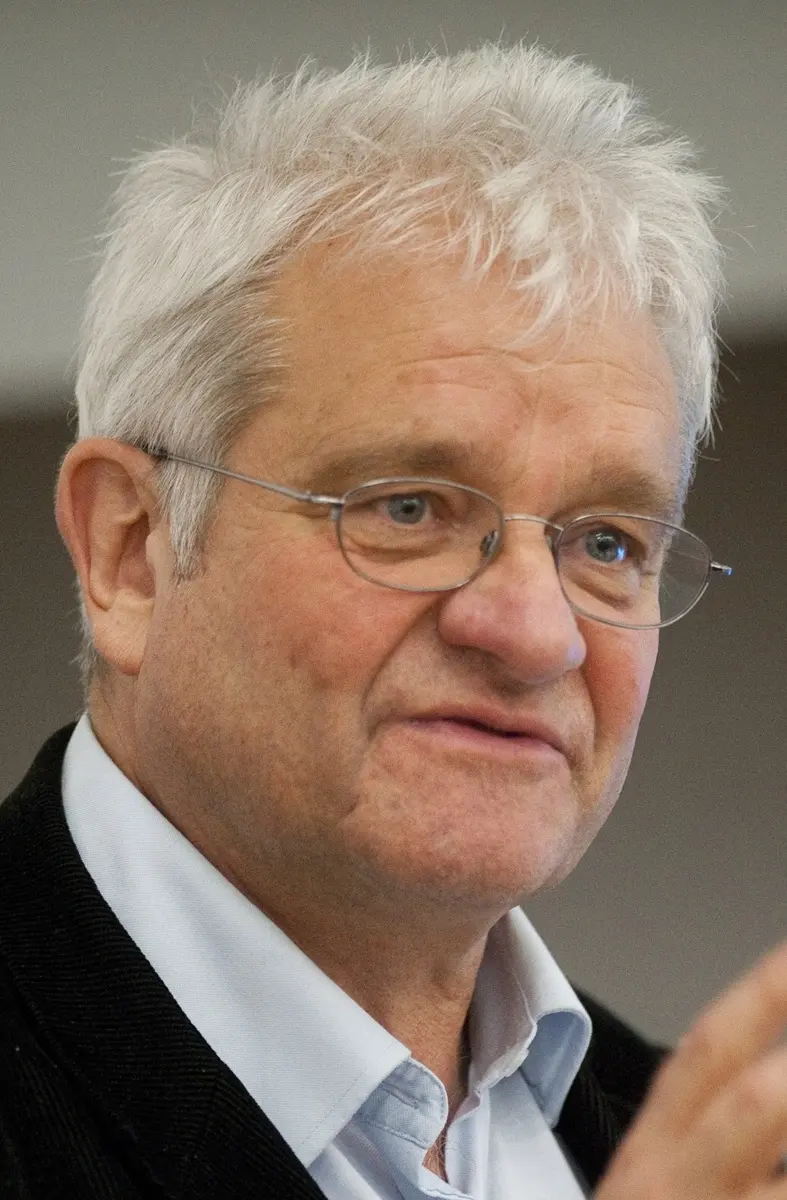
Paul Nurse
born 1949 in the United Kingdom
He kept failing his French exam, so no university would take him at first, and he worked as a technician in a brewery’s laboratory.
Photo: University of Exeter, CC BY 2.0
You began as a single cell, smaller than the full stop at the end of this sentence. Today your body has roughly 37 million million cells (37 lakh crore). Every one of them came from that first cell, by one cell splitting into two, again and again. Even now, millions of your cells divide every second, to replace worn-out skin, blood and the lining of your stomach.
Each time, the cell must do things in the right order: grow, copy all its DNA exactly once, and share the copies out fairly between two new cells. Get the order wrong, and the new cells may be damaged, or may start dividing out of control, which is what happens in cancer. In 2001 the Nobel Prize in Physiology or Medicine went to three scientists who found the molecules that keep this order.
The cell cycle
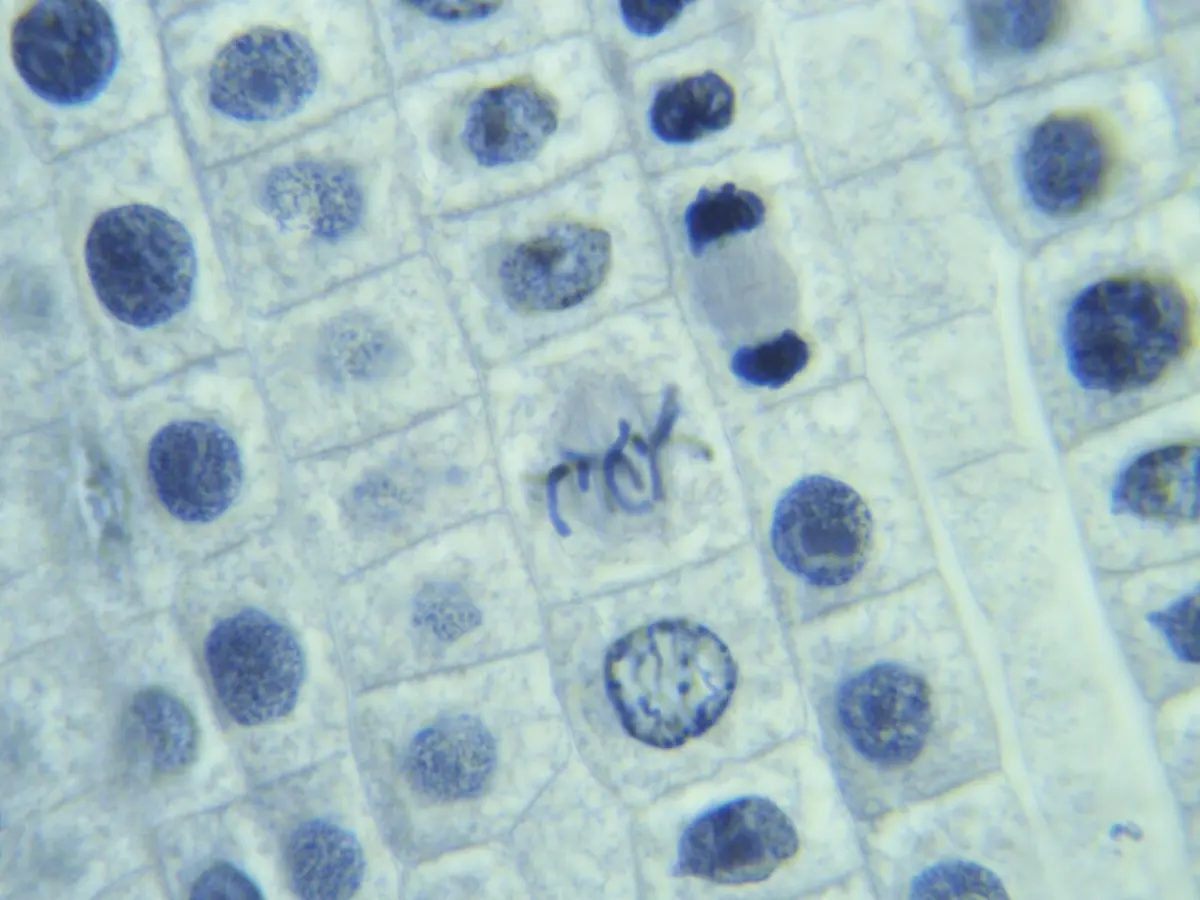
You have learned that a body cell divides by mitosis, making two daughter cells with the same chromosomes as the mother cell Grade 10: Mitosis. But mitosis is only the last, short part of a longer story. Between one division and the next, a cell goes round a cycle of four steps, called the cell cycle:
- G1 (“gap 1”): the new cell grows. If it is not needed, it can stop here and rest.
- S (“synthesis”): it copies its DNA. Every chromosome becomes double.
- G2 (“gap 2”): it checks that the copying is finished, and gets ready.
- M (“mitosis”): the copies of the chromosomes are shared out, and the cell splits in two. Each daughter cell starts again at G1.
In most human cells one turn of the cycle takes between 10 and 30 hours.
In which step of the cell cycle does a cell copy its DNA?
Pick an answer to see why.
The problem: who gives the orders?
By the 1960s, scientists could watch every step of the cycle through a microscope. But they could not see what made it happen. What tells a cell, “you are big enough, now copy your DNA”? What stops it dividing before the copy is finished? A cell has no brain. The orders must come from molecules inside it, and nobody knew which ones.
The steps are hidden inside a tiny cell, and they all happen together, so it was very hard to tell which molecule did what. The laureates found two ways in: yeast and sea urchin eggs.
What they did, step by step
Hartwell: the genes of the cycle, in baker’s yeast (1970s)
Yeast is a fungus made of single cells, each with a nucleus, like our cells. It is the yeast that makes bread and sel roti dough rise Grade 8: Fungi. Baker’s yeast divides by budding: a small bud grows out of the cell, gets bigger, takes one set of chromosomes, and breaks off.
Leland Hartwell, at the University of Washington in Seattle, USA, saw in the late 1960s that yeast was perfect for finding the genes of the cycle. It grows fast, it is cheap, and it is easy to change its genes.
- Broken genes that break only when warm. Hartwell looked for mutants: yeast cells with one gene changed. The changes he wanted were special: the gene still worked at a cool temperature, but stopped working when the yeast was warmed a little. So he could grow the yeast cool, then warm it up and watch what went wrong.
- Stuck at one step. In some mutants, after warming, every cell stopped at the same step of the cycle. Under the microscope they all looked alike: all with a big bud, for example. That told him the broken gene was needed to get past that step.
- The CDC genes, 1970–71. In this way Hartwell found dozens of genes needed for the cell cycle. He called them CDC genes, for “cell division cycle”.
- “Start”. One of them, CDC28, was needed for the very first step: leaving G1 and setting off round the cycle. He called this step start.
- Checkpoints. Hartwell then found that when a yeast cell’s DNA is damaged (by X-rays, for example), the cycle pauses until the damage is repaired. He called this kind of control a checkpoint. A washing machine works the same way: it won’t start spinning until the water has drained out.
Nurse: the master gene, from yeast to people (1970s–1987)
Paul Nurse used the same kind of method in a different yeast, fission yeast. It is shaped like a tiny sausage. Instead of budding, it grows longer and then splits across the middle. It was first found in African millet beer, and its scientific name, Schizosaccharomyces pombe, comes from pombe, the Swahili word for beer.
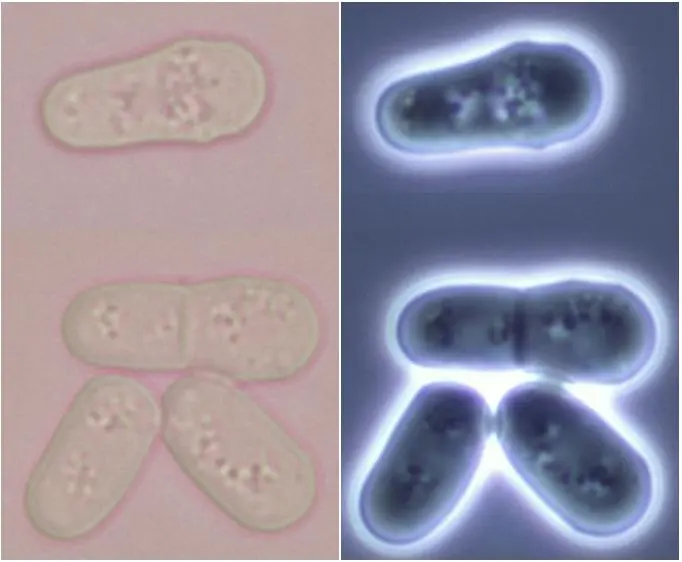
- cdc2, 1970s. At the University of Edinburgh in Scotland, Nurse found a gene he called cdc2. If it was broken, the cells never divided: they just grew longer and longer.
- Too early, too small. He also found the opposite kind of mutant. These cells divided too early, while they were still small. He named them wee mutants, from the Scottish word for “small”. Some changes in cdc2 itself did the same. So cdc2 was not just needed for division: it decided when division happens.
- The same gene as “start”. Nurse found that cdc2 also controls the step from G1 to S, just as Hartwell’s CDC28 did. They turned out to be the same gene in the two yeasts. One gene works at two points of the cycle.
- 1987, a human gene in yeast. In Nurse’s laboratory, Melanie Lee took human genes and put them into fission yeast with a broken cdc2, to see whether any human gene could do its job. One could: the human cdc2 gene, now called CDK1. Yeast and humans had separate ancestors more than a thousand million years ago, and yet their cycle is run by the same gene.
The protein made by this gene is a CDK, short for cyclin-dependent kinase. A kinase is an enzyme that sticks small phosphate groups onto other proteins, which switches those proteins on or off. In this way CDK gives the orders: it changes the proteins that copy DNA, pack the chromosomes and build the machinery of division.
Nurse put a human gene into a broken yeast cell, and the yeast could divide again. What did that show?
Pick an answer to see why.
Hunt: the protein that comes and goes (1982)
Tim Hunt, a biochemist at the University of Cambridge in England, spent his summers teaching at a marine laboratory at Woods Hole, on the coast of the USA. There he studied the eggs of sea urchins. When a sea urchin egg is fertilized, it divides again and again, about every half hour to an hour, and it is easy to measure the proteins it makes.
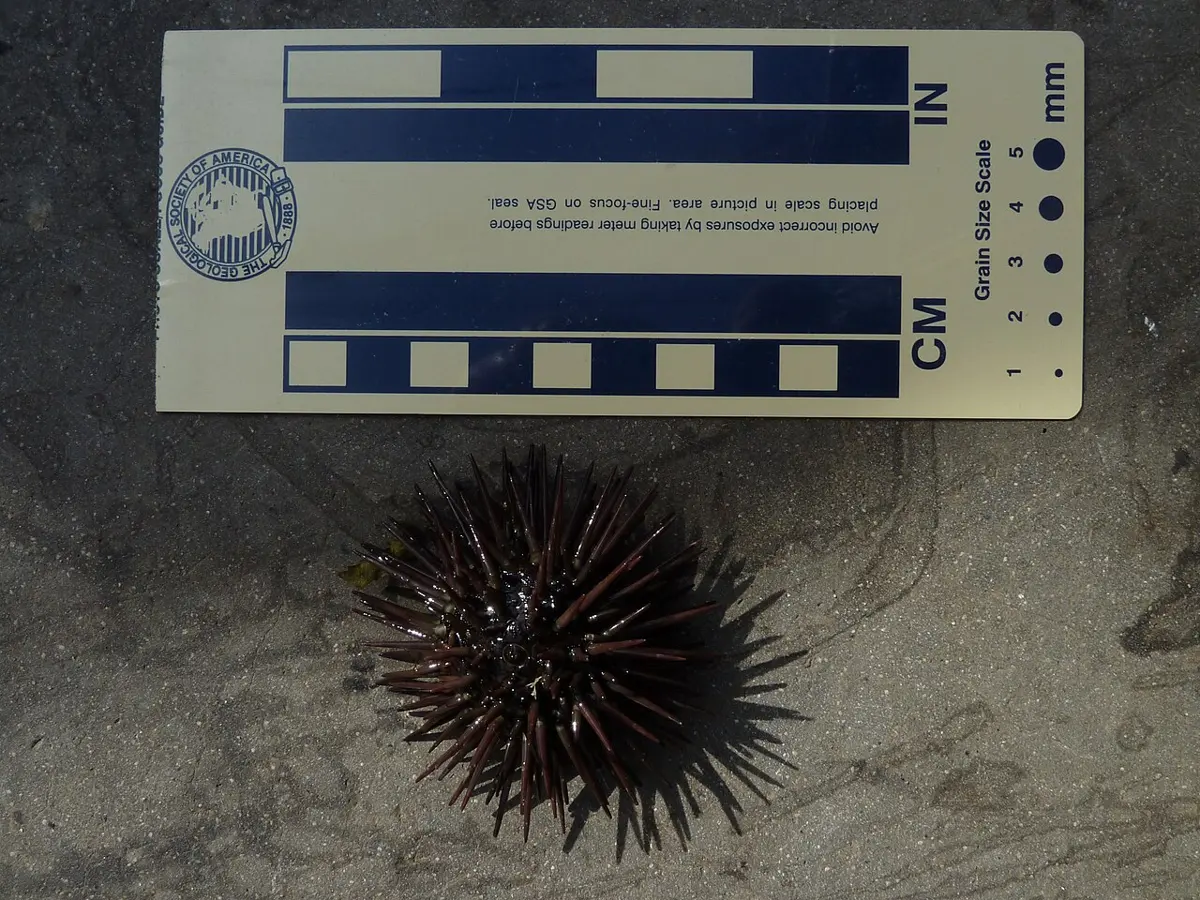
- July 1982, a simple experiment. Hunt fertilized some eggs and measured the proteins they made, minute by minute.
- A protein that vanished. Most proteins built up and stayed. But one built up steadily after fertilization, then disappeared suddenly, about ten minutes before the cell divided. Then it built up again, and vanished again at the next division.
- Cyclin. Because its amount went up and down with each cycle, Hunt named it cyclin. He soon found cyclins in clams, and later in frogs and in humans.
Back in Cambridge, with no sea urchins to work on, he worried all winter that he had imagined it. The next summer at Woods Hole, the result came out the same.
Putting it together: the engine and the switch
By the late 1980s, the three discoveries fitted together:
- CDK (Nurse) is the engine. It is in the cell all the time, in about the same amount. But on its own it does nothing.
- Cyclin (Hunt) is the switch. When cyclin joins a CDK, the pair becomes active and drives the cell to the next step. When the cyclin is destroyed, the CDK switches off.
- Checkpoints (Hartwell) watch the cycle and stop the engine if a step is not finished or the DNA is damaged.
So the cell has a clock made of molecules. Cyclins of different kinds are made and destroyed one after another, switching on different CDKs, and pushing the cell round the cycle, one step at a time, in the right order. Destroying the cyclin also makes sure each step happens only once per cycle.
Cancer: a clock gone wrong
A healthy cell divides only when the body needs it, and its checkpoints stop it if its DNA is damaged. A cancer cell has collected changes (mutations) in its genes that break these controls. It goes round the cycle again and again when it should rest, and its checkpoints no longer stop it when its chromosomes are damaged. Many cancer cells have lost or gained whole pieces of chromosomes.
Since 2001 scientists have found that, in many cancers, the genes for cyclins, CDKs or the checkpoint proteins are changed. One checkpoint protein, called p53, is broken in about half of all human cancers.
In your life today
- Cancer medicines. In 2015 the first medicine that blocks two CDKs (called CDK4 and CDK6) was approved, for a common kind of breast cancer. Several similar medicines are now used. They put the brakes back on cancer cells that divide too often.
- Many cancer medicines work by attacking cells in the middle of dividing, which is why they also harm other fast-dividing cells: the cells that make hair (so the hair falls out) and the lining of the gut.
- Every cut that heals, every centimeter you grow and every new blood cell (your body makes millions every second) depends on this clock running correctly.
What came next
- More cyclins and CDKs. Humans have many cyclins and many CDKs, each working at a different step. Scientists have also found the machinery that tags a cyclin for destruction at exactly the right moment.
- Checkpoints in medicine. Some new cancer treatments attack the checkpoints that cancer cells still have left, so the cells divide with badly damaged DNA and die.
- Nurse’s later work. Paul Nurse went on to lead the Royal Society, and became the first director of the Francis Crick Institute in London, one of the largest biomedical research centers in Europe.
In your science books
- Grade 8: the cell and its nucleus, and fungi, including yeast.
- Grade 10: mitosis, meiosis and the number of chromosomes.
- Going further: from one cell to trillions, and what proteins do.
Learn more
- The Nobel Prize’s own summary: Press release, Physiology or Medicine 2001 (nobelprize.org).
- The laureates’ Nobel lectures: Hartwell, Hunt and Nurse.
The official reason
The prize was given “for their discoveries of key regulators of the cell cycle.”